Despatches from the Frontiers of the Female Mind – anthology
WHAT.
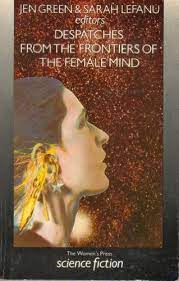
I didn’t know this book existed until this year. It was published in 1985.
The list of contributors is just… I mean:
Joanna Russ (the only reprint)
Gwyneth Jones
Tanith Lee
Pamela Zoline
Mary Gentle
Lisa Tuttle
Raccoona Sheldon! …
and that’s just the names that I immediately recognised.
It’s nearly 40 years old, so some of the stories have aged, I guess? But honestly the general issues in discussion still feel pretty real. Zoline’s “Instructions for Exiting this Building in Case of Fire” – children kidnapped and swapped to stop a nuclear apocalypse – still feels like a chillingly appropriate concept. Josephine Saxton’s view of advertising is hideous and, again, not as laughably far-fetched as I might like (it is ridiculous, but also… ads…). Beverley Ireland’s “Long Shift” is remarkable for its focus on a single woman, just doing her job; I wouldn’t have been surprised to see this published today. Pearlie McNeill is (was?) Australian, and I’ve never heard of her! Apparently this was her only piece of fiction? – SF, anyway. And this is where Raccoona Sheldon’s “Morality Meat” was first published, which is… a moment.
There are very few poor stories here. This is an amazing anthology.
After the Dragons – Cynthia Zhang
SOMEONE gave me a voucher to buy books for my birthday, and I was stumped. I love a voucher but then I get all – I must buy The Right Thing! I don’t want to waste it! So what books to buy?? And then I remembered that (at that stage) the Ursula K Le Guin Prize shortlist had just been announced, so there was an answer to that question: I bought a bunch from that list. And After the Dragons is one of them.

In the cover quote, Mary Robinette Kowal describes this book as having “quiet intimacy”, and that’s so right. It’s not about epic events (like She Who Became the Sun); it’s about the everyday joys and tragedies, in a world with lots of problems.
It’s set in a kind of tomorrow – it’s not far future – but in a world sideways to ours, because there are dragons. Not epic mythological dragons for slaying – it’s unclear whether those were ever real even here – but small, say pet-size. Indeed sometimes they are kept as pets… and as with kittens and puppies, sometimes they get dumped by their owners. And sometimes they just live as wild animals, and that means having to adjust to living in urban areas and with humans. Which doesn’t always go well. I was thinking about Anne McCaffrey’s Pern – still probably the fictional dragons my mind goes to first – and these are more the fire-lizards of Dragonsdawn rather than the later, genetically altered dragons.
For all that the dragons are there, this world is very much ours. There’s climate issues, there’s political tension, there’s racism; poverty and illness and family trouble on the personal level. The story is told from the perspectives of Beijing resident Kai – Xiang Kaifie – an artist, carer for dragons, and ill; and Eli, Elijah Ahmed, biracial American student visiting the hometown of his deceased grandmother, who gets drawn into Kai’s world of rescuing street dragons.
As I said, this is not epic. It’s low stakes on a global scale, although high stakes on a personal one: health and love and relationships and what the future holds are all immensely important to the people involved. It hints at troubling systemic issues but always focuses on the people at its heart. If you need a relief from world-shattering events this is a good choice, although I’m not promising that it’s all sunshine and light (it’s not). But it is a delight, and it is definitely worth your time.
Can’t wait to read more from Cynthia Zhang.
She Who Became the Sun

Whaaaaaat a book.
And yes, I am incredibly late to this party, since Parker-Chan was nominated for the Best Novel Hugo this year (losing to A Desolation Called Peace, by Arkady Martine, a massive favourite of mine so I’m glad I didn’t have to choose…).
This novel is just brilliant. One thing I will say is that it was a bit different from what I expected – which is entirely about me, not about the book. Because of the Hugo nomination, and my genre-leaning friends, I was expecting this to be a book with greater, or more obvious, fantastical elements. Nothing about the book itself made me think that! Parker-Chan’s bio says she was inspired by “epic East Asian historical TV dramas”, and my knowledge of such is below limited (although I am an Australian kid of the 80s and 90s, so does the original Monkey count?).
ANYWAY. It’s 1345, China is ruled by the Mongols – who think the ethnic Chinese are all barbarians, and vice versa. There’s famine in the south; two children in a family are told their destiny: he is bound for greatness, she is bound for nothing. But then he dies, which means his destiny is going wanting… so she decides to become him…
Epicness ensues as Zhu gets caught up in events far beyond what she imagined as a child. First as a monk, then as a warrior and a leader; always worried that heaven might catch on to the fact that the destiny she is grasping was not, actually, intended for her at all. She teeters on the precipice of failure and discovery – not sure which is worse – and sometimes through luck, more often through her intelligence and grit and sheer bloody-mindedness, she ploughs on through…
I believe this is a duology, and honestly the next one cannot come fast enough (which is rich, given how late I am to the party). The pacing was excellent, the stakes were high, Zhu is mighty and charismatic. The supporting cast are varied and intriguing – Parker-Chan writes a significant portion of the story from the other side, as it were: what’s going on in the Mongol camp, particularly from the perspective of a Chinese captive-risen-to-general, which gives the entire novel even more drama and intensity, emotion and high stakes.
What a book.
The Employees: A workplace novel of the 22nd century

When the Ursula K Le Guin Prize shortlist was announced, I was intrigued. I hadn’t heard of most of the titles, and I happened to have a book voucher from someone for my birthday, so I promptly went ahead and bought a number of the books.
This is the first one I’ve read. And it’s amazing. And it was also shortlisted for the Booker Prize??
It’s 136 pages in length. Not all of those pages are filled, because the bulk of the book is made up of employee statements… and as anyone who’s ever looked at employee feedback will be unsurprised to learn, some people have written a couple of pages and a few have written just one sentence. And that’s it – that’s what you learn of this 22nd century workplace. It’s almost entirely from employee feedback.
It’s brilliant. There are devastating gaps, and hints at terrible and wonderful things. There are touching moments of humanity and grim reflections on work and the workplace. Have you seen Severance? It’s not exactly like that but if you put them together you are forced to start thinking more about corporate workplaces than perhaps the managers would like us to.
The workplace is the Six-Thousand Ship, and the employees are its crew. Where are they? Not quite sure; that is, it’s around a planet called New Discovery, and it’s not near Earth, but other than that – no details. Some of the crew are human, while others are humanoid: some who were born, others who were made. There’s sometimes tension between the two groups, and sometimes camaraderie. Most of their work is what you’d expect on a spaceship, but some of it isn’t. Some of the complaints are also what you’d expect – around isolation, for instance – but some of the comments centre around objects that are never fully explained, from New Discovery itself. It’s deeply familiar, because some Ravn suggests aspects of work won’t change no matter the situation, and simultaneously quite alien.
It’s very, very, clever; absorbing, wrenching, sometimes disturbing, and I loved it.
Death metal, by T Coles
I read this courtesy of NetGalley and the publisher. It’s out now.
Death metal is very much not my scene, but music documentaries are; Coles references the documentary series Metal Evolution from some years ago, which I adored. As a musical history of the last four decades, I found this really quite fascinating. Although it must be noted that reading the names of some of the albums and songs, as well as a description of what they’re singing about, wasn’t always pleasant. So if you’re really not in the zone for some lightly gross description, avoid this!
Surprising things include the fact that I actually recognised some names of bands! More surprising though is that the second chapter begins with a mention of Hildegard von Bingen, and the fact that in the morality play attributed to her from 1151, the instructions are for the Devil to be played with a harsh voice. Coles draws a comparison here to the ‘death growl’ that helps make death metal what it is. So that was quite a moment.
The book follows a straightforward historical line from the beginnings of death metal and its early influences in the 1980s, through to when they are finishing the book in late 2021. This means that some of what is being discussed is coming from that a period when stuff that’s regarded today as on nose was still accepted by most of the scene. The main issue here is the misogyny of some of the lyrics, and I was very relieved that in the final chapter Coles does reflect on how problematic much of that early stuff is, and how at least some modern bands are actively pushing back.
Does this make me want to listen to death metal? Nope. Does it make me appreciate it more as a musical genre? On an abstract level, yes. It’s good that books like this exist.
Spoiled: The Myth of Milk as Superfood

I read this via the publisher and NetGalley. It’s out in April 2023.
This is an angry book.
I’m not saying that’s a bad thing, or that the anger is unjustified. Just that Mendelson doesn’t make much effort to hide the fact that a lot about Big Dairy in America makes her angry, and that the appalling lack of science around the claims for milk make her angry, and that the fact drinking milk is pushed as some mighty panacea when actually the ability to digest cow’s milk as an adult human is largely restricted to humans descended from north-west Europeans… that makes her angry, too.
Some of the most crucial sentences for understanding the point of the book comes early on: “… the founders of modern Western medicine had no way of understanding the genetic fluke that allowed them… to digest lactose from babyhood to old age… That lack turned the one form of milk that is most fragile, perishable, difficult to produce on a commercial scale, and economically pitfall-strewn into a supposed daily necessity for children and, to a lesser extent, adults.”
Yeah.
The section I most enjoyed for itself was the first part, where Mendelson looks at the long history of dairying, and in particular points out that drinking “fresh” milk (which is a whole other discussion of terminology, given what happens to milk in most Western countries today) wasn’t something early herders did. Instead, they were using fermented milk – naturally fermented, from being left out in the heat. She goes through the science of what’s actually happening in this fermentation, discussing why the bacteria in the milk doing all of this doesn’t poison human consumers of such milk. There’s also a really interesting discussion about the archaeology and other evidence for dairying of various forms in numerous locations.
Science is a fairly big part of the book, which I also enjoyed. There’s a lot about what’s in milk of various types, and why, as well as how that’s connected to the digestive system of the various animals that humans choose to milk. Plus the discussion about how limited the ability to actually properly digest full-lactose drinking-milk is, among the adult human population. If you can digest milk as an adult, it’s you that’s the genetic mutation, not everyone else. Doesn’t that make all the soy milk etc-haters look like numpties.
The angry-making bit really starts when the discussion turns to the 18th century in Europe, and the way that ‘drinking fresh milk’ suddenly became imperative for children, in particular, and the idea that if children were denied all the milk they could possibly consume then somehow society was failing them. All of which is nonsense since… see above. And then, of course, it gets into how the industry makes claims, and medical types get on board, and honestly it just makes me really sad and horrified to see how outlandish claims based on ‘science’ (sometimes) that has now been superseded, or sometimes just based on a desire to make money, is still having a massive impact on how we think and act today.
Also? this insistence on drinking-milk all came as a) more people were living in towns and b) before good refrigeration and c) before adequate food-safety measures like pasteurisation (which gets a whole section here, because of the raw food movement) were in place. All of which meant a bunch of kids, in particular, actually got sick and many of them died because of the milk they were told they needed to consume in order to be healthy.
One of the reasons for the angry nature of the book is its focus on the modern American dairy industry. I’m not going to claim that the Australian industry is immensely better, because I don’t know all that much about it, but I do know that we do things a bit differently. And then there’s the way in which drinking-milk is still being pushed as necessary… to populations that are, overwhelmingly, unable to digest full-lactose milk as adults. I think that’s just appalling.
Don’t read this as a fun history or science of milk. Do read it if you’re interested in how drinking-milk got to be the thing it is today – which is genuinely fascinating, as well as infuriating. There’s discussion of Kellogg’s, and milk-drinking cults, and the furore around pasteurisation and homogenisation, and the raw milk fad as well…
Sewer, by Jessica Leigh Hester

I read this via NetGalley. It’s out in November 2022.
OK, first thing to note is that you probably want a relatively strong stomach to read all of this… and you definitely don’t want to read it while eating. While it’s not revolting, there are some descriptions of sewers and fatbergs that are not the most pleasant of reading experiences.
Secondly, stop flushing wipes. No, seriously. Even the ones that say they’re flushable. Stop flushing them. They’re not really flushable. When you put something down the toilet it doesn’t ACTUALLY, magically, disappear. It still needs to go somewhere. And wipes? Oh, they do not disintegrate and become harmless like you might imagine. Stop. Flushing. Wipes.
This book is really remarkable. As with the best of the Object Lesson books, it’s personal and it’s deeply researched and it’s fascinating. Hester is convincing in her argument that sewers are vital to understand because they help us understand our past, as well as consider our future. She is also adamant that investing in sewer infrastructure is something that has been lacking (and I’m completely terrified and appalled by some of the stories about that) and is vitally important for our future. No one wants a return to typhoid and cholera in places like London. Which also means that those places without good, sturdy, reliable sewers – ones that DON’T JUST EJECT WASTE INTO THE OPEN WATER – absolutely need financial assistance in getting that done. If you don’t think that’s a priority… you’re wrong. Simple as that.
Highly recommended for the civil engineer in your life, or the person who’s always asking ‘why is it like that?”, or the person with the more-scatalogical-than-necessary sense of humour.
Also, STOP FLUSHING WIPES.
The Once and Future Sex: Going Medieval on Women’s Roles in Society
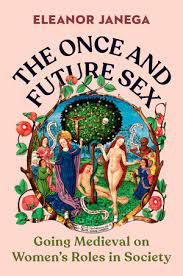
I read this courtesy of NetGalley; it’s out in January 2023, from WW Norton.
Janega aims to explore medieval attitudes towards women in a variety of contexts – appearance, sexuality, education, work, maternity and so on – and to show how that is similar to, different from, and informing modern attitudes. I think she does an excellent job on the first, but I think there’s something lacking in the second.
The introduction to the concept of “the Middle Ages” is excellent, as is her argument for why studying this period is important, both for understanding the development of attitudes towards women and more broadly. Janega uses an excellent variety of sources to demonstrate how medieval society – particularly at the elite level, but also how that percolated through the other 99% – developed their ideas; through theologians (mostly male, but also Hildegard de Bingen of course), and medical texts, becoming educational manuals, as well as through ‘pop culture’ like ballads and Christine de Pizan’s poetry, and visual art as well. She also destroys some really important myths, like the notion that women as workers is a modern invention (you think a “farmer’s wife” is sitting around doing nothing?) and that beauty standards are in some way objective and timeless (all those images of nude Eve with a wee pot belly).
I do think that some of the ideas Janega draws together from medieval and modern are really important. The thing about beauty, for instance: that only the wealthy could attain what was regarded as truly beautiful, but that women shouldn’t be seen to work at BEING beautiful; if you did work on being beautiful that was vain and therefore sinful; if you were poor and somehow, miraculously, beautiful, you were clearly meant to be amongst the great instead… and so on. Also, beauty and virtue going together. It’s painfully clear how these things resonate today, with issues of cost as well as luxury time all coming together – think of women who are on public transport in their sneakers, with their high heels in their bag. Beyond the beauty issues, Janega talks about a lot of other issues for modern women and how these are similar to/different from our medieval counterparts. However, I didn’t feel like the links were drawn quite strongly enough between the medieval and the modern to show how one developed from, or reacts again, the other.
Overall I do think this is a very good book about historical European ideas of women: who they are and can be and should look like. Janega does make some imortant commentary on modern women, too – the fact that I wanted a tighter connection does’t detract from her powerful statements. This can definitely be read with little knowledge of the European Middle Ages.
Stroller, by Amanda Parrish Morgan
I read this courtesy of NetGalley. It’s out on 20 October 2022.
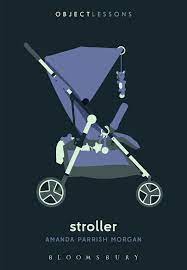
Of the four Object Lessons books I’ve read so far, this is by far the most personal. It’s really quite remarkably personal, actually, and I admire Morgan for what she says about herself to illustrate the points she’s making more broadly about society.
While the focus of the book is the stroller (or pram), this is very much a book about motherhood, mothering, expectations on and of mothers, and how consumer goods like the stroller fit within that. I am not a mother, but even I know some of the pressures and expectations from society imposed on, and internalised by, mothers. Morgan describes herself as someone who didn’t expect to be a mother from early on; and as someone whose identity was strongly tied to being a runner. Both of these things influenced the way she perceived maternity, and the stroller. Her early recounting of telling a (not-mother) friend that she’s going to try and have a baby, and the quite awful reaction from that friend (“That’ll be the end of all your running”, p6), sets up a lot of what Morgan picks up through the book (and made me worriedly think back to how I’ve reacted to child-announcements from friends. I don’t think I’ve ever been that awful?). Morgan relates her experiences of juggling not wanting to fall into the ‘must have everything’ trap, to not be swayed by alarmist or aspirational advertising. She talks about juggling routines, two preschools, her own desire to run (between two preschools, with a double stroller); and she relays the commentary she received from onlookers, too, which honestly just made me mad.
Morgan mixes in academic discussion, too: of how American society emphasises the ‘production’ part of ‘reproduction’, with the mother as unskilled worker; the use of the word ‘labour’ and ‘delivery’ and what they suggest about the relationship between mother and child and the whole process of the second leaving the first. And then how baby products get tied into identity, and parenting strategies, and what all of those things mean and say about you and your choices. It emphasised a lot of things for me: just how harshly mothers are treated sometimes, how many minefields need to be navigated, and how unapproachable so many of our cities and spaces are. Also, my goodness it’s harder in America than in Australia (paid maternity leave, etc).
It’s not quite the book I was expecting – there’s not a huge in-depth history of strollers and their alternatives, for instance, although there is some – but it was nonetheless engrossing and… well, I want to say enjoyable, but that’s not quite the right word. I read it quickly and with fascination.
Bake, from Paul Hollywood
I received this from the publisher, Bloomsbury, at no cost. It’s out now; $52.00 for the (very lovely) hardcover.
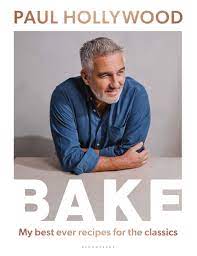
I’m not naturally a celebrity chef fan, and I was late to the Great British Bake-Off. But I do now love GBBO, and I enjoy Hollywood’s style within the show as a rule; I also own his bread book because it has a very good range of styles, and is accessible. So I was quite interested to receive this and see what it contains.
First, in terms of appearance: this is, unsurprisingly, a very pretty book. I love a hardcover – although I’m a bit sad this is lacking a ribbon. Just one of those things I like. Anyway! The recipe pages are entirely standard, so they’re perfectly easy to read and follow; the pictures are nice and appealing. There are a few recipes that have some step-by-step photos – croissants, for instance, and the meringue roulade, which didn’t seem to need it as far as I was concerned.
There are six chapters: Cakes, Biscuits and Cookies, Breads and Flatbreads, Pizzas and Doughnuts, Pastry and Pies, and Dessert. There’s nothing especially revolutionary or new in these sections. The subtitle is “My best ever recipes for the classics” and that’s exactly what this delivers. So if you want a surprising take on ginger nuts or a revolutionary way of making croissants, this is not the book for you. Instead, I would class this as your second baking book. It’s not the book for a novice; there are some assumptions about techniques and so on that would stump someone who’s never baked. But for a person who enjoys baking and wants a book with a good variety of recipes – ones to make all the time and ones for occasional adventures – this is pretty good.
What I’ve made:
- No cakes yet! Just haven’t had the inspiration. But I have my eye on the Chocolate Orange Banana Bread.
- Biscuits: Hazelnut and Apricot Cookies are excellent and will go into steady rotation. The Double Chocolate Chip Cookies were fine, but probably not better than others I already make. The ginger biscuits were exactly what they should be. I’m quite interested to try his scones, just to see how his method works.
- Bread: I made his baguettes! Which was time consuming although not a lot of work. I think I over-proved at one stage? They still tasted ok, just not a great shape. Excellent tip: I froze a couple, and then defrosted and ‘refreshed’ for a few minutes in the oven, and they were really good!
- Pizzas and Doughnuts: haven’t been making pizza recently (don’t ask; we haven’t found the required bits for the pizza oven…) and I cannot come at deep-frying doughnuts.
- Pastry and Pies: I love a pie, so I’m looking forward to making some of these; it just hasn’t happened yet. The recipes look excellent and fairly doable; I’ll probably even make the pastry, at least a couple of times, to see how that goes. I HAVE, though, made the danishes! Just to say that I have, and that I can. I wasn’t in love with the pastry – it seemed a bit too bready, and not flaky enough, so I’m not sure if that’s me or the recipe. It’s a long and drawn-out process, but not too hard. The one thing I was cranky about was making the creme patisserie. The recipe says mix ‘until thickened’. Now I’ve been making a lot of custard, so I assumed I was going to that consistency and it would thicken a bit more when rested. Nope. I ended up having to warm it again to thicken it further, because it went absolutely everywhere when I tried to put it on the pastry. This is one reason why I don’t think this is a novice’s book.
- Dessert: I made the meringue roulade (with berries, not mango). And it’s easy as, and very tasty, so this is going on the make-again list for sure..

 Randomly Yours, Alex