Cooked, by Michael Pollan
 This book was recommended to me by the sourdough baker whose course I took. It turned out that I had already one of Pollan’s books – The Botany of Desire, which was awesome and looked at various plants in light of the general idea of desire. (My biggest take away message: the Agricultural Revolution was the grasses using humanity to destroy the trees. Also that all edible apples are clones.)
This book is Pollan’s attempt to learn more about cooking, having looked at the gardening and the eating side for a long time. He divides the book into four sections: Fire, Water, Air, Earth. Or, basically: barbecue, braise, bread, and fermenting. Continue reading →
Galactic Suburbia: Bloodchild
 In which parasites are creepy, pregnancy is body horror, and consent is important! You can get us from iTunes or at Galactic Suburbia.
Get comfy and listen to Alex & Tansy’s discussion of Octavia Butler’s “Bloodchild” and her essay “Positive Obsessions,” both available in the Bloodchild & Other Stories collection (plus Bloodchild is available as a single story digitally).
Don’t forget: submissions for the Octavia Butler tribute anthology are due on Jan 8! See Submissions for details.
Please send feedback to us at galacticsuburbia@gmail.com, follow us on Twitter at @galacticsuburbs, check out Galactic Suburbia Podcast on Facebook, support us at Patreon and don’t forget to leave a review on iTunes if you love us!
Proof of Concept
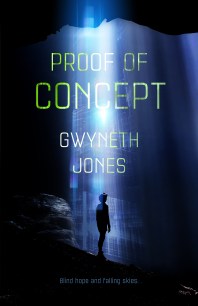 This novella was sent to me by the publisher, Tor.com, at no cost. It will be out on 11 April, 2017.
Um. Wow. No seriously. Terrifying and amazing and absolutely captivating.
Jones is saying a lot about modern society in this novella and most of it isn’t very nice. She’s also presenting a compelling story and believable characters and… this is yet more evidence that novellas are a fantastic length for stories.
There’s been a lot of discussion recently about how facebook mediates news and how people who only get their news from facebook can end up in an echo-chamber, essentially, with their own opinions endlessly reflected back to them. Jones presents GAM: Global Audience Mediation. An avatar, the AI of GAM, asks questions for news broadcasts – it’s “the statistical sum of… real-time responses” from the global audience (4). It’s crowd-sourced journalism, where presumably minority views and questions get drowned out in the fantastically huge audience. No room for dissenting voices then. Then there’s the broadcasts of the VLDMT (Very Long Duration Mission Training) – in theory Earth 2-like training situations for people who might go on interstellar missions, but effectively ending up like reality tv – Big Brother in extremis.
And this isn’t even really what the story is about. They’re just creepy incidental issues that Jones throws in to show that this is a real and believable future story. I love Gwyneth Jones.
What the story is actually about is getting off Earth as the population and climactic situation gets progressively worse and worse. There are two solutions being proposed: the VLDMT people imagine a space ship, while Margrethe Patel is working on a method of hyperspatial travel that shifts within 4D information space. (Happily, Jones is not Greg Egan, so there’s no vector diagrams to attempt to understand.) The two groups come together when an enormous abyss is discovered under Poland and it appears to offer a place to practise for both groups. They need complete isolation from the rest of the planet, and things go from there…
Did I mention that the focal character, Kir, has an AI in her head? Yeh. There’s a huge amount going on here.
I loved Kir and how she faces the various problems – like annoying people and difficult work – that confront her. I was gutted by how Jones imagines this possible future, and I was enthralled by what she imagines as solutions. If you like science fiction you need to read this story. When it’s available.
The Edge of Everything
This book was sent to me by the publisher, Bloomsbury, at no cost. It’s being published in February 2017; RRP $16.99.
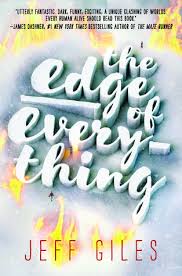 I have to say first off that I think the title is naff. It doesn’t tell you anything and it also doesn’t relate to anything in the story. So that’s my whinge.
The promo material for this book suggests 12+. I would say 14+, personally; I can’t think of a 12 year old I would deliberately give this. Some 12 year olds would take it for themselves and cope quite nicely, I suspect, but that’s a different issue.
Zoe’s father died a few months ago; her brother goes out in a snowstorm and she has to rescue him; she meets a stranger with tattoos and apparently some sort of extraordinary power. He has no name; she calls him X. He’s a bounty hunter; things of course do not go well for him or for Zoe and her family.
It’s not the most original-sounding narrative, but there are some remarkable aspects to the book. Slight spoiler: X is from what would be best described as hell, but the Lowlands are quite different from any other incarnation of hell that I’ve come across in fiction. It’s an intriguing vision of the place and of how it might be used. There’s no explanation of the Lowlands and how it operates; instead the focus of the narrative is on relationships, and the work of bounty hunters… it’s all about the vibe of the thing. And overall that worked. Certainly there are a myriad of unanswered questions about the mechanics, but they don’t really matter for the story itself.
The human world and especially Zoe’s family are beautifully realised. The different expressions of grief are portrayed sensitively and realistically. Jonah, Zoe’s brother, has ADHD; it’s just a fact of life and oh my goodness he’s a cute terror, as little brothers usually are. Mum is vegan and a bit nuts and fierce and has always struggled to hold the family together: I adored her so much. Zoe’s friends Val and Dallas are a delight (Val made a Tumblr of her girlfriend’s feet) and although I thought it was going to veer into dodgy love triangle territory Giles avoids that neatly. Dad… well, he was a struggler, and the way mum slowly revealed a bit more about what he was like to Zoe over the course of the book was heart-breaking and, again, intensely realistic.
Into this human world comes X, quite accidentally, and in some ways – although a third or more of the book is from his perspective – he’s the most opaque of all of them I think. Partly this is because he almost has no personality, thanks to how he has grown up; he really only starts to live after meeting Zoe. I was reminded of those suggestions of how Matt Smith’s Doctor ‘imprinted’ on young Amelia Pond, as I watched X and Zoe together. I was initially a bit squeaked by their budding romance because I thought he was much older than her; turns out he’s maybe 20 to her 16 (which is still a bit squick for me). The intensity of their attitude towards one another, especially his for her, was the main eye-rolly bit for me. It all seemed a bit too intense too fast.
Perhaps the most disappointing thing is that this is the start of a series. It felt to me like the sort of intense story and relationship that ought to be encapsulated in just one, say 450-page, book. I don’t know how it could have been resolved but I definitely would have preferred that.
Overall this is a well-paced and intense book that I read in the course of one day. I enjoyed most of the relationships and I was genuinely surprised by a couple of the revelations. I’m not sure whether I want the sequel because I’m afraid it will lose the intensity, but that’s a problem I’ll just have to deal with.
Snow White, Blood Red

I’ve been meaning to read this book for ages. And I do mean years. Finally got it this year because I was reminded of it by someone when I read a very poor version of the Snow Queen.
Many of the stories are excellent, although it’s not quite the anthology I was expecting. I wasn’t expecting there to be discrepancy in whether the stories were pretty faithful or quite different versions; I found it a bit disconcerting to bounce from one to the other, and then have completely made up (that is, not based on commonly told fairy tales) stories in there as well. I’m not saying any of those three options is bad but it felt jarring to have them all mixed together. But I think that’s mostly my expectations.
Lisa Goldstein’s use of Hansen and Gretel motifs to tell a story about a woman’s relationship with her daughters was a delight and a really intriguing way to end the anthology. I loved Patricia A McKillip’s take on the snow queen and Esther M Freisner’s “Puss” was deeply troubling. Actually a lot of them were deeply troubling, but that was kind of the point both because original fairy tales just were troubling and because this anthology was always intended to be about both the fantasy and the horror aspects of the stories. Hence the title. There were a lot of really great stories in this anthology and I can see why it keeps getting talked about. I guess I finally need to read Angela Carter now
The Light that gets Lost
This book was sent to me by the publisher, Bloomsbury Children’s, at no cost. It’s on sale now; RRP $19.99.
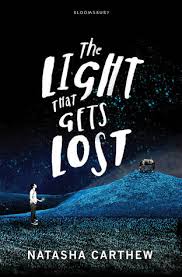
The promo material that comes with this says it’s for 12+ years. Me, I wouldn’t give this to a 12 year old that you wouldn’t give Lord of the Flies to – and I’m guessing that’s most of them. It’s been a while since I read Lord of the Flies but there are definite overtones of that scenario in Carthew’s book, especially in the second half. I rather feel a kid would need to be a bit robust to read and enjoy this, because it’s certainly not all rainbows and cupcakes. I know dystopia is (was) all the rage but this feels a bit closer to home than that…
The set up sees Trey, as a small child, hiding in a cupboard while his parents are murdered. What a cheery opening, right? And then the story skips forward eight years and Trey is getting himself into a farm camp for juvenile criminals, in theory intended to train the adolescents in useful skills but in reality more like forced labour. Trey has willingly gone there in order to try and find the man responsible for his parents’ deaths. Which is a bit messed up I think.
There are some really interesting ideas here, but for me some of the better ones are the ideas that get mentioned and then lost. It becomes clear int he second half that society outside of the camp isn’t exactly the society of Britain (I think) in 2016… but exactly what’s going on and how it got there is never explored. It’s just mentioned in passing, almost for no reason, and then ploop… disappears. The entire set up of the farm isn’t explored or explained in that much detail, so it just sort of… exists… as a place for things to happen.
The main focus of the story is friendship and revenge. Friendship in this kind of environment is always going to be a bit fraught, what with sadistic overseers and bullies and a system aimed at breaking kids down. The friendship between Trey and a boy in his bunk room, Lamby, is believable enough but I didn’t always buy the friendship between Trey and Kay, a girl with whom he ends up doing farm work. It might have been a bit more believable if there had been other female characters with whom we got to see Kay interacting, or even Trey interacting with them.
The revenge aspect drives the initial part of the plot and again I didn’t entirely buy the eight year old boy turning into an adolescent so driven by revenge that it’s as if there’s a demon under his skin. This idea of a demon gets a few mentions – including on the back cover – but isn’t really explained; Trey occasionally talks to it but it’s not clear what we’re meant to think is going on. Maybe that’s left deliberately ambiguous but it didn’t work for me in this context. There is some resolution to this revenge plot but, again, it didn’t entirely work for me.
This all makes it sound like I hated the book, but I didn’t. I didn’t love it, but neither did I loathe it. Cart hew writes beautifully on a sentence level; the Financial Times apparently described her as using “vivid, imagistic language” and certainly a lot of the language is vivid. Some of the lacunae are obviously deliberate and evocative, which I liked, it just didn’t always sit well with the plot.
In the Chinks of the World Machine
Look, any book whose title is taken from a Tiptree story – and “The Women Men Don’t See” no less – is likely to be very appealing to me. And ta dah! It was.
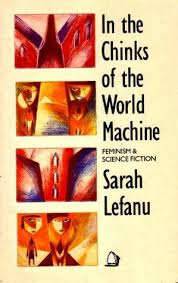 This delightful feminist, academic, personal, humorous, thoughtful, and passionate examination of women in science fiction and women writing science fiction came out in 1988. So yes, it’s dated – of course it has. There have been lots more stories written in the last (oh heck) nearly thirty years that have a variety of female characters, and of course more female authors challenging and playing with science fiction ideas. But I think that the categories that Lefanu considers – Amazons, utopias and dystopias, women in love, and so on – these categories often still apply to the ways that women appear, or are thought that they should appear, as characters. So I certainly found these chapters resonant and not only from a historical perspective.
The second half of the book was the bit that I really loved, though. James Tiptree Jr, Ursula Le Guin, Suzy McKee Charnas and Joanna Russ: what a magnificent set of women, and a magnificent set of stories between them. Lefanu examines a set of the novels and short stories of each of the women (in Russ’ case, almost all her science fiction) and dissects the ways in which they present women. She’s not always flattering – she has some issues with Le Guin’s early female characters, which I don’t entirely agree with – but she is always interesting and insightful.
One of the things I really appreciated and enjoyed about this book is that while Lefanu is absolutely writing an academic piece and interrogating issues of feminism and how science fiction fails or encourages women, there are also personal moments that didn’t feel at all out of place. I really, really like this idea that the writer actually exists and has an opinion – that the book isn’t pretending to be a disembodied, clinical examination but acknowledges the very real body behind the … well, typewriter probably.
If you’re interested in feminist science fiction, in women in science fiction (in all senses), or have a somewhat historical literary bent, this is a really great book. It’s very approachable and even if you haven’t read the stories Lefanu examines (I’ve only read one of the Charnas books), she explains them enough that her analysis makes sense… and I still want to read the books.
Down Among the Sticks and Bones
So yes, I’m very privileged. I got to read Every Heart a Doorway a long time before it came 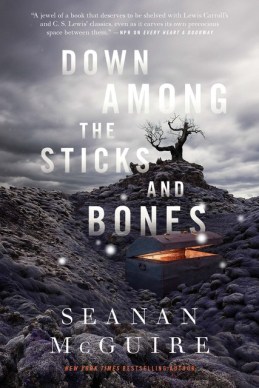 out. And now I’ve had the chance to read the prequel a long time before it comes out, too. It’s out from Tor.com on 13 June 2017…
The blurb says
Twin sisters Jack and Jill were seventeen when they found their way home and were packed off to Eleanor West’s Home for Wayward Children.
This is the story of what happened first.
Jacqueline was her mother’s perfect daughter—polite and quiet, always dressed as a princess. If her mother was sometimes a little strict, it’s because crafting the perfect daughter takes discipline.
Jillian was her father’s perfect daughter—adventurous, thrill-seeking, and a bit of a tomboy. He really would have preferred a son, but you work with what you’ve got.
… and the opening, which is set in the Real World, is about the most horrifying part of the whole thing. Parents who have children because they think it will make them look good, who force children into preconceived notions and potentially do a lot of damage: it’s just hideous. And the worst part is the way that McGuire writes about this from a very knowing, self-aware position: the narrator is pointing out what the parents are doing, making sure the reader knows how dreadful this is. And it works to heighten the horror rather than defuse it; this is not ‘telling instead of showing’, this is a sympathetic yet almost malicious commenter making sure you know exactly what’s happening.
Then the twins find themselves in a different world, and they get to make choices for about the first time ever and those choices have serious implications. And the way they’ve been brought up has consequences for the choices they make, and also doesn’t in the slightest prepare them for them.
I can’t tell you how happy I am that Every Heart a Doorway wasn’t a standalone story. And this is an absolutely standout addition to the world of portal fantasies that McGuire created there, with Other Worlds matching the people who find them and having an irrevocable impact on the inadvertent travellers. I love how McGuire takes bits of other stories and fairy tales and weaves them into her story in her very own way: you get the pleasure of recognition combined with the shock of difference and it’s a delight.
Apparently there will be a third book. I’ll just be over here, watching my inbox, waiting…
Galactic Suburbia 156
In which Tansy and Alex share a culturepalooza — witches, spies, hockey romance and magical secret agents! Get us from iTunes or at Galactic Suburbia.
New on the internet?
@GailSimone asking for recommendations of books/comics by POC, LBGTQ or other marginalised creative teams.
CULTURE CONSUMED:
Alex: The Shepherd’s Crown, Terry Pratchett;
Tansy: Her Every Wish, Courtney Milan;
Alex: The Song From Somewhere Else, AF Harrold;
Tansy: Mockingbird,
Alex: Long Hidden anthology, Rose Fox and Daniel Jose Older;
Tansy: Sarina Bowen The Ivy Years: The Year We Fell Down, The Year We Hid Away, The Understatement of the Year;
Alex: Agents of Dreamland, Caitlin R Kiernan;
Tansy: The Hamilton Mixtape,
Alex: Imprudence, Gail Carriger
Tansy: The Miraculous Ladybug
Please send feedback to us at galacticsuburbia@gmail.com, follow us on Twitter at @galacticsuburbs, check out Galactic Suburbia Podcast on Facebook, support us at Patreon and don’t forget to leave a review on iTunes if you love us!
Agents of Dreamland
This novella was sent to me by the publisher, Tor.com, at no cost. It will be on sale on 28 Feb, 2017.
 If you’re looking for resolution and answers, do not come to Caitlin Kiernan.
If you’re looking for a linear narrative that moves smoothly through chronological time, do not come to Agents of Dreamland.
If you’re afraid of mushrooms or fungus, do not read this novella.
And if you’re concerned that beings Out There are coming to get us, and that people Down Here are trying to hide that fact… well, you might want to read this, but it won’t give you any reassurances one way or another.
There’s a Waco-syle whacko, and a glitch with New Horizons (which really happened!), and super-secret agents trying to figure out exactly what’s going on and how to save the world. Which may not be possible but I guess we’ll try anyway, and it may require copious amounts of coping alcohol.
Kiernan develops a vision of possible impending doom across the twentieth and twenty-first century, mostly through the experiences of two opaque secret agents and one ex-junkie. It’s not always an easy read but it’s definitely a gripping one. Definitely recommended.

 Randomly Yours, Alex