Musketeers
I love The Three Musketeers in the same way I love Sherlock Holmes. Via their later interpretations.
I’ve read Dumas… a long time ago… probably when I was too young to really enjoy it. And after I’d seen the movie, and loved it.
 Hmm. Let’s be honest. After I watched Kiefer Sutherland and some others and loved Kiefer Sutherland. The others were ok too.
ANYway, I love the idea of the Musketeers, and I adore reinterpretations. Thus, readers: Musketeer Space! Tansy is doing a gender-swapped space opera version and I am very much looking forward to reading it. She’s also experimenting with Patreon to see whether people want to support her in the endeavour, and is offering all sorts of incentives. Like promising to review Musketeer-related stuff. The first such is a review of the 2011 Musketeer movie involving airships and other steampunkery, which I tragically never got around to watching. Until today.
 There are many, many amusing aspects to this movie.
Number 1: I’ve thought of Luke Evans as the new Orlando Bloom for a while now, so to see them in the same movie is hilarious.
 Number 2: as Tansy points out, Orlando Bloom is doing his best to channel 1970s Elvis hair.
Number 3: Mads Mikkelsen chewing the scenery.
Like the Sutherland version, D’Artagnan is the most wet and boring of all the characters. I just don’t get him, and I eye-roll so hard at the thought of Chris O’Donnell that don’t even get me started.
I mostly agree with Tansy’s review, especially the desire to see Milady and the lads conduct heist after heist after heist. I do disagree with her about the Cardinal – remembering that I am no connoisseur of the original, I don’t think he was dull; understated, perhaps, instead of underplayed. Tim Curry was an archetypal villain in the Sutherland version and I can’t help but feel that this one was doing his best to differentiate himself. I thought it worked ok. I also disagree with her assessment of Constance’s speech about a lady in waiting not being as important as a musketeer – my understanding of this section is that she was suggesting she was in less danger partly because she was a woman, but mostly because her position as a lady in waiting offered protection. It is possible I misheard some of this exchange because the knitting was distracting me….
I am most saddened that, after a delightfully swoony prologue read by Matthew MacFadyen, he really just phoned in this performance. Not a jot on Kiefer.
I do not think this has a lot of rewatchability, so I am amused and impressed that Tansy sat through it a second time. It was genuinely enjoyable, and there may have been shrieks of laughter especially over the airship’s steampunk machine guns, but it is not a cinematic masterpiece.
Also thanks to Tansy, I now have “All for Love” stuck in my head. And I’m starting to fear that the Suck Fairy may have visited my beloved 1993 (gasp! 1993?!?) version…
A Pursuit of Miracles
I’ve had this book sitting on my shelf I think since AussieCon 4, in 2010. Oops. And I don’t think I realised it was a set of short stories, otherwise I probably would have read it earlier. Yup. Oops. Still – another book off the TBR pile!
So. George Turner. I’ve never read anything by Turner before. I’ve heard his name a bit, from those who were active in Australian SF in the 1980s, but… that’s not me. So now I get to actually have an opinion! And that opinion is… he’s not bad. Not my new favourite author, and perhaps the shorts aren’t his best work – hopefully someone will tell me? – but these are solidly intriguing, sometimes deeply engrossing, stories. The introduction has it right, too: many of his protagonists are quite aggressive, which gives the entire collection a certain pugnacious feel.
“A Pursuit of Miracles” is ostensibly about the experimental pursuit of telepathy. However this is really just am excuse to meditate on what might happen in and with a society that believes itself to be living in the Age of Miracles – that this might give scientists leeway to do what they like, such as experimenting on humans and calling them not humans. The discussion about how dreadful telepathy or telempathy would be is indeed insightful.
“Not in front of the children” is hilarious as a rumination on generational divide. The question about whether people would actually want to associate with previous generations if they were all alive at the same time is, again, insightful, and Turner is really very funny in suggesting how the generations would distinguish themselves. I can’t help bit wonder if Turner had grandchildren when he wrote this.
“Feedback” is the story I am most indifferent towards. A discussion of solipsism is not my thing, and the use of the term “Abo woman” stung.
No wait, “Shut the door when you go out.” This one I really didn’t care for.
“On the Nursery Floor” is the most intriguing from the point of view of form – a series of interviews with occasional journalistic interventions. The idea is one of investigating the consequence of meddling with intelligence. This is a more severe version of Brian Caswell’s Cage of Butterflies, and very clever.
“In a Petrie Dish Upstairs” is, of the stories that seem at least vaguely plausible (I exclude “Feedback” and “Shut the door”), the least sensible. The idea that three generations – fewer, in fact – would be enough to change a society separated by distance if not entirely psychologically is unlikely. Obviously it’s a thought experiment to some degree, but that timing aspect got to me. The other bits, though – how women might be considered, the politics, the concept of Ethics, the change in language – were clever enough to make it worth reading.
“Generation Gap” is silly.
The final story uses a few different narrators – including an astonishing but, on reflection, entirely believable reversal – to tell a story that, in close up, is about the destruction of a family and one boy’s bid not to slide into ignominy. On a larger scale, this is a terrifying view of the implications of climate change on society, and it’s very, very ugly. A fine conclusion to the collection.
Galactic Suburbia is 100!
Alisa, Alex and Tansy invite all our listeners to join us as we celebrate our 100th episode of Galactic Suburbia in time-honoured tradition, with cake! We can be found over at iTunes or at Galactic Suburbia.
Alisa is eating Golden Gaytime cheesecake. Tansy is eating orange sour cream cake. Alex combined them both to create chocolate orange cheesecake! Let us know what kind of cake you ate while listening to the podcast! If you’d like to enter our cake logo contest, please send a picture of your Galactic Suburbia themed cake to us by email or Twitter by the 27th May!
NEWS
The Norma Shortlist includes some Twelfth Planet Press books!
Alisa recently announced the Kaleidoscope TOC, and may be launching Rosaleen Love’s book Secret Lives of Books at Continuum.
Hugo Packet – Orbit UK not including the novels.
Tansy news: upcoming Tor.com reread column & web serial
The Galactic Suburbia scrapbook available soon for download.
Listen to the episode for giveaway codes. Free books!
Limited editions second print run for Love & Romanpunk by Tansy Rayner Roberts. Let Alisa know now if you want one of these – she’s printing them for London.
What Culture Have we Consumed?
Alex: Hav, Jan Morris; Graceling, Kristin Cashore; so much Fringe. And Orphan Black. No more Comixology for me.
Tansy: Captain America: Winter Soldier; Gravity; Fangirl by Rainbow Rowell, Saga 3
Alisa: OMG I AM IN EDITING/PROOFING ARMAGEDDON – Kaleidoscope almost ready to drop and Secret Lives of Books! And …. Tea and Jeopardy
Galactic Suburbia highlights.
We love you all, thanks for listening to us!
Please send feedback to us at galacticsuburbia@gmail.com, follow us on Twitter at @galacticsuburbs, check out Galactic Suburbia Podcast on Facebook and don’t forget to leave a review on iTunes if you love us!
Graceling
Reading this was like eating M&Ms. Stopping was very hard. I began it one evening at 8pm. I finally forced myself to go to bed at 10pm. I had read about 200 pages. The prose is just that easy to read.
 This secondary world of Cashore’s isn’t a place where magic happens. It is, though, a place where some people are born Graced: they have a skill, or a thing, that they are superbly, unbeatably, good at. You might be a Graced chef, or a Graced archer; be Graced with mind-reading, some sort of prescience, or being able to eat rocks. I was about to write that I would like to be Graced with memory, but then I remembered the books I’ve read where characters never forget anything and I realise that would be appalling. Perhaps I would like to be Graced with pastry-making. Or with patience. Perhaps pattern recognition.
Anyway, you can tell someone is Graced before they act because they have eyes of different colours. Sometimes this happens as soon as the baby is born; sometimes it takes months, even years, for the eye-colour to settle in. In most parts of the Seven Kingdoms, those who are Graced are automatically feared, and become the property of the King. When you are already the king’s niece and your Grace is fighting… well, Katsa was screwed from the moment she threw her first punch as an under-ten. She’s been fighting for, and being a one-person bully gang in aid of, her uncle for a long time now. But she’s starting to try working around and under the king – helping out people where she can – and this has to come to a head at some point.
The story is a quest for knowledge and for self-identity. Katsa’s age is unclear – she’s certainly late teens if not 20s – and it’s not quite a coming-of-age; she’s cynical and knows about the world already. But while embarking on a quest to help a friend discover the truth about a family member, she definitely learns more about herself and how to be in the world. This search for identity is a current through the whole story, but it’s not overwhelmingly dominant; there are some reflective moments, but there are a lot of moments of action too, for readers like me who usually prefer that sort of story. And the actual quest means that Cashore gets to introduce us to bits of the Seven Kingdoms, which is always fun. I enjoyed the developing friendship between Katsa and Po, I liked the secondary characters, I liked that there were a few plot twists and that while it’s not a light and breezy story, it’s also not grim and gloomy (I have no problem with either, I just like that this one was at the lighter end).
There are a few failings. The ten-year-old is unbelievable enough that I thought she was going to end up being Graced with something that made her wiser than her years. Some of the secondary characters, especially Katsa’s cousin, could have withstood a bit more character development. Over on Goodreads I briefly saw two complaints. One is that it’s an enjoyable book except for the “raging feminist agenda.” I am bewildered by this. Is it a raging feminist agenda to have a supremely competent female lead, to suggest a woman can be a monarch, to not have a female character desperate to get married, to allow characters sex before marriage, to have female characters who don’t care that much about clothes? If so, AWESOME I WANT MORE. Me, I just see that as, y’know, reflecting the real world. The other complaint is about the romance – spoiler! There is one! (If you didn’t know that, you could read the cover quote which claims it has “a knee-weakening romance that easily rivals that of Twilight” … Thanks, LA Times. I have nothing to say.) That reviewer, I think, has an interesting point to make which is that (SLIGHT SPOILER HERE) Katsa’s refusal to consider marrying Po means that what they have isn’t really love, because love is meant to be sacrificial. She is NOT saying they ought to just get married – at least as far as I understand it (here, read it yourself – it’s the one written by Miss Clark). However, while I see her point, I think I disagree. I think Katsa is willing to be with Po forever, and that especially at this point it’s not not-love for her to be keeping her options open, and being wary. Or maybe I’m just too dewy-eyed.
There are two other books in the not-quite-series, but I don’t think I will hurry to get either. While I loved this book, it’s the writing and the characters that I adored. I’m not so fussed about other people in the world and their carryings-on.
(Another books from the stash of unread books, busted!)
You can get Graceling from Fishpond.
Hav
 I have never, in my life, read a book two times in a row. Until I read Hav. This was possible because Hav is not a novel in the ordinary sense. It’s a travel memoir to a fictional place that could easily exist; it’s a meditation on East meeting West, on history and culture and modernity; it’s about being a stranger in somewhere simultaneously familiar and alien. And it has some of the most wonderful prose I’ve come across.
This section from Hav illuminates many of the aspects that make the book so wonderful.
[The boats] often use their sails, and when one comes into the harbour on a southern wind, canvas bulging, flag streaming, keeling gloriously with a slap-slap of waves on its prow and its bare brown-torsoed Greeks exuberantly laughing and shouting to each other, it is as though young navigators have found their way to Hav out of the bright heroic past. (p66)
This. It’s beautiful, for a start. It suggests that conjunction of somewhere existing both in the present and, somehow, in the past that makes Hav so intriguing. And it’s quoted back at its author in the second part of the book, as an indication of her own understanding of Hav.
(We’re all about the meta.)
Two thirds of the book was written and published in the 1980s. According to Ursula le Guin, who wrote the introduction, it led to people going to their travel agents looking to book a ticket to Hav because it was so convincing. Now, it really is convincing, but at the same time there are aspects that make it quite clear that Hav is a fiction. Like the fact that you’ve never seen it on a map, maybe? I was confused by that until I look Jan Morris up, and discovered that she has written many actual travel books (under that name and as James Morris). So I concede that perhaps if you knew her earlier work, you could be forgiven for some confusion if not quite that much. Anyway, the last third was written in the early 21st century, and sees Morris going back to Hav after the Intervention – which was just starting as she left last time. And this allows Morris to explore a whole other aspect of culture and development.
“Last Letters from Hav” are entries written between March and August, with Morris arriving in Hav at the start and being bustled out as trouble brews at the end. In between, she does what any travel writer does: she stays in interesting places, she visits the important and not-so-important places in the city, she talks to people, she reminisces about what other people have said about the place. I’ve been having a great deal of difficulty writing this review because the books is absolutely busting at the scenes with themes, with commentary, with historical (a)musings. There’s multiculturalism and colonialism and identity – the losing and finding and historical nature of and doubt around. There’s appropriation on a massive scale – see previous note – and getting on with the business of life. There’s ordinary mystery and profound mystery, religion and politics and architecture and this book had me in RAPTURES. Can you tell?
Hav is a city-state in a world that really doesn’t have them any more. It’s got an uneasy relationship with Turkey, its only (?) land neighbour, but a seemingly thriving one with certain Arab nations and perhaps the Chinese. It’s basically meant to be somewhere like the Dardanelles – although the geography isn’t quite right – because it’s a big deal that this was where Achilles and his Myrmidons came ashore. And the Spartans too, apparently. And, later, Arab merchants, and Venetian merchants, and it’s one of very few venerable Chinese merchant settlements outside of Asia. See how Morris twists history and makes it just believable? There really were moments where I could believe this was real. Because her discussion of history is modern, too: the Brits wanted to colonise it; Hav was shared by France, Italy and Germany under a League of Nations mandate; Hitler might have visited, and Hemingway did. Morris talks to people who are flotsam from this era; and also to a man claiming to be the 125th Caliph. Also a casino manager, members of the ‘troglodyte’ race who live in the nearby mountains, the local philosophers, and some bureaucrats. She visits odd monuments, the Conveyor Bridge (I admit I had to ask someone whether that was actually possible, because I was teetering on the edge of What Do I Believe?), and the Electric Ferry. I don’t believe that this book could have been written by anyone other than an established travel writer, because her eye and ear for (even imaginary) detail is breathtaking.
The second section is much shorter and deals with only a week or so, some two decades later when Morris is invited back to Hav after the Intervention. “Hav of the Myrmidons” does all of the same things as “Last Letters,” with additional meditation on the nature of change and tourism and the impossibility of an outsider ever really understanding the internal workings of a foreign city. There’s also the inevitable nature of change, and the sinister side of globalisation with imported labour and native populations made to relocate – which, intriguingly, is given a possibly positive spin. Morris’ books is either revered or believed to be banned in Hav, depending on who she speaks to (it’s one of the bureaucrats who reveres it that quotes the passage above at her, as part of the reason for why she was asked back). But things have changed. Most of the glorious many-centuries-in-one-place nature of former Hav is gone, replaced with new and forbidding and disorienting architecture. Like the massive Myrmidon tower, surmounted by an M – but no one really knows who or what the Myrmidons are, or meant to be, in this context. Some things of old Hav have been retained, but sanitised, bent to a new understanding of the world. Tourists are allowed, but only in a defined space – which leads to another bit I wanted to quote, because I think it’s an indication of a travel writer’s despair:
“The thing is… one feels so safe here. The security’s really marvellous, it’s all so clean and friendly, and, well, everything we’re used to really. We’ve met several old friends here, and just feel comfortable in this environment. We shall certainly be coming again, won’t we darling?” “Oh, a hundred percent. I think it’s bloody marvellous what they’ve achieved, when you remember what happened here.” (p196)
Thus spake an older English couple with no intention of leaving the resort.
Hav puts me in mind of China Mieville’s The City and the City, and Christopher Priest’s The Islanders, both of which do a similar thing with inventing places that ring so amazingly true. The Priest is clearly fictional but written as a travel book; the Mieville is a fiction but set in a city that purports to be real. I guess Hav conflates the two.
This review gets nowhere near what I really want to say about Hav. I am so glad that it exists, and that I have read it. And now I will force it into the hands of anybody I possibly can… although I admit to some trepidation that maybe other people won’t like it as much as I do. (I haven’t been able to look at any Goodreads reviews for that reason.) I may have used the word intriguing too many times, and I may have given in to hyperbole, but I don’t care. I love this book and want to hold it to my heart FOREVER.
(Another of the books that has been languishing on my shelves for far too long, unread. WHAT OTHER GEMS ARE WAITING FOR ME??)
You can get Hav from Fishpond.
Black Ice
It’s the exacting details in this book that means it has dated so dreadfully that for all it’s an interesting enough story, I just can’t imagine anyone born after about 1980 enjoying it. Except possibly for its historical value.
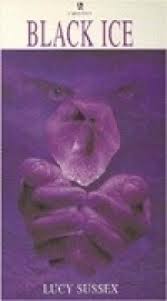 There are two plots entwined here: a ghost story, and a technology story. And they’re packaged with a family drama, just to give the main character another headache.
The ghost story aspect holds up, as one would expect, in that it’s not context-reliant; you could have the same story set in 1850 or 2050. Syb’s new house is always cold, and the new housekeeper Hille starts talking spooky things as soon as she moves in. Hille wears an amethyst and claims to see ghosts, or spirits, all over the place. Syb is dubious, but….
The technology aspect, though – oh, I giggled. This was published in 1997. Syb is really lucky because she has an email address and can dial up the internet with her modem any time she likes. She wins a competition and gets an internet camera. People are able to get hold of each other’s email addresses quite easily, there’s only a few websites to search for on any one topic, and hacking is a breeze. I have no doubt that Sussex was going for close-to-bleeding-edge experience with this story, and going for serious verisimilitude with the intricate details. But all of that means that it really hasn’t travelled well. Which is a shame, because Sussex does write well and engagingly.
The inside cover calls it a Children’s Book; it’s what I would consider the younger end of YA. Syb’s parents are going through a rough patch, and this is dealt with brusquely but (and?) sensibly. It’s a “this is not the end of the world” attitude, but not “this doesn’t matter.” Intriguingly given how many such novels get rid of the parents completely, Sussex does it a bit differently: the mum goes away but stays in contact via email; the dad is always a bit absent in his attitude but is always present and still relevant. Also, the romance interests are just barely present but more usually as an irritant than anything else.
This book was read as part of my read-all-the-books-I-own-but-haven’t-read effort, and conveniently also contributes to the Australian Women Writers challenge for 2014.
Galactic Suburbia
Galactic Suburbia the John Campbell Memorial not a Hugo Episode
In which we do discuss the Hugo shortlists both Retro and Current, but this is not an episode. Not at all. For… administrative reasons. We’re on iTunes or over at Galactic Suburbia.
Brandon Sanderson says interesting things about fandom groups, and the Wheel of Time nomination.
Some gender notes on the Hugo shortlist
Tansy’s Hugo links post
Tansy & John DeNardo of SF Signal discuss the shortlist on Coode Street Podcast
THANK YOU EVERYONE WHO NOMINATED GALACTIC SUBURBIA FOR BEST FANCAST, WE LOVE YOU TOO. WE LOVE YOU SO MUCH WE WOULD GIVE YOU FIVE STARS ON ITUNES.
Galactic Suburbia 98
In which we approach Fringe from multiple sides, rant about Game of Thrones, muse about cake lit and Alisa is a PhD student again! Bonus supplemental awards chat (but not in depth about the Hugos because we recorded before the shortlist went public) and an invitation to CAKE OUT for our 100th. See you there…
You can get us from iTunes or over at the Podbean site. I should warn you that I felt entirely off my game for this ep, but Tansy and Alisa keep the ball rolling very nicely.
Culture Consumed:
Alex: Fringe season 1; A Million Suns, Beth Revis; The Crooked Letter, Sean Williams;
Tansy: Game of Thrones rant, Jenny Colgan novels, Jago & Litefoot 7, Yonderland!
Alisa: Game of Thrones; Generation Cryo; The Cuckoo by Sean Williams, Clarkesworld Issue 91; the PhD Report
Aurealis Awards were awarded.
(sidetracked: Before the Internet from XKCD)
Hugo nomination (!! third time running!!)
CAKE COMPETITION! For our 100th episode, we would like to have a new logo. On a cake. Designed by you. Send a picture of your creation and you could win… something… and you can eat the cake, too. (This is episode 98, so you’ve got 4 or 5 weeks to plan your creation.)
Please send feedback to us at galacticsuburbia@gmail.com, follow us on Twitter at @galacticsuburbs, check out Galactic Suburbia Podcast on Facebook and don’t forget to leave a review on iTunes if you love us!
River of Gods
 One of the central yet peripheral things in many characters’ lives in this remarkable novel is the ‘soapi’ Town and Country. It’s the Indian version of Neighbours, or Eastenders. And in some senses this show – banal and humdrum, focussed on banal and humdrum activities, just like those shows that have enormous and devoted followings today – is emblematic of River of Gods itself. It is neither banal, nor humdrum; but much of it is concerned with surprisingly mundane and domestic issues, which become absorbing and riveting partly because of the skill of the author, partly because of the allure of the exotic: the exotic of the future, and the exotic of a country other than my own.
(Is it wrong to be enchanted by the exotic? And by exotic I simply mean other-than-my-familiar… which is, surely, an inherent part of the appeal of much fantasy and science fiction. Perhaps Other would be a less loaded term than exotic, at that. Hmm.)
River of Gods is set in 2047; the cover proclaims “Happy birthday, India.” Which becomes rather ironic, and somewhat sad, when it turns out that India as it exists in the early 21st century doesn’t exist in McDonald’s vision of its future: it has fractured into several, often rival, states. The political aspect is rarely front and centre in the novel; although it consumes at least one of the characters, McDonald focusses on his larger life, rather than simply making him a political animal.
See how I’m struggling to get on with this review? It’s hard to figure out where to start, what to say. Perhaps I should begin with “I adored this novel,” and attempt to explain why…
I adored this novel. You can stop reading now if you like.
Structure
The novel itself is split into five parts, each of them named for some aspect of Hindu mythology. It’s entirely possible that I have missed some deeper meaning here that relates to the novel’s structure, but I didn’t have much access to the internet while I was reading it so I wasn’t able to chase up meanings. The first part sets up the rest of the novel, introducing all but one of the main characters. Each of them gets their own chapter (in the third person), and the issues set up here continue across the novel with occasional intersections with other characters or their issues. Shiv is a crook, involved in various nefarious deals; Mr Nandha is a Krishna Cop, concerned with the regulation of aeais (AIs). Shaheen Badoor Khan is deep in the political regime of Bharat, Najia an ambitious journalist, and Lisa is a polymath scientist concerned with alternate versions of Earth’s development. Add to that a dropout scientist, a set designer for Town and Country, and a wannabe stand-up comic forced to go home to the family business. Parvati, married to Mr Nandha, is introduced later. Through their individual experiences, the novel tells the story of the world over a couple of weeks in 2047, with India as the focus.
Plot
Family trouble, political intrigue, criminals to chase, and AIs to try and understand. Also an alien artefact.
Each of the characters has a story. For some of them, the novel encompasses crisis and resolution. For others, we’re brought in halfway through, while for yet others we’re made to leave before the resolution. Some of these stories are exactly the sorts of domestic stories that are the fundamentals of soapies today: love and family and betrayal. (Please note I am in no way using ‘domestic’ in a derogatory sense here. Domestic stories are different from, for example, politically-focussed stories: Much Ado about Nothing is domestic, Macbeth – despite some domestic scenes – is not.) Other aspects are more detective story or political thriller. It does need a bit of adjustment to jump between them, but each chapter heading clearly tells you who the focus is, so it’s not that hard.
Language
McDonald uses Indian slang and terms throughout the novel. I didn’t realise until I was a third or so in that there’s a Glossary at the back (it is mentioned in the contents pages, but who reads the contents pages of a novel?), but even then not all of the words are explained. Most of the time the words – especially the slang – are understandable within context; I don’t need the exact translation to understand when someone is using profanity. Now, I have absolutely no idea whether McDonald is using the slang and other terms in appropriate ways. I’m willing to assume that he hasn’t made too many stupid and insensitive mistakes because he’s seemed to do well in the other, non-Western, novels of his that I’ve read – but if I’m completely wrong here I would like to know, so drop me a line if I need to be put right.
I loved the language. It was a little bit like reading a Greg Egan novel; if you’re put off by not being able to understand absolutely everything, this is not the novel for you (and I’m sad for you). And McDonald writes in an utterly captivating manner that meant putting this novel down was occasionally painful.
Characters As mentioned above, the novel focusses on a great range of people (and it passes the Bechdel test, if not spectacularly), which is a fine way to demonstrate the depth of the world-building. I’m not in love with how some of the female characters were portrayed (and some of the sex scenes seemed out of character with the rest of the novel), but other women were presented realistically. The men and women were just as likely to be competent or not, ruthless or not, etc. There’s only one main character who stays at home, with no job, and she’s female – but this makes sense in the context of 2047 India: there’s more men than women (one to five), so those women who want to work have trouble doing so because the men are favoured.
One of the most intriguing characters, both for who yt is and for yts storyline, is Tal. See that “yt”? Tal is a nute, surgically altered to have no genitals and psychologically/mentally altered to change the neurological aspects of yts previous gender. How Tal comes to physically be thus is briefly discussed, but why is not – so private a decision that the reader isn’t invited in. I have no idea how a reader who identifies non-cis would read Tal and those like yt. As an outsider looking in, I thought yt was treated like every other character and while yts nature was absolutely necessary for elements of the plot, it didn’t feel like a MacGuffin. While yt is treated as a freak by some, this is never (I think) portrayed as an acceptable attitude; and yt’s treated as an ordinary co-worker or neighbour by others. Yts other-ness isn’t treated as something added in just to add spice to the narrative, but as a genuine choice that ought to be available to people who so choose to change their own bodies. A minority, and one occasionally feared and derided, but legitimate.
Issues and themes
There are many. The place of women, as mentioned briefly above. The place of AIs – how do you legislate against them, how do you police that, and what are likely to be the ramifications? Climate change is a major factor, looming large in the background, because the monsoon hasn’t come to India in quite a while and this is, of course, disastrous. The development of new technology features. How to exist as a minority, and how to live as a fish out of water.
Overall, this is another great novel by Ian McDonald and I’m looking forward to reading Cyberabad, his set of short stories set in the same universe. You can buy it from Fishpond.
A Million Suns
I loved Across the Universe, the first of Beth Revis’ series about a generation ship. I was really excited about the sequel and bought it ages ago… and have only now read it, as part of my Read the Books I Own but Haven’t Read thing.
Sadly, I was disappointed.
 Spoilers for Across the Universe and A Million Suns.
The story picks up pretty much where the first one left off, again alternating between Amy – awakened before time on a generation ship that’s meant to be racing towards a new planet for colonisation – and Elder, now officially the one who’s in charge of the ship and the one who woke up Amy when he wasn’t meant to (which, the more I think about it, CREEPY. Which gets addressed briefly here but not enough). The book revolves around the issues confronting the population now that they’re off the drug that’s been in the water, keeping them all nicely docile, which also means that they can now realise that they’re being led by a sixteen year old boy (an issue which is only briefly addressed).
The good: I continue to like the exploration of generation ship issues. While I have some problems with how it’s done, it’s nonetheless good to see it done at all. If you’ve grown up in a tin can, it makes sense that at least some people are going to find the idea of not having walls utterly terrifying. It also makes sense that some people are going to resent begin, effectively, just a means to an end – why do stuff for people, and a destination, that you’ll never see? I was glad that Revis addressed some of the issues of resources and the problem of being a closed system, even if not in great detail.
I liked that people started thinking about political change. I can’t decide whether that happened too quickly or not, but it amused me greatly to see the French Revolution being referenced.
There are some pleasing aspects in Amy and Elder’s relationship. I really like the discussion of whether, if you only have one possible choice, falling in love with that person is real. There are too many examples of that just happening, as if OF COURSE I love you because you’re in front of me. Of course, this ignores the fact that people don’t necessarily fall in love with people of their own age – as demonstrated by Victria – which makes Amy’s flailing about do I/don’t I a bit precious. As mentioned above I really liked that Elder’s fascination with frozen Amy was revealed to Amy, even if it was only briefly an issue for her when I think it should have been more significant.
Overall, the writing is smooth; it’s not hard to read.
The bad: look, I don’t think I’ll read the third. That should tell you enough.
Amy and Elder both drove me nuts at different points. Amy whinges a lot, and Elder is alternately arrogant and fearful and it didn’t always make sense in context. Their relationship bugged me, especially towards the end – and I got annoyed because much of the story is about their relationship. When I realised that really, this is a love story that happens to be set in space, I got a bit less annoyed. Because that’s totally fine: it’s not what I was expecting or hoping for, but it’s a perfectly fine choice for Revis to make. Except that the story of their love just didn’t interest me that much – but that’s an issue of story telling rather than story choice.
To move on to the plot – Orion setting clues for Amy so that she finds out the truth about the ship was just ridiculous. It makes no sense for Orion to have done that, since I don’t think it’s suggested anywhere that he was sadistic. One clue, leading Amy to discover a video of Orion explaining the truth about the Godspeed, would have made sense. Or leading her to the space suits so that she could go out and see the truth for herself – that would have been fine too. But this convoluted trail that relied on Amy, a seventeen year old, having read certain stories and paying any attention to the shelving of books… seriously. No.
And the great reveal? I absolutely guessed that the ship was stationery, having already arrived. I think that the idea of people refusing to go down because of wild animals is weak, and the suggestion that people would not have earlier made exactly the decision that’s made at the end of the novel – of splitting the population – is ludicrous. The only thing that kept me reading this was to find out how the generation ship aspect was dealt with; I do not care enough to read about the population trying to make their way on the dirt.

 Randomly Yours, Alex