Galactic Suburbia 106
In which the Galactic Suburbia crew discuss the future and present death of blogs, explore our personal relationships with social media (but mostly Twitter), and stage a memorial ceremony for the death of Livejournal. WE LOVED YOU, LIVEJOURNAL.
You can get us from iTunes or at Galactic Suburbia.
News
Patreon!! Spoilerifics!! Oh my!
Pet Topic
Future redundancy: The death of blogs?
What blogs do you still read? What blogs are the key places to find out about shiny new things?
What Culture Have we Consumed?
Tansy: Intelligence
Alex: Risk: Legacy; Monstrous Regiment, Terry Pratchett; Beacon
Alisa: yes we really are going to make her throw a book away every single time. She… reinterprets the term’s challenge. But the results are worth it.
Please send feedback to us at galacticsuburbia@gmail.com, follow us on Twitter at @galacticsuburbs, check out Galactic Suburbia Podcast on Facebook, support us at Patreon (http://www.patreon.com/galacticsuburbia) and don’t forget to leave a review on iTunes if you love us!
Snapshot: Cat Sparks
 Cat Sparks is fiction editor of Cosmos Magazine and former manager of Agog! Press. She’s won a total of nineteen Aurealis and Ditmar awards for writing, editing and art. Over sixty of her short stories have been published since 2000. She is currently engaged in a PhD examining young adult post-disaster literature. Her collection The Bride Price, was published by Ticonderoga Publications last year. Her first novel, Blue Lotus, is finally nearing completion. @catsparx
The Aussie spec fic snapshot project is starting to take on aspects of Michael Apted’s Up documentary series — you know, the ones profiling a group of British children, revisiting them again every seven years. Snapshot comes around more frequently, but I’m starting to see distinct parallels. The Snapshot is a worthy cultural endeavor but for me, it serves to highlight how little control I have over my own career, creative development and achievements.
1. Your collection The Bride Price took out the Ditmar for Best Collection, and its story “Scarp” took out the Ditmar for Best Short Story, this year – congratulations! What was it like to put this collection together? Did it achieve what you hoped it would?
Ticonderoga’s Russell B Farr approached me three times about doing this collection. Three other publishers had previously expressed interest – in the end Russ wore me down with sheer persistence and the offer of a Canberra Natcon launch. I was worried I wasn’t ready, a pointless concern harking back to a different era. Once, authors only got collected when they’d attained a certain level of achievement. Today’s market is saturated with short story collections. I was happy to win a Ditmar for mine.
2. As well as writing, you’ve been an editor and are a designer, including designing the remarkable cover for The Bride Price. Have these skills worked together for you, or are they sometimes in tension?
The tension resulting is always about time and focus. Serious fiction takes serious slabs of time, commitment and research. The longer you’re at it, the more disassociated activities you end up having to shed. Personally I have never had more time to focus on writing than I have now, yet even writing full time isn’t enough. My output is slow, I am always behind and I never seem to achieve as much as I’d like to.
3. You’re currently working on a PhD, which is very exciting. What are you investigating, and how will this impact on your fiction?
My PhD research question is: How does real world climate change data and anxiety shape and inform post-disaster science fiction for young adults? I’m only halfway through but already my fiction has been permanently affected. I no longer believe in a non-climate changed future and expect fiction to acknowledge the dramatically altering landscape, be it science fiction, cli fi or more common garden varieties.
4. What Australian works have you loved recently?
I’ve bought so many Australian books this year but have barely had time to read them. PhD material sucks up most of my reading time. The last thing I loved to pieces was Max Barry’s Lexicon. I also really dug Andy Macrae’s Trucksong and Lara Morgan’s The Rosie Black Chronicles. I’m currently picking my way through Ben Peek’s Dead Americans, Thoraiya Dyer’s Asymmetry and Kirstyn McDermott’s Caution, Contains Small Parts. Podcast-wise, I remain a steady fan of both The Coode St Podcast and Galactic Suburbia. Artwise, I adored Nick Stathopoulos’s portrait of Robert Hoge currently hanging in Sydney’s Salon Des Refuses, as well as the short film produced by Nick and Ryan Cauchi: It Grows. (disclaimer – I appear in that movie myself, a fact that serves to enhance hilarity as I can’t act to save my life!) Trailer link here.
5. Have recent changes in the publishing industry influenced the way you work? What do you think you will be writing in five years from now?
I have zero interest in self-publishing or becoming a relentless self-promotion machine. I write what I’m interested in writing, study the form, work hard to lift my game. That’s what being an author means to me.
Right now, I’m two weeks off finishing a novel and delivering it to my agent. This novel in various forms and guises has been weighing heavily on my shoulders for a very long time. If I’m still working on the same book five years from now, do me a favour, please take me out and shoot me.
This interview was conducted as part of the 2014 Snapshot of Australian Speculative Fiction. We’ll be blogging interviews from 28 July to 10 August and archiving them at SF Signal. You can read interviews at:
Snapshot: Alisa Krasnostein
Alisa Krasnostein is editor and publisher at Australian specialty press Twelfth Planet Press, a creative publishing PhD student and recently retired environmental engineer. In 2011, she won the World Fantasy Award for her work at Twelfth Planet Press. She was the executive editor and founder of the review website Aussie Specfic in Focus! from 2004 to 2012. In her spare time she is a critic, reader, reviewer, podcaster, environmentalist, knitter, quilter and puppy lover. And new mum.
1. You’re just about to launch the anthology Kaleidoscope, which you’ve coedited with Julia Rios and funded via crowdfunding. How has the experience of creating this anthology been different from previous ones you’ve done? And has it lived up to your hopes of being a political and diverse set of stories?
With every project I’m always evolving and learning. For a long time I’ve wanted to be able to pay pro rates so with the advent of crowdfunding platforms, I was able to explore that business model for this project (SFWA raised the pro rates after we ran our campaign which was bad timing!). Crowdfunding is a fascinating and time consuming business model and we learned a lot about the maths behind them and also the amount of marketing and promotion required. It definitely helped keep my mind off my delivery date of my baby!
Kaleidoscope has definitely lived up to my hopes of a political and diverse set of stories. I felt a lot of pressure to do that – when you are given the money up front. The editing process was also a fascinating one. It challenged a lot of my own ideas about creating a good book and in the way I acquire stories. It’s markedly changed the way I approach and read fiction. I’m still processing a lot of my thoughts about it. Which is lucky because that gives me food for the thesis! Kaleidoscope is filled with a really diverse array of stories and protagonists – straight, queer, of colour, disabled – we hope there is a story in there for every reader to identify with.
2. Another project that you’re still working on, which is now well on its way to finishing, is the Twelve Planets series wherein you decided to publish collections of short stories by Australian women. I know originally the plan was to publish these over a year, or a bit more, which I’m sure in hindsight seems crazy! What impact has the process of developing the Twelve Planets had on you as an editor and publisher, and has it met your expectations?
In hindsight, I’m not sure it was every feasible to publish the Twelve Planets across a year – it’s actually a very tall order to ask writers to produce 4 outstanding stories on so tight a turnaround! Most authors ended up submitting more than that before we got to their final collection of 4. I think I’ve grown a lot as an editor through these collections – both in terms of my editing ability and in the mechanics of how collections work. At times, choosing to do shorter collections was really challenging because you can’t get away with things that maybe you might in a longer collection – you can’t hide a bad story amongst three others. Which I guess has made me much less compromising as an editor – if I wouldn’t buy a story for a collection where I can’t hide it, why should I buy it ever?
As a publisher, the Twelve Planets taught me a lot about branding and the effectiveness of a series for promotion and marketing.
The Twelve Planets was conceived back in 2009 as a response to the lack of female authors on awards shortlists. I’m very proud of the work that’s been published in this series. I think it shows the outstanding quality of short stories being written by Australian female writers. The series has more than met my expectations and I can’t wait to see the full project sitting on my bookshelf!
3. You always seem to have a lot of projects on the go, and more bubbling to the surface all the time. Do you imagine that the next five years will see Twelfth Planet Press branching out into other areas, or strengthening the areas you already do well?
Publishing tends to work on a three to five year timeframe. The more books I publish, the more I am understanding that it really does take 2 to 3 years for a book to properly come to fruition, especially if you’re working on developing projects rather than just buying out of an open submissions process. That’s a long way around saying I have a lot of the next 3 years’ projects already in progress. And if I could source funding, a few more beyond that! I think the next 5 years will see us strengthening areas like novels, our crime line and young adult fiction. But yes, I have a view to branch out further. 🙂
4. What Australian works have you loved recently?
I’m currently enthralled by Sean Williams’ Twinmaker – I kind of want to read his PhD thesis after I finish with all his fiction related to matter transmitters. Twinmaker is a fast paced YA thriller and I can’t put it down.
5. Have recent changes in the publishing industry influenced the way you work? What do you think you will be publishing in five years from now?
Yes. How can they not? Adapt or die. I have absolutely no idea what the industry will look like in 5 years time. I know we’ll do our best to try and ride the wave but I suspect that what will be *it* in 5 years hasn’t even really begun to be a thing yet. Recent changes have had us learning how to make good quality, flexible ebooks and to do our best to bring release all formats in tandem. We’re now looking at keeping up with the ever expanding distribution channels for ebooks and wondering about the longterm viability of print book distribution. Bookstores keep closing even though readers still buy print books.
Snapshot: Max Barry
Max Barry is the author of five novels, including “Lexicon,” the New York Times Notable Book “Jennifer Government” and “Syrup,” now a film starring Amber Heard. He is also the creator of the online political simulation game “NationStates.” He lives in Melbourne with his wife and two daughters.
1. Your novel Lexicon won the Aurealis Award for Best SF Novel this year – congratulations! The novel’s plot revolves around the power of words, which isn’t in theory a new concept but you take it in a really remarkable direction. Did the plot and the SF aspect emerge separately or together? And were you pleased with the result?
Thank you! I was very happy with how that book came out. The SF angle… I never think of my stories as science fiction or anything else until my agent or publisher starts talking about how to sell them. I have three or four novels now that could be correctly classified as science-fiction, in the sense that they deal with ideas and a slightly modified world, but to me they’re just stories. They’re about people in a particular situation. The characters don’t think they’re in a science fiction book so I don’t either.
2. An earlier novel, Machine Man, was adapted from an online serial that you started in March 2009 and continued for nine months. What was it like to have the deadline of completing a page a day? And was the process of turning it into a novel easier or harder than writing one from scratch?
The serial was a brave experiment in writing with people looking over my shoulder. It was amazing to have that immediate feedback, posting a little page and seeing people react to it and comment the same day, so different to novel-writing, where I find out whether anyone likes what I’m writing two years later. It was terrifying, and raw and rough because I couldn’t take my time to build the story. It was just: Go!
Turning it into a novel was challenging because the serial was in bite-sized pieces, which doesn’t really work for a reader who wants to sit down for an hour and be immersed. I had to retell the whole story for the new medium. But I had a big first draft that I wrote quickly because I had to, so that was helpful. It made for a different kind of book, in the end; I think I mostly hid its roots but they’re still there.
3. On your blog you note that you’re working on “too many books.” Do you tend to work on more than one project at a time? Are the ideas all pushing impatiently to get out?
It’s easy to lose perspective on a story when you work on it every day for months. You forget how to see the book through the eyes of a reader. So it’s valuable to take a break, go do something else, and come back a few days or even weeks later. When I do that, I see its strengths and weaknesses far more clearly.
But the drawback is, yeah, too many books. I get immersed in the thing that’s meant to be a temporary distraction and suddenly a month has gone by.
4. What Australian works have you loved recently?
“Splitsville” by Sean Condon. I had always really enjoyed Sean’s books but recently I got to hear him read some of one and it elevated the whole thing to a new level. Because Sean is not some writer sitting back cleverly constructing bitter, intricate, insane, gallows-humor fiction; he is actually intricate and bitter and insane. So it’s even funnier. You have to read his books slowly, and normally I hate that, writers being tricky with sentence structure, because I just want the story, but Sean is so hilarious he breaks the rule.
5. Have recent changes in the publishing industry influenced the way you work? What do you think you will be writing in five years from now?
The industry is undergoing change, for sure, but I don’t feel affected that much. It makes a difference to the finances and mechanics of how I publish books but in the end almost all of what I do that matters is between me and the reader. How I get words to them, exactly, is not that big a deal. Not compared to how important it is to make sure they’re the right words.
This interview was conducted as part of the 2014 Snapshot of Australian Speculative Fiction. We’ll be blogging interviews from 28 July to 10 August and archiving them at SF Signal. You can read interviews at:
The Sapphire Rose
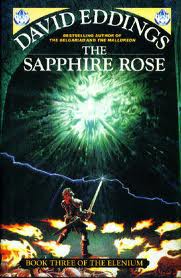 EDDINGS RE-READ: The Sapphire Rose, BOOK THREE OF THE ELENIUM
Because we just don’t have enough to do, Alex, Joanne and I have decided to re-read The Elenium and The Tamuli trilogies by David (and Leigh) Eddings, and – partly to justify that, partly because it’s fun to compare notes – we’re blogging a conversation about each book. We respond to each other in the post itself, but you can find Tehani’s post over here and Jo’s post here if you’d like to read the conversation going on in the comments. Also, there are spoilers!
ALEX:
Almost the very first page of this book has an Author’s Note, which says that the wife wants to write the dedication. And “since she’s responsible for much of the work,” he’s going to let her. Why don’t you just acknowledge the co-authorship, DUDE?
JO:
I don’t see the ‘David Eddings’ on the covers any more. In my mind, it’s ‘David and Leigh’ 🙂
TEHANI:
Of course, when I first read these I had no idea, but since finding out, it’s been an annoyance every time I picked up one of the books.
Also, I think this is the first of the books where we see a really intrusive breaking of the fourth wall by the author/s? For example:
The appearance of the detachment at the gate was, in Preceptor – ah, shall we say instead Patriarch – Darellon’s words, disgraceful. (p. 155 of my version).
ALEX:
The descriptions of Ehlana, who gets cured of the poison in this book, are beyond horrid. There’s “overpowering femininity,” and women being “notoriously adept” at recognising things like a ring being an engagement ring (did I miss that seminar? How DO you tell that a ring is an engagement ring? How do I know whether I’ve been stooged?). Ehlana is unbearable smug about “netting” Sparhawk. I will admit that the point about wavering between wanting to flaunt her “womanly attributes” and wanting to hide them is fair – and even perceptive – but it’s surrounded by so much URGH. And I’d like to say that I, for one, am glad that Sparhawk tried to get out of their marriage. I know that 17 years’ difference doesn’t HAVE to be a barrier, but there is SUCH a difference between the two of them.
TEHANI:
By the end of this book, I was starting to get an uncomfortable feeling about the number of very young girls who become obsessed with older men. And Aphrael’s manipulation with kisses is most disturbing!
JO:
Oh yes that’s definitely a thing in these books.
ALEX:
urgh.
JO:
And we meet Mirtai! Isn’t she an interesting character? Super-strong, super-warrior who is quite happy to be a slave. In fact, she insists on it.
TEHANI:
Mirtai is such a contradiction! Not always deliberately on the author’s part, I think… This bit really got up my nose on this reread though:
Mirtai’s skin had a peculiarly exotic bronze tinge to it, and her braided hair was glossy black. In a woman of normal size, her features would have been considered beautiful, and her dark eyes, slightly upturned at the corners, ravishing. Mirtai, however, was not of normal size. (p. 324 of my version)
SO. MUCH. WRONG. To begin, what the heck is “normal size”? And the “exotic” bronze tinge of skin and “slightly upturned eyes”? ARGH!
JO:
I should probably leave this discussion for Domes of Fire, because there’s not much Mirtai in The Sapphire Rose.
ALEX:
Jo – indeed – but yes, that exoticising is repellant. And the whole ‘normal size’ thing makes me cross-eyed.
In the last book there was the issue of being ‘misshapen’. I couldn’t help but notice that in this one, when the Pandions are being domineering of the Elenian council, there’s the pederast Baron and Lenda and “the fat man”. Does the fat man ever get named? Fat isn’t entirely an evil thing like deformity is, in these books – Platime is fat but approaches genius-ness on the council, Patriarch Emban is very clever, and both of them are good – but it’s still always mentioned. There’s barely a reference to Emban without mention of his belly. And he uses that sometimes – to defuse tension, for instance – but I’m still not entirely comfortable with it.
TEHANI:
That’s interesting though, because both Platime and Emban are important, good characters – not presented as useless or bad people, and so I guess I read that as subverting the trope? Although there is Otha…
JO:
Even though Platime and Emban are good and important characters, their ‘fatness’ is mentioned a lot. Like it’s a personality trait.
TEHANI:
Very true.
ALEX:
Speaking of the council, I would like to declare my sympathy for Lycheas. He’s a dimwit and a pawn, but surely he deserves sympathy.
TEHANI:
Oh, I disagree! He’s not very bright and he’s been led astray I accept, but I think he knew he was doing wrong, and there were times he could have chosen another path. He was as hungry for power as the rest of them!
ALEX:
Hmm. Perhaps. How much choice did he have with a mother like that probably poisoning him from the start? (If we accept the premise of the story.) … oh wait, does that shoot my theory down, at least somewhat, given that is probably exactly the reason why he’s hungry for power? Dang.
JO:
I think the Eddings set him up to be disliked, and he simply has no say in the matter. He’s always portrayed as snivelling and pathetic and stupid. He may or may not be hungry for power, it doesn’t matter. He’s there to be a lesser baddy that everyone can look down on and routinely threaten to kill.
ALEX:
You’re saying he’s just a narrative device? SAY IT AINT SO.
A rather chilling part of this novel is the utter lack of regard for the civilians in Chyrellos, during the siege. It was really quite unpleasant reading.
JO:
I find the siege so boring I have to say that never really bothered me. The scene that does stick in my mind is when Sparhawk and an unnamed soldier witness a woman dragged into an alley and quite obviously raped (though thankfully off camera). The soldier, crying because she ‘could have been his sister’ shoots the rapist. But then the woman staggers out of the alley, sees her not-quite-dead rapist, takes his dagger and violently finishes the job and steals his loot. The soldier ‘retches’ and Sparhawk says “Nobody’s very civilised in those circumstances”.
This scene was always a WTF moment for me. When you consider Sparhawk’s career, what about her actions make them ‘uncivilised’, exactly? He does much worse things to people and is rewarded for them! Is it because she’s a woman? Or because she’s not a Church Knight and it’s okay when they do it. Or because she took the loot? I mean, seriously…?
ALEX:
Yes!! This!! I was so ANGRY at that reaction from the men – who are safe on so many levels from this sort of thing – getting all uppity about her taking revenge. I don’t like her doing it either, but I don’t like the initial rape even more.
I cried at Kurik’s funeral. Not at his death – that all happened too fast, I think – but when I got to the funeral…well, I was glad to be by myself. However, I am still suspicious of the idea of Aslade being quite so accommodating of Elys.
JO:
Kurik *sniff* 😦
TEHANI:
And you know, none of that business really makes sense. Kurik is portrayed as steadfast, loyal, moral and really quite upright (even uptight?), so the fact he cheated on Aslade (and their four sons, essentially) is, well, just a bit weird. It was a useful way to have Talen important to the group, I guess, but the character path is very odd.
ALEX:
YES. Also it makes adultery completely fine, which… I know there are other ways of doing relationships than ‘conventional’ monogamy, etc etc, but not within THIS world’s framework – everyone else who does that is regarded severely. Whereas Sparhawk etc are all, “dude, no worries! Everyone sleeps around sometime, the wimmens is so attractive we can’t help it!”
JO:
YES from me too. Never felt right to me for exactly those reasons.
TEHANI:
I do like the way the Kurik’s sons talk about their “mothers” in the later books though. That said, remembering I read the Tamuli trilogy first, I was quite certain Aslade and Elys had been both married to Kurik, the way they are referred to there!
JO:
Heh yes. I can imagine. Although I was always proud of Aslade and Elys for being able to put aside their potential conflict and just get on with life. So often the relationships between women are portrayed as bitchy, jealous, spiteful things. And usually its over the attention of a man. So I appreciate that they went down the opposite path.
Actually, in the Tamuli there are a lot more examples of strong female friendship too.
TEHANI:
Some more perpetuation of stereotypes here, too. In this case, the temper of the red-head:
In Delada’s case all the cliches about red-haired people seemed to apply. (p. 282 of my version).
JO:
Yeah I thought they got a little carried away with that!
TEHANI:
And what the heck is this bit of elitism? Stragen says, Whores and thieves aren’t really very stimulating companions… (p. 410 of my version). Um, well Talen and Platime AND HIMSELF are thieves and all presented as quite stimulating! The whores get a poorer presentation, but still!
ALEX:
That bit also made me very cranky. Again with the superior attitude.
TEHANI:
And this awful bit of Ehlana characterisation:
“Would you all mind too terribly much?” Ehlana asked them in a little-girl sort of voice.
YUCK! The woman is a queen, and fully in command of herself and the power she wields, yet she resorts to that (for no reason, anyway!)?! No! We talked a bit about this in one of the earlier reviews, how the women themselves are supposed to be powerful, and there are quite a lot of them, which is nice, but the actual presentation of them really undermines this at times.
JO:
Yes! This is what’s been irritating me the whole time, and it only gets worse as the series goes on. Doesn’t matter how strong a woman is, she still resorts to hissy fits and theatrics or childishness to either get what she wants, or basically keep control of the ‘relationship’. Even Sephrenia does it in the later books! It just feels to me like the books believe that deep down, women are irrational children. OR that they will resort to acting like them as a way of keeping their men in line.
JO:
Am I the only one who finds Ehlana’s speech to the council a little…difficult to believe. All these supposedly hardened politicians/Patriarchs completely suckered in by her ‘divinely inspired’ speech? Just because she’s pretty, or something? And because she ‘fainted’?
TEHANI:
I have such a different view of the Patriarchs to you! I always read ANY of those political gatherings as being a bunch of little boys just grabbing for power, none of the “hardened” politicians at all! In fact, Eddings seems to have very little respect for political systems at all. They’re all corrupt or useless!
ALEX:
I don’t think they’re MEANT to look like that, but they sometimes do – and it’s another thing that annoys me about the Eddings portrayal of religion, because it’s JUST another instance of politics and again there’s so much uselessness and cunning and unpleasantness. Also, Ehlana manipulates them, and I think it manages to make her look silly – conniving and dangerous with the using feminine things in dangerous ways – AND it makes the Patriarchs look silly for falling for such obvious, feminine strategies. Way to go for insulting two groups there!
JO:
Last time I said that I found The Ruby Knight a lot faster-paced and more enjoyable than I remembered. I have to say the opposite for The Sapphire Rose. Oh god I was so sick of the siege by the time it ended, and it seemed to take forever to get to Zemoch. It felt like so much padding. Just destroy Azash already!
TEHANI:
Some excellent examples of Faran the human horse again:
Faran made a special point of grinding his steel-shod hooves into a number of very sensitive places on the officer’s body.
“Feel better now?” Sparhawk asked his horse.
Faran nickered wickedly. (p. 155 my version)
JO:
I could summarise the plot again but you probably don’t want me to do that this time!
They cure Ehlana. She’s all grown up now and in love with Sparhawk. They ‘accidently’ get engaged. Off to Chyrellos to stop Annias being elected Archprelate. There’s a siege which goes on forever. Then Wargun and Ehlana turn up and the siege is over. Ehlana and Sparhawk get married. They go to Zemoch with Bhelloim to kill Azash. It takes forever. They get to Zemoch. Kurik dies. Martel dies. Otha and Annias die. Azash dies. Lycheas dies. Arissa kills herself. They return to Cimmura. Everything’s peaceful, but kinda crappy, because the gods are shell-shocked by Azash’s death. Danae happens. Eventually, Aphrael and everyone go on holidays and spring returns.
ALEX:
Nice work there, Jo. I would add: Sparhawk and Ehlana get married in the same way that a person might buy a horse; Martel dies but everyone’s real sad, because actually he was decent and just led astray, y’know? And “Danae happens” means that a goddess is incarnate in a different racial family and that’s really kinda cool.
JO:
Heh, that’s awesome.
TEHANI:
Well, we’ve picked a lot of nits in the Elenium books, but final verdict on the first three? For me, I have to admit I still thoroughly enjoyed reading them, with grins and tears throughout, and the comfy blanket feeling of an old favourite that still (mostly) holds up. Although there were definitely a lot more grimaces at the rough patches than when I was younger!
ALEX:
I think I feel basically the same as you, Tehani. It really is a warm comfy blanket… with moth holes and a few scratchy bits… but a lot of love and memories holding it together.
JO:
Couldn’t agree more! I might snipe at them, but I still love these books and rereading them has been thoroughly comforting. It also reminds me what I love about reading and writing in the first place. It’s just so much fun!
Snapshot: Nike Sulway
Nike Sulway is an author and academic. She is the author of several novels, including Rupetta, which—in 2014—was the first work by an Australian writer to win the James Tiptree, Jr Award. The award, founded in 1991 by Pat Murphy and Karen Joy Fowler, is an annual award for a work of “science fiction or fantasy that expands or explores our understanding of gender”. She teaches creative writing at the University of Southern Queensland, loves rabbits, chocolate and children. Not all for eating or cuddling.
1. Your novel Rupetta won the Tiptree Award and the Norma K Hemming Award this year – congratulations! It’s a grand novel about love and family and history and automatons – do you feel that it accomplished all that you hoped?
I’m very pleased and grateful to have received both of these awards. Among other things, they have helped the book to find more readers – or perhaps that should be the other way around (it has helped readers find the book!).
As a writer, I’m incredibly ambitious. Perhaps all writers are. Not in a worldly sense, but in terms of what I want to achieve in the works themselves. For me, every work exists in an ideal state … before I start writing. Writing is, in one sense, the process of dismantling the Ideal/dream version of the book, and instead creating its shadowy reflection. A kind of fall from the Platonic Ideal to the Shade. So, in that sense, nothing I’ve ever written is a perfect realisation of all the dreams I dreamed for that work. I can’t remember which writer said that that’s why you write the next thing: because you still have work to do, ambitions to realise.
I’m very proud of some of the things I achieved in Rupetta. I’m pleased with small things. I love little Perihan; I love the relationships between Henri and Miri, and between the Salt Lane Witches. I’m proud of the fact that love is central to this book about war and ambition; that the daily experiences of women are at the centre of the story. Its strong, strange, complex spine.
But, there’s always more work to do.
2. You’ve written books for children as well as for adults… which do you think is harder? And do you start with an audience in mind, or a story?
I think writing both for children, and for older readers, are incredibly complex and difficult tasks. I think in writing for children, you have to work hard not to be condescending or overly romantic about children, and childhood. Not to diminish your sense of who your readers are, or your characters. I have this little bit of something I wrote on my blog called ‘How to write a story for a child’ which begins: First, consider the child. That’s not as easy as it sounds! I think of writing as being about a particularly unusual and strangely intimate relationship between writer and reader. You have to be willing to encounter the other person as themselves, warts and all. I think building emotionally (and narratively) rewarding relationships is hard work! No matter who that relationship is with.
I start with … hmm … I start with an image, usually, and the image most often includes a character. With Rupetta, this was an image of a half-broken, half-repaired neglected piece of clockwork slowly decaying in a country barn. I’m trying to remember which comes first, but I think – for me – the two (readership and story) arrive together. Entwined.
3. Not all of your work has been speculative fiction. Do you anticipate writing more speculative fiction, or does the story idea dictate the genre?
When I sit down to write, I don’t really think of myself as working in a particular genre. Not exclusively, at least. I enjoy reading and writing speculative fiction; I enjoy reading and writing contemporary realist fiction, and picture books, and non-fiction. And the things I’m working on slide across all those boundaries, especially while I’m working on them.
I’m working on a trilogy at the moment, the first book of which is called The Orphan King. I’ve done a picture book version – no words – and a graphic novel version, and a textual version that draws a little on my reading of Henry James Turn of the Screw, in that whether you read it as speculative or realist depends on … well, depends on you. The text itself (the writer herself?) hasn’t yet decided. The final version will be a novel; if I think of it as belonging in a genre at all, I would like to think it is in the same little sub-genre/cross-genre field that Gary Wolfe uses to describe Karen Joy Fowler’s work. He said her stories are “trapdoor genre stories”; stories which they can be read as non-genre until that one moment when you realise this isn’t quite what it seems.
4. What Australian works have you loved recently?
I absolutely adore Lisa Jacobson’s The Sunlit Zone, which is a verse narrative set in a dystopian future. It is astonishingly beautiful, and moving, and strange.
Marie Williams’ memoir Green Vanilla Tea will never leave me. I was lucky enough to work with Marie on this book about her family, and particularly about what happened to her family when her young husband is diagnosed with a terminal illness, and dementia.
Finally, Melissa Lucashenko’s Mullumbimby is a work of grace, courage and humour by an Australian writer we should all be reading more often. If only she would write more!
5. Have recent changes in the publishing industry influenced the way you work? What do you think you will be writing in five years from now?
As a writer, I have a rather ambivalent relationship to the writing and publishing industry. I know a little bit about it, and I try to stay aware of what’s going on, but at the same time I don’t want to let the market unduly influence what I write. At least, not in a negative, limiting way. Plus, I think of ‘The Writing Industry’ as being a bit like the many-headed hydra, or at least of myself as being like one of the blind people who are asked to describe an elephant: what I think it is depends on which bits and pieces I get hold off on any particular day.
So, I’m not going to write a sparkly vampire erotic fan fiction in which lead characters are killed off at unexpected moments just because those are some aspects of some popular books right now.
I’m not going to lead the charge into hypertextual/hybrid forms of narrative, because I’m a writer, not a multi-platform artist. Though I would embrace working collaboratively with other artists/craftspeople across a range of mediums.
I can’t see myself pioneering a radical new form of storytelling cos, really, I like the old form. Words, in sentences, one after another, that somehow perform this magic trick of transforming into people, places, experiences and emotions.
I’m also, in the end, a bit of a romantic; I think stories and storytelling will endure, though perhaps the medium through which stories reach readers will change beyond recognition.
Five years from now, I’ll still be snuggled up in a comfy chair with a book of some kind, lost in some other world, with some people who never existed, and when I get up to make tea, I’ll stare out the window at the leaves all over my unraked lawn and wonder what on earth I’m going to write about next.
This interview was conducted as part of the 2014 Snapshot of Australian Speculative Fiction. We’ll be blogging interviews from 28 July to 10 August and archiving them at SF Signal. You can read interviews at:
Snapshot: Kirstyn McDermott
Kirstyn McDermott has been working in the darker alleyways of speculative fiction for much of her career, with many critically acclaimed and award-winning short stories under her authorial belt. Her two novels, Madigan Mine (Picador, 2010) and Perfections (Xoum, 2012) both won the Aurealis Award for Best Horror Novel in their respective years, and a collection of short fiction, Caution: Contains Small Parts was published by Twelfth Planet Press in 2013. Both her novels are to be reissued by Twelfth Planet Press in 2014 – Perfections for the first time in print. When not wearing her writing hat, she produces and co-hosts a bimonthly literary discussion podcast, The Writer and the Critic, which generally keeps her out of trouble. After many years based in Melbourne, Kirstyn now lives in Ballarat with her husband and fellow scribbler, Jason Nahrung.
1. Congratulations on “The Home for Broken Dolls” picking up a Ditmar this year! You said at the time that it was a horrible story and seemed surprised that it won the award… how hard a story was it to write?
Thank you very much, I was so pleased with the Ditmar! Emotionally and psychologically, “The Home for Broken Dolls” was the hardest story I’ve ever written due to the nature of the research involved, and the need to stay intimately connected to all of that, to remain open and not inured to it, during the year or more I was working on the piece. Technically, it was difficult as well. The tone of the novella very much reflected the protagonist, Jane, so the writing itself needed to be calm and controlled and, to some extent, distant, almost clinical in its observations and descriptions. It was a departure in style for me from a lot of the work I’d done in the past, a commitment to a type of minimalism that was quite confronting. When you’re writing such sparse, deliberate prose, there really is nowhere to hide, artistically speaking. I actually learned a lot about myself as writer from working on “Dolls”, although, for various reasons, I didn’t actually compose another word of fiction for more than a year afterwards.
2. Twelfth Planet Press recently picked up and published Perfections, which is really exciting. What’s it like to have a book given a second outing?
Exciting is definitely the word – and it’s such a relief to see it published again, especially in print. The amount of people who asked about the availability of a paperback when it was only a digital release was heartbreaking. I’m exceedingly grateful to Alisa from Twelfth Planet Press for picking Perfections up, dusting her off, and sending her out into the world with a swank new party dress! It’s a novel I’m very proud to have written, even if it did steadfastly refuse to be the novel I thought I wanted to write for much of its creation. It’s funny, but when I was proofing the manuscript for re-publication, I started to see some precursor themes and ideas – and even stylistic notes – that would later become core elements in “The Home for Broken Dolls”. I guess my own personal obsessions and concerns are never really far from the surface . . .
3. What are you working on at the moment? Do you have lots of stories waiting impatiently to be told, or do they form an orderly queue?
I’ve started a PhD this year, so my creative work for the near future will be in that arena. I’m writing a suite of short fiction that I think of as post-fairy-tales – the stories of what happens after the fairy tale ends, when the fairy tale girls become women. And because I’m also doing oodles of research on fairy tales, I actually do have a whole bunch of stories percolating in my mind right now, some more ready to be told than others. There’s no queue as such – I only ever really work on one story at a time, so whichever one is speaking the loudest once the current work in progress is finished will get my attention. I’ve spoken in the past of how I see my creative process as akin to walking around a junkyard, finding interesting bits and pieces and putting them in my pocket for later. After a while, sometimes after many years, I’ll stumble across a piece that fits with two or three others I have and – voila! – there’s a story to be written. It’s still the same process now, I suppose, only I’m exploring a much larger junkyard at the moment, my searching is a little more targeted and I’m finding a whole lot more interesting bits and pieces!
4. What Australian works have you loved recently?
I’ve been catching up on story collections over the past year and have been so damned impressed by the wealth of talent we have here in terms of short fiction writers. The Bride Price by Cat Sparks, The Bone Chime Song and Other Stories by Joanne Anderton, The Year of Ancient Ghosts by Kim Wilkins, and Asymmetry by Thoraiya Dyer are all absolutely sterling books, imaginative and intelligent and exactly the kind of eclectic speculative fiction that I adore. Very recently, I read Dead Americans by Ben Peek, a collection I had been looking forward to for ages and which was well worth the wait – I’m even more keen to get my hands on his upcoming novel, The Godless, now.
5. Have recent changes in the publishing industry influenced the way you work? What do you think you will be writing in five years from now?
I can’t say that any recent changes in publishing have affected how I work to any significant extent. I realised quite a few years ago that I’m not a highly commercial writer and – barring some miraculous confluence of events – the kind of writing that I do, the kind of writing that I am interested in doing, will never really be highly commercial. So I’m never going to have a writing career that will pay a mortgage but, on the other hand, I’m never going to have to rely on a writing career to pay a mortgage. Swings and roundabouts. I do find the recent developments in crowdfunding and regular patronage models fascinating, though, and I love the idea that this is where the former “midlist” might find a home, with a direct connection to a readership. That would be a model I might be tempted to consider in the future, if I had the right project for it.
As to what I see myself writing in five years from now, I haven’t really thought about it. Barring incident, I’ll be finished my story suite and PhD by then so who knows? There is a quasi-SF novel that’s been loitering about in the junkyard for a while now and I might have found enough pieces to start putting it together by then. Or the Dolls might have finally convinced me to write their novel, or else I might have stumbled across some other compelling idea that I can’t put down. Five years is such a long time. As long as I’m still writing, and developing as a writer, I’ll be happy.
This interview was conducted as part of the 2014 Snapshot of Australian Speculative Fiction. We’ll be blogging interviews from 28 July to 10 August and archiving them at SF Signal. You can read interviews at:
Snapshot: Bruce Gillespie
Born 1947. First eleven years spent in the south-eastern suburb of Oakleigh, along with my Mum and Dad and two sisters, both younger than me. Various house moves took us to Melton (which then had 500 people) and Bacchus Marsh, even while I was gaining my BA and Diploma of Education at Melbourne University (1965–68). At the end of 1967 I met quite a few of the best-known SF fans in Melbourne, and joined fandom in 1968. I attempted to teach in Ararat (1969–70), before gaining a position in the Publications Branch of the Education Department (1971–3). After travelling overseas for five months (September 1973–January 1974), I decided to try a life of freelance editing, which I’ve been doing ever since. I met Elaine Cochrane in 1974, but we did not get together until 1978, and married in March 1979, about the time we moved into a house in Collingwood, along with five cats. We moved to Greensborough, a northwestern suburb, in 2005. We still have four cats.
1. You’ve been publishing SF Commentary since 1969, according to the all-knowing Wikipedia, and it’s been nominated for a Hugo Award three times. You’ve also published other fanzines over the years. What is it about publishing fanzines that you love?
In 1961, when I was in Form 3 (Year 9) at Oakleigh High School, my friend Ron Sheldon and I published 26 issues of 6-page duplicated magazine and sold it to fellow students. I did not know the term ‘fanzine’ then, but read about fanzines later in a column by Lin Carter in If. That’s what I wanted to do — publish a magazine in which I could write about anything I wanted and could send it to anybody in the world I chose. In 1966, I bought my first fanzine from the front counter of McGill’s Newsagency (run by Merv Binns, the organiser of the Melbourne SF Club, which was situated in a lane behind McGill’s). It was Australian Science Fiction Review, edited by John Bangsund. At last! In-depth articles about science fiction, plus literate humour from Bangsund and his correspondents. However, I did not write to John until I had finished my degree. I enclosed two articles I had written about the novels of Philip K. Dick. John asked me to visit him in Ferntree Gully. On that weekend in December 1967 I met many of the people who have remained important in my life, such as John Bangsund, Lee Harding, John Foyster, George Turner, Damien Broderick, Tony Thomas and Rob Gerrand.
I desperately wanted to begin publishing, but had no real income until I started teaching at the beginning of 1969. I typed, and John, Lee and Leigh Edmonds actually produced and posted the first issue of SF Commentary early that year. Although that first issue was one of the worst-looking fanzines of all time, it elicited an enormous letter response, including a letter from Philip Dick, my favourite author. I managed to buy a duplicator, produced 18 issues of SFC in two years, and in 1972 I gained my first Ditmar Award and Hugo nomination. SF Commentary itself has lapsed in production from time to time, but I have also produced such magazines as The Metaphysical Review (dealing with all my interests other than SF, and now replaced by Treasure), Steam Engine Time (co-edited with overseas friends, featuring longer articles about SF and fantasy), and *brg* for ANZAPA (Australian and New Zealand Amateur Publishing Association [of which he’s been the official editor for ten years – ed]) and its online version Scratch Pad.
To answer your original question: the main pleasure of publishing fanzines has been the pleasure of making something oneself, and receiving a huge amount of warm response, including letters of comment, magazines exchanged with mine, and articles and artwork. In later years, people began giving me prizes as well, including making me Fan Guest of Honour at Aussiecon 3 (1999) and giving me a trip to the west coast of USA (the Bring Bruce Bayside Fund in 2005). But even these awards are not as rewarding as the actual act of publication.
2. One of the fascinating things about your fanzines is the letters columns, wherein people appear to be having conversations that have lasted over many issues — and therefore, sometimes, over years. Have you made friends via letter columns? What is it about that venue that works for people?
I had very little self-confidence when I was a young man, and not much now. But my life was transformed when John Bangsund enjoyed the articles and reviews I sent him, and then many people responded by mail to the first issues of SF Commentary. At my first SF convention, Easter 1968, few people wanted to talk to me. At my second convention, Easter 1969, after SFC 1 had appeared, I was greeted at the door. I seemed to become a different person in print, somebody people wanted to meet. In turn, I could introduce my readers to each other. The conversation, a sort of slow-motion, in-depth version of the Internet, keeps going.
3. Do you anticipate keeping on with SF Commentary, and Treasure, into the future? Are there still things that you want to say?
The problems of producing SFC have always been practical. When I had the time to produce an issue, I did not have the money to print and post it, and when I had the money I did not have the time. These days the main brake on the print version of SF Commentary is Australia Post. Most of my most enthusiastic readers live overseas, but airmail postage has shot up greatly over recent years. To compensate, Bill Burns in America offers the website efanzines.com, where he will post issues of fanzines in PDF format for anybody to access. This has proved a lifesaver to me and many other fanzine editors who no longer have the income to print and post their zines. Until Australia Post makes it quite impossible to send out print copies and/or Bill Burns has to give up his website, I will keep going. Producing fanzines is what I do.
4. What Australian works have you loved recently?
There are not many Australian fanzines still being published. One of the best, Ethel the Aardvark, can only be read by members of the Melbourne SF Club. However, I can point to Chris Nelson’s Mumblings from Munchkinland (available both as a print and PDF version) as being the ideal small fanzine that covers a lot of ground, especially the history of fannish activity in Australia. Bill Wright is still publishing his Interstellar Ramjet Scoop on efanzines.com, and Van Ikin told me at Continuum that he has four issues of Science Fiction nearly finished.
The Australian fiction scene has expanded in the last 20 years, from a time between 1975 and 1985 when Cory & Collins (Paul Collins and Rowena Cory) and Norstrilia Press (Carey Handfield, Rob Gerrand and me) published most of the new Australian SF titles, two or three a year. The mainstream publishers are now not putting out many more SF and fantasy books than they did in the 1980s, but the new crop of small press publishers (beginning with Aphelion Books, and Eidolon and Aurealis magazines) now produce a huge quantity of fine books every year. The trouble is that very few of them are science fiction books (i.e. realistic books about the future). The switch to fantasy and horror titles was initially puzzling and disappointing to me, but has been justified by the quality of the writers who have emerged in the last 20 years. My own favourites include Kaaron Warren, Angela Slatter, Cat Sparks, Deb Baincotti, Rosaleen Love, Jack Dann and Rick Kennett. (Only two males? Who would have believed that in 1968, when Australia’s small number of working SF writers, all male, would huddle in one corner at conventions?) I feel left behind by the sheer quantity and quality of current fiction, and admire people like Nalini Haynes (Dark Matter) and you podcasters who try to keep up with the field.
5. Have recent changes in the publishing industry influenced the way you work? What do you think you will be publishing or reading in five years from now?
As I say, I can keep publishing while the physical means (either print or efanzines.com) remain available. I have no interest in changing to blog production, and indeed rarely access websites, blogs, or podcasts. It’s hard enough finding time to read the incoming emails each day. I don’t want to read books on a tablet or computer screen, so do my best to obtain physical copies (preferably hardback) of major new books. If new books appear only as e-books, I won’t be reading them. Not that I have any problem with lack of reading matter — our house is filled with books, many of them unread. And I have many great books to re-read, especially those by Philip K. Dick, Brian Aldiss, and Cordwainer Smith.
This interview was conducted as part of the 2014 Snapshot of Australian Speculative Fiction. We’ll be blogging interviews from 28 July to 10 August and archiving them at SF Signal. You can read interviews at:
Snapshot: Kathleen Jennings
Kathleen Jennings is an illustrator and writer based in Brisbane, Australia. Her (mostly illustration) blog is at http://tanaudel.wordpress.com. Her art has won a number of Ditmars and been nominated for two World Fantasy Awards. When she doesn’t have paper to hand she has been known to draw on people.
1. You always seem to have a number of art projects underway – can you tell me what you’re working on at the moment, and what process you’re using to construct it?
I’m working on several book covers, but am moving between them at the moment, so I’m not sure which I’ll be working on when this is published!
- For one, I’m constructing a scene out of several existing elements – a digital collage of sorts, but with my own work. I anticipate some frustration with this, as I will have left it to the last minute (since it’s new) and because I have to *make* things fit, instead of creating them to.
- Another is part of a series of covers for Laurie Marks through Small Beer Press. The intention is for the covers to interlock, but the books weren’t all ready when I started. So we had to design an interlocking element and add the specific elements as we went.
- And I’m sketching ideas for Fablecroft’s Cranky Ladies while waiting for the contents to be finalised so I can lock it down! That’s an interesting one as it needs to work both as a cover and a separate piece of art, for crowd funding reward. I’m also doing a cover for its twin publication Phantazein.
- I’m also evolving a possible project with Tiny Owl Workshop. She creates marvels, and is inventing as she goes, which is wonderfully freeing, because we are both working out what can be done. The process so far is a series of fits and starts: idea, inspiration, procrastination, angst, frantic activity, lull, run into each other at parties, apologise, scheme to exclusion of all others… Once we lock it down, it will run much more swiftly and smoothly. It seems to involve Hounds.
- And I’m usually doing something unexpected for Angela Slatter and/or Small Beer Press!
These will be a combination of digital, cut-paper silhouettes, scratchboard and pen-and-ink. My usual process involves about 90% angst, sketches and delay. If I have a lot of sketches to do (a wide variety of ideas to work up, or internal illustrations & collateral material), I’ll use an accordion-fold sketchbook of watercolour paper to make a little book of ideas, colour, reference – that way there’s something physical and pretty at the end! Then I send thumbnail sketches for approval. If the final piece is very constructed and detailed I’ll send developed pencils for approval, but often it’s a more organic piece, particularly when people want a sketchy style. Then I might just get approval on direction and the final before tidying up.
I’m never sure if I enjoy more getting art direction, or just being turned loose. Both are great privileges. It really helps to work for someone with a strong sense of purpose and aesthetic judgement, but who will let me use mine – it’s nice to know that they will have an opinion if I need one, or at least parameters I can work within.
2. A number of your artworks are available on your RedBubble page, including the cover of Midnight and Moonshine. How has a site like RedBubble affected the way you think about art, and where it might be used or seen?
I’m still learning to see art as a decoration/product. I grew up seeing art-as-part-of-story, and I’m on continuous horrifying journey of discovery of the organisation and logistics involved in the fine/decorative arts, and in making art products, which doesn’t exist in illustration by itself. Also striking a balance between pictures full of movement and more static images, which works best in which context, etc.
I plan to take some time to sit down and explore the possibilities of RedBubble and similar sites in a more deliberate and systematic way, instead of just putting something up when requested!
But it’s so delightful when people show up to something wearing a shirt with my drawing on it – gratifying, but also that sense of a shared discovery: “this came out of my pen, and you liked it too!!”. I hope to make things beautiful, and that suggests to me it may have worked.
Part of it is learning to manage time and think about money, too, and how they feed into each other.
3. In the next five years, do you hope to be doing more art or more writing or balancing the two? Are there projects that you’re desperate to get onto the page?
I hope to be storytelling, in words and pictures. It is a balance act practically, because one has more paying deadlines, and the other takes longer! But even though I don’t often combine them in my own work, illustration and writing are inextricable for me.
I am desperate to get more stories on the page. Short stories, long pieces. I have a number of works in progress, short and long (including the infamous Large Amorphous Manuscript and a novella I’m turning around trying to work out how to expand it into a novel). I am learning how to create the space I need for editing when I lack mental, temporal and physical room (everything in my house gets taken over by ink and paper). Angela Slatter flenses things for me with great patience and enthusiasm – a vigorous Slatterian pruning does wonders for a writer’s growth.
But writing is happening, if slowly. I have two or three stories coming out this year so far: “Skull and Hyssop”, an airship adventure (maybe this year, details to come at some point); “The Last Tale of Detective Charlemagne”, a noirish tale of inspiration and publishing in Insert Title Here, and “A Small Wild Magic”, a comic in Monstrous Affections: an anthology of beastly tales. So you know, I am a writer too!
I want to develop my own illustration projects as well – I’m getting too used to only being guided by other people’s deadlines, and need to fool myself into believing in some of my own. I keep coming up with all these ideas during workshops and lectures – scraps of paper full of sketched notes for stories about invisible paths, or crane mothers…
And I still keep an illustration wishlist, which has a habit of coming true very indirectly. Endpapers are still on it! I’ve tried twice, but the first time they turned into cover art for Kelly Link’s Stranger Things Happen (Subterranean Press) and the second time they became internal illustrations for Angela Slatter’s Bitterwood Bible (Tartarus, forthcoming). Endpapers and a wine label and being asked to be artist-in-residence on an expedition or unusual worksite. Among other things.
Thinking about time and finances, as mentioned above, are high on my list of Things To Be Done. Where is time made? How do we create and contribute to a sustainable industry, do we do it for love, how do we show and transfer love? What is professionalism? What about patronage? Can you be self-supporting? How many different ways are there to do this, and which don’t we talk about enough? What are the interstices between starve-your-art, starve-for-art and become-wildly-successful? What about resilience when circumstances change – what gives? What matters? Where are the interesting conversations? Is this all just procrastinating? Peter Ball is covering a lot of this territory – the business of creative work – on his blog, and Clare Bowditche’s Big Hearted Business takes another inspirational angle.
4. What Australian works have you loved recently?
Everybody’s! This feels like a trick question… Alas, most of what I read now is the manuscript form of something I’m illustrating. I need to get out more.
I will mention Shaun Tan, always, because he creates worlds that you can fall into – hugely textured and detailed and just inexplicable enough to be all-encompassing. I’ve been seeing his art for his latest, Rules for Summer, in Spectrum for ages, so I’m delighted to have it all in one book at last. I don’t know if he gets enough credit for his writing, as well as his art. Tales from Outer Suburbia is one of my very favourite books of short Australian fiction – unsettling, enchanting, hopeful. It’s like a little box of wonder. And the art and words are so interwoven…
Angela Slatter’s Bitterwood Bible should be coming out from Tartarus very soon (full disclosure: I illustrated it). Dark and vivid and beautifully tragic, and I still get choked up by a few of the titles. “Now All Pirates Are Gone”. Good grief. Oh, and Black-Winged Angels is coming from Ticonderoga Publications.
And everything Tiny Owl Workshop is doing, and everyone with whom it is done. Utterly charming and delightful.
5. Have recent changes in the publishing industry influenced the way you work? How do you think you will be writing/creating in five years from now?
Yes, but not in the way I would have predicted. Ebooks were meant to be the death of illustration, and hard copy books, and of course this failed to be true in the usual ways. But then people also started being freed up to make beautiful books-as-objects again, and now there’s this niche where gorgeous, heavily illustrated books are taking off – I mean, look at Subterranean and Folio and Tiny Owl (not saying Folio or even Subterranean are that recent, but it seems there’s a new resurgence and visibility, and I keep seeing my favourite illustrators showing up in their catalogues). It’s given small press a new niche as well, to do really jewel-quality limited-edition pieces, often for an established market. And of course the internet and social media have opened up the visibility of those books, without traditional marketing channels, and created ways to finance them.
The biggest impact for me has actually been the shift from ‘traditional’ publishing finance back to an older form of raising funds: pre-orders and subscription printing. That is, crowdfunding. It’s both good and… weird. On the one hand, it lets everyone get paid reasonable amounts, commensurate with market rates and audience, so it removes that curious guilt/bargaining/barter barrier to quoting on projects you really, really want to work on, lets people make high-quality books and a real community around a book, and can remove a lot of the game-of-chance quality. And it can be tremendously exciting and fun. On the other, it completely skews timeframes and deadlines. Definitely positive on balance, but a learning curve.
So, how will I be writing/creating in five years from now? Not how I expect to be. But I hope to team up with publishers and authors who’ll experiment with new technology to create beautiful physical objects, and beautiful communities online or in real life. As technology and services are more affordable, open-source, widely available, etc, small presses will be able to take a keen look at the aesthetics of what they’re making, and afford to compete on that level, as well as the content. Beautiful stories.
This interview was conducted as part of the 2014 Snapshot of Australian Speculative Fiction. We’ll be blogging interviews from 28 July to 10 August and archiving them at SF Signal. You can read interviews at:
Snapshot: Narrelle M Harris
As Narrelle M Harris, I’m a writer of crime, fantasy, horror and non-fiction. My first book was Fly By Night (2004), containing the novellas Fly By Night and Sacrifice, about Frank and Milo, musicians who are also a couple and get caught up murders. The book was nominated for a Ned Kelly Award for best first crime novel, and was translated into Croatian. In 2013, my vampire novel Walking Shadows (Clan Destine Press) – sequel to The Opposite of Life – was nominated for a Chronos Award for SF and fantasy, and shortlisted for the Davitt Awards for crime writing. Other books include Witch Honour and Witch Faith and the short story collection, Showtime. When Clan Destine Press invited me to submit stories for a new erotic fiction imprint, I accepted the challenge. Now writing as NM Harris, I have two series currently underway with the Encounters imprint and a third on the way. My short story, Sky High, Bone Deep was published by Escape Publishing in July 2014. My new romance blog is Adventurous Hearts (http://harrisheart.wordpress.com/). My other current project is an online novel about a rock band that saves the world from monsters, at http://www.kittyandcadaver.com. I’m preparing the manuscript for submission and embarking on a research trip to London for the second in the series. Find out more about all my work at http://www.narrellemharris.com
1. You’ve recently finished up Kitty and Cadaver, your online novel about family and vampires and music. Did the novel itself accomplish what you hoped, and what was it like to publish it as a serial?
In terms of the book itself, I am pretty happy with how it turned out. I’d structured most of it in advance and I think apart from one week, I posted a new update of the book each Monday for the duration. I’m happy with the result – I got some lovely comments on the story posts – and am currently editing and polishing it for submission to a publisher.
It was slightly terrifying publishing it online in this way – but it kept the push on to keep writing, to keep ahead of the deadline. It’s as well I did plot it all out in advance. It could have been a disaster, story-telling wise. I used to laugh in a slighty panicked way about having seen a cliff-face, deciding ‘fuck, yeah, I can fly’ and flinging myself off into space – only to spend the next 12 months flapping my arms like crazy and hoping I won’t crash too hard.
In terms of the bigger project – it was much harder than I’d expected. I really should have thought that through a bit more! I was trying to write a book, promote a book, maintain the related blog, develop creative partnerships for the music, comic and jewellery side projects (and when you’re working with others, you just don’t have the control over the output) – all at the same time as holding down a day job, working on other writing projects, maintaining two other blogs and just getting through the challenges of everyday life as well.
No wonder I’m tired.
But seriously, even just looking at the Kitty project by itself – that’s a lot of stuff to be doing, and while I feel I have the capacity within myself to do all of those jobs, given time to learn, the fact is that they take separate skill sets and a lot of time, so I set that bar a bit high.
Having said that – the jewellery project side is underway now and we have an Etsy store set up. I’m still working with Jess on music and we’re going to bring in some more musicians to complete the songs, so I still plan on getting the album done. It’ll just take time.
The same is true of the comic project – the artist will need money up front to pay for his materials, but he’s busy establishing his career in another comic project and as a tattoo artist. When we have time, we’ll do costings and look at a Kickstarter or Pozible fundraiser to get the comic done.
In the meantime, I’m about to head off to London for a few weeks to research the second book of the series. If all goes well, there will be even more to come, each book set in a different city.
2. Much of your work in speculative fiction tends towards the darker side of things, while also including significant amounts of humour. What appeals to you about this combination?
It’s just life, isn’t it? Full of darkness and light, and often simultaneously. I have always enjoyed juxtapositions – the humour in dark situations, the darkness in the mundane. All of that. In story telling terms, it’s where the meat is, too – the exploration of what it is to be human, and to suffer, and to seek hope and redemption, and we do that through our self-kknowledge and in the way we form relationships.
Basically, people are fascinating, and what makes us tick is fascinating, and I doubt I’ll ever get tired of poking into all of that with a pencil (or a keyboard) and trying to unravel it all.
3. You’ve got at least one more Kitty and Cadaver story in your head – do you think you will go the web-novel route again, or go for a more traditional approach?
It may depend on what happens with finding a publisher for the first book, Not the Zombie Apocalypse. My intention at this point is to find a publisher (either web or print) to take them both on, but continue with the blog site to post related stuff, things about the ongoing projects and short stories. I have more than one Kitty story idea in my head, you see – I have ideas for a story in Montreal as well, and some stories set along the band’s 700 year history. The concept has legs and I want to see how far it can run.
4. What Australian works have you loved recently?
*quickly checks Goodreads to see what I’ve read this year*
I’ve just finished The Rosie Project, which was terrific. Nobody told me it was a romance novel, and it really was among the very best of its genre. Kate Hendrick’s The Accident was also fantastic. I caught up on some of the anthologies on my bookshelf too, so loved the variety of Australian talent showcased in collections like Worlds Next Door, After the Rain and Australis Imaginarium (all Fablecroft books I think). And I loved Marianne de Pierres’s ‘Aussie Sf Western’ Peacemaker. She’s always a good read.
5. Recent changes in the publishing industry have obviously influenced the way you work, having explored the web-serial option. What other changes do you anticipate in the future? What do you think you will be writing in five years from now?
I think it’s really hard to see how the future will shape up – the whole industry is still very much in flux. Bookshops haven’t quite died out in the way predicted, and there remains a place for print and digital books, both. Maybe that will change as a generation used to reading on screens grows up without the nostalgia for print.
I expect that, rather than consolidating, the way books are presented will remain diverse. We’re in the age of ‘mass customisation’ after all – with small press and small print runs having a place alongside people trying online multimedia projects, and everything in between. The idea of ‘artisan books’ has grown, too.
The internet has shown that people like to engage more actively in their entertainment – though there are plenty who are happy to just consume. But cosplay isn’t limited to fan conventions any more, and online reviewing and discussion is lively. People are keen to support interesting, niche publications through crowdsourced funding models. There’s a lot going on!
Self-publishing through digital has brought a huge number of books into the arena and in ways that makes it harder to sort through the volume to find work you like – but there are huge numbers of reviewers and blog sites too, and people share their favourite finds through word of mouth (or type of tweets) so I think that quality will continue to be found. (After all, as I’ve said before, not all books that make it to print are that good either. Excellence and dross are equally to be found everywhere.)
I think while the methods of distribution will remain diverse (print as well as digital) perhaps the main changes will come in the ways readers are encouraged (or choose to take on) different channels for engagement with the work. Those ways have existed for decades, at least, of course (as any fan can tell you – from 19th Century Holmesians onward) but the technology and opportunities for doing so have increased.
So in the end, five years from now I hope to still be writing stories that interest and excite me, and I hope that I’ll have found the time and expertise to better engage with readers using the tech at our disposal, whether those stories are published on paper, as digital books, in serial form on a blog or in a weekly engraving on a thin sheet of tin to be found at hidden locations all around the Melbourne CBD…
This interview was conducted as part of the 2014 Snapshot of Australian Speculative Fiction. We’ll be blogging interviews from 28 July to 10 August and archiving them at SF Signal. You can read interviews at:


