Snapshot: Tehani Wessely
Tehani Wessely was a founding member of Andromeda Spaceways Inflight Magazine in 2001 and started her own boutique publishing house, FableCroft Publishing, in 2010. Now firmly entrenched in Australian speculative fiction and independent press, she also judges for several national literary awards and reads far more in one genre than is healthy.
Since 2002, Tehani has edited ASIM #4, #16, #27, #31, #36 (co-edited) and #37, three Best Of ASIM e-anthologies, the Twelfth Planet Press anthology New Ceres Nights and e-mag Shiny, and for FableCroft produced the original anthologies Worlds Next Door, After the Rain, Epilogue, One Small Step, reprint anthologies Australis Imaginarium and Focus 2012. She is currently working on FableCroft’s Insert Title Here anthology, Cranky Ladies of History (with Tansy Rayner Roberts) and several other projects. Tehani also edited To Spin a Darker Stair (a boutique gift book), the original novels Path of Night (Dirk Flinthart), Ink Black Magic (Tansy Rayner Roberts) andGuardian (Jo Anderton), and the award-winning debut collection The Bone Chime Song and Other Stories by Joanne Anderton.
In her spare moments, she works as Head of Library in a Canberra boys’ school and enjoys spending time with her husband and four children. You can find Tehani online as @editormum75 and @fablecroft on Twitter, or at http://fablecroft.com.au, http://thebooknut.wordpress.com and https://www.facebook.com/FablecroftPublishing
1. You’re currently working on the anthology Cranky Ladies, which was crowdfunded earlier this year. What was it like to crowdfund a project like this? and what’s it like editing this anthology in general, given such an awesome premise?
Cranky Ladies was my first foray into crowdfunding, and it was a great experience – I think the fact we funded less than halfway through the campaign was a big help with that! The Cranky Ladies concept really seemed to strike a chord with people, and we were fortunate to get a good amount of mainstream media attention for the campaign, which was a huge help. Well, I say fortunate, but really that was partly good management – Tansy realised that March was Women’s History Month, and we pushed up our timeline to fit in with that – super smart move Tansy! This is why it’s important to work with clever people 🙂 It was a heck of a ride, running the campaign and the blog tour, and I don’t think my nerves could handle doing it regularly. That said, it’s a really interesting way to finance a project that has a broad appeal, and when the funding is essentially a pre-order system, and the funding is designed to funnel straight to the authors/artist, I think that helps.
The editing process hasn’t really started yet, although some of our wonderful authors have already sent in stories (which I am resisting, because I’m neck deep in edits for other projects!). It’s very exciting working with new authors though, and particularly international authors I’ve not been privileged to publish before. I’m looking forward to the challenge of balancing the historical and speculative elements that some stories will have, and absolutely cannot wait to see what our writers have come up with. It’s also been a long while since I’ve co-edited with anyone, so I’m really pleased to be doing that again with Tansy, too!
2. Something you’ve done recently is rescue a series of books where the final book hasn’t been published, for some reason. You’ve done this for Tansy Rayner Roberts, publishing Ink Black Magic, and for Joanne Anderton with Guardian. Is this the frustrated reader in you swaying the publisher, and do you anticipate doing more of the same in future?
Tansy coined the phrase “bibliophile search and rescue” when we launched Jo’s book at Continuum in June, and I’m totally stealing it! It’s an interesting experience, publishing the last book of a trilogy, with some adjustments in thinking required. There are some challenges involved – how do you market to a new audience if it’s been a while between books? Conversely, what if you’re targeting an existing audience, how do you reach them? There were some differences with Guardian and Ink Black Magic, in that we had the rights to reprint the first two Mocklore books for Tansy, but Jo’s are still being sold through Angry Robot, which has some implications for marketing and promotion. Given we were following through on relatively recent releases with Guardian, we really wanted to make sure the cover art looked like it belonged with the series, and that the format of the book itself (and the price point), was as close as we could get to the first books, in order to be appealing to those who already had the first books. One challenge has been in reviewing – third books are often really hard to get reviews for, because many reviewers are reluctant to invest the time in them if they don’t standalone. We like to think that both Guardian and Ink Black Magic DO work as individual books, though of course the experience may be enhanced by reading the others in the series!
I don’t think it’s something I would do without having already loved the first books of the series, which of course I did for both of these, but it certainly is not something I would write off doing again in the future, that’s for sure. In fact, I may have a little something similar already on the boil, but shhhh…
3. You always seem to have a ludicrous number of projects simmering away. Will Fablecroft be branching into new arenas in the future, or do you anticipate strengthening the things you’re already doing well?
Heh, yes, ludicrous is probably a very GOOD word for it! It’s quite amazing to me how many avenues keep popping up that I’d like to explore. I will continue to produce anthologies regularly, as long as I keep having crazy ideas for them, and I’m keen to look into more original novels as well as the ebook reprint line, such as with Glenda Larke’s Isles of Glory trilogy. That said, FableCroft is definitely branching out – I’m working on several children’s book projects right now, one under the Cranky Ladies banner, and another that involves several works in a shared world series – although given our first book was a children’s anthology, maybe it’s not so much branching out as coming back to our roots! I’m also looking at a new non-fiction range of ebooks that will essentially be “related works” for SF & F. Still working on some details there, so don’t want to say too much yet. Keep an eye on the website or the Facebook/Twitter page for announcements!
4. What Australian works have you loved recently?
Other than books I’ve published myself? Oh, SO MANY! I judged for the CBCA Book of the Year last year, so I can’t really talk too much about the fantastic YA and Children’s books I read as part of that, though I do encourage people to check out the OR category, as there are several speculative books on the list that I highly recommend 🙂 Likewise the Aurealis Awards shortlists – I’ve worked my way through most of those, and really enjoyed them (go AA judges!).
In 2014 work, I was lucky enough to read an advance copy of the Twelfth Planet Press anthology Kaleidoscope a few weeks ago, and I will be terribly surprised if the book and stories from it don’t appear on shortlists all over the world. It’s an amazing collection of diverse YA fantasy and SF, and it’s brilliant. I read Glenda Larke’s new book The Lascar’s Dagger earlier this year and it’s just as good as everything else she’s done – awesome fantasy with great plot and characters. DK Mok’s first novel also crossed my path, which was a really fun but also thought-provoking read. I enjoyed Marianne de Pierres’ Peacemaker, which holds a little piece of my heart because I was lucky enough to republish the original short story the novel grew from in Australis Imaginarium, and I love seeing things like that happen! I’m sneak reading Sean Williams’ next book (nyah nyah, you’re not!) which is excellent, and I have a bunch of Aussie books on my TBR shelf right now that I’m looking forward to – some really new, some that I just haven’t had a chance to get to yet, but I’m looking forward to. My Goodreads page will have them when I get to them!
5. Have recent changes in the publishing industry influenced the way you work? What do you think you will be publishing in five years from now?
It’s a really fascinating time to be a boutique publisher, because we have more opportunities now than ever before to reach a global audience and engage with readers all over the world. Rapid changes in technology have seen us broaden our horizons and our expectations immensely, and this brings with it both challenges and rewards. We’re able to market to an international audience now, in both print and ebook, and we’re really seeing the advantages of this, particularly in the ebook field, which seems to be so much more advanced in the US and UK, so that helps! However, of course we’re competing with the internationals too, but that’s okay, because Australia produces darn fine writers, and I think an international stage can only mean good things for them. We’ve seen some pretty big changes to the major publishers in recent years too, which seems to mean there are a lot more fantastic manuscripts out there that the majors aren’t willing to take a risk on, but that offer great opportunities for boutique publishers.
Self-publishing is becoming more mainstream and accepted, particularly when a lot of self-publishers are putting in the hard yards and finances to professional editing and design. However, the authors are also seeing established small press as a good option over self-publishing, because when it comes down to it, most of them would rather be writing than hustling their books, and marketing and promotion is such a big part of the job! It’s also an area that indie press still does it tough in against the majors, but with our social media connectedness, that too is gradually changing.
I think we’re moving towards a situation where loose conglomerates of publishers of various sizes will really work together to support and promote each other – not necessarily in a proscribed way, but in that really, working together makes so much more sense than competing with each other!
What will FableCroft be publishing in five years? I have NO idea! I daresay our ebook catalogue will continue to grow – I’m excited about bringing awesome books back into “print”, particularly those which didn’t receive the fanfare they deserved when they first appeared, so I’m looking out for that sort of thing. I would love to see Cranky Ladies or similar projects have legs that take them five years into the future. I hope to be publishing more brilliant original novels, and to keep my finger in the anthology pie. But given the changes in the past five years? Well, I think the best thing I can do is be open to ANYTHING, and see what comes.
This interview was conducted as part of the 2014 Snapshot of Australian Speculative Fiction. We’ll be blogging interviews from 28 July to 10 August and archiving them at SF Signal. You can read interviews at:
Snapshot: Angela Slatter
Haha! At first I thought it was just a single one-off story, but I enjoyed writing it so much and I got so much great feedback on it that I thought I should take it a little further. Originally I thought I’d write three novellas with the same characters and pitch them to small presses in Australia. But I got to the point (after writing the original short story and two of the novellas) of thinking “You’re an idiot, just write the damned novel.” So I did and it’s taken three and a half years, and that’s as much because I’ve had to pick story threads apart and re-work them to fit into a more traditional novel structure as because I was also working on other projects and doing part-time work (and finishing a PhD). In short, it was a nightmare I wouldn’t wish on my worst enemy. But I got there in the end, with a huge amount of beta reading from Lisa Hannett, Peter M Ball and Alan Baxter — thanks, guys! Now it’s a matter of seeing how it goes out in the real world on the hamster wheel of agents and publishers — which has started.
4. What Australian works have you loved recently?
5. Have recent changes in the publishing industry influenced the way you work? Do you think you will be writing differently in five years from now?
One of the things that I really like is that novellas are on the rise again: small presses like Earthling, TTA, Twelfth Planet, and Gray Friar Press are producing some terrific works.
I don’t think I’ll be writing any differently, but the means of getting the work out there may well change. The message stays the same though the medium might change. And I think it’s important for writers to network and maintain relationships with individuals in the industry, rather than think their future is entirely invested in a single publishing house — very few writers nowadays are ever published by a single house. But editors and publishers and agents and booksellers all move around the industry: keep your ties with them and new opportunities may well come from that.
This interview was conducted as part of the 2014 Snapshot of Australian Speculative Fiction. We’ll be blogging interviews from 28 July to 10 August and archiving them at SF Signal. You can read interviews at:
Galactic Suburbia 105!
 This episode of Galactic Suburbia is brought to you by the flavour vanilla and the colour of fairytales. You can get us from iTunes or at Galactic Suburbia.
News
Drowned Vanilla Cover reveal – order the book at the publisher’s site.
Tansy’s Drowned Vanilla Pinterest board
Wiscon Update
Aussie Spec Fic Snapshot is on again.
What Culture Have we Consumed?
Tansy: Go Bayside (April Richardson); Breaking Bubbles; Dimetrodon, the Doubleclicks; First 3 Harry Potter movies, The Prisoner of Azkaban
Alisa: Squaresville; The Secret Diary of Lizzie Bennet; What book will she discard?
Alex: The Elenium and The Tamuli trilogies, David Eddings; Snowpiercer; Reality Dysfunction, Peter F Hamilton; Extant
Please send feedback to us at galacticsuburbia@gmail.com, follow us on Twitter at @galacticsuburbs, check out Galactic Suburbia Podcast on Facebook, support us at Patreon (http://www.patreon.com/galacticsuburbia) and don’t forget to leave a review on iTunes if you love us!
Snapshot: Sean Williams
Sean Williams is the #1 New York Times bestselling author of over forty award-winning novels for children, young adults and adults. His latest include Jump and Missing, Presumed Evil, with Garth Nix. For more information, please visit twinmakerbooks.com.
1. You’ve recently completed a PhD – congratulations! – and you’ve published a few stories connected to the topic of your research. How did your fascination with “d-mat” start, and do you think it’s a concept you’ll use in future stories?
I’ve been obsessed with matter transmitters for about as long as I’ve been obsessed with stories. Where the obsession comes from isn’t hard to identify–it’s Doctor Who (not Star Trek)–but it’s taken me forty years to work out why I keep coming back to it. And boy, do I. Before Twinmaker, I had over two dozen published novels and short stories featuring the trope (plus my very first, unpublished short), and the number of Twinmaker-related stories just passed twenty-five. I’m currently working on two more, and I have an unsold novel featuring matter transmitters that I co-wrote with a friend last year. It would be fair to say that there’s no sign of the flood easing any time soon.
But why keep coming back to it? Because the matter transmitter is a trope that allows an author to tackle any aspect of society, identity, physicality, and spatiality she wants. It is the perfect SFnal trope, in fact: there’s literally nothing about the present world you can’t interrogate with it. That’s my opinion and I’m sticking to it!
2. Some of your best known work is your Star Wars novels. What was it like working in a shared universe like that? Has it had much of an impact on your other writing?
It’s both fun and extremely hard work. I enjoy doing it because it takes me out of my own worlds and into a much larger collaborative space than the one in which I normal operate, where I’m working on my own or with another author, with the help of my agent and editors. Tie-in work is massively constrained in lots of ways, but that forces you to be more creative. I find that kind of thing immensely stimulating.
3. You’re in the midst of a children’s series, with Garth Nix, called Troubletwisters. Do you already have an idea of where the story will take the twins, and how many more books are there to go?
Yes and yes. We have always known pretty much where the twins would end up, although the journey there has brought its share of surprises, as with all writing. As with all journeys, I guess. I feel like we could write about Jaide and Jack forever, but sadly all stories must come to an end, and Garth and I are even now looking into the stories we’ll be telling next.
4. What Australian works have you loved recently?
I’m way behind on everything, including, most shamefully, the work of my friends and peers. Here’s some I’ve read this year, in no particular order:
These Broken Stars, Amie Kaufman & Meagan Spooner
Beauty’s Sister, James Bradley
Newt’s Emerald, Garth Nix
It Shines and Shakes and Laughs, Tim Molloy
The Bride Price, Cat Sparks
5. Have recent changes in the publishing industry influenced the way you work? What do you think you will be writing in five years from now?
As I mentioned earlier, Garth and I are mapping out our post-Troubletwisters series, while at the same time I’m looking at what will come after Twinmaker. There have been no radical changes to the way this falls into place, for me, anyway. I still work pretty much the same way I did when I sold my first novels, ie drafting stories in a word processor (no Scrivener), delivering through a traditional publisher and an agent, and selling books mainly in paper form. That doesn’t mean I have a problem with e-books. Quite the contrary! They’re all I read, and most of my earlier novels are available that way now. The only reason I haven’t gone down that road yet is because I have no interest in being a publisher myself, not to mention the time to learn the skills required. But that could change if the right project comes along.
What do I think I’ll be writing in five years? Five years ago I thought I’d be writing adult crime novels, and here I am loving every moment in YA and MG, so what do I know? Whatever it is, I’ll be totally invested, and totally loving it. That’s the only way to be.

This interview was conducted as part of the 2014 Snapshot of Australian Speculative Fiction. We’ll be blogging interviews from 28 July to 10 August and archiving them at SF Signal. You can read interviews at:
Snapshot 2014
Snapshot has taken place four times in the past 10 years. In 2005, Ben Peek spent a frantic week interviewing 43 people in the Australian spec fic scene, and since then, it’s grown every time, now taking a team of interviewers working together to accomplish!
In the lead up to Worldcon in London, we will be blogging interviews for Snapshot 2014, conducted by Tsana Dolichva, Nick Evans, Stephanie Gunn, Kathryn Linge, Elanor Matton-Johnson, David McDonald, Helen Merrick, Jason Nahrung, Ben Payne, Tansy Rayner Roberts, Helen Stubbs, Katharine Stubbs, Tehani Wessely, Sean Wright and me. Last time we covered nearly 160 members of the Australian speculative fiction community with the Snapshot – can we top that this year?
To read the interviews hot off the press, check these blogs daily from July 28 to August 10, 2014, or look for the round up on SF Signal when it’s all done:
http://crankynick.livejournal.com/tag/2014snapshot
http://bookonaut.blogspot.com.au/search/label/2014snapshot
http://www.davidmcdonaldspage.com/tag/2014snapshot/
http://fablecroft.com.au/tag/2014snapshot
http://helenstubbs.wordpress.com/tag/2014snapshot/
http://jasonnahrung.com/tag/2014snapshot/
http://kathrynlinge.livejournal.com/tag/2014snapshot
http://mayakitten.livejournal.com/tag/2014snapshot
http://www.merwood.com.au/worldsend/tag/2014snapshot
https://randomalex.net/tag/2014snapshot/
http://stephaniegunn.com/tag/2014snapshot/
http://tansyrr.com/tansywp/tag/2014snapshot/
http://tsanasreads.blogspot.com/search/label/2014snapshot
http://ventureadlaxre.wordpress.com/tag/2014snapshot/
The Ruby Knight
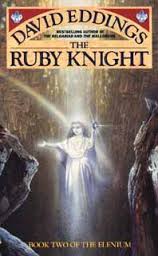 EDDINGS RE-READ: The Ruby Knight, BOOK TWO OF THE ELENIUM
Because we just don’t have enough to do, Tehani, Joanne and I have decided to re-read The Elenium and The Tamuli trilogies by David (and Leigh) Eddings, and – partly to justify that, partly because it’s fun to compare notes – we’re blogging a conversation about each book. We respond to each other in the post itself, but you can find Tehani’s post over here and Jo’s post here if you’d like to read the conversation going on in the comments. Also, there are spoilers!
ALEX:
Sparhawk starts this book a) immediately after the end of the first one, and b) wanting someone to jump him, so that he can get all violent on some unsuspecting footpad. I don’t think I was really paying attention to that sort of thing when I was a teen. He’s actually not a very nice man a lot of the time, and that makes me sad.
JO:
It is a bit sad isn’t it 😦 Sparhawk’s most common reaction seems to be violence, and the narrative and tone celebrates that part of him.
TEHANI:
Alex, you say “not a very nice man” but I never read it that way (and still don’t, I guess!) – he’s a product of his culture and his time. They seem to quite happily wreak havoc on people at the drop of a hat, and he IS a knight, trained to battle!
ALEX:
OK, maybe I don’t have to be quite so sad about him – that he’s a product of his time – but still his active desire for violence does act, for me now, against my lionising of him as a teenager. He is flawed, and I’m troubled because Jo is exactly right – the narrative celebrates him and his anger/violent tendencies.
TEHANI:
You’re both completely right. I still choose to read it in the context of the book, AND STICK MY HEAD IN THE SAND. Damn. That’s the problem with rereading with a few more brains behind us, isn’t it?!
ALEX:
Something we didn’t note in our review of The Diamond Throne is that the book is prefaced by a short excerpt from a ‘history’. This is a really neat way of building up back story and developing the world without having to info-dump – although of course the Eddings pair don’t really have an issue with info-dumps; after all, why else assign a novice knight to teach a young thief history? Anyway, I still like it, and it does show that there has been a fair bit of thought put into the world, even if much of it simplistic.
JO:
Yeah I enjoy these histories too. Good way to set the scene, highlight anything that’s going to be important for the book (like Lake Randera) and do a quick recap. They definitely like an info-dump, but at least the Eddings do it with style and humour!
TEHANI:
I reckon there’s reams of world-building behind these books, especially if the work that we see in The Rivan Codex (for the Belgariad/Mallorean world) is any context!
JO:
I enjoyed this book a lot more than I expected. I remembered The Ruby Knight as a very ‘middle book’, just basically a long build up to finding Bhelliom and saving Ehlana. But on the reread it was a lot more engaging than that. Maybe it’s because Eddings has the space here to really get into the characters, and I love these characters so much that I enjoyed that to no end.
TEHANI:
It really does boggle me that even though I’ve read this several times, I still don’t get bored of this long questy-ride-alonging. It really IS a middle book, and nothing terribly much happens, but it’s still a really enjoyable read! Bizarre. Is it nostalgia that makes it so, or some quality about the book that means I don’t chuck it across the room like I would most other “middle books” that really just march in place?
ALEX:
I found this one a bit more boring than I remembered – it really is just them wandering around. I totally still enjoyed the character development, and it is banter-ific, but on this re-read I got a bit impatient with the lack of actual plot movement.
JO:
They’re also very good at throwing everything in Sparhawk’s way. I mean, this is basically a quest book. We even have a ‘fellowship’ don’t we – Sephrenia mentions how important it is to have a certain number of people on the quest, it’s all about symmetry. But from the outset, everything that can go wrong does, and all of this does a great job of increasing the tension. Not only that, but characters we meet in the beginning and/or middle come back towards the end, which makes these side-quests feel a little less side-questy. By the time Sparhawk and Co. get roped into Wargun’s army I just wanted to scream because they were so close and it is so not fair! But I do love it when characters get put through the wringer like that. Nothing’s easy.
TEHANI:
Masochist! But I’m right there with you – wouldn’t be any fun if things just went to plan, right?
ALEX:
omg when I got to that and remembered that they were being co-opted I think I might actually have groaned out loud. GET ON WITH IT.
TEHANI:
I like that there’s a few points in this book that smack back at the classism – Wat and his fellows teach Sparhawk a thing or two: “Not meanin’ no offence, yer worship, but you gentle-folk think that us commoners don’ know nothin’, but when y’ stack us all together, there’s not very much in this world we don’t know.”
Ulath backs this up some chapters later: “Sometimes I think this whole nobility business is a farce anyway. Men are men – titled or not. I don’t think God cares, so why should we?”
“You’re going to stir up a revolution talking like that, Ulath.”
“Maybe it’s time for one.”
ALEX:
Tehani, you beat me to it – I LOVE that bit; I metaphorically punched the air.
JO:
Go Ulath! 🙂
TEHANI:
Unfortunately, there is also some nasty gender stuff – it doesn’t stem from our heroes, but isn’t challenged by them, and is somewhat supported by them to an extent (Kurik emphasises the nasty noble’s words by drawing his sword in this exchange):
“Mother will punish you.”
The noble’s laugh was chilling. “Your mother has begun to tire me, Jaken,” he said. “She’s self-indulgent, shrewish and more than a little stupid. She’s turned you into something I’d rather not look at. Besides, she’s not very attractive any more. I think I’ll send her to a nunnery for the rest of her life. The prayer and fasting may bring her closer to heaven, and the amendment of her spirit is my duty as a loving husband, wouldn’t you say?”
(more follows on p. 217 – of my copy…)
ALEX:
urgh. Hate that.
JO:
And it’s ok that he feels this way because it was an ‘arranged marriage’. Poor bloke, getting stuck in an arranged marriage like that. *flat stare* There are a lot of comments in these books about women being obsessed with marriage and men ‘escaping’.
ALEX:
And there’s other uncomfortable gender moments, too, like the serving girls in the tavern often being blonde, busty, and none too bright… *sigh* And then there’s Kring, who asks whether it’s ok to loot, commit arson, and/or rape when they partake in war with the Church Knights.
TEHANI:
Oh, so many uncomfortable moments…
JO:
Yeah I’d totally forgotten that about Kring. I was so excited to see him, because I always liked him, but that took the wind out of my sails a bit.
TEHANI:
But Kring kind of changes, I think (though later on) and that element is quite lost later. However, it does NOT do well to realise which culture the Peloi are intended to represent. Oh, the casual racism…
ALEX:
On the topic of racism – every time Sephrenia rolls her eyes and says “Elenes,” I can’t help but think of the bit in The Mummy where Jonathan says “Americans” in that insulting tone of voice (which I can’t find on YouTube, darn it).
TEHANI:
I think Sephrenia is quite within her rights saying it in that EXACT tone of voice!
ALEX:
Also, Ghwerig being ‘misshapen’ isn’t quite suggested as the reason for his being evil, but it’s pretty close – and keeps cropping up throughout the series. I can’t imagine how that makes a non-able-bodied reader feel, given it makes even me gnash my teeth.
TEHANI:
You know, I never actually read it that way – it mustn’t be quite as overt as some of the other uncomfortable things. But of course, now you’ve pointed it out, yes, I completely see it.
JO:
Oh hey I never really noticed that either! But now that you mention it, I can’t unsee it. Which says a lot. Why do I see all the gender stuff immediately, but this passed me by? Of course there’s a long literary tradition of physical deformities = spiritual ones. That’s no excuse. I must be more aware in my reading.
TEHANI:
Kurik’s acknowledgment of Talen (p. 392) made me cry as much as it did Talen!
ALEX:
You softy. I didn’t cry in THAT bit…
JO:
Oh no, the bit that always made me cry is still to come…
ALEX:
Mine too.
Apropos of nothing, did either of you find it a bit odd that Kurik checks on Sparhawk in the middle of the night?? I bet there’s fanfic out there…
TEHANI:
There’s fanfic out there for EVERYTHING! I didn’t think it odd, though I did love the naked man-hug in the early pages of the first book! (go on, go check, I’ll wait…) 🙂
JO:
I am NOT going to go looking for fan fic. I am NOT…
ALEX:
Oh, I don’t need to check, Tehani, I remember 😀
Also, do you remember whether you suspected Flute of being actually divine before the great revelation at the end of this story? I’m not sure! I hope I did…
TEHANI:
Well, I read these completely backwards (Tamuli before Elenium), so I was spoiled for that already I’m afraid!
JO:
Tehani that breaks my brain.
I had suspicions about Flute from very early on. I remember being very impressed with myself at the time. I reread it now and think how could you not? They do kinda hit you over the head with it :p
TEHANI:
I think by now we’ve read WAY too much in the field to be surprised by something like that – but a newish reader to the genre? Maybe they wouldn’t pick it!
Well, being the middle book of the trilogy, there isn’t really much by way of plot to chat about, I guess, so shall we move along? Perhaps faster than the plot of the book itself… 🙂
JO:
We should talk about plot shouldn’t we 🙂
Sooo… As usual the book opens up with Sparhawk travelling through Cimmura at night in the fog. Notice how often that happens in these books?
TEHANI:
Yes, you’re right! It’s a trend in the books, for sure.
JO:
I quite like the repetition. He’s got both rings, and now he knows he needs Bhelliom to cure Ehlana and it’s time for the sapphire rose to be found again anyway. The fellowship head off on their quest for the magic jewel and have adventures along the way, including being stuck in the middle of a siege, dealing with Count Ghasek’s possessed sister, raising the dead and finally fighting the Seeker who has been chasing them all this time.
Eventually they make it to Ghwerig’s cave – after the introduction of Milord Stragen, another favourite character – fight and defeat the troll. Flute is revealed as the child-Goddess Aphrael, and gives Bhelliom over to Sparhawk.
Was that the kind of thing you had in mind? 😉
TEHANI:
This is why YOU’RE the writer…! Nicely summed up indeed. The Count Ghasek storyline was a bit of a tough one. On one hand, Ghasek seemed like a nice enough chap. On the other, the motives behind his sister’s madness, well, not great to examine that too closely, I think.
JO:
Although I did appreciate the throwback to book one – Eddings could have introduced any old character here, but Bellina is the woman Sparhawk and Sephrenia witnessed going into that evil Zemoch house.
TEHANI:
Well seeded indeed…
ALEX:
GET ON WITH THE STORY, EDDINGS PEOPLE!
Galactic Suburbia 104
In which we gaze into the World of the Future with a double dose of Culture Consumed and Culture Yet To Consume. Get us at iTunes or Galactic Suburbia.
Culture We Are Looking Forward To
Alex: new James SA Corey; Isobelle Carmody’s last Obernewtyn novel; every TPP; Guardians of the Galaxy; Snowpiercer; Saga.
Tansy: The Goblin Emperor by Katherine Addison; Kameron Hurley, The Mirror Empire; Ben Peek, The Godless; Sailor Moon
Alisa: Extant
Culture We Have Consumed
Alisa: Twinmaker, Sean Williams
Alex: holidays!! Diaspora, Greg Egan; The Reluctant Swordsman, Dave Duncan; James Tiptree Award Anthology 3
Tansy: The Secret Diary of Lizzie Bennet.
Please send feedback to us at galacticsuburbia@gmail.com, follow us on Twitter at @galacticsuburbs, check out Galactic Suburbia Podcast on Facebook, support us at Patreon and don’t forget to leave a review on iTunes if you love us!
The Diamond Throne
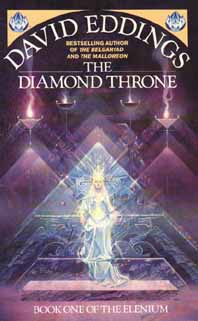 EDDINGS RE-READ: The Diamond Throne, BOOK ONE OF THE ELENIUM
Because we just don’t have enough to do, Tehani, Joanne and I have decided to re-read The Elenium and The Tamuli trilogies by David (and Leigh) Eddings, and – partly to justify that, partly because it’s fun to compare notes – we’re blogging a conversation about each book. We respond to each other in the post itself, but you can find Tehani’s post over here and Jo’s post here if you’d like to read the conversation going on in the comments. Also, there are spoilers!
TEHANI:
I was feeling a little book-weary yesterday so thought I might as well start my reading for this conversational review series, given it’s usually a soothing experience. Within a single PAGE, I was reaching for Twitter, because SO MUCH of the book cried out to be tweeted! Great one-liners, the introduction of favourite characters, and, sadly, some of the not so awesome bits as well. I was having a grand time pulling out 140 character lines (#EddingsReread if you’re interested), but the response from the ether was amazing! So many people hold these books firmly in their reading history, and it was just lovely to hear their instant nostalgia.
ALEX:
And I read those tweets and everything was SO FAMILIAR that I immediately started reading as well. And finished a day later.
JO:
Ok. A) You people read too quickly! B) Tehani those tweets were enough to start me feeling all nostalgic. I was in the middle of cooking dinner and had to put everything down, run upstairs and dig the books out of their box hidden in the back of the wardrobe.
TEHANI:
I am not at all repentant! 🙂 Also, did you both find this a super easy read? Is it the style, or just that I’ve read it several times before? It really was like sinking into a warm fluffy hug, hitting the pages of this book again. I actually can’t remember the last time I read it, but it’s got to be over a decade, yet I felt instantly at home again. Eddings was one of the authors who caused my addiction to the genre, and even in the very first chapters, it’s easy to see why. The light and breezy writing style is instantly accessible, and the way we’re thrown straight into the action, with our hero Sparhawk leading us through, makes the book start with a bang.
ALEX:
Reading that first page was a little bit like going back to my high school, many years after graduating. It just felt so familiar, and comfortable. And like high school, I know it’s not without problems – but it’s still somewhere that has a lot of ME wrapped up in it. I also don’t remember when I last read these, but it’s not for aaaaages… And yes, super easy to read. TOO easy! ;D
JO:
Oh yes, absolutely. As soon as I started reading it all came back to me. I remembered the moment I found The Diamond Throne in the library, and the first chapter and intro of Sparhawk hooked me instantly. While I think as a teenager I identified the most with Polgara from the Belgariad (I wanted to BE her) I have always loved Sparhawk.
ALEX:
Polgara is still one of my absolute favourite characters! Sparhawk is too, though – one of the great characters for me in my early teen years. I adored that he was older, and cynical, and world-weary. When I was 14 I thought I was all of those things…now that I am 34 I still absolutely empathise! This story also shows that his cynicism is cut with a very large streak of sappiness, which I think serves to make him just a bit more relatable. His love for Sephrenia, his respect for Vanion and Dolmant and Kurik – he’s actually a fairly well-rounded character, as these things go. His habit of calling people ‘friend’ and ‘neighbour’ is why I call everyone ‘mate’ to this day. True story. I also adore the relationship he has with Faran, that ugly roan brute; I love Faran unconditionally.
TEHANI:
He is so pragmatic, completely prepared for violence at all times, and yet from the very early pages where he gives the street girl some coins and calls her “little sister”, we see he’s an absolute marshmallow inside. I’m with you Alex, I adore him.
JO:
I have an admission to make. I still love him, but Sparhawk’s making me a little uncomfortable in this reread. For all his neighbours and his giving money to the scrawny whore, I’m starting to feel like he’s a bit of a bully. He gets what he wants because he can and does threaten violence if he doesn’t get it…and it feels like Eddings thinks this is ok because he’s Sparhawk. He’s a Pandion (not only a Pandion but the best of them, as we are repeatedly reminded) and the people he threatens are ‘evil’ anyway so no harm done… I dunno, it’s just made me feel a bit squeamish this time round.
TEHANI:
That’s a really good point. I’ve had a similar discussion with my Doctor Who reviewing buddies Tansy and David about David Tennant’s Doctor – he does and says some pretty awful things, but we accept it generally without question a) because he’s the Doctor, but more importantly b) because David Tennant plays him so charismatically. Sparhawk has the same sort of issues – we know (or are given by the narrative to believe) that he’s on the side of right, and that he is the Champion, therefore we accept his behaviour because it’s presented as being for the right reasons.
ALEX:
*sigh* you are of course both correct – Sparhawk’s use of “might is right” is totally accepted by the novel because he is so awesome. And if that’s not an abuse of power, right there, then nothing is.
On a more positive note, I think I like all of the other characters, too. Sephrenia is delightful although definitely not rounded out enough here…and I do have a problem with her “we Styrics are so simple and you Elenes are so complex” thing. I want to believe that she’s just serving back to the Elenes what they believe about themselves, so that she can manipulate them, but I’m not sure if that’s knowledge of the rest of the series or wishful thinking (more on that below). Talen is already totally amusing and reminds me a lot of Silk, from the Belgariad, which is unsurprising. The Merry Men really are dreamy; Ulath and his blonde plaits will always be my favourite, because who doesn’t love the quiet cryptic type?
TEHANI:
And I adore Kalten, because he’s always needling Sparhawk yet they clearly love each other. Talen was a definite favourite from early on too, and Kurik is marvellous – a definite father figure, or maybe more an uncle…
ALEX:
The classism and the racism…ouch. The Rendors are meant to be Arab analogues, right? Because everyone knows that living in the heat makes your brain go soft. OUCH. Also, why have I always thought the Styrics were analogues for Jews? Is it just that the Elenes burning their villages is frighteningly similar to pogroms in Christian Europe in the Middle Ages? (But of course there’s no religious similarity at all, and the only ‘real’ similarity is the refusal of pork.)
JO: I always thought that about the Styrics too.
TEHANI:
Oh yes, that was the first thing I picked up on in terms of the negative stereotypes – completely over my head when I read these in my late teens, front and centre now. I actually wrote a uni paper on representations of reality in Eddings and Feist, but I’ve sure learned a lot since then! I could easily IDENTIFY the real world correlations, but did I notice the negative aspects of this? No I did NOT. *sigh* Bad past me, bad!
This time around, the classism was just as interesting too – I think I was so indoctrinated into the usual process of high fantasy in my 20s that this would never have even occurred to me to see. This time though, Sephrenia’s derision about the intelligence “common” Elenes and Styrics is, ugh, just awful. And when it’s other races as WELL as commoners, well, that’s terrible.
ALEX:
The class aspect is ugly as all get out. When they’re in the council chamber confronting Vanion, Dolmant – the lovely, gentle Dolmant – says why believe an untitled merchant (his words!) and a runaway serf over and above the honorable Preceptor (code: titled)? Now we know that those are both lying, but that’s beside the point. I dunno, Dolmant, maybe because truth and honesty aren’t actually the privileges of the wealthy and titled?
JO:
Oh goodness yes. I have to admit this is something that passed me by the first time I read these. Maybe because in the world Eddings writes it does feel so natural. Which is disturbing.
TEHANI:
It really is, isn’t it! And once you see, you can’t unsee…
ALEX:
This is one of the first real instances I remember of the Crystal Dragon Jesus trope – taking what can be broadly recognised as a version of the medieval Catholic Church and transporting it to a secondary fantasy world.
TEHANI:
I’ve not heard of the “Crystal Dragon Jesus trope” – please elaborate?
JO:
Neither have I!
ALEX:
Instead of creating your own religious system for your magical fantasy world, you take the broad brush strokes of (usually) the medieval Catholic Church – because hey, everyone knows that medieval stuff is bad, plus Catholics are easy to laugh at, right? It generally involves a monotheistic religion with a convoluted hierarchy, seemingly-pious churchmen (and only men) who are meant to be celibate but often aren’t, because that also makes them easier to turn into evil characters. The only thing that the Eddings missed is the saviour/messiah/ someone who sacrificed themselves bit, of the religion. It irks me because it is so lazy.
JO:
I did not know there was a term for that 🙂
ALEX:
Tehani, you said there was a Lord of the Rings reference early on – did you mean Ghwerig the Troll-Dwarf being like both Sauron and Gollum, with the whole rings thing? (Also, how did Ghwerig ‘casually’ smash a diamond?) There’s also a Hamlet reference, at the end, when Sparhawk comes across Annias praying in the chapel and chooses not to kill him.
TEHANI:
Yes, exactly! I missed the Hamlet reference, and I think there were a couple of others in there!
I could hand-wave the diamond smashing – I figured if he was working under the influence of the gods, he could pretty much do anything!
JO:
You know, there’s a lot of repetition in this book. It almost feels like any time anything happens, it has to be reported back to the group in the next scene, and discussed. Same goes for any time they meet a new character, we have a recap of events up until this point. All done with amusing dialogue, of course. But still!
TEHANI:
You’re right, but it’s so breezily written I hardly notice it! I do quite like the way travelling actually takes a significant amount of time, even when that slows down the action.
ALEX:
Thanks to your tweets, Tehani, I noticed every single time the word ‘peculiar’ was used.
JO:
By the end there I was getting a little sick of “I’m (terribly) disappointed in you, ___.” Or something similar. I noticed it a couple of times then couldn’t unsee it!
TEHANI:
Yes, Eddings has several “tics” of writing that once you notice them, you ALWAYS see them! “Flat stares” are my favourite 🙂
JO:
Particularly when they come from Faran. I love that horse and his flat stares.
TEHANI:
That horse is practically human.
ALEX:
That horse and his prancing make me happy.
JO:
I’m having a strange and conflicted reaction to the female characters in these books. On the one hand, they are such wonderful strong people. Sephrenia is powerful, but that’s almost not what makes her strong – rather her pacifism compared to the bloodthirsty knights around her, and her determination to do her duty to her goddess. And her relationship with Vanion. Ehlana’s still encased in diamond at this point, but the effect she had on Sparhawk pretty much says it all! Even Arissa has her own desires and knows her own mind. But…but… I dunno, something feels off to me. Maybe because there are few of them? Maybe Lillias’ rather large hissy fit soured it all for me. I just don’t know. Would love your reactions.
TEHANI:
I actually thought the Lillias thing was reasonably well handled – it was made pretty clear it was a cultural “norm” rather than her personal feelings, which made it okay for me, I guess. The female characters are interesting though; I wonder if it’s because they are constantly stamping their feet at the men and pretending to be less powerful than they are to get their own way that’s the problem? Possibly I’m getting ahead of myself though – this is only the first book!
ALEX:
I loved Lillias’ melodramatic turn – and that Sparhawk played to it for her sake. I am conflicted about Sephrenia: are the knights looking after her because they love her, or because they see her as weak? Or is that an “and” situation? I don’t like Arissa but I admire her strength. For me, I think it’s that this is such a boys world the women feel a bit out of place. The other female character of course is Flute, and she’s quite funny, but one thing I wanted to point out: she ‘somehow’ escapes the convent where they leave her, and meets the crew further on…and no one goes back to tell the convent she’s ok?! Seriously??
TEHANI:
Don’t look too hard Alex, there’s all SORTS of little nitpicks like that! I think we’re almost ready to move on to the next book. I don’t suppose it really matters that we’ve not talked about the plot, right? It’s your basic high fantasy quest, with lashings of barriers thrown into our hero’s journey, a cast of thousands (seriously, it gets quite large in the end…) and lots fun dialogue that means you completely don’t notice that sometimes nothing really happens for several pages *cough chapters cough*.
ALEX:
Things happen! Characters develop! Banter is committed! 😀
JO:
Yeah, what more could you possibly want? Lots of riding horses to get to places. Things go wrong for our heroes all the time. I do think Eddings is good at that in particular. Just when you think they might finally achieve something, *bam* something goes wrong. Usually involving Martel. And yes, lots of banter. Banter is awesome.
TEHANI:
Hey, have you two seen this? http://42geekstreet.com/fantasy-casting-agency-the-diamond-throne-the-elenium/
ALEX:
omg. How awesome. One big nitpick: they CANNOT make David Wenham Martel! Nononononono. No. Kalten maybe?
JO:
LOL ‘who could play Sparhawk in a movie’ is my husband’s favourite pastime. It drives me nuts.
Also, Gerard Butler? Gerard Butler? That’s it, I quit the internet. *walks away from the internet*
TEHANI:
What’s WRONG with Gerard Butler! *wanders off whistling* See you both back here for the next exciting instalment of our reread!
Pablo Neruda
I took this with me on a holiday by the beach in winter for two main reasons:
1. The friend who first introduced me to Neruda (with “Tonight I can write the saddest lines”) loves that particular town, and it seemed appropriate; and
2. The friend who loaned me the collection would surely find it hilarious to imagine me clutching the book to my bosom, staring tragically/romantically/poetically (they’re all synonyms right?) out to sea.
Actually, so would the first friend.
 Anyway. I am not much of a reader of poetry. I love the sound of poetry and I appreciate the artistry of using words as Neruda does, but I am at heart an impatient reader. I love words and I like the idea of lingering over them, but… it never really happens. Plus, I am realising that I am more plot-driven than beauty-focussed, which means poetry isn’t really going to work for me.
ANYWAY 2. Neruda. He uses words in beautiful ways – well, I presume he does in the original Spanish, and this isn’t just WS Merwin’s attempt to get work out there under someone else’s name. (What would be the point of that anyway?) Friend 2 pointed out to me that Neruda objectifies his subject a lot, and that’s absolutely crucial to much of his poetry: you don’t get “Body of a woman, white hills, white thighs / you look like a world, lying in surrender” otherwise. But he does create some exquisite imagery.
Ah vastness of pines, murmur of waves breaking,
slow play of lights, solitary bell,
twilight falling in your eyes, toy doll,
earth-shell, in whom the earth sings!
I had at first expected “Tonight I can write” to be the “Song of Despair” mentioned in the title, but it’s not – it’s the twentieth love poem. Which made me realise, as I had been slowly realising over reading the collection, that to differentiate the love poems and the song of despair is to suggest something that is not there. In most of the love poems, despair is either present or looming on the margins. And the song of despair is of course only possible because of the love that is also present.
If you like poetry, this is highly recommended. If you want to try poetry, this is short and delightful and evocative. I’m glad I read it.
The Reluctant Swordsman
This is not the sort of book I would have picked up of my own accord. But a friend loaned me the entire series, and I felt obligated to give it a go, since we usually have similar tastes.
 This is a fairly standard portal fantasy. The main character is dying in our world and then wakes up in the body of a remarkable swordsman in another. Intriguingly, we get very little of Wallie’s life in the ‘real’ world. We know he’s an engineer, has no family, and… that’s about it. The focus is entirely on The World.
Of course, the swordsman/Wallie has a task to complete, and there are many and significant obstacles to that. This book is basically a getting-the-band-together story, as Wallie figures out what he has to do (which he doesn’t really know even by the end of the novel), and gets his people together – an appropriately motley group for an unlikely hero (well, an unlikely hero’s mind, anyway).
Wallie himself I am largely indifferent towards at this stage. He’s an excuse to explore different aspects of the world, and question some of its aspects (more on that later). He’s approachable enough, and hasn’t done anything quite as repellant as Thomas Covenant manages in his first fifteen minutes. Of the other characters, his sidekick has a phenomenal memory and developing sword skills; his slave girl will hopefully develop a personality; and the elderly priest is the one that I hold out most hope for, of being snarky and clever.
The novel suggests a world where gods exist and interact with people – sometimes – and although I guess a direct intervention from a god would have an impact, I found Wallie’s change from sceptic to fervent believer a bit fast. I am interested to see how this aspect develops. I’m also intrigued by the notion of unstable geography which strongly connects to the idea of the Goddess; I think this may be the most interesting facet of the world building so far. The rest of the world building… well. There’s slaves, and Wallie reacts strongly against this initially, but he does then go and buy one. Admittedly he does so for noble reasons, and he really likes her, honest!… still. That’s playing into the system, right? There could have been more conscience wrestling about that. And any moral objections raised are rather undercut by Duncan later in the novel when another character buys a slavewoman entirely based on her voluptuous appearance, and this is upheld as humorous in the first instance and then later as advantageous to the plot. This is a problem for me.
I may read the next one, just to see whether Duncan manages to do anything clever or original. I’m not really holding out much hope, to be honest. It would probably have been an enjoyable book when I was 15, but now I’m feeling a little bit too cynical and well-read.


