The Crooked Letter
I’ve read this as part of my great Read Everything I Own but Haven’t Read Yet pledge, which I’m hoping to make serious inroads into this year. We’ll see…
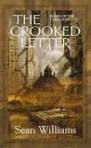 I got this a number of years ago as part of a show bag at a Swancon. I had read some Williams before, but not much. Since then I have read large chunks of his SF, but – until now – none of his fantasy except for the Troubletwisters books with Garth Nix. (It’s actually been a while since I read much fantasy at all, which is curious to realise.)
Slight spoilers!
Williams clearly has a thing for twins. In this, the twins are mirrors of one another, down to one of them having his heart on the righthand side of his chest. Their names are Seth and Hadrian – and I’ll admit to being a bit disappointed with the name choice, given that both lend themselves to some nice tricksy name-association, just not with each other. Moving on… Seth and Hadrian are on holidays in Europe. They end up travelling with a girl, Ellis, and then everything gets weird when one of them is stabbed. That’s not the weird part, though – the weird part is the non-stabbed one waking up and realising that the world is very, very different from when he last had his eyes open. And then things just get worse. For both of the twins.
There are some really nice elements to this story. Overall I thought the twins’ relationship was a well-developed one, nearly perfectly balanced between love and… not hatred, but perhaps despair at being tied to this same person in so many ways for so long. Occasionally I got a bit bored by the whinging, but perhaps that’s teenagers for you. The cherry-picking of mythology and characters from all over the world was a nice touch – it certainly avoided being eurocentric, which is always nice to see, and plays into a bit of a Jungian idea of the great subconscious with these commons themes that can (maybe) be seen. And I especially loved that Hadrian’s adventures mostly took place in a city – THE city, the great underlying city, what every city dreams of being. While I do love me some epic horse-riding and camping out, grand fantasy played out on city streets also has a lot of appeal.*
There are, though, some aspects that grated. Hadrian’s absolute insistence on finding Ellis – and that people are willing to help – strained credibility: HELLO, everyone ELSE appears to be dead, so how exactly are you planning on finding one probably-dead girl in the great uber-city? I was hoping right from the start that Ellis was going to turn out to be more than just a girl, and that all of the non-humans knew it, since that would excuse it to some extent. The first was correct but not the second, so my annoyance with that plot element still exists. Sometimes the mashing of multiple mythologies did not gel for me, and the explanation of the Three Realms really didn’t work for me. I can’t explain why; I don’t think it’s my faith getting in the way, since it rarely does with this sort of fantasy (that is, the sort that’s clearly playing with pagan ideas, rather than Crystal Dragon Jesus types).
I did finish it, which means I did enjoy it even if I didn’t adore it. I own the second Books of the Cataclysm, The Blood Debt. While it’s not next on my list, I will definitely be reading it at some point… and from there I’ll see whether I get around to the other trilogy that this is actually a prequel to, the Books of the Change.
You can get The Crooked Letter from Fishpond.
*Hmm. Do I need to read Lord of the Rings again sometime? I’m getting an itch…
Greg Egan: Quarantine
I think – in all my vast understanding of the world – that one of the things that really sets Greg Egan apart is his willingness to drive real physics to its ruthless end.
This is not to say anything against his plots or his characters. On the contrary, I think Egan does utterly absorbing plots and some remarkable characters. But so do other SF writers. There are few others, though, who combine this with a determination to take real-world physics and drive them a long, long way.
 Quarantine is a case in point. Take the idea that quantum mechanics suggests, that of collapsing probabilities as a wave function and the role of the observer in doing so. (Dear scientists, if I have just or am about to claim the equivalent of the Dark Ages being a real thing, please let me know and forgive me at the same time.) This leads to the many-worlds theory, whereby every action spawns alternate worlds where that action was done differently.
Now extrapolate to its ruthless conclusion.
Now add a detective thriller plot.
Now add a world in which there are no stars – they went out some decades ago.
Add the ability to mod your brain (turn off boredom, modulate emotions, change memories and attachments).
Add a world where Arnhem Land has become an autonomous nation and offered part of its land to become New Hong Kong.
… and you begin to get an idea of what Quarantine is like. Seriously, just a few of those things could make for a great novel. But they’re all there. Some are just part of the world-building, some are fundamental to the plot, all work cohesively together to produce a book that I read in a day (it’s only 250 pages, ok? And there are no formulae in this one, unlike the Orthogonal books).
I am never bored by Greg Egan, I am never impatient with Greg Egan, I am consistently surprised by Greg Egan. This is another good one.
You can get Quarantine from Fishpond.
Galactic Suburbia 96
In which we announce the 2013 Galactic Suburbia for activism and/or communication that advances the feminist conversation in the field of speculative fiction.
[If you want to listen unspoilt to the episode discussing shortlist and winners of the GS Award, listen over here right now without reading the rest of the show notes. Don’t even glance at them! Move along, nothing to see here]
Culture Consumed:
Alex: Shadow Unit! Haven ep 1!
Alisa: Fringe, Haven S1, Game of Thrones S1 and S2, Veronica Mars Movie
Tansy: The Lotus Palace by Jeannie Lin; Dark Eyes 2 (Big Finish); Veronica Mars Movie
Shout out for Night Terrace.
Cranky Ladies of History funded!
Galactic Suburbia Award!!
for activism and/or communication that advances the feminist conversation in the field of speculative fiction
Malinda Lo’s continuing statistics gathering on LGBT YA books
Foz Meadows for her blogging generally, but particularly “Old Men Yelling at Clouds.”
Anita Sarkeesian – Tropes vs Women in Video Games (Damsel in Distress 1 & 2, Ms Male Character)
Kameron Hurley, ‘We Have Always Fought’: Challenging the Women, Cattle and Slaves Narrative,” at A Dribble of Ink.
The Doubleclicks – Nothing to Prove music video
Cheryl Morgan – The Rise & Fall of Grimpink
Deb Stanish for her essay in Apex magazine: “Fangirl isn’t a Dirty Word.”
Honorary shortlistee (the Julia Gillard Award):
Wendy Davis for her amazing filibuster
Joint Winners this Year!!!
(drum roll please)
NK Jemisin for her GoH speech from Continuum (link)
Elise Matheson for her essay “How to Report Sexual Harassment at cons” (link)
Also discussed:
“Not Now, Not Ever” (Gillard Misogyny Speech) by Australian Voices
Please send feedback to us at galacticsuburbia@gmail.com, follow us on Twitter at @galacticsuburbs, check out Galactic Suburbia Podcast on Facebook and don’t forget to leave a review on iTunes if you love us!
Freedom and Necessity
So there’s this girl I’ve known for about half of my life. She’s been foisting books on me for most of that time. Sometimes that works out really well; she threw a comic fantasy at me by a new Tasmanian author once, someone called Tansy Rayner Roberts, and that’s turned out ok. At other times, I have been less… enthused. Because much of what she has directed me to has been romance.
(Long time readers of this book, cue the eye-rolling.)
Mea culpa: I have been a member of that set who poo-poohed romance as a genre. I have been dismissive of the covers and presumed they genuinely represented the contents; I have dismissed romance as not worth reading; I have dismissed the people who loved reading it. The fact that some of my friends enjoyed reading it confused me no end, because how could they be part of that group? I dismissed it as mere escapism… even as I bared my teeth at people who did the same to me over reading science fiction.
I am not proud. I am still getting over this attitude. And what both makes this attitude bizarre and helped me get over it was, at the time grumpily, actually reading most of the books I was directed to… and realising that they were well-written. Yes there’s crap romance; there’s really crap SF too. This should be no surprise. Also, I finally admitted that I quite like good romance aspects to my SF&F, and that that is okay. Part of my problem had been dealing with rather anti-girl and anti-feminine aspects of my own character (this is something that’s years in the discarding).
Anyway, she gave me Freedom and Necessity, and… the world changed.
The aforementioned friend recently sent me a copy of Freedom and Necessity which she rescued just for me, thinking I should read it again. Oh, how I love this book.
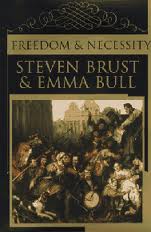 It’s 1849, and the convulsions that threw Europe into confusion in 1848 – attempted revolutions all over the place – have mostly simmered down. The Chartist movement in England (wanting outrageous things like manhood suffrage, paying politicians – so you don’t have to be rich to stand for election – and a secret ballot) has also mostly been contained. James Cobham wakes up at a rural pub with, he writes to his cousin, no memory of the last two months, during which time he has been presumed dead by drowning.
The entire novel is constructed via letters and a few diary entries. This does mean an occasionally improbable concession towards memories being excellent, but also raises the intriguing possibility of unreliable narrators all the way through. Also, the friend pointed out that reading it on the days the letters are written is both a fascinating and excruciating experience – the latter because the urge to keep reading is just. so. strong.
There are four main letter-writers. James; his cousin Richard; James’ step-sister and Richard’s paramour, Kitty; and Susan, also a cousin. The family is aristocratic in that way that doesn’t entirely make sense for a modern Australian – they’re not dukes, but they are wealthy and landed. James has been the family’s black sheep for a long time and clearly has a dubious past; Richard is something of a dilettante and scandalous for living with Kitty; Kitty seems flighty and wilful, at least at first; and Susan is sensible, determined, and intimidatingly modern.
Susan is my favourite. Susan is on visiting terms with Friedrich Engels.
The plot wheels between political machinations, dastardly plots of a political and a personal nature, family in-fighting, pseudo-druidical secret societies, fairly in-depth philosophical arguments, and falling in love. The fact that it is written as letters between different people means there are four distinct voices, with their own personal ambitions, hang-ups, and secrets; people don’t have all the same knowledge at the same time; and sometimes letters don’t get to their intended recipient at the hoped-for time, leading to… well. You can imagine.
I love the romance aspect; I love the historical aspect; I love the thriller aspect. There are serious arguments about Hegel that leave me bewildered. This book is delightfully well-rounded, and I am so very thankful to Kate for giving it to me so I can read it again and again, and loan it to Very Special People.
(Kate, by the way, is the creator of incredible jams and chutneys from local Tasmanian ingredients. If you’re keen on suchlike, search her out on Twitter – @justaddmoon – seriously awesome! /end plug)
You can get it”> from Fishpond!
Galactic Suburbia 95
In which the Hugo host debacle online conversation became a many-tentacled AI that wants to steal our souls, and ladies are cranky. Get us from iTunes or over here!
Speaking of Cranky Ladies – check out Tansy and Tehani’s crowdfunding campaign.
News In Depth: The Hugos v. Jonathan Ross, Safe Spaces & Online Discussions
Foz Meadows laying out the original drama in her usual inimitable style.
Cheryl on the arguments for & against Jonathan Ross as host as particularly on the importance of Intersectionality – how to be a good ally, and why you LISTEN to why people are upset, even if it’s inconvenient to you or your community.
The Chairs of LonCon apologise for the situation – weirdly, this graceful and thorough acknowledgement of their responsibility for how the chain of events went is often not being mentioned in coverage of the discussion.
UPDATE, PLEASE READ:
The downside of recording several days ahead of broadcast is that sometimes the conversation we are contributing to moves on without us – in particular with the “Hugos and Jonathan Ross” conversation we recorded on Wednesday night there has been some serious reframing of the narrative, some of it highly gendered.
We wanted to reference some of this further discussion rather than be seen to ignore such an important (and troubling) development.
Some important posts calling attention to the reframing of the narrative to trivialise the concerns of women (and to hide the fact that many prominent men shared and vocalised those concerns):
Kameron Hurley on Power, Responsibility, Empathy and Privilege
Kari Spelling on how the conversation has changed from being about the unsuitability of Ross as a Hugo host to being about how women were “mean” on Twitter – and how those women are continuing to be unfairly targeted.
Natalie Luhrs on “Reframing and Punching Down” – with particular reference to how those posts calling for people to be nicer to each other, or how fandom is too hysterical to deserve nice things, aren’t always as helpful as you think they are.
David Perry questions the mythical concept of Seanan Maguire’s Angry Mob, calling particular attention to how Seanan and her tweets are now being reframed as central to Jonathan Ross’s resignation, due to selective quoting, selective memories and gross misrepresentation of the actual timeline of events. This is important stuff, people. Our history just got rewritten while we were watching.
[note: we deliberately didn’t mention Seanan by name while discussing the issue in this episode of GS because we could see she was already being unduly blamed and centred in the discussion despite being only one participant – it’s the exchange between Seanan and Jane Goldman mentioned in the Perry article that Alisa also refers to as a conversation that ends in mutual apologies and is later misrepresented by others long after it’s concluded.]
Another important post by Kameron Hurley, Rage Doesn’t Exist in a Vacuum. On why internet rage happens, why someone else might be more upset than you are about a thing, and why it’s important to speak up about upsetting things even if it ruins someone else’s happy party fun times.
Culture Consumed:
Alisa: Game of Thrones S1, Fringe S3, Kaleidoscope ToC
Tansy: Ms Marvel #1 & She-Hulk #1 Fringe S3
Alex: Midnight and Moonshine, Lisa L Hannett and Angela Slatter; A Stranger in Olondria, Sofia Samatar
Pet subject: feedback
Galactic Suburbia Award!! (last call for suggestions)
for activism and/or communication that advances the feminist conversation in the field of speculative fiction
Please send feedback to us at galacticsuburbia@gmail.com, follow us on Twitter at @galacticsuburbs, check out Galactic Suburbia Podcast on Facebook and don’t forget to leave a review on iTunes if you love us!
A Stranger in Olondria
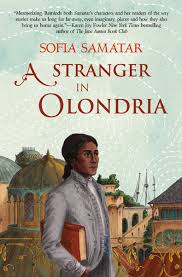
This is another cover by Kathleen Jennings, and isn’t it lovely? I especially love the background – the city is so jumbled, and so delightfully different from an Australian city, and I love the hint of the ship at the back too.
I’m not much of a one for poetry, lyrically or as prose. That is, I like it, and I appreciate it, but I’m a fairly pragmatic person and I generally prefer story over how the story is told. My absolute preference is for good prose with story if I can get it, but of course that doesn’t always happen. And sometimes the beauty of the prose makes a bit of a non-story into something wonderful. I think particularly of Kij Johnson’s “The Man Who Bridged the Mist”: there’s really not much story to be told, but the way it’s told is so beguiling that I really enjoyed it.
Ok, maybe I’m confused about what I like. Whatever. I know it when I read it.
So here’s the thing. This is a beautifully written novel. It’s lovely. And the story is an intriguing one; it’s all about being a foreigner and how to negotiate that; it’s all about the use and abuse of books, and of religion, and of power; it’s about love, and family, and history. All of these things are great big YES PLEASEs for me.
But it didn’t work. For me, this story needed more straightforward prose, so that I could really get at the ideas. I felt like Samatar was obscuring the ideas, drawing veils or mists around them with delightful words, so they remained frustratingly hard to comprehend and chew on. And there’s also a lack of story, which means that as a novel it didn’t work. I can imagine reading this as a novella – the same length as the Johnson would have been perfect.
All of that said, I did actually finish it, and I don’t feel sad about that. I did want to know what would end up happening to Jevick, and I’m really pleased that the story kept going after what could have been the obvious end-point. I was, and remain, genuinely intrigued by what it said about the power of literacy and how that can be abused, as well as the problems with prizing ignorance (and whether ignorance and illiteracy are necessarily the same thing).
I’m sad I didn’t love this more, given the love it’s been getting from a few quarters and the noises about it getting onto awards shortlists. I understand why it appeals, and that’s cool; I can see parallels between this and Jo Walton’s Among Others, which I adored but I know didn’t work for others. It too had lovely words and what might be called a ‘quiet’ narrative, but I think Walton’s story worked better. However, I am still going to keep looking out for Samatar’s work; after all, I adored “Selkie Stories are for Losers.”
Galactic Suburbia 94!
 In which we get excited about awards, and sexism in SF. In other words, it’s Galactic Suburbia! You can get us at iTunes or over at Galactic Suburbia.
Tiptree Award Winner & Shortlist – first Australian Tiptree winner! Congrats to N.A. Sulway!
Culture Consumed:
Alex: All Harry Potter movies; Project Bond; Supurbia
Tansy: Regency romance novels, Minister of Chance
Alisa: Supurbia
Pet Subject: the not-SFWA “debate”, the pervasive dismissal of women in SF
Note: this episode was recorded several days before broadcast, before Sean Fodera made his apology to Mary Robinette Kowal, who accepted it gracefully. Please look at her post about why she accepted, and the role of apologies in general.
Some other relevant articles we discuss or allude to, or which Alisa found after recording and wanted us to include – keep following the Galactic Suburbia Facebook Page as she’s been updating it with interesting links daily:
GENERAL BACKGROUND
The Radish hosted early discussion on the Bulletin anti-censorship petition.
The Daily Dot coverage of the petition & responses in the community.
Steven Gould on why the petition was based on a false premise.
SL Huang writes Can We Please Not Rewrite History, Folks?, and worth checking in on SL’s original Timeline of 2013 SFWA Controversies, now updated. [my apologies for stumbling over pronouns on the podcast]
THE LATEST WAVE OF TURMOIL, DISSENT AND SEXISM
Silvia Moreno-Garcia outlines the invective against Mary Robinette Kowal on SFF.net and the politics of “plunging necklines,” “diaphanous white outfits” and ankles.
Mary Robinette Kowal’s post on Being a Representational Example
Scalzi presents the Insect Army t-shirt design courtesty of Ursula Vernon’s awesome artwork.
N.K. Jemisin makes her own comments on the current shenanigans. Some really important words here. Alex also mentions Nora’s important tweet from 5 days ago:
N. K. Jemisin @nkjemisin
The loss of privilege is not oppression. The loss of privilege is not oppression. THE LOSS OF PRIVILEGE IS. NOT. OPPRESSION.
The post we possibly discuss in most detail on the podcast today: Juliet McKenna’s Why The SFWA Shoutback Matters
A really important message from James Patrick Kelly on age, and generations, and making a difference.
and don’t forget the…
Galactic Suburbia Award!! for activism and/or communication that advances the feminist conversation in the field of speculative fiction. There’s still time to send us your suggestions – only work from 2013, please, but start saving the 2014 links to send us next year.
Please send feedback to us at galacticsuburbia@gmail.com, follow us on Twitter at @galacticsuburbs, check out Galactic Suburbia Podcast on Facebook and don’t forget to leave a review on iTunes if you love us!
Supurbia
Superheroes have lives outside of superheroing. Of course they do; you see it occasionally in the movies (my main source of superheroness): the occasional lover, usually getting into danger and needing rescuing; wise parents/parental figures; smartass friends…
Then you get movies like The Incredibles, where superheroes have to stop superheroing and try being normal. And how well does that go? (I love that movie.)
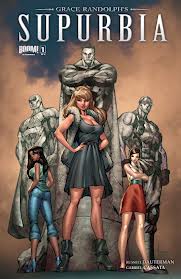 Supurbia takes the middle line. Superheroes be heroic, AND they have lives. How do you prevent their loved ones from being kidnapped by the arch-nemesis? Put them all on one normal suburban street and hope that no one cracks the code, of course. Here you have wives and husbands and kids and lovers… and while the superheroes are off saving the world, they’re at home. Watching the news. Worrying. Talking to each other. Maybe organising themselves to help you. Maybe being exasperated or afraid or angry. (Or high.)
I love this comic. I like the variety of families, I like the way the characters interact, I like the way the superheroes are problematised (they are far, far from perfect individuals in the way they interact with those nearest and dearest). I’m still not at the point where I can comment fully on the art, but what I noticed I liked – the women are differentiated! – and it by no means got in the way of enjoying the story, which for me as newbie comic readers is an important aspect.
This series comes highly recommended.
Fairy tales. New ones.
Sometimes I forget how much I love reworkings of fairy tales. How crazy is that?
Ever since my mother (I think?) gave me a lovely little collection of twisted fairy tales – I have no idea what it was called, whether they were all by the same person, or whatever – I have been passionate about people taking well worn stories and twisting them. Sometimes slightly, sometimes extremely. But, it turns out, I forget this. And then I read Troll’s Eye View, and I remember… because sometimes the villain is absolutely the most interesting character, and sometimes they’re not actually a villain if you look at them a certain way. And I read To Spin a Darker Stair, and the prose is wondrous and the stories gripping.
But then I forget. And I have something like Paula Guran’s anthology Once Upon a Time: New Fairy Tales sitting there waiting… waiting… waiting to be read, and when I finally get around to reading the first one I think, why have I been waiting so long?
Maybe having written this, I am less likely to forget in future. I can hope.

I enjoyed every story in this anthology; some more than most, but there wasn’t a one that I flicked through impatiently. There’s a great range of stories. Yoon Ha Lee, whom I’m just discovering, brings a Korean-inspired story in “The Coin of Heart’s Desire” that fits into the “be careful what you wish for” zone; Cinda Williams Chima brings native American folklore into a “gritty industrial landscape” a little bit like Charles de Lint. Angela Slatter turns a princess into a bird in a story of revenge, while Priya Sharma, in “Egg,” wonders about all those stories where all the woman wants is a child… There are retellings, too: Genevieve Valentine plays with “The Snow Queen,” Jane Yolen and Ekaterina Sedia take “Sleeping Beauty” in two completely different directions (Sedia does it better, I think); Tanith Lee uses the one about the dancing princesses. Richard Bowes brings a sardonic Puss in Boots into the world of social media and Caitlin R Kiernan takes Little Red Riding Hood into space. Cory Skerry smashes “Beauty and the Beast” and AC Wise makes “The Six Swans” a rather darker story about desire and selfishness. Perhaps most profound is Erzebet Yellowboy, whose story means I will never, ever view the (step)mother in Snow White in the same way again.
This is a glorious anthology – one that you could sit down and read cover to cover, or dip in and out of.
You can get Once Upon a Time from Fishpond.
Midnight and Moonshine
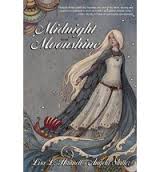
This book. Oh, this book.
It took me a few months to read this collection, this mosaic novel. This is no reflection on the quality of the book. Well, actually it is, but not the way you might think. See, I’d read a story, and then I’d be forced to close the book, sigh, and stare into space in order to wallow in the beauty of the prose. And then I’d have to go read something else, because (like with me and Gwyneth Jones’ Bold as Love series) sometimes too much beauty is painful and you need a break.
First off, look at that cover. Is she not glorious? are the colours not soothing and enticing? Created by the awesome Kathleen Jennings (who chronicles the saga of its production on her blog), I would absolutely have this on my wall. LOVE.
Angela Slatter and Lisa L Hannett created the contents. Writers who collaborate are even more of a mystery to me than authors who work alone, and to produce this sort of magic has to be just that – occult somehow. And they haven’t been content to just a straightforward story. Instead, as suggested above, this could be seen as a collection or a mosaic novel. A collection because it is made up of short stories that can basically stand by themselves. You could take one and put it in an anthology and it would still work ok. However – and here’s a metaphor I’m very pleased with – that’s like taking a candle out of a chandelier. Yes, it still sheds light. But when you put it with its fellow candles and they’re ringed with crystal, the whole effect is so much more just a few candles in one place. These thirteen stories, read together and in sequence (and wrapped in that art), are far more than the sum of their parts. Together, they create a history of an entire people: their origins, their interactions with humanity, their crises and triumphs, and the ongoing impact of a few families and their heirlooms. Thus, a mosaic novel – there is continuity, but it’s thematic and genetic; there’s only one character appears in or influences lots of the stories. I couldn’t help but be reminded of Edward Rutherford (London, Sarum) and James A Michener (The Source) following multiple generations in one place in order to fictively illustrate local history. Slatter and Hannett do just that… with magic. And Norse gods. Same amount of revenge though.
The premise, as set out in “Seeds,” is of Odin’s raven Munin (memory, here called Mymnir) surviving Ragnarok and setting out for Vinland (thought to be somewhere on the north-eastern corner of North America) with a few followers. Once she gets there, she creates an enclave and peoples it with servants, and sets out to rule it I guess like she learned from the Aesir she’s observed for however many centuries. Of course this does not go entirely well either for her or for her people. There’s love and betrayal, selflessness and vindictiveness; people get beaten up, rescued, married off, wooed… and some people even manage to make their own destinies. My estimate is that the stories take place over roughly a millennium, but that’s based entirely on the fact that that’s about how long ago it’s posited that Vikings did historically head off for Vinland and settle for a short span. The early stories take place in a sort of timeless, medieval-ish zone; from memory there are no dates in the first seven stories, and it feels like that sort of myth/fantasy where time itself is important but recording it is less so. Then, with “Midnight,” suddenly the external world exists and thrusts itself onto this dreamy place. From then on, time is relentless, and within 5 or 6 stories it’s the modern world. This development works mostly because although the stories do stand alone, there is continuity within families. Sometimes the names give them away, sometimes it’s an heirloom appearing, occasionally a reference to a past event. This often means that rather than having to struggle for a new emotional connection every time, the reader can build on the investment already made in the character’s family, from an earlier story. It’s the same reason Rutherford and Michener’s works can be successful.
And on top of all of this, the sheer beauty of the prose. I do not have the words to explain how delightful the words in this book are. It just all works.
Did I mention it’s an Australian production? Produced by Ticonderoga, in Perth.
You can get Midnight and Moonshine over at Fishpond. (Although it does ship from a US supplier.)

 Randomly Yours, Alex