The Lifecycle of Software Objects, by Ted Chiang
I read this online at Subterranean, where it originally appeared.
I found it really hard to rate this story on Goodreads. Not that I don’t think it’s an utterly incredible story – I do. But I found the very end a bit disappointing, so not for the first time I found myself longing for half-stars. And I have absolutely no idea how I missed reading it last year; I must just have completely missed the name Ted Chiang. I’ve finally got around to it now because it’s on the Novella ballot for the Hugos – against two of my all-time favourite stories, “Troika” (Alastair Reynolds) and “The Lady who plucked Red Flowers from beneath the Queen’s Window” (Rachel Swirsky).
It’s told in alternating sections from the point of view of Ana, a zookeeper retrained in software, and Derek, who’s always found a living in animation. They both end up working for a company that is creating digients – sort of like digital pets, designed to run on a platform that is as far away from Second Life as Second Life is from chatrooms, but is that sort of idea. Digients are designed as well as bred, trained as well as written, groomed as well as engineered. But much more than being a story that follows the development of a new form of digital life, Chiang also chronicles the development of Ana and Derek and their society as well, because this story takes place over years. The timeline is one of the aspects that I found less convincing, because it didn’t really seem like Ana and Derek aged. Yes, they learned, but the story must take place over at least ten years, and I didn’t think there was a big enough difference in tone or attitude for characters who experienced that period of time.
Overall, though, this is a wonderful wonderful story, and it definitely deserves its place on the Hugos ballot.
Galactic Sububria 33!
In which we wax lyrical about awards, short stories and the love of reading. Because it’s that time of year! You can download us from iTunes, or get us at Galactic Suburbia.
News
Aurealis Awards and Ceremony!
Aqueduct links to 25 commemorations of Joanna Russ
New podcast – How I got my Boyfriend to Read Comics
Last Short Story is on Twitter @lastshortstory
New Galactic Chat: Kirstyn McDermott
What Culture Have we Consumed?
Tansy: The Shattering, Karen Healey
Alex: The Wise Man’s Fear, Patrick Rothfuss; How to Suppress Women’s Writing, Joanna Russ; Welcome to Bordertown, Ellen Kushner and Terri Windling; finished Stargate SG1 for the second time.
Alisa: Ken Liu’s Paper Menagerie (F&SF March/April), Joanna Russ’s We Who Are About To
Pet Subject: Last Short Story 2011
Please send feedback to us at galacticsuburbia@gmail.com, follow us on Twitter at @galacticsuburbs, check out Galactic Suburbia Podcast on Facebook and don’t forget to leave a review on iTunes if you love us!
The Wise Man is wise to fear unfinished trilogies

I read The Name of the Wind a while ago, and had a bit of a rant then about how I was over big fat fantasy trilogies, for all sorts of very sensible reasons. And then I spent several hundred words frothing at the mouth about why that book was an exception to the rule that basically made me go weak at the knees (clearly Tansy’s Creature Court trilogy is also an exception, but at least in that case I know that a) the third is already written, and if it wasn’t… well, b) I know where she lives). I’ve had The Wise Man’s Fear sitting on my shelf for a good few months. I’ve half-reached for it a number of times, but each time my hand hesitated and fell on something else. Know what that other book usually had going for it? It didn’t weigh a kilo. Gentle reader, this book is nearly 1000 pages long, and it’s only one third of the story. The entirety of The Lord of the Rings (discounting the appendices no one reads (NB I mean including the one about Aragon and Arwen because you have to read those, but excluding the others)) is only just over 1000 pages long and people complain all the time about it being unwieldy! (Not me, but you get my drift.) So it is no wonder that the thought of picking up this tome was somewhat daunting. And then… then I was given a Saturday with no one in the house, rain outside the house, and a hankering to know what mischief Kvothe could get up to now. So I read for the entirety of Saturday (with a break for Doctor Who. And occasional food). And today, Monday, I have finished it off. The problem now is that the third book has not been written. I may actually go mad. (No, not literally.) (Oh boy. Oh no. I just realised that the book doesn’t actually say that this is a trilogy. What if Rothfuss pulls a Jordan?!?!) (The Goodreads blurb does call it a trilogy. My hair may be saved.)
I realised while reading that one of the reasons why this series feels so attractive is because it genuinely feels like a memoir. Partly, of course, that’s because of how it is written – as readers we are asked to identify almost as much with Chronicler, I think, sitting there listening to Kvothe, as we are with Kvothe himself. But it’s also because we get the nitty-gritty of Kvothe’s life, and the sheer size of the books contributes to it looking and feeling like a multi-volume biography. This vibe definitely works for me, overall. That said, for all the luscious and lavish detail spent on most of Kvothe’s adventures, there are a couple of incidents that are surprisingly and uncomfortably lacking in detail. It feels out of character for Kvothe and Rothfuss both, and threw me out of the reading experience. On the flipside, there is one incident in particular that is dwelt on in overwhelming and unnecessary detail, to the point of exasperation. I won’t discuss what it involved, since that would be quite a spoiler, but I do think the encounter could have been given half the words and still have been shown to be appropriately significant. It’s one of the few times that I found myself growing impatient.
We pick up the narrative with Kvothe beginning the second day of his recitation for the Chronicler. He continues to discuss his life as a student at University, with most of the same problems that he left off the first day still to tackle: what to do about Ambrose and Denna, how to get money, and how to have all his questions answered. About a third of the book is set at the University again, and it’s a tribute to Rothfuss that I didn’t find this section repetitious. Instead Kvothe genuinely progressed, with his teachers and his friends and his studies, as he ought. Eventually, other adventures beckon, and the reader is introduced to more of this world that Rothfuss has created as Kvothe travels about. I particularly liked that Kvothe visits a culture that is very, very different from his own, in the Adem. Rothfuss introduces fascinating small differences that together make a world of alienation – one of them being that women are most definitely viewed as equal to men. This is not to say that Kvothe’s regular culture is incredibly biased, but seeing the Adem made me re-evaluate “the Commonwealth” – and not in a good way. Pointing out the flaws in his main culture is a brave thing for Rothfuss to do – not that he ever claimed that it was perfect. Additionally, the Adem have a very different way of thinking about life, and these attitudes certainly made me think both about the book-world and our own; that the Adem view everyone else as barbaric certainly gives pause for thought. (It’s also interesting to reflect on the fact that Rothfuss does all of this without making them the urbane intellectual effetes that Eddings did with the Malloreans. They feel like an amalgam of Rome and Sparta, with other bits thrown in for good measure.)
Once again, along with enjoying the adventures of young Kvothe, I was really pleased by the scenes with contemporary Kvothe, or Kote. The insights provided, of his relationship with Bast on the one hand and the general bitterness and resignation he feels on the other, are a large part of what is driving me to so desperately want to find out what happens in this story. The fact that it is a memoir makes it all the agonising. I already know about his magic and his ability to get into trouble everywhere; I need to know how he comes by all of those other experiences and skills that made him the legend he so clearly is, when he is recounting the story. We start to get an understanding of Kvothe’s legend towards the end of this instalment; the nerve and subtlety at play, and the insinuations Rothfuss makes, are frankly marvellous. (Also, I really really need to know about Denna (I don’t think it’s a spoiler to say that that is in no way resolved in this book).)
So now I have to wait for the third to be written. I am unimpressed.
Love and Romanpunk: not a review
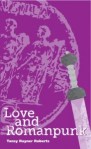
This is not a review. It can’t be, really. Partly because it’s by a friend – although I have reviewed Tansy’s work before, and that by other friends too (fortunately, I usually like it, so that’s no hardship). No, the main reason why this isn’t really a review is the dedication. It’s dedicated to meeee!! Tansy says that this is dedicated to Random Alex (heh), and that I am totally wrong for liking Marc Antony more than Octavian.
Of course, she is totally wrong about that. How could anyone appreciate a psychopathic megalomaniac, who played up his relationship with Caesar in order to capitalise on Roman sentimentality and killed opponents willy-nilly, who rewrote history to make him and his look better and changed laws to suit himself, and who was utterly ruthless when it came to his family? Especially when said ego-tripper is set in opposition to a man who evinced so much humanity that he loved a non-Roman woman and anticipated that his children with her would actually inherit from him, whose prowess in battle didn’t need to be eulogised by an imperial flunky, and whose generosity was legendary.
Ahem. So Tansy and I have some… issues. Clearly, however, she loves me despite our differences, and that’s very nice indeed. She did put me in a slightly awkward position, though, when I made her sign my copy: she said (in caps no less), that I HAVE TO LOVE THIS BOOK.
Oh yeh, no pressure.
I am, of course, a fan of Roman history. I studied at uni, and I even wrote my honours topic on Nero and his love of Greek things. Thinking about Tansy’s area of study, though – Roman imperial women – makes me realise that my study of Rome was entirely typical. That is, a bit of the Gracchi, Marius-Sulla-Caesar, a run through of the Empire… and a little bit of ‘daily life’ blah. Not a whole lot on women , really, except where they happen to be interesting either for genealogical reasons or because of their notoriety. Like Julia Agrippina Minor. I’ve always liked her.
The first story in this collection is “Julia Agrippina’s Secret Bestiary.” It gives a potted history of the Caesar family… with added monsters. I really enjoyed Tansy’s characterisation of the various members of this crazy family. She captures an essence, I think, of the various emperors and their wives/sisters/mothers that actually rings quite true. I particularly liked that although Gaius – Caligula – is shown to be a bit nuts eventually, he’s handled much more sensitively than most other fictional representations bother. Of course. And the monsters made a bizarre sort of sense; they fit in delightfully well with the overall vibe of the story.
The stories progress chronologically through what Tansy affectionately calls the Agrippinaverse. The second story is “Lamia Victoriana” – lamias being the Roman equivalent of female vampires. Here, in Victorian England, Fanny and Mary run away “with a debauched poet and his sister,” as the blurb has it, with the coda that “If it was the poet you are thinking of, the story would have ended far more happily, and with fewer people having their throats bitten out.” The blurb is, by the way, one of the most enticing and true to the story that I’ve read in a long time. It gives an accurate, and seductive, portrayal of each story, and teams that with snarky comments which perfectly fit the tart, sometimes lovingly exasperated, voice of the stories. This second story is the odd one out in some ways; it’s a great story, still, but it’s different in mood and tone from the other three. Darker.
“The Patrician” is the story written in a time most clearly like our own… if Australia had a recreated Roman city somewhere. This is in many ways the centrepiece of the collection. Clea Majora meets a stranger visiting her town, and gets drawn into an adventure even weirder than living in a town called Nova Ostia. There’s not much to say without giving away the awesome way in which the story develops. It’s brilliant. Everyone should read it. It stands by itself as well as being perfect within the context of the other stories.
Finally, the collection is rounded out with “Last of the Romanpunks.” Where the first story is basically historical fantasy, and the second riffs off the Gothic sensibilities of the Victorian era, and the third is beholden to urban fantasy, the fourth ventures into science fiction territory. Managing all four of those genres, clearly connecting the stories through characters and ideas but keeping the vibe of each distinct, is quite the feat. Anyway, Tansy decided to close the collection with a bang, since I think of this story as the most action-based of the four. And again, very enjoyable.
So… it wasn’t going to be a review, but I guess it sort of has. Oops.
Galactic Suburbia 32
(It’s now older than me!) (just)
On Joanna Russ: some reminiscences (and here), and Samuel Delaney’s interview with her (transcript only).
Alisa: Madigan Mine, Kirstyn McDermott, Fringe Season 3
Alex: Deep State, Walter Jon Williams; Shattered City, and Love and Romanpunk, Tansy Rayner Roberts; Pushing Ice, Alastair Reynolds; Troubletwisters, Garth Nix and Sean Williams.
Tansy: Doctor Who & Big Finish audio plays (The Eighth Doctor Adventures).============
Announcing upcoming Spoilerific Book Club on Joanna Russ with particular focus on The Female Man, How To Suppress Women’s Writing and short story “When it Changed.” Read along with us!
Galactic Chat interviews Glenda Larke
Please send feedback to us at galacticsuburbia@gmail.com, follow us on Twitter at @galacticsuburbs, check out Galactic Suburbia Podcast on Facebook and don’t forget to leave a review on iTunes if you love us!
Pushing Ice: it’s what we do
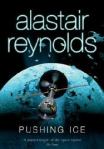
(Amusingly, I blogged about this book the first time I read it… five years ago!)
…mild spoilers…
So my love of Reynolds’ work is becoming embarrassingly well known. To the point where a number of people at Natcon asked me which one they should read. The first person to do so admitted that they are not huge fans of very far-future SF, which therefore makes House of Suns – probably my favouritest of his books ever – a bit inaccessible. And I wasn’t sure how she felt about the slightly baroque-feeling SF that is Revelation Space. So I suggested Pushing Ice, because I cannot bring myself to recommend Terminal World (I am still getting over that disappointment and will have to read it again sometime to figure out whether I am being silly or not). And I recommended it to a few other people, too… and then realised that I hadn’t actually read it since that first time. I’ll admit to being a little worried that maybe it wasn’t as good as I remembered, because then I would be responsible for other people not liking Reynolds, and then MY LIFE WOULD BE OVER.
Ahem.
Anyway, the prologue made me actually wince when I read it… because it’s set 18,000 years in the future. Oops. Happily, it’s a fairly accessible 18,000 years in the future, because it’s about a politician making deals and proposals. Her name is Chromis Pasqueflower Bowerbird, and the parliament is made up of several solar systems, but still – it’s familiar. And then it goes waaay back in time to 2057, where Rockhopper is an asteroid-mining ship about to be sent on a rather extraordinary mission. Janus, one of Saturn’s moons, suddenly starts acting in a most un-moon-like manner, which is of course something to be investigated.
What happens during the chase, and after catching it, is what the plot revolves around. But it’s not a story about technology, or a first-contact story (although there is some of that), or even really about the exploration of space. Instead, it’s about the human interactions that take place in situations like this: a small number of people confined together for an extended period of time; a small number of people forced to make difficult, sometimes lift-threatening decisions. And at heart it revolves around the friendship of two women: the captain of Rockhopper, Bella Lind, and her best friend Svetlana.
The plot, while linear (with the exception of the prologue), does not simply follow the spacers through their adventures, one after the other. Instead it skips forward several times, sometimes over decades. After the initial adventure of chasing down the ‘moon’, and the repercussions of doing so, the narrative essentially consists of extended snapshots. It shows how society changes – and remains static – over those periods; it looks at how human interactions change, and how small things impact on major decisions. How one grudge can change the way a whole community works.
I loved it. Again. I loved the space bits and, I guess, the more specifically SF bits; they weren’t too tech-heavy, but definitely detailed enough to be enthralling. The interactions with aliens (spoiler!) were cleverly, and sympathetically, and subtly, done.
I loved the depiction of how a society might function in an enclosed space, and over such a long time, too. It’s probably a bit romantic in that the society doesn’t completely implode, but I’m fine with that – there are other places for reading about societies that disintegrate horrifically.
I liked the characters. There are none that I can say that I actually loved – they’re just not that sort of people, which I perversely liked, because it pushes them more towards the believability end of the spectrum. Neither Bella nor Svetlana, leaders at different points in the narrative, come out as particularly rosy – one looks slightly better, at times, but both are, simply, very human. Flaws, frailties, grudges, narrow-mindedness, ambitions… hopes, dreams, and sacrifice.
So, I’m happy with having recommended this! It’s a fairly good example, I think, of what Reynolds writes. An awesome reach, cool characters, and galactic-yet-still-human ideas.
I’m enjoying re-reading.
Troubletwisters: a review

I am a long-time fan of both Garth Nix and Sean Williams (more so the latter’s SF than fantasy), so the idea of a collaboration between the two – aimed at children – is exciting indeed. And I was fortunate enough to hear Sean Williams speak about the act of collaboration at Natcon50, where he discussed the different things that each brought to the writing: that (I think!) Williams wrote the first rough draft, then Nix added bits and changed bits, and sent it back again… and so on. I was particularly amused to hear that the two got into some serious brinksmanship over who could be the most gross, since they are both little boys at heart, so I intrigued to read and discover what this looked like in practice. (The answer: they do indeed manage to be quite gross. I am not a fan of rats or cockroaches.)
Troubletwisters harks very strongly to the classics of fantasy written for younger readers. The main characters are twins: Jaide and Jack. (In talking about the story, Williams admitted that he has long been intrigued by twins and their use in fiction. As I see it, it’s almost like you’re getting a character for free – and it means that you always have the opportunity for your characters to discuss things, disagree about things, or be worried about someone.) Their father is away a lot, and they know nothing about his side of the family… until a disaster means that they have to go and stay with their mysterious paternal grandmother, where they begin to learn about some strange abilities. These plot devices could have felt hackneyed and stale, being by no means original; instead they feel familiar, but by no means comfortable. Williams and Nix use the twins as a means of exploring different reactions to scenarios and individuals, and there are indications that the two will have different experiences of their abilities that will be explored in later books of the series (there will be another four). The trope of leaving home and going to an alien place is as old as fiction itself; it can be, and is used here as, the catalyst for self-discovery and learning about the world. The strange relative and slightly intimidating new environment – Grandma X and her weird house – are perfect for the target age-group: visiting unknown relatives can be a very scary thing indeed.
The plot moves quickly: the twins arrive at their Grandma’s house and soon things start to go wrong. Additionally, weird things happen when they are around: a sign their mother can’t see, a freak whirlwind, talking cats…. There is, of course, a reason for this – it’s their nature – and the narrative is largely concerned with the pair beginning to learn about their abilities, and what it means to use them. Of course, they can’t simply do this is peace and quiet. Instead, they are confronted with a rather nasty villain, and it’s in dealing with this villain and its impact on their environment that they really start to learn about what it means to be “troubletwisters”. While the twins are allowed some breathing space – Williams and Nix don’t pretend 12-year-olds can simply go on throughout the night – the main action takes place over only three or four days, so it does feel a bit relentless. Since this is certainly how it feels for Jaide and Jack, that’s a perfectly reasonable feeling for the reader.
As with Nix’s Keys to the Kingdom series, which shares a certain tone with Troubletwisters, it’s unclear what country this book is set in. Grandma X lives in Portland – but not the one you’ve heard of. Reading as an Australian, I could well believe that this was set on the Victorian coast. Having visited the UK, I can imagine it set there, too, and I imagine that setting it in America would be as easy for readers there. This ubiquity is no doubt good for getting international readers; it also gives the book a certain Everyplace vibe. This could happen to anyone, anywhere.
I have two, fairly minor, quibbles with this book. The first is the naming of the twins. I quite like the names Jaide and Jack… but those names are short for Jaidith and Jackaran. These names simply do not work to my ear – Jackaran in particular seems too complicated, and I am not a huge fan of made-up names in a real-world context. I really hope that there is an explanation for the names in later books. On the same topic, but in the opposite direction, I was disappointed by the lack of originality in naming the villain (which I won’t reveal here). It seemed too mundane for something that so threatening.
Overall, then, this is a marvellous opening to what promises to be a very interesting new children’s fantasy series. It sets up the main characters as attractive and interesting, although not without their problems, as well as introducing some supporting characters who will no doubt go on to be important (did I mention the talking cats?). There is clearly a problem to be resolved – what to do about the villain – as well as a quest, in learning to use and control their abilities. Plus, of course, there’s the issue of their slightly fractured family, which will no doubt continue to be an issue that the twins have to deal with. I have faith in the two authors that this series will continue to be enjoyable, without being predictable.
This is not the podcast you’re used to
At Swancon, I got together with a number of other awesome Aussie podcasters to record a megapodcast: Helen Merrick from Pangalactic Interwebs, Jonathan Strahan from Coode St, and Kirstyn McDermott from The Writer and the Critic. We spend an hour arguing over what bits of fantasy and science fiction people should – nay, must! – read or view. It was immense fun. I did nearly lose some friends by suggesting Lord of the Rings and admitting that The Fifith Element is my favouritest movie of all time… but I think they forgave me.
You can stream our marvellous podcast over at The Writer and the Critic, or you can also get it from iTunes by going to their podcast bit there. Thanks to Kirstyn for hauling her gear over west and making us sound professional!
Galactic Suburbia 30
Sorry, let me rephrase that: DITMAR-WINNING Galactic Suburbia, episode 30 ( 🙂 ) recorded live at Swacon36|Natcon50
News
Shirley Jackson nominees
PK Dick awards
BSFA awards
SF Hall of Fame inductees
What Culture Have we Consumed?
Alex: Kraken, China Mieville; Doomsday Book, Connie Willis; Mappa Mundi, Justina Robson; Brasyl, Ian McDonald; Nightsiders, Sue Isle
Tansy: The Clockwork Angel, by Cassandra Clare, The Last Stormlord by Glenda Larke, Fun Home & Dykes to Watch Out For by Alison Bechdel, Tales of the Tower: the Wilful Eye edited by Isobelle Carmody & Nan McNab, especially “Catastrophic Disruption of the Head” by Margo Lanagan, Nightsiders (twelve planets 1) by Sue Isle.
Pet Subject: Indie Press: Alisa talks Ebooks!
Please send feedback to us at galacticsuburbia@gmail.com, follow us on Twitter at @galacticsuburbs, check out Galactic Suburbia Podcast on Facebook and don’t forget to leave a review on iTunes if you love us!
Deep State: a review
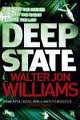
Dagmar Shaw is a game designer, but her games are way more interesting than any MMORPG that exists today. I never entirely came to grips with what Alternate Reality Games actually entail, but it has players follow a story, interpret clues online, and it sometimes has real-world connections. The story opens with Dagmar Shaw designing a James Bond movie tin-in game that sees some players going to Turkey to actually follow some of the action in real life, while tens of thousands of others follow the video and other media Dagmar and her employees upload to the web. She runs a successful game, and is then recruited by a US – ah – security specialist to do some interesting things in Turkey. Which she does. Things do not go entirely to plan, not unexpectedly.
It’s interesting coming to Deep State after having read The Dervish House. Both are set in Turkey, but that’s about where the similarities end. The plots are entirely different, and Deep State isn’t as futuristic as Dervish House. More interestingly, where McDonald made almost all of his characters Turkish, and events happen exclusively in Istanbul with little reference to the outside world, Williams has only a few Turkish characters, and the plot revolves around foreigners getting themselves involved in Turkish politics. Williams does seem to know Istanbul, but he doesn’t evince quite the same love for the country as McDonald; and Turkey is not of the same fundamental importance to Williams as it was to McDonald. Deep State could as easily be set almost anywhere but Western Europe, I think. Turkey, although quite well realised, is not irreplaceable.
This is, it turns out, the second book about the main character here, Dagmar. She has a few flashbacks to the events of the first, This is Not a Game, and there are a few aspects of her character that are not entirely explicable but would be, I think, with knowledge of earlier events. However, it does stand alone fairly well.
The story is well-paced. The opening, with the James Bond game, is as exciting as it should be. There are lulls in the action for character development, the action is spread over a few different characters, and it wraps up nicely. I enjoyed the politics, although I’m not au fait enough with the current Turkish situation to know whether it is completely believable or not. The characters are not the most well-developed I’ve ever read, but they were more than sufficient to carry the plot. Dagmar herself is quite complex enough to be interesting; she had a difficult childhood and still suffers from the aftereffects of the events of the first book. These make her more than simply another game designer, as well as more than simply a cipher. Her boss is appropriately mysterious, while the members of her team are varied enough to provide interesting interactions. I really enjoyed the snippets of online discussion that were included; it was a nice touch. Overall the book could have done with a few more female characters; given that most of them are computer-types of one sort or another, there’s not even the (weak and laughable) excuse of needing men to do the action stuff. There were, I think, only three female characters, and one of them was almost incidental. This was my main disappointment with the novel.
Aside from the plot and the characters, the really cool part of the book – and one that, I must admit, I probably didn’t appreciate as fully as I might have – was the tech side. The creation of the ARG by Dagmar and her team, the way in which they manipulate video, the technology they use to keep track of everything: very, very cool.
Deep State is immensely enjoyable. I have put the first book on my to-read list, and expect that there will be a third at some time which I will definitely be seeking out.


