Red Gloves are a bit creepy
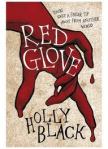
This is the second book in the Curse Workers series. As such, it almost certainly contains spoilers for the first, White Cat (which was awesome).
We left Cassel Sharpe having discovered that he is not only a worker – possessed of magic – but the mightiest of all workers, capable of transformation magic. He had also discovered that his brothers had been using him as a tool for murdering people, that he had turned his best friend into a cat (which is better than having killed her, which he had thought), that she has now been cursed to love him, and that life is not, actually, going to be easier now that he is really part of the family. I think it’s fair to say that White Cat was a moderately dark book. It’s also fair to say that Red Gloves is, too. It’s not like things really can improve when you’re regarded suspiciously by most people at school, you’re in love with someone who’s forced to love you, your mother encourages you to help her con people, and you can’t trust either of your brothers. Oh, and your grandfather is a death worker, magic is illegal, and the mob wants a piece of you.
Fun times.
This is definitely a sequel. You could probably get by without knowledge of White Cat, but it would likely drive you a bit nuts. And rightly so; the power dynamics of the Sharpe family, and interactions with the Zacharov family, were neatly set up there and carried through here. (Also, at under 300 pages and a ripping read, it’s not like it would be a chore.) Those dynamics are fundamental to the plot of this story because when Cassel’s oldest brother, Philip, is murdered, both the Feds and the mob (with magic being criminal, of course there’s an underworld) come calling, wanting Cassel’s help and/or connivance. Cassel has to figure out how to deal with both sides of the law, not get kicked out of school, not get his mother sent back to jail, and how exactly to cope with Lila-in-love. It would be nice to know who is actually responsible for Philip’s death, too. There are some amusing moments in this book, mostly thanks to the witty banter that Black pulls out, but it is no light-hearted romp. The problems Cassel faces cannot be dismissed with witty banter and a clever con, much as he might like to.
I saw someone describe this as a ‘slice of life’ narrative, and that’s pretty accurate. There’s a fair bit of what could be seen as downtime – it’s not an action-on-every-page thriller, by any means. There’s having dinner, and doing homework, and catching up with friends. But neither is that dead time, because it’s developing characters, and the characters are a large chunk of what is so appealing about this series. Cassel himself is a very believable teen. His angst is real and heartfelt but also not overwhelming – broody Cassel never lasts that long; his family and friend relationships are appropriately messy and difficult to navigate. His school friends, Sam and Daneca, continue to play a large part in his life – helping, hindering, comforting, playing fall-guy. Their relationship also changes, separate from Cassel’s traumas. And then there’s Lila, who although central to White Cat in so many ways – her ‘death’ obsessing Cassel no end – hardly developed as a character at all, for obvious reasons. She gets much more of a showing here. Her awareness of the love-curse and her struggles with it are fundamental to much of Cassel’s own experiences. She doesn’t have much of a life apart from him, which makes sense in context, although towards the end there are some intriguing indications of What Might Be. In terms of minor characters, we get much more Mother Sharpe, which is fun if at times rather disturbing – the opportunities for emotion workers to be seriously creepy are legion. There wasn’t enough Grandpa for my liking, but I guess you can’t have everything.
The wider world of magic prohibition is slightly expanded in this volume, although the focus is still fairly tightly on Cassel and his issues. The main problem facing workers in New Jersey is a new proposal that would see everyone tested to find out whether they are hyperbathygammic – magical. The question then of course is how, or whether, that information would be kept private – and the fear is that the government would use that knowledge for nefarious purposes. There are overtones of the concerns raised by comics such as X-Men, of course, as well as other more general concerns about what the government (and other agencies, hello Faceblah) might do with personal information. There’s a very pertinent discussion of politics within this riveting fantasy.
I can’t wait for the third book.
Tiptree link of interest
This is from a while back, but Niall Harrison of Strange Horizons wrote about Her Smoke Rose up Forever and raised some interesting issues about some of the stories – including “Houston, Houston, Do you Read?” Some of the comments are very interesting too. Those of us who are reading the anthology for the Book Club started by Dreams and Speculation may find it stimulating – although I did skip over some of the discussion, because I haven’t read those stories yet!
Miles grows up: my Bujold discovery continues.
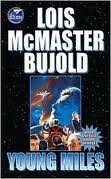
Tehani and Alex forge on to the end of the second Vorkosigan omnibus, watching Miles grow up and cause havoc. Alex falls further in love with the universe and Tehani watches gleefully. Spoilers! (We’ve reviewed Cordelia’s Honor here, and The Warrior’s Apprentice here.)
Tehani:
“The Mountains of Mourning” was an early foray into the Vorkosigan world for me. It was available for free from the Baen e-Library and I downloaded it, among a bunch of other stuff. It’s a novella, not a novel, and it is somewhat different to most of the other Miles books. It’s a rather introverted story, in which Miles is given an opportunity to consider the Vor aspect of himself and what it means, at the same time as confronting some ingrained social issues in his society that relate directly to him. “Mountains” gives us a rather more thoughtful Miles than we saw in The Warrior’s Apprentice, and fills out a bit more of his personality, and, again, grounds his honour more solidly. It’s a sad story, but one that ultimately fits in very well with the overall world-building.
June Tiptree book club discussion
Along with everyone else, I was sad to see that TJ had made the (sensible!) decision to let her blog, Dreams and Speculation, go. I came across her because of the Women in SF Book Club, and have so far really enjoyed the books and discussion. Rather than letting a good thing go, Shara at Calico Reaction and I have made the decision to jointly host and continue the Book Club; she’s doing the novels, and I get the joy of talking about James Tiptree Jr. So, welcome! And enjoy.
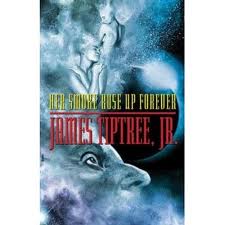 June’s story from Her Smoke Rose Up Forever is “Houston, Houston, Do you Read?” – a story I have previously read as novella double, paired with Joanna Russ’ “Souls” (there’s a headspin for you). What follows is some of my thoughts on the story – completely full of spoilers, so if you haven’t read it yet, back away! Following in TJ’s footsteps, I’ve added a couple of questions at the end of the post – feel free to consider them in the comments or completely ignore them, as you see fit.
This story sees three astronauts on a solar mission; they encounter a flare and when they come back around to the Earth side, things are… different. Houston doesn’t answer, but someone else does. They get picked up by a very different spaceship, one that seems almost entirely crewed by women – and it’s several hundred years into their future.
This story does what my favourite stories do: with an awesome sf story, its focus is on the people – their reactions, their attitudes, their problems. The astronauts are appropriately different from one another such that a range of reactions can be explored, but they don’t feel like ciphers; Tiptree deftly sets them up as individuals. I believe this story first came out when Tiptree’s true identity was unknown; all I can say is, Seriously? Did they just not see the feminism?
Anyway, the slow unravelling of the men’s good nature at being rescued by women is very cleverly done. I found the attitudes of the men towards the men really quite harrowing; their patronising tone, their easy assumption of supremacy, automatic belittling of the women’s competencies – it was presented as so horrendously normal and obvious. Bud, in particular, is horrendous in his attitude towards women as nothing but sex objects. That said, in some ways Lorimer is almost more horrifying; as the narrator and because of his scientific background I felt sympathy for him, but still his attitudes and perceptions of the women are almost entirely sexist.
The gradual reveal that not only is the entire ship crewed with women but the entirety of the human race is women, thanks to an epidemic three hundred years previously, is very cleverly handled. The idea of a single-sexed humanity has been explored in other science fiction, with varying results; I quite like this idea, with clones to allow reproduction. The most poignant reflection on the differences between a single-sex and two-sex world comes right at the end, when Lorimer tries to defend Bud and Dave’s aggressive actions. I could almost feel sorry for all of them at that point.
Questions:
1. Did you pick that the future society was single-sexed before it was revealed?
2. Was the futuristic society believable for you?
3. What were your reactions to the men’s characters and attitudes?
4. This story was published in 1976. Do you think it is still a relevant story?
Bujold: the saga continues. Or begins.
Tehani and Alex continue their conversational review of Lois McMaster Bujold’s Vorkosigan saga – Alex for the very first time. Spoilers ahead. (We have previously discussed the omnibus of Cordelia’s Honor here.)

Young Miles omnibus: Warrior’s Apprentice.
Tehani:
Warrior’s Apprentice was actually one of the last Vorkosigan books I read, despite it being the very first Miles book in the internal and publication date chronology. I probably couldn’t tell you which book I actually started with, but I know Young Miles (which contains this novel) was the last omnibus I worked through on my first time read. It was quite strange at the time, reading it with all the knowledge of what was to come but absolutely fascinating to see where the split personality that is Miles – Lord Vorkosigan of Barrayar, and Miles – Admiral Naismith of the Dendarii mercenary fleet, really began. It absolutely encapsulates everything we come to know of this mad little man – the fly-by-the-seat-of-his-pants ingenuity, his hyperactive intelligence, his sarcastic dry wit, his absolute faith in the abilities of those around him to do everything he thinks they can and more. We as the reader can’t help but fall in love with him as he careens from crisis to crisis, almost falling flat on his face more times that we can count but with that incredible brain working ten steps ahead of anyone else.
Well, that answers my question about the significance of the mercenaries! I figured they would continue to crop up; it seemed like too much perfect setting-up to simply have them only play a bit part in the continuing saga. Your assessment of Miles is spot on, and I think his faith in others is one of the more interesting aspects of his capabilities as a leader. It’s a much more realistic view, for a start. I guess you could argue that it allows Miles to get away with stuff that he really shouldn’t, and perhaps he could be seen as grasping too high/too fast; but really the ability to inspire others, and knowing when and how to use others (in good ways) is key to any leader actually succeeding. I was amazed by the careening – it was like watching someone who is just on the brink of falling flat on their face but instead manages to turn into semi-competent running. Also, the speed with which he went from washed-out wannabe officer to recruiting his first fellow-washouts was hilarious. Watching the development of the Dendarii force was mesmerising… like watching an avalanche and not knowing whether this is a good thing or a bad. It’s so unlikely, and yet… it works.
Tehani:
In this book, we get our first glimpses of the darkness that dogs Miles, a counterpoint to his hyperactivity and seemingly endless hubris. Always the outsider on Barrayar, set apart by his physical deformities as well as his intelligence and questioning mind, Miles suffers greatly when facing rejection or personal failure. This ties into both his sense of honour, instilled by his family and his social environment, and his own desire to prove himself. In Warrior’s Apprentice, he faces down defeat and finally feels like he’s made something of himself. But of course, what he’s made is completely made up! It’s a fascinating premise, and the action and characterisation, of even the most minor characters, is what makes it work.
Honour is clearly going to play a seriously large part in the whole series – the Cordelia books set that up, of course. I was amazed by the fact that he failed his physical, and deliberately within those first few pages! Not exactly an auspicious start for a hero. And the continuing darkness that, indeed, dogs him, is fascinating. It too lends Miles a sense of reality; he’s closer to three-dimensional because of it. I’m going to be really interested to see what Bujold does with that. I can see ways that it could be done badly – wallowing, or using it as a mark of a hero, getting repetitive or eventually letting it slip away without explanation… I hope none of those come about!
I’m assuming at this point that one of the reasons for Miles’ despondency in later books is the loss of the lovely Elena. Their relationship was a really fascinating one. I had assumed from early on that Elena and Miles would end up growing up together, and was curious to see where that went. I was saddened that it didn’t out with her! I really liked the honesty of Elena’s reaction to Miles’ declaration of love, though – that she would be swamped by him, which is I’m sure a fair assessment. To see her develop as a character, and to see Miles encourage her in that even as it means she’s growing away from him, was a really nice touch of character development. It must be said that Elena’s wedding to someone else was not the moment at which I had tears in my eyes, though. No, that was reserved for Bothari’s funeral. It was heartbreaking! And I was surprised that she got rid of him so early in the series, but I guess it would have been awkward for a cadet in the Imperial Forces to have a bodyguard all the time. Connected with Bothari is the other rather raw moment of emotional honesty: when Miles stupidly tries to bring Bothari together with the original Elena. Her hatred and revulsion of Bothari are so appropriate, and it was nice not to have an author thinking that should be smoothed over for … I don’t know what reasons can be used there, but I know it’s been done.
Tehani:
Oh, Bothari! I always forget that he dies here because Bujold lets him live large in Miles’ life in future books, simply by way of the enormous presence the Sergeant had in his early life. It was a spectacular way to demonstrate that no-one is safe in Bujold’s books, no matter how much of a staple they might appear, and also a very apt way to resolve (sort of) Elena’s mystery. To be fair, it also ties into helping Elena say no to Miles’s mad proposal – knowing the truth about her origins could have only strengthened her knowledge that realistically, a marriage to Miles would in no way be condoned on Barrayar. And Elena too was brought up with the same strict sense of honour that surrounded Miles, so it was something she could no way get around. Poor Miles – with the mother he has, only a certain type of girl is ever going to appeal to him, but finding the one who can cope with him, and his background, is never going to be easy!
I was impressed by Bujold’s treatment of Miles’ disability in this book. I had wondered whether it would simply pop up when it was narratively convenient, but the reader is hardly ever allowed to forget it – like Miles – not because it’s being forced down your throat but because she keeps reminding you that his legs drag, or limp, or that he’s slow and wears braces, and so on. It’s genuinely a part of the story, and that’s really really nice.
Also, one of the nice things I picked up – eventually! – is the fact that the pilot is Mayhew: presumably the same Mayhew who has a cameo as the pilot gulled into helping Cordelia escape Beta Colony. Nice tie in!
Tehani:
Ooh, I never figured that out! I’m a terrible reader – I am hopeless at noticing cameo characters!
I continue to be hooked. Questions raised: where will the Dendarii fleet end up next? What assignment will Miles end up with at the end of his training? Will Elena feature in the later books?
Tehani:
Again, I only answer one questions – YES, we will have more Elena! 🙂
Fly By Night: a review.
 Mosca Mye, 12 years old and named for the common housefly, has escaped the dreary confines of Chough with Eponymous Clent, a swindler, and Saracen, a goose. What could possibly go wrong?
This book was written by someone (Frances Hardinge) who loves books and words, for all of us who do likewise. It’s utterly enchanting, with a sly sense of humour and delightful characterisation. I just love it. I read it when it first came out, and reviewed it for the Victorian Association for the Teaching of English. I believe I had grand plans of donating the book to school; I think I convinced them to buy their own copy instead. I have re-read it this past weekend because I discovered that Hardinge wrote a sequel, and I finally got my hands on it… and it reminded me of how passionately I loved it the first time. Surely, I thought, the Suck Fairy can’t have visited in six years? Happily, she hasn’t.
Mosca lives in a world that borrows liberally from the Britain of the early eighteenth century but also, as Hardinge herself warns, takes great liberties with anything resembling historicity. It’s a world of coffeehouses that float on the river; beautiful ladies in awesome gowns who go to watch beast matches; men with monocles and gloves and dastardly plans; and one girl who can read, is desperate for words and stories, and has a rather large dollop of bloody-minded determination in her head. Who else would kidnap a goose when she runs away? And who else could persuade the goose to hang around? The world’s resemblances to historical Britain also include a recent-ish Civil War, but here the result has been a Fractured Realm: no monarch has been properly proclaimed, and Parliament is dithering in its effort to confirm one (and has done so for decades). Religion, too, has been fractured, and it’s based loosely on the Protestant Reformation and Catholic Counter-Reformation (I’ve just realised; sometimes I am seriously dim).
So Mosca runs away from the sodden Chough, after rescuing Eponymous Clent (I never get bored by that name); they have various adventures, and end up in Mandelion, where yet more adventures await them. There are traitors, and mysterious benefactors, and villains-who-aren’t, and a just-manageable cast who remain entertaining and enthralling for the entire story; I certainly never got bored by any of them. Mosca demonstrates hidden strengths, as befits a plucky heroine, who at times descends to genuinely murky depths. Hardinge plays very interesting games with Clent, leaving the reader guessing for quite a long time as to whether he is a blood-sodden genius or a silver-tongued skin-of-the-teeth and seat-of-the-pants petty crim. Even Saracen the goose has some wonderful moments.
The narrative is entertaining, the characters are endearing, and the world is enthralling. Over all and in all and making it all wonderful, though, is the prose. Hardinge has a wonderful turn of phrase, full of alliteration and poetic language. It never falls into the flowery trap, mostly because it’s often in Mosca’s mouth, which means it tends towards acerbic instead.
Example 1:
The roof of the dovecote stealthily rose, and two sets of eyes peered out through the gap. One pair of eyes were coal beads, set between a bulging bully brow and a beak the colour of pumpkin peel. The other pair were human, and as hot and black as pepper.
Example 2:
Clent: Where is your sense of patriotism?
Mosca: I keep it hid away safe, along with my sense of trust, Mr Clent. I don’t use ’em much in case they get scratched.
Hugely recommended.
The discovery of Bujold: Cordelia’s Honor
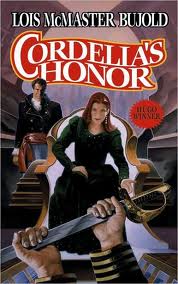 Alex has never read anything by Bujold. Tehani is a long-time fan. Welcome to a conversation of discovery and re-reading that will undoubtedly include a lot of squeeing, spoilers, and misdirected guesses from Alex. Also a fair bit of meta-commentary, since we can’t help ourselves. There will be spoilers.
It’s so wrong, isn’t it?
Awesome 😀
The Secret Feminist Cabal – now with extra awards
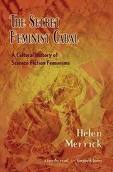
Since I wrote this review last year, The Secret Feminist Cabal has placed on the Honour List of the James Tiptree Jr Award, and I received a Chronos Award (voted on by the Victorian SF community) for the review itself. Allow me this gratuitous moment of reposting! The other exciting thing that has happened since is that I got to spend time with Helen Merrick herself – an utter delight.
The Secret Feminist Cabal: A Cultural History of Science Fiction Feminisms
Helen Merrick
Aqueduct Press, 2009
“… what kind of self-respecting cabal would openly advertise its ‘secret’ existence through websites and conventions, identify its members through the wearing of garish temporary tattoos, and fund itself by the sale of home-baked chocolate chip cookies?” (p1)
I did not grow up considering myself a feminist; I have no idea whether my mother would identify as a feminist or not. That said, I grew up in the ’80s with a younger brother and there was never a time at which I felt that I could not do exactly the same things as my brother, if I wanted to, so I know (now) that I benefited from second-wave feminism – and from liberal, caring parents. I was regarded as a feminist by at least some people by the time I was in my late teens (looking at you, high school teachers), probably because I was loud and everyone loves a stereotype. It’s only been over the last decade (my twenties) that I have consciously thought of myself as a feminist. And it’s only been in the last couple of years that I have consciously sought out feminist books, feminist perspectives on historical issues, and really come to grips with the idea that feminism is not a singularity.
All of this is by way of contextualising my reading of The Secret Feminist Cabal, a marvellous book that has challenged the way I think about science fiction, fandom, and feminism. Merrick had me from her Preface, where she describes her journey towards writing the book in ways that resonated deeply with me, from the nerdy adolescent to the discovery of feminism and the dismay that many female acquaintances not only do not share our love of science fiction, they are completely mystified by it. Having only recently discovered the niche community that is sf fandom, the fact that so much of this book is concerned with expressions of feminism within that community – and how they impacted on sf broadly – was the icing on the cake.
Merrick begins by examining the very idea ‘feminist sf’, defining which – much like attempting to define sf by itself – is like the proverbial attempt by blind women at describing an elephant. She approaches it by discussing the multiplicities that are the reality of the genre, which is indicative of the approach she takes in the book overall and an incredible relief for those of us who are sick of being told THIS IS THIS and if you don’t fit, get lost. She also gives some space to justifying the use of literary criticism on science fiction, tackling that persistent and derogatory argument that science fiction doesn’t count as literature. While accepting that sf and popular fiction generally have an ambivalent position, as far as literary critics – including feminists – are concerned, Merrick makes no apology for using their tools. The rest of the introduction lays the groundwork for the book: what feminist fiction is or can be, the potentially problematic nature of feminist genre writing, and the ongoing divide that exists between mainstream criticism and feminist sf criticism. I particularly enjoyed that while Merrick engaged with these issues, at no point does her discussion become a polemic against those who have disagreed. Rather, she situates her investigation within the ‘grand conversation’ of feminist sf, and demonstrates constructive ways in which that can be extended to mainstream criticism – to the advantage of both.
I was forced to stare into space for some minutes when I read the opening to chapter 2. Merrick quotes from a letter written in 1938 wherein an sf reader opines that: “[a] woman’s place is not in anything scientific. Of course the odd female now and then invents something useful in the way that every now and then amongst the millions of black crows a white one is found” (p34). If nothing else, this book has made me grateful for the changes that have occurred over the last century, such that I have never been personally confronted with such a statement. This chapter provides an overview of the ‘invasion’ of women, sex, and feminism into sf, with a fascinating if horrifying look at the arguments of the 1920s and 30s for and against women being allowed into the genre. (She makes the point that of course women were already there, both as authors and readers, and that it’s hugely problematic when those foremothers are written out of history, as happens too often.) The 1960s and 70s saw some changes to the field, and the disputes that attended this period of ‘sexual revolution’ make for fascinating – if, again, horrifying – reading. My favourite section is that on Joanna Russ writing letters and criticism and the way such respected names as Philip K. Dick and Poul Anderson responded to her and her comments. I love the fact that what now generally appears on blogs as a long and convoluted comment-thread then featured in magazines, albeit at the mercy of the editor. This chapter alone is worth its weight in cookies for outlining the milieu in which both male and female sf writers and fans existed for so much of the twentieth century – an invaluable resource for a newbie like myself.
The third chapter takes up one strand mentioned in the second and runs with it: the idea of ‘femmefans’. The fact that female fans were distinguished by a separate moniker goes some way to revealing how they were regarded, at least by some males of the community. It’s almost heartbreaking to read of the letters written to pulps such as Amazing Stories by women who imagine themselves as the only female readers of such stories – another reason I love the future that is blogdom. What I particularly love about this chapter is its uncovering of specific women involved with sf fandom, in many and varied ways. Instead of making generalisations about readers and contributors to zines, Merrick goes out of her way to trace named individuals and outline their experience within the scene. Appropriately, there is a section on Australian women, who seem to be even more hidden from view than their American or British sisters.
The development of specifically feminist criticism of sf is discussed in chapter 4, with a fair amount of space given to Joanna Russ, as one of the progenitrices of formal feminist criticism and the name to which many others felt themselves to be responding. Merrick chronicles the rise of feminist fanzines in the 1970s, and the impact these had on writers and fans, as well as the increasing numbers of feminist anthologies being produced. The chapter moves through to the 1980s and ’90s, noting trends and struggles as feminists of those times attempted to define themselves as well as understand their histories. As with the previous chapter, Merrick provides copious accounts of individuals here, and an extensive reading list of both criticism and fiction.
Bouncing back to fandom, chapter 5 examines the development of feminist fandom concurrent with the development of feminist criticism of chapter 4. Again going for the intensely personal stories to illustrate a broad, diverse narrative, Merrick weaves a story of female fans and their involvement in the fannish community from the 1960s to the 2000s. The feminist fanzines sound like an amazing community to have been involved in. Her discussion of the place of Marion Zimmer Bradley in this community – beginning as a fan, becoming a well-known writer, and causing all sorts of controversy over her (at least early) non-identification as a feminist – is enthralling, and beautifully illustrates the axiom that the personal is always already political. The chapter ends with a discussion of how WisCon (a feminist sf convention) and the Tiptree Awards were established.
The last two chapters of Cabal “examine how recognition of the cultural work of sf feminisms filters out into other critical communities,” and as a consequence have a heavier, more literary-critical, feel, which may make them more opaque to some readers than the first five chapters. Chapter 6 deals with sf feminim’s response to cyberpunk, a 1980s sf movement that some saw as eclipsing or superseding the feminist sf fiction of the 1970s. Merrick connects this with theorist Donna Haraway’s call for feminists to consider the cyborg as a way of considering the fundamental issue of what it means to be human. The movement also connects with a growing sub-genre of cultural studies, that examining techno-science and cyberculture. A feminist take on these issues is an intriguing one, especially in its observation that much cyberpunk is opposed to the material, the body – and how problematic that can be.
Interestingly, Merrick takes her discussion in what feels like quite a different, although still relevant, direction for her last chapter: the connection of feminist sf with science itself, and how feminism is and can be in dialogue with that discipline. She suggests very strongly that sf feminisms can and should play a vital role in dialogues negotiating the interplay of science, nature, and culture, and gives examples of a number of ways in which this has already occurred productively.
Finally, Merrick has a provocative conclusion. She addresses new challenges such as those posed by queer theory and postcolonialism, and where or how feminism might still fit in. Along with a consideration, appropriately enough, of what the Tiptree Award has taught us since its inception, Merrick considers the question of whether the science fiction field is ‘beyond’ questions of gender. She argues that feminism – as long as it remains the challenging and diverse field it has been until now – still has a great deal to offer science fiction writers and readers.
A critical work based in a deep-seated love of the genre, Cabal is a testament to the enduring impact of women, feminism, and fandom on the fractured behemoth that is science fiction. 2010 saw it shortlisted on the Hugo ballot for Best Related Work, and win the fan-voted William Atheling award for best critical work. These are well-deserved honours. I hope coming generations of both writers and fans will make use of the cornucopia of references Merrick has gathered, both to understand the history of the field and because most of them make for wonderful reading.
Galactic Suburbia 34
In which we surf the wave of feminist SF news that has deluged the internet this fortnight, plus Margaret Brundage, why YA books are allowed to be as dark as they want to be, the Tiptree Award, Connie Willis, were-thylacines, Ted Chiang and Alex finally discovers Bujold… You can download us from iTunes, or download/stream from Galactic Suburbia.
News
Nicola Griffith on the m/f imbalance in an informal SF favourites poll in the Guardian.
The Guardian: Damien Walter, author of the poll & followup articles revises his comments in response to Griffith.
Niall Harrison follows up on Strange Horizons.
Cheryl Morgan on invisibility of women (some really interesting discussion in the comments, too).
The Guardian again, asking with wide innocent eyes if SF is inherently sexist.
Ian Sales announces the SF Mistressworks blog project.
Nicola Griffith asks you to take the Joanna Russ pledge.
Gwyneth Jones, Karen Traviss & Farah Mendlesohn talk on the radio about the perception of women in British SF. Transcript.
MK Hobson on the term ‘bustlepunk’ and why there is a place for a domestic sub-genre of steampunk; follow up post on the assumptions made about works coded ‘female’ .
2011 Chesley Award Finalists; Cheryl Morgan on female & trans artists.
Nine Reasons Women Don’t Edit Wikipedia (interesting in light of the recent spout of incidents we’ve watched, notably the one with Nick Mamatas where winning World Fantasy Award was considered too regional to be significant).
Wall Street Journal on YA fiction.
Change to the Norma eligibility guidelines.
Why Galactic Suburbia T-shirts are no longer available through RedBubble.
What Culture Have we Consumed?
Tansy: Thyla, Kate Gordon; Will Supervillains Be on the Final? Naomi Novik
Alisa: Coode St Podcast with Ellen Klages, Eileen Gunn and Geoff Ryman; Connie Willis – Even the Queen; Octavia Butler – Bloodchild
Alex: Chill, and Grail, Elizabeth Bear; The Lifecycle of Software Objects, Ted Chiang; Welcome to the Greenhouse, Gordon van Gelder; Steampunk! Kelly Link and Gavin Grant.
Please send feedback to us at galacticsuburbia@gmail.com, follow us on Twitter at @galacticsuburbs, check out Galactic Suburbia Podcast on Facebook and don’t forget to leave a review on iTunes if you love us!
Chill, by Elizabeth Bear
 This is definitely a second-book-in-the-series, not that you can tell that from the cover – which must have been annoying for some people. As such, there are spoilers for the first book, Dust.
Chill picks up only hours after the end of Dust – Tristen Conn awakens in an acceleration tank, after the colony ship has had to accelerate at drastic rates to escape a supernova. The first part of the story therefore follows the experiences of Tristen, Caitlin, Benedick and Perceval as they accustom themselves to their new roles, new relationships, and – in Perceval’s case – new status. They do not do this unhampered, of course, because Arianrhod – she whose actions contributed significantly to the disasters of Dust – is also abroad, and again contributing to chaos. Much of the novel is in fact concerned with chasing Arianrhod, with Tristen and Benedick’s desires for vengeance running hot. As they do so, they encounter new areas of their world/ship, Jacob’s Ladder, that both broaden and confuse their understanding of the world and its purpose.
There is a lot of chasing in this book; a lot of running, some hiding, the occasional ambush. One consequence for the reader is in demonstrating the sheer size of the ship. However, this is not done as well as I would have liked, as Bear shows little interest in emphasising the size or making it feel as seriously large as it must be. This is problematic because without it, I couldn’t help but feel that Tristen, Benedick and their companions were doing little more than running through corridors, either aimlessly or only to advance the plot by allowing them to meet new and difficult characters. Although they clearly have a destination – or, for most of the story, an objective – it did make the book feel a bit like it was running on the spot. On the other hand, they do meet new and interesting characters (just wait for the orchids), and in the process we learn more about the characters (especially Tristen), the history of the Conns, and the world/ship. Not quite enough that everything makes sense – and I still have some trouble with the Conn family tree, which makes things a bit confusing sometimes – but enough that some pieces from Dust begin to fall into place, and other conclusions are suggested.
More is learnt about the Conns and the world/ship through those who stay behind, too. Caitlin – Chief Engineer, doing what she does best – learns all sort of interesting and uncomfortable things from the resurrected Jsutien, once an Astrogator. Meanwhile Perceval, who has had hardly any time to come to grips with the fact that her sister-love Rien has been subsumed into the new world angel, is forced to start acting as Captain – which means interacting with the new angel, whether she likes it or not. Despite her preeminence in Dust, and her new role as Captain, Perceval actually doesn’t appear as much as I had anticipated here in Chill. This lack contributed to my feeling somewhat unfulfilled by the novel as a whole. Even when she was the focus of particular sections, the reader is not given the same access to Perceval as in the first book. This is not a result of shifting focus; this actually contributes to the pace and excitement of the story, I think, as well as its richness. Instead it felt more like Bear wasn’t sure how to deal with the new Perceval – and that she was more interested in the chase scenes. Perceval’s scenes felt a bit cursory.
It might sound as if I didn’t enjoy this book very much, but that’s actually not true. I like the characters, and especially learning more about Tristen and Benedick, who were fairly opaque in Dust. Bear does some interesting things with the world/ship as a whole – and although she doesn’t always see them through, offering them more as tantalising possibilities, I’m hoping that the third book (Grail) will bring things to a magnificent conclusion. I generally enjoy Bear’s dialogue and her descriptive passages as well. So I’m definitely going to read the third book.


