Tiptree book club: With Delicate Mad Hands
Welcome to July’s Tiptree Book Club story-discussion-thing, which I have inherited from TJ on the closing down of Dreams and Speculation. This month we’re looking at “With Delicate Mad Hands,” which marks the halfway point in the anthology Her Smoke Rose Up Forever. (A note on the next few months – I’ve changed it around a little so that we’re reading kinda-sorta the same number of pages each month: August will be “A Momentary Taste of Being;” September “We Who Stole the Dream;” and “Her Smoke Rose up Forever;” October “Love is the Plan the Plan is Death” and “On the Last Afternoon;” November “She Waits for All Men Born” and “And So On, and So On;” December “Slow Music” (yes those last two are not in the order given in the anthology).)
This discussion is completely riddled with spoilers, so don’t read on if you’d like the joy of discovery all for yourself!
It’s worth saying up front that this story did not go in any of the directions I had expected, which shouldn’t have surprised me with Tiptree. That a story could go from a discussion of how awful a girl’s life was because she had a squashed nose to her being the first human on a extra-solar planet, beloved by an alien and bequeathing an enormous amount of new knowledge… yeh, that’s pretty awesome.
Of course, to get to the awesome you have to struggle through some quite awful stuff. CP’s life is horrid right from the start – and I hope I’m not the only one slightly frustrated by the tantalising looks into this ?post-apocalyptic world offered by Tiptree, where you can rarely see the sky and Managers are the be-all and end-all. CP’s drive to get into Basic Space Crew Training eventually gets her there, and while I was initially impressed with a society that eventually lets girls in, that was rapidly quashed: she has to pay for her own sterilisation, which was awful on numerous levels, and, along with her other duties, she has to allow the men onboard to use her as a sexual ‘waste can’. My horror knows no limits…
The events on the ship, with CP eventually getting rid of the men and taking off towards Galactic North, I found surprising and I’m not sure why. Perhaps because of the no-nonsense way it was all described; and perhaps because CP’s preparedness for just this eventuality is chilling. I did, though, really enjoy her enjoyment of solitude, and finally doing just what she wants; that she went around and pulled off all the blinds to be able to see out felt so familiar that I think at this point I was able to identify with CP, just a bit. And then to have her find a roving planet… as I said, it was unexpected, and utterly utterly intriguing. That life could grow somewhere like this! That radiation could have a positive impact on life… that telepathy etc would develop, and the different ways that can be found to do science… Tiptree had a seriously amazing imagination. (Also, did anyone else feel like she might have been a little influenced by Yoda, in characterising some of her little aliens?? This story came out in 1981, so it’s just feasible….) The poignancy of discovering that yes, there really had been a voice in her head all that time, and that she was and had been loved, was a wonderfully touching conclusion.
Some questions to get discussion going:
How did you feel about CP, and did this change over the story?
Did the story develop as you were expecting?
What did you think of Auln, the alien world?
Galactic Suburbia’s Joanna Russ Tribute Show
We started talking about doing a Joanna Russ Spoilerific episode just after she died, in April, and here it is! We discuss Russ’ non-fiction polemic How to Suppress Women’s Writing, her novel The Female Man, and the short story “When it Changed.” We also discuss whether the issues confronted are still relevant today, and some of the problems we have with these works. All in a spirit of love and respect, of course, and attempting to overcome our feelings of inadequacy and terror in the face of the mighty Joanna….
You can get the episode from iTunes, or download it from Galactic Suburbia. Do leave us a review on iTunes, or email your comments to galacticsuburbia @ gmail . com !
Mirror Dance: Bujold gets very crunchy
Tehani and I are getting towards the pointier end of the Miles Vorkosigan series – me for the first time, Tehani along for the ride. We’re having great fun discussing them as we go along. Many, many spoilers. (We have discussed Cordelia’s Honor, the Young Miles Omnibus, Cetaganda, Ethan of Athos, “Labyrinth”, “Borders of Infinity” and Brothers in Arms previously.)
TEHANI:
Mirror Dance brings back Mark in full bloom, building on the seriously conflicted character we met in Brothers in Arms and making him the catalyst for a whole new era of Vorkosigan adventures. While Miles is away from the fleet (enjoying some Elli-time!), Mark swings in and masquerades as Admiral Naismith, commandeering a vessel to undertake his own vendetta. With predictably horrible consequences. Which lead to further terrible events, that force Mark to both confront his fears and also step up and become the man he needs to be.
ALEX:
ohhhh, NOW I understand your comments about Aral and his love for Cordelia! Cordelia’s own dissection of Aral’s predilections – that he prefers soldiers, and that she was attractive because of that… and, although she doesn’t make the connection obvious when she’s speaking to Mark, she therefore solves the problem of children and inheritance. This is a very cold analysis! That Cordelia is fine with it – comfortable, even indifferent – is I guess because of her Betan heritage, which is indifferent towards non-hetero forms of sexuality. I guess, too, that since she fell in love with him at the same time and it wasn’t like she had to convince him to accept her, what does it matter who else he’s attracted to or exactly what makes her attractive? It works, and that’s all that matters.
I had been longing for more Cordelia, so this was an awfully nice interlude on Barrayar, even if it was fraught and difficult!
TEHANI:
Cordelia is fascinating in this book. She’s so pragmatic and stoic about everything that happens, which is totally in character, but makes you wonder how much is going on beneath the surface. I mean, her son is dead and MISSING, her husband has a heart attack and almost dies, she has this new son who is, let’s be honest, somewhat hard to get used to, compared to Miles, and yet, she just copes! And it’s all completely believable. She’s totally my hero.
ALEX:
Yes, Cordelia is much the most self-controlled of the family, and the most accepting too. I love the comments throughout from various people about how they’d have to account to her for what they’d done to or for her son… and they mean Mark, even before he’s met her.
Anyway… I finished this book a week ago and it has taken me this long to write down my thoughts because, well, it was a really hard book to read in many ways. What Bujold does to Mark! Oh my.
I really liked the structure of this book, and was especially appreciative when we found out about the Barrayar dance called the mirror dance. Miles and Mark do indeed mirror each other for much of the book – I will have to re-read at some stage to really see some of the deeper resonances which I am sure are there. Flipping between two characters is obviously not new (hey, I’m a Lord of the Rings fan from way back), but Bujold uses it brilliantly. And again, it’s a different sort of narrative structure from previous books – she really didn’t want to get bogged down.
TEHANI:
The mirror dance is a nice touch and shows how clever Bujold is. I love too the trouble Mark has with interacting with women – if you remember, Miles was very similar in the early books! It wasn’t until Elli that he really began to feel comfortable in his own self with the opposite sex! Hmm. And even then, I suppose he was Admiral Naismith and not himself! So Miles Vorkosigan with women is still a problem (and one I’m enjoying now, in A Civil Campaign – no spoilers!) 🙂
ALEX:
The Miles story is the easiest one, I think, even though he is actually dead for a large chunk – and wasn’t that a shock to the system!
TEHANI:
Shock? What! It was HORRIBLE! It was like Bujold went, oh, well, I’ve got this OTHER character now – we don’t need THIS Vorkosigan any more… ARGH! And then to LOSE him! Elli’s reaction in this was the most heartwrenching – even though she doesn’t want to marry Miles Vorkosigan, she totally loves Miles, and her decisions and actions here are very telling.
ALEX:
Yup, absolutely. I continue to love Elli!
The early part of his story is interesting and all, but it’s the coming out of amnesia that is seriously intriguing, and shows that Bujold knows exactly what she is doing with him. His automatic expectation that people will listen to him – even when he doesn’t know who he is! – and other visceral responses are I think an indication of just how innate all of that is to Miles as Miles. The fact that Mark does not have those responses gives an indication, at least for me, of just how much Miles is a product of his environment.
TEHANI:
Too true! Mark was pretty much a slave who Miles freed, whereas Miles fought for everything he had and forced it to happen through strength of will. Chromosomally identical, it’s fascinating to see their differences here!
The relationship with the doctor is interesting – Bujold doesn’t let little things like ongoing relationships get in the way of the story, does she!
ALEX:
No indeed. Once Miles has a bit of self-confidence – at least as the Admiral – sex sex sex… 😀
And then there’s Mark. When he managed to con Bel (if only briefly) and go off to rescue some clones, I was wondering just how Bujold turned this story into a novel the length it was – I wondered whether it would be like The Vor Game, with what seemed like two different halves of a narrative. But no, things went badly… Miles comes to the rescue and is killed because he won’t abandon his brother, and then eventually Mark is kidnapped in his own attempt to rescue his brother. Ah, mirrors. Before the kidnapping of course we have Mark on Barrayar, and isn’t that revealing and compelling all on its own! I loved the bits with Cordelia and Aral coming to terms with Mark and their different reactions – Aral being more like his own father than he is probably comfortable with – and Mark finally seeing what it might be like to be part of a family. I cannot BELIEVE that on top of Miles dying Bujold then damn near killed Aral, too! And then to have Mark tortured! … well. The torture was of course a really horrible part of the narrative. Bujold handles it skilfully and sympathetically with regard to Mark, I thought – that is, I didn’t find it gratuitous in description, and the idea of Mark splitting his personalities (just like Miles has done under slightly less fraught circumstances…) promises some very interesting future ramifications.
TEHANI:
Bujold is mean to her people. MEAN. And this book has so many bad things happening to good people, which is different from the past books I think – bad things happen, of course, but not in such numbers to our favourite characters!
It’s very easy to forget that Mark has had a lot of training in a lot of things – he’s not ever going to be Miles, but he was TRAINED to be Miles, and that included a simulcrum of the military training Miles undertook. I liked the scene where Mark almost kills some Barrayans inadvertently, because it reminds us not to underestimate him just because a) everything he’s done so far has been a debacle, and b) he’s not Miles.
ALEX:
It was a very good point, that one – that he may not be Our Miles but he still has a lot of things going for him.
I was so pleased with the way the book finished, too. Miles and Mark on near-equal footing, Mark happy with being – having consciously chose to be! – heavier than Miles… yeh, I can really see this series going some interesting places.
TEHANI:
And now you’re on to Memory. If you thought THIS book was hard to process, just wait!
ALEX:
oh great!
Shattered by The Shattered City
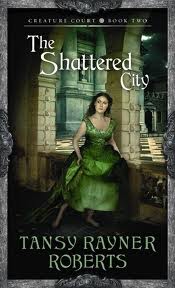 I read this about 10 weeks ago, and I’m not sure why I’ve left it til now to actually review it. I think it’s because I read it too fast, and was then a bit shell-shocked. I couldn’t face reviewing it immediately, and then I kept putting it off… so now the review isn’t as good as it might have been, but I can at least tick it off my to-do list and move it to the bookshelf, rather than having it staring at me accusingly from the shelf above my computer…
Tansy is very very mean to her characters. If you’ve read the first book, Power and Majesty, this will not be a surprise to you.
Velody is coming to terms with being the Creature Court’s Power and Majesty. Delphine and Rhian are not coping with the changes quite so well, and neither are swathes of the Court itself – never exactly predisposed towards being welcoming or accepting of another’s power in the first place. Ashiol is still having to do great soul-searching and agonising over what to do about his power, and Velody and Garnet… something bad might be happening to the Duchessa… and something really bad might be going down in the sky.
Shattered City is a magnificent second book in that it develops the characters in unexpected ways, furthers the plot in totally twisty, snarky, and unexpected ways, and ups the ante in occasionally devastating ways. The writing continues to be elegant and precise and enticing. The world of Aufleur grows more and more well realised, as details are added about the different festivals, the food, the clothes, and the architecture… nice details that add depth.
I am desperate for the third book. I really hope it comes out this year. And I will try my best to give it a better review than this one…
On suppressing women’s writing
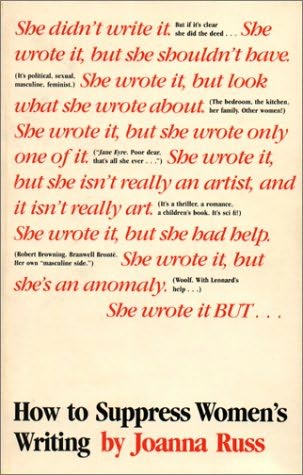 Just the front cover is enough to make me cranky. It’s a list of the ways in which women’s writing (and art) has been suppressed; the book is a brief and eclectic examination of how those different modes have operated, and some suggestion of why, too.
I finally got my hands on this book after I heard of Russ’ death. I’d heard of it in vague terms over many years, and more specifically in the last couple – particularly thanks to Galactic Suburbia, and a growing realisation that I really wanted to understand feminist SF, and that Russ is one entry into that. Plus, she seems like one of those writers everyone talks about… but few (especially of my generation, we post-70s women) have really read.
Russ progresses logically through various modes of suppression, dismissal, and marginalisation. As her evidence, she uses reviews of women’s work over the last century and a half or so; their presence (and absence) in anthologies and university curricula; and in biographies, as well as other sources.
The comparison of the different ways Charlotte Bronte’s work was received when it was believed to be by a man compared with when it was known to be by a woman were distressingly similar in some ways – given the difference in time – to the reception of James Tiptree Jr’s work as male/female. Russ herself notes that while some things have changed – critics are less likely in the late twentieth century to openly denigrate women’s writing simply because of the author’s gender – others have not: said critics have found alternative ways to marginalise the writing.
I’ve been sitting on this review for nearly two months, thinking there must be more to say. There is. I’m going to post this as-is, though, because I’m not sure that I can write down all of my different reactions and thoughts coherently… and we’re going to be doing our Joanna Russ Spoilerific Book Club for Galactic Suburbia soon, and hopefully that will help me clarify some ideas. (It did!)
Borders of Infinity, Brothers in Arms… a Miles overload
Tehani and I soldier on with Bujold – me for the first time, Tehani accompanying and refusing to give spoilers. This review does contain spoilers, though… (We have discussed Cordelia’s Honor, the Young Miles Omnibus, Cetaganda, Ethan of Athos and “Labyrinth” previously.)
ALEX:
“Borders of Infinity” is a curious novella, in that it sets Miles almost completely apart from all of the other characters we’ve come to know and love. Here, he doesn’t have the support of his parents, or Ivan, or a Bothari… it’s just him and his wits. And for much of the story the reader has no idea what is going on, which is also quite different from Bujold’s style in earlier books. No idea why Miles is in the POW camp – was he captured? is this deliberate? – no idea where everyone else is… at least we do have a vague idea why he’s organising the camp: because he can’t help himself. He is an inveterate organiser, schemer, and meddler; he could no more leave the camp disorganised (even without the greater plan that he turns out to have) than a cat could ignore catnip.
TEHANI:
It’s my absolute favourite of the novellas, because it showcases Miles being completely, utterly MILES! All he has are his wits and the insane charisma that makes people follow whatever the heck mad scheme he comes up with. No trappings, no trimmings (not even any clothes!) – just Miles.
ALEX:
That’s exactly it! It is – heh – naked Miles…
I did, of course, really enjoy this story. It was fun to watch Miles build something from nothing, and to see people’s reactions to him when he has absolutely nothing concrete to offer them. And the number of times someone asks, dubiously, “What did you say you were?”, and he replies “A clerk,” only to have them respond with “Yes sir”… brilliant.
TEHANI:
Heh! Best lines 🙂 There was some interesting stuff in here too. These people had been stuck in the dome for three years, succumbing to the machinations of their captors and degenerating into anarchy, but who were the organised ones? The women. They formed their own enclave within the prison, to protect each other – it’s a very telling little message from Bujold I think. I also think the story examines leadership – Miles is a fascinating leader, and has mastered the skill of making the most of the abilities of others, even when he has no idea what they might be!
ALEX:
That the women were the organised ones was an interesting aspect, yes. I think the idea that they would do so for protection makes sense. Other takes on this idea have often seen women essentially becoming part of a harem, in exchange for men’s protection. There was one interesting comment about Tris, the leader of the women – the fact that she was a trooper, not a tech, like most of the other women. Not sure what to make of that; women as soldiers still not accepted on this world?
I was heartbroken at Beatrice’s death. I could so see her joining the Dendarii. Also Murka. Looking forward, I am… not glad, but impressed maybe? respectful certainly of Bujold making sure Miles is haunted by those deaths. It makes him much more real.
TEHANI:
You’re fishing for spoilers! Won’t give. But yes, Beatrice was a sad loss, but I like that Bujold reminds us no-one is safe in her books – we can’t get complacent about characters we love!
ALEX:
Who, me? Fishing?? Beatrice died! … didn’t she?
TEHANI:
Ah, oops! Forgot that Murka was already IN the Dendarii (from “Labyrinth”) for a minute there! Carry on… 🙂
ALEX:
For me, this story reminded me in some ways of the hell described in Iain M Banks’ latest novel, Surface Detail, although Bujold’s is not nearly as unpleasant as Banks’.
TEHANI:
Darn you Alex, you’re always adding to my reading pile!
Brothers in Arms
ALEX:
Lesson #3432 I have learnt from Miles Vorkosigan: don’t joke about having a clone brother. It might just be true.
Miles has an evil twin! HAHAHA! Brilliant.
Brothers in Arms follows directly on from “Borders,” with Cetagandan forces chasing Admiral Naismith to deliver retribution for rescuing so many POWS at Dagoola IV. He ends up on Earth – Earth! – something of a backwater from a commercial point of view, due to its lack of wormhole entrances, but still commanding a cultural and psychological hold over humanity, it appears. Things, naturally, go wrong, mostly because of the plot to replace Miles with his six-years-younger clone twin.
TEHANI:
I like that it takes quite a while for the actual clone story to start here. It gives us time to anticipate the incipient disaster we just know will come! And one of the best bits is when Miles thinks he’s hallucinating, but later realises he really was seeing the clone!
ALEX:
Yes, I thought that was a nice twist – that he wasn’t going quite as crazy as he thought he was.
On the plot:
Awesome. Nice plot twists with the struggles of the clone. One of the highlights of course is the utter DISASTER of Admiral Naismith and Lieutenant Vorkosigan being on the same planet at the same time – which is what leads to the crazy story of the clone… oops. It didn’t feel like there were that many sub-plots going on in this book as with some of the others; there’s the Miles/Quinn love story, but it’s not like Ivan or Galeni get their own little thread. Also, this wasn’t really a detective story like Cetaganda, nor was it space opera-y Warrior’s Apprentice. It is certainly SF, of course, and it’s a lot of fun knowing that, in reading a Bujold novel, you do not necessarily know what sort of a plot you’re in for, nor what sort of a setting. Very clever, and very attractive.
TEHANI:
Very skilful too. There’s not all that many authors around who can write equally well with a detective plot, a space opera, a romance (just wait), an action adventure and so much more! This one was relatively straightforward I agree, without the twisty turns of some of the other Vorkosigan books, but also important, in the larger scheme, particularly because of Mark, but for other reasons too. No, I’m not telling!
ALEX:
On the characters:
Miles continues to be awesome, natch. He also develops quite a lot of humanity in this novel, I feel, as he has nightmares about Beatrice and Murka dying (from “Borders”), as well as his great quandary over whether to get it on with Quinn or not. He finally seems to be learning a bit more about how to be subordinate – although it sure doesn’t come easily. The effect of having the clone mirror to him his gestures and words and entire personality is a really neat trick to force some self-reflection. In his mid-20s, it finally feels like Miles is almost old enough for his brain, which continues to devise interesting, if somewhat desperate, schemes. I particularly enjoyed the little trap under the Thames barrier – getting everyone to eliminate everyone else while searching for Miles.
TEHANI:
Oh yes, VERY effective. And the business of Beatrice and Murka hanging over him is sobering for him – he’s had people die before, but he’s beginning to understand one of those huge responsibilities of leadership – the introspection of that is quite a settling force, in some ways. I was particularly sad about Murka – we’d already seen him in action in “Labyrinth” and he was a great character! Bujold really subscribed to the “Kill off your darlings” mantra eh? 🙂
ALEX:
Mark, the clone, promises to be a verrrry interesting part of the saga from now on. Bujold does an intriguing thing here with the question of nature/nurture, because while Galen was attempting to re-create Miles, he was doing so in a completely different environment. Let’s not even go into what was necessary to turn Mark physically into Miles – I had hoped that they would have tried introducing the poison into the uterine replicator or something similar, but no…. I felt an immense sympathy for Mark, which I am sure was Bujold’s point; he’s just a pawn for everyone, even Miles, it’s no wonder that he has trust issues. I can’t wait to see what Bujold does with him over time. I admit that I had rather expected everything to be tied up, if not neatly then with greater hope than we are left with re: Mark’s position, by the conclusion of the story. Bujold doesn’t exactly make things easy, does she?
TEHANI:
Never! And just you wait til Mirror Dance!
ALEX:
On the other hand… yay Quinn! More Quinn is good! It was fun to see Miles finally having a mostly-normal relationship with a woman (not pining unrequitedly, not getting it on with an 8ft, 16-year-old genetic experiment…), particularly when it’s a woman who most definitely knows her own mind stands up for herself. The bit where she refuses to be Lady Vorkosigan but still wants to jump his bones? Marvellous.
TEHANI:
I like that Quinn doesn’t succumb to Miles here. We know he’s got such a forceful and charismatic personae that it really would have been something he could have talked her into. And, traditionally in stories, the hero gets the girl, right? And he’s already missed out on Elena, so it’s his turn now, right? Which makes it so much cooler that he DOESN’T get the girl! It’s logical, and sensible, and I’m glad that Bujold let it happen this way.
ALEX:
Their relationship makes sense – on her terms, not his.
Ivan… still not that intriguing, I’m afraid. I like him and all, but he’s not come into his own yet. I admit it’s clear that he’s nowhere near as dense as Miles might sometimes think though.
TEHANI:
We definitely are starting to see some sparks of who Ivan really is, when he’s not completely bombarded by Miles. The flashes of innovative thought are hopeful!
ALEX:
For some reason I was thinking about Tom Clancy the other day, and it occurred to me that if Clancy were writing Miles, he would end up being the Emperor. Or at least in Illyan’s job. That would be awesome.
TEHANI:
You’re fishing again!! Interesting train of thought… 🙂 Onwards!!
Grail, by Elizabeth Bear

The last thing I expect from the final book in a trilogy is for it to throw up major questions about the characters we have come to, if not love, like and admire over the course of two books. But that’s exactly what Bear does in Grail. It’s a remarkable move that I admit makes a fitting end to a remarkable series. As with Chill, there is no way of telling from the front cover that this is part of a series, although the blurb mentions that it brings Bear’s space opera “to a triumphant conclusion.” Unlike Chill, though, this book probably would make a bit more sense by itself.
As the third in the series, this review contains some spoilers for the first two books (Dust and Chill).
Grail opens not on the great generation ship but on a planet, with a completely new set of characters. At first I thought this was going to be the descendants – or perhaps even the ancestors – of our friends on the Jacob’s Ladder. Turns out that no, these people are human colonists who have been on this planet for generations, the descendants of the people who had initially populated Jacob’s Ladder.
You may think you can see where this is probably going. I certainly wondered if this was going to turn into an Us vs Them scenario, and whether it would lead to violence. However, I seriously underestimated Bear – always a bad idea. The inhabitants of Fortune (the planet, which the Jacob’s Ladder crew have jokingly named Grail as they approach) have not been static in their own development. They haven’t gone down the same route as Perceval and co, though. Rather, they have made explicit moves away from the religious zealotry that originally drove the generation ship into space. And they have done this via psychological and, I think, chemical means. Isolating the area of the brain leading to ‘sociopathic’ tendencies and… minimising them.
Bear does not set up a good/bad dichotomy here. From Fortune’s perspective – and especially through the eyes of Danilaw, currently in charge and the one who ends up interacting most with Perceval etc – those on board the ship are totally, utterly, unregenerate barbarians of the worst kind… and the reader gets to see just how weird some things about them are, from the outside. Things the reader has come to accept as normal, over the last two books, because that’s what you do when you suspend disbelief. To have that acceptance thrown back into my face was, frankly, shocking. I can’t imagine what it would be like now to re-read the series, with this new perspective thrust upon me at the end. At the same time, though, it’s not like Danilaw et al are that normal and comfortable. I almost found them harder to accept because at least on the Jacob’s Ladder, I know they’ve been deliberately making evolutionary choices, they’ve been in space for centuries, and weird semi-cyborg things of course happen out there in that context. Fortune’s inhabitants do not have that excuse. Their psychological and neurological changes happened initially on Earth itself, in response to perceived threats from religious and political zealots. I was reminded uncomfortably of ideas from 1984 and Fahrenheit 451 – not that Bear is riffing off them, but having choice removed from people, particularly choice that is dear to my heart? Squirm-y making.
The plot is appropriately twisty and intriguing, as befits the conclusion to this series. The characters continue to be intriguing, attractive and repellant almost at the same time. We finally get a better understanding of the ship itself, thanks to the outsider perspective, which is a nice culmination of the gradual reveal from the first two books.
All in all a very clever conclusion to a very clever series.
Werewolves, vampires, parasols…

This is the fourth book in the Alexia Tarabotti/Maccon series, The Parasol Protectorate. As such there are spoilers for the first three (Soulless, Changeless, Blameless), but there are NO major spoilers for Heartless.
When a ghost turns up in front of Alexia and mentions that there is a plot against the queen’s life, Alexia naturally flings herself into uncovering and halting it. Even if she weren’t muhjah and therefore responsible for such a thing, she could hardly help herself from meddling and being all Miss Marple-y. In the course of her investigations, Alexia must of course deal with the supernatural set – werewolves and vampires mostly – of London, have hair-raising adventures, and drink a great deal of tea. All of this while she is eight months’ pregnant. Oh, and her life is being threatened on a regular basis, too.
Readers of the previous Carriger novels will know, in broad terms, what to expect. Exciting chases, clever detective work, witty repartee, clashes between vampires and werewolves, unexpected twists in the plot. It delivers exactly what you expect from it, and is therefore very satisfying. There is further development of vampire/werewolf society, and a bit more of their collective and individual history; a bit more about preternaturals and Alessandro Tarabotti, too. It doesn’t stand out from Carriger’s other novels, but I wouldn’t have wanted it to. Alexia’s story, while clearly episodic, follows a naturally developing plotline overall – personally, in terms of how she fits into society, and more broadly in terms of how supernaturals fit into and impact on society. That each story feels the same thus makes sense.
I enjoyed the plot of this novel as much as I have previous ones. Just who might be plotting against the queen was revealed what I thought was surprisingly early, but the question of motive was made more suspenseful, and fit in well with the overall themes of the book. The subplots, mostly revolving around the interactions of various characters, was nicely played out; they made sense in the context of those characters as well as furthering our understanding of them. The characters are a large part of what makes this series so endearing. Here, we get an even larger dose of Lord Akeldama than previously (darling), and his fashion sense continues to surprise; his changed relationship with Biffy, once-drone-now-werewolf, is a touching and revealing aspect of the story. There is, sadly, little of Ivy and her daring hats, but a gratifyingly large dose of Professor Lyall.
One of the most intriguing aspects of this story is the fact that Alexis is heavily pregnant for its entirety. Too often in urban fantasy – or any other works, really, except those that are specifically about being pregnant – a woman’s pregnancy is either largely ignored or there’s a nine month slippage in events. Here, though, it’s both integral and not a limiting factor. When Alexia tries to run, she is hampered by her belly. Carriger frequently describes her as waddling, or other such words; she is eating more, sleeping badly, and needing to pee at inconvenient times. She is definitely, genuinely pregnant. But she also does as much as she can around the infant-inconvenience, as she calls it. I don’t have children, and it may be that some mothers will read these sections and shake their heads in ridicule at what Alexis accomplishes so heavily pregnant. For me, it seemed slightly unlikely, but that was forgiven by the fact that a) it’s fantasy, and b) it’s Alexia. I’m happy to be corrected, of course.
Two things are, sadly, beginning to make this series not the wonderful, joyous ride it was to begin with. The first is the snobbery. I understand that it is period-appropriate, and that perhaps it is undertaken with sarcasm or irony in mind. But actually there’s only so much withering scorn that I can put up with when directed towards the middle-classes – those who wear knitwear, or who might be in trade – not to mention the attitude towards servants. This is also a small part of my larger problem with the series… which is Alexia herself. I am beginning to find her tiresome. Her snobbery is a factor; I am also realising that I am nowhere near as interested in fashion as a true Carriger/Alexia devotee needs to be, to not find Alexia’s discussions of and thoughts about clothing a bit tedious. I also don’t think Alexia has developed that much over the course of the series, which means that those quirks that were initially endearing are now become irritating. This is not to say that I am abandoning the series; I am terribly excited to read the final novel, Timeless, when it eventually comes out. But I won’t be sorry (I imagine) that that’s the last novel.
All in all, fans of Carriger’s previous works will not be disappointed – although if you can, I would personally recommend waiting for the fifth book to be published, so that you don’t have to wait however months it is to get the finale.
The Bujold discovery continues: Ethan, and a touch of Miles
Tehani and I continue our conversational review of the Vorkosigan series here with Ethan of Athos and the novella “Labyrinth” from the omnibus Miles, Mystery and Mayhem. This is my first time reading Bujold, Tehani’s nth. (We have discussed Cordelia’s Honor, the Young Miles Omnibus, and the novel Cetaganda previously.) Spoilers aplenty!
ALEX:
This novel started enjoyably enough, if weirdly, what with the discussion of uterine replicators – it is an unusual enough thing to encounter in SF that imagining a roomful of the things with an attending physician is weirder for me than reading about FTL! Anyway, things then got even weirder, and for me way harder to read, when it’s revealed that these replicators are being used because Athos is a world populated entirely by men.
TEHANI:
It’s really clever, the way it starts out. We know about uterine replicators because of Cordelia’s story (and Elena’s too, in fact), and so we naturally assume these are simply gestating children for some parents of the “usual” type. It’s quite a shock when we find out differently! It was a good introduction to the world though, setting us up to be fond of the main character.
ALEX:
The opening few chapters, those set on Athos, were quite a trial for me to read. The misogyny was so believably portrayed that, were this my first encounter with Bujold and/or I thought it was written by a man, I would probably have given up in disgust and never touched the series again. I swallowed my bile and continued because I figured a) Bujold deserved some trust after the characters of Cordelia and Elena, and b) neither Tehani and Tansy would have put up with that sort of crap. Turns out, thankfully, that this was a fair decision. Of course.
TEHANI:
Of course! Would we steer you wrong? I think (our friend) Alisa might have stumbled into that problem though – have a feeling it may be the books she tried to start with, which really isn’t a good idea. Readers, be warned! Ethan of Athos is NOT the place to start reading this series!
ALEX:
Whoa, I cannot imagine starting with this book.
TEHANI:
Having said that, I didn’t have the same reaction as you. For some reason, I wasn’t offended that this was a lifestyle choice made by a group of men a couple of centuries earlier. I guess I read it as that while yes, some of the men making up the colony originally might have been women haters, others would have joined for different reasons. And many years later, there is that whole whisper game that’s gone on about what women are like, causing both inaccuracies and naivity in the current generation. Ethan’s own reaction probably demonstrates that best, when he reads the scientific journal and can’t tell which articles are by men and by women! (Hilarious, by the way, in light of recent discussions on just that!). I was more cross that the children growing up on Athos weren’t educated about the outside world, and women, in any sort of way other than to dismiss or demonise them. Hmm, maybe that’s what you mean!
ALEX:
I think I find the very idea of men wanting to escape from women in this permanent way – since that’s what the planet is all about – irrational and offensive, when they also want to ensure continuity of their genes. They’re not giving their sons the chance to make the choice for themselves. There are some lines that really struck me – the “revolted silence” that greets the idea of growing female fetuses to harvest their ovaries, for example. It is a revolting idea, but the men are revolted by the idea of women being present in any real way on their planet. The way that some of the characters spoke of genetic choice I also found uncomfortable.
Anyway, the ovaries that Athos has been using for 200 years to develop their foetuses from are coming to the end of their productive lives. Ethan is an… obstetrician, I guess… who discovers that the replacements they’ve purchased are not what they thought. In turn, he gets sent on a mission off-world, to get some more. This of course means that he has to deal with that sin-inducing entity, Woman. His first encounter on the station where he disembarks is with just such a personage… who turns out to be Elli Quinn! Tehani, she is back in my life, just as you promised! Ethan ends up getting involved in a Cetagandan mess concerning genetic experiments with telepathy. He learns that women are not (necessarily) the enemy – although he does end up going home, to Athos, and mostly happily.
TEHANI:
Yep, it’s an overdose of Elli! She’s so awesome, and I think this book is fantastic because it really sets her up as an intelligent and resourceful person all on her own, not just as a sidekick to Miles. Well played Bujold!
ALEX:
Yeh, I am definitely an Elli fan.
Athos as a planet is a really interesting place. I’m very interested to hear, Tehani, what you think of it coming from a mother’s perspective. Like I said I found the misogyny hard to deal with. As a society, though, I was fascinated. The idea of earning social credits so that you can become a Designated Alternate – and the idea that being a parent is actually, hugely, valued in society. Ethan’s shock and horror that parenthood should be treated as unpaid labour was quite welcome coming from a male character! The idea also that celibacy is an accepted part of society was nice to see, as was the genuine love for children and Ethan’s desire to have a large, connected family.
TEHANI:
I think the actual societal model is brilliant! There are some people who really shouldn’t have kids, and parenthood is definitely undervalued in our society – to have both issues dealt with (in what I think is actually a very smart and sensible model) was a delight. Somebody make that world with women and I’ll be there! 🙂
ALEX:
Cetaganda does not come off well in this story at all. Their genetic experiments are shown as just that, experiments, and the idea that they might just possibly be serving an admittedly somewhat dubious greater purpose – as demonstrated in Cetaganda – is barely alluded to. This is one of the disparities between the two stories.
TEHANI:
See, this is where it fell apart a bit for me. Terrence and his background simply don’t fit the Cetagandan societal mould set up in Cetaganda! Here’s a quote (from p 319 in the paperback omnibus) to demonstrate:
“Is Cetaganda – controlled by women or something?”
A laugh escaped her [Elli]. “Hardly. I’d call it a typical male-dominated totalitarian state, only slightly mitigated by their rather artistic cultural peculiarities…”
It goes on to talk about genetics projects headed by men, sponsored by the Cetagandan military. In Cetaganda though, genetics is the sole province of women, right? And telepathy is NEVER hinted at!
Later (p 373), this conversation takes place:
There was no talk at all of ever admitting him to the ghem-comrades, the tightly-knit society of men who controlled the officer corps and the military junta that in turn controlled the planet of Cetaganda, its conquests, and its client outposts.
It all just feels WRONG given what we know from Miles’ adventures on Cetaganda – which surely Elli knows too!
Ethan of Athos was published about ten years before Cetaganda though, and therein lies the problem. Bujold obviously changed her mind about how she wanted Cetaganda to work between the two books, but reading them in close proximity makes the continuity issues very apparent. I like the Cetaganda version better (as I mentioned in the last review) and I think comparing the two, it’s pretty easy to see why Bujold changed track there. Terrence’s Cetaganda, what we see of it, seems just another male-dominated society, whereas the exploration of the society we see in the novel Cetaganda gives us a very different norm.
Bujold’s afterword in the Miles, Mystery and Mayhem omnibus which contains these stories is interesting for her discussion on the way she let the Cetagandans evolve in their own book, rather than just being the “rather all-purpose bad guys” they started out in the earliest stories. She also talks there about extra-uterine replication and genetic engineering, themes in all three books to one extent or another, making it a great wrap up to the sequence!
To be fair, I think the Cetagandan glitch one of the very few continuity problems with the Vorkosigan saga as a whole, so maybe I’ll simmer down and just let it slide now 🙂
ALEX:
It is indeed an interesting look at lack of continuity. I’d be interested to know what sort of notes Bujold kept!
Miles does not feature in this story personally. He does get several mentions, though, as Quinn reflects on her ?love/admiration? for him, and the role that she is playing within the Dendarii Mercenaries as an information agent. It’s a curious part of the Miles universe in that sense, and I can’t help but wonder whether Bujold considered a series featuring Quinn in her own right….
TEHANI:
OOOH!! What a GREAT IDEA!! Let’s write to her and ask her for that 🙂
I liked the ending of this book – I think Ethan shows tremendous but believable growth throughout the story, and his admiration of Elli is expressed in the most important way he can. Perhaps taking Terrence back with him and the little hopeful romance projected are a bit trite, but overall, it works pretty well.
ALEX:
I was shocked at first by Ethan’s request/suggestion that he take one of Elli’s ovaries, but came around to your point very quickly – that it’s an expression of immense respect, actually. Terrence is the character we haven’t spoken of much yet – he’s quite the enigma, since Elli and Ethan have slightly different takes on him and the Cetagandan has a very different view. I actually wondered, towards the end, whether the Cetagandan was telling the truth and that Terrence would actually end up betraying Ethan, so I was pleased to discover that he was on the up and up. And I didn’t think the romance was that trite, in the end.
The Omnibus is complemented by the novella “Labyrinth” which rounds out quite nicely, I think, a discussion of genetic engineering in the Vorkosigan universe. Miles gets employed to pick up a disaffected geneticist from Jackson’s Whole. Things (of course) go somewhat awry, and Miles ends up having to retrieve a genetic package… which is secreted in the leg of a genetic experiment… which is locked in a dungeon at the bottom of a very nasty man’s research facility. The genetic experiment turns out to be a fanged, clawed and 8-foot-tall 16 year old girl.
TEHANI:
And isn’t it fun how Miles’ adventures ALWAYS go awry? One of my favourite things about the books.
ALEX:
SO MANY DISASTERS.
I enjoyed this story, and it was nice to get back to Miles relying on his wits to get things done – and, this time, actually finding that his lack of height is af advantage, when having to crawl through ducts. I will admit to being a bit uncomfortable about Miles’ sexual encounter with Taura – no matter that she’s huge, she’s still young! And I’m not comfortable with the idea that sex can be used quite so (ahem) mercenarily – not and have both parties apparently enjoy it. Yes yes, perhaps I am confused in my attitude towards this bit; I’ll be the first to admit it!
TEHANI:
Yep, I struggled with that too. So many reasons this is not cool. From one angle, if you squint, it could be said that Bujold is using Miles like women are often used in books – as a sacrifice on the altar of sex in order to get to a higher goal. But yeah, Taura is so young, and naive, and unsophisticated, that it’s just icky. It also makes me wonder why, exactly, the character had to be this age? Miles is 23 in this story, and it’s something that bothers me a lot – if there’s no real reason the character couldn’t be a year or two (or three) older, why not make them that? I mean, Taura has a shortened life span, so making her 16 means Bujold can get more years out of her I guess, but really? It’s her own world building she’s dealing with! And while we aren’t going to read Falling Free in the reread (it’s not a Vorkosigan book, it doesn’t count I tell ya!), Bujold does the same thing with a character there too, which also squicked me (and is one of two main reasons I don’t really like the book – the other being, it’s not MILES!). So yeah, not cool, especially when it’s avoidable. If Bujold gets so much right, should we fuss when we have a problem with one thing?
ALEX:
I guess it’s disappointing to find these sorts of issues in books that we otherwise enjoy – I don’t like finding flaws in those I admire!
Anyhow, I also enjoyed this story for its greater exploration of Bel Thorne, the Betan hermaphrodite, and other Dendarii. I can see the crew developing in further stories, and I look forward to it greatly.
TEHANI:
Ah, Bel. I’m a fan of Bel – it is such a complex character, and Bujold draws it so well. Its emotional and physical journey is a highlight. Overall, I liked Labyrinth, and, no spoilers, but this story actually sows a lot of seeds that will grow hugely over the coming books!
ALEX:
Of course it does. Look forward to their growth and harvest!
Cetaganda: a conversational review
Tehani and I continue our very enjoyable review series of the Miles Vorkosigan saga with the first story from the third Miles omnibus – the novel Cetaganda. (We have discussed Cordelia’s Honor and the Young Miles Omnibus previously.)
ALEX:
I really enjoyed this story! Miles – and Ivan – are sent on what ought to be a relatively boring diplomatic mission to bear witness to the Cetagandan Empress’ funeral, and of course things go haywire from the first moment. Mischief certainly seems to dog Miles’ footsteps. There’s an attempt to frame him as part of a conspiracy against Cetaganda (Barrayar’s longstanding rival) and several attempts to wound and/or assassinate him – as a result of which Miles ends up investigating a potentially enormous Cetagandan conspiracy, involving the genetic inheritance of that race. Miles falls in love (well, in lust), goes to parties, gets hurt, and meets the Emperor… pretty much a standard fortnight, as far as I can tell, for him. There were a goodly number of twists and mysteries and surprises to keep me guessing and intrigued – it was much more a detective story than a space opera. It just happens to be set on an alien planet with a whole lot of genetic engineering going on (those kitteh plants are just weird). I allowed myself to be carried away by the story and didn’t spend too much time trying to outthink Miles (or Bujold), so the ultimate revelation – that it was a haut woman married to a ghem man, conspiring with a planetary governor – was a surprise, albeit one that made perfect sense.
TEHANI:
I was certain I remembered this as one of my least favourite Miles books, but on rereading, I found it really enjoyable. I think I know the source of my mistaken assumption though – it is very much, as you say, a detective story, with barely any space opera-ish events! Nothing wrong with that, but when read in the wrong order (ie: after a bunch of action-packed Miles adventures), it was a little tamer by comparison…
ALEX:
I can understand that coming at it from a more adventurous story would be weird. For me, it worked – The Vor Game isn’t exactly packed with space battles.
On the gender politics: I though the revelation and discussion of the intricate power balances within Cetagandan society were really interesting from a gender point of view. Miles’ surprise at the power that the haut women had, and the way in which it manifested, was perfectly appropriate: he wasn’t surprised they had it, but the way they had it, I think. The very idea that they have power over the development of the ghem and haut genetic development is a neat twist on the idea of maternal responsibility for children, I think. I’m not sure what to make of the ending, in light of this – the Emperor ‘marrying’ the Handmaiden, attempting to gain control over it? Will Rian give up control, or is the power structure too embedded?
TEHANI:
That’s a good point and I hadn’t really picked it up! I think that Miles, for all that he has grown up in a male dominated society, is pretty damn accepting of women in powerful roles (mainly thanks to his mother, no doubt). So you’re right, that was expressed well here, and it was mostly Miles trying to adjust his own notions of what an imperial society looks like, and who has the power.
To me, it seemed that Rian cemented her power base by “marrying” the Emperor, and I really couldn’t see how it would benefit him more than her. However, it was a smart move by the Emperor, at the same time!
ALEX:
hmm, perhaps you are right about Rian. Perhaps it’s both being pragmatic about how best to deal with a dangerous situation, and do what is best for the haut, which seems to be the overriding concern for both anyway.
On Cetagandan society: there have been references to the ghem and haut in other novels, if briefly, so it was good to get some greater understanding about what the heck is going on in this society. I still can’t say that I entirely understand it! It’s a fascinating way of thinking about genetic engineering as a way for society to express itself, and as a way of bettering itself too. Miles has some interesting insights into their collective attitude towards expansion which I still need to think about; there’s certainly an assumption – on Miles’ part as well as the Cetagandans – that expansion must happen, but quite why this is so imperative is opaque to me. One of the unfortunate things about the name choices is Bujold’s habit of saying “the haut Rian,” because I couldn’t help but read that as “the hawwwt Rian”…
TEHANI:
It is a really interesting way to consider genetic engineering. Expansion I think is a theme right from the beginning of the saga though – after all, Cetaganda invaded Barrayar when it was rediscovered; Cordelia and Aral met on opposites sides of a planetary claiming of Sergyar. It’s almost like the Wild West – who can claim the most planets, even when (like Komarr and the Betan colony), they are barely livable! But expansion is the reason Earth went a-colonising in the first place I guess, and despite all other advancements, humans are STILL overpopulating their habitats.
We need to talk more about the portrayal of the Cetagandan society when we look at Ethan of Athos – this book was written nine years AFTER Ethan, even though it precedes it in the internal chronology, and I think it’s one of the few places where Bujold mucks up her consistency with all the popping around. I like what she does with Cetaganda here better, for the record.
ALEX:
Ethan of Athos, up next!
On the characters: I so knew Maz was going to end up with the ambassador. Saw it a mile off. I enjoyed Lord Yenaro immensely – the idea of scent-work being a worthy art to pursue is delightful. Rian was… I was going to say impenetrable, but that gives all sorts of nasty implications. She was appropriately hard to fathom, I guess. I liked that she was mysterious and that it made sense for her character. Having Miles fall in love/lust with her makes sense, because of her great beauty and her untouchability. Miles continues to develop here, although it was hard to remember how young he was supposed to be – so much has happened to him! And Ivan isn’t nearly so annoying as he threatened to be in earlier books.
TEHANI:
I loved Maz! And I loved that the Ambassador loved Maz. I think it’s a very clever thing Bujold does with her minor characters – it’s very subtle and I wonder if you’ll notice it. Frequently there’s some little side story or a throwaway characterisation that shows about how some Barrayaran person or other has taken a step outside the old-fashioned, quite restrictive societal norms of the planet. Look out for these! They are showing the progression and modernisation of the planet from a sideways view!
I also loved Ivan in this. You need to watch Ivan closely too, as the series progresses. I want to talk more about him, but I won’t, til you’ve read some more books 🙂
ALEX:
ooooh you are giving me such teasers! I did wonder whether she was going to keep Ivan in a cute-Obelisk kinda role, or whether he would develop greater diplomatic insights as time went on. On Maz etc, t’s so nice to see secondary characters actually having a life outside of their interactions with the principal cast.
Questions: will Miles indeed have more to do with the Emperor Giaja? Will Miles ever be allowed to leave the planet again? What are Elena Bothari and the Dendarii Mercs up to??
TEHANI:
You know, I can’t remember if Miles runs across the Emperor (or Rian) again! Could they really STOP Miles from going space-side? 🙂 As for the Dendarii, just wait… 🙂
ALEX:
ARGH. Mooooore Miles to come!


