Women’s History Month: Jill Reichstein

Jill Reichstein attended Monash University and was involved in numerous demonstrations against the Vietnam War. This is a short excerpt from our interview, where she talks about her motivation for being involved.
Transcript:
Jill: My journey started when I was doing my matriculation year at a private girls’ school in Melbourne. And both my parents were fairly conservative. And I had a history teacher who – or politics, political science teacher – who was wonderful. And she discussed the Vietnam War. So we’re talking 1967. And I was outraged. And I really started to get involved and have a look at it. I mean, I knew we were involved in it, but I didn’t sort of take a lot of interest
I didn’t think we should be sending our soldiers to fight in a war that had nothing really to do with us. And I think I was slightly anti American. And I didn’t like the idea of following what Americans did. And I just didn’t understand the rationale behind it. I mean, it was a war in a country between the North and the South. Obviously, America was spooked. But I didn’t understand the rationale behind it. So I started writing essays at school against the war. And then the following year, I went and lived in the UK for 12 months. You know, my parents wouldn’t let me travel. But they let me go to a liberal arts college, which sort of – wasn’t a finishing school, because we actually, we actually did politics and history. And there were an amazing range of women – there was 100 women living out in the country near Oxford – so I ended up spending a lot of time with people in Oxford, who were also very politically opposed to the war. And so I’d go down to the demonstrations in London, that’s when I first started to participate in the anti-war demos, concerts, etc. And then when I came back to Melbourne and went to Monash University – hotbed of, you know, political unrest – a lot of my friends, and in fact, my future boyfriend, he was a draft dodger. So there were all all of those issues for me that I faced. So I ended up going to quite a lot of the demonstrations here in Melbourne – quite memorable to think that our streets were just 1000s and 1000s and 1000s of people who were opposed to it; providing safe havens for people who were avoiding it. And so that election night when Labor won was just such a celebration.
Alex: Were you were opposed to conscription early on, or did that develop later?
Jill: No I felt it was challenging somebody’s liberty to tell them they had to go and fight somebody else’s war. And I probably didn’t really understand the political agenda behind it, other than mimicking what America was doing, which I really disliked, and I thought to force someone to fight in something they didn’t believe in was inappropriate.
If you know a woman who lived in Melbourne at the time and was involved, please leave a comment!
Women’s History Month: Diana Crunden
Diana Crunden was at Melbourne University when she started to protest against the Vietnam War and the National Service Act. The Harry she mentions below is Harry van Moorst, a leading figure in Melbourne’s protest scene, who recently passed away. She was part of Students for a Democratic Society (note the misspelling of Crunden’s name on that page), amongst other things. This is a short excerpt from our interview, where she talks about some of her motivations for protesting.
Transcript:
Diana: But I always had a fairly sort of social justice type of thing. Like, I thought the White Australia Policy was terrible, et cetera. And my parents were pretty appalled at my political activity, really, but didn’t try and restrain me at all. That was good. My political education, I guess, started when I went to uni. And I happened to meet Harry [van Moorst], because we were all in the same year. …
I was at home, up where I was born, and I came back to Melbourne to find out that a smallish group of people both at Monash and Melbourne had raised funds for the National Liberation Front. And I thought, wow. You’re prepared to go to jail for this? And it was all pretty amazing.
And then, of course, the anti-war movement started to develop. And I was pretty involved in that, but I wasn’t a leader, I wouldn’t say. I mean, I was relatively well-known, but I think it was more because I was Harry’s partner than anything else.
Alex: In terms of the war itself like, what were your objections?
Diana: It wasn’t something that America should be involved in, and Australia shouldn’t be involved in. And it was typical of Australia that it went in league with the States. It was just appalling. And, you know, all the things about, if the referendum had been – not the referendum, the – you know, the United Nations had said, “This – the demilitarised zone, and when that’s – we’ll have elections, and then that will be the solution to it.” And, of course, America decided they didn’t want to do that, so they intervened. So those were all appalling. I mean, I must have developed this perspective quite quickly, but I did have it.
Alex: And conscription?
Diana: Yes, yeah. Because so many of my friends were involved.
Alex: Would you have described yourself as a pacifist? Or was it more about the forcing people who didn’t want to do it?
Diana: No, not really. Because that just seemed to be – it was an unjust war. And that should be sufficient grounds to allow people to get conscientious objection. But, of course, it wasn’t. You had to be a pacifist. But no, I wasn’t a pacifist.
f you know a woman who lived in Melbourne at the time and was involved, please leave a comment!
Women’s History Month: Jean McLean
Following in the footsteps of those who have gone before me, here I am highlighting Jean McLean first. The truth is, though, that she really is and was awesome. I’ve included here a short excerpt about some of her motivation for protesting, and the story of how the Melbourne SOS (Save Our Sons) initially started.
Transcript:
Jean: Menzies announced in December 1964 that he was going to bring in conscription for overseas service. Now, I had always – and still am – very interested in our region. So I knew a lot about Vietnam, I knew the history of Vietnam, and I knew about the secret war that America was carrying out in Laos and creeping into Vietnam and Cambodia.
And Australia had been – Australia asked, actually, whether they could go and kill some people in Vietnam. And they finally invited us – not straight away – the Americans. And then the government said it was through ANZUS. And it wasn’t through ANZUS. Again, if one understood the history of all this –
So I knew that this was why he introduced conscription, to join the war in Vietnam. And so I obviously opposed it. I spoke to women that I knew. I was a young mother. I was doing a pottery class, and I spoke to the women in the pottery class. And a couple of them had fourteen-year-old sons, and they said, “God, this could affect our children.” And they were pretty upset.
And so I said, “Well, let’s have a meeting, call a meeting, get as many people that we know together, and see what we can do.” I mean, I’d never done that sort of thing before, and nor had they. But anyway, we had a house meeting. And I invited a minister of religion called Bruce Silverwood, who was the – the Uniting Church had just combined, with the Methodists and Presbyterians. I think he was Methodist. I think – but anyway, he came to the meeting, because he was – he spoke out about peace and this sort of – and I think he had a letter to the editor, or something like that. So I asked him to come, to tell us what to do. How to oppose things. Not religiously, but just to speak.
Anyway, he suggested to hire a hall in the city called the Assembly Hall, because it only cost $9 or £9 to hire it. And it was a public hall, you know, so you could invite people. Which we did. And we put a little ad – I wish I had it. A little ad about that big in the Herald or The Age. The Argus – no, The Argus had had it by then. The Age or the – anyway, we put this little ad in. And we had over a hundred people turn up. We got the shock of our lives. Because we didn’t have a network. We didn’t have anything.
If you know a woman who was in Melbourne and protested against the Vietnam War, please leave a comment!
Women’s History Month series

Links to interviews (and transcripts) with Melbourne women who protested against the Vietnam War and the National Service Act.
(list continues below)
Continue reading →Women’s History Month: a series

(TL;DR: all March I’m posting excerpts from interviews I’ve conducted.)
For a few years now, I have been interviewing Melbourne women who were involved in protesting against the Vietnam War and the National Service Act.
Let me explain.
- The Vietnam War: Australia sent its first troops into Vietnam in 1962, and officially withdrew in 1973. Different people have different views on why Australia was involved. They tend to revolve around fear of Communism (ie the “domino theory” that said countries were falling to communism, or could do so, in a steady domino-like pattern), following America’s lead, fighting for South Vietnamese independence from an encroaching North, or imperialism. About 60,000 troops were sent in that decade (including my dad); 521 died, and 3,000 were physically wounded (many more later diagnosed with PTS, and other issues probably related to things like Agent Orange, a defoliant used in the war)
- It’s called the American War in Vietnam.
- The National Service Act: passed in 1964 at the instigation of PM Robert Menzies. Menzies’ argument was about “aggressive Communism” all around Asia. 20 year old men had to register for service, and if their number was called, they were required to serve 24 months with the Army. Initially this was for service at home; six months after the legislation passed, it was expanded to include service overseas, and less than a year later Menzies announced conscripts would be going to Vietnam (including my dad). “Natios” (national servicemen) were chosen twice a year: marbles that represented birthdays were put in lottery barrels, and several would be plucked out. Not registering for the national service was a crime; so was not turning up if your number was called. There was the possibility of registering as a conscientious objector, but it was pretty tough.
- Protest against both Australia’s involvement in Vietnam and to the National Service Act started right at the beginning, all around Australia, but it was definitely fighting against the prevailing attitude for several years. There were existing peace groups that wanted to do things like ‘ban the bomb’ and who had been holding Hiroshima Day marches and peace congresses for years, who moved right on to protesting this new war. And there were new groups that started up, and new people who got involved, because of this specific war and this new legislation. Early on, they were a small group. By May 1970, though, when there were moratorium marches all around the country, it wasn’t so small: estimates of the number of people in Melbourne who participated on 8 May 1970 range from 60-100,000.
- One of the first acts of Gough Whitlam’s new government in November 1972 was the repeal of the National Service Act; he had campaigned partly on that, and on officially withdrawing Australia from the war.
Many general histories of Australia’s involvement in the Vietnam War give scant room to the opposition. Some of them don’t take it very seriously at all. If it is mentioned, then some of the sensational stories – like the draft resistors who evaded arrest – tend to get most coverage. If women are mentioned, then it’s SOS – Save Our Sons – and in Melbourne, it’s particularly Jean McLean (which honestly I can hardly blame them – check out this recent interview and then this picture from back in the day) who gets star billing. Maybe also ‘the Fairlea Five’: five women (including McLean) who went to prison for eleven days for ‘Wilful Trespass’ – they handed out leaflets about conscientious objection in the Department of Labour and National Service.
All of which is a long way around to saying that I decided someone should fill the gap: all those other women who were involved in protesting against the war and conscription – sometimes fiercely, and for years – and that I guess I could be that person. Happily, it’s not just me: last year, Carolyn Collins’ book about SOS all around Australia was published, and it is fantastic.
Throughout Women’s History Month I’m going to post short excerpts from the interviews I’ve conducted, to give a sense of why women were involved and what sort of things they did.
If you know a woman who lived in Melbourne at the time and was involved, please leave a comment!
Our Fermented Lives: How Fermented Foods have shaped Cultures and Community
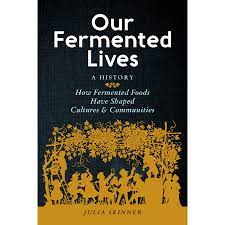
I read this courtesy of NetGalley. It’s out in July 2022.
Sometimes I forget how much I love food writing, and food history, and thinking about how food works in society. Then I read a book like this and I’m reminded all over again.
I’ve never particularly gone down the fermentation path. I did have a sourdough starter for a year or so – before lockdown, I swear! – but I found it too wasteful, throwing out the starter (I am considering going back to it, having read this…).
This book is:
— personal – Skinner mentions parts of her own journey, both in understanding food and more broadly, throughout.
— aiming to be broad in outlook and postcolonial in attitude: she carefully notes having tried to speak to / read from the people who actually make the ferments, and that it is “critically important, particularly as someone with relative privilege, not to overshadow others’ stories with my own words and perspectives”. I think food history is one way in which the colonial agenda can, indeed, still be present, so I appreciate this acknowledgement and the attempt.
— partly a history, looking at the role of fermentation in different cultures across time, and speculating about how such things might have been discovered. Also the range of fermentation experiments! I love any story that includes garum, that probably-incredibly-stinky fish sauce of the Romans.
— a bit science-y, but not that much. Humans are really only beginning to understand the interplay between the gut microbiome and our general health, so it was interesting to think a bit about how fermented foods might help there.
— partly a cookbook. Why yes, I have every intention of trying mushroom ketchup, thankyouverymuch (it came before tomato ketchup, because after all don’t forget how late tomatoes are on the European culinary scene).
— a bit philosophical, which wasn’t always my cup of tea (… or kombucha…). There’s discussion of the word ‘culture’ and how it can mean the microbes as as well as human interactions, which I didn’t fully get on board with – it seemed to stretch the ideas a bit far. And claims about mindfulness and community that did, actually, make me stop and think. The idea that ferments enable us to ‘live a more embodied life’; that the time taken to have a slow meal with friends ‘is a necessary act we give ourselves precious little time for’.
— not perfect. Some of the segues between sections are abrupt and don’t follow what I would consider logical or natural links. And there are some instances of poor editing – mentioning that the eruption of Mt Vesuvius happened in 79CE, for instance, twice on one page. But those are relatively minor issues. (I was more thrown by the idea that Samuel Pepys was “best known for burying his beloved wine and cheese stores to protect them from the 1666 Great Fire of London” rather than, say, for the incredibly detailed decade-long diary he kept.)
Overall, a book I thoroughly enjoyed reading, and I have quite the list of recipes to try out.
The Dark Queens: The Bloody Rivalry that forged the Medieval World
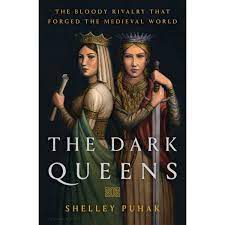
I read this courtesy of NetGalley. It’s out in March 2022.
OH YES.
1. This has pretty much everything I love about a history book.Rediscovering, or repairing, or reframing, previously maligned historical figures.
1a. In particular, women. And here, Puhak does it to not one but TWO women, living at the same time, with lives that were interwoven and had an enormous impact on each other.
The late 500s in what is now France was a remarkable time: it was, as Puhak points out, a time of “dual female rule” – Brunhild and Fredegund, one a Visigoth princess and the other a former slave, were regents for their grandson and son respectively. Together they controlled nearly as much land as Charlemagne would a few centuries later. This dual female rule wouldn’t be repeated in Europe for another thousand years. And why don’t we know about it? Because, Puhak claims – with some pretty strong evidence – there was a concerted effort at damnatio memoriae; getting rid of all memory of the actions of these two queens from history. A lot like what happened to Hatshepsut in Egypt. Either expunge the actions of the women, or cast them in as completely evil or irrelevant light as you possibly can. Because how embarrassing to remember that women had been instrumental in leading and shaping your kingdom for decades!
2. I learned many new things.
A lot about the Merovingians, of course – which I had no knowledge of, except for the name, and (as Puhak ruthfully notes) as the name of a character in a Matrix film. But I also learned that the Latinised version of ‘Clovis’ – whose name I did know – who was the first Merovingian king – is LOUIS and there you get the beginning of, what, 17 kings with the same name.
3. Utterly readable.
Puhak says that this is “not an academic history; it is a work of narrative nonfiction based on primary sources”. And I think this is a really intriguing way of putting it. I guess the ‘not academic’ aspect is strictly accurate, although I do think Puhak is underselling herself. There aren’t footnotes – but there are extensive references at the back, and my goodness her bibliography is incredible and IF I HAD THE TIME (and access to them) I could glut myself on following them all up. I love the use of the primary sources here; she uses the various histories from the time, and later, judiciously – weighing up their perspectives and their intentions and figuring out what makes sense. And it ends up being absorbing and riveting.
4. What a story.
Honestly, you could present this as fiction and people would believe you. Marriages brokered, broken, and occasionally seen through; so many murders and possible-murders; kingdoms divided and reunited; treason, scheming, bargaining… Puhak argues that Cersei from Game of Thrones is inspired by these two women, in some sense, and I’m not quite convinced of that but it tells you something about their lives.
What a fantastic book.
Persians: the Age of the Great Kings

I read this courtesy of NetGalley. It’s out in April 2022.
I really, really wanted to love this book.
(That, children, is called ‘foreshadowing’. You can almost see the BUT looming behind those words.)
A book that’s basically the postcolonialist version of Persian history we’ve all been waiting for! A view on Persian history that’s not just repeating the Greek and Roman commentaries that were absolutely written with a very particular perspective! YES PLEASE. And even more when Llewellyn-Jones makes the acerbic comment in the introduction about how the concept of European superiority can be dated back to Herodotus etc and the way they presented the terrifying East. So yes, let’s have a version of Persian history that is largely based on Persian sources, or uses the Greek sources very carefully – to find the Persian reality behind the Greek propaganda.
And it starts so well. There’s a discussion about Persia vs Iran as a name – and I’m not sure whether his explanation of the political nuances there are accurate, so I defer to others on that, but it seemed to make sense within what I do know. There’s a discussion about the archaeological activities that give historians what they know from Persepolis etc, and a candid admission about the lack of sources. The Persian history proper starts with a discussion of the movement of different peoples into the area we know today as Iran, and some speculation about how they interacted etc. Then it moves into discussing the development of the Persian empire as empire, and interaction with the Medes. All of this section was intriguing and the use of inscriptions was well done. I did start to get a bit uncomfortable about the lack of reference to other sources – like other historians; I understand that getting the balance of what can seem to be most approachable, and what can seem too scholarly, may revolve around footnotes etc but… there’s just no way the author didn’t use other references.
I also started to get a bit uncomfortable when the author claimed that Cyrus’ mother “delighted in singing Median nursery rhymes to him” (p60 of the e-version), because that seems… weirdly specific? And then I got to the description of him as “lean and good-looking in that way that Persian men are uniquely handsome” (p63 of the e-version) and I had to stop and blink and decide whether to laugh or cry. What happened to treating the Persians as real people and not exoticising them, which I thought was part of the postcolonial agenda? I also have a problem with the statement that “A society that requires such codes of respectful behaviour” (obeisance before the monarch, etc) “is very likely to have autocratic political organisation, characterised by the coercive power of a king” (pp194-5). It just seems too blanket a statement.
And then! We have Darius’ half-sister and wife described as “a Lady Macbeth-like villainess, hellbent on power and ruthless in her bloody ambition” (p288) and I really started to wonder whether it was now a different author, or if he had been to sexy the book up. Next we have “years of adoration and unnaturally demonstrative mother love meant that [Darius] was self-centred, cruel, vindictive, and brutal” (p292); and that mothers experience “that particular twang of jealousy… when their sons give their hearts to other women” (p294). In case we worried that it was about misogyny, we then have a eunuch described as “a veritable creature of the court” (uh, eunuchs who are made eunuchs to BE at court are literally that??) who was “born to corruption, whose ambitions were for the very highest office of state” (p333) and I just can’t even. The author then has the temerity to accuse the Greeks of employing the “topos of the wicked eunuch” and I need to ask some questions about self-awareness.
So. I am ambivalent about this book. It’s a super necessary idea, and the use of Persian inscriptions and the way some of the Greek sources are handled is a really good example of how to read through sources to get more than they think they’re saying. On the other hand, some of the descriptions are clearly ridiculous (robes of “chiffon-like linen, gauzy cotton, and shimmering silk” (p293) – not to mention that nursery rhyme – really need some evidence!). And the bits quoted above are enough to make me despair. Did I learn something about the Persian empire and the kings who ruled, and the way it all worked? Absolutely. Is this the last word in Persian imperial history? I sure hope not.
Would not recommend to someone who is completely new to the history of this area and time, or to someone who is naive in reading historical books. For those looking to deepen their knowledge, it’s useful – with the caveats above.
Atlas of Forgotten Places
I read this courtesy of NetGalley. It’s out now.
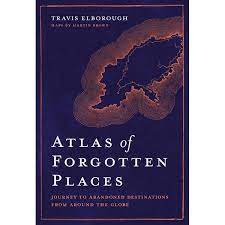
These are beautiful books, even in electronic copy – this Atlas of Forgotten Places, and the Atlas of Improbable Places; I’m sure they’re even more lovely in paper. That’s definitely a key thing to note. The photography of each place is generally very good, and evocative of whatever idea is being presented; and the maps are also intriguing. They show where the place is in context – near other towns or within a country or whatever is relevant – and also shows the layout of the particular area. Because with this Atlas in particular, I think, many of the places featured aren’t just individual buildings (although there are plenty of those); they’re also entire towns, or bits of towns. And the maps show what still exists, what’s crumbling, what’s changed over time. They’re really well produced.
Chapters includes Vacant Properties, Unsettled Situations (abandoned towns, largely), Dilapidated Destinations (tourist spots and hotels), Journeys Ended (airports etc), and Obsolete Institutions. Sometimes the categorising is a bit of a stretch, but I’m happy enough to go along with it. It closes with Alcatraz, which I thought both amusing and fitting; there’s a town called Santa Claus, a lighthouse, several hotels, and a Bangkok mall, as well.
I have two quibbles. One is an admittedly minor irritant: the book needed slightly better editing (ashes are interred, not interned, surely). The other is that sometimes most of the entry for a location is a digression – about Napoleon, when the entry is about something on Corsica, or about why an indigenous group wear bowler hats when it’s about a railway in Bolivia, or how both cardigans and balaclavas were named for military things (a man and a place) associated with the Crimean War, when it’s a submarine base in Balaklava. If you’re going to feature a place, surely you should spend your two-ish pages talking just about that place? Expanding more on what it was like and what led to its being forgotten? It made me wonder whether Elborough was padding for the sake of making each entry about equal, and pointless words really, really annoy me.
I should also note that the list of places mentioned in the blurb on Goodreads is wrong – three of the places mentioned there do not actually feature in the book that I read (I doublechecked the index and everything). So if you want to read about the abandoned Peter’s Ice Cream Factory, it’s not in this book.
Those quibbles aside, though, I have no trouble recommending this for the armchair traveller, or the lover of quirky facts.
Public Faces, Secret Lives
I read this courtesy of NetGalley. It comes out in May 2022.
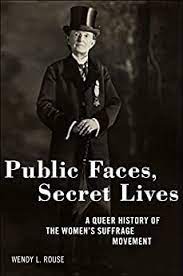
I have been known to joke that historical women were invented in the 1960s – before that, only Cleopatra, the Virgin Mary, Joan of Arc and Elizabeth I existed (obviously none outside of the European context). More recently I have added that queer people were invented in the 21st century.
I was joking, but … only because there’s an element of truth. Straight white men rule history, amiright?
This book, then, is a massively important addition to the history of the fight for suffrage.
I should point out that although I have a fairly substantial library of suffrage books, they are all either Australian or British. My knowledge of the American experience is limited to the film Iron Angels, and the magnificent “Bad Romance” spoof video clip. I do not, therefore, know a lot about the private lives of the main characters like Susan B. Anthony, who aren’t covered here in any detail because it’s been done elsewhere. It’s interesting therefore to get the focus on women who were, apparently, lesser lights – or who have become such as the history of the period has been presented.
I’m also not an expert on queer history, so I don’t know whether Rouse’s particular definition is standard or expansive. Here, queer is outlined as “individuals who transgressed normative notions of gender and sexuality… suffragists who were not strictly heterosexual or cisgender” (p2). There’s a nice point about how language changes and that words we might use to describe relationships today, for instance, may not have been available to or appropriate for people in the past.
The chapters follow general themes, or categories, allowing Rouse to explore different ways in which queerness was expressed – and fought against, in some instances. For example, in the chapter “Mannish Women and Feminine Men”, she examines how some suffragists fought against the derisive stereotype of ‘mannish women’ by insisting that suffragists perform femininity to a signifiant degree – to the detriment of gender non-conforming individuals and those women who advocated less restrictive dress. Other chapters include “Queering Domesticity” and “Queering Family” – so many of these women ended up setting up house together, and whether they were in physically romantic relationships can often not be conclusively determined, but they still spent their lives together! There’s also “Queering Transatlantic Alliances”, “Queering Space” and “Queering Death”, so it covers the entire gamut of suffragist lives.
There’s a really nice intersectionalism at work here, too, with commentary on how “queer white suffragists… helped maintain a system of white supremacy by policing access to the vote” (p63), for example. There are definitely black and First Nations people mentioned in the book, but I suspect one problem of not being familiar with the American history here is that I didn’t automatically recognise the name of any of the suffragists – let alone recognise whether they were white or not. Still, Rouse did point it out, and made note of the times when white suffragists, for instance, either tried to block black women from marching in demonstrations or told them to go to the back of the line. There’s mention, too, of class – something that’s often lacking in standard stories of the British fight for suffrage, if it focuses on Emmeline and Charitable Pankhurst and forgets Sylvia.
I’m really glad this book exists. It’s a really great look at the American fight for women’s suffrage in general (as far as I can tell), as well as presenting a dimension that is much-needed across all history.


