Macbeth: the start of a project
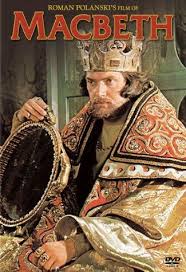
I have loved the play ever since I encountered it. I have seen many versions since then – several on stage (a memorable one at Melbourne Uni, performed in the round, with costuming to make it classic leathers-n-chains punk gangs), and several on film. Now I embark on an endeavour to watch as many versions I can find…
It’s a lot about Lady Macbeth – she is so active and yet she’s not allowed to be powerful without being punished. I’m also fascinated by the way it portrays power. And then the text around it is fascinating too: the utter misuse of history that it represents (yo, English propaganda!); the way that aspects of Lord of the Rings (the Huorns going to the Hornburg/Ents going to Isengard, and the Witch King being killed by a hobbit and a woman) are apparently speaking to Tolkien’s annoyance with the play (the forest coming to Dunsinane; no man of woman born…) – and its many appearances in popular culture.
So: here go.
1971: Polanski / Finch.
The 1971 Polanski Macbeth is my ur-text for the play. We watched it in Year 11 English, and it has coloured my view of the play irrevocably. (This was 1995 and of course I had no idea of anything about Roman Polanski at the time.) Francesca Annis is what I most remember – even more than Jon Finch – because her Lady M was so fierce and then so completely undone.
The weird sisters:
- First appearance;
- Maiden/mother/crone styling.
- Entirely physical – no sense that they are magical
- The maiden flashes her genitals!
- Second appearance:
- A cave full of naked women, all contributing to the cauldron.
- Macbeth drinks their concoction and then has weird hallucinations. – it’s not clear whether they have done magic or just given him really trippy drugs.
Macbeth:
- You really don’t get a sense that Macbeth is very impressive at the start: we don’t see him fighting, just immediately confused by witches.
- He’s conflicted right from the start – even in front of his men. Distracted, rather than decisive.
- Malcolm and Macbeth suspicious of each other from the start.
- His haircut is doing him no favours.
- After the coronation, when he’s dealing with the murderers, is when Macbeth starts to show some determination (being bloody, bold, and resolute…).
- His behaviour is verging on manic.
- Macbeth dreams of Banquo and Fleance killing him, after he sends the murderers for them.
- By the time he’s told that the English and Malcolm are coming, he’s becoming cruel and rash.
Lady Macbeth:
- In the first shot, we marvel at the HAIR. And the CLEAN DRESS.
- She is excited to see Macbeth – and he to see her: they are shown to be in love.
- She suggests murder – to Macbeth’s complete surprise.
- Uses tears to manipulate Macbeth into assassination.
- She has a potion to hand already that will drug Duncan’s servants.
- She is already freaked out while Macbeth is doing the deed. And she never recovers the composure she had at the start.
- Lady Macbeth falls asleep doing embroidery – first sign that she does anything so ladylike. And she has her first hallucination of bloody palms: her behaviour is very distracted.
- Re-reading the first letter: hair in disarray, can’t read for tears.
- We do not see her fall, but hear the cry of the nurse at finding her.
The Fall of Egypt and the Rise of Rome
Read via NetGalley and the publisher. It’s out now.
My feelings on this book are conflicted. There are some good bits! There are also some frustrating bits that definitely got in the way of my enjoyment.
The good bits: just the existence of a book about the Ptolemys is a pretty good thing, I think. They so often get ignored in histories of Egypt; and they just end up as a prologue to Cleopatra VII. And I get it – it’s hard to figure out where they fit in, as an invading ruling family that doesn’t fit with OG Egypt. I am also intrigued by the idea of putting the Ptolemaic dynasty and the rise of Rome together: if you know anything about the two, you know they have a stunning convergence in Cleopatra VII/ Caesar / Marc Antony, but what de la Bedoyere shows is the ways Egypt and Rome had been interacting for generations beforehand, and why therefore Caesar went to Egypt and Cleopatra thought getting the Romans involved made sense. I have a much greater appreciation now for the ways Rome was meddling in their surrounds, and how Egypt and Syria and others were using external players in their internal struggles.
Other positive aspects are the fact that the women get some discussion (although that’s also a source of frustration, see below), and the fact that this is written fairly accessibly, within the confines of ‘there are a lot of the same names and that gets very confusing’. I appreciated that the author did acknowledge things like ‘Roman historians have a LOT of prejudice’ and that there are several aspects of Ptolemaic history where historians simply do not have enough information to adequately explain things.
So. The less good bits. Firstly, the frustrating-ness is partly a product, I suspect, of writing a book that’s intended to be generally accessible – so it doesn’t go into a lot of detail about some aspects, and doesn’t have all THAT many references either. Instead, the author just makes claims… which are sometimes such that I raised my eyebrows. Perhaps the most egregious, from my perspective, is the fact that he doesn’t try to examine why various non-Roman kings in the Mediterranean world would appeal to Rome at the start, when Rome is an international upstart. He simply says that it happens because the Romans had won some wars. There seems to be an underlying assumption that Rome was always going to preeminent, so it makes sense that everyone acknowledged this early on. I wanted to write “needs more evidence” in the margin.
Secondly, the portrayal of the women is fairly problematic. The second Ptolemy was the first to marry his sister. De la Bedoyere blithely states that the sister, Arsinoe, basically made the marriage happen after she ran to her brother for help when previous marriages had gone badly wrong, because she was so ambitious. There is no explanation offered for her characterisation as ‘ambitious’. The fact that she married various rulers doesn’t tell us anything about HER attitudes. There is no suggestion that maybe Ptolemy forced or convinced her to marry him. Given the extravagant after-death cult stuff set up by Ptolemy II – which may be partly about playing into Egyptian religion – it seems more like to me Ptolemy II was either besotted or very, very political (why not have both?!). There are other moments when the various other Cleopatras, Berenices, and Arsinoes are also treated like this: mothers acting as king instead of stepping down for their sons, or manipulating brothers… and maybe some of them were indeed political machines! But I need evidence of that – because achieving that in such a patriarchal world would be admirable and worthy of applause! I point you also to this claim: “Worried that her power and influence were waning after his triumph over [another ruler], [Cleopatra Thea] tried to poison her son. Having already killed one child, killing another must have seemed comparatively easy.” NO WORDS.
Fourthly, connected to what I said earlier about acknowledging the problems with Roman sources in particular: relaying what those sources say in great detail, AND THEN spending a couple of lines saying ‘but we can’t take everything they say at face value’ doesn’t really work. Pretty sure that’s what lawyers do when they know a jury will be asked to ignore some evidence, but THEY’VE ALREADY HEARD IT (lol, at least that’s how it works on tv, and you see what I mean). I really think those sections – usually bad-mouthing a Ptolemy, and especially Cleopatra VII – needed to be PREFACED with ‘but the Romans had an agenda’. I really got the sense that de la Bedoyere doesn’t care for Cleopatra VII at all, to be honest; he claims she didn’t care for Egypt in the slightest, just her own power, and again – I’d like to see more evidence please.
Finally, there are some odd choices in terms of the book’s presentation. Every now and then there are boxes with random bits of information that is tangentially connected to the main part of the story. I found these more distracting than helpful – although I guess YMMV and maybe for some people this really works.
Overall… I’m reluctant to recommend this to an Egypt or Rome novice. I really think you need a slightly sophisticated reader who is able and willing to question some of the assumptions, and put things into context. So like I said: I am conflicted.
The Green Man series

I’ve been aware of this series for a few years, but never got around to reading them. Then I found out that Cheryl, of Wizard’s Tower Press, was going to have a table at WorldCon in Glasgow – where I would also be present – and I knew it was finally time to give it a go. I picked up the first book – Actual Paper! – and read it in early September. In a day. And then I bought the next two ebooks… and I read them pretty quickly… and then I caved to the inevitable and bought books 4, 5 and 6 in ebooks, knowing that this was a series I would be consuming in entirety.
All of which is pretty convincing evidence that I am loving this series. Another indication: I am very glad there’s a 7th book coming out this year.
The series follows Dan Mackmain, son of a dryad mother and human father; a carpenter by trade, who moves around following jobs (until he gets ongoing work a couple books in). Having greenwood blood, he can see things ordinary humans can’t – like boggarts and hobs, and dryads and nereids in their natural form, black shucks and wood woses: basically the things out of British folklore. He also seems to have been singled out by the Green Man as the go-to human for when bad things are happening either to, or because of, those folk: murder, mayhem, and other inconveniences. Over the course of the six books he has developed connections across Britain both with actual mythical creatures (dryads, mermaids, nereids, swan maids) and with humans who are either like him (offspring of human/not human couples) or who, somehow, have knowledge of that other world. Together, they basically act to make the world safer whenever issues arise.
The series is set in the here and now, which was clear from the technology, but I don’t think McKenna ever actually specified a year in the early books. Which means she could just have kept writing as if it were 2019 forever. Or she could have chosen to make this a completely alternate world. Instead, the fourth book – which came out in 2021 – talks explicitly about Covid, lockdowns, social distancing… it’s all there. I think it might be only the second book I’ve read (after John Scalzi’s Kaiju Preservation Society) which includes the plague. And that’s largely on me, and the sort of books I read (I do not regret this fact); but it still made it quite remarkable to read, and something I really valued. The other thing I continue to find intriguing across the books is the amount of mundanity that McKenna includes – and I mean this in a good way. Characters are in a cafe; they read the menu, they order, they eat, they pay. There’s a great deal of observed everyday-ness that makes the whole story feel real.
I have no idea whether the stories across these books are building to some grand finale – there have been some hints that maybe some of the otherworldly types are becoming restless, because of something stirring – or whether this is going to be an ongoing crime series as Dan needs to deal with yet another unexpectedly real creature (I don’t know my British folklore well enough to know what hasn’t been included yet, but I’m sure the Celtic fringes in particular will have a lot to offer). I think I would like to see some grand denouement… but who am I kidding, I can totally imagine reading several more of these books even if there isn’t.
The Green Man series is immensely fun: a fast-paced mystery/crime element with a delightful dose of folklore, characters who are generally charming and enjoyable to be around, and engaging writing that means I’ve read pretty much every book in a day. Highly recommended.
Ocean: A History of the Atlantic before Columbus
I read this courtesy of the publisher and NetGalley. It’s available now.
Broad sweeping history like this, even when done well, is both very intriguing and enjoyable to read, and occasionally frustrating. As long as you know what you’re reading, you can get around that.
To get the frustrating bit out of the way: the book focuses almost entirely on the European experience. It touches briefly on Africa, and even more briefly on the Americas, but largely through a European lens. Now, I am sure that this is partly a dearth of written records – but a significant portion of the book is about pre-history and/or relies on archaeology, so that doesn’t hold as a reason. I would have less of a problem with this if the book itself made clear it was “the European Atlantic,” but it doesn’t.
So, on the understanding that this book is largely about the European experience of the Atlantic before Columbus sailed across it, this is a pretty good book! It’s a survey, so it covers an enormous swathe of time and, within the European bounds, a broad range of cultures too – which does mean it doesn’t have really nitty-gritty detail, but that aspect is entirely expected.
Having recently visited Skara Brae, on Orkney, I was delighted to discover a section on that site, and to learn more about what it reveals of how Neolithic folks used the ocean. Haywood covers what we can know about how humans have eaten from the ocean (isotopes in bones, how amazing), as well as – when the literary sources exist – how they thought about it, used it in myths and stories, and so on. And then of course there’s sailing, for a variety of reasons and in a variety of vessels.
I left this book intrigued by the different ways people have used this ocean over time. I generally enjoyed Haywood’s writing style, and think this is accessible to the general reader.
The City in Glass

I am relatively new to Nghi Vo and now I want to read pretty much everything she has ever written.
There is so much that is enchanting about this book.
I love the idea of an immortal being having a long-term connection to, basically a relationship with, a particular place and group of people. What that looks like over a long period of time is a key part of what Vo is looking at here. I think connection to place is something that we don’t talk about enough.
And then there’s the fact that the main protagonist is called a demon, while the antagonist is an angel… nice work on the challenging expectations and flipping conventions, Vo.
The writing itself is also just a delight. This was such an easy book to read – it was so easy to just KEEP reading, to be sucked into the world and desperately need to know what was going to happen. This is always a good sign.
I remain delighted to have read this.
The Mercy of Gods

Read courtesy of NetGalley and the publisher. I will admit to a little trepidation when I saw this was coming. I’m a major fan of The Expanse series; there’s always that mix of excitement for new work from a favourite author (combo, in this case), and worry that new work will not compare to the old. What if the first stuff was a result of thinking and planning for their whole life, and now they are doing stuff with less preparation?
Happily, my fears were completely and utterly unfounded. This book is wildly imaginative, the characters are flawed and complex and compelling, and I am already psyched for the next one. Which is probably in at least a year, so that’s going to be so very frustrating.
Humans live on Anjiin. They haven’t always been there, but they have no history to explain how or why or even really when they arrived. But they’re doing very well in terms of arts and sciences and general life standards. They have a highly structured society, which isn’t great for everyone, but people deal with it as people always do. Dafyd works in a team that has recently made a major breakthrough: they have figured out a key step in integrating the two sets of biology on Anjiin. Because this is the clue as to humanity not being indigenous to Anjiin: there is the biology that seems related to humanity, and there is… everything else. And ne’er the twain shall meet. Until now.
At this point, it seems like the story will be about science and scientific rivalry. Which is all well and good. But then something is spotted on the edge of the heliosphere, and it turns out to be aliens, who do dreadful things to Anjiin and then collect a bunch of humans and take them… somewhere else. At which point the story becomes something else entirely. There are a whole range of aliens under the dominance of the Carryx, and humans are now one of them; they have to figure out what that means, on a personal and collective level. There are (unsurprisingly) a range of responses – and it’s in this that Corey shows a deep and compassionate understanding of humanity. I don’t agree with all of the ways various characters respond – and I’m not meant to – but I do understand why they act like they do.
It’s a first book in a series, so the ending is in no way a finale. It’s absolutely a prologue to what’s to come – indeed, the opening of the book, written by a Carryx, already says that Carryx interaction with humanity is going to have unexpected and catastrophic consequences. Exactly how will that happen? No idea! Need the rest of the series to figure that out!
History in Flames: the Destruction and Survival of Medieval Manuscripts

Read via NetGalley. It’s out in August 2024.
This book is highly engaging, thoughtful, sometimes depressing, and overall wonderful.
It’s also occasionally snarky. To whit: “On 19 July 1870 France declared war on Prussia (this was a time when states still officially declared war).”
One of the things that people who have never studied history don’t really think about is just how much we don’t know about the past. And that that lack is not for want of trying, but because the sources simply aren’t available. And that sometimes, that lack isn’t because people in the past didn’t bother to record it, but because the sources have been “lost”. Sometimes “lost” means the sources succumbed to time and the environment; sometimes folks re-used the medium for other purposes (binding other books, or for bullet casings – which makes me weep). And sometimes, as in the focus of this book, they are destroyed when humans destroy archives and libraries during military campaigns. The examples are from France, Ireland, Italy and Germany – he is frank, in the introduction, about the focus being narrowly European and medieval; that’s his area, after all.
The book starts with an overview of how we know what we know – a good reminder for the expert, an easy intro for the novice. It then uses one of the most famous European examples of how narrowly some of our information has avoided being lost: the manuscript of Beowulf, whose story gives me nightmares every time I read it (one manuscript, nearly lost several times… we were THIS CLOSE to not having Grendel and Grendel’s mother and MY GOODNESS imagine how different European literature would be).
The meat of the book is in four chapters that focus on four specific case studies – four instances of the military destroying archives or libraries. In two cases, Bartlett focuses on one significant object that was lost in the destruction, as a specific example of what we used to have; in the other two, he focuses on the entire oeuvre that was destroyed, and what that means for our knowledge of an era. So each chapter has an explanation of why folks were fighting, and why the specific place (Dublin, Chartres) was affected; then discusses what was in the library/archive – how and when it was made, why it was important, how it got to be in that place. And then the process of destruction (being blown up from the inside; bombs dropping from above).
All of that is what I expected from the title, and the overview. What I had overlooked is that the subtitle also says “and Survival”. So each chapter also includes how scholars tried to save the information otherwise lost: finding examples of transcripts, lithographs, and photographs of the now-destroyed work; finding copies of letters and so on in other archives; and so on. Within the horror, therefore, at losing an enormous swathe of Irish medieval history or the largest Mappa Mundi, there is a small amount of joy and gratitude at how people tried to mitigate the loss. And that makes me very thankful.
This is an excellent book for the reader who has a keen interest in medieval history; for those interested in the construction of knowledge; and for those with a broad general interest in history. I loved it.
The Book Eaters, Sunyi Dean

How, exactly, did I manage to miss reading this when it first came out? I am bemused, because this is exactly the sort of thing I should have been all over.
Well, thanks to the Hugo packet I have finally devoured it.
Book eaters are exactly what they sound like: they are people who look human, but who rather than eating human-food eat, well, books. (Most of them anyway: there are also a few who eat, uh, minds. So it’s a bit zombie-ish (but not).) These folk live in our world but generally have no interaction with humans – they’re a very insular community, necessarily. They’re also a community on the wane; women tend to have a maximum of two children, and some will have none, for health reasons. An intensely patriarchal society as well, women are moved around and married where needed – and, key to this story, kept separate from their children after about the age of 3.
Devon experiences exactly this life: growing up she is treated as a princess, as the only daughter in the house; she is married off, to act as a brood mare basically. However, she is a feistier woman than the men in her life expect, and when her son is born a mind-eater… well, things go a bit sideways, frankly.
The story is told across two periods, in parallel: Devon growing up, and Devon in the now, living in hiding with her son. Eventually, of course, the past catches up with the present, and we understand exactly how Devon has got to this point. So while we certainly start sympathetic to Devon, our appreciation and horror at what she has endured deepen steadily and relentlessly: Dean gets the pacing just right, with a steady revelation of more and more terrible things committed both by and against Devon.
A story of mothers and children, families both blood and found; highly enjoyable, with compelling and fascinating characters, and a plot that REALLY works.
Troy, by Simon Brown

I bought this, I think, at one of my first Swancons – I know I bought it direct from Russell, and Ticonderoga. I don’t know if Simon Brown was there, but for some reason I think Sean Williams was? I did discover that I have a a page with signatures from all of the contributors – also including Garth Nix, who wrote the delightfully whimsical introduction – so that’s pretty cool.
All but one of these stories have direct or indirect connections to the Trojan cycle; the exception is an interesting enough story, but one that I do rather wish wasn’t included, because it feels quite jarring to come across (and it’s about troubling Catholic priests, which is not exactly an enjoyable topic). Some of the stories use the issues of war and trauma; others confront the sheer length of time involved with the cycle.
My favourite story is “The Masque of Agamemnon,” for a lot of reasons. First, the title is clearly brilliant. Second, it combines SF elements – AI and space ships – with the Trojan story in delightfully clever ways. Third, it manages to get into some of the key issues and relationships of both the original stories and the ways in which it’s been dealt with since. Also the final line is hilarious.
I have no idea whether this can still be bought anywhere, but I hope so.
Mexico in Your Kitchen: Mely Martínez

I received this book from the publisher, Rock Point (part of the Quarto Publishing Group), at no cost. It’s available now, $45.
I’ve been making my way through this book for… a while now. But: life. Anyway! Now I’ve made enough of the recipes to be able to say that yes, this is a cookbook I’ll be keeping; there are several recipes that I expect will become staples.
How I got to now without a Mexican cookbook in my house is something I can’t quite believe, but here we are. I’ve made bits and pieces, but just by looking recipes up after having something particularly good at a restaurant. Oh, and one of my lockdown purchases was a tortilla press, at a time when a local Mexican supplier had a deal on (press + 3x1kg bags of corn meal). So I’ve now been inspired enough that I have bought more corn meal, Mexican oregano, some dried chillies, and Mexican chocolate…
The first thing to know before you rush out to buy this as your first Mexican cookbook is that it is Martínez’ second book. This means that it does not include some of the more basic, fundamental recipes; she includes a list of the recipes from that first book, and it’s things like tortillas, Frijoles Refritos (Refried Beans), and Pico de Gallo. So if you want the very basics, I suspect it’s actually a good idea to get that first book (The Mexican Home Kitchen), which I don’t personally own but I assume is as good as this one.
Martínez starts with an overview of Mexican food customs, and then – ever-useful for folks looking to cook outside of their usual customs – “The Mexican Pantry”. This section doesn’t just explain foods that the reader may be unfamiliar with (in my case, nopales); it also talks about how particular foods (eg carrots) are used in Mexican cuisine. There’s an entire section on Peppers; living where I do, many of these are inaccessible, but it was useful to see which are hotter than others, so I can make adjustments as necessary.
So, things I have made!
- Chilquiles: actually a breakfast food, but we had it for dinner. Fried tortillas, avocado, refried beans, a tomato salsa… this was totally delicious.
- Papas con Chorizo (chorizo with potato): hilariously, thanks to a mistake with my butcher, I did not get my chorizo… so I made this with bacon instead. And it was fine, but it would be better with chorizo.
- Chilorio: pork shoulder, simmered for an hour, then cooked with a sauce made from peppers and various spices. Super tasty, super easy; almost a breakfast, but this Anglo-Celt can’t come at that.
- Spicy Pork Short Ribs: didn’t make this with short ribs, because this isn’t a common cut in Australia, as far as I can tell (at least not in my area). But it was delicious nonetheless: simmering the pork and then frying it in its own fat is intriguing and excellent.
- Tuna empanadas: delicious also! Empanadas are very easy!
- Tilapia a la Veracruzana: I don’t think we have tilapia, so I used rockling. Fish, capers, olives, tomato… you’re not really going to go wrong.
- Enfrijoladas: same deal as enchiladas, but the sauce is made with beans (frijoles), rather than a tomato or pepper sauce. The things you learn! Stuff tortillas (cheat and use bought wraps) with (store-bought) roast chicken, top with a black bean sauce and avocado… fancy as! And super tasty.
… and there are still more I haven’t made yet. Recipes are generally well written, with clear instructions and times. Photos aren’t the most stylish I’ve ever seen but they do convey what the end result should look like. I’m looking forward to a lot more Mexican in my life. (Anything to facilitate more avocado.)

 Randomly Yours, Alex