Robespierre: the democrat, the radical
It’s a running joke in my Revolutions class that I have a little history-crush on Peter McPhee – one that I do all I can to play up, in all honesty. Robespierre has not, however, been my particular revolutionary crush; that’s Danton. After reading this biography, I’m half tempted to switch my allegiances… but the larger than life Danton is still more alluring than the somewhat severe Robespierre.
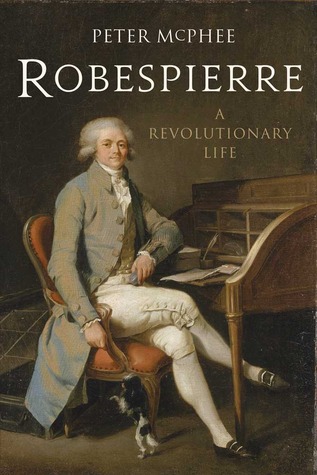
Anyway, this biography is exactly what I was hoping for. It’s clearly written and easy to read; I don’t know accessible it would be for someone with zero knowledge of the revolution, but I’m no expert and I had no trouble following it. It follows Robespierre’s life chronologically – indeed giving a bit of background on his family too – and provides what felt like an appropriate amount of background and contextual information on the realities of life throughout France, reasons for revolution, and attitudes among different groups for the duration of said revolution.
I’ve not read any of the other numerous biographies of “the Incorruptible,” and McPhee gives an interesting overview of them in his final chapter. I know that some have tended towards utter condemnation, but I didn’t realise that others turned into panegyrics. This one certainly comes down largely in favour of Robespierre as a man and a politician, demonstrating quite conclusively how consistent his ideals and desires were, even predating the revolution of 1789 that made at least some of those ideas acceptable. McPhee doesn’t shy away from the fact that lots of people died in the Terror, but does point out that in no way can the majority be laid at Robespierre’s feet – he was horrified by the actions of some deputies in rural France. He also doesn’t shy away from the likelihood that Robespierre was in fact going too far, by mid-1794, and may even have been tending towards paranoia.
If you’re at all interested in this period, or in how a leader can influence events, this is a really brilliant bio.
Galactic Suburbia #59
 In which the boob window is explained. Don’t say we’re not educational! You can get us from iTunes or Galactic Suburbia.
News
Drink Tank loves us! Download their Hugo shortlist commentary here.
Mondy loves us too! He makes us go awww.
James Tiptree Jr finally in the Science Fiction Hall of Fame, and about time too.
Talking to Alistair Reynolds: he defends the idea that science fiction has a limited number of plots
Women in (Japanese) Comics: Cheryl Morgan reports; Anime News Network
Some kickstarter stuff:
Feminist Historical Anthology from Ann & Jeff VanderMeer
Scalzi on Amanda Palmer and how she worked hard for 10 years to get her “overnight success”
What Culture Have we Consumed?
Alisa: We Wuz Pushed by Brit Mandelo
Alex: Castles Made of Sand, Gwyneth Jones; Captain America; The Avengers; Confusion of Princes, Garth Nix
Tansy: A Confusion of Princes, Garth Nix; The Avengers; Earth 2 & World’s Finest; Ishtar
Tansy’s Note: “I do not mourn the boob window” is a classic line that should be long remembered and oft repeated – but Cheryl Morgan said it first! I only steal from the best…
Please send feedback to us at galacticsuburbia@gmail.com, follow us on Twitter at @galacticsuburbs, check out Galactic Suburbia Podcast on Facebook and don’t forget to leave a review on iTunes if you love us!
A Confusion of Princes

I was really looking forward to this book, so perhaps that’s why I was a bit disappointed: expectations too high?
Khemri, our narrator, tells us straight up that he has died three times, and that this is the story of those deaths “and my life between.” It’s also made clear that although he is called a Prince, he hasn’t been born into a royal family but, rather, effectively kidnapped – requisitioned might be a better term. The story is that of Khemri learning that much of what he knows about being a Prince is wrong, or at least wrong-headed. He learns this while avoiding being killed – usually not because of his own wits – and while gradually coming to terms with the realities of the Empire. He has a wise, enigmatic Master of Assassins by his side (and the novel includes a bonus short story that gives just a little more insight into Haddad’s character), and while he does die a few times the first time isn’t until he’s actually learnt some things, which is a plus.
The overall story is fairly enjoyable. The twists and turns in Khemri learning how the Empire actually works, as opposed to how he has been taught that it does, is generally well played, although not especially original; there were only a couple of times I was genuinely surprised. I enjoyed the idea of the Princes all vying to be the next Emperor and how that might play out when there are ten million of them, mostly bloodthirsty or at the very least ruthless. And the world building was particularly interesting.
Truth be told, it was the world building that really kept me reading. The combination of Mektek, Bitek and Psitek is wonderfully intriguing – how an empire could get to the point where all three are valued, and used, and used in conjunction is fascinating. The idea of the Empire itself was… interesting, and intriguing even, but there wasn’t quite enough background or explanation to satisfy me. There is some explanation of what it means to be Emperor by the end of the story, but still not really anything about why it is an empire that rules this sprawling, mostly-human conglomeration of planets; nor why or how it was decided that Princes ought to be sought from the general population. I really liked this aspect, but it still was confusing about why it was there in the first place, if not simply as a narrative device.
Sadly, it was an aspect of the world building that really, really grated on me and meant that even if the story had been glorious, I would still not have been in love with this book. Princes get mind-programmed thralls: butlers, valets… courtesans…. This aspect of Khemri’s life, and the fact that throughout all of his adventures he basically accepts this as his due, revolted me. If there had been some questioning of this ‘right’ for Princes, if there had been some interaction with a thrall that indicated they had awareness and Khemri wondered about them, I could perhaps have swallowed a bitter pill and taken this for an aspect of a hinted dystopia. But there isn’t. Instead, we have slaves, who have been programmed, conditioned, to serve their master and be incapable of rebelling. This, I cannot accept.
On a different note, Khemri is your Perceval-type character. (Remember when David Eddings wrote a big long thing about how to construct a fantasy world and story? Maybe at the start of… I forget, one of the Belgariad tag-along books. Anyway, he said your main character, who was clearly going to be male, basically fell into Arthurian archetypes, and Garion was Perceval: the slightly dim well-meaning young fellow who needed everything explained to him.) He’s arrogant and dim, without realising the latter while relishing the former; he has his hopes for his young Princely life dashed and then nearly his actual young Princely life as well, and he gradually learns about power and authority and their right use and etc. Standard stuff. Haddad is nicely played as enigmatic-older-guide, and I would really liked to have seen more of him; the fact that people such as him get assigned to different Princes over their careers suggests all sorts of intriguing possibilities for issues of loyalty. Other than that, there’s A Girl, and a fairly large cast of C-characters who alternately challenge, nearly kill, and befriend our hero.
The gender issue is also an interesting one in this story. Princes can be either male or female, and they are treated no differently from one another; once you are a Prince, with all the conditioning and genetic tweaks attendant on that, you’re just… a Prince. Male or female no longer counts for anything, if it ever did. The same goes for priests and assassins; there seems to be no barrier about holding significant roles within either field, or indeed any other, based on gender. With all of that, the one female who plays a significant role is a love interest. She does other things too, but it still feels like she almost entirely defined by the romantic aspect, and the impact this has on Khemri. Which was a little disappointing.
Overall, I was somewhat disappointed: by the thralls specifically, but by the lacklustre nature of the story more generally. It’s touted as a space opera, but it’s just not grand enough for that. Some might argue that it is grand enough for a YA space opera, but I don’t think YA means getting to be a little bit boring with plot and magnificent gestures. It may be that I am cynical and jaded (never let it be said that I am too jaded to admit that’s possible). On the other hand, maybe this does just miss the mark.
Galactic Suburbia 58
In which we pore over the Ditmar ballot, Alex makes Tansy squirm about her nominations, Alisa makes Alex say ‘sexytimes’ more than once, and we take on the hard-hitting issues of the day: plagiarism, pirates and mommy porn. You can get us from iTunes or Galactic Suburbia.
News
Ditmar shortlist
Shirley Jackson shortlist featuring Deborah B
Stephenie Meyer moves into film production and who can blame her?
Story Siren & Plagiarism: Smart Bitches presents the story. Kristi’s apology.
MindMeld looks at great SF reads for teenage girls. But what KIND of teenage girls?
What Culture Have we Consumed?
Alisa: Feed by Mira Grant
Alex: By Light Alone, Adam Roberts; Lathe of Heaven, Ursula le Guin; In the Mouth of the Whale, Paul McAuley; Among Others, Jo Walton;
Tansy: Womanthology, The Pirates! Band of Misfits
Feedback: Fifty Shades of Grey
COMPETITION – SHOWTIME – What’s your favourite vampire?
Please send feedback to us at galacticsuburbia@gmail.com, follow us on Twitter at @galacticsuburbs, check out Galactic Suburbia Podcast on Facebook and don’t forget to leave a review on iTunes if you love us!
So Silver Bright
This review contains spoilers for the first two books, but not for this one.

I am pleased to have finished this series! Having the questions of whether Bertie’s parents could or would ever get back together, or even whether she would ever see either of them again; and whether she would end up with Ariel or Nate (or neither? or both?! – as River Song would say, that is a whole other birthday…) in the end were driving me a bit nuts.
And now I know how Mantchev resolved it. And if you haven’t read the books, you don’t. So nyer.
The story opens with Bertie dealing with the aftermath of how she dealt with Sedna, the Sea Goddess, and its repercussions for her father, as well as Nate – whom she has rescued – and Ariel, to whom she is kind of now married… as well as being married to Nate. Um, oops. So, it’s back to the Caravanserai, but not for long because she receives a summons from Her Gracious Majesty to perform before her, and so the journeys of this crazy little troupe continue. They involve bandits, a queen, several tricky journeys, the use of magic, gaining and losing companions, and finally a return to where everything began, the Theatre Illuminata.
The plot is generally well-paced, and there were some clever twists and turns to it. As far as characters go, Bertie did not grow on me further. I really liked her in Eyes Like Stars, the first novel; then she got a little grating in the second, as it didn’t feel like she was quite taking charge enough. By this time, even though it’s only a few weeks after the events in the first story, she has… evened out, maybe? Although she is still being pushed around by the winds of fortune (heh), she feels more balanced, and at the same time more willing to take necessary risks. I don’t think I’m explaining this very well, but the upshot was I think that I like and respect her more in this story, certainly by the end, although I’m still not convinced I’d like to know her in reality.
The rest of the cast don’t change that much, with the exception of Ariel. Nate develops more as an individual because he actually has some page-space, which his kidnapping had largely disallowed for the last book and a half or so, but he doesn’t exhibit any unexpected character traits like sea-sickness or being a mathematical genius. He remains a loyal friend, and a good friend, which is exactly what he should be. Waschbar is probably the most intriguing and underdeveloped of all the characters, with his determination only to steal unwanted items… and just wait til you meet Varvara. But then there’s Ariel, who is developed in this story. We finally get more of an insight into his motivations (aside from lusting after Bertie like nothing else), and that’s unexpectedly poignant (much as I dislike the terminology, I have always been Team Nate).
Finally there’s the fairies, who continue to be awesome and pastry-lusting and crude. Just for bonus marks, there is a marvellous exchange between Moth and Peasablossom on the question of vampire bats: “Don’t be ridiculous… Vampire bats don’t sparkle.” “They do! They’re a great glittery menace!” Ah fairies. So snarky. So true.
Food, power, and family: By Light Alone
The last book by Adam Roberts that I read, Yellow Blue Tibia, I did not enjoy. At all. So I was a little dubious about reading this one until I saw the cover, and I am willing to admit here and now that in this case at least, the cover totally sucked me in. An art deco sensibility is definitely the way to at least make me interested in starting your book.

And then I read the blurb, and decided that this could indeed be a book for me.
One of the great answers to “how would you change the world” in stereotypical beauty pageants is, aside from world peace, an end to world hunger. It’s something that writers of near-future sf occasionally deal with: do we get awesome new genetically modified wheat? Do we farm algae in the seas? Do we ship everyone off-planet? Roberts suggests something entirely different: create a bug that, once ingested, turns human hair into a light-gathering factory. That is, allows it to undertake photosynthesis.
Et voila! Hunger solved! As long as you have access to sunlight. And as long as you have hair long enough to catch enough sun.
Marvellous! But, now that all of those people over there are no longer starving, how do the fancy people over here prove that they are still at the top of the social scale? Easy: they eat real food. Also, they shave their heads.
It’s a bizarre world that Roberts imagines, in some ways: people lying around quite literally soaking up rays, the changed language that reflects changes in society, and so on. But, most frighteningly and tellingly, actually this future world is a lot like our present one. Maybe worse. There are haves and have-nots, at all point on the spectrum; there is discontent, both individually and collectively; there are power struggles, and cultural misunderstandings.
The novel begins as a family drama, when George and Marie’s daughter is kidnapped while they are on a family skiing holiday in Turkey. (George and Marie are skiing; their children stay with their nanny in the designated children’s play area, and get brought out when the nanny is summoned to do so.) Their experience with the local authorities is frustrating to say the least, no ransom is demanded, and the outlook is bleak – until George finds someone willing to undertake an investigation on their behalf. Dot explains why children are sometimes kidnapped: the energy from New Hair is not sufficient for a pregnancy. So either women have to get food somehow as a supplement, or… they get themselves a pre-made one. As it were. While there are indications before this event that this brave new world is not a perfect one for everyone, this is the first big crack, suggesting that the worst of human nature can still exist even when one of the major crises is lifted. This whole experience also reveals some of the cracks in George and Marie’s marriage, and they just keep getting bigger.
Just less than half the novel is taken up with George’s story – losing and eventually finding Leah, everyday life as a rich man in New York, his friendship with various people and a slowly developing interest in not continuing as normal. His perspective is rather abruptly abandoned in favour of a short vignette from Leah’s perspective, which confirms what the reader has already suspected fairly early on (um, mild spoiler?): she is not Leah. Thanks to this insert the reader is given a brief, fascinating glimpse into life in a village somewhere in Turkey (maybe; the geography is unclear), where New Hair is how people survive and power games have shifted accordingly. And this is contrasted with her experiences as the pampered daughter of a rich American family, which is of course rather stark.
The rest of the novel is divided between two more perspectives: that of Marie, George’s wife, a fairly shallow woman floating along on her own indulgences; and that of a girl living with New Hair, in a no-account little village, who ends up leaving her village and commensurately its protection and familiarity. The comparison between these two is striking, and says a great deal about power, expectations, and the impact of an individual’s choices.
Am I glad I read it? Yes indeed. While it’s by no means action-packed, the plot does move along at a steady pace, even though the events could sometimes be regarded as trivial; when the focus is a single family struggling with grief, interactions with doctors and friends and a daughter returned naturally assume significance. And just like ordinary life, these events are taking place against a background of seriously geopolitical events, if the reader cares to pay attention. Of the characters, George starts off like Konstantin in Yellow Blue Tibia – annoying and self-centred and self-pitying – he improves as a human in general, plus his interactions with people also make him more interesting than he initially seemed. I cannot say the same for Marie – she never becomes a person I would want to know – but her perspective provides a crucial, and crucially different from George, view on the world. And finally, exploring how a world so different from ours, without hunger, can still be so much the same, is a sobering reflection on human nature. One that I rather hope need not prove true.
I read this basically as soon as I finished 2312. It was a serious headspin to go from THAT world to this.
Timeless: the last Alexia Tarabotti novel
The last Parasol Protectorate book, Heartless, bugged me because of its snobbish attitudes towards the middle class. I was very pleased to see that this was not quite such an issue here, mostly because there is little real interaction with the middle classes. So that was one problem cleared up.
This review contains spoilers for the first four books, but NOT this one.
 Timeless opens with a delightfully domestic scene: Alexia Tarabotti and Conall Maccon dressing for the theatre (to the latter’s disgust) when they are summoned… to the bathroom. Where chaos is ensuing, because their toddler daughter Prudence really, really doesn’t want a bath. And while bathing a toddler can be a trying time under ordinary circumstances, when said toddler steals vampirism and werewolfism from those individuals with a single touch and she is being bathed by vampires… well. Potential disaster for those involved, hilarity for onlookers.
This is the reader’s introduction to the new life Alexia finds herself with, since the end of Heartless saw the birth of said daughter. For most of that book, Alexia was heavily pregnant but did not generally allow that state to get in the way of adventures and potentially risky undertakings. Having had her daughter frees Alexia somewhat to go back to her old life with even less worry, especially since Prudence has officially been adopted by the outrageously dressed Lord Akeldama (confidant, vampire, fashion guru). Alexia is a devoted and caring mother, and also a working mother. She can manage to balance motherhood and work fairly well because of her privileged position in terms of wealth and what essentially amounts to a very large, devoted, extended family who are willing to do much of the routine stuff. There is little explicitly said about how this affects Alexia (or Prudence), and the only other mother in the book with toddlers also has enough money to afford a nanny, so the realities of life for working mothers is left uninterrogated. This is also, I think, a factor of the book’s setting in Victorian London, where this was the norm for moneyed mothers, even those who did not undertake paid work. So while it was good to see a mother being able to act as a human being, apart from her child but still with the child making a fundamental change to her life, it would have been nice to see a bit more reflection on that situation. (Perhaps that was too much to want in what is intended as a romp.) While this aspect was a little underdone to my tastes, the very fact that there was any discussion of the impact of fatherhood on Lord Maccon was very welcome indeed. Although it had been revealed in an earlier book that he was already a father, we see here how he feels about a toddler – and the answer is very positive. Devoted, in fact, and willing to be directly involved in her life and upbringing. His distress at being unable to hold Prudence whenever he likes, because of her ability to turn him mortal and herself therefore into a werewolf cub, is subtly but clearly painted, and is one of the nicest domestic aspects of the whole book.
Domesticity is therefore a consistently present theme throughout the book, and how to balance it with undertaking potentially life-endangering missions for pack, queen and country. The action, though, is driven by a summons Alexia receives from the vampire queen of Alexandria, requiring her to present herself and Prudence before her. This necessitates some sort of cover to allow them to travel without suspicion to Egypt, and the gaining of that cover is definitely the funniest part of the entire narrative. Capers is Egypt unfold as expected, which is to say unexpectedly, and involve boats, balloons, and donkeys.
More than any other of the Parasol Protectorate novels, this one features a substantial sub-plot, involving Maccon’s great-great-great-granddaugher, Sidheag Maccon, the Lady Kingair. It also ends up involving Biffy, Akeldama’s former acolyte turned reluctant werewolf. His particular journey is one of the most interesting across the novels, I think, because many of the other immortals have either been that way for a very long time or were desperately hoping to become one. Biffy, though, is now cut off from most everything he loved in his former life – starting with Akeldama and descending, oh my, to the fact that he just can’t keep his hair neat any more. While this latter issue may seem incredibly superficial, as does his fastidious attention to fashion, it reflects his attempts to integrate his original life with his new one, so the compromises he makes are actually quite significant. Plus, awesome dress sense.
Also, there are a lot of frocks. And cravats, and hats. Ivy features, and she has a lot of hats. Some of them have feathers.
Music, women, and listening habits
I was thinking about my music listening habits the other day while I was doing just that. I had realised that new music hasn’t been happening for me for a while: I basically gave up on JJJ a few years ago partly because of the disaster that was the Hottest 100 of All Time, and partly because when we came home from overseas it just didn’t appeal to me any more. Plus, I have less time to listen to the radio than I did a few years ago, when I had a (fairly) serious commute. So, considerably less exposure than say five years ago. The two albums I can remember buying in the last two years are Old Man River, after seeing him on RocKwiz, and Imelda May, after seeing an ad for her album on SBS (while watching RocKwiz).
So, I listen to a lot of the same stuff over and over, and I’m mostly fine with that – it’s stuff I’m passionate about and really do love. What I realised though is that there’s a dearth of women’s voices on high rotation. And why? Well, my immediate reaction was that women don’t tend to sing the sort of stuff I like.
I know, right? Maybe I should listen to Galactic Suburbia a bit more often.
Thing is, I’m not saying that women can’t or even won’t sing the stuff I like – which, for the sake of this post, is mostly rock; depending on who you talk to, the harder end of the rock spectrum, shading into metal. I’m saying that I haven’t found many women who do. I haven’t looked that hard for it, to be honest, because I like what I’ve found and I’m not the sort of person who always needs New Music (my iTunes random playlist just now tossed up the Beach Boys, and I’ve been listening to them for more than 20 years). And since I’ve never actively sought out new music, that means that at least part of the fault lies with the radio stations who have been failing me, and failing those bands that I would like, if they do indeed exist. So now I’m wondering whether there is awesome music that I’ve been missing out on.
(Yes, I am now feeling more sympathy for readers who say that they don’t read books written by women because they’ve never found them. However, the analogy falls down, because while I suppose you could go your whole life reading Heinlein and Clarke (and, ahem, Reynolds and Banks and Simmons…*cough*), readers tend to look for new stuff more often than I, at least, need new music. Also, I don’t think I’ve ever seen a shelf of SF without women in it… but yeh ok this could lead to an argument about proportions etc. Which I don’t want for this post, because dammit! I have a point!)
This post is a challenge: suggest bands I might like! For reference, probably my favourite band in the world at the moment: 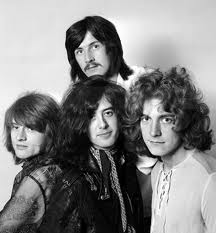
(that would be Led Zeppelin)
I’m also a very big fan of 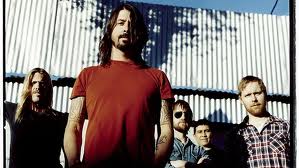
(the Foo Fighters)
and
(Wolfmother)

Before you despair of me totally, either for feminist or aesthetic reasons, I do listen to other sorts of music, and that does often include women: Goldfrapp is probably the band I listen to the most, interchangeably with Led Zeppelin, and I love Fiona Apple too, just as examples. Honestly I have eclectic tastes (protesting much?) – but what I’m really looking for is female voices doing awesome rock.
Can you help?
Tea from an Empty Cup: a cyberpunk review

When I read Trouble and Her Friends, I was forcibly reminded of what Helen Merrick says about it in The Secret Feminist Cabal (while thinking for a moment that it was my own brilliant insight), something along the lines that women made cyberpunk very much about bodies (sorry, Helen, for badly paraphrasing). Cadigan does a similar thing here. The focus is almost entirely on the issue of bodies: who inhabits them and how much physical reality is in artificial reality and to what extent bodies – artificial and physical – are our identities… and all sorts of fun things.
The story revolves around two very different women who go into Artificial Reality looking for answers: one to find someone gone missing, the other to find clues (she hopes) about a murder. Neither is experienced in AR, but other than that they are quite different. We learn very little about Yuki – not her job, not her overall circumstances in the world, just that she is “full Japanese” and that she values Tom Iguchi highly enough to seek out the probably dangerous person who might be able to point her towards him. Konstantin, on the other hand, is a slightly more open book. She has recently broken up with her partner; she’s a cop; and she possesses a remarkable bloody-minded determination that will either see her crack cases or get her skull cracked for her. Having the two main characters as women is (was), it occurs to me, probably not that common in cyberpunk literature – and having the two be so different, with quite different aims, worked nicely. Of course, in AR one’s physical gender, and body, and identity, are quite irrelevant – something that the protagonists have a bit of trouble with but that others are at pains to point out. Out there is not in here and can have little or no bearing depending on each individual’s preferences. And, much like Doctor Who and House are both at pains to point out, people lie. In AR, it’s quite likely that everyone is lying all the time. And when you’re trying to find a person or trying to find clues, that’s not particularly useful.
The AR that both Konstantin and Yuki interact with is a… simulation, I guess, of post-Apocalyptic Noo Yawk Sitty (yes really).* Interacting with it and other AR users requires a complex understanding of mores and manners, and it’s very easy to be shown up as a virgin and either mocked or turned into prey. It’s not a very nice place, as experienced by Yuki and Konstantin, and certainly suggests that Cadigan imagines AR being used for the sort of entertainments and identity-experimentation that would be frowned on, considered morally dubious, or actually legislated against in reality. It’s hinted that AR has other uses in this world, but they’re not fleshed out in the slightest. It is therefore quite an unpleasant little world Cadigan introduces the reader to, and suggests that she is pessimistic about the uses humanity would put AR to. Given the amount of porn on the internet, perhaps she has a point.
Finally, any novel that manages to get away with having an avatar called Body Sativa is pretty awesome as far as I’m concerned.
* Interestingly, the novel is so utterly concentrated about the experiences within AR that although maybe a quarter of the novel takes place in real-reality, I have no idea in which city (I’m presuming America thanks to references to DC); I also have little idea what is going on in the rest of the world, with the exception of something terribly having overcome Japan. I have a much clearer understanding of how life, or society, works in the Sitty than in Konstantin’s actual city. (And frequent ARers would undoubtedly dispute most of the adjectives in that society.)
The Lathe of Heaven
And so my le Guin adventure continues…
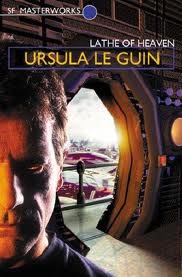 Sooo… not my favourite le Guin. Which is sad, which is itself silly, since I half expect every new le Guin to become my new favourite!
The premise here is that George, a remarkably ordinary man, has the ability to have what he terms effective dreams: dreams that alter reality. He doesn’t always dream effectively, but when he does he can’t control it. And it’s driving him mad, because he doesn’t want to have this ability. Thus, drugs, and then therapy. However, that’s when things go even less as George would want them to, because his psychiatrist Haber discovers the ability and… well. ‘Manipulation’ has such ominous overtones, but it’s appropriate here.
Objectively, there is little about this book that ought to work, in some senses. For a start, George Orr is a nobody. He doesn’t want to be a villain or a hero. In fact, there are several long sections of the book where the incredible normal-ness, average-ness, and boring-ness of George are analysed in depth, with some interesting discussion about whether his being so very very average is actually quite amazing. I really like George’s normality, and I can imagine that choosing to put this amazing ability into the hands of Mr Boring was actually quite a radical choice for le Guin (it also made me think of Deb Biancott’s Bad Power set of stories, where people get powers without having any desire to have them). Haber is another sort of character altogether, and a deeply unpleasant one at that. But still we don’t get very much insight into Haber – not whether his actions are motivated by greed or misguided altruism or what. We only see him through George, and George is a fairly ignorant observer.
Then there’s the narrative. There isn’t really very much plot, as such, for the simple reason that the world keeps changing. There can’t be much continuity, even in George’s own life, when he keeps changing fundamental aspects of the world itself. And this is disturbing and uncomfortable and a rather confronting narrative device. Of course, part of the point I suppose is to demonstrate that ‘changing the world’ isn’t as easy as it sounds; Haber thinks it will be simple to make things better, but chaos theory tells us that changing one thing can have immeasurable consequences… and when you throw in the added difficulties of everything being mediated through George’s unconscious mind, well. Hello havoc. Essentially the narrative consists of George and his quest to be normal, please.
I thought the explorations of George as Mr Average were a really interesting aspect of the novel, because in some ways it seemed to be interrogating the idea of the hero, in life as well as in literature, and also of course pointing out that the idea of ‘average’ is entirely a construction: no one should actually sit completely at the midpoint of any measures. I was absorbed by le Guin’s awfully relentless exploration of dream-logic and what it would do to the world next. But – apparently The Times declared this book should be “read again and again.” I’m not convinced it has that much re-readability, for me.


