Women’s History Month: Judy Maddigan

Judy Maddigan went to Melbourne University and participated in several demonstrations against the Vietnam War. In this excerpt she discusses her motivations for being involved.
Transcript
Judy: I came from a family that wasn’t interested in politics at all – my parents would have voted Liberal all their lives; we used to live out in the seat of Kooyong which of course was Robert Menzies’ seat – so I wasn’t interested at all in politics. When I went to university I didn’t – wasn’t involved in any political activities except for the Vietnam War. And I think a lot of people were involved in the Vietnam War – apart from the practice of war, we should never been fighting because it had absolutely nothing to do with us – but the system of selecting young men to go and fight, which was in my view it was extremely unfair – and the fact that they couldn’t get enough volunteers, I would have thought would show that most people in Australia think it’s totally inappropriate.
Alex: So if you came from a family that was, I guess, relatively conservative for the time, and so on, what made you I guess, aware of Vietnam? And what made you think that it was a war Australia shouldn’t have been involved in – like was the news, was it friends?
Judy: I think it was probably more – more being at Melbourne University and all the newsletters came out, and other people talking to us about it. So – and there was huge amount of publicity about in the time, and the guys who refused to put their name in a hat, who got into terrible trouble. I think if I hadn’t been at university, I’m not sure it would have been different or not. But certainly, I think being at university and like, there were discussions about it all the time, people talking about it all the time. But even on the news, like there were so many – continually people disagreeing with us being there. And there’s still people saying you shouldn’t do that; if you want to send people you should have a national service system, so everyone has to go for six months or something. But just – I think the fact that it was so unfair, just, you know, bad luck. And if you think like in the time, so… ’60, bit over ’60, middle ’60 – most of us would be hard pressed to find Vietnam on a map if we’d been asked where it was. And I think the other thing – but I have a bit to do with RSLs – so I have corrected them on some cases, because a lot of those soldiers think that all those marches were against them. So I try and make it clear, it wasn’t about you. It was saying you should never have been sent there in the first place. I’ve never met an ex servicemen who fought in the Vietnam War, who thought was a good idea. And it’s very hard to meet an ex servicemen who thinks any war is a good idea. Which I think is the truth about it. And I think – but some of those people I think were devastated. And I think once again, that’s because the government put – kept putting out media about doing your service for the country and all of the rest of it, which was absolute crap of course, had nothing to do with Australia at all, Vietnam was never going to bomb Australia, and we lost the war anyway. What was the point?
Alex: And do you think at the time you were more concerned with Vietnam or conscription, or were they just so intertwined it’s a pointless question?
Judy: Well, they were very intertwined I suppose. I think it was mainly in Vietnam more because of the unfairness of it, which brought in, you know, the way they were conscripted, which, as I said, I think many people thought it was awful, which – it was awful. And I think – and even I’m thinking when I went to work, you know, people who are sitting there petrified on the day they used to draw the lots – numbers – out of the hat or whatever they did, you know, that one of their family members or their boyfriend or the man next door or something got drafted – so it made, it made the community really anxious and nervous, and that stuff was there till they stopped doing it, which was a great relief to all.
If you know of a Melbourne woman involved in protesting against the Vietnam War, please leave a comment!
Women’s History Month: Sandra Goldbloom Zurbo
Sandra Goldbloom Zurbo was (as you’ll hear) involved in protests and demonstrations from a very young age, mostly because of her father, Sam Goldbloom. She was heavily involved in organising various actions throughout the era of the Vietnam War. In this short excerpt she talks about her motivation for being opposed to the Vietnam War.
Transcript
Alex: Were things like the Vietnam War and conscription being talked about at home or amongst your family.
Sandra: Mum wasn’t particularly political, but dad was extremely. … There was always, almost always something political would come up at dinner. “See that butter sandwich, the price of that butter is determined by…” and so on. In my teens, I was part of a organisation called the Youth Peace Group, which was kind of a spin off from the Victorian Peace Council, which was the Victorian branch of the Australian Peace Council, which was – basically it was a pro Soviet peace thing, but they did some really good work. And long before moratoriums, like from the early 60s, members of the Victorian peace group were protesting the Vietnam War. Twenty people would show up, you know – “Vietnam? where’s that?” – people didn’t have a clue where it was. …
Alex: Would you have described yourself as a pacifist?
Sandra: No, never. No, I was never a pacifist. I’m still not a pacifist.
Alex: Why would you not see yourself as a pacifist?
Sandra: Well, because I think there are times when people have to fight because you can’t – you can’t just say, listen, America, would you leave here? Listen, you know, China, Russia, whoever you are – I mean, people have to often take up arms or stones or rocks or whatever they – in Middle East, you know, whatever they need to take up – to get rid of what I think of it as oppressors. No, I mean, I’ve never been a pacifist and I’m still not.
Alex: So when it came to thinking about the Vietnam War and Australia’s involvement in Vietnam: you objected to that, obviously. How were you thinking about why Vietnam was a problem as a war?
Sandra: Australia only went there to – to kiss American arse, just as they went to Afghanistan, and every other war that it’s fought apart from World War Two, in which we were very late to take part. Otherwise, certainly everything postwar that we’ve done, Korea, and so on, so on. It’s all been, you know, as I say, to kiss American arse, and under the misguided belief that if we ever got into any trouble ourselves, then the Americans would come to our aid. And I know full well that the Americans will come to our aid if and only when it suits them politically and financially and diplomatically and every other -ly. … So I never thought that Australia should be engaged. And I certainly didn’t think the Americans should be engaged.
If you know a Melbourne woman who was involved in protesting against the Vietnam War, please leave a comment!
Women’s History Month: Ceci Cairns
Ceci was probably the youngest member of the Melbourne SOS (Save Our Sons). She was a young mother when she first joined. The Jeanie she mentions in this short excerpt from our interview is Jean McLean.
Transcript
Ceci: I came from a family – my father was a conscientious objector in the Second World War. And my family were Labor Party supporters. My father probably would have been a Communist, except he had differences with the way the Communists were behaving in Europe, and he never joined the Communist Party.
But he was – he basically believed in, sort of, socialism, and in peace, and he was totally anti-war, obviously. And he was an official conscientious objector. Which meant you were officially in the army.
And so I come from that sort of background, which I’m still dedicated to, that idea of freedom and peace, and anti-war. I mean, I’m anti the whole idea of armies anyway, I think they should be – I mean, I think the way they’re trained, which is to kill – basically to kill people, they have to be trained to – they have to be brainwashed into thinking the people they kill aren’t actually human beings like them. And so they become monsters without even realising. So perfectly normal people can become terrible people. As we keep finding out about army generals and things, who go wrong.
And so that’s my position. I very deeply feel all that. So when – I remember when I was at school, and I was about seventeen years old, reading then about – in the early days of Vietnam, when America actually was very influential in the politics of Vietnam, and put – I can’t remember the history of all that … So I was interested from an early age in Vietnam, anyway. To do with being at school, I suppose, and what was interesting in that era was, there was a great deal of information out there about what was going on in the world. I think, despite all our media, and despite our flash, flash, flash of information, we actually – there was a deeper understanding of the politics, if you bothered to read it, at that time.
And, of course, over the period, sort of, ten years after that, the papers were full of terrible photographs which illustrated what was happening. And I think everyone who became anti that war learnt a lot from those photographs, which I’m sure everyone says.
So that’s my kind of position. I wasn’t particularly – I mean, I had feminist sensibilities, but I didn’t come at it because I was a feminist. I came at it because I wanted justice for everyone, and justice for the Vietnamese. I wanted justice for the young men who were coerced into being in the army. The cruelty for those young men, putting them in a situation that they had no idea what they were going into, just seemed to me so unjust.
So that was where I was coming from. So when I realised how much I was – I knew I was on the side of the anti-Vietnam people, and I must have met up with Jeanie somewhere, and said, “Hey, I want to join you.” [laughing]
If you know a Melbourne woman who was involved in protesting against the Vietnam War, please leave a comment!
Women’s History Month: Jan Muller

Jan Muller was a student at La Trobe University in the late 1960s/early 70s. She was heavily involved in protesting against the Vietnam War; as well as being in protests, she also typed and Gestetner-ed many pamphlets, and assisted draft resisters. In this short excerpt, she talk about her motivation for being involved.
Transcript
Jan: First of all, I was a good little Christian girl. And from a middle class, conservative family, and I remember finding in the shed one of the Uniting Church’s early booklets about the effects of napalm and, and so forth, on children and in the villages of Vietnam. And I was pretty horrified. And so I think that was my first – I mean, we did, we did talk about the Vietnam War in school, but it didn’t mean anything in school.
So I suppose I was about sixteen or seventeen when I saw this, these graphic – graphic photos of, of injuries, and I was pretty incensed about that. So, moving on, that would have been in the mid ’60s.
And when I was at Teachers College in 1968, ’69, I wasn’t – I was pretty politically naive. But I do remember people talking about going to the demonstrations against the war. … My fiancé, I think, was quite politically active in ’68, late ’68, early ’69. And I think I went to my first demo with him. And it was a very violent demonstration. Not violent from our side, by the way. But I was so naive, I didn’t think that the police would actually hit women. So I had a big wake up then.
Alex: It seems like your initial problem with what was happening was the way that people in Vietnam were being treated.
Jan: Yep.
Alex: And then did you come to oppose conscription kind of because of Vietnam, or conscription in general?
Jan: I do remember, one of the neighbours, who my father called a pinko, driving up the street with a “no conscripts for Vietnam” sticker on the back of her car. And I didn’t know what the word “conscripts” meant. And I didn’t – I knew that Vietnam existed. I knew about Vietnam because I was a stamp collector, so I knew what Vietnam was. But I didn’t know what the word “conscripts” – but I do remember seeing that car every day as the neighbour drove home, and wondered what “conscripts” meant. That’s, that’s in the ’60s, early ’60s.
So by the time I got to be aware of conscription, I was already politically active. And, yes, I had a neighbour who was conscripted. And I got involved in the anti-conscription movement, and had friends in the Draft Resisters Union.
If you know a Melbourne woman who protested against the Vietnam War, please leave a comment!
Women’s History Month: Jill Reichstein
Jill Reichstein attended Monash University and was involved in numerous demonstrations against the Vietnam War. This is a short excerpt from our interview, where she talks about her motivation for being involved.
Transcript:
Jill: My journey started when I was doing my matriculation year at a private girls’ school in Melbourne. And both my parents were fairly conservative. And I had a history teacher who – or politics, political science teacher – who was wonderful. And she discussed the Vietnam War. So we’re talking 1967. And I was outraged. And I really started to get involved and have a look at it. I mean, I knew we were involved in it, but I didn’t sort of take a lot of interest
I didn’t think we should be sending our soldiers to fight in a war that had nothing really to do with us. And I think I was slightly anti American. And I didn’t like the idea of following what Americans did. And I just didn’t understand the rationale behind it. I mean, it was a war in a country between the North and the South. Obviously, America was spooked. But I didn’t understand the rationale behind it. So I started writing essays at school against the war. And then the following year, I went and lived in the UK for 12 months. You know, my parents wouldn’t let me travel. But they let me go to a liberal arts college, which sort of – wasn’t a finishing school, because we actually, we actually did politics and history. And there were an amazing range of women – there was 100 women living out in the country near Oxford – so I ended up spending a lot of time with people in Oxford, who were also very politically opposed to the war. And so I’d go down to the demonstrations in London, that’s when I first started to participate in the anti-war demos, concerts, etc. And then when I came back to Melbourne and went to Monash University – hotbed of, you know, political unrest – a lot of my friends, and in fact, my future boyfriend, he was a draft dodger. So there were all all of those issues for me that I faced. So I ended up going to quite a lot of the demonstrations here in Melbourne – quite memorable to think that our streets were just 1000s and 1000s and 1000s of people who were opposed to it; providing safe havens for people who were avoiding it. And so that election night when Labor won was just such a celebration.
Alex: Were you were opposed to conscription early on, or did that develop later?
Jill: No I felt it was challenging somebody’s liberty to tell them they had to go and fight somebody else’s war. And I probably didn’t really understand the political agenda behind it, other than mimicking what America was doing, which I really disliked, and I thought to force someone to fight in something they didn’t believe in was inappropriate.
If you know a woman who lived in Melbourne at the time and was involved, please leave a comment!
Women’s History Month: Diana Crunden
Diana Crunden was at Melbourne University when she started to protest against the Vietnam War and the National Service Act. The Harry she mentions below is Harry van Moorst, a leading figure in Melbourne’s protest scene, who recently passed away. She was part of Students for a Democratic Society (note the misspelling of Crunden’s name on that page), amongst other things. This is a short excerpt from our interview, where she talks about some of her motivations for protesting.
Transcript:
Diana: But I always had a fairly sort of social justice type of thing. Like, I thought the White Australia Policy was terrible, et cetera. And my parents were pretty appalled at my political activity, really, but didn’t try and restrain me at all. That was good. My political education, I guess, started when I went to uni. And I happened to meet Harry [van Moorst], because we were all in the same year. …
I was at home, up where I was born, and I came back to Melbourne to find out that a smallish group of people both at Monash and Melbourne had raised funds for the National Liberation Front. And I thought, wow. You’re prepared to go to jail for this? And it was all pretty amazing.
And then, of course, the anti-war movement started to develop. And I was pretty involved in that, but I wasn’t a leader, I wouldn’t say. I mean, I was relatively well-known, but I think it was more because I was Harry’s partner than anything else.
Alex: In terms of the war itself like, what were your objections?
Diana: It wasn’t something that America should be involved in, and Australia shouldn’t be involved in. And it was typical of Australia that it went in league with the States. It was just appalling. And, you know, all the things about, if the referendum had been – not the referendum, the – you know, the United Nations had said, “This – the demilitarised zone, and when that’s – we’ll have elections, and then that will be the solution to it.” And, of course, America decided they didn’t want to do that, so they intervened. So those were all appalling. I mean, I must have developed this perspective quite quickly, but I did have it.
Alex: And conscription?
Diana: Yes, yeah. Because so many of my friends were involved.
Alex: Would you have described yourself as a pacifist? Or was it more about the forcing people who didn’t want to do it?
Diana: No, not really. Because that just seemed to be – it was an unjust war. And that should be sufficient grounds to allow people to get conscientious objection. But, of course, it wasn’t. You had to be a pacifist. But no, I wasn’t a pacifist.
f you know a woman who lived in Melbourne at the time and was involved, please leave a comment!
Women’s History Month: Jean McLean
Following in the footsteps of those who have gone before me, here I am highlighting Jean McLean first. The truth is, though, that she really is and was awesome. I’ve included here a short excerpt about some of her motivation for protesting, and the story of how the Melbourne SOS (Save Our Sons) initially started.
Transcript:
Jean: Menzies announced in December 1964 that he was going to bring in conscription for overseas service. Now, I had always – and still am – very interested in our region. So I knew a lot about Vietnam, I knew the history of Vietnam, and I knew about the secret war that America was carrying out in Laos and creeping into Vietnam and Cambodia.
And Australia had been – Australia asked, actually, whether they could go and kill some people in Vietnam. And they finally invited us – not straight away – the Americans. And then the government said it was through ANZUS. And it wasn’t through ANZUS. Again, if one understood the history of all this –
So I knew that this was why he introduced conscription, to join the war in Vietnam. And so I obviously opposed it. I spoke to women that I knew. I was a young mother. I was doing a pottery class, and I spoke to the women in the pottery class. And a couple of them had fourteen-year-old sons, and they said, “God, this could affect our children.” And they were pretty upset.
And so I said, “Well, let’s have a meeting, call a meeting, get as many people that we know together, and see what we can do.” I mean, I’d never done that sort of thing before, and nor had they. But anyway, we had a house meeting. And I invited a minister of religion called Bruce Silverwood, who was the – the Uniting Church had just combined, with the Methodists and Presbyterians. I think he was Methodist. I think – but anyway, he came to the meeting, because he was – he spoke out about peace and this sort of – and I think he had a letter to the editor, or something like that. So I asked him to come, to tell us what to do. How to oppose things. Not religiously, but just to speak.
Anyway, he suggested to hire a hall in the city called the Assembly Hall, because it only cost $9 or £9 to hire it. And it was a public hall, you know, so you could invite people. Which we did. And we put a little ad – I wish I had it. A little ad about that big in the Herald or The Age. The Argus – no, The Argus had had it by then. The Age or the – anyway, we put this little ad in. And we had over a hundred people turn up. We got the shock of our lives. Because we didn’t have a network. We didn’t have anything.
If you know a woman who was in Melbourne and protested against the Vietnam War, please leave a comment!
Women’s History Month series

Links to interviews (and transcripts) with Melbourne women who protested against the Vietnam War and the National Service Act.
(list continues below)
Continue reading →Women’s History Month: a series
(TL;DR: all March I’m posting excerpts from interviews I’ve conducted.)
For a few years now, I have been interviewing Melbourne women who were involved in protesting against the Vietnam War and the National Service Act.
Let me explain.
- The Vietnam War: Australia sent its first troops into Vietnam in 1962, and officially withdrew in 1973. Different people have different views on why Australia was involved. They tend to revolve around fear of Communism (ie the “domino theory” that said countries were falling to communism, or could do so, in a steady domino-like pattern), following America’s lead, fighting for South Vietnamese independence from an encroaching North, or imperialism. About 60,000 troops were sent in that decade (including my dad); 521 died, and 3,000 were physically wounded (many more later diagnosed with PTS, and other issues probably related to things like Agent Orange, a defoliant used in the war)
- It’s called the American War in Vietnam.
- The National Service Act: passed in 1964 at the instigation of PM Robert Menzies. Menzies’ argument was about “aggressive Communism” all around Asia. 20 year old men had to register for service, and if their number was called, they were required to serve 24 months with the Army. Initially this was for service at home; six months after the legislation passed, it was expanded to include service overseas, and less than a year later Menzies announced conscripts would be going to Vietnam (including my dad). “Natios” (national servicemen) were chosen twice a year: marbles that represented birthdays were put in lottery barrels, and several would be plucked out. Not registering for the national service was a crime; so was not turning up if your number was called. There was the possibility of registering as a conscientious objector, but it was pretty tough.
- Protest against both Australia’s involvement in Vietnam and to the National Service Act started right at the beginning, all around Australia, but it was definitely fighting against the prevailing attitude for several years. There were existing peace groups that wanted to do things like ‘ban the bomb’ and who had been holding Hiroshima Day marches and peace congresses for years, who moved right on to protesting this new war. And there were new groups that started up, and new people who got involved, because of this specific war and this new legislation. Early on, they were a small group. By May 1970, though, when there were moratorium marches all around the country, it wasn’t so small: estimates of the number of people in Melbourne who participated on 8 May 1970 range from 60-100,000.
- One of the first acts of Gough Whitlam’s new government in November 1972 was the repeal of the National Service Act; he had campaigned partly on that, and on officially withdrawing Australia from the war.
Many general histories of Australia’s involvement in the Vietnam War give scant room to the opposition. Some of them don’t take it very seriously at all. If it is mentioned, then some of the sensational stories – like the draft resistors who evaded arrest – tend to get most coverage. If women are mentioned, then it’s SOS – Save Our Sons – and in Melbourne, it’s particularly Jean McLean (which honestly I can hardly blame them – check out this recent interview and then this picture from back in the day) who gets star billing. Maybe also ‘the Fairlea Five’: five women (including McLean) who went to prison for eleven days for ‘Wilful Trespass’ – they handed out leaflets about conscientious objection in the Department of Labour and National Service.
All of which is a long way around to saying that I decided someone should fill the gap: all those other women who were involved in protesting against the war and conscription – sometimes fiercely, and for years – and that I guess I could be that person. Happily, it’s not just me: last year, Carolyn Collins’ book about SOS all around Australia was published, and it is fantastic.
Throughout Women’s History Month I’m going to post short excerpts from the interviews I’ve conducted, to give a sense of why women were involved and what sort of things they did.
If you know a woman who lived in Melbourne at the time and was involved, please leave a comment!
The Tragedy of Macbeth (2021)
Well. I have a lot of thoughts! And… spoilers, I guess? If you don’t know the play, then definitely spoilers; and if you’d rather not know about the staging, then those will be too.
Straight up: I loved it. I think it’s beautiful to watch, I think it captures the play’s ideas, and I thought the actors were generally fantastic.
(Keep in mind, I am no drama teacher, and neither am I a film critic! I’ll probably have missed the point of some elements…)
As a film:
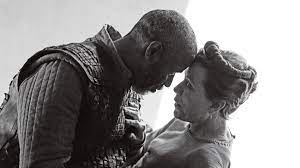
- Most obviously, it’s filmed in black and white, which was awesome. It was, oddly, so very rich – saturated, I guess – I certainly didn’t feel like I was missing much without colour. It made the fades between scenes more interesting, and it made everything much more stark.
- Some of the segues were glorious. And the use of silhouettes was brilliant.
- The use of birds throughout was a very nice motif: they’re the first thing you see – and, I realised only after a scene with the witches, it’s three of them; and circling “through the fog and filthy air”, in fact. Then Duncan sees them flying overhead, then you see them at other points too. In particular, the witches turn into birds after their final scene with Macbeth – and when Macbeth thinks he’s having a go at Banquo’s ghost, everyone else sees him flapping at a bird. (And Lady Macbeth opens a window and shoos the bird out, which is GOLD.)
- The movie is basically without context. There’s no attempt to make Washington have a Scottish accent, and Brendan Gleeson as Duncan has his Irish accent on full display. And then there’s the PLACE, which I adored: it’s utterly unplaceable. The witches and Macbeth and Banquo could be walking across dirt, or it could be sand, or dust. No idea! Duncan’s camp could be three tents or dozens; no idea! And then when we get inside, Lady Macbeth is walking down a corridor and Duncan arrives to a courtyard – but there’s no sense of how large this place is. Actually that’s not quite true; the bits of building we see are unreal, and far too large. Even when inside, there’s a tight focus on people, and especially on faces, so we basically don’t know what their surroundings are like most of the time. The only time we see a full building is the castle of Fife – and it’s a solid tower plonked on a cliff, also looking unreal. It’s almost like a cinematic version of a theatre – all hints at buildings, not whole. It lends the film a claustrophobic feel.
- The clothing is also interesting. It’s definitely not modern, suits and so on; but neither is it full-on medieval, or even faux medieval. Macbeth looks like he’s wearing a gambeson, the padded coat under armour, the whole time; Lady Macbeth is wearing long dresses but they’re not of a time. Timeless, in fact.
The story:
- Opening with JUST the witches’ voices was really interesting… and then to see just one witch, I was intrigued. But THEN she stands above water and there’s two witches in the reflection, and THEN they come out of the water? Very cool, and a nice way to differentiate this version. And Kathryn Hunter, the actress, actually DID all those contortions??
- Banquo’s eyebrows are quite the statement.
- This Macbeth is never happy. Not even at the start.
- They showed a dagger when he’s hallucinating, but then it’s actually the door handle! Very clever.
- Duncan is awake when Macbeth murders him! Now that’s a choice – and somehow makes it worse, I think.
- I paid close attention to Lady Macbeth’s hair, since it’s so often used as a signal for a woman’s state of mind, and… I think it is here? But not so dramatically as in other films. When she’s in control, her hair is very neatly and tightly and elaborately up. It’s in a plait when in bed, but that just makes sense. And at the end, when she’s sleepwalking, it’s definitely more on the loose-and-wild side.
- They kept the porter scene, which… I guess you need to let Macduff into the castle; they made him a bit silly but definitely didn’t play it up (and I think it may have been cut down, but it’s been a while since I read/saw it).
- The murderers are the least murderous-looking murderers I’ve ever seen.
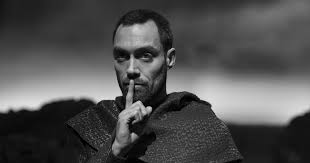
- What the heck is up with Ross?? He talks to an “old man”, who is played by the woman who plays the witches; he seems to be on everyone’s side. And then he’s the third murderer?? And he’s the one to find Fleance and consciously allows him to live? I’m very confused and intrigued. Because THEN you see Ross approaching Lady Macbeth at the top of the stairs – cut – and then Lady Macbeth is dead at the bottom of the stairs, so… ?? Ross is then the one to bring the crown – and Macbeth’s head – to Malcolm. And finally, the film ends with Ross going back to the old man, who has been hiding Fleance, and they ride off together … and when they get to a dip in the road, they don’t appear again – but a big flock of birds fly up and away… Ambiguous, to say the least.
- I’m always a fan of ‘Lady Macbeth as one of the witches’ and she puts something into Macbeth’s wine… and then he wakes up ‘tomorrow’ and there are the three witches, in the castle. So that’s another ambiguous touch.
- The testing of Malcolm is NOT included, which is an interesting choice. It does make the play longer, and it can be a bit confusing. I feel like there might have been a few other bits with Malcolm that were cut, early on; so Coen has chosen to focus just on Macbeth, and not bother with the comparison with the saintlier Malcolm.
This was just wonderful and I expect it will be embraced with joy by many English and drama teachers. And, hopefully, people who haven’t seen a Shakespeare production in years / ever.

 Randomly Yours, Alex