MCU 1 (well, 2 for us)
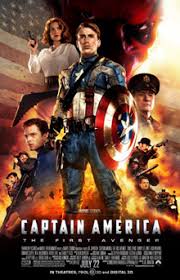
We got Disney+; we decided to rewatch the MCU; we decided (after watching Iron Man) to watch in internal chronological order.
Thus, we went back to Captain America: The First Avenger.
This is… not my favourite MCU. It’s fine. It’s a solid war film. And that’s what this is: a WW2 film. It’s Where Eagles Dare without Richard Burton, but with weird ray-guns and a disfigured villain (because that’s such a novel idea; see: every James Bond film ever).
This is actually one of the positives about the MCU. The Powers That Be haven’t insisted that every film have exactly the same feel; Iron Man and this film are very different. And so they should be! They’re telling different stories, and Rogers and Stark are very different men, and so on.
The film is: little guy doesn’t like bullies, undergoes radical transformation, becomes a ripped Chris Evans… manages to stay the virtuous little guy in a buff bod, and punches villains. Don’t get me wrong, I do think Chris Evans is great in this role; as an Australian I can say that he seems to fill a very particular idea of American masculinity (which, ahem, given the period of this film, is remarkably like the Nazi version of Aryan…).
I love Stanley Tucci in the minimal time he’s given; I would watch Tommy Lee Jones in basically anything (fight me if you don’t like Space Cowboys); Hayley Atwell is excellent, of course. And Sebastian Stan is fun, and it does make me excited about re-watching the Winter Soldier stuff. Hugo Weaving is a marvellous scenery-chewing villain, and Toby Jones is also fantastic.
Having seen the rest of the films, this feels like such a prequel in many ways. It sets up Cap’s personality – his quirks, his doggedness, his reasons for the at times holier-than-thou attitudes that so pisses off Stark; and of course, the dedication to Bucky. Which is integral to all that is to come, and the depths of which I had probably forgotten when I watched Winter Soldier last time.
I didn’t love this film, particularly, but it does make me excited for what’s to come.
Iron Man: MCU 3 (well, 1 for us)
We’re however far into lockdown 2.
We have however long left until things even begin to be ‘normal’.
And so we have caved. We have subscribed to Disney+. Partly for The Mandalorian… partly for the MCU.
And so, we have begun The Epic Rewatch Of The Entire MCU (movies only).
(We love Agents of SHIELD and look forward to catching up on the season/s we haven’t seen yet, but I have zero intention of rewatching the whole lot. Also, I watched the first couple of eps of Agent Carter, and it just didn’t work for me.)
Initially, we planned to go on production order, and so:

Iron Man
We’ve probably seen this three or four times, I guess? Of the individual-focused films, Iron Man would have to be my favourite set. I haven’t seen this in a while and I did wonder whether it had aged.
The answer: nope.
Downey Jr is still marvellous to watch as Tony. Tony is an unpleasant, arrogant, wilful, privileged, and selfish man, who actually begins to change through the movie. The fact that he is also a mechanical and theoretical genius makes his other traits more frustrating, for me – but yes, I still like him overall. Yes, this is a problem. I really liked the cave-construction part of the film, and the fact that it’s clear Tony is no Elon Musk; he can actually make stuff. He’s a Tesla rather than an Edison; a Robert Hooke or Robert Boyle. In fact one thing I really like is the somewhat-reality of the iterative nature of making the suit: that it’s not perfect, needs refining, etc. (And looking forward, the way that this progresses for Tony’s character is truly fascinating.)
Everyone else in the film is also great. Jeff Bridges is outrageous as Obadiah; Terrence Howard is fine as the long-suffering Rhodes; yes, I like Paltrow as Pepper, too. The pacing works, the soundtrack is infectious, the graphics still look fine to my eyes (which may be slightly rosily-hued, who can say). It was delightful to see people who carry on through the whole set – especially Coulson, of course, and Fury in the end-of-credits scene; and Iron Man’s musical motif, too.
Overall, this is a film that really stand up.
————————————————————
… as foreshadowed, after we watched this, we reconsidered our viewing order. We’ve decided to go internal chronology, which means we go back to The First Avenger and Captain Marvel next, rather than moving straight to Iron Man 2. So that will be fun.
The Gurkha and the Lord of Tuesday
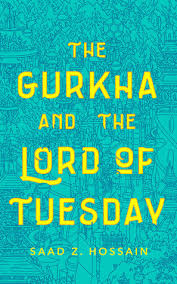
I have a question. And that question is, what the heck was I doing this time last year that I didn’t rush out to get myself a copy of this novella? Because it really can’t have been that important. I didn’t even know what it was about! I just can’t quite get my head around that; what a failing on my part. Still, thanks to WorldCon and whoever mentioned it on a panel, I finally got my act together and I inhaled it pretty damn quickly.
At some unspecified point in the future – definitely a ways into the future, but not so far that humans are off colonising the far reaches of the galaxy – Melek Ahmar, the Lord of Mars, the Red King, the Lord of Tuesday, Most August Rajah of Djinn, wakes up. Turns out he has been asleep for a rather long time, and things have changed. Wandering through the Himalayas trying to figure out what’s going on, he comes across Bhan Gurung, a Gurkha living fairly contentedly, it seems, by himself in a cave. Melek Ahmar is disconcerted by Gurung’s lack of servility but makes use of his knowledge about the modern world – like the existence of nanobots, and that there is a city nearby, Kathmandu, which might be ripe for him to take over; after all, a great king like him needs subjects. Melek Ahmar and Gurung go to Kathmandu and… things progress from there. Poorly, for some people; certainly sideways for a number of them. It turns out Gurung has ulterior motives; and things aren’t quite what they seem in Kathmandu – although the fact that it is run by an AI, allocating karma rather than money as currency, isn’t a secret.
There’s a lot going on here. Melek Ahmar, the Lord of Tuesday, himself has a lot going on; all sorts of references to Greek and Egyptian and I think Hindu? mythology/ ancient history that make me long for a prequel story about the dastardly deeds of Ahmar’s youth. The slow unravelling of the story behind Kathmandu, and why the world runs with nanobots, is superbly paced and very exactly revealed, until it all finally slots into place. The same with Gurung and the revelation of his character, his story. And the story overall is a joy to read; a variety of characters and their interactions, a setting that’s sketched more than detailed but nonetheless brought to life, and a pace that keeps it all rolling along.
This is one heck of a story. I’ll be getting hold of the two other novels Hossain has out, and looking out for more.
Flyaway

Bettina lives in a very small town with her mother somewhere in the outback. It’s an area of farmers and hard scrabble and everyone being in everyone else’s business; they’re a long way from everyone else. Her father and brothers have been missing for some time, but Bettina’s life seems to be going its own quiet, easy way, until something comes along that starts a disruption. And then she chooses to follow where that disruption leads, becomes (re)acquainted with two of her peers, and goes on the sort of literal and figurative journey that means you can never properly go home again.
Like most Australians, I am a city/suburbs person. Like slightly fewer Australians I have spent some time “in the bush” although never for especially extended periods (days and weeks, never years). For all that much of the (white) Australian apparently has this romantic notion of, or attachment to, “the outback”, that’s not the reality for most people – who’ve never spent long periods outside of a large town, never worked on a farm (I’ve visited but not worked), don’t really know what it’s like away from streetlights.
All of that is, I think, an interesting backdrop for coming to this novel. I definitely think Australian audiences will come at it differently from, in particular, an American one. For Australians, the fact that Jennings did in fact grow up in a rural area will be an important part of trusting her insight and the way she sets her story up; it certainly was for me. Not that someone like me couldn’t write a story about an outback town and have it work – but I trust Jennings and her observations because I assume she is writing at least partly from experience.
Jennings calls this an “Australian gothic.” I did not study the gothic genre at uni, when most of my friends did; it has never especially appealed to me as a genre. I think, in my head, it comes too close to the aspects of horror that I dislike; I don’t enjoy being made to feel uncomfortable. So I can’t speak to the accuracy of the gothic label – although there were definitely bits where I felt uneasy, and was put in mind of the stories we used to tell each other as kids, about things like the Min Min lights and other such things.
There are many things to love about this book. Firstly, the structure. The narrative proper is interrupted every second chapter by the insertion of a story-within-a-story. These might be told by someone who’s present, or be second or third-hand. Their connection to present events isn’t always obvious, but always becomes so. And they’re generally linked to some piece of folklore, or apparently superstitious warning, that might be straightforward to ignore during daylight but becomes less so at twilight. This was an intriguing way to flesh out the story, and also contributed to a sense of … disconnect; of things not working exactly as they should, because the narrative isn’t straightforward. It left me feeling unbalanced, like I wasn’t sure things were happened as I expected.
Secondly, the art. Jennings is probably most well known in Australia, and indeed overseas, for her art – which isn’t entirely fair since she’s written and had published any number of short stories; but her book covers, in particular, have had a fair bit of notice, and justifiably so. It’s her own artwork on the cover, which is awesome; there are also fantastic pieces at the start of every chapter, and on the folded covers. They make me particularly happy to own this in hard copy.
And thirdly, of course, the writing and the story itself. Publishers Weekly describes it as “spellbinding, lyrical prose”, Kelly Link says that her prose “dazzles”, Holly Black that it is “exquisitely rendered.” All of that. Jennings evokes a particular feeling of Australia – the space, the dust, the sun, the trees, the oppressive expanse – that made me glad I was reading this in my nice suburban house (even if it is during lockdown), and not while out camping, because I think that being in the bush while reading it might have been just too much. It would have made it too… real. So the setting works brilliantly; and the people do, too. My nan moved to a small town after marriage when she was 20 years old; into her 70s some of her peers still treated her as new to the place. Small towns can have delineations that strangers don’t see – I’ve heard the stories of Catholic and Protestant areas in teeny little Victorians towns – and that’s brought to the fore here, too. And then there’s the folklore, and the uncomfortable sense that maybe more is going on beneath the surface than is immediately obvious…
I really hope Flyaway gets a lot of notice, and from a wide-ranging audience. A lot of Australians will enjoy it for the way it plays with notions of “The Australian outback” – and frankly it’s just gorgeous.
A Table for Friends
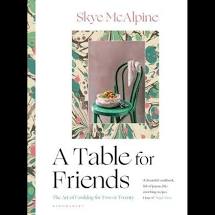
This book was sent to me by the publisher, Bloomsbury, at no cost. It’s out now; RRP $49.99.
It feels an age since I reviewed a cookbook! And usually I like to actually cook from one before reviewing, but… well… look at the title. None of that is happening at the moment. And although of course I could cook from it for two, the one time I tried to get the ingredients recently it fell through because of Issues with Shops. So I figured I should just get on with telling people about the book, since it’s out now!
Firstly, this book is gorgeous. It’s hard cover, and it has a ribbon (as all cookbooks ought) and the pictures are lovely. I am indeed one of those people who loves flicking through a cookbook looking at the pretties, and this is one that rewards such actions.
Beyond the appearance, though, I am intrigued by the way it’s arranged – which is slightly different, at least in the naming. McAlpine says in her intro she wanted it to feel ‘intuitive’: so it opens with what she calls Stars – the centrepiece of a meal. But that’s not always a roast; she includes chilled almond soup, and burrata with preserved lemon, mint and chilli (bring on summer) in this section, as well as Pork Wellington and poached cold salmon. For every star, McAlpine suggests what might go alongside from the other sections – Sides and Sweets. Basically, she is doing all of the menu planning for you, if you choose to follow her ideas. She rhapsodises about the joys of throwing together dinner and lunch parties in her introduction, which is something I have never found easy – enjoyable, yes, but for me sometimes quite stressful since I’m not sure what works together and I can get flustered by organisation. McAlpine’s point, then, is to make those like me just chill out a bit.
So the other sections are Sides and Sweets, and Extras – truffle mayonnaise and cocktails and the like. But one of the great triumphs is found at the back. The section called How to Cook by Season sets out suggested meal plans by seasonal availability of produce: a Make-Ahead Weeknight Supper for Spring, Late Summer Lunch Al Fresco, a First Blush of Autumn Supper, Food for Celebration in Winter… and so on. Just the names make me really, really want an end to the Current Situation. And THEN, joy of joys, she has a section called How to Cook by Numbers, which is something that really stresses me out. Starting with Cooking for Four to Six, and going to Cooking for Twenty (or more), she suggests recipes that work most easily at those quantities. Which is just magnificent. I don’t ever want to properly cater for twenty, because that seems like way more trouble than I can face; but she suggests a lot of things that can scale. And finally, because she’s clearly a sensible and canny writer, McAlpine finishes with How to Cook by Timings: the things to do last-minutes, and the things you can prepare days ahead.
I am really, really looking forward to cooking from this book, both just for us when ingredient can be come by easily, and for larger groups of friends. I am also quite greedily happy just to have it on my shelf to look at.
The Space between Worlds
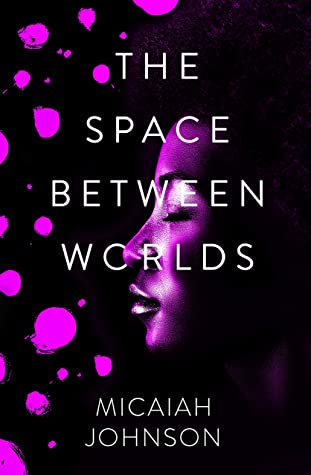
This book was sent to me by the publisher, Hachette Australia, at no cost. It’s due out on August 11; RRP $32.99 (trade paperback).
This is a debut novel – which doesn’t mean Johnson has never written a novel before, of course, just that this is the first one to be published. And it’s pretty great.
It is unclear to me exactly when this is set; some time in the future, but not unimaginably so. It’s also unclear where this is set – I just assume it’s meant to be America because as an Australian, I assume most novels are set in America unless they’re evidently in the UK somewhere. (Realising the setting is Australia, or somewhere other than the US or UK, is often a very surprising moment, unless I’ve gone in knowing the story is deliberately set in, say, Nigeria.)
Anyway. Both the when and the where are basically irrelevant to the story, because the most important where is that most of the action is on Earth Zero. This is a world where not only have parallel universes been discovered to be real, but someone has discovered how a person can travel between them.
These sorts of stories have happened before (says the fan of Fringe) but the particularly clever thing that Johnson does is the caveat that you can only survive traveling to a world where your dop (doppelgänger) is dead.
Barring unfortunate accidents, you know who makes the most valuable traversers, therefore? who are the people able to access the most worlds? It’s the people whose survival to adulthood is unlikely. For wealth, ethnic, gender, location, and other systemic reasons. Those who grow up in areas with a lot of violence. Those from families or suburbs or countries with widespread violence. Those who, in the general course of a capitalist world, are seen to have little real value.
This is a brilliant twist, and I love it. And I also love that Johnson doesn’t present this as meaning that those people suddenly get great lives. Instead, the protagonist – Cara – is always aware of the fact that she could be replaced by robots when that tech works; that the people who were born in the nice town, as opposed to where she grew up (very much not-the-nice town), look down on her or fear her. Her existence is precarious despite her value to the company.
So partly the narrative is about Cara and her navigation of the two worlds – the rich and the poor, in brutal essence – that she straddles. It’s also, of course, about literally moving between worlds, and seeing how different choices have led to different outcomes – on a societal level or an individual one. Unsurprisingly Cara ends up being more involved in one of these other worlds than is appropriate by company standards, and that has knock-on effects for that world as well as her own, which is the bulk of the story.
The novel has little interest in explaining how moving between the worlds works; the science and technology are irrelevant to the story. Instead, Johnson is interested in the people: what secrets are kept and why; how relationships work; why certain decisions are made, and how they change human interactions. I enjoyed this focus a lot.
One aspect didn’t quite work for me; there’s an undercurrent of science v religion, especially in the way that Cara talks about the experience of moving between worlds – as a goddess allowing her to do so. I didn’t feel like this really fit the rest of the story. However, this does not detract from the rest of the story; it just felt undeveloped, like there could have been a bit more discussion of the possible mysticism of moving between worlds; it’s just not there as much as I think I expected.
Overall, this was a very enjoyable book, and I hope that Johnson is able to write many more in a similar vein.
Talkin’ Up to the White Woman

As with Living on Stolen Land, I don’t want to be the white woman talking about and appropriating an Indigenous woman’s words. So if you’ve been thinking about reading this book, do it! This review is intended to prod people into doing so, and in no way is a substitute for Moreton-Robinson’s own words.
I saw Aileen Moreton-Robinson at the Broadside feminist festival last year and she was intriguing. On the panel I saw, about women of colour and how they approach feminism, she was the oldest by perhaps a decade or more, and she seemed to get quite impatient by what some of the panellists were saying – and how they were saying it; she told them (in a poor paraphrase) that feminism is a white woman’s thing and they, not being white, needed to think differently – and maybe white feminism wasn’t actually what they needed. That’s a very poor paraphrase, actually, but I think it gets some of the sense of what she said – and for me, as a white feminist in the audience, it was eye-opening and kind of stunning. I am in a weird halfway place I think between second and third wave feminism; I don’t think I think that all women are sisters and experience oppression in the same way, but I’ve definitely had to work on fully manifesting intersectionality in the way that I think and act. The panellists too were intrigued by how Moreton-Robinson spoke; at one point someone (only half-jokingly) suggested the panel should be the rest of them asking Moreton-Robinson questions.
The other thing that really stuck in my mind was the fact that this book was published in 2000, and Moreton-Robinson had never before been asked to speak at a conference in Australia about it. Never. Nineteen years of a book that was the first Indigenous Australian interrogation of feminism… and conferences have ignored it, and her. That’s a disgrace. There is, at least, a 20th anniversary edition out this year, and Moreton-Robinson seems to have been on some programmes (ABC Radio, The Drum), so that’s a bit of an improvement?
So, the book. It took me quite a long time to read, partly because this year I have been struggling to read new stuff – which I think is the case for many people – and partly because it’s been a while since I read any theory; it’s not every chapter, but several deal with anthropological theory and feminist theory so I knew I needed to read it slowly to actually absorb what was being said. Rushing through would have been a disservice to the book, and I wouldn’t have really appreciated everything being discussed.
Throughout the book Moreton-Robinson talks about “the subject position middle-class white woman” which I found challenging, in some ways – because as she points out, women like that/women like me are indeed accustomed to being the default. And even when I am aware that I am those things, constantly having it pointed out (like Indigenous women, like African-American women, like… etc usually experience) is a novel experience. And an important one. And is one of the core points of the entire book: feminism – especially as it was in the late 1990s, in some corners I think it may have changed a bit in the last two decades – has been developed by white women with themselves at the centre, and while we’re busy interrogating various positions of power etc we forget to think about how, even in our gender oppression we massively benefit from (and help to support) racial oppression.
Moreton-Robinson begins my talking about how Indigenous women have presented themselves in their life-writings, pointing out the differences in those experiences compared to middle-class white women. She then tackles a massive job in looking at how various feminists have theorised ‘difference’ and ‘race’ over time and in different places – mostly white feminists, since they have been the most significant for Australian ways of thinking. And along with a whole bunch of interesting things here the main take-away for me is that white feminists haven’t considered that they are white; that they (we) have race/colour/ethnic position. And then the third chapter was perhaps the most gut-punch, from a historical point of view: she gives an overview of how white feminist anthropologists have talked about “Indigenous women” and all the ways that has been part of the colonising process, which chapter 4 also continues to interrogate.
All of the preceding stuff is incredibly important and could have stood by itself. What Moreton-Robinson then does in chapter 5 is present interviews with white feminist academics (ask me how hard it’s been to remember to put ‘white’ at the start of each nominal group… hello privilege), about how those academics think about race and present it in their courses and interact with people from different ethnic backgrounds. And this was illuminating and also for me challenging: who do I interact with and why, how do I present an anti-racist stance in my teaching and also live it in the world, and so on.
Finally, the last chapter presents a history of how Indigenous women (up to 2000, which I think is important to remember, since more will have been done and said since then) have challenged white women and their intentions and words. Which was its own version of challenging mostly because of how white women have responded to being challenged (often, badly).
This book won’t be for everyone; I know that reading theory isn’t going to be appealing for many. But the ideas and challenges that Moreton-Robinson present are vital for us middle-class white women to hear and acknowledge. If you ever get a chance to hear her, please do so. If you think you can cope with some theory, please get hold of this book and read it.
Bone Silence
The first book was Revenger.
The second book was Shadow Captain.
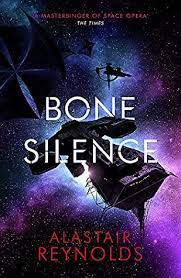
This is the third book.
I really like Alastair Reynolds’ work. I own all of his novels (except the Dr Who), and most of his chapbooks and collections. I have re-read several of them, and I get excited about new books.
But.
Um. I was bored by this book.
Like, I skimmed through paragraphs of description in the last third or so.
When I got to the end, I just felt a bit… numb. How had it come to this? How could I possibly not have loved this book?
Let me suggest some reasons:
- The book is too long. Maybe 1/3 too long. There are long, boring descriptions that add nothing to the sense of place or experience. There’s lots of time where nothing happens – and sometimes that can be fine; I will read Legolas and Aragon and Gimli running across Rohan endlessly – but these periods of waiting were… boring.
- The climax didn’t feel like it fit the book itself, or the trilogy overall. Actually I started feeling like this in the second book where all of a sudden we weren’t just off to save someone, but there was something weird going on with the whole civilisation – but that wasn’t something that was even foreshadowed earlier so it came as quite a surprise. And then this book is theoretically all about finding out the answers to those civilisation-wide issues, but there’s a whole lot of waaaaaiting… and then BAM here are (most of) the answers you were waiting for. Which were themselves a bit weird and didn’t feel like they fit the world-building to that point.
- Fura and Adrana, the sisters at the heart of the story: I didn’t really care. Maybe if I had re-read the first two books before getting into this one, I would have been more concerned with their welfare and fates. As it was, neither of them were particularly appealing as characters, and I didn’t feel very compelled to cheer for them.
- The writing style. It was already a bit grating in the first book, and it really wasn’t working for me by this stage. The trilogy is basically like Hornblower in space; the space ships use (light)sails to get around, and there are pirates and privateers and loot and boarding parties and such. The language reflects that idea of 18th-century nautical-ness, especially in conversation. And it got old.
So there we go. I haven’t always adored every Reynolds; the Poseidon’s Children books weren’t my favourite, but I still enjoyed them. Hopefully this book is a blip – maybe a case of the editor not editing as thoroughly as previously? Who knows. I will still be buying the new Reynolds, whenever that comes out; I’ll just be a bit more cautious in my enthusiasm, I suspect.
Murderbot #5
… whose proper name is Network Effect, but everyone just calls all these stories Murderbot, don’t they?
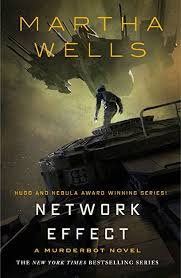
In case you’re late to this party: in 2017, a novella called All Systems Red came out and a lot of people went a bit nuts about a Security Unit robot who had hacked its governor module and was therefore under no one’s control, who kept doing its job because it didn’t know what alternatives there were – it just knew that sitting in one spot and watching media all day was going to land it in trouble. And thus, Murderbot. All Systems Red introduced Murderbot and its problems with humans (including that they keep trying to get themselves killed; Murderbot’s job is preventing that); its love of an epic drama called Sanctuary Moon; and a particular job that goes sideways because the galaxy it inhabitants is largely run by corporations, and the corps like to try and get away with everything. Security Units are used by other companies to try and prevent the other other companies from destroying or killing their stuff.
Artificial Condition, Rogue Protocol and Exit Strategy all followed, wth Murderbot trying to learn more of its own history, the possibilities for its future, and where it can access more media please and thank you except probably without the pleasantries.
If you haven’t read the four novellas yet, you want to stop reading here – partly because of spoilers and partly because seriously your life will be better for having read Murderbot why are you even still here? Ann Leckie says she loves Murderbot; NPR claimed “We are all a little bit Murderbot” and I have to say, right now: so true.
So that brings us to the novel, Network Effect. This picks up fairly soon after Exit Protocol; Murderbot is on Preservation, working for/with Dr Mensah and her family, and trying to figure out what it’s doing and what should come next. Well, it’s not actually on Preservation at the start of the novel; it’s with a survey team and we all know how well that tends to go. And that’s pretty much how it goes… and then things manage to get worse, right about when it shouldn’t. What a surprise. No wonder Murderbot despairs of humans.
Basically if you like the Murderbot novellas I don’t see any reason for you not to love the novel. It’s just… more. More snark from Murderbot, more hating on having emotions, more existential confusion about what it should be doing. Many, many more explosions and much drastic action and epic failures of plans (sometimes because of unforeseen events; sometimes because humans), opportunities for hating on the corporations, and conflicted feelings about the humans in its care responsibility.
I can only hope that Wells is interested in continuing to explore Murderbot’s developing sense of self, and their conflicted relationship with their risk assessment module. Murderbot isn’t human, has no desire to be human, and hates passing itself off as human even when that’s a security necessity. And there is no better way to explore the concept of humanity than through its interactions, its changes in response to stimuli, and its refusal to accept what’s right in front of its visual inputs.
Catfishing on CatNet

In 2016, Yoon Ha Lee introduced servitors who might have a mind of their own in Ninefox Gambit and then proceeded to develop them as a subplot, eventually introducing one who liked to re-cut its favourite media with better music. In 2017, Vina Jie-Min Prasad gave us Computron and its obsession with Hyperdimension Warp Record, and Martha Wells gave us Murderbot and its love of media.
In 2015, Naomi Kritzer had already given us the AI in “Cat Pictures, Please” who definitely doesn’t want to be evil and knows everything about you because you put your life on the internet and while it mostly likes looking at your cat pictures it also knows about your obsession with hentai, that you should buy this house over here, and that you really need a new job.
IN 2019, Kritzer produced Catfishing on CatNet which I finally got around to reading because it’s nominated for not-a-Hugo, the Lodestar Award for Best YA novel. And I am super pleased that I did finally get a chance to read it, because it was hugely enjoyable.
The novel follows the short story in that there is an AI, who is an occasional narrator; they do love cat pictures. Here, they’ve set up a social networking site that’s meant to be mostly about cat pictures but as always happens has become something more – not least thanks to the social engineering of the AI, who puts people in groups it thinks they will enjoy.
The focus, though, is on Steph. Steph is a teen who has moved around a lot because her mother is paranoid – and not without reason: Steph’s father was abusive, and her mother is determined not to be found by him. Steph has come up with coping mechanisms to deal with changing high schools a couple times a semester, sometimes; mostly it revolves around trying not to make friends. But at the new school, she starts making friends; and, of course, things do not go smoothly. For Steph, or for the cat-picture-loving AI.
There’s a lot to love about this novel. It’s fast-paced, which is unsurprising in a YA novel. It spends what feels like a nice amount of time setting up the school circumstances, as is appropriate for a YA story where that’s really the big deal for the main character; when things go wrong, they really go wrong and events move right along. There’s some excellent diversity – I can’t believe I still feel like this is something I need to say, and maybe it’s reflective of me being old and the target audience for this novel would just roll their eyes at me; whatever: there’s racial and gender and sexual diversity, and it’s an entirely natural part of the social landscape, as it should be. So is the commentary on the fact that there are racists and sexists and homophobes out there, but the kids kinda just… deal with it.
The AI is not the central character but its actions are central – without its interference/ help, events would unfold very differently. In the short story, the AI discusses how it has examined different moral and ethical codes, and frankly found them unhelpful in its own pursuit of correct action. That’s not explicitly in the novel, although there is some discussion of ethics; but the AI definitely does consider the rightness of its actions with regard to its human friends, and this conundrum – how best to act – informs a lot of what happens. And I love it, because of course these are the sorts of discussions we should be having.
The sequel to Catfishing is meant to be out soon. I’m very excited.

 Randomly Yours, Alex