FarScape s1, e11
Season One, Episode Eleven: Til the Blood Runs Clear
John and Aeryn go for a little haunt ‘round the block to collect data towards getting John home. Things go far better than expected, which goes to show how rude John can be, and brings the science back to this show for an episode.
A: Just the title of this episode bodes poorly for D’Argo. I love Aeryn’s snarkiness in this opening; she’s so funny.
K: I didn’t even realise that. Ah well, maybe it’ll give him a chance to redeem himself for past episodes.
A: aaaand Zhaan is having A Moment in the sunlight, which is quite spoiled when Pilot points out the radiation could harm the baby. Guess that’s going to be a thing for the rest of the show. Continue reading →
Another One Bites the Dust, Jennifer Rardin
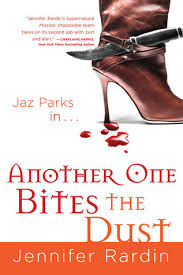 This book was sent to me by a dear friend and unfortunately, it’s just terrible.
Too much? Perhaps:
This book is just not my thing.
I do believe that it has systemic issues that aren’t just problems for me, though.
Firstly, and I acknowledge this is partly my fault, I haven’t read the first book (Once Bitten, Twice Shy). So I don’t have the knowledge about the relationships that might have made some of the banter and the fraught silences make more sense. Pardon does attempt to explain how they’re all connected, but it didn’t always make sense.
Another thing that didn’t always make sense is the different others – and yes, that’s how they’re referred to in the book: the supernatural entities. It seems like a new being just pops up every now and then for the heck of it – and sometimes with narrative reason – and their powers or whatever aren’t clearly explained. Which is related to the biggest beef I had, narrative-wise: clearly Our Heroine, Jaz, is on the track of someone who happened in the first book – there’s occasional references to them and their Dastardly Deeds – but I have almost no idea what they did or how bad they are, aside being told they are Bad. I know info dumps are sometimes clunky, but gosh some detailed explanation would have been helpful so that I understood the stakes (… heh…).
Anyway. The narrative revolves around a team of maybe-CIA-connected types, who include a seer and a vampire, trying to track down and do… something… with a vampire who has stolen some technology. Things move incredibly quickly, but there’s still time for the description of intricate details about clothes, shoes and accessories being worn; this is problem for me, with rare exceptions like Gail Carriger. There’s a Winter Festival, and belly-dancing, and murder, and magical powers, and anti-other sentiment being expressed in unpleasant ways. There’s romance, although not in a very interesting way, and attempts at disguise, and Revelations of Nefarious Purposes.
And it’s just written badly. I did finish it, partly because I wanted to see how many twists cold try and get in, and where the romances would end up going (because this friend likes to send me romances), and because – well, it wasn’t quite so bad as to make me want to abandon it, and I was a little invested in some of the characters and knowing where they would end up.
I will not be chasing down any more Rardins.
Galactic Suburbia 149!
 In which we compete for gold, silver and bronze medals in chatting.
WHAT’S NEW ON THE INTERNET?
WSFA Small Press Award shortlist released.
Aussie SF Snapshot 2016 – 150+ short interviews with active members of our community. What’s everyone up to? Find out in a snap!
CULTURE CONSUMED
Alisa: Star Trek Beyond, Olympics
Alex: Deadpool and Batman v Superman; Dusk or Dark or Dawn or Day, Seanan McGuire (out next January from Tor.com); Strange Matings, ed Rebecca J Holden and Nisi Shawl; The Godless, Ben Peek
Tansy: Shadowhunters (Netflix), Masks & Shadows by Stephanie Burgis; Damaged Goods by Russell T Davies adapted by Big Finish Audio
Independent Olympians at the Olympics
Please send feedback to us at galacticsuburbia@gmail.com, follow us on Twitter at @galacticsuburbs, check out Galactic Suburbia Podcast on Facebook, support us at Patreon and don’t forget to leave a review on iTunes if you love us!
FarScape Rewatch: s1, e10
Season One, Episode Ten: They’ve Got a Secret
Peacekeeper issues are still on board as fits with the plot when it suits. It may have infected D’Argo, who is then hurled out of an airlock. All in a day’s work when you’re on Moya.
K: I wonder how this conversation started – ‘John, come here, I need a ladder I can order about?’
A: Oh I HOPE so. Plus, D’Argo is a right little whinger. “Wah, I’m doing droid work!”
K: And I wonder if Pilot can regenerate just so it’s easier to have his puppets back to normal after the last episode…
A: what, you don’t think it’s narrative-driven?! Continue reading →
An Accident of Stars
This book was sent to me by the publisher at no cost.
 This is the first book of the Manifold World series. It’s a portal fantasy and a coming-of-age story, with an Australian schoolgirl following a woman who had helped her – and following her through a rift into another world.
Saffron’s life is a fairly normal one; it opens with a distinctly unpleasant experience with a boy at school harassing her, and a stranger supporting her as (sadly) almost no one else ever had. In going to thank the woman, her adventures start – and almost immediately they go bad, showing very early on that this is not going to be an easy experience for Saffron (although the language barrier is dealt with through a particularly convenient piece of magic). She eventually discovers that she’s wandered into a state whose politics are currently rather grim, and has fallen in with people who aren’t exactly the Most Popular Citizens. And then an escapee from the castle ends up finding them, and things get even more fraught, and adventures ensue.
Perhaps the most remarkable thing about this book is the sheer diversity of the characters. Most of the leads are female, with a couple of men. There’s a wide variety of sexual orientation, from bi to someone I think is aromantic. There’s a wide variety of skin colours – you know, like in the real world; a trans character; those who are religious and those who aren’t; the magical and the not; old and young; parents and not; and all the other personality quirks that individuals humans can have, from characters with sunny dispositions to those who consistently make you want to leave the room when they enter.
In terms of narrative, there is a lot going on in this book. There’s the experiences of Saffron, who has to deal with the strange world she’s in and the physical changes forced on her – how will she explain these when/if she gets home? (I was forcefully reminded of Seanan McGuire’s Every Heart a Doorway.) There’s Gwen, the world-walker, trying to manage this new girl as well as her own allegiances and secrets. There are a lot of conflicting allegiances because there’s a huge amount of politicking going on: both of the states where most of the action takes place are in difficult positions regarding their leaders, with people trying either actively or passively to change the status quo. Sometimes, indeed, I felt like there was too much going on. I liked that Saffron is forced to deal with the politics of the world she’s entered, and that the places she’s in are not presented as the only states, and that politics can be confusing. But sometimes I felt like the political situation wasn’t explained clearly enough – or, actually, that the problems with the system or the way that people were using the system weren’t explained clearly enough for me to care to the level that I ought.
It’s a fast-paced story, problems rarely being dealt with before more crop up; there’s magic that is difficult to use and requires training; there’s a bit of romance but not too much (for my tastes!). There’s a bit of traveling-around-the-place and camping but mostly it’s urban, and there’s a variety of perspectives used to present the narrative too.
I did enjoy reading it, although I’m not left desperately waiting for the next one. The book largely stands by itself – there’s a bit of cliffhanger at the end but in terms of the main narrative, it’s largely complete, which I appreciated.
You can get it from Fishpond.
Leviathan’s Blood
This is the sequel to The Godless, and will therefore have some spoilers for that first book. Like that one, this was sent to me by the author at no cost. 
Aaaaarrrrrgggghhh. The third book isn’t out until 2017.
The Godless basically ends with the siege of Mireea ending badly for our friends there, with additional problems like having killed a couple of very powerful men, while Buerelan’s friends are dead and the child-god is being distinctly creepy. So you just know that this second book is going to be completely full of happy, cheery adventures. Or not.
Peek’s pre-prologue is from a historian writing fifty years after the siege of Mireea, which I quite like as a conceit since it allows him to remind the audience of some of the major events with a bit of chronological distance that provides for the introspection and reflection of good historical writing. The prologue itself is deeply unsettling, since we’re introduced to someone who, sadly, doesn’t survive (sorry, but it is kind of obvious). And that’s because he’s in the wrong place at the wrong time: on the coast, when Aela Ren – the Innocent, who was pretty much a myth and a rumour in the first book – comes to shore. Which bodes for the entire novel.
The Godless followed a few different perspectives; Leviathan’s Blood steps it up a notch by adding more perspectives as the web of the story becomes increasingly complex. A lot of the story occurs in Yeflam, whence the survivors of Mireea have decamped as refugees – and I can’t help but think that Peek’s presentation of their situation, being stuck on an island with little provision and viewed with deep suspicion by the people of Yeflam – reflects current experiences of refugees, especially in relation to Australia. Ayae is having to deal with being a refugee again but also being in a unique position as someone cursed, or blessed, with a god’s power – and therefore viewed very differently by the people of Yeflam, whose state is largely ruled by such people (the Keepers). She, however, largely feels loyalty to the Mireeans and their ruler – as well as to Zaifyr, who is also in a difficult position, since he’s arrived in Yeflam as a prisoner for the murder of two Keepers. Which he knew would land him in hot water, to say the least. Then you’ve got Captain Heast, who may be my very, very favourite character since he’s so much the put-upon, battle-scarred, trying-to-be-moral, old soldier (huh… so I have a type then: Sparrowhawk; Mal Reynolds; Han Solo). And then there’s Buerelan, who probably has the most difficult narrative throughout this book, since it begins in such a hard place – blood-brother dead and cursed by the child-god – and it just gets worse as he goes to Ooila, the home from which he has been exiled for a very long time and where he knows he won’t get a great reception.
This series is definitely one of those thats fits into the Rather Gloomy side of epic fantasy. That’s not a negative, but I probably wouldn’t be giving it to someone who hasn’t read any since they enjoyed David and Leigh Eddings as a teen! There’s a lot of difficulty for our heroes, and often our heroes aren’t actually very heroic. Instead, they’re fallible and frustrated and human; not always likeable but almost always compelling.
There were points at which I felt like the narrative dragged a little, when it feels like we’re getting a bit bogged down in the details of how the Mireeans will get out of their difficult situation with Yeflam or the internal politicking of Zaifyr and his completely dysfunctional family. Having said that, all of those details add up to a very rich world – one where life isn’t all adventures and near-misses, but where understanding realpolitik is genuinely life and death, and buying farms can be a risky manoeuvre, and who you spend time with might actually change your life.
And thus, dammit, begins the long wait for the final book.
You can get it from Fishpond.
2016 Snapshot: Nike Sulway
Nike Sulway lives and works in regional Queensland. She is the writer of the books Dying in the First Person, Rupetta, The Bone Flute, The True Green of Hope, and What The Sky Knows. In 2014, Rupetta became the first work by an Australian author to win the James Tiptree, Jr Award. Nike can be found at her blog.
Your most recent novel is Dying in the First Person, which has been getting some rave reviews. There’s a lot going on in the book, but one aspect that you’ve written a little bit about on your blog is the idea of paracosms, or invented worlds. What drew you to the idea of including one in this novel? What do you think paracosms say about individuals or society?
I’m not sure I can put my finger on a single moment when I first encountered the idea of a paracosm, and wanted to write about it. Do other writers really have those singular moments when ideas flash into their thoughts as subjects? I’m not sure that’s every happened for me, instead it’s slow accretion, slow obsessions. Anyway, there are probably at least a few things. As a child, I had a really good friend, a ‘bosom buddy’ as Anne would have said, and we had a shared paracosm. It wasn’t quite like Nahum: it didn’t exist in some ‘other’, undiscovered place. It was the bushland that extended out from the back of her house. But in our relationship with it, that bushland was populated by storms of magical creatures. Fairies especially, but also a terrible, cruel Bunyip, and winged horses and trolls. When we left the house to go bushwalking, we entered that parallel world, as if through a magical portal. One of the interesting things about that process, to me now, is that when we entered the bushland, we also put on other versions of ourselves. We had different names and different bodies. And I remember, very distinctly, looking at my friend, Cavel, and seeing her as other self. Magical and strange. And wondering if she saw what I thought of as my true self, too.
When I came to writing this novel, I think there were several things that collided in my imagination. I’d been working at the LOTE centre (a now-defunct division of the Department of Education, dedicated to supporting the teaching of Languages Other Than English), so I’d spent some time immersed in a community of workers who all had a language other than English as their first language. And then I spent some time in the Netherlands, with my family. My Oma had dementia, and one of the effects of that, for her, was that she slipped in and out of the languages she spoke–particularly English and Dutch–weaving them together in a way that made sense to her, but was often difficult for those caring for her. There were times when her shifts made a kind of mnemonic sense: when she spoke about living in Australia, she would use English, and vice versa, but at other times there didn’t seem to be any rhyme or reason for the shifts. And she was very old, and very frail. I was conscious — we all were — that she was dying. So these ideas, of languages and how they relate to our sense of self and community and family, of alternative realities and shared, created worlds, and the loss of love. The way families can be physically separated, but deeply emotionally connected to each other, all came together in these two brothers, and Nahum, and the stories they wrote for each other.
I’m not sure I can say anything conclusive about what paracosms say about individuals or society for others. That’s much too big a question for me to answer. But I do see patterns in the research I’ve done around childhood paracosms, in particular. Oddly, they’re often connected to children who are conceived of as geniuses — as peculiarly talented or sensitive. They seem, most often, to be expressions of a utopian ideal, but one in which darkness nevertheless lurks. They might be kingdoms where children rule, or where children are not policed by parents and teachers, but there are monsters lurking at the edges of those worlds. War and death and loss.
I suspect that paracosms, like most created worlds in speculative fiction, are most often mirrors that their creators hold up to the real world. Distorted reflections that reveal things about ourselves and our worlds, and poke at them. Sometimes, they’re forms through which we can ask those ‘what if’ questions: what if the moon were made of cheese, what if women were equal citizens, what if gender was understood differently, what if race was understood differently. In Nahum, Samuel and Morgan create a world in which, unconsciously, they wonder what would happen if the only citizens of the world were men, and each of them lived alone.
You spend a good portion of your life talking about writing, and teaching others about it. Does this help or hinder your own writing? And I’m very curious – has the number of students taking such courses increased or decreased lately?
A little of both, actually. Sometimes it’s inspiring and challenging; sometimes it’s enervating and overwhelming. At times, just at a very banal and practical level, the teaching (and other aspects of my day job) mean I don’t have time to write, or the imaginative energy left after long days of meetings and administration, email and committee work. But the classroom, or workshop, and the conversations I have with my postgraduate students, those are most often rich, strange and challenging. I think they make me a better writer. Having to help others become better writers, helping them find the tools they need to express what they want to express, challenges me to do the same thing. To constantly question what I think good writing is, and how it can be achieved, and what it can do. It keeps me from becoming lazy or complacent.
I work in a regional university, and I’ve only been there a couple of years, after a long ‘absence’ from the university sector. At USQ we have a relatively new Creative Writing program, so it’s been growing steadily since I took up the role two years ago. That said, late last year I went to the annual AAWP (Australasian Association of Writing Programs) conference, in Melbourne. It’s a conference that I’d attended annually in my early years as an academic, from the second year it ran. And I was overwhelmed by the number of people there. It was HUGE. So I think, totally anecdotally, that there’s been an enormous increase in the number of students enrolling in undergraduate writing programs, but even more radical growth in postgraduate enrolments, particularly research Masters and PhDs.
Your novels to date are quite different from one another, and your short stories likewise. Do you have ideas or characters you’re hoping to explore in future stories?
I wonder if that’s confusing for readers. I have so many passions as a reader, and I think that that diversity in my reading passions is reflected in the styles and genres of stories that I end up writing. And perhaps my teaching influences me, too. Particularly in the undergraduate program, I’m concerned with offering students the opportunity to write across a range of styles and genres, and that means I’m constantly thinking about, reading, and discussing a wild array of works. This week, it’s been Nature Writing, Science Fiction, Ecological Criticism, Fairy Tales, Fantasy, Historical Fiction and the personal essay. You can probably expect works in ALL those genres from me at some point.
At the moment, I’m working on two novels (one of which might evolve into a kind of not-novel: we’ll see). One is the first of a trilogy of historical novels. It’s called The Orphan King, and is about Edward VI, the orphaned son of Henry VIII and Jane Seymour. The other two books in that series are about his two sisters, each of whom, like him, was the child of Henry VIII, both of whom became queens of England. The three orphaned monarchs are haunted by a trilogy of ghosts: their dead mothers: Jane Seymour, Katharine of Aragorn, and Anne Boleyn.
The other book, Tern, is a fairy tale. At least, what I think of as a fairy tale (to me, Rupetta was a fairy tale, too). It’s the story of a girl, Tern, whose several sisters are cast out of the family home after drought ruins their father and his new wife, pregnant with his first son, refuses to have them in her home. Tern sets out to find each of her sisters, but this is complicated by the fact that each of them has become something else. An animal, a piece of the landscape. So she’s walking around Australia—her and her dog—seeking women who aren’t women in an Australia that’s not quite, but is absolutely, the one you think you know.
What Australian work have you loved recently?
I have been reading a lot of essays lately: I read and absolutely adored Rebecca Giggs’s essay ‘Whale Fall‘. As far as books. My socks were blown off by Quinn Eades’s ‘All The Beginnings’, Josephine Rowe’s ‘A Faithful, Loving Animal’ and by Libby Connors amazing feat of historical work ‘Warrior: A Legendary Leader’s Dramatic Life and Violent Death on the Colonial Frontier’, which tells the story of the Indigenous warrior and lawman of the Dalla people, Dundalli. The book is more than just an account of one man’s life. It’s an account of his people, and of the culture that white ‘settlers’ tried so hard to wipe out.
Which author (living or dead) would you most like to sit next to on a long plane trip and why?
A dead one, so that I can use their seat and my own—really stretch out while they hover without a body in the aisle–and not arrive, at the other end of my international plan trip, feeling like Death.
More seriously? Recently, I listened to David Sedaris reading and discussing Miranda July’s short story ‘Roy Spivey’. This is a story that begins: “Twice I have sat next to a famous man on an airplane.” One of the men the narrator sits beside is “a Hollywood heartthrob who is married to a starlet”. It’s an astonishingly good, heartbreaking, funny, surprising story. July is never disappointing on any of those grounds. And really, I want to sit next to her so I’ll appear, with a name that is ‘almost an anagram’ of my real name, in a future story, poem, film, or artwork by Miranda July.
Miranda July would have had a better answer for this question.
2016 Snapshot: Kathryn Barker
 Kathryn Barker was born in Canberra, but growing up involved plenty of travel. She started primary school in Tokyo (the only kid with a sandwich in her lunchbox) and finished high school
in the woods outside Olympia, Washington State (aka that rainy place where Twilight was set).
In the years that followed she went to university, became a lawyer, changed her mind, re-trained as a film producer and worked in television. Kathryn currently lives in Sydney with her family, and In the Skin of a Monster is her first novel.
Kathryn Barker was born in Canberra, but growing up involved plenty of travel. She started primary school in Tokyo (the only kid with a sandwich in her lunchbox) and finished high school
in the woods outside Olympia, Washington State (aka that rainy place where Twilight was set).
In the years that followed she went to university, became a lawyer, changed her mind, re-trained as a film producer and worked in television. Kathryn currently lives in Sydney with her family, and In the Skin of a Monster is her first novel.
Your novel In the Skin of a Monster won the Aurealis Award for Best Young Adult Novel in 2016 – congratulations! What was it like to write such a novel? Had it been gestating long?
The story wasn’t exactly ‘gestating’ for long… it just took a really long time to write! We’re talking years. Several of them. Honestly, I did more re-writes on that book than I care to remember.
As for what it was ‘like’ to write In the Skin of a Monster? Well, at times it was tough. I mean, the story involves the fall-out from a school shooting and takes place in an alternate realm populated by nightmares and monsters. Getting into the headspace of the characters was a bit dark sometimes. Having said that, the story also has lightness and love and friendship and redemption. Writing those moments was an absolute joy. So, in short, the process of writing In the Skin of a Monster was both tough and joyous… and pretty much everything in between.
In the Skin of a Monster is your first published novel, but how much unpublished work is sitting on the metaphorical drawer right now?
The drawer’s empty I’m afraid – In the Skin of a Monster was the first thing I ever wrote. Truth be told, I didn’t even have a crack at short stories before jumping in head-first. It’s not like there were any magical short-cuts, though. All of the usual learning curve stuff still applied (finding your voice, finding the story etc)… I just did it all ‘on the job’. Like I said, the story took me several years to write.
These days my ‘metaphorical drawer’ is filled with ideas and outlines that I haven’t had a chance to write yet… but I’m (slowly) working on it!
What writing plans do you have for the future? Are there ideas or themes or genres that you’re hoping to explore?
I’ve just finished an early draft of my second novel, which I’m really excited about. Without giving too much away, it’s a YA mash-up involving classic works of English literature. Thematically, I wanted to explore the idea of ‘romantic ideals’ and how they measure up against what’s real. Also, there’s time-travel… because who doesn’t love time travel?
What Australian work have you loved recently?
This is such a hard question, because there’s been so many! Off the top of my head, I’m going to say ‘My Sister Rosa’ by Justine Larbalestier. I mean, who can resist an adorable little psychopath wreaking havoc?
Which author (living or dead) would you most like to sit next to on a long plane trip and why?
Tough call. Hemingway would be good for a drink and an upgrade… but I’m going to go with Philip K Dick. Anyone who can come up with that many crazy, genius ideas is someone I want to chat to. Though knowing my luck, he’d probably sleep the whole trip…
2016 Snapshot: Kirstyn McDermott


Author Photo Kirstyn McDermott
Kirstyn McDermott has been working in the darker alleyways of speculative fiction for much of her career. Her two novels, Madigan Mine and Perfections, each won an Aurealis Award and her most recent book is Caution: Contains Small Parts, a collection of short fiction published by Twelfth Planet Press. When not wearing her writing hat, she produces and co-hosts a literary discussion podcast, The Writer and the Critic, which generally keeps her out of trouble. After many years based in Melbourne, Kirstyn now lives in Ballarat where she is currently pursuing a creative PhD at Federation University with a research focus on re-visioned fairy tales. She can be found online (usually far too often) at www.kirstynmcdermott.com.
You recently hit 50 episodes of your podcast The Writer and the Critic – congratulations! You sounded quite surprised, in the episode, that you had got there. Was that because you didn’t think you’d put up with Mondy for that long? How are you feeling about the podcast at the moment?
Thanks! I’m feeling pretty good about the podcast right now. We made some minor adjustments to the format so that we can be a bit more curatorial about the books we choose to pair together, rather than each of us simply recommending a book we like. Also, no longer constraining ourselves to picking books we have already read has been kind of liberating … especially for my To Be Read pile! It’s a little daunting as well, in that neither really want to spend half an hour bitching about a book we ended up hating, but we do make our selections in good faith, choosing books we are genuinely interested in reading and think we will enjoy. Of course, as with our latest episode, it doesn’t always work out that way! I also love the interaction we have with listeners and being on Patreon this year has been great for that. Our next episode is “Patron’s Choice” where some of our supporters on Patreon have nominated and voted for the books they’d like us to read. I’m really looking forward to that one.
And I see I’ve somewhat dodged your original question – ha! The only reason I didn’t think we’d make it to 50 episodes was that it covered such a long time period. We started recording eleven times a year, then only every second month for a while, so Episode 50 seemed a lifetime away. I wasn’t sure how long I’d have the stamina, especially once I started a PhD, but I’m glad we’re still recording. Ian, to his credit, seems indefatigable! I love chatting with with every month and coming across books I might not otherwise have thought to pick up. Having intelligent, in-depth conversations about books (whether I loved or loathed them) really is one of my favourite things to do in the world, and getting to have those conversations with a dear friend on a regular basis is brilliant. It’s like my own personal book club. Plus it makes me read non-PhD stuff and that’s a good thing.
Your novels Madigan Mine and Perfections recently got re-released by Twelfth Planet Press. How does it feel to see your older works (well, they’re not THAT old!) released back into the world?
Yes, Madigan Mine was published in 2010 so not that old really! But it does feel a long time ago. I’m stoked that Twelfth Planet was able republish them both digitally as well as giving Perfections its first life as a physical book. I’m particularly grateful for the latter – Perfections had a troubled road to publication and was originally only available as an ebook with limited exposure, so it’s great to see it get a second chance, so to speak. That doesn’t come along too often in publishing.
You’re currently working on a PhD. You may be sick of answering this question, but what’s it on and have you been surprised yet by any of your research?
It’s a creative PhD, so the core of it is a collection of re-visioned fairy tales which, as it happens, are all turning into novelettes. Research wise, I’m focusing on collaborative female relationships within narratives and I guess the surprise – though that word connotes delight, so perhaps it’s not quite the one I would use – is realising how pervasive the absence of these types of relationships really is, not just in fairy tales but in broader cultural narratives about real and fictional women. We don’t tend to tell a lot of stories where women (who might not even necessarily be friends) help one another or band together for a common purpose without animosity or acrimony –especially in a relationship which is defined in some way other than by a connection to a male character. Or else, when we do tell those stories, they tend not to be valued very highly or taken seriously by the larger culture. Maybe that’s one of the reasons I love the remake of Ghostbusters. For all its flaws, the collaborative relationship between those four women is the beating heart of that movie and it’s found an permanent place in mine. And Holtzmann. Oh my god, Holtzmann.
What Australian work have you loved recently?
Two novels spring immediately to mind: Lament for the Afterlife by Lisa Hannett and A Single Stone by Meg McKinlay. I adored both of them on all levels – intellectual, emotional and visceral – and think they’re both incredibly important and engaging books that should be widely read. Honestly, I’m still stunned by how damn good Lament is from a craft point of view; it’s one of those books that make me … not wish that I had written it precisely … but wish that I had written something like it. And Single Stone, well, I still tear up thinking about certain aspects of it. Highly, highly recommend them both.
Which author (living or dead) would you most like to sit next to on a long plane trip and why?
Oh my goodness, what an opportunity that would be. I cannot choose a living author as that would feel way too much like stalking, so I’m going to nominate Shirley Jackson and Angela Carter. I’d tell Shirley that she has written the best opening paragraph to a novel EVER (The Haunting of Hill House). I’d tell Angela how her versions of fairy tales have edged me along the same fascinating path. All three of us would drink pre-mixed G&Ts and chat about ghosts and the gothic and fairy tales and feminism and the magic of words until we were completely sozzled and cackling like wise old crones while flagging down flight attendants to bring us more cheese and crackers. Can it be a flight all the way to Europe? Please?
FarScape: s1, e9
Each week on a Sunday afternoon, join Alex (of Randomly Yours, Alex) and Katharine (of the unpronounceable Ventureadlaxre), as they re-watch the Australian-American sci-fi show Farscape, notable for the Jim Henson animatronic puppets, the excellent mish-mash of accents, and the best OTP ship of all time.
Season One, Episode Nine: DNA Mad Scientist
A scientist promises a way home for the lost wayfarers, but of course all is not as it appears. Friction results within our merry band…
A: EW NEEDLES IN EYES gross.

 Randomly Yours, Alex