The Summer Prince
 Sometime in the future, when things have gone very pear-shaped, there’s a thriving city in what used to be Brazil. They’re ruled by a queen and the aunties. There’s a king, too; but he dies every year, thanks to a ritual that goes back to the setting up of the settlement and issues around who caused the world’s problems and oh yes there was a plague, too. Plus, there’s life-prolonging treatments so you’re a child, in the ideas of society, for a really long time. And we all know how people respond to the idea of being treated like a child when they think they’re totally adult and ought to be consulted on, like, stuff.
With this as the basis, now add a girl who has parental issues and a deep, deep desire to do something serious – something political – with her art. Things can’t help but get explosive, right? ART. Let’s rock the world with art. Make political statements and confront the authorities and be provocative so they can’t ignore us any more. And if they don’t like it let’s do it some more.
I was somewhat reminded of Osiris, by EJ Swift – just a bit in the post-apocalyptic nature of the world. The issues are different, in that the haves and have-nots are differently conceived, as is the outside world. But it’s still interesting to see visions of the future like this getting explored in different ways.
It’s a fast-paced ride, and very easy to read. Johnson juggles love and sex and sexuality, tradition, art, technology, family relationships, despair and hope and ambition. And right up until the very end I had no idea how Johnson was going to be able to bring it to a satisfactory conclusion – satisfactory for me, that is. And she pulls off something very clever indeed.
This was my first taste of Johnson’s novels. I am fully intending to read more.
All Men of Genius
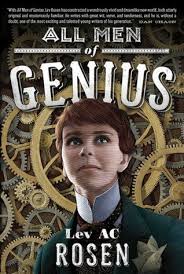
Rosen takes a large dose of Shakespeare (As You Like it, specifically); adds a liberal dose of mad science and a pinch of Ada Lovelace; shakes gently, and decants the resulting mixture in fairly smooth prose to produce a generally enjoyable book, with a somewhat abrupt and disappointing finish.
The first thing to know about me and this book is that with one exception (Much Ado About Nothing, thank you Kenneth and Emma), I basically loathe Shakespeare’s comedies. I do not like twins. I do not like mistaken identity. I do not care. I will not go and watch a comedy if I have a choice do not even try.
Rosen, however, made me care, because finally there is a good reason for identity swapping rather than just the amusement of seeing a man in a skirt pretending to be a man (oh HA HA geroffthastage). But taking your brother’s identity in order to get into the most prestigious science academy in London in order to make crazy beautiful science with the full intention of revealing yourself as a lady at the end of your first year? VIOLET I LOVE YOU.
The fact that your brother is gay and you don’t have a problem with that is just extra cute and an additional bit of sticking it to the establishment.
I liked it. If you like slightly artificial prose (not as jaunty as Gail Carriger but that sort of thing) and some seriously mad science, this is a fun book. There are lots of gears. And talking rabbits. No really, it’s funny, if lacking in ethics. Also invisible cats, difficult decisions, and cranky professors.
Thoughts for people who’ve read the book: SPOILERS AHOY!
I really enjoyed Violet’s interactions with the other students, overall; it’s a slightly grown-up version of boarding school romps, basically (like, the drinking is legal). I was really pleased that Rosen allowed Jack and Violet to be and remain good friends – I guess it helped that Jack had his sights firmly fixed on Cecily – and that it turns out Drew knew she was female for a while and it just didn’t matter. Hooray for cross-gender friendships!
I generally liked Cecily. I liked that she was good at science, and wanted to be good at science. I was bemused by her attachment to the rabbit, since it made this intelligent young woman seem like she was about six. I also generally liked Miriam, and I was fascinated by her status as a dark-skinned, widowed, Jew… but it did feel a bit tokenistic. That is, I am perfectly fine with her being all of those things, but Rosen begins to explore the ramifications of those aspects of her identity aaaaaand doesn’t fulfil the promise.
Other things that didn’t work so well:
The relationship between Violet and the duke is a bit ugh. The age difference is icky. The ‘but I don’t think I’m an invert!’ (Rosen’s word, presumably – I hope! – historically appropriate) attitude from the duke after kissing Violet-as-Ashton skirted, and may have fallen into, problematic (I’m cis, I’m no judge).
The switching of voices. What for, Rosen? The fact that it doesn’t properly start until well into the book makes it particularly weird. I liked Fiona well enough but I really didn’t need her perspective, nor that of the duke, nor Cecily or Miriam’s, unless they were all going to be as thoroughly explored as Violet’s. Which they’re not. And Ashton is distinctly left out, really, which makes no sense.
The ending. The marriage happens waaay too fast – or it could have happened in as few pages but there needed to be a bit more about how it all got resolved, and wait a minute isn’t she a bit young??
Galactic Suburbia: Teen Feminism edition
In which Tansy, Alisa & Alex take on Feminism 101 with a recs list of teen-friendly resources. Get us at iTunes or Galactic Suburbia.
Long-time listener and frequent commenter Scott emailed us to say : “My 16 year old daughter has been have issues with boys belittling her views at school class and not being supported by close minded teachers. One of the boys asked if she was a feminist. She said she looked it up on the internet and wasn’t sure it was very positive. I’ve told her it can be a positive term depending on how it’s used. Could you point me to a book or two that I could give her that could help break down feminism and put it in a positive light?”
And so, Lily, here are our thoughts…
Feminist Teacher – http://feministteacher.com/
with special note of this vid made by teen boys after taking a high school class on feminism – https://www.youtube.com/watch?t=319&v=9Vh60p4p2QM
Anita Sarkeesian: How to Be A Feminist http://feministfrequency.com/2015/03/24/how-to-be-a-feminist-panel-at-all-about-women/
Mindy Nettifee – For Young Women Who Don’t Consider Themselves Feminists: https://www.youtube.com/watch?v=i-aD9WrfWTM
Laci Green: https://www.youtube.com/watch?v=UwJRFClybmk (also recced by Renay on Twitter)
Kitty Flanagan – woman against women against feminism
https://www.youtube.com/watch?v=8iADPHWoJb0
Stuff your Mom Never Told You: How To Talk To Friends About Feminism
https://www.youtube.com/watch?v=vfRcIVGvEoA
Emma Watson’s UN speech – https://www.youtube.com/watch?v=gkjW9PZBRfk
We should all be feminists | Chimamanda Ngozi Adichie: https://www.youtube.com/watch?v=hg3umXU_qWc&feature=youtu.be c/Tehani
The F-Bomb http://thefbomb.org/
Jessica Valenti: Full Frontal Feminism (2008), He’s a Stud, She’s a Slut, and 49 Other Double Standards Every Woman Should Know (2009)
Amy Poehler – smart girls in the room https://www.youtube.com/user/smartgirls
Vid with a 7 year old explaining feminism & generally celebrating issues to do with being female. https://www.youtube.com/watch?v=OJqTAVJB_x8
Herself – http://herself.com/about/ [NSFW]
Mary Sue’s film recs for growing feminists: http://www.themarysue.com/six-films-growing-feminist/
Listener Recs:
Girls Against Girls by @bonniegrrl c/ Booksandsundry via Twitter
@_TYFA: Twitter Youth Feminist Army c/ Cheryl Morgan
AmeliaBloomer.com Recommended feminist lit for Birth to 18yrs c/ Melina D via Twitter
teenfeminist.com c/ Melina D via Twitter
@SamMaggs’ FANGIRLS GUIDE TO THE GALAXY is beyond brilliant. c/ Deb Stanish
ETA:
From Cheryl:
Awesome though Ruffalo is, he was just quoting someone in that rant. Here’s the original:
Also my awesome pals in Bristol who are doing great things on the menstrual health front.
http://www.bristol247.com/channel/news-comment/comment/cheryl-morgan/lets-talk-about-tampons
Recently found:
Rookie Magazine – aimed at teenaged girls – kinda seems like the teen girl version of a weekend magazine.
Culture Consumed:
Alisa: Sisters of the Revolution: A Feminist Speculative Fiction Anthology, Ann and Jeff Vandermeer; The Grace of Kings, Ken Liu;
Tansy: Mad Max: Fury Road, Captain Marvel 2: Stay Fly, Kelly Sue Deconnick; Karen Memory, Elizabeth Bear
Alex: Mad Max: Fury Road (NB Feminist Mad Max); Guns of the Dawn, Adrian Tchaikovsky; Girl Genius vol 1-13; Summer Prince, Alaya Dawn Johnson
Letters to Tiptree submissions by June 8: http://www.twelfthplanetpress.com/submissions
Bring a mug to our live recording! Or drink tea while listening to our next episode, and tell us about it.
Please send feedback to us at galacticsuburbia@gmail.com, follow us on Twitter at @galacticsuburbs, check out Galactic Suburbia Podcast on Facebook, support us at Patreon and don’t forget to leave a review on iTunes if you love us!
Letters to Tiptree submissions period
I am very excited to say that I am currently working on a project with Alisa Krasnostein of Twelfth Planet Press, and it currently has a (short!) open submissions period! The project is called Letters to Tiptree, and… well, here’s the deal:
The great James Tiptree Jr was born sometime in 1967, a little over forty-eight years ago. Fifty-two years earlier Tiptree’s alter-ego, the talented, resourceful and fascinating Alice B. Sheldon was born. And somewhere in there, about forty years ago, poet Racoona Sheldon showed up.
In celebration of the 100th Anniversary of Sheldon’s birth, and in recognition of the enormous influence of both Tiptree and Sheldon on the field, Twelfth Planet Press is publishing a selection of letters written by science fiction and fantasy’s writers, editors, critics and fans to celebrate her, to recognise her work, and maybe in some cases to finish conversations set aside nearly thirty years ago.
LETTERS TO TIPTREE will be a collection of letters written to Alice Sheldon, James Tiptree or Racoon Sheldon; a set of thoughtful pieces on the ways her contribution to the genre has affected (or not) its current writers, readers, editors and critics.
… we are looking for two types of submissions.
Firstly, letters that are between 1000 and 2000 words, exploring personal and/or literary reflections on Tiptree/Sheldon.
Secondly, briefer responses addressing questions such as:
Does it make a difference, reading James Tiptree Jr’s work, knowing that Tiptree was Alice Sheldon?
Who is James Tiptree Jr to you?
Why do you care about James Tiptree Jr?
What impact has reading James Tiptree Jr’s fiction had on you?
We are paying 5cpw up to $USD100 to be paid on publication. We are looking for World First Publication in all languages, and exclusivity for twelve months. LETTERS TO TIPTREE will be published in August 2015.
Submissions are open between May 18 and June 8.
Please send your essay to contact@twelfthplanetpress.com
Soooo… got an opinion on Tiptree? Write it down! Send it to us!
Galactic Suburbia: Jupiter Ascending
In which Alex and Tansy take on the movie that the Mary Sue dubbed “The Worst Movie Ever” and “full-out, ovaries-to-the-wall original space opera.” Sexist melodrama or feminist fairytale? Why can’t it be both? Get us from iTunes or over at Galactic Suburbia.
Shout out to the Jane Rawson readathon:
“Just Read readathon, running through June and July to raise money for the Indigenous Literacy Foundation. I’m lousy at physical activity, growing moustaches and sobriety so I wanted to offer another way for people to raise money for a good cause.”
Also, Letters to Tiptree: submissions period! (Closes June 8)
JUPITER ASCENDING: or how a hot wingless werewolf got his groove back, and how being a space princess is actually a worse job than cleaning toilets.
Silvia Moreno-Garcia: No, Jupiter Ascending Is Not Your Feminist Fairy Tale
The Mary Sue Review: Jupiter Ascending Is The Worst Movie Ever Go See It Immediately
Also on the Mary Sue: The Ethics of Jupiter Ascending, Or why I am not a vegetarian
This is the podcast that made Tansy want to watch the film: Fangirl Happy Hour 4: Bees Don’t Lie (well this and Cranky Aunty Lou’s texts messages which you can’t have a link to)
Please send feedback to us at galacticsuburbia@gmail.com, follow us on Twitter at @galacticsuburbs, check out Galactic Suburbia Podcast on Facebook, support us at Patreon and don’t forget to leave a review on iTunes if you love us!
Galactic Suburbia 119
Belated show notes!
In which there are fast cars, ancillary swords, Vote! Helsinki! t-shirts, feminist serial killer narratives and answer the all important question: was watching all of Lost worth it, Alisa? You can get us from iTunes or at Galactic Suburbia.
Alex’s plan for Hugo reading.
Upcoming episode: being ok with being feminist. Request for links! Send us vids, articles, book titles etc. to recommend to teens.
Vote for Helsinki for Worldcon 2017!
What Culture Have we Consumed?
Tansy: Avengers: Age of Ultron, DC: Convergence, The Fall (Netflix Original)
Alisa: Reign, Lost
Alex: Ancillary Justice and Ancillary Sword, Ann Leckie; Incandescence, Greg Egan; Book of Strange New Things, Michael Faber; Fast&Furious 7; Avengers: Age of Ultron
Please send feedback to us at galacticsuburbia@gmail.com, follow us on Twitter at @galacticsuburbs, check out Galactic Suburbia Podcast on Facebook, support us at Patreon and don’t forget to leave a review on iTunes if you love us!
Incandescence
Another in my long slog towards Reading Everything By Greg Egan, Dammit.
When I started this last week, I was completely thrown: it was familiar. Like, I had definitely read this before. Yet I had definitely got it from the TBR shelf, so… wha? I thought about it, and I didn’t remember the ending, but let’s be honest – that’s not exactly unusual for me. So I read a few more pages – still familiar. I read ahead 20 or so pages – getting less familiar. Eh; I decided just to keep reading, and see what happened. Turns out that at some point, I read the first 50 or so pages, and then gave up. I have no idea why I would have given up at that point, because it’s not even like this is a particularly hard book as Egans go.
 That is to say, if you don’t like entire pages of dense scientific discussion and you’re not the sort of person who is happy to skim that to get back to the plot, do not read this book. It’s ok; it’s no reflection on you; it’s just not going to be a happy match-up between the two of you and it’s not worth your time getting annoyed.
Even more than any other Egan until the Orthogonal books (The Clockwork Rocket and Eternal Flame), half of this book is unashamedly working through a scientific revolution. In a society where things just are the way they are and curiosity isn’t rewarded – cooperation and teamwork are, hormonally – one misfit manages to co-opt a fellow worker into being curious about the way weight changes in different parts of their habitat, and… from there, you get an explosion of scientific discoveries. How does that even work? What sort of questions do you even need to ask in order to discover basic principles of gravity, for instance? Egan throws himself, and the reader, into these issues – without forgetting that they occur in a vacuum, and therefore also incorporating discussions of social change and disruption and, because this is Egan and it’s just what he does, a bit of gender role discussion as well.
Seriously. This man.
The other half of the book is a slightly more straightforward SF plot, where the far-future equivalent of a bored early-20-something seems to handed the puzzle of a lifetime and he sets off on a joyride around the galaxy, complete with sidekick. Well, not quite, but close. You could definitely take these chapters and have a fairly good SF novel, anyway, about the differences between living in the disk of the Milky Way and living in the bulge, and how you might go about being a detective with all sorts of cool gadgets (wait til you read about the telescope they construct). The reference to the sidekick is a little unfair; Parantham is not just along to have ideas bounced off. He/she is an undeveloped character in many ways; not descended from DNA but rather – to put it crudely – from AI, Parantham allows Egan to suggest issues around body perception and suchlike but doesn’t do that issue justice. The not-quite adolescent, Rakesh, verges on petulant and annoying and just manages to avoid being such, most of the time. Their interactions are interesting enough and certainly add a different dimension to the novel overall.
In the end, I enjoyed this. It’s not Egan’s greatest, by any stretch. It’s a clever way of thinking through some scientific issues, and it has some nice character moments. Probably not the place to start with reading Egan, though.
SPOILER –>
I really thought this was going to end with Rakesh helping the people of the Splinter, and with a discussion of the role of the Aloof. As the pages kept turning and there was no actual contact, I just could not figure out where Egan was going with it. When I got to the last page, I admit I was flummoxed at first. But then I realised: Rakesh had been interacting with much later generations of the Splinter. They weren’t happening at the same time, at any point! Not that Egan had ever suggested they were, of course. I quite liked this.
The Book of Strange New Things
 Importantly, I am a Christian.
Also, this is a complicated book and my reactions are complicated, so I may not always be completely coherent….
Overall:
A company called USIC has established a base – a colony in all but name – on a habitable planet they’ve called Oasis. It already has a sentient species living there. Peter, a Christian minister, gets the job to go and evangelise to these aliens. How is there even a question about whether this is science fiction?
The novel has a straightforward structure, with one intriguing aspect: the ‘title’ of each chapter is the last line, or sentence, of the chapter. This is… weird, and adds some remarkable suspense, and it means each chapter feels circular; it ends up where it began. I’m not sure whether this will turn out to have some greater significance than I currently perceive over the course of the novel.
Now, spoilers… Continue reading →
Ancillary Sword
Spoilers for Ancillary Justice (first review and second review).
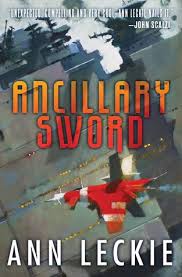 I loved this second book possibly not quite as much as the first, for which my love burns for its originality as well as its characters and action; but it’s a true love nonetheless, for a book once again dealing with complex issues without making them un-complex, and for characters who aren’t cardboard, and a plot that – stripped back – is really very straight forward but that kept me reading voraciously.
The issues are similar to Justice, as you would expect, although with a different emphasis. Of course the gender aspect is still there; yes I still found myself wondering whether that deadbeat was female or male, that that leader a man or a woman, and so on. A little bit less than when reading Justice, I hope, since I read this immediately after my re-read and I was a bit more in practise of just reading ‘she’ and remembering that genitalia is irrelevant. More importantly, and indeed driving the action to a much greater extent than in Justice, are the twinned notions of imperialism and colonialism. How does an empire genuinely make sure all of its new citizens are treated like the old ones? How does an empire deal with pre-existing racial and other tensions that are going to manifest even though you’re all now officially the same? And then you add corruption to the mix and of course things will not be pretty. And THEN, into that mix, you add someone new – someone with a powerful sense of justice – and you watch how things fall, and which things blow up.
It amazed me to discover that Leckie is an American, what with her Radchaai obsession with tea.
Breq continues to develop across this novel. Justice saw her get some form of justice, and then has her direction changed by Mianaai herself. She has more time, here, to reflect on the pain of losing Awn, and the pain of losing the majority of herself; there are some intriguing moments where Leckie thinks through what it would be like to be that one, remaining, very small part of something previously so large. How does that one small segment develop an identity? Does that experience bestow compassion or impatience with others experiencing similar issues of dislocation?
I was pleased to have Seivarden sticking around, and not be so whingy as in the first. I am very pleased with the new characters introduced; they provide neat foils for Breq and Seivarden. One baby lieutenant with issues (oh how I love the discussions of baby lieutenants and how they are brought up by ships and crews)
My prediction for the third book: it will have to deal with the alien Presger, as well as the outcome of the civil war within Mianaai herself. In fact, I don’t really see how this can be resolved in just one more book. MOAR BOOKS, LECKIE.
Ancillary Justice
This is my second time around in reading this book. I knew I needed to reread it before reading Ancillary Sword. You can read my original review over here.
 Multiple spoilers ahead!
I still found the almost exclusive use of ‘she’ to be quite disconcerting, and I feel like I noticed those few times that someone is ‘properly’ gendered more than I did the first time I read it. I still found myself trying to pick gender clues from behaviour and descriptions, which of course says something about me… and also quite a lot about Leckie, since I really don’t think she enables such a reading of anyone. I have absolutely no clue what sort of genitalia Lieutenant Awn had.
Because I wasn’t so staggered by the gender issue this time I believe I felt the imperialism/colonialism aspect more. The Radch is a monumentally arrogant civilisation – and I felt very keenly those discussions about how such a sentence would be constructed in their language, since the word for ‘civilised’ IS the word FOR their civilisation, and for themselves: Radch. So this arrogance, this narrow vision, is constructed into their language – while I’m not a complete subscriber to the notion that language creates reality, it certainly has an impact on our perception of such. Leckie herself notes the similarities between the Radch and the Roman Empire, which is useful both for the yes and the no. Make new peoples citizens, subsume/ align their gods with your, but use ‘corpse soldiers’ to help make it work and have a bunch of apparently random cultural hang-ups.
I loved the gloves thing this time. I could drive myself mad trying to figure out how a culture develops a horror of bare hands except in the most intimate of circumstances.
I’m not sure I noticed the descriptions of skin colour last time (oh the advantages of being white). Much like the people of Earthsea, the Radch are dark-skinned… which is neither here nor there in the book’s greater scheme of plot and character and theme, but is nonetheless important in the greater scheme of, you know, the world.
Another aspect I feel I appreciate more deeply this time around is the religion. Everyone, basically, is religious. All of the ships are named after religious figures; all of the decades of soldiers likewise. There is an expectation that senior soldiers will pray and cast the omens each morning. Each new planet has their own religion whose parallels with the Radch’s own must be found – and there’s even discussion of a problematic, exclusively-monotheistic bunch who have caused issues in the past, who basically appear atheist to the Radch: either horrifying or bemusing, depending on your attitude. Not everyone is especially devout, but there is no doubt in anyone’s mind that religion belongs in humanity and in space and everywhere there are humans. This is refreshing.
Finally, the plot. Even though I did have some memory of how everything was going to play out (that notorious memory of mine), I still found it gripping. The massacre of civilians to the death of Awn, the gradual change in Seivarden, the drama at Omaugh: it’s not the most fast-paced space opera I’ve ever read, but it is definitely compelling and in no way just a vehicle for discussing Important Issues.

 Randomly Yours, Alex