Mothership
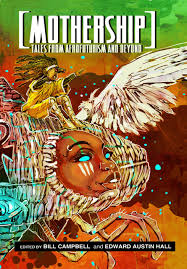 When I finished reading the first story in Mothership, a little voice in my head said “Was that really the story to start this anthology with? I mean, sure it’s got a black protagonist, but is that enough?”
And then the rest of me took a step back, looked horrified, and said: “Have you learned nothing from Pam Noles’ essay “Shame”? And from the entire Kaleidoscope project? The story has a black protagonist. That’s entirely the point.”
And then I sat, aghast at my own white ignorance, and felt ashamed.
And then I kept reading, because that’s the obvious way to combat such an attitude and is at least part of the point of this project and why I supported its production.
There’s a really wide variety of fiction in this anthology. Some skirt the edge of being ‘speculative’ (Rabih Alameddine’s “The Half-Wall”) while others hurtle over the edge and throw themselves at it. I didn’t click with every story (Greg Tate’s “Angels + Cannibals Unite” really didn’t work for me, and nor did Ran Walker’s “The Voyeur”), but many of them were absolutely breathtaking.
Nisi Shawl’s “Good Boy” – one of the only stories that really qualifies for the ‘mothership’ appellation by being set in space – is a glorious fun romp.
“The Aphotic Ghost”, by Carlos Hernandez, did not go where I was expecting and was utterly absorbing.
SP Somtow’s “The Pavilion of Frozen Women” has a wonderful line in bringing together several quite disparate cultures and tying them together into a fairly creepy thriller.
NK Jemisin does intriguing things with the notion of online communities in “Too many yesterdays, not enough tomorrows.”
“Life-Pod” is Vandana Singh’s haunting reflection on family and identity and connection.
In “Between Islands,” Jaymee Goh suggests how different things might have been for the British in colonising Melaka and surrounds with different technology…
Tenea D Johnson’s “The Taken” is a profound reflection on contemporary issues and problems stemming from the historical transportation of enslaved African to America… I don’t even inhabit the culture that’s dealing with it.
One of the intriguing things about this anthology is that it’s not focussed on African-American fiction, which I had basically expected thanks to the title’s reference to P Funk and Afrofuturism. Instead, there are stories here that draw on Egyptian, Native American, Caribbean (I think? I’m Australian, sorry!!), Japanese and Malaysian (again, I think) traditions and cultures – and those are just the ones that I (think I) could identify. There are definitely others that draw on other Asian cultures (I think there’s an Indonesian one?). The author bios don’t universally identify where the authors are from, so that doesn’t assist in figuring out what might have influenced them… which is not a complaint, by the way, because so what? (in the most prosaic ‘fiction is fiction’ sense). So it’s a really broad understanding of what falls into “Tales from Afrofuturism and beyond” – much more inclusive therefore than, for example, many anthologies of the last few years, let alone decades.
This is an good anthology, period. That it’s exploring and accomplishing a particular political aim is icing on the cake. You can get it from Fishpond!
Fringe spoilerific episode!
Earlier this year I watched the entirety of Fringe – a show that Alisa and Tansy have been raving about around, near and at me for quite a long time. So because I watched it – all of it – in a short period of time, we were finally able to record a Galactic Suburbia spoilerific episode of it. And here it is!
We spoil absolutely everything. We’re really not joking about that. Only listen if you’ve watched the whole lot, or really don’t mind spoilers.
The Falcon Throne
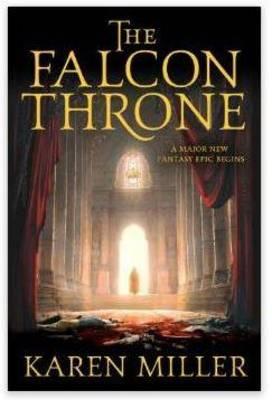 I received this book as a review copy from the publisher.
I am sad to announce that I abandoned this book. Mostly for “it’s me not you” reasons – although not entirely…
1. I’m really not in an epic fantasy kinda zone at the moment – and “at the moment” has lasted for a few years now (albeit with a few exceptions – though not many). So that counts against it for me – but for anyone who’s really in that mood, I think this is probably a good option. It’s certainly epic (in a good way!).
2. I’m not really a – argh, I don’t like the term – grimdark fan. And I’m pretty sure this counts as such. Others have compared it to A Song of Fire and Ice, and while I’ve only seen the show not read the books that sounds like the right sort of comparison. So the style is really not for me. I don’t mind bad things happening to characters, but there’s something about unrelenting unpleasantness – especially before I care about any of the characters – that frustrates and bores and annoys me. So that’s a style issue that is my problem, not the book’s.
Then there’s the style thing that I had an issue with, and it’s the way sex in general and women on occasion are described. I’m not a complete prude, although I guess I’m closer to that end of the spectrum than not, but there’s something about descriptions like “he’d have had the little wagtail pinned against a wall long since” (64) or “Aside from a writhing woman pinned on his cock, was there anything better in the world than a lance in his hand, a grand horse between his legs, and a man before him a handful of heartbeats from defeat?” (15) that leave me not just cold, but actively uncomfortable. As for the women – I got to about page 90, and most women by this stage are dead, useless, or conniving. The wet-nurse clearly has gumption and I hope she’s allowed agency and smarts, but that’s about it.
So there it is. Not a book for me. I am sad because it’s an Australian female author… but not sad because it’s an epic series I don’t have to get invested in so that saves me some time… but sad because I really don’t like abandoning books.
Indistinguishable from Magic
Sometimes when people talk about an author’s work being ‘raw’, it’s as if they think words just appear on the page and there’s no mediation whatsoever. That these words, ideas, thoughts had been flying across the savannah just minutes before the author brought them down with a flying leap to serve them up still warm for the reader. I’m not silly enough to think that – and even if I were, Catherynne Valente’s excoriating essay against people who think authors are just the conduit for some muse (“she  wrote it but…”) would have made me rethink my position.
When I say that much of Valente’s work, as presented in Indistinguishable from Magic (provided to Galactic Suburbia for review by Mad Norwegian Press) is raw I mean that she has not hidden her emotions, she has not hidden herself, from the world while writing these essays.
(One presumes. It could all be a very elaborate persona, with a very detailed background and crafted voice. Y’know, I wouldn’t put that past her – she certainly has the mad writerly skillz to accomplish such a feat. And if that’s the case, well, more power to her.)
The essays collected here are variously from Valente’s blog, speeches, and a few other sources. They’re arranged into categories: pop culture and genre; writing and publishing; gender, race, and storytelling; fairy tales, myth and the future; and “Life on Earth: An Amateur’s Guide.” And they showcase the brilliant variety of Valente’s interests passions: Persephone and Doctor Who (… possibly not so much of an antithesis there…), fairy tales, equality in all manner of things, Jane Eyre (see, Tansy? she’s on MY side), poetry, and Single Male Programmer Types managing to have sex (trust me, it’s very a very funny essay).
The pop culture musings range between 2003 and 2011. Valente’s writing is beguiling enough I actually read the entirety of the first essay, which is about Buffy and Angel, despite having watched maybe three episodes of the two shows combined. Her comments on what the show meant to 20-somethings nonetheless resonated – and that pretty much set the tone for the rest of the collection. I’m also not a big Trek fan, and have watched very little DS9, but her musings on what the station would have been like with social media? Priceless. More seriously – no, it’s all serious; more academically, her essay on why World War 2 and the Nazis keeps on popping up in comics and other fantastic culture is deeply insightful.
I read about half of the essays on writing and publishing; not being in the game myself means that I don’t really have the emotional attachment to the issues necessary to connect with much of what she writes here. That said, the first essay – the one about writing actually being hard work – is a glorious piece of writing; her explanation of her love of the term metal makes me itch to use the word more; and her utter dismantling of the argument that ‘traditional publishing is dead = a good thing’ is brilliant.
Valente is wonderfully, evocatively, angry and sincere and honest and passionate and conciliatory and clinical in her essays about gender and race and why those things matter in storytelling. “The Story of Us” skewers very neatly the whole ‘but why does it matter?’ complaint – and matches nicely with Pam Noles’ “Shame,” which I read in a Tiptree Anthology. She gets dangerously personal in “Confessions of a Fat Girl” – dangerous to herself, I would guess, because of potential backlash (I really, really hope she didn’t get any); dangerous to some readers because of how it might make some squirm at their reaction; dangerous to other readers because it might just call out their own troubles, and make them confront them.
All the essays up to this point have been easy to read – delightful to read. Some have shown Valente’s academic training. With the essays on fairy tales and folklore, though, she gets her academia on. Katabasis in Alice in Wonderland, The Wizard of Oz, and The Nutcracker? Why fantasy keeps going back to the medieval (“Dragon Bad, Sword Pretty”)? The purpose of Persephone, and her multiple faces? Oh yes.
Finally, the last set are more whimsical as a group – they don’t really have a collective theme, aside from ‘some thoughts on living in the world’. Her reflections on why people love apocalyptic literature are fascinating; her frustration at being of a generation told to live as well as their parents without the means to it revealing; and her reflections on Cleveland surprisingly moving. Her essay on her love of the anchorite idea just sings, as does her discussion of “Two Kinds of Love.”
I read this not quite in a sitting, but with nothing else around it. It certainly works like that. It would also work beautifully as a collection to dip in and out of – none of the pieces are very long, after all. There is so much going for Valente’s writing – for those who are writers, for those interested in fantasy and folklore, for those interested in the world in general. And even if you’ve been a faithful reader of Valente’s blog, Rules for Anchorites, I would suggest this is still a great collection because reading these essays in this order, with essays from elsewhere to add depth and piquancy – it just works.
The World is Not Enough
This review is part of Project Bond, wherein over the course of 2014 we watch all of the James Bond movies in production order.
 Summary: in which we get a Bond film that deals with both oil and nuclear weapons at the same time! Swoon! Also Denise Richards is a nuclear physicist and Hamish Macbeth is an unconvincing anarchist.
Alex: one of the things that people remember about this film is Denise Richards. Or maybe that’s just me. So let me get this bit out of the way first. I was already groaning in anticipation of rewatching her in this film. My thoughts were coloured by two things: the first time we see her, and the last time. The first time, she’s climbing out of a hazmat suit and the only way the camera could have fawned over her any more would have been to actually be touching her skin. It’s not quite a strip tease, but mostly because she’s still wearing clothes (a crop top and tiny shorts). Then the last scene… it might actually count as the worst line in Bond history, and let’s be honest that there’s some pretty… oh heck… stiff competition. Her name is Christmas Jones, and I’m pretty sure that’s her name solely in order to set up that last, appalling, joke: Bond saying “I thought  Christmas only came once a year.”
So yeh, my expectations were pretty low, and when you take in to consideration my love of Michelle Yeoh just a fortnight prior… I was resigned at best. Turns out, though, that Richards is better than I remembered. Yes her opening scene has her wearing ridiculous clothes, but later she mostly gets to wear sensible clothes (except when Bond is using her to distract someone, which I am not best pleased by). She doesn’t have the greatest dialogue – not her fault – and sometimes her delivery is a bit painful. But she is by no means the worst Bond girl ever, and she’s allowed to be competent at her job, too. Bond says “What do I need to defuse a nuclear bomb?” and she says: “Me.” And then she does it, too, on a speeding rig inside an oil pipeline. So Richards, you were better than I remembered. Good work.
Since I’m already talking about the women: Sophie Marceau… meh. She’s ok. I think the character of Elektra (yay Greek spelling!) is a fascinatingly complex and intriguing one: daughter of a construction baron, kidnapped then escaped when not ransomed; takes on father’s business but insists that it’s because the oil was found by her mother’s family – so Azerbaijani, I think? – and that her father stole it from them. So we get notes of colonialism in different forms here, which is surprisingly deep. And it turns out that rather than having Stockholm Syndrome – since she’s working with the Big Bad – she turned him, to get revenge on her father. So she has great agency, even though the film insists that she must use her body in order to get it. But I wasn’t in love with Marceau’s performance, sadly (also I can’t help but have the line “I have heard about your…. woman” from Braveheart in mind, which is totally my problem not hers).
And M rocks, as always, and this time she’s in the field! And she manages to Magyver an alarm clock to rig a location beacon so Bond can find her! Brilliant. She’s also revealed to be a mother, which I am unconvinced was a necessary move.
So the plot: someone is sabotaging Elektra King’s pipeline, and because her father was M’s friend M sends Bond to investigate. It eventually turns out that Reynard the Anarchist is doing it – in collusion with Elektra, because the idea is actually to nuke Istanbul, making the three Russian pipelines impossible and therefore Elektra’s pipeline the only one that the West can access. So it’s partly about revenge (dad didn’t ransom me), partly about money, and for Reynard (Hamish Macbeth Robert Carlyle)  it’s both about love (of Elektra) and anarchy.
Well, I presume Reynard’s in it partly for the anarchy. He’s called an Anarchist by M et al, but to be honest you never see any real demonstration of his attachment to anarchy as an ideal. He’s also back to being that not-quite-normal Bond villain: he has a bullet in his brain that means he’s slowly losing all sensation, which apparently makes him super strong for some reason? Anyway I think he’s amongst the most boring of all Bond villains.
Far more interesting is Robbie Coltrane, another Scot playing a Russian, reprising his role as Valentin. How can you not love a character who greets Brosnan with “Bond James Bond!” Love it. His caviar factory gets sawn in half by a helicopter tree cutting saw, then he appears to die – but doesn’t – but then does, although not before helping Bond escape from Elektra. He’s a great cameo, almost replacing Felix Leiter I think.
The saddest part about this film is Bond’s scene with Q, wherein Q introduces him to his trainee – John Cleese – whom Bond dubs R. Bond asks, concerned, whether Q is really thinking about retiring; Q doesn’t reply. Desmond Llewellyn died at the end of the year this film was released (1999).
James: I disagree that Q doesn’t answer the retirement question … Bond shows his dismay that Q is considering retirement and then Q signs off with his famous “Now pay attention, 007,” and then offers some words of advice: Q: “I’ve always tried to teach you two things: First, never let them see you bleed;” Bond: “And second?” Q: “Always have an escape plan” — before he is lowered out of view. Foreshadowing! Back to the rest of the film then, the opening sequence is one of the best with a high speed boat chase on the Thames. Like Alex I expected Denise to be more cheesy that she turns out to be, the character is overdone but then many things about this Bond are. Bond is issued with the usual modern era set of interesting gadgets; a ski jacket which can turn into a protection cocoon, another BMW to destroy and a watch with a grappling hook built in. The twists and turns of the villains and not villains could have been very clever, but in the end Elektra has to explain it all or the film wouldn’t make sense. 2 Martinis.
Tomorrow Never Dies
 This review is part of Project Bond, wherein over the course of 2014 we watch all of the James Bond movies in production order.
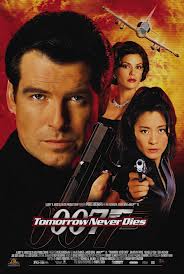
Summary: in which Michelle Yeoh is more bad ass than Pierce Brosnan, and the Bond franchise moves with the times to realise that the media can be more terrifying than lone wolf assassins.

See? Bad. Ass.
Alex: I love the opening to this film. M and various military people are watching a ginormous screen showing a Russian illegal arms bazaar, courtesy of some unnamed-but-we-know-it’s Bond British agent. Once they have confirmation that some important dude is there, the ranking admiral calls in a missile strike and M gets incensed that her man hasn’t had time to get out. And then Bond points out that he’s looking at a nuke OH NOES! Bond then steals the plane and the nuke. Natch. It’s a seriously awesome opening with good dialogue, good tension, great stunts. It sets the film up really nicely… although it actually doesn’t suggest the central premise, which is the power of the media.
The next scene doesn’t flag the media either: a British naval ship is overflown by a Chinese MiG saying the ship is in Chinese waters. Cut to a Scary Stealth Sub with a scary drill, and it turns out that someone is manipulating both the Brits and the Chinese. But then – oh then – we get a scene that’s basically a throwback to Blofeld: a white-haired man directing operations from a secret high-tech base, telling the men on the sub to kill the survivors in the water. What’s different here is that he’s writing headlines as he does it.
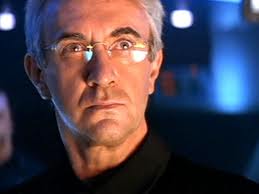
Elliot Carver. Oh, Elliot. You are so clearly meant to be Rupert Murdoch – or maybe that’s just my bias flashing. In my memory he was a bit more subtle than he turned out actually to be; Jonathan Pryce basically chews scenery in some parts of this film. It’s all about the eyebrows. It’s also how he’s written (so he’s like Jessica Rabbit?): this is a man who is pleased when new software is released deliberately full of bugs (so stereotyped Murdoch + stereotyped Bill Gates?), as well as bribing the US president to lower cable rates. And his biggest problem, what makes him act like a petulant little boy, is that China won’t let him play in their media space. BOO HOO. So he’s setting up a confrontation between the British and the Chinese, hoping that things go very badly and a Chinese general in his pocket will end up in charge. So… kinda like some other villains we’ve known, I guess, but this time rather than hoping desperately that people – world leaders, etc – will notice what he’s doing, Carver goes straight to the masses with his newspaper/media conglomerate. I really, really love this concept.
The women? I’ve already mentioned Michelle Yeoh. She is so, so cool. She gets one awesome lone fight scene which is fantastic; she has 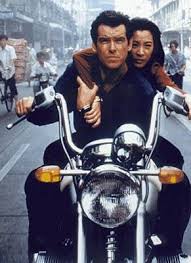 some great gadgets (walking down the side of a building, anyone?) and Bond acknowledges her as an equal. The scene with Bond and Wai Lin handcuffed together but riding a motorbike is a magnificent stunt set piece – and I especially love that it ends with a potentially provocative outdoor-fully-dressed shower scene… and she leaves him handcuffed to the shower. Did I mention she’s an agent of the Chinese equivalent of MI6? Intriguingly though the film reassures us that she’s not really a Communist; she specifically says that she doesn’t even own a Little Red Book. I don’t think they ever felt the need to reassure us about the Russian ladies not being Communist; China is somehow more scary? Who knows. I was sad that Wai Lin did indeed end up kissing Bond, but I guess I can’t have quite everything.
Bond can though; he starts off with revitalising a fling with Paris, now Elliot Carver’s wife and played by Terri Hatcher. This role always disappointed me, because Paris is just a pawn to be used by both Bond and Carver to their own ends. Bond’s regret for her ending up dead doesn’t make up for any of that.
And then there’s M, and Dench continues to bring the goods. Possibly my favourite exchange of the entire film:
Admiral Roebuck (played by Dench’s on-screen lover in As Time Goes By): “With all due respect M, sometimes I don’t think you have the balls for this job.”
M: “Perhaps. But the advantage is I don’t always have to think with them.”
Mic. Drop.
This film wasn’t quite as good as I remembered, but it’s still enjoyable and has very few cringeworthy moments.
James: The height of modern technology, a Nokia clamshell ‘smart phone’, dates the gadgets in this Bond somewhat – Bond can however drive the car with it so that’s quite cool. It is still one of my favourite modern era Bonds, a nice balance of humour, gadgets and action. Why oh why does Bond (especially Brosnan it seems) have to tip off the villains that he knows (albeit with clever puns about being all at sea etc)? 3 Martinis
The Bitterwood Bible
Sourdough and Other Stories by Angela Slatter has been on my radar for ages, but somehow I’ve just never got around to reading it. For a while I didn’t realise it was available as an ebook – and Tartarus Press does lovely hard copies, but they’re a leedle expensive for a book you’re taking a chance on. And I also wasn’t sure that these stories were ones that I would really connect with. I mean, yes, I loved “Brisneyland by Night” in Sprawl, and a few others Slatter has written – especially with Lisa L Hannett – and Midnight and Moonshine made me cry with its beauty, but… I just wasn’t sure. And then I found out that Slatter had a set of ‘prequel’ type stories coming out, so I thought I should read those first.
 Halfway through reading The Bitterwood Bible and Other Recountings, I finally bought myself Sourdough because there is no way I can now not read that collection. Because I am absolutely an Angela Slatter convert.
The stories collected here are not quite a mosaic in the same way that Midnight and Moonshine are. There, each story was clearly connected – most often by family, which made it seem a generational saga. Here, while there are a couple of stories that feature the same protagonist, a few more with recurring cameos, and most set in the same place or with the same background characters, it’s more like a series of stories set in a couple of distinct suburbs or small towns. Of course you’re going to get the same bars, or neighbourhood characters, or landmarks mentioned; that just makes sense. But the narratives themselves aren’t necessarily connected… although sometimes they are. And these locales that Slatter has invented are very believable. They’re well-realised, and they’re familiar in that fairy-tale sort of way. Because these are indeed a sort of fairy tale. There’s not a whole lot of magic; what there is is generally a quiet, dare I say domestic without it being in the slightest derogatory, magic; no flashiness or gaudiness here, no winning of wars. That would draw too much attention, and drawing attention in these stories is generally A Bad Thing. The women – and the protagonists are almost all women – mostly want to be left alone, to get on with their lives. Sometimes they’re forced to interact with the world, or with other people, that they’d rather not; because they need to achieve some specific goal, or because they’re being manipulated, or they otherwise have no choice. But you certainly get the feeling that most of them would just prefer never to be in the limelight, not to be a household name… not to stand out.
There are scribes and poisoners, seamstresses and pirates, teachers and coffin-makers and servants. They are mothers and daughters and child-free and orphan, young and old and neither; rural and urban, rich and poor. They have varying degrees of agency and control, varying chances of living after and of living happily ever after.
This is a wonderful collection of stories. They can and should be read and enjoyed separately; they can and should be read and enjoyed together, making a whole even greater than its parts. Oh, and Kathleen Jennings’ lovely little illustrations throughout are a delightful addition; I imagine they’re even more impressive in print, but electronically they’re still fine.
This review is part of the Australian Women’s Writers 2014 challenge.
Kaleidoscope
 Declaring my connections: the publisher and half the editors of this anthology, Alisa Krasnostein, is a Galactic Suburbian with me; so is the author of the first story, Tansy Rayner Roberts.
I’m a lucky person because I’m white, and straight. I’m marginalised in fiction because I’m a woman who reads science fiction. I’m one of those female readers who long ago learned the trick of imagining myself with the fellas in the books I was reading – courtesy of all those Biggles books, mostly, and all that never-written-down fanfic of joining the Fellowship of the Ring (mostly to swoon over Legolas). So my emotional connection to the idea of needing diversity in fiction is somewhat less than, say, Julia Rios – one of the editors of this anthology – who notes that “As a bisexual Mexican-American woman, I didn’t see myself reflected very often in books I read as a child or teen…”. Nonetheless, I do get personally terrifically bored of straight while male characters, and I intellectually and ethically passionately support the need for diversity in all fiction. All of which is a long-winded way of saying that this project was a great one in theory, and has turned out to be a great one in practise.
Krasnostein and Rios got themselves an awesome set of authors to approach the idea of stories whose protagonists represent diversity, but where that diversity isn’t the point – it just is. Just like it should be in life. So this isn’t an issues book, and it’s not even really a themed anthology. There’s superheroes (hey Roberts, where’s that novel?) and d-mat transportation and mythology and aliens. There’s neurodiversity and mental health issues and gender and sexuality questioning and non-whites! and teens being teens and why haven’t you bought it yet?
I’ve noted before my assumption that picking the first story of an anthology must be hard. I say this with no reference to Tansy being a friend: “Cookie Cutter Superhero” really does deserve to springboard more stories. A universe wherein machines to create superheroes have appeared around the world? Where different countries take different routes to figure out who gets to use it, and the machine decides what they’ll be like? Seriously. Someone get that woman a contract and option the TV rights. And Roberts setting this in Sydney, casually mentioning the indigenous superhero who refused the media’s attempt to make him tribal, and our soon-to-be-superhero lacks a hand and it’s not the focus of the story… everything is right about this story. Up to and including the ending.
There are other stories in the anthology too. Sean Williams throws in a story set in his Twinmaker world, and it’s mighty fine. Gabriela Lee’s “End of Service” is a bit creepy both for the SF elements and for its real-world elements. Faith Mudge’s “Signature” is wonderful and not only because it reminded me strongly of The Changeover which is a pretty sure way to my heart. I hadn’t read a new Dirk Flinthart in a while, so finding “Vanilla” in here was a delight. The title suggested one thing, especially with the discussion around identity and what being a ‘proper’ Australian, or Somali, or Somali-Australian actually means… and then it turned out to have another meaning as well. Karen Healey’s “Careful Magic” is a bit Holly Black, and all awesome. I should not have read Sofia Samatar’s “Walkdog” in public – let that be a warning – I love her use of footnotes, and the eccentric spelling works beautifully, and the format does too. It’s not often you see Celtic mythology get utilised in a story, and Amal El-Mohtar does so wonderfully in a story about owls and displacement.
This isn’t a complete list, by any means. There’s also Jim Hines, Ken Liu and John Chu, Shveta Thakrar and Alena McNamara, and a bunch of others coming at the notion of diversity in YA from different points. As a reader, therefore, thanks to everyone who helped get this anthology off the ground – this is a great book that should do the rounds of every YA reader you know.
You can get this from Twelfth Planet Press direct – Australian release coming in October!
Galactic Suburbia 108
In which we level up in Gamergate, give away Kaleidoscope, and give each other Guardians of the Galaxy mix tapes. You can get us from iTunes or from Galactic Suburbia
TRIGGER WARNING: discussion of virtual attacks and physical violence towards women.
Gamergate & Zoe Quinn:
Charles Tan does a breakdown: Understanding Gamergate.
The word of the day is: doxx
Kaleidoscope ebook giveaway – contact us via email or social media with a recommendation of a Kaleidoscope-esque YA book or short story in order to enter.
What Culture Have we Consumed?
Tansy: Guardians of the Galaxy, Please Like Me Season 2, Kaleidoscope, Sensation Comics featuring Wonder Woman, John Chu “The Water That Falls On You From Nowhere” yes finally, shut up.
Alex: Alias season 1; Planet of Exile, Ursula le Guin – and a whole bunch of essays, from Dancing at the Edge of the World and Language of the Night; Landline, Rainbow Rowell; Kaleidoscope; Anita Sarkeesian’s Women vs Tropes in Video Games; Guardians of the Galaxy as well; Radio Lab podcast
Alisa: Rocket Talk – interviews with Kate Elliott and Nora Jemisin; Kameron Hurley; Renay; Podcasts abandoned – This American Life and TED Talks; Frankenstein (Pemberley Digital), Guardians of the Galaxy
Please send feedback to us at galacticsuburbia@gmail.com, follow us on Twitter at @galacticsuburbs, check out Galactic Suburbia Podcast on Facebook, support us at Patreon (http://www.patreon.com/galacticsuburbia) and don’t forget to leave a review on iTunes if you love us!
Galactic Suburbia 107
In which, Alisa and Tansy debrief Alex on their Worldcon adventure: The Ritz, the books, the people, the Hugos, the ribbons, the concrete wasteland, and the jet lag. Get us at iTunes or at Galactic Suburbia.
Here are the magic stats from the Hugo Awards.
If you still don’t have your copy of Kaleidoscope, here are some places you can buy it.
Check out the full Ustream footage of the Hugo awards.
Tansy’s post-Loncon Jet Lag Links
Alisa’s Debriefs:
1 – Yarn Edition
2 – Dealer’s Room
3 – The Ritz
4 – The Hugos
Please send feedback to us at galacticsuburbia@gmail.com, follow us on Twitter at @galacticsuburbs, check out Galactic Suburbia Podcast on Facebook, support us at Patreon and don’t forget to leave a review on iTunes if you love us!