Amongst Our Weapons (Rivers of London)
I received this at no cost from the publisher, Hachette. It’s out now; RRP $32.99.
Firstly, this is number 9 in the Rivers of London series, so do not pick it up if you haven’t read the rest. You’d be able to follow the basic plot – provided you’re ok with the idea of London police needing to deal with weird bollocks (that is, magic); but the relationships will make no sense to you and the references to past problems won’t have any impact. Also, it’s an enormously fun series (with, sadly, some thick-headed and annoying misogyny in the early books from the main character) so if you ARE fine with modern London policing engaging in magic and dealing with criminal practitioners, just start from the start.
And if you’re already on the Rivers of London train, you really don’t need me to write this review because you’re already going to be reading it whenever it comes in at the library / your preorder arrives / you nick it from your mum. So if the purpose of the review was to convince people to read this particular book… there’s really no point.
Not my main reason!
I have enormously enjoyed the development of Peter Grant over these books – I was very dubious about him as the POV when I first started, because he was just a bit … painful. Young? Smug? At any rate, not a character I could particularly connect with. But the world Aaronovitch presented – a very modern one, but where magic fries electronic circuits; his boss Nightingale, whom I always found intriguing; and the magical cases themselves – all convinced me to keep going. And Peter has indeed grown up, due to circumstances and Beverley, and has become much less annoying and more like a decent bloke and a generally good copper. So that’s been worthwhile. The cases keep being interesting – and what I like there is that Aaronovitch doesn’t feel like he has to keep uping the ante; it’s not like one book we’re blowing up a building then the city then the world. Because magic can help you do a vast assortment of nefarious things so you can just have varied crime, rather than ratcheting up.
Here, Aaronovitch takes the opportunity to make some Lord of the Rings jokes, with a bunch of people connected through university and each in possession of odd rings being targeted by a peculiar and rather terrifying person. There’s the usual work with Guleed, more Seawoll than usual, and trainee Danni – plus, of course, Nightingale. (I would love a bunch of Nightingale prequels…) Not so much Mary or Foxglove, but more foxes; plus, Beverley is very nearly at term, so there’s paternity leave to be considering, too. It’s a standard Rivers of London, which is in no way a slight! It’s exactly what I was hoping for: a bit ridiculous, some very clever connections, an enormous fondness for London as a city, lots of banter and precisely paced – brisk, but not whirlwind. I’ll happily keep reading these for as long as this standard endures.
The Normans: Power, Conquest & Culture in 11th Century Europe

I read this courtesy of NetGalley. It’s out on 22 March, 2022.
I love the Normans. I have been fascinated by them as a group for a pretty long time now. The conquest of England! Randomly being in Sicily! The First Crusades! Occasionally popping up elsewhere!
I also love a good interrogation of sources. And asking new questions, or using new information to contribute to questions already asked.
Therefore, I thoroughly enjoyed this book.
Given the above, I can’t say how easy this would be to read for someone with zero knowledge of the Normans. Even I found it hard to follow the Roberts and Rogers and various families (honestly I kind of stopped caring about whether I was completely following who was related to who; it didn’t seem to matter in some instances, and Green often reminded me when it did). It should also be noted that there is more historiography than I think is usual for a purely narrative sort of history, so if learning what specific historians (medieval and modern) have said about specific issues is not your cup of tea, you may well find this book a bit annoying. For the rest of us… this is a really great, and thorough, examination of the Normans in the 11th century.
I really liked how Green examined what was going on in Normandy, England, Sicily/Italy and Antioch/the First Crusade as a way of trying to see if there really is something to the very IDEA of ‘being a Norman’ – which honestly is a brave thing when you’re entire book is about ‘the Normans’ – but that’s exactly the point of it. Some people at least claimed the Normans as Very Special People with a Very Special Place in the World (via God or character or whatever else). Is that actually true? Is it even possible to speak of “Normans”? Gosh I love these sorts of questions. I also quite like that Green doesn’t entirely come to a complete answer. She has some suggestions – that maybe Normans themselves in the 11th century weren’t alway seeing themselves as ‘Normans’ – and also proposes a whole bunch more avenues for investigation. Which is the other awesome thing that Green does – she’s not just using the old Williams of history (Jumieges, Malmesbury, etc), but adding in archaeology and DNA and various other sources to make a way more interesting and complete picture.
Overall, not My First Introduction to Medieval History, but a really great work on a group of people who had a fairly hefty impact on medieval Europe (and beyond).
Straits: Beyond the Myth of Magellan
I read this courtesy of the publisher, Bloomsbury. It’s out now; $39.99 trade paperback.
… and I thought I was an iconoclast. What a remarkable, thought-provoking and intriguing biography.
Things I already knew about Magellan: he did not circumnavigate the world. I learned that in a book about how Basques influenced the world, because the captain of the only one of Magellan’s boats that did, actually, go around the globe was captained by a Basque.
Things I did not know: most of what Fernandez-Armesto discusses in this book. I did not know that Magellan (to use his Anglicised name) was Portuguese who ditched that kingdom and went to Spain – a traitorous act at the time. I did not know that he was a little too keen on chivalric romances and maybe wanting to emulate them. I definitely did not know what a truly dreadful leader and person in general he was.
OK, that last bit is something of an exaggeration. Indeed one of the problems that Fernandez-Armesto discusses here is the difficulty of ever truly understanding someone like Magellan: partly because of the temporal distance, as well as the mental distance, between me and a Portuguese court-educated man of the 1500s; but also because much of the evidence is deeply conflicted. There’s something close to hagiography by someone who was on the voyage and managed not to die… but there’s also plenty of accounts from men who mutinied. So how do you get to ‘the truth’, and what even is that.
Anyway. As a biography this is awesome. The author brings the context wonderfully to life, exploring what the world was like for someone like Magellan in the 16th century – what Europe knew of the world, and what the world knew of Europe; what kings and adventurers wanted, how empire was going, knowledge of the Atlantic and Pacific, and so on.
Something I had never really appreciated before reading this: just how Very Big the Pacific is. Especially for those accustomed to the Atlantic.
For the historians, Fernandez-Armesto skilfully uses primary sources to make his points, and to show people in their own words – and they never get overwhelming, or in the way of the story. It’s a really great example of how such sources can and should be used.
And finally, the last chapter is called “Aftermath and Apotheosis”, and this is where my iconoclast remark comes in. I got the sense that Fernandez-Armesto doesn’t necessarily like Magellan – which is fine, if intriguing; he certainly proves that Magellan deserves to be studied, if only to learn what he can show about his world. And beyond that, Fernandez-Armesto completely goes to town on previous biographers who do love Magellan, and all those companies who use Magellan’s name as if it’s some sort of shorthand for scientific endeavour or great achievements or frankly anything good. Because what the author shows is that Magellan deserves none of that. He had no scientific interest; he was out for the main chance. He didn’t achieve anything much that was great: yes, he sailed through the straits that bear his name, but he didn’t know they were there and he wasn’t the pilot or navigator anyway PLUS the cost in human suffering was enormous.
This is a great book. If you’re keen on the history of exploration, or early modern biographies, or learning the story behind a fairly familiar name, this is an excellent choice.
Taste: A book of small bites
I read this courtesy of NetGalley. It’s out in August 2022.
Food has often been used by poets as a way of expressing themselves. Chefs and others have often been moved to exuberant, passionate language to try and describe food. So a book like this makes perfect sense. Dubrow explores our relationship with our five tastes through experiences – some near-universal, some not – and exquisite language, to try and get at what we mean, what we experience, when we saw sweet or sour or salt or bitter or, most recent to the Western vocab, umami.
There’s the sense-memory of strawberry jam, and being a feverish six year old – like Proust’s madeleines; heathen that I am in never having even attempted Proust, I have heard of this story and how the taste catapults the narrator through memory. There’s Persephone and the sour pomegranate seeds, the experience of sweat dripping down one’s face, the ceremony of making a cup of tea. How food have been represented in art – still-lifes, and others – and what this says about the particular foods. Cheese and coffee and chocolate.
It’s a delightful collection of moments, of mediations. It reminds that food isn’t just fuel, that taste is an experience even if we’re just gulping something down as fuel. We don’t always have to sit and reflect on the emotion brought about by a particular taste, but it can occasionally be rewarding.
Gastronativism: Food, Identity, Politics
I read this courtesy of NetGalley. It’s out in June 2022.
This is a really fascinating book that takes food and issues of ‘nativism’ and looks at how they work together. It seems kind of obvious once you start thinking about it that food can be a political tool – even a weapon… one need only think of some of the racist insults that people use, which are either specifically or tangentially food related. Or the way politicians are publicised eating particular foods. Or the boycotting of foods…
One of the first things that I appreciated about this book is that Parasecoli is quite open about things needing much more extensive research to fully understand what’s going on, and that “patterns [he identifies] are tentative, unstable, and shifting” (xi). That the book “raises questions rather than offering solutions… proposes one point of view, food and its ideological uses, to read events and and tensions that are obviously much larger” (xii). This sort of intellectual honesty is a delight, and also brings me hope that maybe the ways food is used and discussed in connection to politics may indeed become a greater field of investigation.
Parasecoli’s idea of ‘gastronativism’ is a broad one, and encompasses political positions that are, at least to my mind, both arch-conservative leaning towards fascist, and at the other end much more progressive. The first limits what it means to be in a community (white supremacy, anti immigrant) – what he calls exclusionary gastronativism. On the other hand is what he calls nonexclusionary gastronativism (and I can’t help but imagine what it would be like to give a speech on this topic): it looks at “extending rights, resources, and wellbeing to the disenfranchised and the oppressed” (22). Cross-national issues of worker rights, and such issues. I love that such seemingly different issues can be examined together, using similar thought-tools.
It must be acknowledged that this book challenged me to think about the way that I approach food. In one section, Parasecoli discusses the idea of authenticity – “a Thai restaurant feels more authentically Thai if the cook and staff are recognisably Thai” – and that being able to “distinguish authenticity becomes part of consumers’ cultural capital” (89). And then you get arguments about what IS authentic, and things can get very messy. I don’t think the author is saying that a desire for authenticity is automatically bad; but it did make me start thinking about what constitutes ‘the canon’ when it comes to food, and that sent me down a bit of a spiral, being something of an iconoclast in those issues.
There is a LOT in this book; Parasecoli touches on a broad range of issues and explores exclusionary and nonexclusionary examples from various parts of the world. As he says in the intro, he doesn’t always go into huge detail about all of them – that’s not really the point of the book. Instead he’s trying to show what the very concept of gastronativism can be, how it might be interrogated, what sort of actions people use and thoughts it stimulates. And I think he is very persuasive in showing that food isn’t always just something that someone like me eats for fuel. It’s always much more than that.
Nettle and Bone
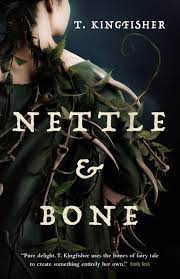
I read this courtesy of NetGalley.
If you’re a fan of T. Kingfisher, I can say “this is exquisitely T. Kingfisher” and know that you’ll run for a copy of this book. (Fair warning: book does include reference to family violence, and an abusive partner.)
If you’re not already… maybe you’re a fan of Angela Slatter? Kingfisher’s books remind me of her work too.
What does that mean?
They’re both doing fascinating things with fairy tales… except not really fairy tales, because they’re not always familiar stories, but it’s the vibe of fairy tales – fairy tale logic – fairy tale expectations and narrative structures. And I don’t mean Disney versions, I mean grim/m and sometimes gritty and meaty and fully embedded in the world, where not everything is lovely and wonderful but sometimes they are, and sometimes by force of personality you can make a change in the world and sometimes you just have to roll with the world’s punches.
I loved this book a lot.
There’s a princess who doesn’t especially want to be and who is really sure that she’s good at it, and a bone dog, and two godmothers, and a dust-wife. Also a quest and a heavy dose of gritted-teeth determination and a good level of snark, generally dished out by old ladies, which is of course the best sort. It goes at a good pace – not so fast as to leave you spinning, but you’re also not just sitting around always admiring flowers. I read this quickly and it felt just right.
This book keeps Kingfisher as one of those novelists whose work I just read pretty much automatically. I mean, it includes such gems as: “My dog trusts me… My dog is witless and also dead” and also this, addressed to a chicken: “I know you aren’t broody, demon, but you’re going to make an exception or so help me…”.
Definitely should go on your to-read shelf.
Spear, by Nicola Griffith
I read this courtesy of NetGalley. It’s due out in April 2022.

I adore the Arthurian mythos, and in particular that it can keep being reworked by different authors with different intentions and get completely different results that are still clearly linked. Most recently I read Lavie Tidhar’s By Force Alone, and it shook me to the core… and now Nicola Griffith gives me something completely and utterly other.
( Which begs the question, Can you read and enjoy this with no knowledge of the Arthur stories? Absolutely. And in fact it would mean that you wouldn’t have the same looming dread / fear / second-guessing that I did, trying to figure out who was meant to be who and would Griffith include that particular thing and oh noooo…. )
This was nothing short of amazing.
To begin at the end: I really enjoyed Griffith’s Author’s Note at the end, explaining both her choices and her inspirations. It wasn’t necessary, but it shows very nicely how Griffith sees herself fitting into the existing canon, and how her choices were influenced by archaeology and other sources. Also, her acerbic “crips, queers, women and other genders, and people of colour are an integral part of the history of Britain” – yes indeed.
Griffith has set her Arthur in the very early medieval period – the Romans are gone but the Normans aren’t there (it took me an embarrassingly long time to realise who the Redcrests were (Roman soldiers)). It’s the beginning of Arturus ruling a fairly small area; he is gathering Companions to help him fight off invaders and also to try and give some sort of peace, and lack of banditry, to his area. But the focus of the story is not on him: it’s on Per, Peretur, who has many names and none, who is on a quest to figure out who she is and where she fits. Because oh yes, this is Perceval / Parsifal as a woman, following in that grand tradition of “women have always fought” and having the same adventures as any of the men might. Griffith uses some of the medieval stories as a starting point – her love, and deep knowledge, of the genre is clear; and she tells a rich and compelling and human story that I just devoured.
One of the most intriguing things from an Arthurian perspective is where Griffith chooses to stop the story – which I’m not going to spoil. But it does make me hopeful of more in this world; she herself mentions the possibility in the Author’s Note, so now I guess I just have to sit here and wait. Because shut up and take my money already.
Our Fermented Lives: How Fermented Foods have shaped Cultures and Community
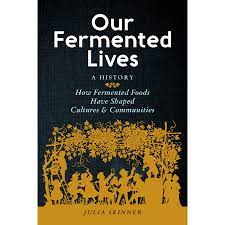
I read this courtesy of NetGalley. It’s out in July 2022.
Sometimes I forget how much I love food writing, and food history, and thinking about how food works in society. Then I read a book like this and I’m reminded all over again.
I’ve never particularly gone down the fermentation path. I did have a sourdough starter for a year or so – before lockdown, I swear! – but I found it too wasteful, throwing out the starter (I am considering going back to it, having read this…).
This book is:
— personal – Skinner mentions parts of her own journey, both in understanding food and more broadly, throughout.
— aiming to be broad in outlook and postcolonial in attitude: she carefully notes having tried to speak to / read from the people who actually make the ferments, and that it is “critically important, particularly as someone with relative privilege, not to overshadow others’ stories with my own words and perspectives”. I think food history is one way in which the colonial agenda can, indeed, still be present, so I appreciate this acknowledgement and the attempt.
— partly a history, looking at the role of fermentation in different cultures across time, and speculating about how such things might have been discovered. Also the range of fermentation experiments! I love any story that includes garum, that probably-incredibly-stinky fish sauce of the Romans.
— a bit science-y, but not that much. Humans are really only beginning to understand the interplay between the gut microbiome and our general health, so it was interesting to think a bit about how fermented foods might help there.
— partly a cookbook. Why yes, I have every intention of trying mushroom ketchup, thankyouverymuch (it came before tomato ketchup, because after all don’t forget how late tomatoes are on the European culinary scene).
— a bit philosophical, which wasn’t always my cup of tea (… or kombucha…). There’s discussion of the word ‘culture’ and how it can mean the microbes as as well as human interactions, which I didn’t fully get on board with – it seemed to stretch the ideas a bit far. And claims about mindfulness and community that did, actually, make me stop and think. The idea that ferments enable us to ‘live a more embodied life’; that the time taken to have a slow meal with friends ‘is a necessary act we give ourselves precious little time for’.
— not perfect. Some of the segues between sections are abrupt and don’t follow what I would consider logical or natural links. And there are some instances of poor editing – mentioning that the eruption of Mt Vesuvius happened in 79CE, for instance, twice on one page. But those are relatively minor issues. (I was more thrown by the idea that Samuel Pepys was “best known for burying his beloved wine and cheese stores to protect them from the 1666 Great Fire of London” rather than, say, for the incredibly detailed decade-long diary he kept.)
Overall, a book I thoroughly enjoyed reading, and I have quite the list of recipes to try out.
The Dark Queens: The Bloody Rivalry that forged the Medieval World
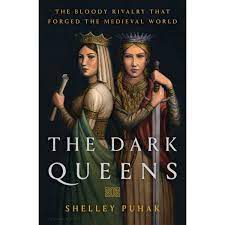
I read this courtesy of NetGalley. It’s out in March 2022.
OH YES.
1. This has pretty much everything I love about a history book.Rediscovering, or repairing, or reframing, previously maligned historical figures.
1a. In particular, women. And here, Puhak does it to not one but TWO women, living at the same time, with lives that were interwoven and had an enormous impact on each other.
The late 500s in what is now France was a remarkable time: it was, as Puhak points out, a time of “dual female rule” – Brunhild and Fredegund, one a Visigoth princess and the other a former slave, were regents for their grandson and son respectively. Together they controlled nearly as much land as Charlemagne would a few centuries later. This dual female rule wouldn’t be repeated in Europe for another thousand years. And why don’t we know about it? Because, Puhak claims – with some pretty strong evidence – there was a concerted effort at damnatio memoriae; getting rid of all memory of the actions of these two queens from history. A lot like what happened to Hatshepsut in Egypt. Either expunge the actions of the women, or cast them in as completely evil or irrelevant light as you possibly can. Because how embarrassing to remember that women had been instrumental in leading and shaping your kingdom for decades!
2. I learned many new things.
A lot about the Merovingians, of course – which I had no knowledge of, except for the name, and (as Puhak ruthfully notes) as the name of a character in a Matrix film. But I also learned that the Latinised version of ‘Clovis’ – whose name I did know – who was the first Merovingian king – is LOUIS and there you get the beginning of, what, 17 kings with the same name.
3. Utterly readable.
Puhak says that this is “not an academic history; it is a work of narrative nonfiction based on primary sources”. And I think this is a really intriguing way of putting it. I guess the ‘not academic’ aspect is strictly accurate, although I do think Puhak is underselling herself. There aren’t footnotes – but there are extensive references at the back, and my goodness her bibliography is incredible and IF I HAD THE TIME (and access to them) I could glut myself on following them all up. I love the use of the primary sources here; she uses the various histories from the time, and later, judiciously – weighing up their perspectives and their intentions and figuring out what makes sense. And it ends up being absorbing and riveting.
4. What a story.
Honestly, you could present this as fiction and people would believe you. Marriages brokered, broken, and occasionally seen through; so many murders and possible-murders; kingdoms divided and reunited; treason, scheming, bargaining… Puhak argues that Cersei from Game of Thrones is inspired by these two women, in some sense, and I’m not quite convinced of that but it tells you something about their lives.
What a fantastic book.
The City Inside

I read this courtesy of NetGalley. It’s out in June 2022.
This was… incredible, and devastating, and gloriously written. And I’m not sure I have the words to properly explain how and why.
Firstly: if you’re looking for an entirely straightforward, narrative-driven story, this is not for you. If you’re interested in character and world development and fabulous prose (and a narrative that still has me thinking), then you’re looking at the right book.
The first few chapters are all about setting up the world. It’s the mid 20th century, I think; and it’s Delhi; and things are both recognisable and completely unfamiliar. Joey is a Reality Controller at a Flowco; she has a smartatt on her wrist that monitors her health and suggests cat videos when she’s stressed, and she regularly has to wear a mask when she’s out and about. Confused? I was, a bit, when I started; but I was also intrigued and rapidly sucked in (and it took me a couple of seconds to understand ‘smartatt’ as ‘smart tattoo’ and then I was very impressed with Basu. Also terrified). The key thing to get your head around is the Flow, which takes the current ideas of infotainment and reality tv and influencers and life-casting and making it more massive, more pervasive, more curated and… generally just More. This is the big thing that’s both familiar and not.
As an Anglo Aussie, I’m the first to admit I don’t know all the ins and outs of current or past Indian political history, nor the concerns people might have for future directions. That’s a big part of the background here: Joey’s parents were involved in protests and suffer the consequences; things are unsettled and maybe tyrannical in Delhi and perhaps across the city. There are ongoing protests and various groups being oppressed. On the one hand, I am quite sure I missed a fair bit of political nuance that someone living in Delhi would just pick up almost without thinking (like a reference to politicians and onions for me). And that’s just fine: there are always different experiences for different readers. Because even without that political knowledge, I could understand enough about the tensions to know that this is a world I wouldn’t want to live in, with its fear of cameras everywhere and no trust of the government. And just to show how bitter things are: “her parents didn’t know whether to blame the pogrom or the pandemic, because they’d known the end times were coming but hadn’t known they’d be multiple choice” (p6).
The story follows Joey and colleagues and delves into the world of a Flowstar as well as tapping on parts of the broader world. Most people are out for what they can get for themselves and their families; some people are trying to buck the system; there is a massive gap between the haves and havenots. Much of the book is about following the characters and experiencing their lives… in much the same way that they themselves are producing a Flow for people to experience. Which makes me reflect in some horror on the explicitly voyeuristic nature of fiction and may send me into a tailspin if I get too worried about the privacy of fictional characters.
The writing is an absolute treat. It’s dense, in the descriptive and absorbing sense; it’s deeply evocative; and still entirely readable. I enjoyed every minute of the reading even while I was completely horrified by the experiences of the characters.

 Randomly Yours, Alex