By Force Alone
I have a long and increasingly cynical relationship with King Arthur, and all the stories around him. I read a fair bit of it as an adolescent – I even did subjects at uni about the mythology and so on. But as sometimes happens, I got cynical and impatient as I got old, and I haven’t read much new Arthur stuff in a long time.
I did re-read Susan Cooper recently, which was an excellent choice and is a bit more left-field than other Arthuriana so doesn’t really count. (Also, not new to me.)
 And then a friend started raving about this book and while he’s not prone to hyperbole I was a bit like… really? That good? But I was intrigued and so I bought it and…
By golly.
I’m not sure I can read another Arthur book ever.
This is it. This is everything.
Tidhar knows Arthuriana intimately. He’s referencing medieval romances. I’m pretty sure there are Mists of Avalon references, and Sword in the Stone. There’s the grail, sure, and the Green Knight, which is obscure but not that obscure… but there’s also the Questing Beast, and… and… yeh. So this is in no way someone coming in and thinking they’re reinventing Arthur (which has been done, and oh so badly). This is someone who knows Arthuriana deeply.
The thing I kept thinking of when reading this was A Knight’s Tale, that Heath Ledger break-out film. It used modern(ish) rock music in order to make the point about how people in the 14th century (the time of Chaucer) would have perceived music that 20th century ears hear as weird and ‘old’, and it used utterly modern language. By Force Alone is simultaneously utterly set in the 5th or 6th century – the Romans are gone, Britain is a by-water and non-existent in political terms, the Anglo-Saxons are coming (ignore the historical reality here) – but feels in some ways very 21st century: Arthur screaming ‘Come at me if you’re hard enough!’ Bully boys in London who want to be knighted, talking about being ‘made men’. Picts on the northern border being vicious.
Everyone, actually, being vicious.
This is a vicious book. There is no gallantry. There is no courtly love – which is right because the notion wasn’t really a thing until at least the 12th century and then honestly becomes part of nostalgia basically the next day. There is no honour except for what you can get; kings hold power by force alone; Galahad gets him nickname for quite, um, different reasons from how it’s usually told.
This book left me dazed. It starts with Vortigern and ends where every Arthur story ends. It covers so much at a break-neck speed that honestly it’s all you can do to hold on and see where this beast is going to end up. But it’s all completely controlled and Tidhar knows exactly what he’s doing. And what he’s doing is amazing. He’s setting a monumental myth in context, and exposing some of the nasty underbelly of nationalism and the Matter of Britain, as well as writing intriguing characters out of characters who are just so well known (what he did with Lancelot was… unexpected, and I’m curious to chase up whether it was based on stories I don’t remember or know; the Green Knight was the most amusingly outrageous). And he keeps the fantastical nature of Merlin and Morgan and makes that part of Britain itself… but in such a way it almost feels realistic. Almost.
This book is incredible.
Slow River
 I don’t often go to the library, privileged as I am to be able to afford books, as a rule – and I like owning books. But sometimes I think I might like to read a book and probably not own it.
This book is one that I picked up at the library because I was there getting something else; the yellow of the SF Masterworks stood out to me, along with Griffith’s name – I didn’t know she had a piece in that set. So, serendipity at play.
This is a fascinating novel and one that I can’t really do justice to in a review – I’d give too much away and I hate doing that.
At the centre is Lore, who either doesn’t know much about herself or doesn’t want to know much about herself when she wakes up naked on the street. She’s taken in by Spanner, who might have acted like a saviour but really isn’t one, not in how she acts and not in how she thinks, and she doesn’t want to be one either. The relationship between Spanner and Lore is… difficult, and sometimes unpleasant; necessary, too, at least for a while. Griffith does a good job at revealing details quietly, and slowly, and almost without you noticing, so that a complex picture gradually comes to light.
This is also the case with Lore’s own family and personal history. A glimpse here and an idea there, gradual filling in of gaps, and suddenly things make so much more sense.
The world Griffith created as futuristic in 1995 is really quite recognisable today. There are some things that are still futuristic – the bioremediation of waterways is probably still a long way off – but her descriptions of the city and the way things work is full of familiar detail. And that’s where Griffith’s genius is, I think; it’s in the detail. This isn’t a Neuromancer adventure; it’s not a Mellissa Scott adventure. This is a story about life and the difficulties – and joys – of relationships, set in a web of competing economics and politics. Above all it’s about identity, and whether identity is mutable or not; whether revelations can change who we are, and whether we want them to; whether other people can change who we are, and whether we want them to.
Just great.
Sleep it off Lady
Once upon a time I was an undergrad Arts student. I was going to study English and History. One of my first semester English classes was Modern Literature. I had no idea ‘modern’ was a critical term rather than just a temporal one; I had never done any literary theory or real critique. I discovered that I loved Orlando (Virginia Woolf) and could barely keep my eyes open for Dubliners (James Joyce); I was captivated by Heart of Darkness (Joseph Conrad) and finally watched Apocalypse Now as a result. And I read Good Morning, Midnight and I don’t even really remember the story but I remember being absolutely bowled over by Jean Rhys. I later read Wide Sargasso Sea (because I kinda do love Jane Eyre) and was astonished all over again.
 Some years later I supported The Second Shelf in their Kickstarter, and as part of my reward I got a first edition of Sleep it Off Lady, a collection of Rhys’ short stories. This was a pretty great result for me, since I had let her fall off my radar, and now I could re-discover this writer that A. Alvarez in 1974 called “quite simply the best living English novelist”.
In some ways I don’t really know how to talk about this collection. They are, by and large, realist fiction – and most are more along the vignette line, rather than having fully developed narratives. But all of them comment on some aspect of life, or relationships, or social interactions. And none of them have superfluous words and none of them are sentimental and all of them left me thinking about what life is like.
“Pioneers, Oh, Pioneers” is set on a Caribbean island, where Rhys grew up; from the perspective of a young girl we get a view on how the Europeans might view another European who doesn’t really match their idea of how a European man should act.
“Goodby Marcus, Goodbye Rose” is also set on a Caribbean island, again told from the perspective of a young girl… whose innocence and expectations of an ordinary life are basically removed when an old man grabs her breast.
Some of the vignettes are reflections on being a young woman in the pre- and inter-war years in Britain, or Paris. And several are haunting reflections on getting old, as a woman, and how people might view you, and how you might view yourself.
This is a really short collection and all of the stories are short, too. They pack an immense punch and they will definitely be re-read.
We Wuz Pushed
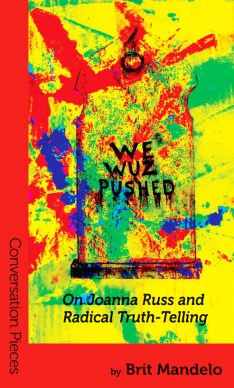
Basically if you’re interested in Joanna Russ’ work, or you’re interested in the way fiction, in particular, can be involved in radical truth-telling, you need to get this book. It’s from Aqueduct Press.
I am a big Joanna Russ fan, so I’m intrigued by everything that does any work deconstructing her work. Mandelo takes as her project the idea that Russ’ entire oeuvre is concerned with radical truth-telling – that art should bring not only pleasure but truth, and not only deconstruct myth but also present new realities. She goes through all of Russ’ science fiction novels, pointing out the truths that are present there and how Russ uses that fiction to suggest new ways of being. I especially liked how Mandelo presented her own journey to understand And Chaos Died – which I haven’t read – and how context can radically change how we understand an author’s intent. I also really, really appreciated how Mandelo addressed the very tricky subject of Russ’ transphobia in The Female Man, and stresses that being able to adjust our understanding of truth should be part of the truth-telling process. And the fact that Russ did, indeed, change her perspective (on trans women and other issues) makes me respect her the more, and gives me something to aim for.
Mandelo also addresses some of Russ’ non-fiction, particularly How to Suppress Women’s Writing and To Write Like a Woman, where the truth-telling is perhaps more obvious in some ways. Overall Mandelo presents Russ’ body of work as a series of writings deeply concerned with the multiple ways in which truth can be told or distorted and what we as a society must do about that. It kinda makes me a bit uncomfortable when I know that I do often go for escapist literature… and I’m not sure how much Russ would approve of that… but perhaps if I can do it with my eyes open she wouldn’t despair too much?
Cuisine and Empire
Was there ever a book more up my alley than this? (Well yes but allow me my extravagance.) I came across this book courtesy of Gastropod, one of my very favourite podcasts: looking at food ‘through the lens of science and history’.
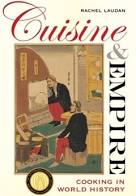 Rachel Laudan takes the idea that we ‘are the animals that cook’ (p1) and looks at how cuisine – how we cook – has travelled and been shaped. She makes a very interesting point that I’d never really thought about: just adopting a particular food doesn’t mean you’ve adopted a particular cuisine, or in anyway integrated a part of a culture. Cooking is the key bit and cooking has always been hedged about with culture and taboo and expectations and so on. She also deliberately looks at the idea of ’empire’ as hegemonic political units can do a lot to spread, enforce, and encourage the adoption of cuisine through a whole range of methods. The point of the book therefore is not to consider regional differences but to look at broad similarities in the way that food is treated, and how those similarities came to be.
There are chapters on the development of grain-based cuisines, and what that meant for cooking in general. She looks at Buddhism and its spread and influence, at Islam and Christianity, and how their morals and philosophies and taboos influenced the way food worked. How shifts from Catholicism to Protestantism in parts of Europe changed things, as well as how industry and increasing globalisation changed modern cuisines.
I love that Europe is not entirely the centre here; that the Mongols and the Islamic empires have a significant impact (on Mexico, via Spain, for example). I am intrigued to think about how political and moral questions have shaped some of the ways that I, and my food culture, think and perceive food. I’m also fascinated by how early decisions, sometimes made consciously and sometimes not, have continuing impacts on the way the world acts.
Honestly, grasses have a lot of responsibility in the development of world cultures.
This book was a lot of fun – well, it was a bit of work, because it’s not always a straightforward narrative. But that was usually fun too. It has made me think about why we do things the way we do, and the cascade of consequences through history. It’s so easy to think of the way we make food as just… passive, somehow; unconnected to politics or anything else. Actually, that’s probably only possible for me because I am a part of the ruling elite, so I don’t need to think about the consequences of my food choices – and I live in a place and time where choosing to eat outside of my particular food culture is totally acceptable. So I am privileged. But I am still constrained, too, by the things I have been taught. And this book helps me think about some of those things.
Mary Russell and Sherlock Holmes
 Things I have not read: Sherlock Holmes stories.
Things I only read occasionally: mystery or crime novels.
Things I have read a lot in the last three months: Laurie R King’s Mary Russell series. Ten books and several short stories, in fact.
This is all because of a friend who suggested the series to me while I was travelling (also the Amelia Peabody series). I decided I needed something a bit light, and I thought it would be interested to give it a go… and all of a sudden I’d read two novels and a novella. And it went from there.
Mary Russell is 15 in The Beekeeper’s Apprentice; orphaned and living with a nasty aunt in Sussex. She literally runs into an older man out looking at bees, and he turns out to be a now-retired Sherlock Holmes. She demonstrates a surprisingly keen mind, he is intrigued, she ends up being his apprentice, they have adventures, and so the series sustains itself.
Russell is an heiress, so there’s no money issues (at least once she inherits); she’s Jewish; she’s very bright, obviously – and gets a degree in theology; and she is, clearly, a match for Holmes in terms of personalities. I can’t speak to how well Holmes is portrayed, but there are amusing references to his being annoyed at Conan Doyle, and the way Watson wrote their adventures up.
To some extent I guess you could call this extended fan fiction. Especially when you have Peter Whimsy turn up briefly, and then Kim (Rudyard Kipling’s Kim), and Dashiel Hammett, and for all I know other characters that I didn’t recognise. But… who cares?
Overall the stories are well-written; they’re definitely page-turners. Sometimes the crimes are dreadful, sometimes they’re on the more intimate side; sometimes Russell and Holmes are personally involved, sometimes they get dragged in. The stories start in 1915, and I’m up to 1924 (where I’m going to pause for a long time, I think; I’ve about done my dash for now), so there’s discussion of blue-stockings and women under 30 not yet having the vote, and King keeps the misogyny and some of the racism that would have been par for the course at the time – which does get a bit uncomfortable at times, it must be said, and I’m sad she felt it necessary.
Overall these are entertaining stories that aren’t too demanding. Perfect for right now, as far as I’m concerned.
Elysium

I bought this book ages ago, I think because it was on the Tiptree Award (now Otherwise Award) honours list. And then I didn’t read it for ages because I thought it was horror – which makes no sense because why would I have bought it in the first place if I thought it was horror? At any rate, I finally decided it was time to read it, and Wow. What an astonishing, wonderful, weird, and very clever book.
It starts relatively easily, with Adrianne and Antoine, a couple whose lives are drifting apart. Nothing particularly odd – except Adrianne sees an elk, in the city; and there’s a brief interlude of computer code that makes no sense. But then the story continues… And then all of a sudden it’s Adrian and Antoine, and Antoine is ill, and Adrian is caring for him but life is so hard.
And then it’s Antoinette and Adrianne. And you can see why the Tiptree committee thought this was a worthy book to include on their list, as the characters slip in and out of genders and relationships and sexualities and the story evolves around them.
Sometimes the pair are lovers; sometimes they are biological family. Sometimes they have a strong relationship, sometimes things are fracturing. And as the narrative develops, the world in which they live gets stranger – not as time goes on but as their story takes place in different worlds; sometimes subtly different, sometimes spectacularly so (sometimes there’s a variation on a plague, so at the moment some readers may wish to avoid). And always the relationship between the two is significant: sometimes it actively influences events in the wider world, sometimes the focus is intensely personal. And always there are the computer-code breaks that hint at restoring or losing data, or resetting systems, and it’s really not clear what’s going on but clearly all is not as it should be (in case you didn’t guess that when there was an elk in the middle of a busy city).
This novel is lyrical and intense and passionately human. I’m so glad I finally got to read it. And then I read the afterword and I was floored all over again because of course that’s where it was coming from.
If on a Winter’s Night a Traveler…
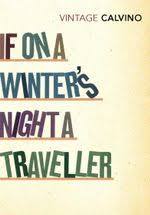 I don’t often read books because I ‘should’ – unless they’re ones that I ‘should’ read before the Hugos, maybe – because I rebel against being compelled to read something when my list of to-be-read books is already one that I will never complete. (Why yes, this is somewhat ironic given my occupation.) This one, though… a number of people recommended it; at least one of Kim Stanley Robinson’s novels makes reference to calvinos; and then in the most recent episode of Galactic Suburbia, Tansy mentioned that it bore a passing similarity to another book I’d read, in being a book-within-a-book. So I thought it was time to get into it.
I am quite sure there are lots of deep, thinky pieces about this novel. It’s a book deliberately and self-consciously exploring the very idea of reading, and what books mean, and what authorship means and how it functions. Something like half of it is written in the second person; the first chapter tells you you’re about to start reading If on a winter’s night a traveler and therefore you should relax, find a comfy spot, tell people to turn the tv down, and so on. Why yes, thank you, I was on the couch in a quiet room with my feet up. Also, the description of what it’s like to venture into a book shop – with those towers of books glaring at you, the Books You’ve Been Planning to Read For Ages making alliance with The Books You’ve Been Hunting For Years Without Success – was an all-too-accurate description of why I prefer buying books online.
And then you, the Actual Reader that has opened the book, watches the Fictive Reader finally open the same book, and rather than read the book with the Fictive Reader, the Actual Reader is given a description of what the book is like… at least for a couple dozen pages, and then the Fictive Reader finds that his books starts repeating itself. And then the Fictive Reader has to go back to the bookshop… and thus the book that the Actual Reader is reading continues, as the Fictive Reader tries to figure out what is going on with the book he wants to read, and things get more and more surreal.
The pronoun from the previous sentences is deliberate. Calvino very clearly situates the Reader as male. Unsurprisingly, I (as female) found this alienating. Obviously I still read the book but I’m quite sure it wasn’t nearly as immersive as it might have been for a male reader. Added to that is the consistent objectification of women throughout the book which I also found alienating. The “Other Reader” is female, and she only exists “as the Third Person necessary for the novel to be a novel, for something to happen between that male Second Person and the female Third, for something to take form, develop, or deteriorate according to the phases of human events” (p166). Which… yes, I understand, interaction between characters is generally seen as necessary in a novel. But this feels all too much like ‘the woman only exists for the benefit of the man’ – surely Calvino could have figured out a way of talking about characters that didn’t seem to suggest something about gender relationships! And the women who appear in the books that the Fictive Reader comes across also only exist as sexual objects. So all of that was disappointing, to be honest.
… despite all of that, Calvino really is doing interesting things with the ideas of narrative and reader expectations and authorial integrity and so on. The Reader (who is never named, oh the joys of being A Universal Being) quite surprisingly goes on a journey to follow the trail of books he encounters in partial form, and there’s never any real explanation for how that has come about – so motive, and cause and consequence, are (at least partly) thrown out the window. The Actual Reader never develops much of a sense of any of the characters, so characterisation: not important? (I certainly never cared for the Reader as my avatar within the pages. I’d rather imagine myself as Pratchett’s Librarian.) And with the openings of several books presented but not developed: continuity, farewell.
I don’t regret reading this. I don’t think I’ll read it again. Will I recommend it to people? … perhaps. People who are interested in novel structure, and the possibilities of fiction, would probably be intrigued.
A Memory Called Empire
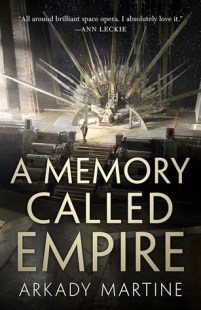 I had a pretty great January of reading because I realised I had time – and it was the time – to do some reading I’d been meaning to do, in order to nominate for the Hugo Awards. And I’d heard this hyped by a few people so I figured it needed to feature.
It was probably my favourite book published in 2019.
And it’s really hard to decide what to say about it.
It’s fitting that the cover quote is from Ann Leckie, because I was immediately put in mind of her colonial/ imperial themes from the Ancillary books when reading this – although Leckie and Martine explore quite different aspects of that troubling human experience. Here, Teixcalaan is definitely imperial, but I would argue they’re just slightly more subtle than the Raadch about it. Slightly. Both are quite convinced that their way of doing things is right, and it’s reflected in their language. What’s different though is the way the protagonist deals with this. Ambassador Mahit, whose home orbital station may be in line for being imperially expanded over, has been chosen as ambassador at least partly because of her fascination with Teixcalaan culture and society. So has she already been culturally colonised or does she know the enemy well or is it a case of appreciating beauty where one finds it? I adore the complexity of this idea.
… before you get the notion that this is an entirely cerebral book, though, don’t be fooled: there are devious plots and explosions and deceitful manoeuvrings, friends who might not be friends and behind the scenes machinations, secrets that must be kept hidden until they’re not, bonkers social manipulation, a great line in snark and discovery-of-unexpected friends.
Basically, I adored every single word.
Martine has enormous ideas and, I’m convinced, a much larger vision of the universe than readers have any notion of yet. There’s even broader problems for Texicalaan and everyone else than are directly dealt with here, and I can’t wait to see where Martine goes with it all.
And I haven’t even mentioned the secret technology that Mahit must protect, and that her predecessor possibly died doing so.
… And then I discovered that the sequel isn’t due out until early 2021, and I had to sit quietly for a while to allow myself to recover from the devastation.
The Light Brigade
 I’m going to make the call: this is the best Kameron Hurley book yet. And I say that as a very big fan of Nyxnissa.
This is… something else. Something outstanding as a narrative, as a commentary, as a work of art.
First let me note that this is not exactly a linear narrative, since I know that will put off some readers. It’s not exactly not linear, either… depending on what frame of reference you use. And yes, if I explain that, it will involve spoilers.
The story is set some time in the future – probably a century or so? Humans have been to Mars, and apparently we’ve also got so fed up with democracies (or been so conned) that Earth is now ruled by mega-corps, where you have to earn the right to be a citizen. And now there’s a war, and enlisting seems like a good way both to earn citizenship (Starship Troopers?) and to get back at the enemy for their atrocities. So that’s what Dietz does, and then the soldiers get broken into light in order to be transported more swiftly, and then weird things start to happen: but only to Dietz.
There’s a huge amount going on here.
There’s the relative merits of democracy, capitalist-authoritarianism, and socialism. There’s war and its impact, in sympathetic and horrific detail; the value of citizenship, the value of life, the use of propaganda and the importance of time…. For a fast-paced military SF novel, Hurley (unsurprisingly) packs a vicious amount of political (in its broadest sense) commentary in.
Plus there’s the evolving character of Dietz, as we delve deeper into back story and follow events and watch, sometimes horrified, as Dietz responds. I don’t think I necessarily like Dietz; I didn’t especially like Nyxnissa, either. But as a compelling and complex character, whose story I am compulsively drawn to understand? Dietz, and Nyxnissa, work.
On the constructed level, Hurley is playing with many “wilful homages” as she calls them in the Acknowledgements. It took me an embarrassingly long time to realise that this was basically a ‘Mars attacks’ novel, and that Hurley was playing with lots of the literary connections there. I suspected one or two other nods, early on, but wasn’t sure if they were deliberate until the James Tiptree Jr reference leapt out and smacked me on the nose. I knew that one was deliberate.
This novel is amazing.

 Randomly Yours, Alex