Glass and Gardens: Solarpunk Winters
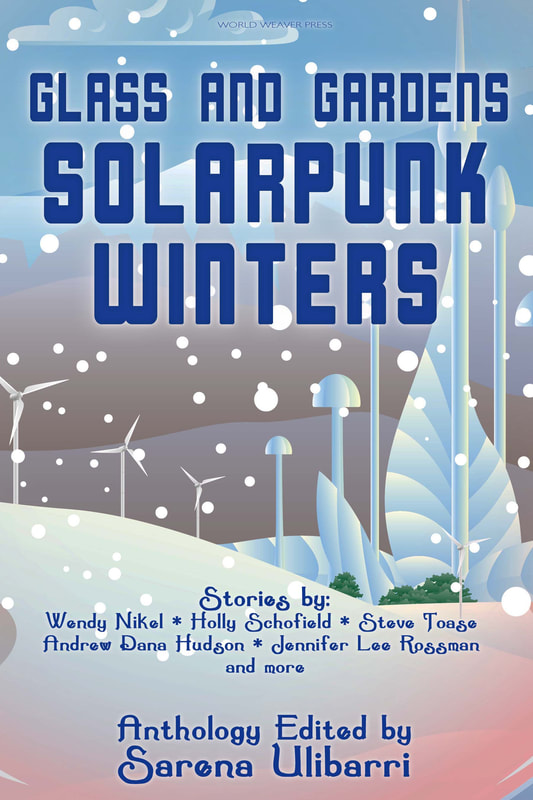
I’ve only recently come across the idea of ‘solarpunk’ – basically a hopeful take on humans living in a post-climate change world, as far as I can tell. I guess this is what ‘hopepunk’ also aims to be? maybe solarpunk is a bit more about the actual mechanics… I don’t know, I’m not going to claim the ability to set genre boundaries. ANYWAY, World Weaver Press has done a bunch of solarpunk anthologies, and a couple of them were on special the other day so I got them.
The first one I read was this, Glass and Gardens. Turns out I was in the right zone for some hopeful SF. As with all anthologies, I didn’t love every story – but also, there were no stories that left me wondering what the editor was thinking. They all fit the overall theme – how to be hopeful when winters have got more extreme or, in a couple of cases, the world has warmed so much that winter no longer happens, with equally disastrous consequences for the environment. It is heavily North American-focused, but honestly as an Australian this is just something I pretty much take for granted.
One thing I particularly liked was that while all of the stories were focused on humans, and what they are doing to live with/ mitigate/ work around climate change, there’s also a focus on how the climatic changes have affected the rest of the species on the planet. It’s s refreshing change and something that seems to be a trope within solarpunk from what I can tell – an acknowledgement that humans aren’t alone on the planet. So there’s Jennifer Lee Rossman’s “Oil and Ivory”, about narwhals and whether they’ll be able to travel underneath pack ice in the Arctic; bears and several other animals in “Set the Ice Free,” from Shel Graves; and several stories that have cities encouraging a lot more greenery and what could be called extreme eco-living compared to today.
An aspect that connects to the idea of hope is the prominence of art in these stories. Your dire post-apocalyptic world has no room for art and beauty. But Sandra Ulbrich Almazan has characters making clothes in a variety of ways in “A Shawl for Janice;” “On the Contrary, Yes” from Catherine F King is entirely focused on art and making art across multiple genres; Andrew Dana Hudson imagines ice-architecture as its own art form in “Black Ice City.”
This is a great anthology, and I look forward to reading more solarpunk.
The Tigris Expedition, Thor Heyerdahl

All of the things I said about The Ra Expeditions also apply here. Although this is happening in the late 1970s, so the racism is both a bit less, but also even less comfortable, if that’s possible.
Interestingly, I didn’t find this as historically problematic as Kon-Tiki or Ra. I think that’s mostly because he’s only sailing around places where there is actual archaeological evidence for contact – Mesopotamian stuff found in the Indus Valley, and vice versa – so there clearly was contact, although at how many degrees of separation is unclear from just those remnants. Although I did have to stop and laugh when Heyerdahl earnestly suggests that just because there’s a similarity between how a place name is said today, and how we think a word was said in a language nobody now speaks – well, that’s evidence that they might be the same place!
For real.
ANYWAY. I don’t need quite such an expurgated version of this book as with the other two, because the ideas and the language aren’t quite as offensive. And as with the other two, this is genuinely a fascinating adventure story. Getting the built made – of reeds, in Iraq – is another amazing story of ingenuity and the problems of materials etc in an area that really didn’t have ‘modern’ resources at the time. Was importing South American boatbuilders the most authentic way of doing it? Probably not. Anyway, then you’ve got eleven men on this little boat navigating the Arabian Gulf Persian Gulf Sumerian Gulf (there’s a whole thing about which name is appropriate), which is filled with enormous boats and isn’t all that easily navigable… and they go to Oman, and Bahrain, and Pakistan, and then back west – honestly it’s an amazing journey, with a lot of quite serious problems that they do manage to overcome. Heyerdahl is open about some of the friction experienced between the men – he has to be, given there’s someone with a camera filming them for much of the voyage – as well as their frustrations about what’s going on on land.
Would I recommend this wholeheartedly? No. Would I recommend it with reservations? Sure. Only to an historically literate reader, who’s in a place to deal with fairly stereotypical 1970s attitudes. It’s probably the best of the three in terms of not being problematic.
Left-handed and Sinister Booksellers, Garth Nix
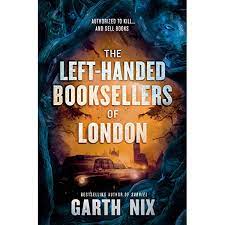
Apparently I didn’t review The Left-handed Booksellers of London when I read it, which leaves me with questions… mostly “why??” and “what was I thinking??”
I have loved pretty much everything of Nix’s that I’ve read, and this was no exception. Set in a 1983 with a history that’s slightly tangential to our own world (Clementine Attlee had me HOWLING with laughter), it’s about a girl, Susan, who has a terrible experience with something otherworldly and gets rescued by a bookseller… but not as you know them. Merlin is a left-handed bookseller, meaning he gets directly involved in dealing with incursions of Old World powers and idiot mortals who decide to meddle in things they ought not to. Adventures and revelations and betrayals ensue. Susan isn’t who she thinks she is, the world isn’t as she thinks it is, etc. I love Susan, I love Merlin, everyone should read this.
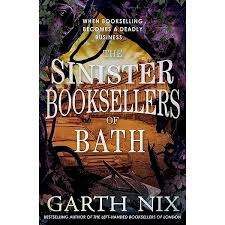
…ALL of which is why I have been looking forward to getting my hands on the sequel! It’s very much a sequel, don’t read this without the first (and why would you??). Susan continues trying to navigate in this newly expanded world she finds herself in; Merlin gets himself into some trouble early on and then they all spend the rest of the book investigating the consequences. Vivien, Merlin’s sister, is back, as are some of the assorted bookseller family members. There’s a mystery, there’s some mayhem, personal crises to be dealt with… and it’s all written as beautifully as Nix ever does. I loved it. A lot. I anticipate re-reading this, and trying to get it into other people’s hands if they’ve somehow slept through it.
Tomorrow’s Parties (anthology)
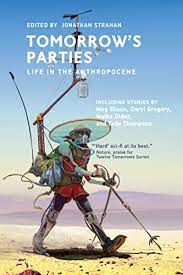
I really have to be in a particular frame of mind to read anthologies, which is why I read several in a row recently – including this one. It’s not that I thought I wouldn’t enjoy them – they’re Strahan anthologies, I’ve never not enjoyed one. It’s just a particular reading experience.
Anyway! Now I have read this awesome anthology and it was as stunning as I expected. As the subtitle suggests, the loose theme is “life in the Anthropocene”, and the authors largely took a similar-ish attitude towards what that means; there’s a lot of climate change-related stories, as is appropriate, and / but all of the authors took quite different approaches to what that might mean.
Every single one of these stories is amazing. I’m intrigued that Strahan chose to open the anthology with a conversation between James Bradley and Kim Stanley Robinson – it’s the sort of thing that I tend to expect at the end of the anthology – and maybe that’s part of the reason for it to be up front: to encourage readers to actually read it. It also sets up the climate change issues that are so front and centre through the rest of the book; the title is “It’s Science over Capitalism: Kim Stanley Robinson and the Imperative of Hope,” which itself speaks volumes.
The ten stories in this anthology are all exceptional.
Meg Elison, “Drone Pirates of Silicon Valley”: the future of online shopping and delivery, yes, but also rich vs poor, and the future of capitalism.
Tade Thompson, “Down and Out in Exile Park”: how communities might live differently, and how that challenges the status quo.
Daryl Gregory, “Once Upon a Future in the West”: multiple perspectives, and quite creepy at times. So many issues – the (negative) future of telehealth appointments, autonomous vehicles, bushfires…
Greg Egan, “Crisis Actors”: a very disturbing story that explores some of the consequences of living in a “post-truth society”. I always adore Egan’s short work.
Sarah Gailey, “When the Tide Rises”: another story that confronts capitalism head-on, bringing back the idea of the ‘company town’ as well as poking at the idea of companies making money from finally doing good for the planet. Brilliant.
Justina Robson, “I give you the moon”: one of my favourites, and not just because it’s one of the most hopeful of the stories. This is post-climate crisis, when humans have figured out how to live in more balance with the rest of the world (her vision is marvellous). Rather than focusing on how we get there, this story is about family dynamics, and ambition. It’s gentle and wonderful.
Chen Qiufan (trans. Emily Jin), “Do you have the Fungi sing?”: the consequences of a hyper-connected world, what happens if an area doesn’t want to participate – and possible alternatives.
Malka Older, “Legion”: completely and utterly different from all of the others, this is the story that’s going to stay with me the longest. Chilling, confronting, challenging… I had to stop reading when I finished this story and take a breath. It takes place over a short period of time – maybe an hour? – in the prep for, and during, an interview on a talk show. The host, Brayse, is interviewing a woman representing Legion, a group who have just won a Nobel Peace Prize. The reader is in Brayse’s head, which starts off as a reasonable experience and then gets… less so. Legion, as the name suggests, are not just one or a small group; they are everywhere, always watching through wearable cameras, and able to call out – or respond to – what they see: micro- and macro-aggressions, and all the ways in which some people are made to feel less comfortable right up to actual harm. Older nails the unfolding of this story perfectly.
Saad Z. Hossain, “The Ferryman”: another incisive take on the consequences of late-stage capitalism, this time how people will respond to death when, for the ‘haves’, death doesn’t need to exist.
James Bradley, “After the Storm”: being a child growing up in the ravages of climate change is likely to suck; at the same time, children do tend to be resilient and make their way within the world that they know. Bradley focuses on teenagers and their experiences – rather than the adults who know how things have changed – and captures the cruelty as well as the love of adolescents beautifully.
All in all, an excellent addition to the literature around ‘what next’.
Desolation Road, by Ian McDonald

This book should not work.
The first few chapters are “and then this person arrived in this place that has no right to exist”. Sometimes the person or family group have some explanation about who they are or why they’re travelling; sometimes their background is incredibly vague. There are hints and vague hand-wavings at what might be coming in the future because of a particular character, and then it takes a hundred pages for anything like that to happen. There are possibly-magical occurrences, there are references that make it sound like you’ve missed the first two books in the trilogy (Our Lady of Tharsis…) and it takes FOREVER until there is something resembling a narrative.
This book absolutely works. And I don’t know why.
Well, I do: it’s because McDonald is an astonishing storyteller, and all of those things that seem wrong just become utterly intriguing and compelling. Someone who manages to make a time machine because a green person pops up at their camp as they travel across the desert? OK. Triplets who may or may not be clones; twins who split the rational and the mystical between them; someone who has an uncanny way with machines… yep, fine. I’ll read it. People are adults at 10 years old? Oh right, it’s Mars, and the Martian year is 2/3 longer again than an Earth year. So yes, actually, that’s fine.
Imagine writing this, and selling this, as one of your first books.
A Deepness in the Sky
Read via NetGalley and the publisher, Tor. This is a reprint so you might be able to get earlier printings, or this one is out in October 2023.

Where do I even begin?
I have never read a Vernor Vinge story before. According to Jo Walton’s introduction to this one, this and The Fire in the Deep are basically the culmination of his lifetime’s work.
Reading this (admittedly quite long) novel is like reading a trilogy that’s been refined down to just one volume. There is SO MUCH GOING ON – and it all works, and it draws you inexorably on. It’s not particular frenetic in pace – I didn’t feel like I was reeling from one explosion to another – but it’s relentless. It’s like an avalanche.
Partly this is because although the story takes place over decades, there are several well-placed time jumps. I think this is part of where the ‘trilogy refined to one book’ feeling comes from. There’s nothing extraneous. There are moments of people just being people – being in relationship, having families, relaxing – but they don’t feel like padding. It’s all adding together to make these characters intensely real.
There are three strands. Two are human: the Qeng Ho, a loosely connected and enormous group of people whose aim is trade; they travel between planets to sell whatever is needed, and call people on planets Customers – not in a taking-advantage kind of way, but in a ‘this is what we do’ way. Then there’s the people known as Emergents, and I wondered about this name for a long time… before I discovered it was because their society is the Emergency, named for a particularly dramatic time in their political history which has had cascading effects on their political and social structures (to become far more authoritarian than the Qeng Ho countenance) and honestly the name tells you a lot about them. These two groups of humans end up working together – much to the dismay and distrust of both sides – as they go to explore an astronomical anomaly. The third strand is the aliens who live on the planet around that astronomical anomaly, who are not bipeds and whose planetary and biological experience has led them to develop in some very different ways from humans… and yet, they are intelligent, and Vinge suggests convergent evolution in a lot of scientific and technological ways.
As I said, there is A LOT in this novel. Love and betrayal and family and war and technology… and then Jo Walton’s foreword tells me that if I read The Fire in the Deep it may completely change the way I understand this novel? I’m a bit sad that it took me until now to read this, AND YET reading it at this age was actually excellent.
I’m so glad Tor is reprinting this and I hope it gets a lot of love.
Small Fires: An Epic in the Kitchen, by Rebecca May Johnson
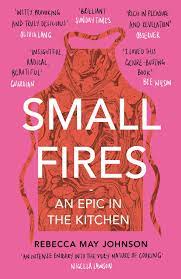
I read this via NetGalley, thanks to the publisher Pushkin Press.
This book is incredible and thought-provoking and I loved it enormously.
I sort of want to say this is a book that is “ostensibly” about cooking… except that it IS about cooking, there’s nothing ostensible about it. But it also uses cooking as a metaphor for many things, and looks at recipes and in-kitchen behaviour both for themselves and as metaphors, and reflects on the author’s life in general as well as her relationship with food and the preparation thereof.
I love reading about food and cooking and, although I feel a little guilty about it, I also love reading about how people feel about food. (The guilt comes because I feel like a voyeur.) This book does that for me, as well as touching on other things I hadn’t realised I would love in connection with a discussion of cooking. Such as…
Johnson has a PhD looking at a German translation of The Odyssey, and I had never before considered how you could make connections between that text and the myriad ways that cooking and food (not to mention gender – although I had thought about that a bit) are used in western society. The way that how we talk/feel about translation can also connect to the way we talk/feel about cooking was absorbing. And then there’s all the other theoretical stuff, like the psychoanalyst who thinks that cooking from a recipe is a sign that the cook lacks creativity… which made me, and Johnson, rage.
This book is at times prickly, at times confronting; Johnson reflects on large chunks of her life so sometimes she is bewildered and struggling while other times doing quite well. There were a LOT of times I responded on a very emotional level with what Johnson was saying: I cook for those I love; I struggle to think about making food for just myself; I have struggled with what my love of cooking says about me in terms of feminism (thank you, third wave feminism, for teaching me about the issues of second-wave feminism).
This is a powerful book. About cooking, yes, and the place of the recipe – and my goodness, Johnson’s exploration of what a single recipe can be, what it does, what it means: all of these things are glorious. It’s also an exploration of life, although I hesitate to call it a memoir and it’s certainly not autobiography. Many people come into Johnson’s life through the book, as she cooks for them and reflects on their relationships, but there’s not a lot of names – there’s a sustained reflection on the idea of ‘YOU’ as the one cooked for, and what body YOU represents changes over time, and exactly who they are and their relationship to Johnson is irrelevant for the purpose of the book. I liked this, too, even though the biography-reader in me kept expecting to understand the various relationships. But it’s not necessary for the book.
This is a book that I may need to own, in paper.
He Who Drowned the World, by Shelley Parker-Chan

Read courtesy of NetGalley and the publisher, Tor Books. It’s out in August 2023.
Vicious, and savage; heart-wrenching, distressing, stunning, and shocking; twisty, and relentless, and deeply powerful.
Pretty much what you’d expect after She Who Became The Sun, although possibly More. Just… more.
Do not read this without She Who Became the Sun. You definitely want to read She Who Became; and this will make no sense without that first book.
Zhu appears to be on her way to becoming emperor. There are some seemingly insurmountable obstacles in her way, but she’s already overcome several of those in her life so why should these be any different? Of course, you should be expecting the unexpected when it comes to Parker-Chan’s treatment of her characters: so there are unexpected alliances and betrayals, unexpected deaths and survivals, and overall an utterly relentless and at time frightening drive from Zhu to claim her destiny. The question is frequently asked: is it worth it? And I’m not so sure of the answer.
Something I really appreciated about this as a sequel is the fact that all of the main characters were set up in the first book. They are greatly enhanced here – in particular, Madam Zhang and General Zhang are given much greater space and, fittingly, Madam Zhang becomes a point of view character. The other opponents who had more characterisation in the first, especially Ouyang and Baoxiang, continue to develop and have their motivations and experiences explored. Of Zhu’s allies, Xu and Ma get some more space, but honestly it’s really all about the enemies.
My one neg is that just occasionally, it did feel like there was too much time spent on the pain and existential crises of some of the characters. Of course part of the point of the story is questioning the lengths to which someone will go to for revenge / to get what they believe they’re owed / and so on, and sometimes that has required them to do truly dreadful things. But a couple of times it felt like there was too much focus on the pain felt by some characters, such that it became a bit repetitive and nearly undercut the rawness and enormity of the emotion – because it was overstated.
However, overall this is another truly amazing book from Parker-Chan. I hate to say it but I can’t wait to see what they do next… and I only hate to say it because it must feel really weird, and slightly distressing, to try and follow up this epic duology.
Viking Women: life and lore, by Lisa Hannett
This is not a standard “here’s what we know about Viking women” book. Those exist, and Hannett acknowledges them, and now I’m all keen to go buy them.

It’s also not a “here’s a reworked set of sagas”, which of course also exist. I’m less excited about those, to be honest, not least because most of the new variations just keep on focusing on the dudes (as far as I can tell).
Hannett is both an academic and a writer of fiction, so this book brings together both in an intriguing and fascinating way. Each chapter generally takes one woman from the sagas (there’s one chapter with two women, and another with three), whom Hannett both explores as a character in her own right, and also uses as a way of illuminating what we know about women in their positions more broadly. And in chapter, Hannett also tells the story of that woman, from her saga. So the history and the fiction are intertwined such that each reinforces the other. Also, Hannett wants you to be under no illusions about the lives of Viking women: while in some respects they did have advantages over the general perception of ancient and medieval European women, they were still absolutely second class citizens (or worse, as slaves).
Hannett describes the way she approached the fictional parts as “reasonably, carefully, colour[ing] them in” – which I think perfectly encapsulates what she’s done. There’s really so little about the women in the stories that a pencil outline just about covers it. Doing both the fiction AND the history means that the reader sees the research – archaeological, literary, intertextual and so on – that informs the fiction, and then how the saga also helps us understand the experiences and realities of life for Viking women. It brings together Hannett’s strengths in a truly glorious way.
I particularly liked that Hannett focuses on ‘ordinary’ women. There’s no royalty (well, not AS royalty), and there’s no goddesses or other, otherworldly women. They are all women who could, actually, have lived – and several of them are documented in less literary sources, so they probably actually DID exist. And so there are enslaved women; there are wives, to men of varying levels of honour, with a variety of experiences; there are mothers with varying experiences of child-bearing. Women who are witches and nuns, women who wield power in a variety of ways; those whose lives were (in context) fairly easy, and others who experienced trauma and exceptional difficulty. So, the whole gamut of life.
This is a fantastic look at the experiences of Viking women, and nicely situates the Icelandic sagas in history and literature. You do not need any background in Vikings to appreciate this.
The Ra Expeditions, by Thor Heyerdahl
I read Kon-Tiki a while back, because I love a travel adventure story. I discovered then that Heyerdahl’s theories about white bearded men civilising South America (a millennia or more before the Spaniards arrived) and that they could be the ones who colonised Polynesia were… um… problematic. I bought The Ra Expeditions before I knew that. I have chosen still to read it because I was interested to see exactly how he would go about tying ancient Egypt into these racial theories about just who settled and civilised where, and also because I wondered whether his ability to tell a good adventure story was a one off. Please keep in mind that I am an over-educated middle class white lady with a lot of historical knowledge and a sufficient amount of knowledge about literary theory, narrative structure, and so on that a) I wasn’t directly in the firing line of Heyerdahl’s period-appropriate (?) racism, b) I was able to read this critically in terms of history and construction. I have the same reservations about this book as I did about Kon-Tiki: it is a genuinely exciting adventure story, because getting to the point of building a reed boat to carry seven men (!) across the Atlantic (!!) is incredible; it’s also chock-full of problematic ideas about race and history. Personally, I found it fascinating to see what ideas existed in the 1950s about cultural dispersion etc, in the same way that reading about people laughing about plate tectonics or that there might be more to the universe than just our galaxy is fascinating. If you’re not in a place to read around the racist stuff – or you’re of Polynesian descent, or South American – then avoid this resolutely.

So the actual account of getting the boat ready – of finding places and people who still make reed boats, of getting everything together in one place (builders from Chad, reeds from elsewhere, and then setting up in the shadow of the Great Pyramids at Giza) is legit a fascinating story of who knows who, ambassadors helping out, meeting U Thant, and uh dodging border security at one point (not great). And as with Kon-Tiki, the story of life on board – the storms, the drama, learning how to actually sail the darn thing, the adventures of a baby monkey they were gifted (uh…) – it is all gripping stuff. I’m also impressed that in the mid-50s, they manage to have seven men from different parts of the world represented: from Chad, from Egypt, from northern Europe, southern Europe, South America, the USA, and a Russian. So that was impressive, although I do wonder whether they really did manage to be quite so idyllic in their political discussions. (Heyerdahl is open about there being occasional arguments about personal living space and so on, but is adamant that there were no religious or political arguments at all.)
What I would love to read is an expurgated version. I can’t believe I’m saying that, but the bits where he’s discussing “the diffusionist” view that somehow there was contact between Egypt and South America because all the points of cultural similarity are just too much to be coincidence, and that the (uh…) ‘savages’ who crossed the Bering Strait to the Americas couldn’t possibly have come up with pyramids etc themselves… yeh, those bits are just too old, now, and too hard to read. The adventure is still worth reading, though! Someone else should do the work to give me “the good bits version”.
I have the final Heyerdahl book to read, too, about the Tigris expedition, but I’m going to give myself a spacer before I read that.


