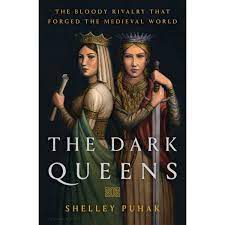
The Dark Queens: The Bloody Rivalry that forged the Medieval World
I read this courtesy of NetGalley. It’s out in March 2022.
OH YES.
1. This has pretty much everything I love about a history book.Rediscovering, or repairing, or reframing, previously maligned historical figures.
1a. In particular, women. And here, Puhak does it to not one but TWO women, living at the same time, with lives that were interwoven and had an enormous impact on each other.
The late 500s in what is now France was a remarkable time: it was, as Puhak points out, a time of “dual female rule” – Brunhild and Fredegund, one a Visigoth princess and the other a former slave, were regents for their grandson and son respectively. Together they controlled nearly as much land as Charlemagne would a few centuries later. This dual female rule wouldn’t be repeated in Europe for another thousand years. And why don’t we know about it? Because, Puhak claims – with some pretty strong evidence – there was a concerted effort at damnatio memoriae; getting rid of all memory of the actions of these two queens from history. A lot like what happened to Hatshepsut in Egypt. Either expunge the actions of the women, or cast them in as completely evil or irrelevant light as you possibly can. Because how embarrassing to remember that women had been instrumental in leading and shaping your kingdom for decades!
2. I learned many new things.
A lot about the Merovingians, of course – which I had no knowledge of, except for the name, and (as Puhak ruthfully notes) as the name of a character in a Matrix film. But I also learned that the Latinised version of ‘Clovis’ – whose name I did know – who was the first Merovingian king – is LOUIS and there you get the beginning of, what, 17 kings with the same name.
3. Utterly readable.
Puhak says that this is “not an academic history; it is a work of narrative nonfiction based on primary sources”. And I think this is a really intriguing way of putting it. I guess the ‘not academic’ aspect is strictly accurate, although I do think Puhak is underselling herself. There aren’t footnotes – but there are extensive references at the back, and my goodness her bibliography is incredible and IF I HAD THE TIME (and access to them) I could glut myself on following them all up. I love the use of the primary sources here; she uses the various histories from the time, and later, judiciously – weighing up their perspectives and their intentions and figuring out what makes sense. And it ends up being absorbing and riveting.
4. What a story.
Honestly, you could present this as fiction and people would believe you. Marriages brokered, broken, and occasionally seen through; so many murders and possible-murders; kingdoms divided and reunited; treason, scheming, bargaining… Puhak argues that Cersei from Game of Thrones is inspired by these two women, in some sense, and I’m not quite convinced of that but it tells you something about their lives.
What a fantastic book.
The City Inside

I read this courtesy of NetGalley. It’s out in June 2022.
This was… incredible, and devastating, and gloriously written. And I’m not sure I have the words to properly explain how and why.
Firstly: if you’re looking for an entirely straightforward, narrative-driven story, this is not for you. If you’re interested in character and world development and fabulous prose (and a narrative that still has me thinking), then you’re looking at the right book.
The first few chapters are all about setting up the world. It’s the mid 20th century, I think; and it’s Delhi; and things are both recognisable and completely unfamiliar. Joey is a Reality Controller at a Flowco; she has a smartatt on her wrist that monitors her health and suggests cat videos when she’s stressed, and she regularly has to wear a mask when she’s out and about. Confused? I was, a bit, when I started; but I was also intrigued and rapidly sucked in (and it took me a couple of seconds to understand ‘smartatt’ as ‘smart tattoo’ and then I was very impressed with Basu. Also terrified). The key thing to get your head around is the Flow, which takes the current ideas of infotainment and reality tv and influencers and life-casting and making it more massive, more pervasive, more curated and… generally just More. This is the big thing that’s both familiar and not.
As an Anglo Aussie, I’m the first to admit I don’t know all the ins and outs of current or past Indian political history, nor the concerns people might have for future directions. That’s a big part of the background here: Joey’s parents were involved in protests and suffer the consequences; things are unsettled and maybe tyrannical in Delhi and perhaps across the city. There are ongoing protests and various groups being oppressed. On the one hand, I am quite sure I missed a fair bit of political nuance that someone living in Delhi would just pick up almost without thinking (like a reference to politicians and onions for me). And that’s just fine: there are always different experiences for different readers. Because even without that political knowledge, I could understand enough about the tensions to know that this is a world I wouldn’t want to live in, with its fear of cameras everywhere and no trust of the government. And just to show how bitter things are: “her parents didn’t know whether to blame the pogrom or the pandemic, because they’d known the end times were coming but hadn’t known they’d be multiple choice” (p6).
The story follows Joey and colleagues and delves into the world of a Flowstar as well as tapping on parts of the broader world. Most people are out for what they can get for themselves and their families; some people are trying to buck the system; there is a massive gap between the haves and havenots. Much of the book is about following the characters and experiencing their lives… in much the same way that they themselves are producing a Flow for people to experience. Which makes me reflect in some horror on the explicitly voyeuristic nature of fiction and may send me into a tailspin if I get too worried about the privacy of fictional characters.
The writing is an absolute treat. It’s dense, in the descriptive and absorbing sense; it’s deeply evocative; and still entirely readable. I enjoyed every minute of the reading even while I was completely horrified by the experiences of the characters.
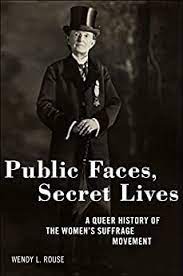
Public Faces, Secret Lives
I read this courtesy of NetGalley. It comes out in May 2022.
I have been known to joke that historical women were invented in the 1960s – before that, only Cleopatra, the Virgin Mary, Joan of Arc and Elizabeth I existed (obviously none outside of the European context). More recently I have added that queer people were invented in the 21st century.
I was joking, but … only because there’s an element of truth. Straight white men rule history, amiright?
This book, then, is a massively important addition to the history of the fight for suffrage.
I should point out that although I have a fairly substantial library of suffrage books, they are all either Australian or British. My knowledge of the American experience is limited to the film Iron Angels, and the magnificent “Bad Romance” spoof video clip. I do not, therefore, know a lot about the private lives of the main characters like Susan B. Anthony, who aren’t covered here in any detail because it’s been done elsewhere. It’s interesting therefore to get the focus on women who were, apparently, lesser lights – or who have become such as the history of the period has been presented.
I’m also not an expert on queer history, so I don’t know whether Rouse’s particular definition is standard or expansive. Here, queer is outlined as “individuals who transgressed normative notions of gender and sexuality… suffragists who were not strictly heterosexual or cisgender” (p2). There’s a nice point about how language changes and that words we might use to describe relationships today, for instance, may not have been available to or appropriate for people in the past.
The chapters follow general themes, or categories, allowing Rouse to explore different ways in which queerness was expressed – and fought against, in some instances. For example, in the chapter “Mannish Women and Feminine Men”, she examines how some suffragists fought against the derisive stereotype of ‘mannish women’ by insisting that suffragists perform femininity to a signifiant degree – to the detriment of gender non-conforming individuals and those women who advocated less restrictive dress. Other chapters include “Queering Domesticity” and “Queering Family” – so many of these women ended up setting up house together, and whether they were in physically romantic relationships can often not be conclusively determined, but they still spent their lives together! There’s also “Queering Transatlantic Alliances”, “Queering Space” and “Queering Death”, so it covers the entire gamut of suffragist lives.
There’s a really nice intersectionalism at work here, too, with commentary on how “queer white suffragists… helped maintain a system of white supremacy by policing access to the vote” (p63), for example. There are definitely black and First Nations people mentioned in the book, but I suspect one problem of not being familiar with the American history here is that I didn’t automatically recognise the name of any of the suffragists – let alone recognise whether they were white or not. Still, Rouse did point it out, and made note of the times when white suffragists, for instance, either tried to block black women from marching in demonstrations or told them to go to the back of the line. There’s mention, too, of class – something that’s often lacking in standard stories of the British fight for suffrage, if it focuses on Emmeline and Charitable Pankhurst and forgets Sylvia.
I’m really glad this book exists. It’s a really great look at the American fight for women’s suffrage in general (as far as I can tell), as well as presenting a dimension that is much-needed across all history.
Green with Milk and Sugar

I read this courtesy of NetGalley.
This is one of my favourite types of history books.
1. It’s about a fairly niche topic – the drinking of Japanese tea in America – which is shown to have connections with all sorts of issues and events across many decades. Trade connections! Racism and how attitudes towards different ethnicities develop and are deliberately cultivated! What happens to the samurai class when they’re moved out of Japanese society! Civil war and foreign war! Marketing and world expos and food regulation. It’s all here, and it’s woven in and through the overall topic beautifully.
2. There’s intriguing and what seem like weird facts. Like the idea of a punch made from ‘very strong tea’, plus a 1.25 pounds of sugar, a pint of cream AND THEN a bottle of either claret or champagne. I feel ill even thinking about it. Also, the idea that apparently people used to add Prussian blue to green tea, to give it a stronger colour??
3. There’s a personal connection to the author, and it’s neither gratuitous (I really like tea!) nor tenuous (my next door neighbour’s grandfather lived in Taiwan!) nor overly emphasised. Instead, the Hellyer family had been involved in importing “Japan tea” to America for many years, back when that was what it was called and when – as the subtitle suggests – “Japan filled America’s tea cups”. When appropriate, the Hellyer family experience is used to illuminate particular aspects of the story – Europeans as merchants in Japan, the shipping to America, and so on.
4. It’s just really nicely written. Hellyer has clearly done a lot of research, and has been very thoughtful in the way he’s put together the material. The overall story is easy to follow – but there’s no sense of a steady march towards a definite end. I mean, in one sense there is, because the reality is that American tastes in tea did change (not least away from tea). But it’s not all ‘oh woe everything was always leading to downfall’ – instead, it follows the changes in fashion and expectations and international relations and shows how those things interrelate with the drinking of, and importing/exporting of, tea.
I love history books about food that illuminate a seemingly mundane part of ordinary life and show just how complicated such things really are.
The Library: A Fragile History
Update: and THEN Allen&Unwin sent me a hard copy!! I’m so excited to have a physical copy of this amazing book!! And it is GORGEOUS – swirly oil-colour end papers, and A RIBBON. PEOPLE, a RIBBON. It’s just swoon-worthy.
The hard cover is RRP $49.99 and is out as of 30 Nov. I’m sure there will be a paperback copy at some point. Definitely the book for the bibliophile in your life.
I initially read this book courtesy of NetGalley.
Oh. My.

What an astonishing book.
Honestly I’ve had such a good year for book-related histories: The Gilded Page (Mary Wellesley), and The Bookseller of Florence (Ross King), and now this. Interestingly, this book contains parts of those two, because understanding how libraries function requires some knowledge of books themselves function, and how the book trade functions. It’s been like a mini-course in the whole book production history of Europe.
The authors begin with a discussion of the fabled Library of Alexandria, which is appropriate given its mythical place in the history of libraries… and ALSO that there’s some attempt to do something similar in the Alexandria of today, which is, let’s say, not the Alexandria of yesteryear.
What utterly intrigued me was the way that exactly what a library is FOR has changed over the centuries. I am a huge fan of the public library, and absolutely uphold its place as a community resource. I do know that in medieval Europe, libraries were the province of monasteries and nobles – not least because that reflects the literacy of the age, and also the aspirations of such people.
It was the use of libraries as exhibitions of wealth that was one aspect explored beautifully here – collecting the ‘right’ books, and beautiful versions. And then how do you have architecture that reflects that? If you’re worried about scholars nicking off with your precious tomes, and you only have a few books, then you chain the books up (literally) and your building reflects that. But when books starting getting more accessible and you are HAPPY for them to be accessed (unlike Oxford libraries not allowing students in and having opening hours for about three hours a week), then what the rooms look like needs to change.
I deeply appreciated the exploration of libraries as both weapons within colonialism and imperialism, and victims of it too. Colonial outposts in NZ and India being sent books; translations into the languages of the colonised; and libraries being looted, or outright destroyed, across the globe – these are things that need to be remembered and dealt with as people keep thinking about the use and abuse of knowledge as power. It would have been so easy to not include those things, and to stick with somehow seeing libraries as just repositories of books – ignoring books as power – but I’m so glad the authors wanted to give a rich and full exploration of libraries as institutions.
Look, I just loved this book. It’s beautifully written and has lovely images. It covers predominantly European examples of libraries. It does so across just over two millennia, from monastery to castle to private home to public institution. And the modern arguments about what a library is for! Clearly these authors are defenders of the existence of libraries, but they’re not just stuck in mid-20th century versions. They are, if anything, ambitious for what place libraries can and should have in communities.
I love books and I love libraries and this was a wonderful history of them both.
Until Proven Safe: the History and Future of Quarantine
I like to imagine Nicola Twilley and Geoff Manaugh saying “No one would have believed…” like Richard Burton at the start of Jeff Wayne’s War of the Worlds, when asked how they feel in 2021 about this book. They started it, as far as I can tell, many years before 2020… and then finished it while large portions of the world were getting the ideas of ‘quarantine’ and ‘isolation’ mixed up. (As the pair make clear, quarantine is when there is doubt about the infection status of a person or object.)

I came across this book because I am a massive fan of Gastropod, “food through the lens of science and history”, co-hosted by Twilley. And as a fan of wide-ranging history in general, it seemed like a good bet that it would be right up my alley. The podcast did one episode using some of the ideas from the book – talking about the quarantining of cocoa plants, mostly, so as to prevent the spread of chocolate-destroying pests, which I am heartily in favour of.
As the name suggests, the book covers both the history and the future of quarantine – and, of course, the present. Many more people know, in 2021, the origins of the word – the 40 days people and cargo on ships were kept out of places like Venice, for fear of sickness. Manaugh and Twilley visit Venice and Dubrovnik and Malta, places where quarantining had a long history in architecture and laws, and occasionally in famous people getting grumpy about being stuck.
The middle section is about quarantine today. As an Australian this is a particularly real issue; we really don’t want to bring yet more pests and diseases in if we can avoid it. There’s a reason dogs don’t get to be smuggled in, JOHNNY DEPP. It was fascinating to read about measures that are used around the world to try and stop invasive stuff – and how often, this is a stop-gap measure, because with ever-increasing world trade it’s just so easy for teeny critters and seeds to travel. This section also looks at ‘quarantining’ radioactive waste – which is a bit of a stretch, since there’s no real question about the stuff being dangerous; and the authors acknowledge that it is, indeed, about isolation, rather than quarantine; but their argument is that places doing this stuff are fascinating for ‘quarantine tourists’ because they showcase ‘extreme engineering controls’. And this section also looks at the measures used around space travel: like I didn’t know the first couple of sets of Apollo astronauts were required to quarantine for fear of moon diseases.
My one grumble about the book is a minor Australian one. In discussing Australian legislation from 1884, they call Australia “the newly unified continent” (p125). Australia didn’t federate until 1901. My quick google suggests that there were, indeed, “Sanitary Conferences” at this time aiming to have a united policy across the colonies, so I guess in that sense the continent was unified?
In the section about the future, Twilley and Manaugh do look at COVID responses, comparing them to medieval responses in terms of government use of power, and even deploy Foucault as a way of examining government (over)reach. We’re discussing these questions a lot at the moment, of course, and it was interesting to see it all in this context. And what was completely terrifying was to discover that there’s a “data-aggregation and modelling firm with close ties to the US defense industry” (p328) called Palantir. Palantir. The seeing-stones of Tolkien’s Middle Earth. Wikipedia notes that “beings of great power could manipulate the stones to see virtually any part of the world”. And someone at this company thought this was a good name for this company.
I think, given our situation at the moment, one of the last points made in the book is particularly pertinent: “Ironically, if quarantine does work… it will almost always be perceived as an overreaction” (p349).
Well written, well researched, broad ranging and examining difficult issues with compassion and clarity. This is a great history of quarantine and I thoroughly recommend it. Exactly WHEN you want to read it will depend on your experience of 2020 and 2021, I suspect.
Where the Drowned Girls Go
I read this courtesy of NetGalley. It comes out in January 2022.
The first thing to note is that I love this entire series enormously. I love the very idea of asking what happens to children if they come back from their fantasy land but they didn’t want to, and then have to confront parents who want them to be ‘normal’.
Pretty early on in the series we learned that there was an alternative school: that Eleanor West’s school was for those biding their time, waiting to go back to their real home; the other place was for those who wanted to forget their adventures. It was obvious that eventually a story would be set there – but I didn’t expect it to be Cora who went. And for this reason, I do think that the previous books need to be read first; you need to understand what Cora has gone through, the trauma she has experienced in helping her friends, before you can understand why she wants to do something to try and forget. So if you haven’t read the others, you should go and do that first… don’t worry, it’s totally worth it, I promise.
So Cora goes the Whitethorn, and things are as opposite to Eleanor’s school as it’s possible to be, and completely dreadful. Unsurprisingly, it’s all even more dreadful than it initially appears, and events unfold as Cora confronts both her own trauma and the school-wide problems. It’s beautifully and devastatingly set up, and – as with all the Wayward Children stories – unfolds in complex, complicated, bittersweet ways.
McGuire continues to do wonderful things with her characters. Across the novellas she’s presented humanity in all of its myriad shapes and colours. Cora being fat has always been a part of her character because it had such an influence on how people saw her, and therefore how she saw herself, and therefore all the choices and consequences from there. In some ways I feel that the deliberate and blunt way in which Cora’s size is presented – and her implacable insistence that, of course, there is nothing WRONG with her – is perhaps more transgressive these days than discussing queer and trans folk. The world is coming to accept a gender and sexuality spectrum… but we’ve still got a lot of hang-ups about appearance. So I love that we have a fat hero, who hears and acknowledges the snark from her peers and it DOES get her down but also it doesn’t destroy her. Cora is so very, very human (and a mermaid).
This is a marvellous addition to the series and my only regret is that I read it too quickly and now I’ve got too long to wait til the next one.
Terciel and Elinor
YAY OLD KINGDOM.
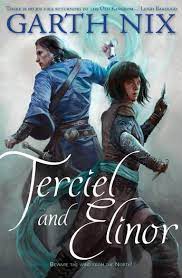
If you haven’t read any of the other Old Kingdom books, let me tell you these things: the Old Kingdom is a place where some people can summon the spirits of the dead, usually using bells and a variety of magic. It borders Ancelstierre, which is kind of early 20th century England? ish. They don’t have magic there. In this story, Terciel lives in the Old Kingdom and Elinor is across the border and they’re brought together by, unsurprisingly, some tragedy and much adventure. It’s really, really, good.
OK, now go and read it and don’t read the rest of this review.
If you HAVE read Sabriel et al…
OMG. Given the opening pages of Sabriel – which, yes, of course I read immediately after finishing this – this was such a bittersweet story! I am SO, so glad that Nix went back to this world and gave Elinor and Terciel their own story. I am always intrigued to read about a young man when I originally knew them as an older man, and of course we had no knowledge of Elinor at all (which is such a classic, if awful, circumstance for YA fantasy). This is a really wonderful addition to the Old Kingdom, and to an understanding of the kingdom and the Clayr and, in particular, the Abhorsens – Terciel’s experience as In-Waiting was not the best!
This is, of course, beautifully written; it’s fast-paced – I read it in a day – and balanced with lovely dialogue and character moments. Definitely going onto the bookshelf for rotation every year or two. (I really need to buy a new copy of Clariel, since someone has nicked mine.)
Quantum of Nightmares

I read this book courtesy of NetGalley and the publisher, Tordotcom. It comes out in January, 2022.
This is a Charles Stross novel on… whatever drugs you take that make you talk at, like, three times the normal speed. (Hmm. Is it speed?)
One blurb says this is a Laundry Files novel. Another says that it is Laundry Files-adjacent… and that’s the accurate one. I haven’t read every Laundry Files, but I’ve read enough that I know what’s going on. The start of this novel, though, was unrecognisable… so then I went to look it up, and it’s the sequel (not mentioned in the blurbs I saw) to a spin-off. So… that’s all important information to have on hand. (There is no Bob Howard in this novel.) Having said that, I did read the whole thing and I did largely enjoy it, so Stross manages to get enough background info in without dry info-dumps to make it understandable… eventually.
CW: there’s some pretty gross stuff here. Think… meat packaging… and really the very worst bits about what can go wrong in abattoirs. Also, and I’m only slightly joking, if you have a phobia about HR and their policies, this is not the book for you; it takes corporate speak and the ill-intentions of large corporations to a whole new level. I suspect this does count as horror, because of those aspects, in which case this is right on the giddy edge for me.
There are many different strands entwined throughout this story. There’s a pseudo-nanny looking after kids who are not what they seem (well, they’re annoying little kids but with Extras); there’s loafers who just want to play D&D who get pulled into annoying real world stuff; there’s the aforementioned HR and a truly heinous view of cut-price supermarkets and a nightmarish future for how they might turn a profit. There are desperate people and sad people and bewildered people; there are double-crosses and worshipping of sinister entities and ruthless acts that just made me blink at their atrociousness. It’s not a particularly happy book; nor is it uplifting; so if that’s what you need right now, go somewhere else. But there is a dark humour to parts, and there’s a diverse cast of characters (trans, queer, not-Anglo), and the occasional good deed, so it’s entirely and unrelentingly depressing.
… when I put it like that I’m not sure how I managed to get through it! It’s not quite as bad as that makes it sound. For one thing, it rockets along at a tremendous pace. I never quite got lost but it was occasionally a white-knuckle, hold-on-tight and trust that Stross is in control of the narrative kind of experience. I probably only kept going because I do, indeed, trust Stross to land such intricate stories in a way that makes sense. Which he does here, yet again.
I don’t think I’ll go find the first book now – I suspect much of it is now spoiled, because I know who survives various difficult situations. Also, if it’s like this one, I need a fair while to balance out the grimness. But I don’t regret reading this one.
Medusa

I received this as a review book from the publisher, Bloomsbury. It’s out on November 1; trade paperback $22.99.
Ah, Medusa. I love her as a character – always have. She has so much to give and so much to say about how women are viewed and used; especially women with power. Burton acknowledges Caravaggio for his portrait of her, as part of the inspiration for this book; I’ve seen Medusa heads in the cisterns under Istanbul. She is an evergreen figure.
The blurb suggests that #MeToo was part of the inspiration for the narrative, and you can see a lot of that here. You can tell a lot about the times in which the story is told from how the, uh, interaction between Poseidon and Medusa is framed. It’s crystal, blindingly, clear here that Medusa was absolutely the innocent. So far so good; not entirely new. But what intrigued me here was the framing of Medusa’s whole life: that she has been accused of being vain – after her neighbours started making comments about her appearance – there’s good commentary here on social expectations and how we just can’t win. And even more than that is the way that Medusa’s sisters talk to her, and what she comes to realise: about her value as a person, and about telling her own story. It’s incredibly powerful. I can well imagine giving this to a mid-teenage kid, frustrated by the messages from the rest of society, and hopefully having good conversations because of it.
Oh also there’s Perseus. Yeah yeah.
Actually that’s unfair – he’s presented in a more complex way here than is often the case, too, and I appreciated that. This is very much Medusa’s story, though, and I love that Perseus is there in service of her growth.
The one thing that disappointed me a bit about the story was that Athena is described as making Medusa’s sisters into Gorgons… but what a Gorgon is never gets explained. It’s not entirely obvious whether this is meant to be punishment, or just a change.
As well as the story, Medusa comes with glorious illustrations. I don’t have the vocabulary to really explain them: there are some examples here, and the most incredible portrait of Medusa is here. Olivia Lomenech Gill has made Medusa glorious – Burton describes the snakes in genuinely loving detail, and Gill has captured that. The pictures throughout are a delight; some are almost like collages; the colours are vibrant, and occasionally juxtaposed with almost pencil sketches. There’s a magnificent four-page set where it’s Medusa on one side of a rock, and Perseus on the other. I’m not entirely ignorant of art, but I don’t always appreciate it as much as I should… these pictures definitely add to the overall quality of the book, and it wouldn’t be the same without.
This is a great addition to the overall discussion of Medusa.

 Randomly Yours, Alex