A Long Day in Lychford
Another novella that I received from the publisher at no cost which I have been remiss in reviewing. Also, another novella where it’s definitely better to have read the previous stories, although not as necessary as for Sarah Gailey’s work.
Returning to Lychford, once again things are amiss with the boundaries between the worlds; this should come as no surprise (poor little village). This time, there are also significant fractures in the relationships of the three witches who must hold the place together. This, of course, leads to more problems – and the most interesting part of the story, as far as I’m concerned. The problems facing the town are definitely significant and I always enjoy the different ways Cornell dreams up to imperil the place. But these stories wouldn’t be nearly as intriguing if that relationship element were missing. All three of the women are outsiders in some way; that has played some role in the previous stories but perhaps most of all here, especially for Amber. The struggle to fit in, the question of whether that’s necessary, the actions of other people in all of that… . I liked that the tensions of how different people cope with things, and that different people experience different issues, weren’t ignored. I’m being a bit vague here but the revelation of the problems to be confronted isn’t something I want to spoil.
The Lychford books fall into that category of stories where normal life goes on for most people while a few go to extraordinary lengths to keep it like that. Here, those few are a female priest, a wannabe Stevie Nicks, and a cranky old woman. I’m really enjoying that the location is a sleepy little village, and the way the three women interact.
A Taste of Marrow
A belated review, as I read this at the start of a long holiday and I really didn’t feel like writing. Which isn’t fair to this novella, which is excellent, and I got from the publisher at no cost.
Firstly, it must be said that this is a direct sequel to River of Teeth. If you haven’t read that, and I highly recommend that you do, this isn’t going to make a whole lot of sense. It picks up a few months after that story ends (dramatically), and there are some spoilers for it ahead…
If you liked River of Teeth, and want more about those characters, this is what you need. Things aren’t all happy and joyful, but you proabbly didn’t expect that. It’s a story much more about the characters than the first one; that point is what the characters want and how they get it, rather than Houndstooth putting together a team as in the first. That said, there are still jobs needing to be done; they’re just secondary to and in service to the personal objectives of the various characters.
There are still hippos. And danger. And banter, although a bit less than in the first I feel becuase things are a bit more dire.
I’m pretty excited to see what else Sarah Gailey produces.
Nowhere Near You
 This novel was sent to me by the publisher, Bloomsbury, at no cost. It’s out in March (RRP $15.99 paperback/ $11.99 ebook).
The following contains SPOILERS for Because You’ll Never Meet Me – which you should totally just go read if you’re into slightly angsty YA epistolary novels.
At the end of Because Ollie mother has died and he and his doctor are setting out on a road trip to meet other ‘freaks’… while Ollie wears what is basically a hazmat suit, where he is the hazard. Moritz has confronted his anger and the damage he did to Lenz and is trying to figure out how to deal with Owen.
By necessity, Nowhere Near You is quite different from the first book. Ollie is meeting people, so there’s that aspect – new people to talk to, and about, and new experiences – and of course he’s also interacting with electricity, which is a whole thing in and of itself. His sheer joy at experiencing a city and all the things that ordinary humans take for granted is a crazy delight to read. While Moritz is still at home, he’s interacting with new people too as he goes to a new school and meets… some good people, and some very dodgy ones. Again, of necessity, these new experiences change the two boys, and not always for the better. Both of them have incredibly awful experiences that reinforce their tendencies towards self-blame and depression, although again they both work hard to encourage the other. As they change they also have to confront aspects of each other that don’t always fit their view of the friendship, and I deeply appreciated Thomas’ care for her characters and desire for honesty in the way their friendship develops and overcomes those problems.
Once again the locations are deeply important, as both Ollie and Moritz interact with their places and try to understand their literal and figurative places within society. Other people become more important as they reject their hermit ways; again, parents of various sorts – biological, adoptive, foster – and various levels of emotional connection. It’s the other kids who are most interesting, though. Ollie meets some of the other experimental kids, and although you could probably read their various ‘disabilities’ as metaphorical I liked Thomas’ deadpan way of dealing with them: here’s who they are, what they can/not do, and they are real in this world and deserving of respect. Moritz mostly meets people who are ‘normal’ (caveats etc) and what I realise, on reflection, is that all of these people – experimented on and not – are as equally likely to be messed up, frustrating to know, or a complete joy, as each other. They’re individuals. I liked that a lot.
Also once again, there’s a lot of secrets that rear their less than pleasant heads over the course of Ollie and Moritz’s communication. And once again they both have their anger and both eventually deal with it. I really like how Thomas shows that being angry with someone doesn’t have to mean the end of a friendship. I think that’s about the most powerful aspect of the whole thing. Oh and also that being different doesn’t have to be the worst thing ever.
This was a delightful diptych and I look forward to seeing what else Thomas produces over the next few years.
Because You’ll Never Meet Me
 This book was sent to me by the publisher, Bloomsbury, at no cost. It was published in 2015 and they have sent it to me now because the sequel has just been published, and they were sending that to me as well. NICE MOVE BLOOMSBURY VERY CLEVER.
I had forgotten just how much I like an epistolary novel. I mean, I adore Freedom and Necessity possibly beyond reason, but that’s a pretty special case. Turns out it works nicely here, too.
Ollie and Moritz start sending letters – yes, actual letters, because Reasons – when Ollie is given Moritz’s address by his doctor. Ollie is a hermit for medical reasons and Moritz has a number of issues of his own such that while he’s not quite a hermit he’s definitely anti-social. Over the letters, the two develop a tight bond that’s mostly based on honesty, although their trust is tested at several points. They both keep secrets for a number of reasons – some good, some dubious. They take it in turns to be utterly depressed, often with good reason, and attempt to encourage one another. With varying degrees of success.
Look, yes, this book presumes that 14 and 16 year old boys are capable of and willing to write letters to strangers. It also presumes that said boys are willing to occasionally be emotionally open. These things can indeed be true. These things are not the least probable aspects of the book.
Ollie and Moritz’s letters are neatly separated by different fonts, which is a technique I have to admit to loving, as well as by tone. There is little fear of mistaking one for the other: Ollie is exuberant (usually) while Moritz is more formal. Their personalities are very different, due to their childhoods and their homes and their experiences. They make a lovely contrast. There are other characters: parents – biological and adoptive, loving and uncaring (those two sets do not always match); love interests; visitors; casual bystanders. The locations form a key part of the stories, as Ollie and Moritz (literally) navigate their worlds. But really it all comes back to the two boys.
This was an excellent novel. It’s YA… and I guess it has other genre elements but explaining those would be spoilers, so… just find out for yourself.
Bright Air Black
This book was sent to me by the Australian publisher, Text Publishing, at no cost. It’s out on 20 March 2017; RRP $29.99 (C-format paperback).

This is a tale about Medea, which makes me happy she is definitely one of the more intriguing of ancient mythical women. Kerry Greenwood wrote a take on her ages ago, which I remember enjoying, and she featured in Robert Holdstock’s remarkable Merlin-and-Jason series (hmm… did I ever finish that? Must check). For the modern writer there must be a challenge in trying to understand what could compel this woman to leave her homeland, kill her brother, and eventually kill her children, and a tension is deciding whether to stay true to the “original” (HA) story, or to put a different spin on it – keep the children alive, for instance. Do you play Jason as a helpless fool or an arrogant one, Medea as loving and betrayed or as cunning herself, and perhaps still betrayed – or the witch that she’s sometimes regarded as? Lots of interesting possibilities.
… and I guess those are some spoilers if you don’t know the Medea story.
Vann chooses to set his version properly far back in time, the 1300s BC; there is reference to Hittites, and Ilium, and Egypt. There are no Greeks; Jason and his Argonauts are the Mynae. Intriguingly, his descriptions of the voyage of the Argo back to Iolcus – which is more than a third of the book – is based on Vann’s own experience of traveling on a recreated ship of Hatshepsut’s time, with archaeologist Cheryl Ward, for a French documentary Building Pharaoh’s Ship.
First, let me mention the language. The copy describes it as ‘poetic prose’, which is apt. Bluntly it means there are lots of incomplete sentences and a few extended ones, and lots of adjectives and time spent on description. The gorgeous reality, of course, is not captured in that summation. For example:
Her father a golden face in darkness. Appearing in torchlight over the water and vanishing again. Face of the sun, descendant of the sun. Betrayal and rage. (p1)
and
The sail not a god itself but only the tracing of a god, a more responsive form of temple. Like fire to reveal Hekate. How can we know when we’re worshipping a god and when we’re worshipping only the sign of a god? Wind itself a sign of something else, and even fire, and white hides behind them? (115).
I’m not accustomed to reading quite such flowery language (which I mean positively), so it did take me longer than expected to read the book. It is wonderfully evocative and enjoyable, don’t get me wrong. And the other thing that I appreciated you can see in that last quote – Hekate. Korinth. Kreon. It’s also Iolcus and Colchis so I’m not sure if that’s annoying inconsistency; some Green scholar will have to let me know.
There are lots of threads that Vann is tracing through Bright Air Black (words from a translation of Euripides – the gods “turn the bright air black” in frustrating mortals). One is the role of gods, or lack thereof. Medea frequently calls on Hekate, who sometimes appears to answer in the form of fortuitous weather; but at other times Medea despairs of her goddess and appears to be at best agnostic. There is no magic here (probably); there is luck and poison and human trickery and the use of power. There’s some commentary on the role of those things in developing human society and how men (as a rule) keep power.
This being Medea there is also commentary on the nature of feminine power. Medea has always been a weird girl, going off into the forest and not being afraid of the night; she plays on that and develops her reputation for fearlessness through her familiarity with the unfamiliar and inhuman – forests, the sea, the night. And then she leaves her family for a foreigner. Medea herself ruminates on the power of women versus the power of men; this includes thinking about her own family, and the complicated genealogy whereby it’s unclear exactly who her mother and grandmother are – are they the same person? No one much cares; it’s the men that matter.
This is a pretty straight retelling of Medea’s story – if you know Medea, you know what’s going to happen. Vann has added motive and explanation, an investigation and justification of some events and a whole lot of description. It’s a great addition to the oeuvre of Greek mythological retellings.
The Edge of Everything
This book was sent to me by the publisher, Bloomsbury, at no cost. It’s being published in February 2017; RRP $16.99.
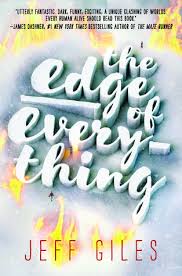 I have to say first off that I think the title is naff. It doesn’t tell you anything and it also doesn’t relate to anything in the story. So that’s my whinge.
The promo material for this book suggests 12+. I would say 14+, personally; I can’t think of a 12 year old I would deliberately give this. Some 12 year olds would take it for themselves and cope quite nicely, I suspect, but that’s a different issue.
Zoe’s father died a few months ago; her brother goes out in a snowstorm and she has to rescue him; she meets a stranger with tattoos and apparently some sort of extraordinary power. He has no name; she calls him X. He’s a bounty hunter; things of course do not go well for him or for Zoe and her family.
It’s not the most original-sounding narrative, but there are some remarkable aspects to the book. Slight spoiler: X is from what would be best described as hell, but the Lowlands are quite different from any other incarnation of hell that I’ve come across in fiction. It’s an intriguing vision of the place and of how it might be used. There’s no explanation of the Lowlands and how it operates; instead the focus of the narrative is on relationships, and the work of bounty hunters… it’s all about the vibe of the thing. And overall that worked. Certainly there are a myriad of unanswered questions about the mechanics, but they don’t really matter for the story itself.
The human world and especially Zoe’s family are beautifully realised. The different expressions of grief are portrayed sensitively and realistically. Jonah, Zoe’s brother, has ADHD; it’s just a fact of life and oh my goodness he’s a cute terror, as little brothers usually are. Mum is vegan and a bit nuts and fierce and has always struggled to hold the family together: I adored her so much. Zoe’s friends Val and Dallas are a delight (Val made a Tumblr of her girlfriend’s feet) and although I thought it was going to veer into dodgy love triangle territory Giles avoids that neatly. Dad… well, he was a struggler, and the way mum slowly revealed a bit more about what he was like to Zoe over the course of the book was heart-breaking and, again, intensely realistic.
Into this human world comes X, quite accidentally, and in some ways – although a third or more of the book is from his perspective – he’s the most opaque of all of them I think. Partly this is because he almost has no personality, thanks to how he has grown up; he really only starts to live after meeting Zoe. I was reminded of those suggestions of how Matt Smith’s Doctor ‘imprinted’ on young Amelia Pond, as I watched X and Zoe together. I was initially a bit squeaked by their budding romance because I thought he was much older than her; turns out he’s maybe 20 to her 16 (which is still a bit squick for me). The intensity of their attitude towards one another, especially his for her, was the main eye-rolly bit for me. It all seemed a bit too intense too fast.
Perhaps the most disappointing thing is that this is the start of a series. It felt to me like the sort of intense story and relationship that ought to be encapsulated in just one, say 450-page, book. I don’t know how it could have been resolved but I definitely would have preferred that.
Overall this is a well-paced and intense book that I read in the course of one day. I enjoyed most of the relationships and I was genuinely surprised by a couple of the revelations. I’m not sure whether I want the sequel because I’m afraid it will lose the intensity, but that’s a problem I’ll just have to deal with.
Snow White, Blood Red

I’ve been meaning to read this book for ages. And I do mean years. Finally got it this year because I was reminded of it by someone when I read a very poor version of the Snow Queen.
Many of the stories are excellent, although it’s not quite the anthology I was expecting. I wasn’t expecting there to be discrepancy in whether the stories were pretty faithful or quite different versions; I found it a bit disconcerting to bounce from one to the other, and then have completely made up (that is, not based on commonly told fairy tales) stories in there as well. I’m not saying any of those three options is bad but it felt jarring to have them all mixed together. But I think that’s mostly my expectations.
Lisa Goldstein’s use of Hansen and Gretel motifs to tell a story about a woman’s relationship with her daughters was a delight and a really intriguing way to end the anthology. I loved Patricia A McKillip’s take on the snow queen and Esther M Freisner’s “Puss” was deeply troubling. Actually a lot of them were deeply troubling, but that was kind of the point both because original fairy tales just were troubling and because this anthology was always intended to be about both the fantasy and the horror aspects of the stories. Hence the title. There were a lot of really great stories in this anthology and I can see why it keeps getting talked about. I guess I finally need to read Angela Carter now
Long Hidden
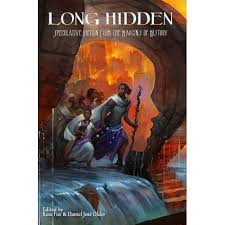 A book that celebrates the marginalised throughout history. The women. The black. The brown. The queer. The trans. The freaks.
Stories that give the marginalised agency, even when they’re oppressed; purpose, even when they’re condemned; existence, even when they’re ignored.
I loved this anthology. I at least liked, if not loved, every single story.
Every story is set in a historical time and place: parts of the Americas, Asia, Africa, Europe. They deal with real instances of marginalisation and oppression: sometimes minorities within hostile communities, sometimes systemic social oppression. In each story the characters are those whose stories have tended not to be told in Official History – at least not until the last few decades, and still slowly at that. In some cases the stories are triumphant; in some cases the stories tell of loss and woe. But almost always there’s an element of optimism, or hope. That through oppression, defiant humanity shines through. That despite others trying to remove that humanity, the marginalised know that they are human, and deserving of dignity. Even if in this instance, they’re not accorded it. I found it an unexpectedly uplifting anthology.
It reminded me of Cranky Ladies of History, for its agenda of shining light into often unlit areas of history. But the difference is that this is consciously speculative fiction about the margins. Most often that’s expressed as magical ability of various kinds, rooted in real religious systems or within individual humans; or there’s the occasional science fictional element. Sometimes it’s zombies or shape-changing, or magical/otherworldly creatures. Sometimes the speculative element is central to the story, and sometimes it’s just there, part of the world. It’s always done well.
Everyone should read this anthology.
Courtney Milan and romances
I was one of those girls – women – who was pretty down on romance as a genre. There are lots of complicated reasons for this. Partly it was a woman thing; I wanted to not be that sort of woman (what sort? I don’t know. I guess I associated liking romances with weakness or something?). Partly it was a genre thing: over here in the disregarded spec fic corner, it’s nice to disregard someone else.
But of course this was always both a) a completely stupid attitude for a multitude of reasons and b) hypocritical. Because I do like reading romances in the stories I’m reading.
 I think I’ve finally figured out what doesn’t usually appeal: romances that exist purely by themselves. I’m certainly not saying that they are bad or stupid, but that as a rule they don’t appeal to me (like I don’t love vampire stories as a rule, although I do enjoy the Blade films). What helped me finally articulate this is having read three of Courtney Milan’s Brothers Sinister series. (There is a fourth but I don’t plan to read it, partly because the main character doesn’t appeal and partly for Historical Snobbish reasons.) This is mostly because of Tansy.
 These are Victorian romances, which means Milan gets to take advantage of some of the interesting social and political and scientific changes happening in the mid-19th century in England (and across Europe). The main point is always about a girl and a boy and how of course they ought to be together but there are all of these problems that might prevent their happiness: scandals in the past, problems in the present, nasty people, social expectations, etc. Some of these relationship problems ring a bit more true than others: I didn’t find Minnie’s ‘scandal’, in the first book, all that convincing, while the problems of the third book were magnificent. Overall, though, the characters are treated sympathetically and the problems carefully – no one of consequence dismisses anyone’s fears without regard, which I found quite a relief. I especially liked that both female and male protagonists get to tell the narrative from their point of view, making the stories much more rounded and feel more genuine than might otherwise be the case.
 And around these relationship issues are the social and political themes that Milan uses to flesh out the world. In the first book it’s class relationships and working conditions and rape and marrying for money. In the second book it’s about race and political representation and social expectations and marrying for money and child guardianship and medical ethics and mental health. In the third it’s mostly about science (oh my, seduction by science I LOVED it) and gender expectations. Some of these issues play into the romance, and some of these issues are things that the characters are dealing with quite apart from their romance because of course life exists outside of does-she-love-me and Milan knows that very well. Milan is presenting complex and complicated individuals and worlds.
Of course, this is all within a fairly constrained society: the focus is on the wealthy, with a few not-nobles thrown in (not just as window-dressing but still, they have to meet the expectations of the Haves), almost everyone is white, and so on. There’s a lot of pretty dresses and balls and large houses. But… that’s the sort of book that Milan is writing. A romance set in the middle-class or working-class echelons would be very different and deal with different issues. And wouldn’t have the foofy dresses, which are – as you can see from the covers – important to the story.
I am not going to start reading nothing but romances (historical or otherwise), because I am still mostly interested in space ships and explosions and the odd dragon, and there are so MANY of those I haven’t read yet. But I am very glad I have grown up enough to acknowledge Old Me’s appalling attitude, and I’m very glad to have read and enjoyed these books.
Agatha H and the Voice of the Castle
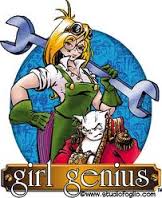
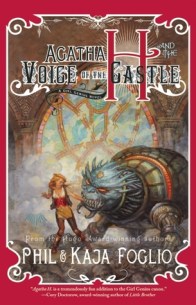 I was predisposed to liking this, of course, being a big Girl Genius fan from a number of years back. I don’t know whether I like the graphic novel or the written novel more; they’re obviously quite different media. I’m still not very good at reading graphic novels, despite a bit of practise – I’m not great at reading pictures.
Anyway, I already knew the story going in although there were a few twists that I had forgotten, which was nice. It’s still an amusing story with Agatha finding her feet as a Spark and as the Heterodyne; I like the relationships with Zeetha and Gil and Tarvek. Something this series has always done well is the secondary and supporting characters – frequently over the top but always enjoyable. I adore the Castle and its quirks – it’s a really nice way of illuminating the Heterodynes as a family, and of course adding some amusing danger along the way.
 One curious and disappointing thing is the cover of this book. It looks like a page from one of the graphic novels, with one big difference. In the graphic novels, Agatha is buxom and curvaceous. But not on that cover. She’s verging on slender, which is really not Agatha. Bit disappointing really.


