Miranda in Milan
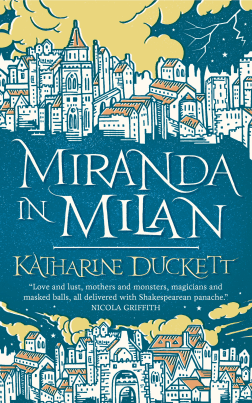 This novel (novella?) was sent to me to review by the publisher, Tor.com, at no cost. It will be out on 26 March, 2019.
Aside from King Lear, which I loathe, I probably dislike The Tempest more than any other Shakespeare play. I don’t know why; there’s nothing particular I can pinpoint. But I really, really dislike it.
It turns out, though, that stories of Miranda after the play are stories I can really get behind. So maybe this is part of the problem: in the play, I think Miranda is just a bit nothing. But For Meadows’ Coral Bones made me swoon for joy, and now Katharine Duckett’s Miranda in Milan similarly plays with the aftermath of Miranda’s return from the island – in a very different way from Meadows, but equally dealing with some of the issues that a young woman with such an upbringing might need to confront.
Here, Miranda is returned to Milan, and basically confined to the room – she’s only allowed out when wearing a veil, which she loathes. Her father is off reestablishing himself as duke, Ferdinand is in Naples, and she has no friends. Until suddenly she does develop a friendship, and she begins to discover some of what’s gone on in Milan that led to Prospero’s banishment – and, by extension, her own.
Nicola Griffith’s blurb is (unsurprisingly) apt: “Love and lust, mothers and monsters, magicians and masked balls…”. That’s about it. What is love and how do you know it, what makes a monster, and can magicians be trusted… Duckett writes about these things, and does it quite beautifully.
Sorry you have to wait til March to read it.
The Seven Culinary Wonders of the World
 This book was sent to me by the publisher, Murdoch Books, at no cost. It’s out on 1 November; RRP $35.
I was intrigued by the idea of looking at culinary traditions and histories through seven key ingredients, and those chosen here seem quite appropriate. Not comprehensive, since you could argue for others (like corn, or potato, were my first thoughts) but nonetheless widely used in a variety of cultures over the world and with interesting histories attached. Linford’s chosen seven ‘wonders’ are: rice; salt; honey; pork; tomato; chilli; and cacao.
In each chapter, Linford talks a little about the chemistry or something scientific of each ingredient, but that’s not the focus. There’s more about the history, although it’s still very much an introduction – how something like the tomato moved from the Americas to the rest of the world (I love that tomatoes are, relatively speaking, new to Italy), as well as the development and cultivation over time of different types (the ambition to create inedibly hot chilli is completely foreign to me). There’s a fairly wide-ranging look at how different cultures use different ingredients; because this is a relatively short book (about 230 ish pages), this is by no means exhaustive, which may annoy some people if she hasn’t chosen a particular culture. Still, she does talk about the use of chilli, for instance, in Mexican and Indian and Thai and Malaysian and Korean and Chinese and Portuguese and Italian and American (esp Texan) and Hungarian and Spanish cookery. And finally, there are recipes. Again, these are not comprehensive, but there’s no way it could have been. For pork, she has everything from Chinese pork potstickers (dumplings) and char siu to sautéed chorizo with red wine to glazed ham; for honey, it’s baclava to honey-glazed shallots and grilled goat’s cheese with honey. The recipes are set out nicely on the page, and each one only takes up a page (possibly a requirement in choosing?)
My one reservation with this book is that sometimes the language got repetitive. It’s as though Linford, or her editor, assumed that people would mostly not be reading this straight through (I did), and so they thought that repeating certain key phrases would be both a good and not noticed. I noticed. And while it wasn’t enormous clumps of text that were repeated, it was obvious enough that I got a bit impatient.
Overall this is a nicely-presented book: I love a good hardcover, although I love a cookbook with a ribbon even more! Each chapter has its own colour for the page numbers and the recipe text and the illustrations (there are some nice illustrations throughout – not photos), which is a nice touch. This is a nice book for someone like me who likes the background to ingredients as well as a variety of recipes.
Women in science history
In a theoretical feminist bingo card, there is one square for Marie Curie: The Only Female Scientist. (If you are particularly nerdy you may also have Ada Lovelace, First Computer Programmer.) Of course this does not reflect reality, and it doesn’t reflect historical reality either – but science history books are so often focussed on the Lone (invariably male) Genius labouring away in the lab that you could be forgiven for thinking that science does actually happen in a vacuum. This is, of course, a fallacy, as these four books demonstrate.
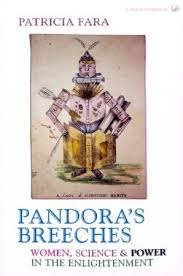 Patricia Fara, Pandora’s Breeches: Women, Science and Power in the Enlightenment(Pimlico, 2004)
Pandora in breeches is an abomination. Pandora is already a problem: the first woman, in Greek mythology, whose existence brings all sorts of problems to the (male) world. But Pandora in breeches means that Pandora is also trying to take over the male world. In this book, Patricia Fara delves into the myth of the lone male scientific genius and exposes it as just that – a myth. While refusing the suggestion that Hypatia and Katherine Johnson could have been at all comfortable sitting next to each other at a dinner party, Fara reclaims the existence of women in scientific endeavour. She does this by taking several Lone Genius men (Descartes, Linnaeus, Lavoisier, Newton…) and examining the role that women played in their scientific lives. In some cases, this is domestically: when science is being done in the home, wives and sisters and household staff get drawn into the science almost automatically. In other cases, it is through correspondence, or through a woman’s own writing that is picked up and expanded on by a man because the woman wasn’t allowed to present her ideas in a public forum. Fara has surely only scratched the surface of the ways in which women contributed to science in this period (and, as she points out, also the male labourers who constructed equipment and so on).
 Dava Sobel, The Glass Universe: How the Ladies of the Harvard Observatory Took the Measure of the Stars (Viking, 2016)
When the Harvard Observatory started taking pictures of the night sky, they did so with glass plates. In order to understand what was happening on those plates, the Observatory needed meticulous ‘calculators’ to look at each one and catalogue the tiny pin pricks of light. This job was usually perceived as tedious, and therefore perfect for women – who were also cheaper to hire. So for decades, women worked on the half a million or so plates made by Harvard and in doing so, made or contributed towards the significant discoveries that form the basis of astronomy today. What stars are made of, the idea of variable stars, classifications of stars – these things were enabled by these women. An intriguing aspect of Sobel’s narrative is that as well as exploring the contributions of the women employed by the Observatory, she explores the contribution of women who gave substantial funding to it – thereby enabling the place to conduct science that might otherwise have been impossible – and the place of the male astronomers’ wives, who also helped significantly in the running of the Observatory.
 Patricia Far, A Lab of One’s Own: Science and Suffrage in the First World War (Oxford University Press, 2018)
The blurb for this book may surprise many readers, since it proclaims 2018 to be a ‘double centenary: peace was declared in war-wracked Europe, and women won the vote after decades of struggle’. Presumably this edition of the book was never meant to be seen outside of the UK. Nonetheless, this is a generally absorbing account of the scientific contribution of women during the First World War. As with her book on the Enlightenment, Fara has dug into archives and found significant records of women in various scientific establishments, doing experimental work, as well as munitions factories and other such manual labour, generally replacing the men who have gone to fight. Women were active in museums, and as doctors (why have I never heard of the female British doctors in places like Salonika?), and in intelligence work. There are also mysteries, like the unnamed clerk awarded an MBE… war secrets taken to the grave, presumably. It must be said that sometimes the book is confused about exactly what it wants to do. There are chapters on science with little discussion of any women being involved, and sections about suffrage that have very little to do with science. Nonetheless overall this book does expand the idea of who contributed to the UK’s war effort in World War 1, and explores the many reasons that women had for wanting to be involved in those efforts.
 Margot Lee Shetterly, Hidden Figures (HarperCollins, 2016)
Thanks to the film that was made at the same time as the book was published, this story of the black female mathematicians who worked for NASA (and for NASA’s predecessor) is probably the best-known of these stories. It is a crucial one, since as far as I can tell all of the women in the other three histories were white. Black women are historically even more obscured than white women. Shetterly has done an excellent job of unearthing references to the work of these West Area ‘computers’ so that their contribution to American space exploration can be appreciated. She gives their educational and social context – which was vital for me since although I know a little about segregation I know almost nothing about historically-black colleges. Shetterly traces the connections between places, people, and influences through some specific women, like Dorothy Vaughan, Katherine Goble Johnson, Mary Jackson and Christine Darden; she also sets the work of these women in the larger NASA context to show just how vital their work was. Shetterly also shows how these women fit into their communities, and how they encouraged the women and girls around them simply by being who they were, and working where they did.
The Girl with the Dragon Heart
 This book was sent to me by the publisher, Bloomsbury, at no cost. I believe it comes out in Australia at the start of September; RRP $14.99.
I heard about this book from Tansy, who adored it, so when I got to a chance to review it I was pretty stoked. But a thing I did not realise: this is a sequel! When I read the first chapter or so I wasn’t sure whether Burgis was doing something quite ambitious for this middle grade/ YA book (the protagonist is 13: I don’t know how to classify books for younger readers) – that is, leaping right into the story and then adding a bit of background information. Then I found out that before this is The Dragon with a Chocolate Heart, and it made a bit more sense. That said, I think that the narrators are different in the two books, and obviously I haven’t read the first but I still managed to read and love this book… so it does stand by itself.
Silke is 13 and determined to write her own story of her life, with herself as heroine not victim. She and her brother have been on their own since their parents were captured or killed as the family were fleeing their homeland some years ago. Most recently, Silke has been making herself useful to the chocolate makers at The Chocolate Heart, who have employed her best friend who is usually in human form but is actually a dragon (it’s complicated). She’s waitressing, and telling stories both orally and via broadsheet. But then she gets a job from the crown princess when the neighbouring fairy royalty, who have been living underground for a century, suddenly come for a visit. Silke has the chance to prove herself but of course things won’t go as smoothly as one might hope…
There’s a lot to like here. The action moves quickly, but there’s still lovely moments of character development. And the characters are great: mostly girls and women, with genuine diversity of character. The crown princess might be well loved, but/and she’s also a ruthless politician when necessary. The younger princess feels overshadowed; the chocolate apprentice is true to her dragon heritage; the adult women are sometimes compassionate, sometimes impatient, sometimes ignorant. The male characters are also diverse – Silke’s older brother is, basically, an older brother; sometimes the men are greedy, sometimes loving. Silke herself is basically creating herself as she goes along, which is probably her most intriguing characteristic: after early trauma she is determined not to have her life written for her. And so she puts on an act – which is sometimes a good thing, and sometimes not, and that’s acknowledged by the text.
As for the action: it’s clear from early on that the arrival of the fairies isn’t going to be the wondrous thing that the population might hope. It takes some unexpected turns, much like Silke learning the ins and outs of the servants’ passageways within the castle. The fairies have a bit less development than some other characters, but it does all work well as a narrative.
I really enjoyed this and look forward to giving it to the younger readers in my life.
Elysium Fire
 This book was sent to me by the publisher at no cost. It’s out now… because I’ve had it sitting here waiting for a review for a few more weeks than I feel happy admitting to… oops.
If you’ve read my blog or listened to Galactic Suburbia, you’ll know that Alastair Reynolds is one of my all-time favourites. One of those authors where I don’t even both reading the blurb, I just want the book. So I was very excited last year when I heard that there was going to be a new Prefect Dreyfus story, because I loved The Prefect (now re-released as Aurora Rising).
You know how books are advertised as “a Nancy Drew mystery”? Well, this is “A Prefect Dreyfus emergency”. I love it.
While it’s not a direct sequel to the first Dreyfus story, there are elements that continue from that first book; you could read this and pick up on those things relatively easily, but it would spoil the first book for you. And I love the first book so I suggest going with The Prefect / Aurora Rising and then coming to this one. If you like police procedural/ mystery type stories in an epic space setting – ten thousand habitats in orbit around a planet, all only connected by the most direct democracy imaginable – then I can’t see why you wouldn’t want to read both.
So, all that said: Tom Dreyfus is once again acting more like a policeman than he’s meant to, following leads that don’t look like leads to most other people, and generally making a nuisance of himself in pursuit of Justice and Truth. Oh, I’ve just realised why I like him so much. Anyway, someone appears to be trying to destroy that democracy I mentioned as well doing bad things to individual citizens, and Dreyfus is having none of it. Races against the clock, persuading reluctant allies, dealing with unexpected foes, and zooming around the Glitter Band all follow ineluctably and create a delightful story.
I like Dreyfus because he’s not perfect and he’s not just banging a drum about some theoretical ideal; he knows the Glitter Band’s democracy isn’t perfect but it’s the system he’s there to protect. He knows he doesn’t always get it right, but he tries and keeps trying. He’s a good friend and an occasionally subordinate employee but only when it seems necessary – and unlike Poe Dameron, he expects to cop to the consequences.
I also liked this book because, like The Prefect before it, it’s not just about Dreyfus; a couple of the other characters also get some space – Jane Aumonier more so in this book than the first, which I also really enjoyed because I love her a lot.
This is a fun read, and a fast one (for me anyway) – the pacing is tight and definitely rolls your through events as consequences start piling up. I’m kinda hoping there might be another Prefect Dreyfus emergency somewhere in Reynolds’ brain…
The Written World: review
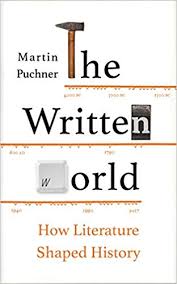 This book was sent to me by the publisher, Allen&Unwin, at no cost. It’s available now; RRP $32.99.
The premise of this book is to examine how literature has shaped history – in fact, not just literature itself, but also the inventions that have facilitated the dissemination of literature around the world throughout history. It “offers a new and enticing perspective on human history,” according to the blurb.
Some of the ideas in the book are really interesting (can you tell where this review is going?). The first chapter, about Alexander and his obsession with the stories of Troy, offer quite an intriguing (although I don’t think new) insight into one of the things driving that man to go and conquer so much land. However, even if all the chapters were individually interesting, it doesn’t feel like there’s an overarching connection between them. Yes there’s the idea of literature (more on that in a bit), but the ways in which literature has impacted on people is vastly different, and Puchner doesn’t seem to try to find commonalities – or draw out the differences in any way. And then it jumps to chapters about technology, which I’m certainly interested in but they seem even more disconnected. Additionally, there’s way more emphasis on retelling stories, like that of Troy or Gilgamesh, than I had expected; it feels quite unnecessary when the specifics of a story aren’t important to the history that the book should be focusing on.
There are other issues, too. For instance, there are grand generalisations for instance about “scribes” and their roles and attitudes; and then there’s the bit where Puchner presents a short biography of the biblical figure Ezra… and then admits that it’s just one possible version of his life. But probably the most egregious is the fact that there is no effort to define literature. And that’s a serious problem. For me, ‘literature’ is fiction, and it’s a value judgement; you can’t consciously set out to write literature (we can have a fight about this if you like). Anyway: Iliad? Sure. Epic of Gilgamesh? No problem. The Tale of Genji? Haven’t read it but given its status, happy to accept it. The Bible? well… ok, I can see how that works. Anything written by Martin Luther? The Mayan codices? Ben Franklin’s newspapers and letters, The Communist Manifesto? Uh, I think not. And does it have to be written? Play scripts aren’t really intended to be read, for example; so there’s a whole issue with the chapter on enscribing oral traditions. So… what ties these together? Puchner doesn’t bother to tell us.
Yet more problems: there’s a chapter on Goethe that alleges to be about world literature as an idea, but it doesn’t develop that concept in the slightest, just talks about Goethe. The last chapter has an incredibly snobby attitude towards Harry Potter that’s remarkable for not being that remarkable. Apparently HP merchandising is “out-of-control” (p332) and… somehow that takes away from it being literature? Or something?
Apparently at some point Puchner’s editor said that he should add more of himself to the text, and I have to disagree with that decision here. Sometimes it works – Bethany Hughes’ reminiscences about being in Istanbul were charming – but here they just come across as indulgent; not helped by sometimes being irrelevant.
Some choice quotes that bugged me: “Nothing is more familiar to us than a rabbi holding a scroll…” (p56). You what? Also, on that same page: he calls it the Hebrew Bible. Dude.
Here’s a minor one: people using framing narratives as in One Thousand and One Nights: lots of people have used this idea, “from Chaucer to Boccaccio” (p134). Mate. Boccaccio died first, but also, they lived in the same century. That’s like saying “there’s been some good Australian musicians, from John Farnham to Jimmy Barnes!”
In the chapter about the Popol Vuh and writing in the Mayan culture, Puchner refers to the people being invaded by Pizarro, Cortes and their cohorts as “Indians” (chapter 8).
Hey authors, your job’s really easy right? “It’s not such a terrible job, being an author. You do some research, come up with characters, shape a plot that unfolds central themes and ideas. Once you’re done, you find a publisher, who in turn finds a printer…” (p193). Oh my. And apparently the American Declaration of Independence influenced the proclamation of independence in Haiti… by way of the French Revolution, which Puchner neglects to mention. Goethe talking to his friend about how excellent Chinese novels were, and the latter is amazed: Puchner comments: “One sympathises: Who wants to read thousands of Chinese novels?” (p235). OH MY WORD. DUDE.
The take away here is: great idea, average to occasionally poor execution. I was sad.
Daphne Park, Queen of Spies
 The title is misleading, because she was never the head of MI6 or anything. But she was one of the few women working in MI6 when it first got going and she did end up pretty senior, so I guess it’s what you get when you’re trying to come up with a catchy title.
Anyway, Daphne Park sounds like one helluva woman. Grew up in Tanganyika in the 30s, stayed with aunts to go to school in the UK, got a job in World War 2 that was kind of undercover and went from there, with some missteps along the way, to being an actual spy in MI6. She was a product of her time: deeply suspicious of the USSR for her whole life, a supporter of Margaret Thatcher, and probably someone I would have argued with a lot by the end of her life. But she also seems to have been fearless, determined, entrepreneurial, ruthless, and generally pretty amazing as a spy. She was eventually made a peer! Can’t help but wonder what she and Gertrude Bell would have made of one another, what with their getting into other nations’ business and all.
As well as this being a biography of a remarkable woman (remarkable in what she did, and remarkable in being very rare for her time), it’s also an exploration of the role of spies during the Cold War. There were several moments where I vocally expressed my displeasure, for instance regarding the international interference in Congo’s first elections. I’m horrified by what the UK, and the US and others, felt they had a right to do in those third-party countries. So it’s unlikely you’ll come away from this thinking Park was always in the right… but she certainly did her job. Sometimes, above and beyond. And, while she didn’t quite do it backwards and in high heels like Ginger Rogers, she was definitely battling that good old sexism for pretty much her entire career.
Gods, Monsters, and the Lucky Peach
 Did your brain go totally Roald Dahl when you saw the title? Mine did. Anyway, this novella was sent to me by the publisher, Tor.com, at no cost. It will be available for you to read from 13 March, 2018 (which is this year!).
Somehow, don’t ask me how, I managed not to read “The Waters of Versailles,” Robson’s highly regarded short story from… last year? The year before? I don’t know how I managed not to read it, given everyone else was raving about it… I just didn’t get to it. I’m going to get to it now, because I’ve read this and it’s excellent.
Seriously, just go pre-order it. Do you like the paradoxes of time travel? Do you like cranky old women being cranky and smart? Do you like a bit of ancient Mesopotamia? GO. PRE-ORDER.
It’s well into the future, things haven’t gone so great for humanity but they’re maybe kinda improving, if people manage to focus on what’s relevant. Time travel is… probably not relevant. But it’s consuming a lot of attention. But maybe it could be used for something relevant? That’s what Minh is hoping, anyway, as she prepares a brief for an intriguing new job.
The world that Robson has developed here is suuuuper developed for such a short story; as in, I wouldn’t be surprised to read at least a novel just fleshing out the things that she hints at here in terms of economies and habitats and generational attitudes and… yeh. That bit alone is completely absorbing; reminded me a bit of Iain M Banks’ civilisations. And then you add time travel.
The opening is somewhat disconcerting, as there’s clearly two separate stories being told – one with gods and monsters, one with technology. Very quickly the links between the two become evident but exactly how things will resolve is not at all evident. I really enjoyed the way that Robson played off the two different civilisational points of view. I also really enjoyed the different characters she employs. Minh is my favourite, of course: how could she not be with her crankiness and her competence and her bloody-mindedness? But her companions are also great and offer excellent, necessary and important alternatives to Minh’s point of view.
I am well impressed with this novella.
The Conscription Conflict and the Great War
This book was sent to me by the publisher, Monash University, at no cost. This review initially appeared in the History Teachers of Victoria journal, Agora. 
The year I got back to teaching Year 9 history I happened to visit Canberra. I wasn’t that keen on the Australian War Memorial – not being a huge fan of military history – but my co-traveller wanted to, so we did. Knowing that I would be teaching something about the conscription debate as part of our history unit, I looked out for what the AWM might say about it. I found it in the 1916 room on the First World War: a single display, showing some postcards from the Yes and No campaigns, accompanied by very little explanation about the situation. When we got to the book shop, I asked whether they had any books on conscription or, failing that, any books on the home front with information about the debate. No, they didn’t.
It turns out I shouldn’t have been surprised at the lack of books on the conscription debate; there hasn’t been a “book length treatment of the conflict since Leslie Jauncey’s effort to document some of the key actors, developments and sources in 1935” (p6). This is amazing and, frankly, depressing, since it “was a defining feature of wartime Australia” (p2) and “unique… quite without precedent – not just in Australia, but anywhere in the world” (p3). The aims of The Conscription Debate are manifold: to offer new interpretations; to compare the Australian experience with other English-speaking countries at the time; and – most provocatively – to “intervene in current debates about how to understand the war by contributing to a more accurate and rounded picture of how it was experienced” (pp6-7). The authors do meet these aims – not always in a great deal of detail, given the length of the book, but sufficiently to give an overview of the issues.
Chapters 1 and 2 (Douglas Newton and Robin Archer) make up Part 1 and set out the philosophical and political context of the conscription. These were the two chapters I found most difficult to follow. I think they would be best read with at least some understanding of nineteenth-century British and Australian political philosophy, especially of what it meant to be ‘liberal’ at that time, as well as an understanding of the ins and outs of contemporary British politics more generally. This is not my area of expertise, so I found myself floundering through the discussion of Liberal Imperialists and New Liberals and Little Englanders. Nonetheless, these chapters are important to the overall picture this volume is putting forward: that the traditions of liberalism, and the existence of the labour movement, are fundamental to understanding the conscription debate.
Part 2 consists of Chapters 3 (on the Antis); Chapter 4 (on the Yes campaign at the University of Melbourne); and Chapter 5 (an examination of the poll results in both 1916 and 1917). In Chapter 3 Frank Bongiorno gives a clear, if brief, overview of some of the incentives for voting no: tyranny vs freedom, women as mothers, and (embarrassingly) ‘keeping Australia white and free’. He speaks not just of the well-known names like Daniel Mannix but also those who have largely slipped off the historical radar. In Chapter 4 Joy Damousi looks at a group of Melbourne University academics such as Alexander Leeper and Jessie Webb who actively campaigned for conscription, pointing out that the yes campaign has rarely been analysed “as a set of arguments or as a movement in its own right” (p93). Such arguments included the suggestion that voting no would significantly contribute to a German victory and Australia becoming a German colony, and that it was democracy that was at stake in this war – so citizens must “show themselves worthy of these freedoms” (p101). Intriguingly, many of these academics went on to be involved in the League of Nations Union. In Chapter 5, Murray Goot undertakes a detailed examination of election results to try and understand voting patterns amongst Labor voters and not, in metro and regional areas, among women, British and German migrants, and between Catholics and Protestants. This chapter is not for those afraid of percentages, but for those interested in the history of Australian voting it is deeply fascinating.
John Connor (Chapter 6) and Ross McKibbin (Chapter 7), in Part 3, match Part 1 in a sense: they put the Australian conscription debate into international context by comparing experiences in other English-speaking countries. Connor gives a chronological overview of English-speaking countries, all of which instituted conscription in some form, while McKibbin provides a more detailed comparison of Britain and Australia. These two chapters highlight the remarkable nature of Australia’s experience at the time, since nowhere else put the question to its citizens in the same way. It also suggests that this issue of conscription and how citizens respond is one that warrants further research.
Finally, Sean Scalmer in Part 4 gives an overview of how the conscription debate – and especially the Antis – have been remembered in Australian history: from being a labour-movement legend to its eclipse thanks to conscription in World War 2 and, more recently, how it fits in with “the broader revival of Anzac commemoration and enthusiasm” (p206). Deeply interesting, this chapter too suggests that there is a lot of room for further research.
One issue I had with the book overall was the use of the word ‘referendum’. My understanding was that non-binding polls like this, which were not asking to change the constitution, were properly called plebiscites. Most of the authors in this book call it a referendum… except Frank Bongiorno in Chapter 3. I would have appreciated some discussion of the terminology, and an explanation for the words used (also consistency).
This is, to coin a phrase, the book on conscription we had to have – because it’s essentially the first. It’s not the book on conscription I wished for; that imaginary book has a lot more about the individuals (I adore Vida Goldstein) and groups that were campaigning both for and against the issue. But The Conscription Conflict does an admirable job of reminding us why 1916 and 1917 were important years for Australia outside of the fighting going on in Europe; it sets out areas that need further research; and hopefully, it will serve to inspire someone (or many someones) to dig deeper into this fascinating period in Australian history.
Istanbul: A Tale of Three Cities
This book was sent to me by the publisher, Hachette, at no cost. This review first appeared in the History Teachers of Victoria journal Agora.
If you are especially keen on the history of the Byzantine Empire, or the Eastern Roman Empire, like me you might have bought the classic John Julius Norwich trilogy. Again if you are like me, you may have got to the end of the second book and thought, “No more!” Despite that, the city at the heart of that empire (thrice-named, eat your heart out New York) has always enthralled me – and, Bettany Hughes suggests, has fascinated, enticed, and aggravated people for a good few thousand years.
Firstly: don’t be put off by the page count. Those 800 pages include an extensive timeline, detailed (and interesting but not imperative) endnotes, a thorough bibliography and an index. At 600 pages, with often quite short chapters, this is a very approachable book for such a complicated subject.
Hughes attempts to do two things in this book, and generally succeeds; she calls it “an organic examination – an archaeology of both place and culture” (6). It is a chronological examination of the development of the city now called Istanbul – the invasions and innovations and growth through successive regime changes (although “not a catch-all of Istanbul’s past” (3)). However, woven through that is a social history of the people who made the city what it is. This includes such luminaries as Theodora and Constantine and Süleyman II, but also the everyday people who made the city function. There are chapters, for instance, on the presence of eunuchs in Constantinople, and the realities of the harem (insofar as they can be known), and the Varangian Guard. Hughes includes discussion of the various peoples who threatened, worked with, and generally impacted on the city (Goths, Vandals, Vikings, Turks). In doing so she naturally expands her focus beyond the city walls, but this is unavoidable when dealing with the likes of a city such as Byzantion. Indeed, it adds greatly to the context of the book: how to understand the numerous Muslim sieges and eventual conquest of the city without an understanding of the growth of Islam? How to understand the birth of Turkey as a country and the move of the capital to Ankara without the context of the First World War and the internal Ottoman politics of the time? And so on. Hughes does a magnificent job of weaving all of these pieces together into a coherent whole.
Nominally the book’s narrative stops at 1924; there’s a chapter after that about Istanbul’s future, but it’s a fairly sweeping overview of the following ninety years. However, something that I very much enjoyed and which added to the book’s approachability is that Hughes makes occasional reference to contemporary events from when she is writing (2016). A passing reference to Prime Minister Erdoğan acting in a similar fashion to Justinian, preparing “to take his money and to fly” (219), points up similarities in situations that may provoke and intrigue the reader. Describing the city as “well designed for rioting” and using the Gezi Park/Taksim Square riots to indicate this truth in 2013 (when Hughes was herself in the city), and then proceed to discuss the AD 532 Nika riots, suggests a continuation in the city’s physical existence that is extraordinary over that span in time.
One of the most captivating aspects of Hughes’ book is her wonderful use of archaeological evidence. There are frequent references to discoveries made in Istanbul and elsewhere around the world, and how the goods and structures uncovered are continuing to change historians’ and archaeologists’ understandings of different periods. For a historian to remind her reader that the story of a place is not completely known is refreshing. She contextualises these sites, too: to find “one of the few scraps of evidence for one of the most remarkable phenomena of the medieval world” (the Varangian Guard), one passes “young men push[ing] second-hand mattresses… on wooden carts and kids sort[ing] through piles of redundant television aerials” (321). This provides a visceral feel for the city as it is today – a living city, not abandoned; a city continuing to leave behind remains for future archaeologists to sift and puzzle through. Hughes also has a lovely sense of humour that occasionally pokes through: in discussing the archaeological finds at Tintagel (which indicate trade connections between that part of England and the Byzantine world), she describes the finding of the graffito reading “Artugno” as “[u]tterly unhelpful for the historian but irresistible for the tourist guides” (292).
Another aspect of Hughes’ attitude towards the city and her people over time is the sympathy she displays. In speaking of the development of iconoclasm, for instance, which she says historians have “[o]ften described… as an irrational, typically ‘Dark Ages’ response” to the consequences of the Theran volcanic eruption in AD 726, Hughes insists “we have to pause for a moment to think of the horror of Thera’s eruption” and proceeds to describe the physical realities of such an eruption (300). This is a lovely moment of historical empathy that enables the reader to glimpse life for an eighth-century Byzantine.
As a physical object, it’s well-designed. The cover is perhaps predictable but gorgeous nonetheless. There are three sets of colour plates, covering a range of people and events, and many black and white images throughout. Each section (there are eight, each representing some important change in Istanbul’s history) has a series of maps at the start, showing changes in the city as well as context such as the reach of the Byzantine or Ottoman Empire over time (there is one section where the map, which goes over two pages, is split by the colour picture insert; that was a bit irritating).
Hughes’ passion for Istanbul – for the history of the place and for the contemporary city – come through across the volume. She delights in all aspects of its history and she wants the reader to share that with her. As an introduction to the complexity of the city’s history, as a history of a place that has impacted on European and Asian history for 2500 years (and was inhabited for many thousands of years before that), and as an example of how history writing can be made approachable, this is a fabulous book.


