Wickhills
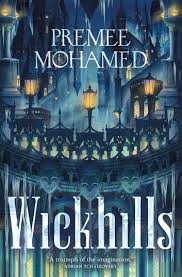
The short version is that if you enjoy a thoroughly realised fantastical city, and you like spies and mystery, you should probably just stop reading this review and go get this.
And if you’ve heard of Mohamed as a predominantly horror writer, don’t worry; while there are certainly unpleasant things happening in this novel, I don’t think I’d classify it as horror. (I say this as a mostly non-horror reader.)
If you’re still here… this review contains some minor thematic spoilers, but nothing major.
There’s something about a novel that loves a city that tends to delight me. Sometimes it’s a real city — China Mieville’s Kraken loves London; sometimes fantastical… to make a similar point, Mieville’s The City and the City. Tolkien’s Minas Tirith has elements of this; Grace Chan’s Melbourne in Every Version of You; Makana Yamamoto’s space station in Hammajang Luck has some of the same vibe. And when that city has weirdness as well… you’ve got me. And I say that as someone who is distinctly not good at directions; if the clue to who the murderer is relies on knowing what’s west and what’s east, from a comment ten pages ago, I am not going to pick up on it.
Wickhills the city is a significant character in its own right in this novel. We’re thrown into it, and its fantastical nature, very quickly: the Market Street Wyrm is on the first page; we have windmills and museums, banks, a busy port, child labour. Across the novel we learn about omnibuses, a variety of options for artificial light, and the fact that humans are only one of the sentient species inhabiting the city. Wickhills is unstable – its geography can change in an instant; Wickhills is a version of democratic; and Wickhills is impossible to know completely.
The main narrative character is Ferec, which is fitting as he has made it his goal in life to try and understand Wickhills as best he can. Unconnected – except insofar as his obsession is useful on-the-job knowledge – for nearly ten year he has worked for Seaborne, a highly secretive counter-terrorism organisation. His jobs have ranged from assassination to seduction to infiltrating and undermining seditious groups. As the novel opens, he and his partner are waiting for a ship to arrive, so that they can locate and procure a particularly valuable asset.
And it all goes downhill from there.
This sort of novel will often feature a ‘getting the band together’ section – which I usually enjoy; I love some repartee and squabbling to figure out team roles. Mohamed, however, largely eschews that. Ferec doesn’t get to pick most of his team; they spend very little time on bonding or coming to know one another. Instead, the entire focus is the mission. Because that asset Ferec lifted off the boat turns out to be wanted by some very serious people (of course) and is far more dangerous than anyone had understood (of course).
Much of the novel is the action of Ferec securing the asset (and losing it and retrieving it etc). But there’s a philosophical aspect to the novel as well, which for me puts the novel in quite a different light. Ferec himself is not an innately moral man, but he does believe in the importance of Seaborne and its place in the city. Over the course of the novel, however, the place and use of Seaborne — effectively a secret police — is brought into question by various characters. Ferec is made to look at how his world works, and where it fits with what he understands of the city. And these questions — of how societies function, the role of secretive power structures, where and how power is exercised — they’re always important to ask; they feel vital at the moment.
Mohamed writes beautifully; her descriptions are evocative, her conversations often tantalisingly full of ellipses but conveying just enough information. The novel provides some answers, but nowhere near all of them — I could imagine at least half a dozen more novels just picking up on some of the points mentioned here. I haven’t even mentioned that Ferec’s boss is a manticore.
Some people are going to find the lack of clarity around some points very frustrating. But no one ever knows their city completely, so what makes you think you would know Wickhills — a much weirder city than the one you live in — any better?
Highly recommended.
Sugar, season 1
I was spoiled for The Big Reveal before I started watching Sugar. I’m a bit mad about it, I’ll admit – it would have been tantalising; it was still tantalising enough; but it did also make me move watching the show further up the list. So there’s that.
ALL THE SPOILERS FOR SEASON 1, stop reading now.
Seriously.
Continue reading →The Missing Thread
A New History of the Ancient World Through the Women Who Shaped It.
I am so conflicted about this book.
The theory: absolutely up my alley. Writing women back into the (hi)story they were always a part of? Of course that’s a good idea!
And yet… I can’t help but feel this book isn’t quite the right way to do it.
Some of the good things first:
It is great to have women like Atossa and others who get one line as a wife or a mother brought to the forefront. Discussing Fulvia and Octavia a lot when discussing Marc Antony and Octavian? Brilliant! Not to mention Olympias when you’re discussing Phillip and Alexander of Macedon. There’s a nice amount about women like Sappho, too, so it’s not just all fighting – and the book opens with what we might be able to understand about Minoan culture, which probably had important roles for women, so that’s also excellent.
And yet. I have reservations.
One issue is that it’s still trying to tell exactly the same story of battles and political intrigue, just with women in it. Sometimes the women feel shoehorned in – this is a story the author wants to tell, and has to fit in the women to justify the story. So that’s frustrating. Partly this is a result of my own expectations: I was hoping for some new stories, making “history” not just about battles.
A large part of my problem is that the author doesn’t make much attempt to differentiate hearsay, calumny, and verifiable stories. There’s occasionally a gesture at that – “oh, these words were used to make the woman / man associated with the woman look bad” – but it’s usually after the story has been presented as legit. And sometimes the stories are just presented as fact: Cleopatra in the rug to sneak into Caesar’s room, for example. So in some instances, the worst stories about women’s roles are blithely repeated.
And then there’s the fact that this is presented as a history “of the ancient world.” Which, to me, suggests “of the world.” The occasional reference to China – with no context at all – does not make a global history. This is a history “of the Classical world” with very occasional reference to things in “the Near East” and about three sentences about China. Which would be fine if the book had made it obvious that’s what it was doing.
So. Yes. I am disappointed. As someone with knowledge of most of the general stuff discussed in the book, I could contextualise what was being presented and it did indeed give me info about women’s actions I hadn’t come across before. But I would not give this to someone with no prior knowledge.
As You Wake, Break the Shell
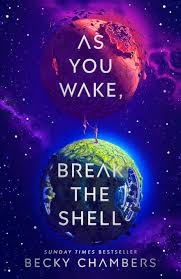
I read this courtesy of the publisher and NetGalley. It’s out in October (sorry).
A more complete review of this will appear in Locus eventually, but: it’s brilliant.
I read Long Way to a Small, Angry Planet when it first came out, I think, and I bounced off it hard. Why? I do not remember. Not a jot. Probably I was in the wrong frame of mind – at least, I can only assume so; after reading this I wonder if actually I was too much in a ‘big space adventures’ mode.
Chambers does some clever narrative things across this novel. Firstly, the chapter sequencing: it starts with Chapter 1… but then all of a sudden you’re in Chapter 764, and no you didn’t skip a lot of pages. So there’s two parallel timeframes. Which means one of the big character questions is resolved very quickly, which means that you can get on with looking at the other questions: how do the characters get from here to there? What changed?
It would be easy to read this mostly as an almost domestic novel, focused on two people and their experiences; there are even recipes! But the reality is that Chambers is doing some really cool political stuff here. The reality of the initial planet’s colonisation, the way the two societies structure themselves, how difference is viewed… yeh, there’s a lot going on.
It’s really good.
Object Lessons: Laboratory
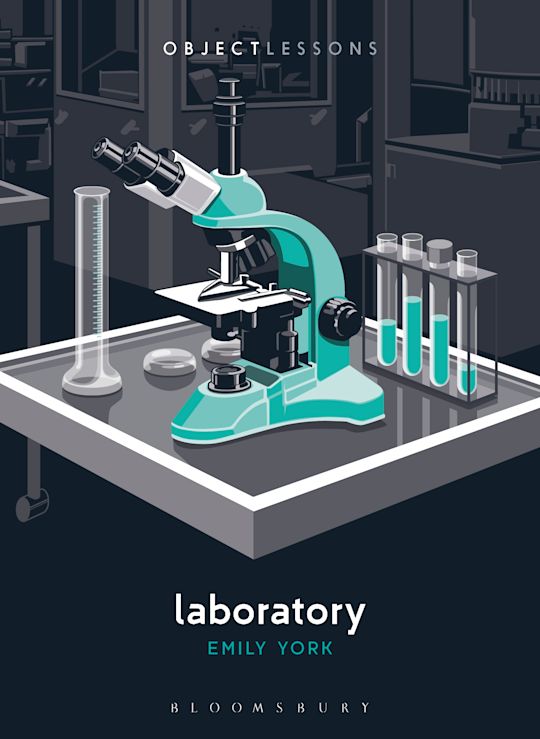
I read this courtesy of NetGalley and the publisher, Bloomsbury Academic. It’s out in September.
I have said this before and I say it again: I love the Object Lesson series. Sometimes the Object in question seems relatively simple – a skateboard! – but sometimes it’s a bit more abstract: like The Laboratory. (One of those words where you can hear an Aussie / Brit vs US accent difference.)
As is so often the case, York uses her own experience – of sort of working in a lab, and sort of not; being science-adjacent – to illuminate all sorts of interesting aspects of the lab, and along the way varying reactions to science as a discipline. She looks at labs in science fiction – in film, in particular, since that informs so much of what non-scientists think of as “a lab” (ask me how I feel about the lab in Fringe).
I enjoyed the expansive view of “the lab” that York brought in this book, and how passionate she clearly is about communicating the realities of scientific research to a broad audience – that it’s piecemeal, that it involves many, many contributors, that it’s usually safe! She has a good section on the development of scientific rigour, and laws around things like animal experimentation – and, of course, given it’s Now, touches on some of the issues around Covid and its genesis.
This is a really great intro to the idea of “the lab” for the non-scientist, but I suspect it might also be a nice thought-provoker for those who work in science to think about how the rest of the world views their work, and their world.
Bodies of Magic
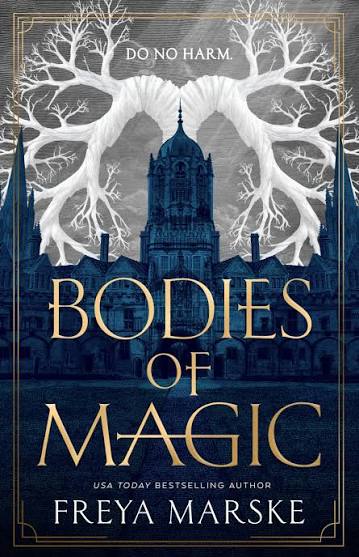
I read this in ARC. It’s out in September. (And it’s worth waiting for.)
A proper review of this is forthcoming in Locus, but the TL;DR is I loved it. I’ve loved everything of Marske’s I’ve read so far, so that’s not a huge surprise – but this is quite different from her other books in some ways. Some similarities, though, too.
Set in secondary world, where some people are born with magical ability and that’s no real big deal. You get tested, you see whether you might have a gift. If you live in Sieuxerr, though, you might have the ability to be a healer – in which case you have no choice but to be a healer. And after five years of study you undertake five days of exams with four other students – not of your choosing – before you graduate. And then you have to go off and be a healer, either in whatever place paid for your training (because of course it costs), or at home if your family is rich enough to have paid upfront.
Sounds familiar, really, doesn’t it.
The book focuses on five students in those final days. All of the characters are beautifully developed. They all have their struggles, and their achievements.
Did I mention there’s a death? There’s a death. Finish your medical exams AND figure out whether the death is a murder or not! No drama! So there’s investigatory shenanigans; there’s falling in love, arguing with family, making your place in the world, defying expectations, etc etc. It’s a lot of fun. I did get about 4/5 through and have to go stare at a wall, For Reasons.
This is such a great book.
The Book of Bots
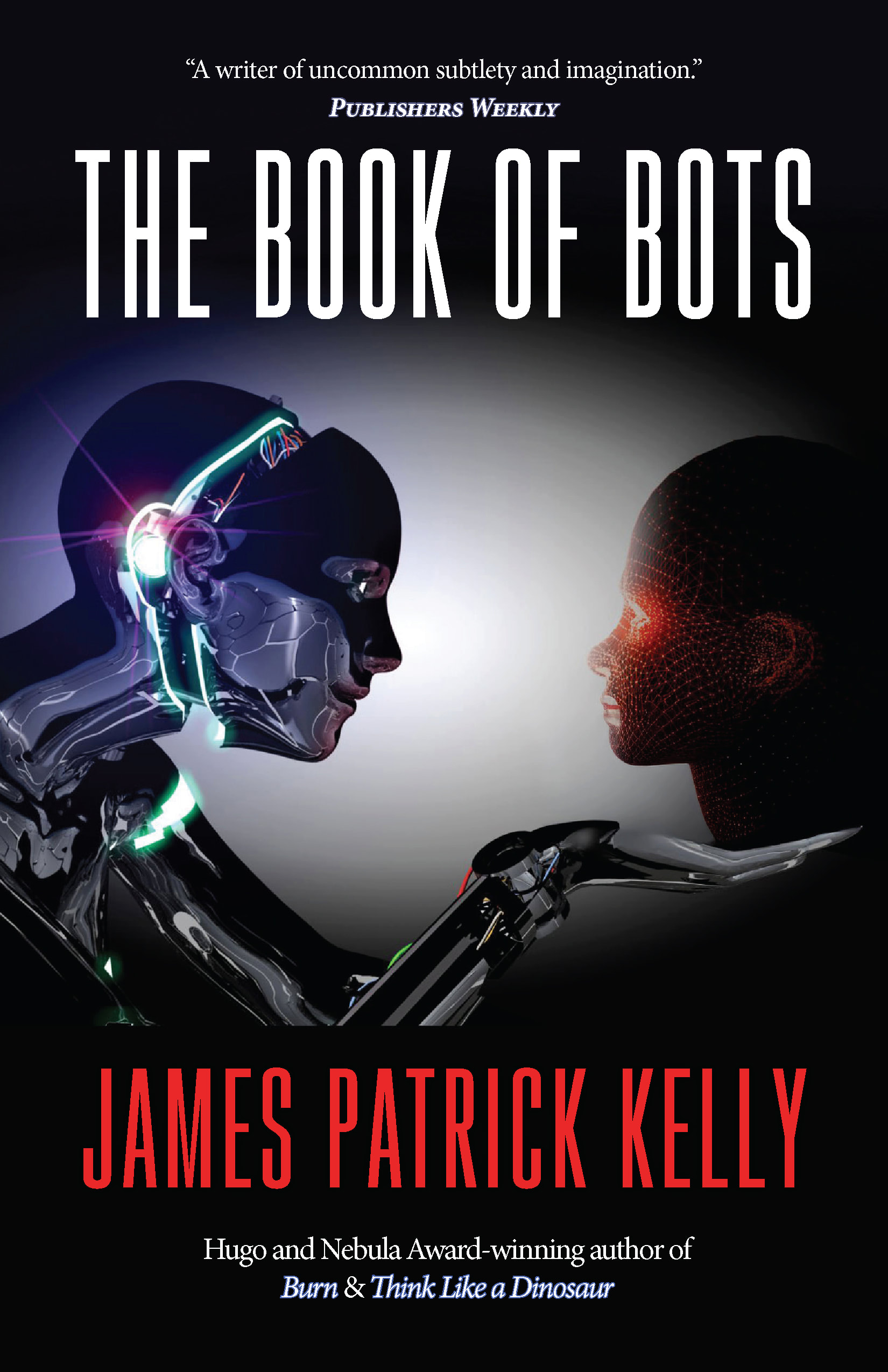
I received an ARC from the author. It’s out in August – but preorders are love!
I often love a robot story; I also enjoy a well-thought-out AI story. And thus, James Patrick Kelly’s The Book of Bots: completely in my wheelhouse.
Covering around 25 years of his career – which is impressive in itself – the range of stories in this collection is fascinating. Some of the robots are actively meant to be caring for humans, in very different ways; stories like “Itsy Bitsy Spider” could come across as cutesy but it is deeply, deeply creepy, from my perspective anyway. Indeed, several of the stories end up crossing into the Creepy realm, because of the way they imagine bots interacting with humans – and, more to the point, humans interacting with bots. “Bernando’s House” is, if anything even more creepy than “Itsy Bitsy Spider;” a house has a personality, and a human figure to represent it, aaaaaand then things go weird. “Yukui!” confronts the idea of humans owning bots, and questions of sentience/slavery. “Your Boyfriend Experience” likewise asks questions about humans creating bots to their own specifications, and how that plays out with and around other humans. And “Je ne regrette rien” is kind of the culmination of the stories about human-like bots, and a quest to be more than they have been created to be.
On slightly different notes, “Undone” brings in a sentient spaceship – the concept itself not unique, but the playing-out and ramifications are what make it worth reading. “What it means to be a car” consists of dialogue between a car and a passenger – the only story that has a particularly different narrative structure, and one I enjoyed for that reason.
The collection also has two essays, one about the modern use of bots and one doing a short history of robots/ AI in literature. Both are entirely appropriate in the context of the collection, and add to the overall story of “what do we mean when we talk about bots.”
This is a great collection. Highly recommended.
Eat Like a Sardinian
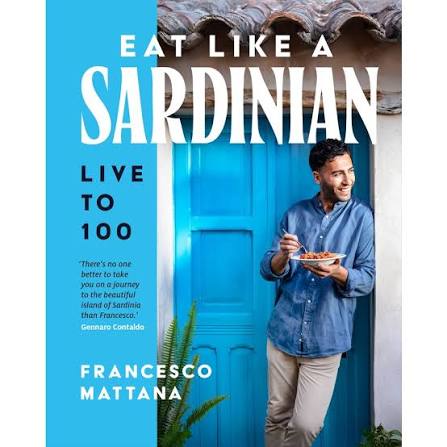
I was sent this book by the publisher, Allen & Unwin, at no cost. It’s out now, RRP $45.
On the one hand, this book has really excellent recipes.
On the other hand, I deeply object to the whole ‘live to 100’ vibe, given probable realities about so-called blue zones.
On the third hand, you can look past that (I do), and it’s a fine book.
As you would expect, this is a beautifully produced book (although to my sadness, there’s no ribbon bookmark; I do love a ribbon in a cookbook). The photography is great, it’s mostly about the food rather than the cook, there are some adorable handdrawn (they look like embroidery!) images scattered throughout, and the recipes themselves are laid out well. No complaints at all about the presentation.
There’s a good range of recipes – the book is structured like a traditional Sardinian meal, Mattana says: Aperitivo and Antipasti; Pane and Pasta; Primi; Secondi; Contorni and Verdure; La Dolce Vita. Within the chapters, there are harder and easier recipes. I would note that this is not a book for a beginning baker: the recipe for (the delicious) sultana and saffron bread asks you to judge ‘if the bread looks ready to bake’ with no suggestion for what that looks like, for example. And in the Culurgiones recipe there’s no indication of when the ravioli is cooked / how long to cook for.
Recipes I have made:
- Pizzette Sfoglia – puff pastry pizzas. So simple! Quite tasty, although I do think the filling (tomato passata, oregano, capers) could have been tastier.
- Su Pani Arrubiu – sultana and saffron bread. Also with orange zest. Absolutely delicious. And he recommends a long, overnight, proving, which I think was really good. Mine wasn’t as good as it could have been – I’m blaming winter – but 100% would make again.
- Tallutzas con noci e ricotta – I made this with bought orecchiette; the combination of ricotta and walnuts and nutmeg was an absolute delight.
- Culurgiones – potato stuffed ravioli. Yes, I made ravioli. Was it worth it? Look, I’m not sure. They were very tasty and I made quite a lot so a bunch went into the freezer. Are they better than very generic supermarket ravioli? Oh yes. Did they take a long time? Also yes.
- Li Puligioni – ricotta ravioli – no, I did not learn my lesson. Yes, pasta stuffed with ricotta and orange and lemon zest is very tasty.
- Spizzulus con cardoncelli e salsiccia – pasta with sausage and mushroom sauce. Had to make a sub here as my local supermarket doesn’t have dried porcini (!), so I used fresh mushrooms instead. It will have tasted a bit different, therefore, but overall this was absolutely excellent. And getting the butcher to de-case the sausage first was also brilliant.
- Panada – Sardinian pie. Further to ‘not learning my lesson,’ yes I made the shortcrust pastry for this pie. The pie has a really interesting structure: basically you’re cooking a really dry stew inside a pastry shell. You’re putting raw meat and uncooked potato inside and it comes out… perfectly cooked. Also a lot of work, but did feed two of us for three dinners.
- Bombas – meatballs. I love meatballs. These are fine but nothing out of the ordinary.
- Involtini di carne con verza. Never again will I stuff cabbage rolls. Maybe using ordinary cabbage rather than Savoy was a mistake – I don’t know, I don’t know cabbage.
- Torta di mele – apple cake. It was fine! I was lazy and didn’t do the apple slices on top, which meant it wasn’t as apple-y as it should have been, so that’s all on me.
There are more recipes I’m looking forward to making, so this one will be staying on rotation.
The Hunger of Those Who Built It
Read courtesy of the publisher, Stelliform Press. It’s out in September; you can preorder it now.
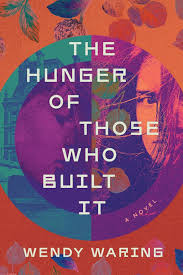
Wendy Waring does an intriguing narrative thing in this novel. The first 60 or so pages alternate between Lou, who has managed to infiltrate The Oxbow – an exclusive and exclusionary colony, basically, set up in the middle of a crumbling Paris – and Diane, Lou’s aunt, Green architect/designer and largely responsible for The Oxbow.
Then all of a sudden we get a timeshift: back 16 years, before The Oxbow exists. Diane is offered a job in Paris, creating vertical farms and helping to green part of the city, at the same time growing food for the inhabitants. It’s a world where in theory, at least, technology is greening, and so some aspects of early-21st-century urban life can change – massive highways, for instance. But, as Diane slowly learns, there are still privileged groups seeking to keep all the good stuff to themselves.
Basically, the majority of the novel is following Diane as she learns how her dream gets turned into the gated community of The Oxbow.
So on one level, it’s a story of a woman watching her dreams get manipulated and changed away from her vision. And it’s powerful for that: how hopeful intentions can be subverted, how good plans can be made to go astray, and so on. How corporations can destroy individual hopes. And, as well, there are some intriguing ideas for how cities might indeed change – for good; this is being advertised as solarpunk, after all.
The novel is not only about ambition and technology and urban infrastructure, and the big picture, though. It’s also focused squarely on the smaller picture: Diane wants to go to Paris because she is seeking reconnection with her sister, from whom she has been estranged for many years. There are many reasons for their separation; some familial, others political and philosophical. None of them have easy solutions, and Diane is frequently conflicted about her own as well as her sister’s attitudes. What I liked about Waring’s story is how very real it feels. Siblings are exactly those people who know how best to get under your skin, and who are also (often, not always) the people you want to be drawn back to.
I have one quibble with the story: an event in Diane’s history turns out to be very different from how she understood it, which has serious ramifications, many of which are part of the point of the story. But one consequence, about the dating of other events, doesn’t seem ever to be addressed, which is unfortunately something I really struggled to reconcile.
However! All up, I very much enjoyed this novel. It’s well written – I devoured it – and Waring balances the macro, urban issues with the micro, personal issues beautifully. They each feel as important as the other.
As a debut, I am deeply impressed, and hope that we can expect more of the same in future from Waring.
Department of the Vanishing
This is another book I read because of Ian Mond. If you’re interested, here’s the publisher, Transit Lounge.
Poetry is very much not my vibe. I have always worried that I just don’t get it and so almost feel I shouldn’t be allowed to read it, and certainly not comment on it. Is this ridiculous? Of course it is. Well, mostly. Am I actually afraid of some beret-wearing, cigarillo-smoking, pretentious white man tut-tutting me?
Well. A little bit. Yes.
Anyway, I’m going to comment on this book despite my fears. And it is poetry – almost all of the text is set out as couplets, with almost no punctuation. Sometimes the story is hard to follow as a result, when it’s not clear how the clauses fit together. Which is, I presume, part of the point. A lot of the time, it’s completely clear, and a delight to read.
This is not, though, just a poetic novel. It’s also playing with the idea of found footage.
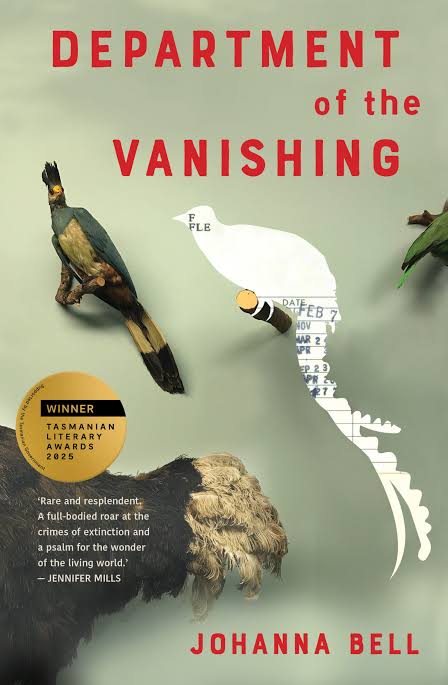
Almost every poetic page has a library stamp on it: RESTRICTED, or an accession stamp, or the link. In between poetry pages, there are collages of newspaper headlines; excerpts from the narrator’s police interviews; photographs and stills from video; pages where birds sounds are turned into text; transcriptions of the narrator’s mother’s maybe-dementia ramblings; and many lists.
Some of the found footage includes excerpts from other books, and friends, I dogeared a page because I didn’t have a bookmark handy when I got to the bit about Shifting Baseline Syndrome: “a gradual change in the accepted norms for the condition of the natural environment due to a lack of experience, memory, and/or knowledge of its past condition. (Soga & Gaston, 2018).
Ava lives in a too-near-future Australia, in 2029. She works for the Department of the Vanishing, archiving references to birds that are, or are nearly, extinct. (There’s a moment where she’s allocated the pelican: where to start? With Stormboy, of course – and my mid-40s-heart gave a great big heave.) She is also caring for her ailing mother, grieving her long-lost father, and seeking connection through a series of flings. Plus, of course, all the heartache that comes with her work.
It’s almost eye-rollingly trite to call this novel is a wake-up call, but of course that’s what it is. The idea that I would no longer hear kookaburras or magpies or the various teeny little tweety-birds I hear on the regular is horrifying. Is there something I can personally do? Probably not. Maybe I should send a copy of this book to some politicians.
It’s a splendid piece of art and I hope it gets more attention.


