The Empire Strikes Back
 The Empire Strikes Back: Things that were quite good
- THANK YOU, George, for that great gift to modern culture: “I thought these things smelled bad… on the outside…”
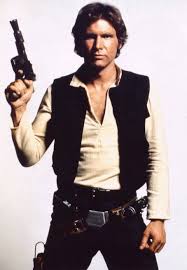
- Han Solo
- The Han/Luke friendship. DAW.
- Han and Leia tension.
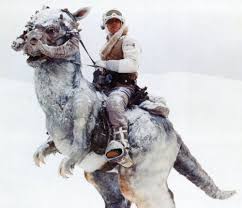
- James: I’m surprised by how early in the film this occurs.
- James: the music makes the film.
- Imperial walkers.
- Luke says, in the middle of a FOREST, “It’s like something out of a dream!” Wow, George. Subtle.
- “Wars not make one great.” Preach, George.
- The revelation that the emperor knows who Luke is is definitely more poignant thanks to the prequels.
- And Yoda’s hovel is more poignant too.
- This entire set of movies should be subtitled: “I’ve got a bad feeling about this.”
- Han.
- Lando!
- I’d forgotten just how echoes/foreshadowings there were in the prequels, with words and actions and scenes. It makes me forgive them a little bit more.
What were you thinking, George?
- Unconvinced by the new bits of the snow critter.
- THAT KISS GEORGE EW MY BRAIN.
- You’re continuing the assumption that cities <=> civilisation in Luke’s little comment about Dagobah, George. I know he’s still a whiny little kids, but nonetheless – unhelpful.
- You retconned Boba Fett’s VOICE, George.
- Vader goes through underlings at a rate of knots. Bad vision of leadership there.
Abaddon’s Gate: Redux
(Some spoilers below for Leviathan Wakes and Caliban’s War. READ THEM.)
The last line of Caliban’s War was an absolute killer, because I read it when it was first published which meant that the next book was about a year away and GOODNESS ME it was a cliffhanger. So I preordered this as soon as I could and happily, it arrived about a week before I went on holidays. I very carefully put it on a shelf where it wasn’t tempting me to read it… and then this week, on holidays, I cracked it open and devoured it in one day. And it was worth the wait. Oh yes. Thank you, James Corey.*
Naw. Cute. PastMe did not feel the need to reread the other two, clearly. Continue reading →
Caliban’s War: Redux
This review will contain spoilers for Leviathan’s Wake, the first in this series. As with that book, I’ve just reread this one, so this is the REDUX…
Suffragette
This post brought to you courtesy of Parissah and Aoife.
I’ve long had a fascination with the Pankhursts and the suffrage movement; I was reminded recently that I did a research assignment on the Pankhursts in year… 10? 11?; I’ve taught the British suffrage movement for a few years; I loved the biographies of Emmeline and of her daughter Sylvia, such different women; I’ve enjoyed other books on the movement too. I’ve wished that the 1970s tv show Shoulder to Shoulder existed on DVD, and I long to see Up the Women. So it should be no surprise that I was pretty excited to see Suffragette.
The only spoilers below are for which bits of the suffrage movement the film focuses on. If you don’t know the events, then I guess there are spoilers… and you need to go read some history. Here, this will help. If I tell you that the film starts in 1912… well, that’s a bit of a giveaway.
Just go see the film, right?
The basic premise of the film is that life is generally crap for women and maybe getting the vote will help. Which was basically the premise of the Pankhursts’ campaign, and that of Millicent Fawcett and all the campaigners for fifty or so years before the WSPU seriously made headlines. The film manages to show just about every way in which everyday life sucked for British women in 1912: unequal pay, sexual abuse in the workplace, men in control of the house – money, children – and the general notion that women are unfit for politics or anything other than menial work. (The focus is on white women, since the suffrage movement In Britain was generally; of course there was a whole other layer of problems for women of colour.) The response of most of the men to the women’s claims for equality is to be abusive or to laugh, at the very idea of it. Let’s not forget that rapper who thought Hilary Clinton shouldn’t be president because she might nuke someone because women get emotional. In 2015. Cue this:
 The focus is on Maud, a 24-year-old woman who’s been a laundress since she was seven. She’s married, she has a son, and she has no time for politics – literally no time, because she works all day at the laundry and then keeps working at home. She gets caught up almost accidentally in a suffrage protest, and things progress from there in an almost textbook case of how to radicalise someone, which is an interesting thought given Australia’s current overblown fears about just that issue.
Most of the cast is fictional, as Maud is. There are a couple of notable exceptions. There’s a scene when Maud is first in prison and she’s introduced to an Emily, who’s on hunger strike. I thought nothing of it, really, until there was a list of names in the police station and suddenly the name Emily Wilding Davison flashed up and if I had been alone watching the film I would have yelped. It had not occurred to me that the film would go there.

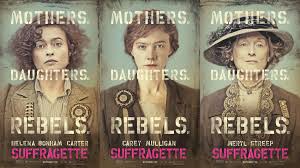
 Meryl Streep as Emmeline Pankhurst only has one significant scene, which surprised me somewhat, although as this review points out the focus on working class women is a fairly radical one and one that I really appreciated. She was appropriately grand, and again, when I saw her, I nearly yelped. They had the costuming down brilliantly, which is to be expected given how many wonderful pictures there are of Pankhurst; no idea whether they got her speech mannerisms or not, because I don’t know of any recordings of her voice.
Of the others – I liked the variety portrayed, within the limited purview of the film (that’s not a criticism; the film deliberately sets itself the task of looking at one group of women). Violet is a long-time campaigner struggling to keep the faith; Edith Ellyn, played by Helena Bonham Carter (who is wonderful AND! I discovered is the great-graddaughter of that bugger Asquith, who rejected women’s suffrage!) is a pharmacist with a loving and supportive husband. There’s a brief appearance from an upper middle-class woman who supports the campaign but whose husband is strongly against, and numerous women around the laundry and Maud’s neighbourhood who do not support it at all because of the difficulties it brings at home.
I have one significant quibble, and it’s one that I’m conflicted over. I liked that the police perspective was given; it highlighted just how anti-suffrage the establishment was, and the lengths that they were willing to go to stop the women. (The scene with the new portable camera – so light it doesn’t need a tripod! – that can be used covertly is hilarious; it’s still a shoebox.) However. However. Why is it that a film about the suffrage movement needed a male perspective? Because that’s exactly what Brendan Gleeson is providing, by being the copper who talks to Maud and is always present when something big is happening on the streets; he’s a male point of view on the proceedings. Could it be that a significant portion of the audience still couldn’t care less about the experiences of a person like Maud – poor, uneducated, female? I’m troubled by this, and it’s the one aspect that made me sad (about the film experience, I mean. There was a lot that made me sad). The film could have shown the police in general, as they prepare to battle the women on the streets; that would have got across the same point without it feeling like Gleeson’s character was an alternate viewpoint on the events.
I’ve also read comments about it being disappointing that there are no people of colour in the film at all, which I think is absolutely a fair call. From the perspective of suffrage history, yes there were women of colour involved but the records about individual members, regardless of race, are pretty sparse so as far as I know it’s not clear what the proportions are. I don’t know what the solution to this could have been (not an excuse, just a comment).
I’ve read a review that suggests Maud is basically a cipher, a stand-in, and not a really person – and to an extent I agree. I mean, basically everything bad that could happen to her, does, and she’s involved in just about everything interesting (well, public anyway) that happens in the suffrage movement in 1912 and 1913. But I don’t think this is a bad thing necessarily. The film is called Suffragette. The only way to really convey the experience of ordinary women in the struggle is exactly like this – to show one woman, experiencing it. I think Maud is intended to stand in for white working class women in 1912 who started thinking about politics, and she does it well.
At the end of the film, there’s a potted history of when different countries gave women the vote; the cinema erupted when Switzerland came up as 1971.
It’s also only I think the second time I’ve been in a cinema when there was applause when the film concluded.
Overall I think this a welcome addition to films about women’s history… since the list of films about women’s history, and feminist history, is a pretty short one. Next I would like to order films about Olympe de Gouges, and one about Mary Wollstonecraft kthxbai.
Leviathan Wakes: redux
I have the fourth book in the Expanse series waiting to be read… but I haven’t read the other three in a long time, and then only once each. So, yes, I am re-reading. And I’m now going to do a Le Guin and REDUX my review of Leviathan Wakes.
Domnall and the Borrowed Child
This book was provided to me by the publisher at no cost.
 I did not love this book.
It’s perfectly adequate as a re-hashing of the ideas about Faerie stealing children and possible consequences and so on, but I don’t think it’s as clever as it thinks it is.
I think the idea of only the old and somewhat pathetic faeries still being around is meant to be – amusing? challenging? – but instead it just comes off as a bit confusing, because the reason for that isn’t really explored; sometimes an info dump can be useful. Additionally I think what happens with the mortal woman is meant to, I dunno, challenge expectations or something. Didn’t really work.
Domnall comes across as a bit boring, rather than the somewhat sly, hard-working and long-suffering fae that I think was the intention. And if he wasn’t meant to be that, and was instead meant to be the lazy good-for-nothing whose butt is kicked to get more done – well, that didn’t really work either. The sidekick that he accidentally ended up with didn’t have enough character to be a funny, ambitious, or appropriately sidekick-y sidekick, and there were a couple of uncomfortable moments between them too (of a sexual nature – nothing too squick, don’t worry).
The plot itself is serviceable, and if that sounds like damning with faint praise… that’s probably about right.
Archer’s Goon
 Yes, that Archer’s Goon.
I really do not understand how I missed Diana Wynne Jones as a child. It’s not like I was too old for her stuff when it was coming out. It’s not like there weren’t libraries in my town. There were even bookshops! … but there it is. I didn’t read my first Jones until a couple of years ago – a Chrestomanci – and I’ve been hearing about Archer’s Goon for ages. And now I’ve finally read it.
Yes, it is magnificent. Yes, I loved it. Yes, I will be foisting it onto every young person when I think they’re not quite ready for it.
If, like me, you haven’t read it – well, just do so. It’s about a family whose house gets gently invaded by a very large man with a very small head who insists that Dad has to write 2000 words, Or Else. And things go on from there with discovering that the town really does not run the way they thought it did. Which naturally leads to Adventures. And those adventures were genuinely absorbing and often unexpected and always wonderfully written.
So what did I really like?
Firstly, the family situation. The adventures centre on the son, Howard, but Mum and Dad are absolutely present and important and relevant. I love the family dynamics, actually; that Mum and Dad are so different, Dad is so magnificently obstinate and Mum is wonderfully competent; that they have a raging row which does not result in them considering divorce; that they complement one another and generally work together. And then there’s Awful. Seriously a family who nickname their daughter Awful and still go out of their way to make sure she’s ok – this family is so REAL. I love them.
I love the Goon. When people were talking about the book I couldn’t for the life of me figure out what the title meant. Clearly goon can mean henchman, but it didn’t seem to fit here; then there’s the Aussie slang term for cheap wine, and that really didn’t seem to fit… so I was lost. Discovering that actually it did mean henchman was a surprise, but made sense once I realised that Archer was of course a person. Anyway, I liked the Goon a lot. Especially his dialogue.
And I liked the plot. I loved that Jones did not explain absolutely everything about Archer’s family and their place in the town; you just need to accept that this is what Howard and his family know, so of course it’s what the reader knows. We regularly deal with events that we don’t have complete context for, so why must it be different in a novel? Going around visiting the different members of the family to investigate what’s going on is of course a familiar trope; it reminded me of Garth Nix’s Keys to the Kingdom series (which of course is a series, not a stand-alone, something else which is a bit different in Jones), amongst others. There’s nothing wrong with using this trope, of course – it’s used so often because it does let the author show you stuff about the world and reveal the plot in bits and pieces. And Jones does it so well.
Finally, in looking around for a picture of the cover, I discovered that it was a TV show – which I vaguely remember someone talking about at some stage. Is it wrong that I immediately got the Round the Twist theme song in my head? (Roger Lloyd Pack as Dad is SHEER BRILLIANCE.)
Slaughterhouse-Five
 I read this to help my school figure out whether they should teach it at Year 11. My thoughts? No.
Yes it’s an occasionally humorous reflection on the horrors of war and yes it’s a clever enough look at life and history and expectations and blah blah but… I did not enjoy this book in the slightest. I did not even really appreciate it much for what it was doing and saying.
If the main point, or one of, is to communicate the horror of war, I guess it does it well enough. But I don’t feel that it’s particularly well done and there are a few bits that justify Mary’s early concern about making war notseem as awful as it really was. I don’t think anyone would come away thinking that war is a lark, but still… it really didn’t work for me. I think there are other books that do it better and without being quite so annoying.
The main problem for me is Billy himself. As much as I am a pacifist I find Billy’s acceptance of everything that happens to him, his absolute passivity, incredibly frustrating and annoying and, frankly, boring. As a fictional character: yes, I know that there are things in my actual life that are just going to happen and I can’t do anything about that, so I like reading about people who have a go at shaking life to try and make a difference. As a reflection on exactly that issue of the human condition: even we, in real life, don’t generally just here, passive. At least we talk or we rage or we complain or we act as though maybe there’s a modicum of free will involved. Billy – the man who just lands in places and does nothing (that we see – clearly he got through optom school but that’s never discussed) but still manages to have good stuff and makes no decision ARGH. Not a character who was ever, ever going to work for me.
And then there’s the women. Yeh yeh it was written ages ago and I don’t care. The daughter, the wife, the girlfriend – nags and obese and existing for sex (only the last two thankfully) and I felt like the hobo who died on the train almost had more humanity than the daughter and the girlfriend, especially.
If I read the phrase “So it goes” one more time I may physically react. Passivity that makes no attempt at improvement or alteration and even movement? No thanks.
The Duke and I
Or, I read a (…nother…) Julia Quinn novel and quite liked it.
I am not a connoisseur of Regency romance (having only read… one? maybe two?) before this, so I have no idea what conventions Quinn might be playing, breaking, or taking outrageous advantage of. So I can only comment on the book itself, not its place in the genre.
 Did I know basically what was going to happen within the first chapter?
Yup.
Did the book still serve up a few surprises?
Yes, a couple. They were quite fun, actually, since most of the plot was predictable.
Did I enjoy reading it?
I read it in a sitting. So, yes. The writing is light and witty, winsome and undemanding. I liked the alternating perspective between Our Romantic Heroes. I liked (sorry Gail Carriger) that there wasn’t a big emphasis on the clothes, nor the food. I like banter, and this has quite a lot.
What about the characters?
Daphne is a forthright, sensible woman who holds out little hope of romance but would at least like to like her husband. She comes from a big, loving family. I liked her, overall; I was a bit disappointed by her eagerness to marry and have children as the be-all, but: a) why not? She’s allowed to desire that; b) as we’re reminded early on, she’s not allowed to go to university if she wants to, and she can’t aim for an awesome career – partly because she’s female, and partly because she’s gentry and they just… don’t work.
Simon had a damaged childhood. Now he’s the duke. He’s been a rake, has no intention of marrying… etc. While I sympathised with his experiences, he was certainly less interesting to me than Daphne.
Are there problematic bits?
Sure. I am always uncomfortable with the Mrs Bennett-ing of all mothers. Quinn turns the tables somewhat with Violet, and gives a marvellous hint at her actually being a very smart woman, but it wasn’t quite enough to stop me from sighing a few times at the ‘must catch the daughter a husband’ thing. Maybe it’s historical verisimilitude, but that doesn’t make it pleasant to read about.
There’s also an instance of maybe-taking-advantage-of-someone that made me uncomfortable, which then did get explored for ‘who did what’ but it still made me sad.
Will I read more?
Daphne is one of eight children. I did wonder why Quinn was ravishing so much attention on the beauty and allure of Daphne’s brothers… and then I discovered that there are, of course, eight novels in this series. Marrying off each of the children, one by one. I must admit to being somewhat intrigued, not least because I really want to find out who the gossip columnist, Lady Whistledown, is. Two of my candidates got blown out of the water by the last page, but I still have one possibility in mind…. So, maybe.
Cranky Ladies of History
This is another book that I’ve given my mum recently. She started reading it and rather smugly emailed to say that now she doesn’t feel so bad about being one sometimes. She says:
I particularly loved “A Song for Sacagawea” because it is the story of all those unsung women who were forced to help conquerors take their lands. They were looked on as trade goods, but much of the exploration/exploitation wouldn’t have occurred without them. There is a similar story of a woman who translated for the conquistadors in Central America [she means Malinche]. Much as I admire those women, their treatment really p….d me off, of course. Don’t quote me on that, though.
(Oops. Heh.)
Anyway, I am so totally excited that this book exists. I supported it in its Pozible funding, I did a little bit of supporting in terms of writing a blog post (I had big intentions to do a few but whoosh there went the month), and generally YAY stories about real historical ladies!
!!
So I finally got around to actually reading it. Firstly let me say I SEE WHAT YOU DID THERE WITH THE ORDER OF THE STORIES, TEHANI AND TANSY.
Ahem.
The first few stories were the sorts of things I expected. Mary I as a child, Lady Godiva, Mary Wollstonecraft… and then Bathory Erzsebet. Who is someone I had never come across and who was very, very not nice. Very not nice. Like, Deborah Biancotti you had already scarred me with your Ishtar and now my brain is even WORSE. Because this story does not redeem Erszebet. It shows that women are quite capable of being cold and cruel and nasty. And, at a chronological and geographical distance, this is almost something to be pleased about… since after all, we are just human.
Hmm. Getting to Erszebet has meant skipping over Mary (a story showing how difficult her childhood must have been, thanks Liz Barr), and Godiva (thank you, Garth Nix, for making her more than just That Nude Lady) and Wollstonecraft (Kirstyn McDermott, I have always loved her at a remove – that is, knowing only basics of her life, I knew she was wonderful. This fictional take helps just a bit more).
Leaving Europe, Foz Meadows goes to the Asian steppes with “Bright Moon” and a fierce tale of battle and kinship obligation; Joyce Chng to China and silkworms and captivity. Nice Shawl teases with “A Beautiful Stream” by talking about events and people from the 20th century I felt I ought to know and drove me to google find out if I was right (yes); Amanda Pillar pleased me immensely by being all provocative about Hatshepsut, one of my favourite historical women ever.
Sylvia Kelso stunned me by talking about two women from Australia’s history that I had no knowledge of (a doctor? lesbians?? in the early 20th century?!) and Stephanie Lai puts flesh on the bones of Ching Shih, the female Chinese pirate I’ve only encountered in passing. I would like to thank Barbara Robson profusely for writing Theodora so magnificently and by incorporating Procopius, to show just how such historical sources can be used. Lisa L Hannett continues (what I think of as) her Viking trend, while Havva Murat takes on Albania’s medieval past and the trials of being born female when your father wants a son.
I don’t mean this as a negative, but I am so not surprised that Dirk Flinthart wrote of Granuaile, the Irish pirate. I was surprised where he took her; pleasantly so, of course. LM Myles brought in one of my other very favourite and bestest, Eleanor of Aquitaine, this time as an old, old woman – still cranky and sprightly and everything that was great about her. I didn’t love Kaaron Warren’s “Another Week in the Future,” but I have no knowledge of Catherine Helen Spence so I had no prior experience to hang the story on. Laura Lam brought in a female pirate I’d never even heard of, the French Jeanne de Clisson, while Sandra McDonald writes a complicated narrative of Cora Crane: there are unreliable narrators and then there are unreliable timelines and sources and they get fascinating.
Thoraiya Dyer introduces someone else I’ve never heard of, by way of 19th century Madagascar and a royal family negotiating the introduction/imposition of European ideas. Juliet Marillier brings a compassionate, loving and beloved Hildegard of Bingen, while Faith Mudge caps the whole anthology with Elizabeth I.
Look, it’s just great. A wonderful range of stories, of women, of styles, of close-to-history and far (but still with that element of Truthiness). I think we need a follow-up volume. I’d like to order Jeanne d’Arc, Julia Gillard, the Empress Matilda, Pocahontas, Eleanor Roosevelt, Malinche, and the Trung sisters. Kthxbai.
You can find Cranky Ladies over here.


