Mind of My Mind
 Just go read it. Seriously.
As I mentioned in Wild Seed, I am glad I read that novel first – the background it provides for Doro, and Emma, is devastatingly important. Of course you could read this first – publication order – and then have the background filled in… but this order definitely worked for me.
This book is very focussed on Doro and the people he manipulates people to his own ends. Even when other characters – Emma (Anwanyu), and especially Mary – get to tell their own story, it’s always connected to Doro: against or in favour, in reaction somehow, trying to figure out how to circumvent or please him. He is the Patternmaster. He is the puppetmaster.
This book takes place over a much shorter timeframe than Wild Seed – just a few decades. In the prologue, Mary is a small child in an abusive home; the narrative picks up with Mary, one of Doro’s many children and an important part of his experimentation, in her late teens. Mary becomes the focus of the story as she seems to be the fulfilment of Doro’s plans, and it basically follows her development and discovery of her powers.
Unsurprisingly, Mind follows some of the same themes as Wild Seed. Why humans acts they way they do, how compulsions can work and why we act in our own worst interests; what slavery can look like. It develops the discussion of the difference between haves and have-nots to a greater extent, and the consequences of power. The idea of family and its power as well as its destructiveness. Humanity at its best and worst.
This book isn’t always pleasant to read, but it is always powerful and it’s always well written and I will definitely be reading it again.
Goldenhand
This book was sent to me by the publisher, Allen and Unwin, at no cost. It’s out now; RRP $24.99.
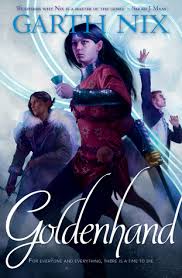 This BOOK! I’m so happy to have read this book! I’m so happy this book exists! (Spoilers for the other Old Kingdom books. Just go read them.)
I’ve been a fan of the Old Kingdom books for a long time. Not as long as they’ve existed – Sabriel came out about 20 years ago and I didn’t read it then – but long enough ago that when the prequel, Clariel, came out in 2014 I was a bit over the moon. So with Goldenhand being a direct sequel to Abhorsen, I’ve been pining for this book for a good while.
This is most definitely a sequel. I’m not sure how it would stand by itself – there’s not a lot of explanation of the whole necromancy by bells thing, nor of the Charter, and there’s a moment where Lirael is required to use her mirror and I was like wait, what? because it’s been a while since I read the other books. But really that’s all right because just READ ALL THE OTHERS ANYWAY.
Lirael is pining the loss of the Disreputable Dog, and trying to fit in with her newly discovered much older half-sister Sabriel and her family, and learning to be the Abhorsen. Something I loved about Lirael was how she always struggled to fit in as a Clayr, and I like that Nix hasn’t just made her magically (heh) well-adjusted. Meanwhile, of course, things aren’t entirely hunky dory in the rest of the kingdom: a nomad appears unexpectedly at the Greenwash Bridge, and even more unexpectedly proceeds to be attacked by other nomads and their awesomely freaky magical constructs. Cue mad flight down the river…
The book follows two tracks: Lirael, taking charge of Abhorsen business while Sabriel has a holiday (heh so cute), which means investigating a message about Nicholas Sayre and there being a magical creature on the wrong side of the Wall… and Ferin, the nomad messenger, whose endurance makes all the other characters look a bit weak and who just occasionally has a wicked sense of humour.
I love Ferin.
Nix’s writing is incredibly easy to read: it’s fast-paced, and it has lovely descriptions that allow you to imagine the place but not get bogged down in detail. I love the idea of the Charter and the additional development that the magic system gets here. In the interview with Nix that’s included in the book, he seems a bit bemused by how many people mention the gender balance in his books. But here’s the thing: when you’re reading about some guards being awesome in fighting and realise that any number of them are women, and that’s just so not a thing for this world, it still blows my mind. Multiple women in multiple sorts of roles: it can be done.
This is a wonderful addition to the Old Kingdom world and I’m so happy that it exists.
Wild Seed
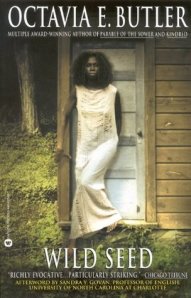 It’s brilliant and you should just go ahead and read it and you don’t need to know anything else … unless incest (at a distance from the reader) really, really squicks you out (it happens but it’s not a huge focus and it’s not dwelt on greatly).
I know Butler didn’t write this as the first in the Patternmaster series but I am so glad I read it first, because Butler sets up the world of Doro and Anyanwu brilliantly; I can’t imagine coming to read this after already having been introduced to Doro, especially, in a different context.
There’s an enormous amount going on in this book. Doro and Anyanwu are very different from those around them: both seem to be immortal and both have talents that set them apart. Doro moves from body to body at will; Anyanwu can heal and change herself. Anyanwu has been living with her extended family and caring for them for generations; Doro has been building himself a people, gathering together individuals with some sort of psychic talent. One day Doro feels Anyanwu and goes to meet her, and Anyanwu’s life in particular changes. She hasn’t ever moved far from her birthplace, while Doro has been setting up colonies in America – this is the 17th century, and Doro and Anyanwu are both African (Anyanwu is Ibo, I believe; Doro… is something else altogether). So this means he’s trafficking in slaves, and working with slave traders. So that’s a whole thing: how people react and feel when they are enslaved, how the trading works and can be used, and so on. And somehow the fact that this is written by an African-American makes a difference. The very question about what makes someone a slave is key to the story, actually; how chains aren’t necessarily visible, how someone can become accustomed to the state – and asking the question about whether, if you don’t mind it, how bad slavery is. I think Butler firmly comes down on the side of it still being an evil, but she’s sure not making it an easy discussion.
Having two central characters who appear to be immortal means that Butler gets to write a story that goes over a couple of centuries. This allows her to explore the development of both individuals and communities, which she does really well. In some ways the people that Doro is developing are like a generation ship: they don’t know where they’re going, and it’s temporal rather than spatial, but they’re definitely on a journey. They just need to keep following orders and keeping the place running. The focus is really always on the relationship between Doro and Anyanwu, because their fraught relationship stands for everyone else: love and hate and need and resentment. Acceptance and rejection. Anyanwu is the one who changes and develops and grows, while Doro is largely static. There’s a variety of reasons for this – he’s that much older and has a very set purpose where Anyanwu is in some regards more passive (and in others really not) – but his lack of growth and change isn’t entirely presented as a positive.
It’s the complexity of Doro and Anyanwu, as individuals and in relationship, that makes this novel an absolute stand out. It bemused me somewhat when I finished reading that, really, very little actually happens: there are few really “significant” events like battles. Instead it’s a steady stream of small events. It’s a surprisingly domestic novel, in that much of it is focused on family and family relationships, centred around the home and small communities. But don’t be fooled – never has the idea of ‘domestic’ equaling ‘unimportant’ been less true.
I read this as part of “Seed to Harvest”, the compilation of Patternmaster novels. I was so engaged and intrigued that I moved straight on to reading the next novel (in internal chronology), because I couldn’t bear to leave the story.
The Silk Roads
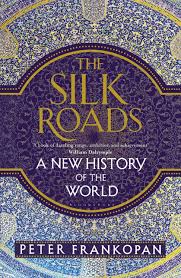 This book was sent to me by the publisher, Bloomsbury, at no cost. It’s out in September; RRP $29.99.
This is one of the finest history books I have read in recent times. It’s also probably the first book I’ve read that calls itself ‘a history of the world’ that does not mention the Norman invasion of England. And that’s because in 1066, from the perspective Frankopan presents here, a wee island on the west coast of Europe was of absolutely no relevance to the movers and shakers of the world. (Henry VIII is barely mentioned either!) The real business of global activity was in what Frankopan calls the real heart of the world – the lands of the Silk Roads, from the Himalayas to the Mediterranean, which for the two thousand or so years covered here drove human history.
Now, that’s a big claim, but what’s a history book without a big claim behind it? and of course important things were happening in places like Britain in the 11th century – but things of regional importance, not things with world-changing impact. Frankopan’s thesis is that the areas connected by what came to be called the Silk Road had an impact on actions, thought, and policy across most of Europe and Asia and, eventually, the Americas and Africa as well. Sometimes this area is actively driving history (the beginnings of Christianity and Islam, anyone? – and Judaism too although it doesn’t start in the period covered) and sometimes it’s – not quite passive – but almost: that this area happens to be incredibly oil-rich isn’t anyone’s fault or decision, but the reactions to it are.
Each chapter of the book is centred around the theme of roads: the road of faiths, to a Christian East, of gold and silver and black gold and genocide. It’s blunt about the horrors perpetrated – so much slavery – and waxes lyrical about the beauties produced by various cultures. Islam and Christianity and Judaism are shown cooperating, although rarely all three together, as well as antagonistic – for religious and political reasons (throw Zoroastrianism in there too, and indeed Buddhism). There are countless invasions – sometimes repelled, sometimes welcomed, sometimes hugely resented; there are alliances and back-stabbings and intermarriages. Most of all, though, there is trade. Trade along the Silk Road – from China and indeed further east, all the way to that insignificant island on the west coast of Europe, and of course within the regions along it too. The impact of Chinese pottery on the Dutch. The impact of silk and gold and – of course – oil, as well as innumerable other goods, back and forth, is mapped out by Frankopan. Not quite half the book is basically from 1900 onwards (the chapter is called ‘The Road to War’), which I know makes sense in terms of the availability of sources; the medievalist in me was a bit sad, I’ll admit.
I am guilty of having a Euro-centric view of history. Partly this is my education and upbringing which have in turn led me to be most interested in European history, especially British and the ‘classical’ worlds. I have a bitser knowledge of events involving Persia across the ages and the regions of Central Asia – usually as they intersect with those areas I have studied (Alexander the Great, the Huns, the Mongols). More recently I am absolutely guilty of falling into the complacent trap of thinking of Central Asia, in particular, as being a war-torn area that is to be pitied (HELLO privilege). To see this area’s history presented chronologically and with a focus squarely on it, the actions taken by people in the area as well as those acting on it; and to see the actions involving Iran and Iraq and Afghanistan and Pakistan and Egypt, and Britain and the US in particular, over the last five decades or so – this was an absolute revelation. For those who are more interested in modern politics perhaps this won’t be quite so eye-opening, but I imagine that for most it will still be a revelation to have all of the pieces fitted together and the connections between them pointed out clearly and cogently.
 Reading about the actions of the British Empire made me embarrassed to be Anglo, at times. The sheer arrogance on display was truly remarkable.
The aesthetics: if I could have a framed copy of the front cover, I probably would. It’s gorgeous. Inside there are two sets of eight pages of colour pictures – which isn’t as many as I might have expected from such an epic book, but they were a reasonable overview of the content. I have a copy of the trade paperback; it’s a hefty tome: I didn’t quite manage to not put creases in the spine, which is an indication of how hard it was to read without opening it fully! (Yes I am that person; crease my book’s spine and I will crease you.) It’s 520 pages long (with another 100 pages of footnotes) – so it’s not a fast read, but it’s definitely a worthwhile read.
This book is a must-read for anyone interested in world history, or in modern history. It should be read by any politician or policy-maker who thinks they can make decisions about any part of the world other than their own without consequences. It should also be read by anyone with a tendency to Eurocentrism. It’s a study in well-written history, too.
Illume
 I have known Kate Smith for a very long time, and I’ve been reading bits of her fiction for nearly that long. The thing about Smith’s writing is that she is often quite opaque – if you don’t get her song lyric references or her film references, you might be a bit lost. But she writes with a lot of passion and a lot of quirky description – which sometimes gets away from her but sometimes really works nicely.
Illume is set in Paris, and focusses on Thane, who works for the equivalent of UNIT or Shadow Unit or all the other not-really-police-branches who deal with the things that go bump in the night. This time, it’s about lovers who think they can make their love immortal, dangerous mirrors, and vampires. You never really get to the bottom of the characters who make the narrative tick; they’re surface, trading witty repartee and dangerous allusions and making intuitive links. That’s not to say they’re superficial – I don’t think they are – but Smith doesn’t really show us what makes even Thane tick, let alone his partner Mal or his crime-partner Genetta or any of the other odd bods who rock up. And I don’t think this is an oversight on Smith’s part; I think it’s quite deliberate. She seems more interested in the glitz and suggestive shadows than in deep psychological questions. So if you’re up for something light-hearted and fast-paced and quirky – definitely quirky – in the urban fantasy vein, this is your thing.
The Quantum Thief
By Hannu Rajaniemi
I’ve had the sequel to this sitting on my TBR pile for a looong time, but I knew I had to reread this first hence the procrastinating. I wasn’t delaying because I was worried, just that rereading sometimes feels so decadent…
Anyway I’ve done it now and if anything this book has improved with a second reading. I did love it the first time but remember feeling hopelessly and helplessly lost a few times. That was largely gone on this reading not because I remembered things – I didn’t because I basically never do – but because I remembered it making sense so I had confidence in it and myself. I did also remember just a few things after my memory was jolted which certainly helped.
So there’s a thief, and someone who needs help; there’s a colony in Mars where everyone has extreme privacy measures and you get to choose who sees what – plus Time is currency. There’s been serious inter-solar-system issues with humanity splitting into many different factions and there are some very serious questions about what is real and whether you can even ask that question my god you’re so baseline human urgh. Brains can be hacked and bodies can be hacked and sometimes bodies are just a costume. But seriously there’s something that needs to be stolen and that’s what matters.
Memory, reality, time, love, death. All the good bits
Runtime
By SB Divya, from Tor.com in May.
This book was provided by the publisher at no cost.
Things I liked about this story:
Technology was not at an end. It’s a small thing, but often stories set “tomorrow” forget that technology keeps developing. There’s a line in here about consumer tech not being ready for something but it soon would be – and I was very happy to read that.
The family relationships were complex and largely believable.
Struggling against a new class system that is completely rigged against you.
Enhanced ultra marathons.
The story telling itself.
The different genders.
Things that I didn’t love:
Mum seemed a bit too harsh, but maybe that’s just my bias? Could be. It made me uncomfortable but actually maybe that’s the point.
There’s a discussion about “nats” – naturals I presume – that got a bit too… didactic, for the context. It made me impatient to get back to the story because it felt like it was interrupting rather than advancing the plot or the central ideas.
Overall it’s a fun, fairly compressed story.
Curtsies and Conspiracies
This is another hugely enjoyable book from Carriger. Once again our girl Sophronia is thrown into difficulties at her alleged finishing school. This time she has a lot more to do with the supernatural element of her world, especially the vampires. Of course there’s a lot of discussion of dresses and fashion and hats and reticules; she must figure out how to carry a knife without it being obvious, she must learn to bat her eyelids effectively, and how best to carry the implements required of a young lady in her position. I’m still surprised by how enjoyable I find yet another school focused book.
Most of this book is spent on the dirigible of Miss Geraldine’s finishing school. Some time is spent in classes, learning about domestic economy, poisoning, fainting and how to properly address vampires. But for Sophronia, much of her time is spent on the outside of the dirigible – climbing – as well as with the sooties down below and the dressing-as-a-boy Vieve. Interestingly the plot follows on from Etiquette and Espionage, in that the MacGuffin here is the same. Of course this time it’s not so much about finding the prototype as it is about figuring out what it can do, how it will do it, and who will control it. There’s a surprising amount of politics for a book that seems at least on the outside as being solely can send with fashion. I guess that’s kind of the point; that the two don’t have to be mutually exclusive and anyone who is thinks they are is likely to underestimates graduates of Miss Geraldine’s finishing school.
One of the big differences in this book compared to the original is that there’s a lot more boys. I’m not really sure what I think about this; on the one hand it’s obviously an important skill for girls like Sophronia and Dimity to learn – that is, how to deal with difficult yet handsome young man. And of course reappearing in this book is Soap, certainly one of my favorite characters although somewhat problematic given that he’s black and his nickname is Soap. On the other hand I really enjoyed the almost exclusively female cast of the first book; the fact that boys were not necessary for the book to proceed, the fact that the girls were perfectly capable of getting themselves into and out of scrapes generally without any male assistance (or hindrance) at all. While some of the ways that Sophronia dealt with her would-be suitors was entertaining, I did find myself enjoying the sections of the plot that solely involves the girls generally more enjoyable.
I continue to be fascinated by the development of this world that Carriger initially developed for the Alexia books. And of course I remain desperately keen to find out how this series will intersect with the earlier one. One of those intersections is quite obvious but I have no doubts that Carriger will provide some further surprises in the rest of the series.
The Oxford History of the French Revolution
 Overall this is a very readable book about the French Revolution. I’m not sure it would work for the complete novice – because I’m not, so I can’t judge that anymore. But it gives a generally thorough overview of the French Revolution and, interestingly, its impact on the wider world; Ireland and Poland both get mentions as being inspired by the Revolution itself during the Revolution, and the rest of Europe by virtue of conquest, with Latin America being mentioned in passing. Haiti also gets a few mentions in terms of the uprising there inspired by the Revolution.
I have two complaints; one stylistic, the other content. The first is that some of the writing is a bit obscure, in that sentences could definitely have been better formulated to avoid confusion. The second is Doyle’s attitude towards women. On the first page he mentions ‘an empty-headed queen’, and doesn’t really walkabout Marie Antoinette much except in terms of being anti-revolution. On one of the last pages he mentions that equality between men and women was never going to be a thing, despite women’s contributions to the revolution – which he’s mentioned about once, with the Women’s March to Versailles, which would be hard to avoid – but there he talks about women pushing matters to extremes, and Mme de Stael as ‘Necker’s busybody daughter’ (!!), and Theroigne de Mericourt and Olympe de Gouges and Claire Lacombe only once each. I found this very disappointing. Of course you can’t mention everyone in one book, but surely these women deserve more than just the one line dismissal of their contributions.
I would still recommend this a very good overview, keeping in mind that no single book is going to be perfect.
The Golem and the Djinni
This post should be read in conjunction with Mondy’s review, because I read it when he first posted it which is, clearly, a long time before I read the book, and it influenced my reading of the Jewish (and by extension Muslim) bits quite a lot. Also, this is another book given to me by Katharine, because she is a great big book nerd.
And this post is pretty much spoiler-filled. You’ve been warned.
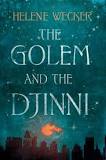 Over on Goodreads, I gave this four stars, because I rounded up; I would have given it 3.5 for preference.
On the good side, this is really nicely written – it wasn’t a chore to read it, I generally enjoyed the switches of narrative perspective, and the Golem and Djinni both provide interesting perspectives on humanity. In fact I think this is the strength of the book (… and this is interesting given I read it very soon after The Just City): these two characters give Wecker the opportunity to think about volition and control and desire through two creatures whose natures are intended to be opposites. The Golem is created to be obedient, and lacking a master means that she has to think through controlling herself, and how not to respond to every whim she encounters, and it’s really hard. When at liberty, the Djinni was accustomed to doing exactly what he wanted and when, indulging any whim he might feel without reference to any consequences. Now restricted by the iron cuff, he’s unable to take any form he wants – so there’s an external restriction – and living as a human means that at least to some extent, he needs to learn about consequence and responsibility. So it’s a bit like watching two toddlers learn about how to be responsible human beings, when those toddlers have superhuman strength or the ability to liquify metal, and who already look like adults and so are treated as such by those around them – no leeway like actual toddlers get. I really felt for the Golem as she wanted to restrict herself and not lash out; I sympathised with the Djinni for feeling imprisoned and also that he wanted to encourage the Golem to actually explore who she is.
I really liked the way that Wecker always referred to the Golem and the Djinni in those terms. As Mondy points out, this is a good way of showing that they’re outsiders. Although they have been given names by those around them, they do not fit in.
I don’t know why Wecker chose the end of the 19th century for her story; it could just be that it was a period that she liked. Post-WW1 could have worked, I think, because living in the Roaring 20s would have allowed all sorts of interesting discussions. (Clearly post-WW2 would have required too many other discussions that would get in the way of the story Wecker was trying to tell.) Anyway that aspect mostly worked; I’m no expert so I have no idea whether it was accurate or not.
On the more negative side, there were a couple of things that really bummed me. Sophia Winston is a big part of that. She gets seduced by the Djinni and doesn’t appear to regret it – fine. She gets pregnant to the Djinni and then loses it in a mystical manner and then her body doesn’t recover and then the Djinni is taken to her house to warm up post-suicide by cooling attempt (… because she’s got the closest fireplace or something? Saleh’s thinking was a bit of a stretch there). And then apparently this is a sign to her family that her reputation is ruined and so her engagement is called off and she goes off on a tour of Warmer Climes (the Mediterranean) aaaannddd… that feels like a really raw deal and I didn’t much like how she was basically just used as a toy by the Djinni and then kinda left, lost, by Wecker.
And the ending really didn’t work for me. Constant reincarnation because the nasty magician is bound to the Djinni? It was sprung on me too quickly, with no prior suggestion of spirits being reborn, so it felt really jarring. Although I did like the eventual taking of the copper flask back the djinnis to look after, getting the magician into the flask was also dubious. And finally, the suggestion at the end that the Golem actually Has Feelings for the Djinni? nonononono. I do not like this suggestion at all. Not because I don’t think she should be allowed to have feelings, but because a romantic relationship there destroys what I thought was interesting about their relationship. These are two completely opposite non-humans trying to live in human society. A romantic relationship just weirds things out.
I enjoyed reading it, but I don’t think I’ll be reading the sequel.

 Randomly Yours, Alex