Fast&Furious 1-3
Cars not my favourite thing. I like a chase scene, sure, and I have a ridiculous soft spot for Top Gear. But cars in general are not enough for me to watch a movie or enjoy it.

The Fast and the Furious therefore is not an obvious movie for me to watch or enjoy. And I did enjoy rewatching it. I haven’t seen it in years, and I had forgotten most of what happens. The plot itself… well. It’s not quite the equivalent of Top Gun, where as far as I am concerned there’s awesome plane stunts broken up by a really crappy story. It’s a mixture of Top Gun for the stunts and the story of Point Break, since it’s basically exactly the same story – cop undercover in an exciting seedy possibly-criminal world, gets too close, and then what happens? Here, Brian is the cop; he’s trying to get in with Dom, an ace quarter-mile illegal drag racer who might be part of a criminal gang knocking over trucks filled with electronics.
What’s good about it? I like the interplay between Dom and Brian. It’s absolutely alpha-male pissing contest, but it’s got… joy, maybe, and genuine respect, tied in. There are some entertaining secondary characters – the suspicious yob, the nerdy one, and two girls who largely exist just for the sexual tension, except Letty does indeed race with the boys and is mighty good at it.
And I love the car scenes.

2 Fast 2 Furious I had not seen before, or if I had it was wiped from my mind… because Diesel is not in it, and seriously bro what is the point then?
Anyway, we watched it. Brian has left the cops and moved to Miami where of course he’s drag racing and gets in trouble. He ends up working for the police to try and catch a big drugs-cartel dude who’s laundering money. Brian drags a former friend into the action, so that we get white boy-black boy interactions to prove that Brian is really hip, bro.
There are some improvements in this film over the last. Suki is a serious racer chick, complete with lady posse, tricked out car, and awesome graphic design skills. And she gets completely tied up in the shenanigans. There are some come-on remarks, but it mostly comes across as genuinely being part of the way they interact – it’s not meant to be taken seriously. And yes, this is problematic I know, but… it’s better than some of the alternatives? The position of the undercover cop Monica is slightly more problematic, being all caught up in URST on Brian’s (and possibly her) part, but it’s still more nuanced than in the first.
But the plot leaves a lot to be desired, given that it’s kind of a rehashing of the first one anyway just with a nastier villain calling the shots and thus raising the stakes. Brian and Roman’s relationship – while entertaining – isn’t much on Brian and Dom’s. And I think there might be less driving.
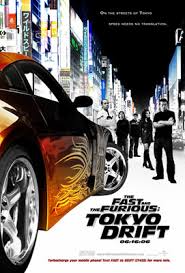
Worst plot, best driving. So my darling described this film, and I think he’s right. Drifting is simply glorious, I think because while I can feasibly imagine driving very fast in a straight line, drifting is an utterly alien skill set. Also, it’s through Tokyo, and that just looks magnificent.
Also, there’s Han: Sung Kang. Dude is so cool he’s basically ice. He’s my very favourite. Plus DK – the stereotypical jumped-up wannabe villain with too much arrogance and testosterone, playing on his uncle’s yakuza ties – is actually pretty awesome too. If only because he does menacing beautifully.
Foreigner in Japan, making all the mistakes… blah. It’s just not done interestingly enough to make the cliche worth it. Also the father-son reconciliation makes no sense. And given that it’s all about a white boy learning drifting from the Japanese kids and then beating the best, it’s could be seen as another example of white man being better than non-white man at something that’s native. In a sense, anyway.
And look, I’m sorry to the Americans, but Sean’s accent really doesn’t help matters. (Neela’s Australian accent is also totally out of place and unlikely.)
Fairy tales. New ones.
Sometimes I forget how much I love reworkings of fairy tales. How crazy is that?
Ever since my mother (I think?) gave me a lovely little collection of twisted fairy tales – I have no idea what it was called, whether they were all by the same person, or whatever – I have been passionate about people taking well worn stories and twisting them. Sometimes slightly, sometimes extremely. But, it turns out, I forget this. And then I read Troll’s Eye View, and I remember… because sometimes the villain is absolutely the most interesting character, and sometimes they’re not actually a villain if you look at them a certain way. And I read To Spin a Darker Stair, and the prose is wondrous and the stories gripping.
But then I forget. And I have something like Paula Guran’s anthology Once Upon a Time: New Fairy Tales sitting there waiting… waiting… waiting to be read, and when I finally get around to reading the first one I think, why have I been waiting so long?
Maybe having written this, I am less likely to forget in future. I can hope.

I enjoyed every story in this anthology; some more than most, but there wasn’t a one that I flicked through impatiently. There’s a great range of stories. Yoon Ha Lee, whom I’m just discovering, brings a Korean-inspired story in “The Coin of Heart’s Desire” that fits into the “be careful what you wish for” zone; Cinda Williams Chima brings native American folklore into a “gritty industrial landscape” a little bit like Charles de Lint. Angela Slatter turns a princess into a bird in a story of revenge, while Priya Sharma, in “Egg,” wonders about all those stories where all the woman wants is a child… There are retellings, too: Genevieve Valentine plays with “The Snow Queen,” Jane Yolen and Ekaterina Sedia take “Sleeping Beauty” in two completely different directions (Sedia does it better, I think); Tanith Lee uses the one about the dancing princesses. Richard Bowes brings a sardonic Puss in Boots into the world of social media and Caitlin R Kiernan takes Little Red Riding Hood into space. Cory Skerry smashes “Beauty and the Beast” and AC Wise makes “The Six Swans” a rather darker story about desire and selfishness. Perhaps most profound is Erzebet Yellowboy, whose story means I will never, ever view the (step)mother in Snow White in the same way again.
This is a glorious anthology – one that you could sit down and read cover to cover, or dip in and out of.
You can get Once Upon a Time from Fishpond.
Thunderball
This review is part of Project Bond, wherein over the course of 2014 we watch all of the James Bond movies in production order.
Summary: in which James Bond is back to fighting SPECTRE, often underwater. We’re back to being worried about atomic weapons, and the problematic nature of plastic surgery. Also, Nassau means bikinis, baby. Yeh.
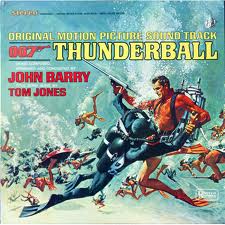 Alex: This Bond moves firmly back into the SF zone with James Bond escaping from some villains at the start of the movie with the help of a jetpack. Seriously, the thing is straight out of the Jetsons. But because he is with A Girl, the jetpack is only useful to get him over a wall to the waiting car; then it’s into the DB5 and up with the bullet-proof screen. The prologue is a classic whack-a-villain sequence; in this instance the only immediate indication we have that the villain is such is that he is cross-dressing in an awesome blonde wig.
I love Tom Jones. This theme song is up there with my very favourites.
This movie sees Bond back to battling SPECTRE – and just like before, if you missed the one and only explanation for what SPECTRE stood for, tough cookies. Once again, Number 1 has no face, but he does have a ruthless streak as wide as the electric chair he utilises on someone who appears to be skimming proceeds. We’ve got a new Number 2: Largo, who proves to be a key player in this film. He has an eye patch. He is therefore, by default, evil.
Most of this film is again set in foreign locations – it opens in France and moves to Nassau – but there is a fairly long stretch in a sanitarium, where Bond is recovering from his last adventure. This involves canoodling his physical therapist. At least, he wants it to; she protests in rather strong terms, which nearly made me cheer. Then he is nearly killed while on a torture-rack-cum-massage-contraption, and in return for him not reporting her… well. Pretty sure that qualifies as blackmail, sir. You are a cad. The sanitarium also sees Bond just happen to come across a man who has been killed, who turns out to be someone else’s doppelgänger… which ends up being the key to the entire mystery. But I get ahead of myself.
While Bond is having massages, a NATO team is out flying a training sortie that involves two real live atomic bombs. Our doppelgänger has killed the real pilot and taken his place, then gasses the rest of the crew while they’re flying around. So he helps SPECTRE steal the bombs. But SPECTRE don’t really want the bombs for themselves – although they’ll probably detonate them anyway; it’s all about blackmailing the British government. For ONE HUNDRED MILLION pounds. (I can’t help but be reminded of Austen Powers.) And the way the government will signal that they agree to the plan? By making Big Ben strike 7 times, at 6pm.
I love the British.

Anyway, off to Nassau; Bond meets the dead pilot’s sister, who is Largo’s mistress and called Domino because she’s always in black and white; he eventually solves it all and they all live happily ever after. But there are some interesting things to comment on along the way… like the fact that Largo keeps sharks, which means I get to reference another XKCD comic! Also that he does not utilise the sharks that well, because Largo falls into that classic Bond pattern of the Gentlemanly Villain. There were so many opportunities for Largo to kill Bond, but when he’s come for lunch it would be soooo rude to push him into the shark pool, don’t you know.

Also in the Bond pattern: a new Felix Leiter! This time a fella who looks like the poor man’s Clint Eastwood, in sunglasses. Q turns up, in a Hawaiian shirt that hurts my eyeballs, and he and Bond go way beyond sparring into evincing quite withering dislike of each other. This hurt my heart a little. Bond’s main assistant in Nassau in female, and black. Naturally, she dies.
Bond gets around quite a few laydees in this film. One of them is with SPECTRE – Fiona – and I quite liked her. I particularly liked her when, after having sex with Bond and then the goons turn up to capture him, she totally calls Bond on that trope that I’m not allowed to name. Bond is snide and says he did it for King and Country, and she is contemptuous of the idea that sleeping with him would make her switch allegiance. Of all the unexpected things, Bond got meta on itself! I nearly cracked up when that happened! And then she died. Because Bond moved her into a bullet (again. This is a habit).
The one thing that really spoiled this film for me was the underwater fight scene at the end just going on toooo long. I’m guessing it was all new and exciting technology, but… it got a bit wearing. I was hoping for some fun when the sharks turned up, but even they were a bit boring.
Hey James, that underwater grenade scene. Would that actually have been as bad as Bond makes out?
James: Yes, water is incompressible so explosive underwater = very unpleasant and direct impact. Also … The nuclear bomb labelled “Handle like Eggs”? love it. I have to say, as a young man I enjoyed the underwater fight very much (which I have seen very many times), but on the re-watch it did rather drag on – 2.5 Martinis.
Midnight and Moonshine
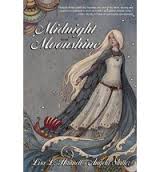
This book. Oh, this book.
It took me a few months to read this collection, this mosaic novel. This is no reflection on the quality of the book. Well, actually it is, but not the way you might think. See, I’d read a story, and then I’d be forced to close the book, sigh, and stare into space in order to wallow in the beauty of the prose. And then I’d have to go read something else, because (like with me and Gwyneth Jones’ Bold as Love series) sometimes too much beauty is painful and you need a break.
First off, look at that cover. Is she not glorious? are the colours not soothing and enticing? Created by the awesome Kathleen Jennings (who chronicles the saga of its production on her blog), I would absolutely have this on my wall. LOVE.
Angela Slatter and Lisa L Hannett created the contents. Writers who collaborate are even more of a mystery to me than authors who work alone, and to produce this sort of magic has to be just that – occult somehow. And they haven’t been content to just a straightforward story. Instead, as suggested above, this could be seen as a collection or a mosaic novel. A collection because it is made up of short stories that can basically stand by themselves. You could take one and put it in an anthology and it would still work ok. However – and here’s a metaphor I’m very pleased with – that’s like taking a candle out of a chandelier. Yes, it still sheds light. But when you put it with its fellow candles and they’re ringed with crystal, the whole effect is so much more just a few candles in one place. These thirteen stories, read together and in sequence (and wrapped in that art), are far more than the sum of their parts. Together, they create a history of an entire people: their origins, their interactions with humanity, their crises and triumphs, and the ongoing impact of a few families and their heirlooms. Thus, a mosaic novel – there is continuity, but it’s thematic and genetic; there’s only one character appears in or influences lots of the stories. I couldn’t help but be reminded of Edward Rutherford (London, Sarum) and James A Michener (The Source) following multiple generations in one place in order to fictively illustrate local history. Slatter and Hannett do just that… with magic. And Norse gods. Same amount of revenge though.
The premise, as set out in “Seeds,” is of Odin’s raven Munin (memory, here called Mymnir) surviving Ragnarok and setting out for Vinland (thought to be somewhere on the north-eastern corner of North America) with a few followers. Once she gets there, she creates an enclave and peoples it with servants, and sets out to rule it I guess like she learned from the Aesir she’s observed for however many centuries. Of course this does not go entirely well either for her or for her people. There’s love and betrayal, selflessness and vindictiveness; people get beaten up, rescued, married off, wooed… and some people even manage to make their own destinies. My estimate is that the stories take place over roughly a millennium, but that’s based entirely on the fact that that’s about how long ago it’s posited that Vikings did historically head off for Vinland and settle for a short span. The early stories take place in a sort of timeless, medieval-ish zone; from memory there are no dates in the first seven stories, and it feels like that sort of myth/fantasy where time itself is important but recording it is less so. Then, with “Midnight,” suddenly the external world exists and thrusts itself onto this dreamy place. From then on, time is relentless, and within 5 or 6 stories it’s the modern world. This development works mostly because although the stories do stand alone, there is continuity within families. Sometimes the names give them away, sometimes it’s an heirloom appearing, occasionally a reference to a past event. This often means that rather than having to struggle for a new emotional connection every time, the reader can build on the investment already made in the character’s family, from an earlier story. It’s the same reason Rutherford and Michener’s works can be successful.
And on top of all of this, the sheer beauty of the prose. I do not have the words to explain how delightful the words in this book are. It just all works.
Did I mention it’s an Australian production? Produced by Ticonderoga, in Perth.
You can get Midnight and Moonshine over at Fishpond. (Although it does ship from a US supplier.)
The Dream Archipelago

This collection of stories is characterised by non-completion. By ellipses, gaps, loss of memory, tantalising hints of more, general incompleteness. In the stories themselves, in the people, in the world.
This turned out not to be the book I thought I was reading. Having adored The Islanders, I thought I was getting an earlier novel set in the same place. Uh, no. This is a set of short stories (including a couple of novellas): some set in the Dream Archipelago, some just referencing it. So I was quite discontent when I read the first ‘chapter’ – The Equatorial Moment – and accepted it as setting the premise for the book… and then realised that The Negation was quite separate, although with strong links. Don’t worry; I got over my disappointment.
“The Equatorial Moment” is not a story. It’s a vignette, explaining the very odd thing about this world: that there is a time vortex, which means it’s the same time everywhere on the world at the same time. It also means that flying somewhere is a rather difficult business. It also sets up that this world is experiencing a war, which – far more than issues to do with time – informs the entirety of this collection. “The Trace of Him” is also a vignette, of a lover and a funeral, that doesn’t really seem to fit the rest of the collection. It’s set in the Dream Archipelago, but that’s all.
Some of these stories are directly about the war, and its impact on soldiers and civilians. “The Negation” is framed around a draftee and his experiences, but also around an author whose art might be subverted by the war. (Its connection to the Dream Archipelago is tenuous – the novel that the soldier loves is set there.) This story was the first taste of incompleteness that flavours the rest, as Priest suggests and hints but does not fulfil. It’s marvellous. “Whores,” too, examines soldiers and civilians, through a different lens. This time the soldier has been granted leave due to sickness which manifests as synaesthesia; the civilians are women who have become whores because of the exigencies of war. This aspect, that the women are not simply whores but that they became such for real, usually economic reasons, and that they might also have other concerns, was a delight. Too often whores (and slaves) just exist in the same way that horses or dogs do, with no reference to what came before. So that worked. And there’s a tantalising question over whether the soldier in these two stories is the same man or not. The last story in the collection, “The Discharge,” also brings together art and war and ellipses. It’s the fullest exploration of the war that’s been affecting this world for a ridiculous amount of time, and makes it clear that ridiculous is exactly what it is. But then the narrator ends up in the Dream Archipelago, and starts exploring art… a type of art that has a genuinely visceral impact on its viewer by messing with the hypothalamus. And the story takes on a whole other layer and attacks a whole other idea. It’s maddening and glorious and a bit creepy.
You know that thing where you’re reading along, and you’ve been assuming something about the race, gender, location or attitude of a character and then something happens and you have to go back and read everything again to see whether you were stupid and made a mistake, or whether the author has been deliberately messing with you? That was “The Miraculous Cairn” for me. And I’m pretty sure the answer is the latter. It’s set half on the mainland and half on an island; half in the present and half in the past; and it’s a horror story. One of those slow, creeping horror stories that might not be a horror story but probably is. Gave me the shivers, anyway, and is the exemplar of non-completion. It has nothing to do with the war. Neither does “The Cremation,” which is set more fully in the Archipelago and whose horror aspects stem directly from that fear of not knowing the local traditions and attitudes and behaviours. It works all too well. Also largely separate from the war is “The Watched,” whose horrific nature really only comes through in the last few pages. Before that, it definitely has its creepy elements but they’re not the focus (although on reflection perhaps that ought to have made it more creepy…). The tantalising gaps in this story are the sort of thing that in another author’s hands would just indicate a lack of imagination, or pages where they’ve simply deleted “MUST ADD MORE INFO HERE”. Instead, the reader is left just as much in the dark as Ordier about the society of the Qataari, his object of frustrated fascination. What makes the novella really work is that this fascination, while at the heart of the story, is not its sole preoccupation. Ordier – living in the Dream Archipelago but not a native, having left the mainland and his war-related work – lives a relatively ordinary life with a girlfriend whose job is demanding and disappointing, and we get many pages of relatively ordinary life along with Ordier’s growing obsession. This adds to the creepiness but it’s not just there as filler; actually I would have been happy reading about Ordier and Jenessa and their experiences, they’re so intriguing. Which is why it works as a novella.
Are they SF? Is this fantasy? No. The collection is set on a different world, yes; but there’s no exceptional technology – it would be easy to read much of it as set in a generic olde worlde rural setting until you get references to planes, grenade launchers and microwaves. There’s also no magic; the time vortex just exists, and except for stuffing around with air travel doesn’t actually impact on life. The people are human, with nothing special about them. This is just… a world. But I would still argue that it counts as speculative fiction, because I am contrary like that.
This is not the sort of collection I can imagine reading again. The stories are demanding, they’re frustrating, and I think they may only work once. But that once was pretty glorious.
Where Time Winds Blow
I have been a fan of Robert Holdstock for a while, both for the Mythago Wood series and his Merlin/Jason and the Argonauts books, which I still haven’t finished… oops… I’ve had this book on my shelf for a very long time, and as part of my effort to deplete the TBR pile I’ve finally got around to it.
Interestingly, this reminded me of two books. Firstly, the idea of a planet with weird time distortions of course calls to mind Dan Simmons’ Hyperion Cantos; this came first, and I can’t help wondering about influence. Secondly, there’s also a similarity to Kress’ Steal Across the Sky, this time in its attitude toward the alien. Aliens were a means to an end for Kress, allowing her to explore different aspects of humanity or society; VanderZande’s World allows Holdstock to do the same. The people are there because of the time winds that rips ng things from the past and the future and deposits them in the present (and presumably other times as well, but let’s not think too hard about that)… but this oddity is mostly just a vehicle for Holdstock to explore humanity.
Humanity have settled on this world partly to explore, and learn to understand the time winds, and partly to colonise. The first is the focus of the story, although the second is touched on and is one of the most interesting issues. The main narrative focuses on a rifter – a man whose purpose is to investigate the stuff appearing after the time wind has blown through. His world starts to go a bit pear-shaped when a new recruit joins his team. Holdstock is interested in how people deal with stress, and how this impacts on relationships, and gradually reveals more of Leo’s life and issues. Of course, things aren’t even as normal-life complex as they initially appear, and Holdstock makes the issues of the past come through in such a way that makes complete sense with what has already been revealed.
Alongside this narrative, Holdstock gives tantalising hints at the world he imagines. It would be human-compatible, but its organic life creates pollens that are toxic. There are two responses to this issue (well, three, because there are also the people who don’t bother to try and settle there): the colonists who are hoping to eventually evolve to the point of unassisted survival; and the manchanged, colonists who have artificially intervened into themselves in order to live without assistance now. The hostility between them is barely examined, but adds depth to the overall narrative as well as depressing believability.
The one problem I had with this book was about the last 20 pages. They felt rushed and forced, and wrapped up an issue in a way that neither felt integral nor necessary. So that left a slightly sour taste in my mouth, which is unfortunate given I enjoyed the rest of it.
From Russia with Love
This review is part of Project Bond, wherein over the course of 2014 we watch all of the James Bond movies in production order.
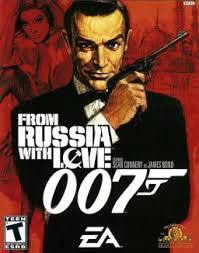 Summary: Bond is lured to Istanbul to help SPECTRE steal a Russian encryption machine. Also, there is bellydancing. And stroking of a cat.
Alex: I’ll start by talking about the gender stuff, because the representation of women’s sexuality is quite interesting in this movie. Two women throw themselves at Bond – which is not exceptional in the canon, but in Dr No Honey Rider was quite reticent and Sylvia wasn’t immediately ripping his pants off, so in 1963 there’s no precedent. Additionally, Kerim Bey – Our Man in Istanbul, and not an especially handsome one – has women dragging him off to bed, and two women in the gypsy camp have a fist-fight over who gets to marry the chief’s son (who as far as I can tell, is never seen). So women are sexual creatures, mostly; the only other woman we really see is Rosa Klebb, but she’s old so clearly she doesn’t count (sarcasm!), because she sure doesn’t do sexy. The young women  are passionate; in fact, they can barely contain themselves. Bond is generally happy to go along with it; while he doesn’t really initiate anything he does take over when he goes along with it. Bey seems to see pleasing his women as a chore (he actually sighs and says “back to the salt mine” when he agrees to canoodle with one), but has an endless number of sons and extols the virtues of big families. From this I guess we learn that women are ruled by their passions and men are ruled by cool intellect? Or something to that effect. Also, of course, in Bond we have an example of the Magical Penis trope (I really wanted to find a link to explain that, but it wasn’t obvious on TVTropes and NO WAY was I going to google it) – he turns Tatiana into a Good Woman through sex.
The mechanics: we get a prologue! In which Bond appears to be hunted and killed, but it all turns out to be a training exercise for Scary People. From which we learn that Bond is already a force to be reckoned with. There is also clear continuity with past movies: Bond is canoodling with Sylvia, the woman from the opening of Dr No, in his first scene here; and SPECTRE are very keen for Bond to be the agent they lure to Istanbul not least to take revenge for his killing of Dr No. Also, SPECTRE! Whose name is not explained in this film so if you weren’t paying attention the one time the acronym was explained in Dr No, sucks be to you.
I was intrigued by SPECTRE, actually. I had forgotten that the face of Number 1 is never shown: just his hand, stroking the white cat, thus spawning ever so many copycats (Baron von Greenback in Danger Mouse, Claw in Inspector Gadget, the villain in Austin Powers… who have I forgotten?). We don’t know his name, and it’s not given in the credits. SPECTRE as an organisation is clearly well-organised (they have a secret training base! Number 5 is a chess champion! They use live targets in training!), and the movie wants us to be aware of their power: it devotes the prologue and then the first maybe 10 minutes to them, showing them as focussed and driven. Conversely, when we finally do get to Bond, he’s relaxing on the banks of a river with a woman. Where Tatiana has just said she is willing to use Feminine Wiles to serve Mother Russia (she’s an unwitting agent of SPECTRE), Bond is using Masculine Wiles just to enjoy himself. A nice dichotomy is set up, which is somewhat undercut by Bond’s willingness to jump at M/Moneypenny’s orders… until Sylvia persuades him to stay just a little longer.
It should of course also be mentioned that this movie sees the introduction, albeit all too briefly, of Q – the eQuipment Officer. Who gives Bond some gadgets, but they are disappointingly low tech and there is a tragic lack of snark from him.
 Other things confirmed by this film: being Bond’s associate is a dangerous business, as Kerim Bey ends up dead. Hmmm… given Quarrel in the previous film, perhaps it’s only dangerous if you’re not white? OK, maybe two films isn’t quite enough to make this generalisation.
Things I did not know until I went to IMDB: Daniela Bianchi, who played Tatiana, was dubbed for this role because her English was so poor! But she was 1960’s Miss Rome so I guess that makes… no, it doesn’t make sense at all.
James: First a note to the editor, if the phrase ‘Magical Penis’ is used in another review my subscript notes will cease.
Alex: it’s a real trope! Happens all the time!!
James: Another tip of the hat to the negative restoration and transfer quality for the Blu Ray nerds. So much of this film has been filmed on location in Istanbul and it really shows, much less blue screen etc. Compared to future Bond the majority of the film centres around one city and few locations, the two embassies and some tourist highlights in Istanbul (The Blue Mosque, Basilica Cistern, Hagia Sophia and the Bazaar). One thing that doesn’t really make sense is that all film the good guys know the bad guys are lurking and yet they are so casual about security … For example on the train Bond tells Tatiana ‘Lock the door, I’ll knock three times’ as the bad guys walk up and down the corridor and occupy the cabin at the end of their carriage. I did enjoy that Bond marks the major villain who’s been stalking him all film by his choice of red wine with fish, and not a million other more obvious things he’s done. 2.5 Martinis (which curiously don’t feature in this film at all).
Lefebvre and the French Revolution

Just look at that cover. Does this look like a history book to you? No it does not. But this is the first volume in Georges Lefebvre’s outstanding history of the French Revolution. Rather than, as the cover suggests, a cook book.
This book is definitely not one for beginners. Lefebvre assumes some knowledge of both the Revolution itself and the the late 18th century in Europe more generally, and if you either have no knowledge or aren’t quick on your feet when dealing with names and politics – well, this will be a hard book to read. Me, I’m pretty good on the French side of things, and that’s the only way I managed to read this without feeling like a complete idiot. There’s also no glossary, so woe betide the reader that misses a term that was explained early on… or wasn’t explained at all and you’re just meant to understand it, but maybe don’t.
One of the most awesome aspects of the book is the very fact that it places the Revolution in its broader European context. I had no idea of the Austrian/Prussian/Russian machinations that were going on at the same time as they were posturing about and around France; the controversy over Poland in particular made me realise just how much I have always viewed the French Revolution in isolation. That is, I know that the American Revolution had an impact, and so on; but I had forgotten that of course those countries who eventually invaded had other things on their mind than just an annoying neighbour. This is a common failing of mine, I have realised. So Lefebvre’s insistence on providing a really broad context – much broader than I would have thought necessary, with the internal politicking of Pitt etc – makes this a quite remarkable part of revolutionary historiography.
The most annoying thing about this is that it is part one of two. And this translator did not, apparently, do part 2 – which incorporates the Terror, and Thermidor, and Danton being his most awesome. Still, Lefebvre does give a succinct overview of the issues leading to the Revolution, as well as description of the early years. Perhaps the most amusing aspect is that he appears not to like anyone. He doesn’t seem to like the proletariat (as he terms them), nor the peasants, and the bourgeoisie quite often come in for disapproval. And let’s not talk about the aristocracy. The other thing of note for those of us who’ve done history more recently and have been forced to deal with issues of historiography and the post-modern/post-structuralist turn is Lefebvre’s utter conviction that his interpretation of events is right. In fact, it’s not even a conviction – that would suggest it was something he had given thought to. No; this is just the facts, and that’s all there is. Which is very appealing, if a little dangerous in the 21st century.
The translation is superb; there was no point at which I thought that it was convoluted or messy.
Steal Across the Sky

There are interesting parallels between this and Mary Doria Russell’s The Sparrow. Both deal with humanity’s contact with aliens, and with the repercussions for humanity especially in the realm of religion. There are vast differences, of course – how contact is achieved, the type of people involved, and so on. I think Russell’s is better, overall; I appreciated the characters more, and I think it’s overall a more sober look at the repercussions for humanity. But I also think the two books are trying to do different things, and Kress has achieved something impressive in her novel.
Aliens have contacted humanity with the sole intention of Atoning for some crime they committed against us… ten thousand years ago. They don’t reveal what that crime is, nor how they intend to atone for it. Instead, they talk to anyone who can get the bandwidth to reach the moon, and set up a boring website asking for volunteers to act as Witnesses. Predictably, they get millions of applicants, of whom 21 are chosen to go to seven different planets – planets inhabited by the descendants of humanity kidnapped ten thousand years ago (cue Stargate music). This, however, is not the crime. Almost the first half of the novel focusses on Cam and Lucca, Witnesses sent to a binary planet system to live with their many-times-removed cousins in order to discover the thing that they will ‘know when they see it’, according to the Atoners. Intriguingly, numerous chapters are also given to one of those whom the Witnesses interact with, providing an at time painful glimpse into the arrogance and cluelessness of one Witness. Slight spoiler, which really isn’t: they discover the thing. They don’t really know it when they first see it. But, as the blurb promises – or threatens – the knowledge does change them, and at least some people back on Earth. The rest of the novel is working through the repercussions of that knowledge, this time largely switching focus to other Witnesses, and only occasionally returning to Cam and Lucca. And, similar to Kim Stanley Robinson so gloriously in 2312, chapters are punctuated with ephemera: conversation transcripts, Oprah interviews, advertisements, etc. These add a wonderful verisimilitude to the world that Kress imagines, only a decade away from now: many thing similar (yes, Oprah; also internet trolls); and some different. Kress throws in some lovely SF-ish moments – just enough to be incongruent, to remind the reader that this is not today.
What this book is not is an alien contact story. Yes, it deals with first contact, and yes the aliens are pivotal. But that’s exactly what they are: a pivot, a lever, a fulcrum. They are a point about which the plot revolves, but not the focus. They are almost completely opaque and don’t exist as characters at all. Rather, the focus is on humanity: how humans react, how humans interact. For an SF novel involving aliens and space travel this is a distinctly earthly novel. It’s also a bit depressing, but perhaps that’s a reflection of a near-future novel published in 2009. That’s not to say that it’s without hope, but… it’s not especially upbeat. Nonetheless, I did enjoy it overall. As mentioned above, Kress deals with the repercussions of the Witness discoveries on religion, as well as on other aspects of society. For this, and the fact that she treats religion seriously (even if it is only through Catholicism, which isn’t completely representative of Christianity let alone all religions on the planet… perhaps it is the most prevalent religion in the US, where it’s largely set? I don’t know), definite kudos. I still think Russell did it in a more nuanced manner, but it was also more of a focus for Russell than for Kress, who is writing a story that’s closer to thriller than philosophical treatise, whereas Russell is the opposite. And Kress does what I presume she set out to do: write an engaging, enjoyable, intriguing novel that combines off-beat characters – not all of whom are likeable – with a plot that keeps you flicking pages (I read it in a day…) and, cliches ahoy, a serious kicker at the end.
Steal Across the Sky can be bought at Fishpond.
Local suffrage history
This is quite impressive, for me: my mother bought me a book that I read before it got dust on it! (Think I’m exaggerating? See this review and this one for how I am a bad daughter.)
 Anyway, knowing that I am developing a keen interest in the history of women’s suffrage in Britain, Mum found me Burning to Get the Vote, a history of the suffrage campaign in Buckinghamshire.
There were two things that did not work for me in this book; one substantive, the other a niggle. The first is that I don’t know the area, and that definitely had an impact on my enjoyment. This is not really a reflection on the book itself, although a map would have gone some way to alleviating that issue and made it more accessible for non-Bucks readers, and especially non-UK readers. Instead it’s a reflection that probably, this history wasn’t imagined to have a general readership outside of the locality, and an academic one a bit more broadly. So I lived with that; I skimmed over the bits where Cartwright goes into detail about the actually location of various meetings – which is probably a delight to those people who know High Wycombe or Wendover or Aylesbury. The second, the niggle, is a style thing. There were a lot of commas that I felt were misused.
Those things aside, this volume has a lot going for it. Cartwright has clearly undertaken a monumental task in sifting through local newspapers to find references to suffrage (and anti-suffrage) activities in his area, as well as digging up minutes from meetings and some correspondence as well. This in itself I find fascinating: the suffragettes and suffragists (the terms, sometimes interchangeable, were often used to differentiate between militant and constitutional approaches) were often holding important enough meetings that they did feature in the media – despite not always getting big numbers to those meetings, and perhaps sometimes because of the opposition they met.
What this history does is set the national women’s suffrage campaign in a local context. So much of this story that gets popularly talked about is London, or perhaps Manchester, based – which is unsurprising because it’s where the Big Names (Pankhursts, Fawcett) were, and where a lot of the eye-catching activities (pilgrimages to Hyde Park, chaining to gates) occurred. But as I’m increasingly realising, this doesn’t cover the entire campaign. And how could it? Of course it is important to convince non-capital city residents of the righteousness of your cause! The leaders of the WSPU and other organisations all travelled around the country, drumming up support. They corresponded with the women (and men) organising local branches in small towns. Sometimes, they retreated to the countryside to recover from hunger strikes and force feeding. So this book should help Buckinghamshire people to understand their contribution to an important national movement, and it should make everyone else realise that history does occur in small towns, too. It should also be seen as a spur to people who are running similar campaigns at the moment. There is no doubt that many of the people (especially the women, I would suggest) who were involved in Buckinghamshire probably got quite disheartened over time; their numbers were never huge, the number of supporters was varied, there was active dislike and vitriol from the community… and it took a really long time. Cartwright believes that the first 20th century women’s suffrage meeting in the county was held in 1904 – although there was some action in the nineteenth century too; women got limited rights to vote in 1918 (over 30, married to a householder) and then voting rights on the same terms as men in 1928.
I liked that Cartwright went to some lengths to find out details about many of the women involved, which often involved finding their obituaries. I appreciated the extensive quotes – from newspapers largely – from the speeches made, and in debates with anti-suffrage campaigners. (The notion that the newspaper would quote so extensively from speakers is awesome.) And I also liked that he included a chapter on those anti-suffrage activities, to demonstrate the arguments that were being made and to show that the suffragists weren’t just battling indifference but serious opposition.
This book is not for the general reader – unless you’re from central Buckinghamshire, in which case definitely read it since you might be living in a house that was used for meetings! But it’s great if you want to see how local history can and should be interesting, or if you’re interested in suffrage history more generally. There is also a bonus for Australian readers: Muriel Matters, an Australian suffrage campaigner, worked quite a lot in the area and is mentioned several times.

 Randomly Yours, Alex