The Fall of Egypt and the Rise of Rome
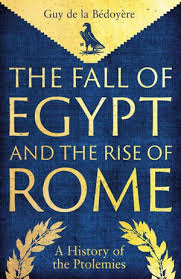
Read via NetGalley and the publisher. It’s out now.
My feelings on this book are conflicted. There are some good bits! There are also some frustrating bits that definitely got in the way of my enjoyment.
The good bits: just the existence of a book about the Ptolemys is a pretty good thing, I think. They so often get ignored in histories of Egypt; and they just end up as a prologue to Cleopatra VII. And I get it – it’s hard to figure out where they fit in, as an invading ruling family that doesn’t fit with OG Egypt. I am also intrigued by the idea of putting the Ptolemaic dynasty and the rise of Rome together: if you know anything about the two, you know they have a stunning convergence in Cleopatra VII/ Caesar / Marc Antony, but what de la Bedoyere shows is the ways Egypt and Rome had been interacting for generations beforehand, and why therefore Caesar went to Egypt and Cleopatra thought getting the Romans involved made sense. I have a much greater appreciation now for the ways Rome was meddling in their surrounds, and how Egypt and Syria and others were using external players in their internal struggles.
Other positive aspects are the fact that the women get some discussion (although that’s also a source of frustration, see below), and the fact that this is written fairly accessibly, within the confines of ‘there are a lot of the same names and that gets very confusing’. I appreciated that the author did acknowledge things like ‘Roman historians have a LOT of prejudice’ and that there are several aspects of Ptolemaic history where historians simply do not have enough information to adequately explain things.
So. The less good bits. Firstly, the frustrating-ness is partly a product, I suspect, of writing a book that’s intended to be generally accessible – so it doesn’t go into a lot of detail about some aspects, and doesn’t have all THAT many references either. Instead, the author just makes claims… which are sometimes such that I raised my eyebrows. Perhaps the most egregious, from my perspective, is the fact that he doesn’t try to examine why various non-Roman kings in the Mediterranean world would appeal to Rome at the start, when Rome is an international upstart. He simply says that it happens because the Romans had won some wars. There seems to be an underlying assumption that Rome was always going to preeminent, so it makes sense that everyone acknowledged this early on. I wanted to write “needs more evidence” in the margin.
Secondly, the portrayal of the women is fairly problematic. The second Ptolemy was the first to marry his sister. De la Bedoyere blithely states that the sister, Arsinoe, basically made the marriage happen after she ran to her brother for help when previous marriages had gone badly wrong, because she was so ambitious. There is no explanation offered for her characterisation as ‘ambitious’. The fact that she married various rulers doesn’t tell us anything about HER attitudes. There is no suggestion that maybe Ptolemy forced or convinced her to marry him. Given the extravagant after-death cult stuff set up by Ptolemy II – which may be partly about playing into Egyptian religion – it seems more like to me Ptolemy II was either besotted or very, very political (why not have both?!). There are other moments when the various other Cleopatras, Berenices, and Arsinoes are also treated like this: mothers acting as king instead of stepping down for their sons, or manipulating brothers… and maybe some of them were indeed political machines! But I need evidence of that – because achieving that in such a patriarchal world would be admirable and worthy of applause! I point you also to this claim: “Worried that her power and influence were waning after his triumph over [another ruler], [Cleopatra Thea] tried to poison her son. Having already killed one child, killing another must have seemed comparatively easy.” NO WORDS.
Fourthly, connected to what I said earlier about acknowledging the problems with Roman sources in particular: relaying what those sources say in great detail, AND THEN spending a couple of lines saying ‘but we can’t take everything they say at face value’ doesn’t really work. Pretty sure that’s what lawyers do when they know a jury will be asked to ignore some evidence, but THEY’VE ALREADY HEARD IT (lol, at least that’s how it works on tv, and you see what I mean). I really think those sections – usually bad-mouthing a Ptolemy, and especially Cleopatra VII – needed to be PREFACED with ‘but the Romans had an agenda’. I really got the sense that de la Bedoyere doesn’t care for Cleopatra VII at all, to be honest; he claims she didn’t care for Egypt in the slightest, just her own power, and again – I’d like to see more evidence please.
Finally, there are some odd choices in terms of the book’s presentation. Every now and then there are boxes with random bits of information that is tangentially connected to the main part of the story. I found these more distracting than helpful – although I guess YMMV and maybe for some people this really works.
Overall… I’m reluctant to recommend this to an Egypt or Rome novice. I really think you need a slightly sophisticated reader who is able and willing to question some of the assumptions, and put things into context. So like I said: I am conflicted.
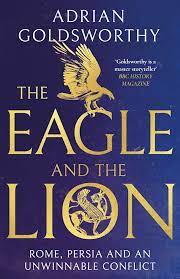
The Eagle and the Lion: Rome, Persia, and an Unwinnable Conflict
I read this thanks to NetGalley and the publisher, Apollo. It’s out now.
Some time back I read a book about the Mongolians, in particular at the western edges of their advance, and how those kingdoms related to what I know as the Crusader States. It completely blew my mind because I’ve read a bit about the ‘Crusades’ general era, and that book made me realise just how western-focussed my understanding had been: the invading Europeans connecting back to Europe and maybe Egypt (thanks to Saladin); maybe you’d hear about the Golden Horde occasionally. But interacting with the Mongols was HUGELY important.
This book does a similar thing for Rome. My focus has always been on the Republic and early principate, so maybe that has had an influence. But in my reading, Crassus’ loss at Carrhae is present but (at least in my hazy memory of what I’ve read), it’s almost like Parthia comes out of nowhere to inflict this defeat. Persia then looms as the Big Bad, but I think that dealing with the Germanic tribes and the Goths etc seem to take a lot more space. Even for the eastern empire, which is definitely not my forte, regaining Italy etc and fighting west and north (and internally) seems to get more attention.
And then you read a book like this. It is, of course, heavily leaning in the other direction; that’s the entire point, to start redressing some of the UNbalance that otherwise exists. These two empires could be seen as, and describe themselves as, the “two eyes” or “two lanterns” of the world (those are Persian descriptions); for basically their entire collective existence they were the two largest empires in this area (China probably rivalled them at least at some points, but although there were tenuous commercial connections, they’re really not interacting in similar spheres). It makes sense that the relationship between them, and how they navigated that relationship, should be a key part of understanding those two empires.
Goldsworthy does an excellent job of pointing out the limitations in ALL of the sources – Greco-Roman, Parthian, Persian – and clearly pointing out where things could do with a lot more clarity, but the information just doesn’t exist. Within that, he’s done a really wonderful job at illuminating a lot of the interactions between Rome and Parthia/Persia. And he also clearly points out where he’s skipping over bits for the sake of brevity, which I deeply appreciate in such a book.
It’s not the most straightforward history book of the era. It covers 700 years or so, so there’s a lot of dates, and a lot changes in this time as well – republic to principate to later empire, for Rome; Parthian to Persian; countless civil wars on both sides. A lot of leaders with the same or similar names, unfamiliar places names, and all of those things that go towards this sort of history book requiring that bit more attention. I definitely wouldn’t recommend this as My First Roman History Book! But if you’re already in the period and/or area, I think this is an excellent addition to the historiography. Very enjoyable.
Julius Caesar on stage
I went to see Bell Shakespeare’s version of Julius Caesar last night as part of my 2010 Christmas present from my mother (Much Ado About Nothing was the first half, in which I laughed harder than I ever have before in a theatre). Often Bell makes a point of shifting a play into an obviously different era – Much Ado had a 1950s Italian-American vibe going on. But Julius just had the players in suits, and other than that was quite timeless.
It was a marvellous production and I am sure there are any number of brilliant reviews already out there. There a couple of things I wanted to note. One is that Cassius was played as a woman, which worked surprisingly well in that very few of the lines actually took on any other significance – unlike when Rosencrantz and Guildenstern are women, which I’ve seen, and gives their interaction with Hamlet maaaany more layers indeed. The woman who took the role was very good, although she did make her quite sharp and shrewd – interesting to consider whether I would have got this impression about a man (I haven’t seen this performed in years). Should also mention that Brutus was exceptionally good – and older than I have seen him played before, as was Caesar himself, which I really appreciated. Also Portia, Brutus’ wife, was agonisingly wonderful.
Mark Antony was appropriately young, and had a very clever transition in terms of costume: the first time he is on stage, his trousers are rolled up and he was shirtless. A bit later he was in a hoody… a while later he was in ‘office-casual’, shirt with cotton sweater; then by the end in quite a sharp suit, with his hair tied back (it had been out for the rest of the play; it wasn’t until this bit that it was obvious he had an UNDERCUT. Hello 1995!) So that was cleverly done.
The actress who played Calpurnia, Caesar’s wife, also played Octavian. Make of that what you will.
The thing that left me breathless with appreciation happened right at the end. The stage was enclosed on three side with office chairs, and the only prop on stage was a single pillar, a la the Forum, with some scaffolding around it. More of the scaffolding gets built throughout the play, by the actors themselves, in some beautifully choreographed movements. Right at the end the scaffold is built up quite high and rods attached to the top… and the final action, basically, is to hide the single pillar with drapes showing three pillars instead. O, the symbolism! I swoon in delight.
Love and Romanpunk: not a review
This is not a review. It can’t be, really. Partly because it’s by a friend – although I have reviewed Tansy’s work before, and that by other friends too (fortunately, I usually like it, so that’s no hardship). No, the main reason why this isn’t really a review is the dedication. It’s dedicated to meeee!! Tansy says that this is dedicated to Random Alex (heh), and that I am totally wrong for liking Marc Antony more than Octavian.
Of course, she is totally wrong about that. How could anyone appreciate a psychopathic megalomaniac, who played up his relationship with Caesar in order to capitalise on Roman sentimentality and killed opponents willy-nilly, who rewrote history to make him and his look better and changed laws to suit himself, and who was utterly ruthless when it came to his family? Especially when said ego-tripper is set in opposition to a man who evinced so much humanity that he loved a non-Roman woman and anticipated that his children with her would actually inherit from him, whose prowess in battle didn’t need to be eulogised by an imperial flunky, and whose generosity was legendary.
Ahem. So Tansy and I have some… issues. Clearly, however, she loves me despite our differences, and that’s very nice indeed. She did put me in a slightly awkward position, though, when I made her sign my copy: she said (in caps no less), that I HAVE TO LOVE THIS BOOK.
Oh yeh, no pressure.
I am, of course, a fan of Roman history. I studied at uni, and I even wrote my honours topic on Nero and his love of Greek things. Thinking about Tansy’s area of study, though – Roman imperial women – makes me realise that my study of Rome was entirely typical. That is, a bit of the Gracchi, Marius-Sulla-Caesar, a run through of the Empire… and a little bit of ‘daily life’ blah. Not a whole lot on women , really, except where they happen to be interesting either for genealogical reasons or because of their notoriety. Like Julia Agrippina Minor. I’ve always liked her.
The first story in this collection is “Julia Agrippina’s Secret Bestiary.” It gives a potted history of the Caesar family… with added monsters. I really enjoyed Tansy’s characterisation of the various members of this crazy family. She captures an essence, I think, of the various emperors and their wives/sisters/mothers that actually rings quite true. I particularly liked that although Gaius – Caligula – is shown to be a bit nuts eventually, he’s handled much more sensitively than most other fictional representations bother. Of course. And the monsters made a bizarre sort of sense; they fit in delightfully well with the overall vibe of the story.
The stories progress chronologically through what Tansy affectionately calls the Agrippinaverse. The second story is “Lamia Victoriana” – lamias being the Roman equivalent of female vampires. Here, in Victorian England, Fanny and Mary run away “with a debauched poet and his sister,” as the blurb has it, with the coda that “If it was the poet you are thinking of, the story would have ended far more happily, and with fewer people having their throats bitten out.” The blurb is, by the way, one of the most enticing and true to the story that I’ve read in a long time. It gives an accurate, and seductive, portrayal of each story, and teams that with snarky comments which perfectly fit the tart, sometimes lovingly exasperated, voice of the stories. This second story is the odd one out in some ways; it’s a great story, still, but it’s different in mood and tone from the other three. Darker.
“The Patrician” is the story written in a time most clearly like our own… if Australia had a recreated Roman city somewhere. This is in many ways the centrepiece of the collection. Clea Majora meets a stranger visiting her town, and gets drawn into an adventure even weirder than living in a town called Nova Ostia. There’s not much to say without giving away the awesome way in which the story develops. It’s brilliant. Everyone should read it. It stands by itself as well as being perfect within the context of the other stories.
Finally, the collection is rounded out with “Last of the Romanpunks.” Where the first story is basically historical fantasy, and the second riffs off the Gothic sensibilities of the Victorian era, and the third is beholden to urban fantasy, the fourth ventures into science fiction territory. Managing all four of those genres, clearly connecting the stories through characters and ideas but keeping the vibe of each distinct, is quite the feat. Anyway, Tansy decided to close the collection with a bang, since I think of this story as the most action-based of the four. And again, very enjoyable.
So… it wasn’t going to be a review, but I guess it sort of has. Oops.
Guest post: Aufleur and Rome
This is a guest post from the wonderful Tansy. Her second book, The Shattered City, has in theory been released recently but I’ve not found it yet (grr) 😦 . When she announced that she was going to do a Mighty Slapdash Blog Tour, I had to be a part of it – and since I got to choose her topic, I asked her to discuss the development of Aufleur, her fictional city. It’s one of the aspects I adored in Power and Majesty (the first book).
Aufleur and Rome
So, I fell in love with Rome nearly ten years ago, when an academic scholarship gave the the opportunity to spend a month there, in a little rental flat with my honey. By day, we went hunting statues of Roman imperial women, tramping across cobbled and concreted streets to various museums or archaeological sites. By night we practiced Italian recipes, copied from the restaurants we’d visited, and watched our landlady’s collection of classic Hollywood movies, or episodes of Charmed and Buffy dubbed into Italian.
Charmed is way better in Italian.
We weren’t great tourists. We barely managed to have a conversation with anyone except each other, and we didn’t shop for anything but groceries (and shiny museum books!). But we hovered in a strange, happy bubble together in the middle of an ancient city, ignoring every modern bit (I couldn’t even bring myself to visit an exhibition of my favourite Renaissance artist of all time because omg, mustn’t get distracted!) and choosing just to exist in the ancient and ruined parts of the city. Sadly these were also the bits with the most expensive sandwiches, but we survived. Later, when I began to write the Creature Court, and I needed a city, Rome was there for me. Not the real, actual city (this much became obvious when my poor mother tried to map the place) but am imaginary, dreamlike Rome, with all my favourite bits and features mushed together. Memories of walks on the Palatine and around the baths of Trajan and the Forum, and the Capitolini Musei, and along the river Tiber, and around the Teatro Argentina, swarming with cats (near which we had a lunch so accidentally expensive that we have since compared its cost to every extravagant meal we have bought in the years since) all poured into my strange, fantastical city. When Ashiol walked from Kelpie’s nest all the way to the Gardens of Trajus Alysaundre with his bare feet in Book One, I was there with him.
All this, of course, means that the city is a real thing for me, something I love, so it means something personal to me when I put it
in danger. Most of the characters in my books are either desperate to save the city, or so cynical and beaten down that they are ready to see it fall. They all have some kind of relationship with it – love, or hate, or loyalty, or resentment.
One of the first images I had in my head of Aufleur was a scene of Ashiol, standing in a wreck of a city, watching scars slide and fall off his skin at the same time as the city rebuilt itself around him…. While the scene didn’t entirely survive the final manuscript, I always knew that this would be the key point of my city, that it was damaged and destroyed and beaten every night, but that it would heal itself, brick by brick, when daylight came.
Until, of course, it didn’t any more.
=====
Tansy Rayner Roberts is the author of Power and Majesty (Creature Court Book One) and The Shattered City (Creature Court Book Two, April 2011) with Reign of Beasts (Creature Court Book Three, coming in November 2011) hot on its tail. Her short story collection Love and Romanpunk will be published as part of the Twelfth Planet Press “Twelve Planets” series in May.
This post comes to you as part of Tansy’s Mighty Slapdash Blog Tour, and comes with a cookie fragment of new release The Shattered City:
“You have a city to think of,” he said sharply. “One house shouldn’t matter. It can’t matter.”
“And that’s why you live underground, so you care about nothing?” Velody flared. “How would you feel if it was the palazzo that fell to the skybolts? If the Duchessa didn’t wake up one morning, and you knew exactly why? How many cups of wine would it take to drown that one out?”
Galactic Suburbia #19: the Greco-Roman issue
You can get us from iTunes or download us here!
While Alisa is away, Alex & Tansy play… in ANCIENT GREECE! We talk awards, the end of publishing as we know it, stressful feminist debates, Vonda McIntyre, Twitter fiction, Stargate, and whether there’s enough Greek & Roman mythology in modern fantasy.
News
Tansy wins WSFA Small Press Award for Siren Beat;
Last Drink Bird Head Award Winners;
John Joseph Adams takes over from Cat Rambo & Sean Wallace as editor of Fantasy Magazine;
Realms of Fantasy dies: from Shawna McCarthy, and the publisher;
Wiscon committee disappoints through inaction (also here); and then finally moves to disinvite Elizabeth Moon as GoH (warning, many of the comments on that one are pretty awful to wade through); also here and here;
Paul Collins on how the ebook revolution isn’t working so well ;
Cat Valente on tedium, evil, and why the term ‘PC’ is only used these days to hurt and silence people;
Peter M Ball explaining how white male privilege uses requests for civility to silence the legitimate anger of others;
on Vonda McIntyre’s “Dreamsnake”, a controversial Hugo winning novel from 1979 which has been out of print for 10 years; and an interview with Vonda McIntyre about the book.
What have we been reading/listening to?
Tansy: Death Most Definite, Trent Jamieson; Blameless, Gail Carriger, Bleed by Peter M Ball, “Twittering the Universe” by Mari Ness, Shine & “Clockwork Fairies” by Cat Rambo, Tor.com.
Alex: Silver Screen, Justina Robson; Sprawl; Deep Navigation, Alastair Reynolds; The Beginning Place, Ursula le Guin; abandoned Gwyneth Jones’ Escape Plans; listening to The 5th Race, ep 1 (Stargate SG1 fan podcast).
Pet Subject
Classical mythology in modern fantasy. Can it still work? Do you have to get it ‘right’?
Book mentioned:
The Firebrand, Marion Zimmer Bradley
Medea, Cassandra, Electra by Kerry Greenwood
Olympic Games, Leslie What
Dan Simmons’ Ilium and Olympos
Gods Behaving Badly, Marie Phillips
Troy, Simon Brown
Margaret Atwood’s Penelopiad and Jeanette Winterson’s Weight, also David Malouf’s Ransom – along the same lines as Lavinia by Ursula Le Guin
Robert Holdstock’s Celtika, Iron Grail, Broken Kings
Rome
I am watching Rome!
That is, I’m into the second episode of the first season.
I still hate Octavian. Sorry. I like James Purefoy and Marc Antony, so that’s a lovely combination. Although I hadn’t expected him to be quite so… brutal… I like my Richard Burton view of him…
I also hadn’t expected the interest in the common people, which is cool. Nor the quantity of sex. (And the full-frontal nudity, too.)
For a TV show, this is a glorious production – as I had heard; it looks like a high-quality film! HBO must be rolling in it.
The Last Legion
Well, call me naive, but I did actually think that this movie would be at least partly based on history, which is why I was interested in watching it. Perhaps that indicates how little TV I watch, because clearly I hadn’t watched the theatrical trailer for it. Otherwise, I would have known that while the beginning is based on historical fact – the Goths being nasty buggers on Rome – the rest was a glorious fantasy.
Spoiler Alert! Stop here if you don’t want it a bit spoiled!
Once I saw little Romulus go for the sword, and read the ‘Latin’ inscription there, I realised vaguely in which direction it was heading… hello, Caliburnus! Not for nothing am I an Arthur tragic. Mind you, it did take my fuzzy little mind a while to realise the teacher was Ambrosinus and the captain Aurelius, so maybe it has actually been too long since I thought about it.
Anyway, once I realised that this was an Arthur-fantasy, I switched expectations and really quite enjoyed it. One one level, anyway, it was miles better than poor old Clive Owen’s Arthur, by which I was utterly disappointed (except for Hengist). To be honest I had been enjoying this one even before I realised what was going on: the nice prince/pauper moment at the start; Colin Firth in general; John Hannah… and the sets were quite nice too, except for that utterly CG statue the kid insisted on moping about on top of. (And as kid actors go, he wasn’t too hopeless.)
A couple of things disappointed me. Mira – well, it was cool to have a chick warrior (always is!), and it was obvious why she was included, but I thought the romance was a bit rushed. Vortigern – cool mask, but not enough back story. I was hoping to find out he was Ambrosinus’ evil brother; that would have been cool.
It does fascinate me that so often Rome is equated with either America or Britain… Firth’s not-particularly-rousing speech about Roman warriors and Roman hearts sounded like something that would appear in a patriotic movie today (it could almost be dubbed into Independence Day). Seriously, it makes me wonder whether these writers/directors know anything about that empire. Probably not.
Iris, Troy and other classical things
A while back, I became a member of the Classical Association of Victoria. I figured I should, since I go to a lot of their public lectures, and it’s not exactly expensive. As a bonus, members get a copy of Iris when it’s published – the CAV journal. I gather that this is something of a haphazard production, because everyone involved has full-time jobs and Iris isn’t it. Nonetheless, it gets produced, and I got my first copy on Friday (bent in half thanks to the postie shoving it through the little slit, instead of lifting the lid for the mailbox…).
Firstly, there’s an editorial, basically explaining why Iris was delayed and ruminating a little on the fate of Classics at various tertiary institutes (I hadn’t realised it resurrected itself at Monash; hurrah!). This is followed by a short intro to Jenny Webb, the new president of the CAV.
The first article – peer-reviewed and all – is “The Making of the Wooden Horse,” by Miriam Riverlea. It feels too short for its material, but is essentially looking at the treatment of the actual making of the horse at Troy, as the title suggests – how this is largely skimmed over by ancient sources, especially, and that there are variations on the theme. She suggests that like epic poetry, as part of the oral tradition, means a story is never told exactly the same way twice, the horse itself is constantly refashioned… at least, I think that’s what she meant. She finishes with a really cool look at two modern examples of the horse. The first is the horse in Troy, the building of which is shown in painstaking detail; and the object itself is now at Canakkale, the closest modern town to the suggested site of Troy (which she points out is hilarious itself – the Turks accepting a wooden horse from strangers… and she parallels this with the Chaser boys trying to get their wooden horse into various places, and it working everywhere – except the Turkish consulte.) The second example is a LEGO version, which some academic apparently finds ridiculous (no sons or brothers?): the creator took eight years to agree to posting the instructions, but now everyone can DIY….
The second peer-reviewed article is by John Whitehouse, who was my tutor way back when and to whom I owe a lot. This, I think, is a paper from his MA: it’s about the similarities between Thucydides and Tacitus, as “Historians of Disillusionment”: Tacitus disillusioned with the Roman Principate, Thucydides with war (after/during the Peloponnesian one). Interesting stuff, especially the question about how deliberately/consciously the parallels are in each from their predecessors.
I must admit to skipping the next article, by Jenny Webb: I’m just not up enough on archaeology to appreciate “Tracking Gender and Technology in Prehistory,” specifically on Cyprus in the Early Bronze Age. I did really enjoy the fourth article, though: called “‘Which of the Gods is this?’ Dionysus in the Homeric Hymns,” it does just that – tracks what the Hymns say about Dionysus (number 1, 7 and 26 if you’re curious) and examine how he is justified as being an Olympian god, despite having a mortal mother (generally this makes you a demigod, and mortal). Very cool – but I was a bit sad it was just a survey of the hymns, and didn’t actually make persuasive arguments about the repercussions on Dionysian worship, for example, or on the origins of Dionysian myth.
I also skipped KO Chong-Gossard’s “On Teaching Euripides’ Medea,” since I’m not likely to do that any time soon, but did enjoy Peter Mountford’s “From Fantasy to Reality in Epic Duels – Iliad 22 and Aeneid 12.” Like Whitehouse, this is a comparison of two ancient texts – but here they’re being compared directly. Mountford’s basic idea, as the title suggests, is that Virgil is more real than Homer, especially in his use and the role of the gods – or lack thereof – in the duels between Aeneas and Turnus, on the one hand, and Achilles and Hektor. It’s a very interesting demonstration of how much Virgil is indebted to Homer – which I already knew, but hadn’t realised how textually that was true: similes, etc, are all borrowed and, generally, re-shaped. I haven’t read The Aeneid since about third year, and didn’t like it as much as The Iliad anyway, but it’s a very engaging article.
The final, very short article is by Meg McPherson. Called “A Perfect Post,” it outlines some of the things she has done in teaching Latin at primary school! It blows my mind to think there’s a primary school that would do that. I had a very brief discussion with someone the other about the point of learning Latin (they suggested there wasn’t one); and I resolutely stayed out of a discussion the other day about whether learning a language had a point at all. Latin at primary school seems indulgent; mostly in a good way, but indulgent nonetheless.
So that’s Iris for 2008. Actually it says 2007 on the cover, but is copyright 2008, so I’m not sure if they run a year behind or what. I think I will definitely continue to support the CAV, and look forward to reading more of their journal.
Productive and critical
Watching four Roman DVDs, for school, and I think I’m going to send all four back. Three are a series – republic, empire, ‘building and empire’; the other is a stand-alone. The stand-alone was definitely for younger kids, which would be fine – since this is for yr7 kids – but the background music was appalling. The others… well, I think they’re just a bit boring. I’m sure I can find docos with more interesting narration, and less bad music. They also feel a bit dated, although I think they’re actually fairly recent; they’re just leaving me cold.
On the plus side, though, since they’re all 30-45 min long – being average, I’ve been skipping through the chapters a bit; has made it a lot faster than I expected! I’ve got a couple of French and Russian Rev (eek! They’ve just shown a clip of a picture from a brothel – one of the awfully explicit ones; really not sure if I can show this to my 7s!) DVDs to preview, too, and a couple of other Roman and ancient Greek ones – hopefully they’ll be better than these.

 Randomly Yours, Alex