Where Time Winds Blow
I have been a fan of Robert Holdstock for a while, both for the Mythago Wood series and his Merlin/Jason and the Argonauts books, which I still haven’t finished… oops… I’ve had this book on my shelf for a very long time, and as part of my effort to deplete the TBR pile I’ve finally got around to it.
Interestingly, this reminded me of two books. Firstly, the idea of a planet with weird time distortions of course calls to mind Dan Simmons’ Hyperion Cantos; this came first, and I can’t help wondering about influence. Secondly, there’s also a similarity to Kress’ Steal Across the Sky, this time in its attitude toward the alien. Aliens were a means to an end for Kress, allowing her to explore different aspects of humanity or society; VanderZande’s World allows Holdstock to do the same. The people are there because of the time winds that rips ng things from the past and the future and deposits them in the present (and presumably other times as well, but let’s not think too hard about that)… but this oddity is mostly just a vehicle for Holdstock to explore humanity.
Humanity have settled on this world partly to explore, and learn to understand the time winds, and partly to colonise. The first is the focus of the story, although the second is touched on and is one of the most interesting issues. The main narrative focuses on a rifter – a man whose purpose is to investigate the stuff appearing after the time wind has blown through. His world starts to go a bit pear-shaped when a new recruit joins his team. Holdstock is interested in how people deal with stress, and how this impacts on relationships, and gradually reveals more of Leo’s life and issues. Of course, things aren’t even as normal-life complex as they initially appear, and Holdstock makes the issues of the past come through in such a way that makes complete sense with what has already been revealed.
Alongside this narrative, Holdstock gives tantalising hints at the world he imagines. It would be human-compatible, but its organic life creates pollens that are toxic. There are two responses to this issue (well, three, because there are also the people who don’t bother to try and settle there): the colonists who are hoping to eventually evolve to the point of unassisted survival; and the manchanged, colonists who have artificially intervened into themselves in order to live without assistance now. The hostility between them is barely examined, but adds depth to the overall narrative as well as depressing believability.
The one problem I had with this book was about the last 20 pages. They felt rushed and forced, and wrapped up an issue in a way that neither felt integral nor necessary. So that left a slightly sour taste in my mouth, which is unfortunate given I enjoyed the rest of it.
Steal Across the Sky

There are interesting parallels between this and Mary Doria Russell’s The Sparrow. Both deal with humanity’s contact with aliens, and with the repercussions for humanity especially in the realm of religion. There are vast differences, of course – how contact is achieved, the type of people involved, and so on. I think Russell’s is better, overall; I appreciated the characters more, and I think it’s overall a more sober look at the repercussions for humanity. But I also think the two books are trying to do different things, and Kress has achieved something impressive in her novel.
Aliens have contacted humanity with the sole intention of Atoning for some crime they committed against us… ten thousand years ago. They don’t reveal what that crime is, nor how they intend to atone for it. Instead, they talk to anyone who can get the bandwidth to reach the moon, and set up a boring website asking for volunteers to act as Witnesses. Predictably, they get millions of applicants, of whom 21 are chosen to go to seven different planets – planets inhabited by the descendants of humanity kidnapped ten thousand years ago (cue Stargate music). This, however, is not the crime. Almost the first half of the novel focusses on Cam and Lucca, Witnesses sent to a binary planet system to live with their many-times-removed cousins in order to discover the thing that they will ‘know when they see it’, according to the Atoners. Intriguingly, numerous chapters are also given to one of those whom the Witnesses interact with, providing an at time painful glimpse into the arrogance and cluelessness of one Witness. Slight spoiler, which really isn’t: they discover the thing. They don’t really know it when they first see it. But, as the blurb promises – or threatens – the knowledge does change them, and at least some people back on Earth. The rest of the novel is working through the repercussions of that knowledge, this time largely switching focus to other Witnesses, and only occasionally returning to Cam and Lucca. And, similar to Kim Stanley Robinson so gloriously in 2312, chapters are punctuated with ephemera: conversation transcripts, Oprah interviews, advertisements, etc. These add a wonderful verisimilitude to the world that Kress imagines, only a decade away from now: many thing similar (yes, Oprah; also internet trolls); and some different. Kress throws in some lovely SF-ish moments – just enough to be incongruent, to remind the reader that this is not today.
What this book is not is an alien contact story. Yes, it deals with first contact, and yes the aliens are pivotal. But that’s exactly what they are: a pivot, a lever, a fulcrum. They are a point about which the plot revolves, but not the focus. They are almost completely opaque and don’t exist as characters at all. Rather, the focus is on humanity: how humans react, how humans interact. For an SF novel involving aliens and space travel this is a distinctly earthly novel. It’s also a bit depressing, but perhaps that’s a reflection of a near-future novel published in 2009. That’s not to say that it’s without hope, but… it’s not especially upbeat. Nonetheless, I did enjoy it overall. As mentioned above, Kress deals with the repercussions of the Witness discoveries on religion, as well as on other aspects of society. For this, and the fact that she treats religion seriously (even if it is only through Catholicism, which isn’t completely representative of Christianity let alone all religions on the planet… perhaps it is the most prevalent religion in the US, where it’s largely set? I don’t know), definite kudos. I still think Russell did it in a more nuanced manner, but it was also more of a focus for Russell than for Kress, who is writing a story that’s closer to thriller than philosophical treatise, whereas Russell is the opposite. And Kress does what I presume she set out to do: write an engaging, enjoyable, intriguing novel that combines off-beat characters – not all of whom are likeable – with a plot that keeps you flicking pages (I read it in a day…) and, cliches ahoy, a serious kicker at the end.
Steal Across the Sky can be bought at Fishpond.
Battlestar Galactica
… the third run-through.
My husband is, amazingly enough, an even bigger fan of BSG than I am (even though he hates Felix, which is SO WRONG). He had been pushing for a re-watch since the start of last year, and I kept claiming that it was TOO SOON – and it really was. I eventually gave in around… October maybe? Something like that. And last night we watched the last three episodes. And we are done. Again.
It’s not an easy show to watch, even when you’ve seen all four seasons more than once in the past and you KNOW what’s coming up. In fact, for a show with as much emotional manipulation and as many highs and lows as BSG, knowing what’s coming up may actually make it more excruciating to watch. And even though I remembered most of the beats, I still refused to watch that spoiler bit at the start of every episode – partly from habit, and partly from a desire to have at least a few surprises.
… Of course, there were fewer surprises for me than might have been, because not only have I seen it all before, I’ve also been following The Mary Sue as an SF-fan watches and reviews each episode for the first time. Which has given me some new insights, as well as a new appreciation of some aspects. Like Gaeta. And Tigh. Tigh’s giggle is one of the best parts of the whole show.

There are a lot of best parts, actually. I adore Starbuck in all her screwed-up-ness; one of my favourite scenes is just her standing with her thumbs in belt loops, with one eyebrow saying “bring it.” I also love Roslin. Well, I don’t love her, a lot of the time; but I do appreciate just how  complicated and complex and light/dark she is as a character. I think she’s far more rounded and intriguing than Bill Adama – and Starbuck is way more interesting than Lee. Just saying. (Also, how similar is she to the original Starbuck?? Very clever.) I even – gasp – appreciated Baltar more this time around. He is truly fascinating, and through all his reinventions he was totally believable. Also, the hair.
Of course, there are bits that I don’t like. Last time we did a watch-through I remember reading somewhere about how many girls die. And I did a count-back last night, and… well, ALL of the girls die. Like, actually all of the female characters. Dead. The only females alive at the end are two who have already died (oops, spoilers! They’re cylons!). Literally NO other women that the show has focussed on get to live. That… is crap. Utter, utter bollocks. And makes me very sad about this show that otherwise counts as some of the greatest tv ever.
Will I watch BSG again? … I dunno. It sure won’t be this year. I am definitely over it for now. In 18 months? Well… maybe. The cool thing about this show is that it looks like it should age well. I’m sure people said that of the original Star Trek, too, but hear me out. It doesn’t rely on a lot of fancy SFX. The Galactica is meant to look beat up and old – because it is. I don’t think there are too many social assumptions implicit (as opposed to explicit and explored) that will make it cringeworthy – although hey, I’m living in it and part of the dominant culture, so maybe I’m totally wrong there (yes there could and should have been more non-white characters, but racism – or colony-ism in this context – IS dealt with, if briefly). So it may well be that I watch it again. But not any time soon, dear, so don’t ask for another twelve months.
Galactic Suburbia 92
 In which we get the band back together again, just before we go on our summer holidays!
Culture Consumed:
Alisa: Doctor Who; The Fall; Orange is the New Black, Black Mirror Season 1
Tansy: Adventures in Space and Time; Cranford by Elizabeth Gaskell, Apex Issue 55
Alex: Snuff, Terry Pratchett; Thor: the Dark World; Tooth and Claw, Jo Walton
Pet subject: The Year in Review
Alisa: PhD, Conflux, Nancy Kress’ After the Fall, Before the Fall, During the Fall, Twelfth Planet Press (Trucksong, A Trifle Dead, Twelve Planets, Shirley Jackson/WFA), made a SF fan
Tansy: Hawkeye; The Almighty Johnsons; A Song of Ice & Fire; reading with Raeli (Edward Eager & Diana Wynne Jones); Doctor Who
Alex: Saga; Doctor Who; Naomi Novik’s Temeraire; re-reading; Lizzie Bennet Diaries.
This is our last episode of the year, because we’re going on a summer hiatus… but we will back in 2014!
Please send feedback to us at galacticsuburbia@gmail.com, follow us on Twitter at @galacticsuburbs, check out Galactic Suburbia Podcast on Facebook and don’t forget to leave a review on iTunes if you love us!
Galactic Suburbia 91
 In which Alisa has a baby, and Alex & Tansy put a bow on it. Not the baby. The podcast!
Birth Announcement: Welcome to Mackenzie Charlotte & all our love and best wishes to the recovering and delighted new parents, Alisa and Chris.
World Fantasy Awards
British Fantasy Awards
Culture Consumed:
Alex: Feminist Frequency’s Tropes vs Women in Video Games; Ancillary Justice, Ann Leckie; Menial: Skilled Labor in SF, Kelly Jennings and Shay Darrach
Tansy: Nanowrimo! Cranford, Elizabeth Gaskell; Horrible Histories; Wife in Space by Neil Perryman, The Time Machine (Destiny of the Doctor), 1963: Fanfare of the Common Men, The Space Race, The Assassination Games; Night of the Doctor
INK BLACK MAGIC BY TANSY RAYNER ROBERTS available now from Fablecroft, Amazon & bookshops who order it in.
GOODREADS GIVEAWAY FOR INK BLACK MAGIC
Doctor Who Women on the Radio including Tansy
Pet subject: SFF for children (they cross genres more easily than adults, basically)
Alex: Victor Kelleher (especially Taronga); Playing Beatie Bow, Ruth Park; Riddle of the Trumpalar, Judy Bernard-Waite; The Hobbit, JRR Tolkien
Tansy: Diana Wynne Jones; Robyn Klein (Halfway Across the Galaxy and Turn Left); Which Witch, Eva Ibbotson; Margaret Mahy, Aliens in the Family and all her books about pirates; Ruth Chew; Five Children and It, E. Nesbit; Edward Eagar (Half Magic and Seven Day Magic – stories for kids who love to read and know how to manage a magical adventure!); comics like Gunnerkrigg Court, Zita the Space Girl, Betty & Veronica spin-offs. The Case of the Origami Yoda bridging fantasy and reality!
Also Possum Magic, Magic Pudding, and other Australian picture-book classics! From England, Charlie and Lola by Lauren Child and various books such as Fairy Shopping by Sally Gardner are appreciated for their gorgeous collage art as much as the stories.
Please send feedback to us at galacticsuburbia@gmail.com, follow us on Twitter at @galacticsuburbs, check out Galactic Suburbia Podcast on Facebook and don’t forget to leave a review on iTunes if you love us!
Ancillary Justice
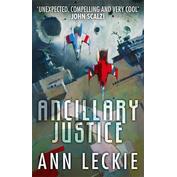 Firstly: OMG I loved this book so very much.
Secondly: a real review. There are some spoilers, but nothing too major. I promise you will still have your breath stolen by many of the events in the book.
So, let me get “the gender thing” out of the way first. I debated leaving this ’til last, because it’s what a lot of other people are apparently fixated on… but for that very reason, it seemed disingenuous of me not to engage. Thus: the narrator of the story, Breq, is from a culture that does not use gendered pronouns. When Breq is dealing with cultures that do use gendered pronouns, there are language problems – troubling enough that it causes Breq quite some stress. And when Breq is thinking/speaking to the audience, rather than rendering pronouns as ‘it’, Leckie has opted for ‘she’. This, obviously, presents some rather intriguing aspects. Except for a few times when Breq is corrected, the reader actually has no idea whether the other characters presented are male or female. I don’t actually think we know whether Breq‘s body is female or male, hence my hesitance to use a pronoun (Breq would use ‘she’ and roll her eyes at me). Why is this interesting? Well, we don’t know whether the leaders have boobs or balls. We don’t know whether the soldiers dying having tits or testes, and we don’t know which the person who ordered those deaths has, either.* And I think this probably changes the way the reader reacts, at least in some instances. More intimately, we have no idea whether the physical and otherwise personal relationships presented are hetero or homo, which is relevant if it matters to you; at any rate the lack of knowledge is surprising, occasionally frustrating, always intriguing. And when any or all of the people might be women, you’re left with the conclusion that women are actually capable of doing/being all of the positions presented – up to and including leading a galaxy-spanning society. Who knew? In the lack of gendered pronouns Leckie is making a call that gender doesn’t matter – except that in choosing ‘she’, this is somewhat undercut.
Look, I’m not actually a gender studies scholar. Probably there are other things that Leckie is doing that I didn’t really pick up on. But as a way of unbalancing the reader that works perfectly within the context of the novel, it’s a brilliant choice; and it also does that thing that great SF should do: it forced me to reconsider my own world.
On to other things: and speaking of unbalancing the reader that works perfectly within the context of the novel, what is with the gloves?? This is a brilliantly clever, and devastating, move on Leckie’s part. Breq comes from the Radchaai, and within the Radchaai everyone wears gloves. If you don’t wear gloves, you are regarded with horror. Why? It’s never explained. It’s like a man getting around in a Jane Austen novel not wearing a shirt; it’s clearly the wrong thing to do, but it’s not going to get him arrested – and Austen wouldn’t bother to explain why it’s a problem because surely you understand? Sheer. Brilliance.
Ancillary Justice does not follow a neat linear narrative. There is a chronological thread – it follows Breq as she (all right, I give up; it’s just easier, ok? and it’s what she would use) searches for something she needs, in an effort to right a wrong. Along the way she encounters someone rather unexpected, who brings a whole pile of unlooked for problems. Alongside and around that thread, the reader lives through the memories of what has brought Breq to this path. The main thing to know, in order to understand what’s going on (and this is on the back cover, so it’s not a spoiler), is that Breq wasn’t always Breq. Until twenty years ago, the body known as Breq was an ancillary of the AI controlling the Justice of Toren, a massive ship of the Radchaai involved in annexing and subduing planets – ostensibly for their own, but mostly for the Radchaai, good. Thus Breq’s memories are mostly those of a few-thousand-year-old artificial intelligence. And being an ancillary means that her body is human, and was co-opted for… duty? inhabitation? use? by the AI.
This issue of ancillaries is one that the book is not obsessed by, but does deal with seriously via several of the characters who respond poorly to the very idea of them. I liked that the story didn’t develop into something too preachy, but I also appreciated that having raised such a frankly horrifying idea, Leckie did not simply leave it as a necessary-but-evil, or evidence-the-Radchaai-are-dreadful, sign. Instead, it’s as complicated an issue as the annexations themselves, because they really do bring benefits to the planets colonised – as other colonisations have – but whether that’s worth all the pain and bloodshed… well. That’s something we’re still processing, to some extent.**
The blurb of my copy paints this as predominantly a revenge story, and I get where that’s coming from. But it lacks nuance, too. Breq is indeed looking for revenge. But she’s also looking for answers – to questions about events in her past, questions about the Radchaai itself, questions about how she can, should, exist as this solitary body rather than as a near-omnipotent (in a constrained space) being. Therefore even if the novel were purely focussed around her, it’s more complicated than just “rargh I get you for what you done to me!” But, of course, as the above demonstrates this is a far more nuanced and complex novel than that. It touches on issues of colonisation, and of gender; it looks at what it means to inhabit a body, as well as to inhabit a planet. And it looks at how religion is co-opted for different purposes, too.
The inclusion of religion startled me, and – when I got over that – made me very happy. It’s something I’ve complained about in the past, here and on Galactic Suburbia: the lack of religion, treated seriously, in science fiction. Seriously people: do you think that just because humanity lives beyond the Earth, they’re going to somehow move beyond a desire for an explanation beyond what science can provide? I don’t think so. Leckie’s inclusion of religion, and the exploration of how religion and colonisation work together, was welcome and clever and shows how much thought she has put into this universe.
This next bit is for those who’ve read Iain M Banks’ Culture novels. I can’t help but assume that at least part of this novel is in dialogue with the Culture. There’s the fact that AIs are in charge of ships and stations, and interact with their human inhabitants. I know that this happens in other stories, but there was something that made me feel a distinct connection to the Culture Minds. That said, these AIs are not really like the Culture Minds. For a start, they’re not meant to have personalities at all. And there’s a very clear point in the story where Breq reflects on the fact that the ships don’t really talk to each other any more; they’re too old, and they’re bored by each other. This is in complete contrast to Banks’ positively verbose Minds, who can usually hardly keep their traps shut. Then, of course, there’s the use of ancillaries – actual bodies – instead of drones, which is… interesting. And reflective of the fact that the Radchaai is a far more problematic society than the Culture, and possibly reflective of the way such a human society is more likely to act (aggressively, rather than with the amused benevolence characteristic of the Culture). It’s entirely possible that Leckie has never read Banks, I guess, but for me this works really nicely in conversation with a series of books that I also adore.
Finally, then: this is what I want my SF to be like from now on. Smart; fast-paced; intriguing characters; believable world. And intellectual depth for added joy.
*I do understand this is reductionist; I’m going for effect here. Additionally, there doesn’t seem to be an indication of these societies going in for large-scale, Culture-esque body shaping, so it seems to me that these crude indicators would still be considered relevant by Breq’s contemporaries.
**I mean on a global scale, not an individual scale. Please don’t yell at me for defending colonisation, because I’m certainly not; I’m an historian, I know and agree with most of your points.
You can get Ancillary Justice from Fishpond. This book was provided to me by the publisher at no cost.
Menial: Skilled Labor in SF
Reviewing an anthology is always a bit more difficult than reviewing a novel. So is rating it. Does one poor story deserve to bring down the entire anthology? Should I mention every single story?
 I gave this anthology a 5-star rating on Goodreads. I did not do this because every single story blew me away; they didn’t, although I don’t remember any story that I loathed, which is impressive in its own right. Partly I was predisposed to being impressed by the anthology because of the theme: the menial. That is, no heirs-misplaced-at-birth, no admirals or planetary governors or princesses starring here; instead, it’s the miners, the sewerage workers, the grunts who feature. Not to say that the stories don’t feature action or adventure – they do – but largely it’s action that happens in the course of everyday work, and often because of accidents: the sorts of things that you’d really rather didn’t happen. The anthology points out the dignity in the menial tasks, as well as acknowledging the sheer back-breaking work that’s likely to still be necessary in the future; it points out the importance of the menial while remembering the danger. And even though the menial workers shine in the stories, it’s clear that for most of them, this isn’t going to lead to a huge change in fortunes. It’s part of a day’s work, or it’s not but it’s not enough to propel them out of drudgery – or indeed it’s something that leads to them getting fired and the consequent uncertainty of unemployment.
This anthology shows that good SF can be escapist in letting the reader escape from their own immediate situation, but can simultaneously speak to the reader who is unlikely to be a spaceship pilot or lead an army, but may well have a dead-end job that they hate. It can provide ways to imagine a different world but also reassure and comfort that even people in crappy jobs can actually have interesting lives, and do interesting things – something much SF ignores.
This anthology imagines a range of possible futures. They’re mostly fairly far future, and involve space travel of some sort; some have humanity spread far and wide, others are a bit more restricted. Because of its focus on the working class, there is less emphasis on the political or military than one often finds in SF, because really, when you’re scraping to get food on the table who has time to worry about the expansion of the empire? Many of these stories are united in their focus on the nitty-gritty details, those details that make up the everyday. Some of them are very familiar, some are familiar but in foreign contexts, whilst others are utterly alien. And the best stories make this work in clever and occasionally utterly bemusing ways.
I was initially dubious about the possibility of making an entire anthology based on the concept of skilled labour; not because I thought the concept was boring but because I wasn’t sure how there could be enough variety within that to keep having different stories. This is because I am not an author. There is, of course, infinite variety in the stories you can tell from the menial perspective – because there’s an infinite variety of stories to tell about humanity.
You can get Menial from Fishpond.
Han Solo
What can I say, I’m one of those people who thinks that Solo is really the star of the Star Wars movies; I was very annoyed that eps1-3 didn’t make a reference to him, even something as small as ‘here’s this kid I’m teaching to be a smuggler…’.
Anyway, a friend was cleaning out her house of books and I became the recipient of a Rather Large Bag of Star Wars novels… and I have finally dipped my toe in. I started here partly because SOLO, and partly because of this article about the author, AC Crispin, having recently died. And I had no idea that AC = Ann.

So. Solo.
Look, this is not a novel that was ever going to win literary prizes. The prose is a bit clunky, some of the characters are a bit stock, and yes the overall plot is a bit hackneyed. BUT! But.
a) It’s SOLO. Who doesn’t want to know how the galaxy’s most loveable rogue got to where he is? Who doesn’t want to know why someone so rough on the outside actually has such a soft smooshy inside? (Much like a tauntaun…). Plus, how did he GET that tough exterior? How did he and Chewbacca find each other, and what about the Millennium Falcon? These are questions I really want an answer to. So, I’ll read the novels.
b) It expands the Star Wars universe. I think one reason why I really like the idea of the enormous number of tie-in novels is that they’re all set in the same universe, but they don’t concentrate on just one bit. The Zahn novels didn’t; this one novel takes the reader to a few different planets, and while most of them are (as far as I recall) referenced in the original movies, this book looks at them from a rather different perspective – and it still works. It’s a lot grubbier, mostly. Yes Solo is a smuggler in the movies, yes Tatooine is the planet-futherest-from-the-bright-centre-of-the-galaxy – but really you don’t see much of the seamier side of the planets, let alone of the empire as an Evil Empire. Contrariwise, Crispin sets a lot of her story in the criminal underground, or on a slave plantation. Some people are nice, some are downright rotters.
c) Gratuitous Star Wars references. Sure Solo’s miff-ed-ness at being called scruffy got a bit tired after a while, but still – funny.
d) It takes Star Wars stuff but it makes it different. There’s an elderly Wookee woman that Solo’s friends with, and there are clear parallels to Chewbacca (also with his non-human companion Muuurgh) – but it’s not identical. There’s a romantic interest and again, parallels to Leia but by no means identical, and indeed provides some rather thought-provoking points on why Solo reacts the way he does to Leia (abandonment issues). Links to the Hutts, being a pilot, etc – all of these essential elements are there, but Crispin does interesting enough things with them that it’s by no means ‘young Solo just imitates old Solo.’ And that’s cool.
Thus this novel was definitely light entertainment. It’s light because it doesn’t require an enormous investment of time or thought-process from the reader – although it does raise genuine issues and does not simply ignore them. It’s entertainment because there are pirates, and smugglers, and chases, and Han Solo.
Galactic Suburbia 90!
 Listen to us via iTunes or over at Galactic Suburbia!
In which we present The Subgenre Report. Is the concept of subgenres meaningful to readers and writers, or just a marketing trick?
Which subgenres are OMG so hot right now, and which genre is doing subgenres better than spec fic?
In other news, Alisa hurls herself into crowdfunding with the baby clock ticking down to midnight…
Grimdark as a Young Man’s Genre? (do read the comments, seriously, that’s where all the crunchy discussion/challenge is)
The Rise and Fall of Grimpink
Culture Consumed:
Alisa: Continuum S1, crimeScene convention, plug for Kaleidoscope, Coode St Podcast ep 162 with Rachel Swirsky; Report from Planet Midnight, Nalo Hopkinson
Tansy: BBC Radio Neverwhere; Untold by Sarah Rees Brennan, Ancillary Justice by Ann Leckie, The Almighty Johnsons
Alex: Agents of SHIELD; Star Wars: The Paradise Snare, AC Crispin; Ragnarok, AS Byatt
Please send feedback to us at galacticsuburbia@gmail.com, follow us on Twitter at @galacticsuburbs, check out Galactic Suburbia Podcast on Facebook and don’t forget to leave a review on iTunes if you love us!
Crowd funding
1. Twelfth Planet Press is running a Pozible campaign to get a new anthology off the ground. Edited by Alisa Krasnostein (one of the voices of Galactic Suburbia; the other one, Tansy, is already writing her story…) and Julia Rios, this is a really awesome anthology: the idea is that (to quote them):
The main characters in Kaleidoscope stories will be part of the QUILTBAG, neuro-diverse, disabled, from non-Western cultures, people of color, or in some other way not the typical straight, white, cis-gendered, able-bodied characters we see all over the place.
Please consider contributing if you can – and either way, spread the word! I’m tardy in posting this, so there’s just 12 days to go (closes 31 October), and they’re not quite halfway yet. Halfway to what? $12000 will allow them to pay pro-rates AND publish the book AND do all the other rewards stuff. That’s not a lot for a whole lot of brilliant. If you need more convincing, they’ve already got three names to the anthology: Ken Liu (!!!), Sofia Samatar, and Jim C Hines. Magnificent.
2. A Kickstarter that I backed ages ago is now live! Mothership: Tales from Afrofuturism and Beyond (that link takes you to Fishpond) is an anthology that does just what it says; wrenches the future from overly white, American hands and puts it into more ethnically diverse ones. My copy came with a mixtape, and when George Clinton’s dulcet tones announced “ah-good evening” as the first track… well, I admit that I squealed a little with joy. Watch this space for a review!

 Randomly Yours, Alex