Damascus: Taste of a City
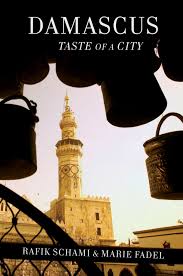
Some time ago I got a bit carried away: I discovered Haus Publishing and their astonishing range of “travel” books, and it’s fair to say I bought quite a few. This is one of them. I had never heard of Scami before, and I didn’t really know what this book was about, but I figured someone talking about Damascus was likely to be fascinating.
Schami is an author, and Syrian, and (at time of writing) had been living in exile in Germany for decades. This book is (he says) essentially transcriptions of phone conversations he had with his sister, Marie: she wondered around their part of Damascus – the Old City, the Christian Quarter – and described what she was seeing, hearing, smelling, remembering. Alongside that are the recipes. Apparently Damascenes are well known for their cooking. The book collects recipes from friends, relatives, and associates of Schama’s family, alongside incidental details about how it can be served, why this person makes the best one, and so on.
It’s very close to walking with a resident, which of course is the point. It’s also an insight into familial and friend relationships – people that I will never know, with complexities I can never understand and which can only be hinted at here, but which speak to a vibrant city that is one of the oldest continually inhabited cities on the planet. It’s almost but not quite voyeuristic – it’s gossipy, for sure, but for me it stops short of being intrusive, so I didn’t feel uncomfortable about knowing these details of people’s lives.
I can’t wait to go back through the book with sticky flags, figuring out what to cook from it.
Kon-Tiki, by Thor Heyerdahl
I do love a good adventure/ travel story, so when I saw this in a secondhand book shop I thought – why would I not read the book that as far as I can tell, arguably started the modern version of ‘person goes on crazy adventure and writes about it’?
I am… ambivalent, now, having read it. Basically one part positive, two parts negative.
Positive: it really is a riveting story. Six men in 1947 on a balsa wood raft, sailing from Peru to Polynesia. They have a radio and a sextant, and modern clothes and sleeping bags; but their raft is genuinely balsa wood, held together with rope. They have no particularly good way to steer. It’s made (apparently) as accurately as they could to match the descriptions from Spanish conquerors to the area. They truly have remarkable experiences, and they went 100-odd days crossing the Pacific. That is epic, as are their encounters with a whale shark, various other wildlife, storms, and just life in general. For that aspect, I don’t regret reading it.
The negatives… well. To start with the journey itself – no, even before. The description of cutting down massive old balsa trees for the construction of the raft had me cringing. Then there’s the seemingly-wanton ‘fishing’ while they’re at sea: they’re hooking and killing far more shark and other fish than they eat, which is just awful. (It is kind of hilarious to read of the flying fish just randomly landing on the boat, I will admit, and eating those makes sense – especially when they’ve been piling up throughout the night.) Also, Thor at least is married and… in the entire book, no mention of the wife. Ever. Not even before the journey, when he’s in America trying to convince people of his theories.
And, yes, here’s the rub, the sticking point, the main problem. Thor goes on this journey to show that it would have been possible for humans to sail from South America to Polynesia, and thereby be the progenitors of at least some of the people living in those islands, and therefore responsible for the impressive statues and pyramids and other ‘advanced’ things that can be found on some islands. But not the Inca, oh no, and not the Olmec, or anyone else you might have heard of: rather, it was a white, bearded race who apparently came before the Inca. And were more civilised, and taught them everything and then got chased off. So… yeah. His entire premise is deeply, deeply racist. This also comes out in descriptions of the Polynesians and others. I’m privileged because I’m white; if a person of native South American – anywhere on that continent – or Polynesian or, I’m afraid, Jewish descent said they were thinking of reading this, I would want to have a good long conversation with them so that they knew what they were getting into. This absolutely means the entire book is problematic, and being a ripping adventure yarn in no way excuses it. It is written in 1947, which offers some context for why Heyerdahl thought it was appropriate to write such things and the publishers apparently had no problem with it – hey, no Polynesian is likely to read it, amiright? and why would they complain even if they did? etc.
Did it have fun bits to read? Totally. Is the book problematic? Absolutely. Did I buy the other two books he wrote, to try and show that Egyptians AND Mesopotamians got to South America by boat? I absolutely did and fully intend to read them to rip the theories to shreds.
Straits: Beyond the Myth of Magellan
I read this courtesy of the publisher, Bloomsbury. It’s out now; $39.99 trade paperback.
… and I thought I was an iconoclast. What a remarkable, thought-provoking and intriguing biography.
Things I already knew about Magellan: he did not circumnavigate the world. I learned that in a book about how Basques influenced the world, because the captain of the only one of Magellan’s boats that did, actually, go around the globe was captained by a Basque.
Things I did not know: most of what Fernandez-Armesto discusses in this book. I did not know that Magellan (to use his Anglicised name) was Portuguese who ditched that kingdom and went to Spain – a traitorous act at the time. I did not know that he was a little too keen on chivalric romances and maybe wanting to emulate them. I definitely did not know what a truly dreadful leader and person in general he was.
OK, that last bit is something of an exaggeration. Indeed one of the problems that Fernandez-Armesto discusses here is the difficulty of ever truly understanding someone like Magellan: partly because of the temporal distance, as well as the mental distance, between me and a Portuguese court-educated man of the 1500s; but also because much of the evidence is deeply conflicted. There’s something close to hagiography by someone who was on the voyage and managed not to die… but there’s also plenty of accounts from men who mutinied. So how do you get to ‘the truth’, and what even is that.
Anyway. As a biography this is awesome. The author brings the context wonderfully to life, exploring what the world was like for someone like Magellan in the 16th century – what Europe knew of the world, and what the world knew of Europe; what kings and adventurers wanted, how empire was going, knowledge of the Atlantic and Pacific, and so on.
Something I had never really appreciated before reading this: just how Very Big the Pacific is. Especially for those accustomed to the Atlantic.
For the historians, Fernandez-Armesto skilfully uses primary sources to make his points, and to show people in their own words – and they never get overwhelming, or in the way of the story. It’s a really great example of how such sources can and should be used.
And finally, the last chapter is called “Aftermath and Apotheosis”, and this is where my iconoclast remark comes in. I got the sense that Fernandez-Armesto doesn’t necessarily like Magellan – which is fine, if intriguing; he certainly proves that Magellan deserves to be studied, if only to learn what he can show about his world. And beyond that, Fernandez-Armesto completely goes to town on previous biographers who do love Magellan, and all those companies who use Magellan’s name as if it’s some sort of shorthand for scientific endeavour or great achievements or frankly anything good. Because what the author shows is that Magellan deserves none of that. He had no scientific interest; he was out for the main chance. He didn’t achieve anything much that was great: yes, he sailed through the straits that bear his name, but he didn’t know they were there and he wasn’t the pilot or navigator anyway PLUS the cost in human suffering was enormous.
This is a great book. If you’re keen on the history of exploration, or early modern biographies, or learning the story behind a fairly familiar name, this is an excellent choice.
Atlas of Forgotten Places
I read this courtesy of NetGalley. It’s out now.
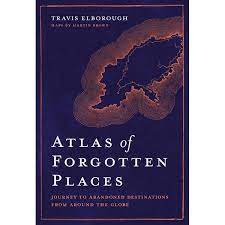
These are beautiful books, even in electronic copy – this Atlas of Forgotten Places, and the Atlas of Improbable Places; I’m sure they’re even more lovely in paper. That’s definitely a key thing to note. The photography of each place is generally very good, and evocative of whatever idea is being presented; and the maps are also intriguing. They show where the place is in context – near other towns or within a country or whatever is relevant – and also shows the layout of the particular area. Because with this Atlas in particular, I think, many of the places featured aren’t just individual buildings (although there are plenty of those); they’re also entire towns, or bits of towns. And the maps show what still exists, what’s crumbling, what’s changed over time. They’re really well produced.
Chapters includes Vacant Properties, Unsettled Situations (abandoned towns, largely), Dilapidated Destinations (tourist spots and hotels), Journeys Ended (airports etc), and Obsolete Institutions. Sometimes the categorising is a bit of a stretch, but I’m happy enough to go along with it. It closes with Alcatraz, which I thought both amusing and fitting; there’s a town called Santa Claus, a lighthouse, several hotels, and a Bangkok mall, as well.
I have two quibbles. One is an admittedly minor irritant: the book needed slightly better editing (ashes are interred, not interned, surely). The other is that sometimes most of the entry for a location is a digression – about Napoleon, when the entry is about something on Corsica, or about why an indigenous group where bowler hats when it’s about a railway in Bolivia, or how both cardigans and balaclavas were named for military things (a man and a place) associated with the Crimean War, when it’s a submarine base in Balaklava. If you’re going to feature a place, surely you should spend your two-ish pages talking just about that place? Expanding more on what it was like and what led to its being forgotten? It made me wonder whether Elborough was padding for the sake of making each entry about equal, and pointless words really, really annoy me.
I should also note that the list of places mentioned in the blurb on Goodreads is wrong – three of the places mentioned there do not actually feature in the book that I read (I doublechecked the index and everything). So if you want to read about the abandoned Peter’s Ice Cream Factory, it’s not in this book.
Those quibbles aside, though, I have no trouble recommending this for the armchair traveller, or the lover of quirky facts.
Green Chili and Other Impostors
I read this courtesy of NetGalley.
Part travel memoir, part personal memoir, and part food history; it’s an intriguing combination. Furstenau discusses her own history – born of Bengali parents, in Thailand, and then growing up in the US. Throughout the book are comments about how hard it was to demonstrate that her visa to India ought to reflect that heritage, but given a lack of paperwork for her parents, it wasn’t to be. This sense of questioning where she belongs is woven through her discussion of “Indian” food, as she looks into the histories of both ingredients and dishes. “Indian” because some of what is discussed is about how now-common ingredients in Indian food actually came to India (green peas, chillis, potato… cheese…); and also some things you might think of as Indian are not, and some things appropriated by others are, of course, from India.
The author travels around India, sometimes visiting relatives and sometimes finding food-connected people, who talk about history and share recipes and teach her to cook some of the dishes. And these recipes are included, of course – Sandesh and Nolen Gur Cheesecake; Kedgeree (which is Indian, not Scottish, and the story of it becoming a breakfast staple is fascinating and I have never eaten it!); Koraishutir Kochuri (puffed bread with green pea filling, and goodness I really want to make this)… and so many others.
This book is very readable; it’s enjoyable to journey around India, it’s varied in what ingredients and ideas it discusses, and the recipes seem easy to follow.
Peel Me a Lotus
I read this courtesy of NetGalley.
You don’t HAVE to read Mermaid Singing, the first of Clift’s memoirs about living on a Greek island in the 1950s, in order to understand what’s going on here; not least because they’ve moved islands, so it’s a whole new crowd of people. But I think it helps, because you come with a sense of what Clift and her husband George Johnston have already experienced, why they left London, and thus can better appreciate their experiences.
Like Mermaid Singing, this is a “domesticity in the exotic” story – Clift and her family living now on Hydra, a small, largely poor Greek island, on the cusp on becoming A Destination for the Artistic, the Beautiful, and the Hangers-On. Clift and her husband/collaborator have bought a house, which brings with it large dollops of angst: partly because of the never-ending requirement for repairs, on a budget that’s basically nonexistent; and partly because now they are settled, they are halfway back to being bourgeois, and many of their fellow Artistic Types can’t figure out if they’re jealous or derisive. Both, it seems.
Unlike Mermaid Singing, Clift is much more ambivalent here about the whole experience: both her own experience, and what island life is like. While in the first she and George are actively writing a novel together about the sponge divers, here she seems to be entirely consumed with looking after the house and the children – indeed, she is hugely pregnant as the book opens, an experience which understandably consumes a significant part of her mind and time. George gets to clatter away at the typewriters, but Clift is busy buying food, making dinner, caring for the baby and the other two children, and so on. Sometimes she seems content with this, and at other times deeply frustrated, worried she is merging into that always-has-been, always-will-be experience of motherhood that she sees all around her. So… a fairly familiar experience, no doubt, for many women who find motherhood a time of personal conflict.
Island life bounces between the seeming idyllic – the beach swim every afternoon, cheap and bountiful food, glorious landscape, interesting if infuriating neighbours (usually it’s the foreigners who are infuriating) – and its opposite. There’s hardly any water to be had in summer. Many people’s health is poor, there are huge prowling alley cats, rubbish is dumped directly into the harbour and no one knows where the sewers drain. Clift doesn’t shy away from the negatives, and also makes little effort to reconcile the two extremes; it’s the reality of life, after all.
A lot of time is spent talking about the other foreigners, for whom she uses pseudonyms, and it’s probably a good thing she did. Having read the introduction, though, it seems their identities are – were? – no secret; Henry and Ursula are Sidney Nolan and his wife Cynthia. Clift presents the various non-Greeks as looking for inspiration or pretending to do so, living dissolutely because they can afford to; some of them are getting allowances from parents, for instance, so they barely even need to dabble in their art. Not so for Clift and Johnston, who are trying to eke out a living on royalties. I don’t even want to look up Hydra today, for fear it’s exactly as Clift prophesied – fancy tourist hotels for the Beautiful People – which may or may not have had positive benefits for the people whose ancestors initially colonised the place.
In some ways I can’t believe this book is more than 60 years old. Parts of it show what feels like a very modern sensibility, while other bits are clearly products of the 1950s. It’s gorgeously, evocatively, provocatively written and I hope lots of people get to read it.
Mermaid Singing
I had thought that I liked travel memoirs. And I do – I can enjoy a good ‘and then we went here and experienced that’ story. But I’ve eventually realised that what I really enjoy is what I choose to call ‘domesticity in the exotic’. Exotic is a loaded word, but I use it here to evoke a sense of difference that I don’t think ‘foreign’ really captures; and I’m just as including a Brazilian or Nigerian writing about moving to Melbourne as I am a Londoner moving to Provence (I think Romulus, My Father arguably fits neatly into my category).
Before A Year in Provence or Under a Tuscan Sun came Mermaid Singing, by Australian Charmian Clift.
I read this book thanks to NetGalley. I’m incredibly pleased that it’s been republished.
Its most obvious parallel is My Family and Other Animals, and the rest of the Corfu Trilogy. Indeed, they were originally published in the same year, 1956. But ‘parallel’ is right: they seem to start similarly and go in the same direction – family moves impetuously to Greek island, experiences with Greek locals don’t always go as expected, genteel poverty etc – but they are fundamentally separated stories. Where My Family is written two decades after the events, Mermaid is contemporaneous. Where Durrell was the spoilt youngest son of the family and was off having adventures and occasionally going to school, Clift is a writer and a mother and a wife; while she has adventures, they’re not the focus, because she has the cares and concerns of an adult: both for her own family and the way she views the people around them.
My Family is a fond recollection of a childhood dream, /something something the world before World War 2 blah blah. Mermaid Singing is part ‘domesticity in the exotic’, but also a rumination on the hardship of Kalymnos life, and the difficulties of being a woman in the 1950s trying to forge and continue a career alongside motherhood.
Clift writes beautifully, and evocatively. Kalymnos is an island that largely relies on about 10% of its population going out on sponge-diving expeditions for 7 months of the year – a dangerous occupation and one that’s bringing back less revenue as, in the 50s, artificial sponges are taking over the market. It’s also an island still, in Clift’s experience, in the grip of patriarchal attitudes (and Clift herself is part of this as she notes she has no right to comment on whether someone has beaten his wife at the end of a drunken week). The whole reason for moving here is for Clift and her husband to collaborate on their third novel, this one to be about the sponge-divers. And they do manage to do this, in between drinking a lot of retzina and being closely observed by all their neighbours and seemingly endless rounds of engagements and baptisms.
This is no day-by-day account of life. Like A Year in Provence it follows a year, observing the changes to life as the seasons come and go. Clift observes moments: a friend giving birth, experiences in the taverna, the experiences of her two children during Carnival…. As a gifted writer, she uses these moments to reflect on life itself – and death; and she conjures a wondrous view of Kalymnos. Is this likely to reflect the lives of the people who lived there their whole lives? Perhaps not. Perhaps they would recognise some aspect of their lives but be confused by an emphasis or examination. It does seem like a genuine reflection of Clift’s experience – an an ex-pat Australian, a writer, a woman who didn’t quite fit the expected mould of womanhood on the island.
I’m inspired to buy this in hard copy if I come across it.
A Year in Provence
Every now and then I fall into reading one of those stranger-in-a-strange-land books, where some person goes to live in a foreign-to-them country and has amusing experiences. Sometimes I feel uncomfortable about this genre – although I’ve never read one that goes out of its way to exoticise the locals, there’s still a potential voyeurism or paternalism that makes me wary. However, I truly loved Under the Tuscan Sun, and Driving Over Lemons was also a delight. The thing that makes me a bit less uncomfortable about these is that they’re white Brits or Americans moving to Europe… which somehow feels less likely to be fraught than, say, a white Brit or American moving to Thailand, or Nigeria. In my mind, that seems much more likely to go difficult places.
Anyway: when I came across A Year in Provence in a secondhand shop I couldn’t remember if I’d read it – surely I had! it’s a classic! – and then I read the first bit and realised nope, never have. Thus, bought.
And it is a delight. I can see why it’s become such a popular book (although I am deeply unconvinced about watching it as a tv show). The style – that Mayle goes through a calendar year, basically following the rhythms of the seasons and how that affects the way farmers, in particular, live – is deeply affective. Yes, there are bits where Mayle is getting amusement out of locals’ quirks; it never feels to me that it’s malicious, and I hope that’s not just me being naive (although that’s possible). It is, of course, a deeply romantic view of living a provincial life. Part of this is the time in which it’s written – the late 1980s – and that feels like (is, I think) a completely different world. And partly this is Mayle’s love letter to his experiences. He doesn’t completely sugarcoat his life – the exigencies of getting labourers to finish their work sounds excruciating – but the humour and general love of life that he exudes makes reading about it just a dream. Also ohmygoodness the FOOD.
I didn’t know there was a sequel, until I found it, soon after reading the first. It’s different in style – I guess repeating the calendar idea wouldn’t have worked. Basically the first thing he opens with here is the fact that the first book made him famous, to the point where strangers would turn up at his door demanding an autograph – and in some cases just wander into his house. Who does that?! I quite liked that he reflected on the consequences of his work – makes it seem more real, in some ways. Again, there’s a lot about food, and that’s completely fine with me. There’s a lot about the house, and local experiences. It’s… cosy. Delightfully cosy. And it makes me wonder whether anything like this life still exists in Provence; my guess is no. Maybe other parts of France?
Living like Mayle is, of course, a fairly affluent choice; most of his neighbours are farmers, working very hard for their bread, while (if you’re being mean) Mayle is a dilettante gentleman-farmer doing whatever he likes. But if you read this as a semi-fantasy, which I think is how I approached it, they’re lovely books. I understand there’s a third book, too; one day I’ll find it.
The Olive Season
It’s fair to say that I take what previously I would have called a guilty pleasure in reading books about foreigners who go to France (or Spain) and rehabilitate dilapidated farms. It’s a guilty pleasure because of course there’s a level of exoticising what for the people these foreigners encounter is just their daily life, and a degree of Othering that I’m uncomfortable with. However, I’m not calling such things guilty pleasures anymore. Problematic, perhaps. It is a pleasure; I’ll not call it guilty anymore. If I keep the problematic nature in mind, and remind myself that these are deliberately romanticised narratives, then I think I’m doing ok.
The Olive Season is the second in a series. I’ve not read the first; I found this in a second hand shop, and while I considered buying the first I decided it didn’t matter. All I need to know is that Carol fell in love with Michel and they bought a near-derelict farm with a few olive trees. Right, got it.
Basically if you’ve read one of the Tuscany books you have a sense for what happens here. Water issues! Planting problems! Madcap guests! However things do get awfully real, too, as Carol experiences some very real and significant tragedy. Her honesty in the way she discusses these in the book is bracing, and a bit heart breaking, and could probably be a bit much for those who have experienced similar things. And it’s appropriate too, since this is a memoir, not a story of a farm. As someone on the outside of such things I respected the way Carol worked through some of the problems in her writing, and the way she also integrated her discussion of the farm, and what it means to her, and how physically working helped her headspace.
Look, the book is set in Provence, and written by someone who loves the place. Of course it makes it sound like it’s a marvelous place to be. There’s no denying the hard work that’s involved in the olive farm, and Carol doesn’t try to downplay it, but nonetheless… she can’t, and the reader can’t, get away from the fact that: this is Provence, and that will always have certain overtones for the non-Provençal.
I enjoyed this book a lot as a holiday read. I won’t go out of my way to find the other books, but if I find them by serendipity I’ll happily grab them.
Jan Morris’ Journeys
 Reading a collection of travel essays written in the early 1980s is a surreal experience. So I’ll break this discussion into two parts: by golly I love Morris’ writing, and the essays themselves.
By golly I love the way Jan Morris writes. She constructs beautiful, evocative sentences. Describing the approach to Wells: “As one descends from the spooky heights of Mendip, haunted by speleologists and Roman snails, it lies there in the lee of the hills infinitely snug and wholesome.” On travelling to China for the first time: “Of course, wherever you are in the world, China stands figuratively there, a dim tremendous presence somewhere across the horizon, sending out its coded messages, exerting its ancient magnetism over the continents.” I’m no writer; I don’t have the ability to assess what makes great prose great. (There’s a great piece of graffiti near my house that says “I know art, but I don’t know what I like.”) I do know that I enjoy Morris’ writing, that I find her descriptions absorbing and sometimes moving, and that some of the books I read would be improved by their authors having read and considered Morris’ style.
Separating the form from the content should not be read as a negative about the content, don’t worry.
The first essay is about Sydney, and as an Australian this was really, really interesting. I felt there were parts that Morris exaggerated, and I was a bit uncomfortable with “Kev,” the white-collar worker standing in for Everyday Aussie, and she pokes a bit of fun at Sydney attitudes and expectations. Now, all of these are standard in a travel essay, sure. But I’ve never read a travel essay by a professional like Morris about somewhere that I kind of know – I don’t actually know Sydney very well, but Morris writes about Sydney as representative of the entire country (to which true Melbournians recoil in horror…). So I enjoyed the essay – she says some very true things, very appropriate things, and of course it’s well written. But it also meant that when I read her other essays, of places I have never been (of every other place she mentions, I’ve only been to Wells), I was aware that a native of those places may well have the same reaction as I did to the Sydney essay. Which made for an intriguing experience: not completely immersed in the narrative or the description, but interrogating her assumptions and elisions and emphases. For this sort of writing, I think my experience was actually enhanced.
This is Morris’ fourth book of essays. None of them have dates attached; the publication details simply explain that most appeared in Rolling Stone, a few in other publications. It came out in 1984 and there’a reference somewhere to 1977, so I presume they all date to that general time; the historian in me really wants dates on each one! There are several essays on parts of the US: my zero interest in Las Vegas succeeded in plummeting even lower, although Santa Fe intrigues; a few on Europe – she’s not a huge fan of Stockholm yet somehow I am now more interested in going, and Cetinje in Yugoslavia (now Montenegro) absolutely fascinates. And the Indian and Chinese essays are probably the most intriguing, and most problematic, in terms of how people and places are viewed.
I love Morris’ work and may well make it an ambition to collect most of what she has written.

 Randomly Yours, Alex