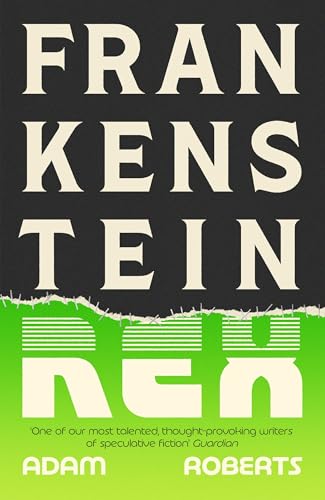
First off: if you’re reading this while the blurb still talks about immortality and seeking an heir, that blurb is WRONG. I won’t speculate about how that happened – not my business – but it’s very, very wrong. That is not what this book is about at all.
To head off any other jokes: it’s also not about a dinosaur. It is indeed a play on Shelley’s Frankenstein, and specifically the creature – and yes there’s a whole bit about the name choice.
So what is it about, then? Well, Frankenstein (the creature) has been king of the world for many, many decades. Since not long after Napoleon popped up, in fact, and it’s now just our time. Frankenstein does seem to be immortal; he’s not ageing or changing, and assassination attempts in the past have failed. Of course, that doesn’t stop other people from trying.
Frankenstein rules as a benevolent (ish) dictator. All land belongs to him – with just a couple of carve-outs, like Jerusalem and Mecca – and he leases it back; but he has strict expectations about energy efficiency etc. The lingua franca is French (heh). National sentiment is forbidden, and regarded as irrelevant by the powers that be. Decade on decade, Frankenstein swings between more liberal and more tyrannical. Someone is arrested for planning to assassinate the king… and the novel goes from there.
It’s very important I let you know that the opening chapter has some quite gruesome torture. I had to skim a couple of paragraphs after I realised what was going on. There’s nothing like it for the rest of the book, so it’s a shocking opener but not indicative of the novel as a whole.
As well as being a novel about trying to understand a would-be assassin, this is quite blatantly a book about politics. If there is literally a monster in charge, how do and should humans act? (Yes, of course there is discussion to be had about whether the creature is a monster, and you’ll note that I don’t use ‘monster’ to describe him.) Sometimes there is something darkly appealing about having one person in charge forever and ever! Change is hard and sometimes painful! … and there will always be collaborators, who are either all-in on the regime or out for whatever they can get; and there will be people who are just muddling along and putting up with it because what else are you going to do; and there will be some few who are defiant and maybe reckless and endanger both themselves and others because they think there’s a better way. Where does righteousness lie? What is appropriate? I know what I think; and Roberts manages to be a lot more nuanced than many other writers would achieve (which does not surprise me, because… well. It’s Adam Roberts. Man knows how to be complicated).
I do have thoughts about the ending; spoilers below the cut.
I don’t think it works.
To suggest that the creature could only exist because of a time traveller is kind of interesting, but it feels like this idea springs out of nowhere. While it doesn’t make the rest of the novel irrelevant, it does feel like it skews the novel to being something completely different. It’s not quite “and then they woke up,” but I did feel quite deflated by the last few pages. I can live with ambiguity! But for me, the whole “are you from the future/ what now” went beyond ambiguity into “not really sure how to end this.” I assume this means I didn’t understand something about the novel that Roberts wanted to communicate. Ending with the creature being alive but mind-wiped would, I think, have been a much stronger ending; the epilogue was unnecessary. Because that resuscitation of Frankenstein means we’re back to the question of power – as the politicians discuss, potestas vs auctoritas, the delineation of which is of such importance in considering power and government. If men are in charge behind the face of Frankenstein… well. Then who’s the monster.


Excellent review. I’m a big Roberts fan, but the end of this left me mystified. What was the relevance of the 3 vials? How did the time traveller connect with the original Victor Frankenstein? Was the time traveller meant to be Shelley somehow, or connected with him? What was the ghost stuff all about? And why Percy Shelley and not Mary Shelley as the focus? All very unsatisfying, which is not what I expect from an AR novel.
Yes!! It was such a weird ending! It almost felt like it was coming from a different novel.
I had similar thoughts (and was a bit dismayed to find no analysis of this interesting book, at all, besides this review and comment). Spoilers below.
The time-travel aspect struck me as underbaked almost to the point of reader-hostility – but I’m pretty sure that the Englishman Sam Ford (a name which surely has significance, given the restrained piecemeal way it’s revealed to us, though if so I can’t puzzle it out) isn’t meant to become Victor Frankenstein or anything like that; I think the idea (given his seemingly advanced, articulate bionic lips) is simply that he gets swept up in the activities of whatever future (post-Frankenstein?) civilisation it is that invents time-travel.
When we learned that Victor was seemingly from the future, I thought surely the twist would be that he was originally Jean-Pierre, the child who grew up in the household of Saint-Acheul, the scientist who had spent seven years attempting to replicate Victor’s experiments; this might also give some Freudian justification to the single odd passage where we’re shown Jean-Pierre’s point of view and violent incestuous fantasies. When Sickert pointedly failed to hear the fighting outside his laboratory, I thought that the interior of his lab was becoming unmoored from the flow of time, and that perhaps the monster’s body would be transported back to become its 18th-century self, hence his atemporal invincibility. The book seemed so strongly to be building towards some combination of these concepts that I was really flabbergasted by its non-climax. The vial scene really felt as if the book were just getting started, or at least as if there should be one big time-hopping extravaganza of a final chapter to wrap it all up.
Regarding the Shelleys: my more charitable interpretation – partly informed by Twenty Trillion Leagues Under the Sea, which sort of takes place “inside” Jules Verne’s mind – is that Frankenstein Rex focused on Percy because *Mary herself* was focused on Percy, and that this aimed to capture something of her emotional or intellectual life in a way that simply focusing directly on Mary would not. I can’t pinpoint what line spurred this, but at some point during the slippery chapter 3 it occurred to me that Percy, or Percy’s dead body, in some sense *is* Frankenstein’s monster – that this is the higher self and reality, filtered through his literary creator’s mind, of which the monster catches glimpses. I’d have to reread the book to see if this interpretation holds up, but I’m afraid it will be a long time before I have the energy – I think Roberts’s self-published ebook Bethany, about a time-traveller who attempts to assassinate the risen Christ, is ultimately a much more satisfying take on a similar concept.
PS: I can shed some light on the mysteriously wrong blurb: it actually comes from an early prototype of this book, which Roberts wrote up as a “Friday Imaginary Review” in 2021, sharing the Frankenstein Rex plot in a sort of Borgesian joke format before he decided to actually write it. A chunk of philosophical musings from the middle of the novel are actually copy-pasted, with some revision, from a fake “extract” that Roberts had originally written for that imaginary review. Exactly how the plot of the blog post ended up in the novel blurb defeats me, however.