Diamond Eyes
 I received this as a freebie at last year’s NatCon, and kept it to read because it was the second winner of the Norma K Hemming Award (“the Norma”). As an Australian award that seeks to recognise specfic literature that deals with gender, race, sexuality, class, and disability, it sounds like an award I would like to stay on top of. That said, I still haven’t managed to get hold of the first winner, Maria Quinn’s Gene Thieves… but I will, honest. Obviously, since the book won last year and I only read it last week, it didn’t zoom to the top of my TBR – but after the sequel, Hindsight, also won the Norma, I thought I ought to get on to it. Despite the fact that I had heard a number of less-than-positive comments about it.
First up, I’ll say that it’s readable. I know that sounds like very faint praise, but a few people had suggested that it wasn’t – readable, that is – and I disagree. The sentences make sense, the world building and general plot make sense, I wasn’t confused about who was who and doing what. So, there’s that.
The plot
Mira Chambers is in an institution, although for much of the book it wasn’t entirely clear why. Yes, she seems to be blind, but that doesn’t get you made a ward of the state. I figured out eventually that it’s because she’s an orphan… Anyway, back to the plot. Mira is nasty to the people who are meant to be looking after her, although as the novel opens she’s introduced to a new nurse, Ben, and there seems to be some hope that maybe he’ll be nicer and so will she. Their burgeoning friendship takes up a significant part of the novel. The plot also revolves around the revelation/investigation into the nature of Mira’s blindness (hint: she’s not really blind, in the can’t-see-anything sense… she just sees differently). Also, there’s a military conspiracy.
The characters
I didn’t like Mira much. Partly this is because she’s not very likeable for the first third or so, even when we get an insight into her reasoning and what she’s experienced in life; partly it’s because I didn’t feel like I ever got to understand her very well at all. And she wasn’t interestingly mysterious, either. For maybe the first half of the novel I couldn’t even figure out how old she was, and that bugged me because I couldn’t figure out whether the relationships around her – with nurses and fellow inmates – made sense or not.
I also didn’t like Ben much. At times too saccharine and at others too morose, he wasn’t consistent enough as a character for me to develop a rapport.
Most of the military characters were a bit silly, as were the science-types. The Matron was almost as inconsistent as Ben, when she could have been awesome because she is trying to change the system from the inside, and that takes guts and determination.
The best character, by far, was Freddy. Probably suffering (is that still the right way to describe it? I sought another word and came up blank… could be holiday brain) from multiple personalities, he is paradoxically quite a consistent character. I really enjoyed the way Bell wrote him, and the way she used him and his… gifts.
The world
It was unclear to me for much of the story where this was taking place. That’s not a problem in itself: I am very happy for novels to take place in an Everywhere (like the Portland of the Troubletwisters stories). However, it became a problem when all of a sudden maybe halfway through, real Australian places were being named and described like it was meant to make sense to the reader. And it didn’t. It’s also not clear when these things are taking place. I initially thought this was a near-future novel, but it increasingly became clear that it was meant to be today. Which is fine, it just confused me.
Overall…
I am conflicted. I must be honest and say that while I read the first 100 pages properly, I did skim the rest (about another 400 pages). That is, I read most of the dialogue, and I read some chapters completely, but there were significant sections where I let my eye scan down the page to see if anything interesting was going on. And much of the time, there wasn’t. However, I think that Bell has created an interesting gift/power/whatever for Mira (which I won’t spoil here), and I am actually tempted to read the sequel just to see where she goes with it.
The Norma
Having read the novel, I profess myself surprised that it won the Norma. Does it deal with gender? Well, the main character is a woman… please don’t lets pretend that’s enough. Race? Ben isn’t white, but that’s not central in the slightest nor dealt with except for an ‘oh really?’. Sexuality? No. Class? No. Disability? … ah. Mira is blind – or everyone thinks she is. But she can see, just differently. Someone suggested to me that actually she’s not disabled; she has a superpower instead. I’m not entirely convinced by that argument, since she is definitely hampered in living her normal life, which suggests that even if it is a power it’s a problematic one at best. Another way this possibly covers disability is the fact that Mira is considered psychologically disturbed by a number of the other characters, and so is Freddy and many of the other people at the institution. But just because that’s how they’re regarded, and even if that’s what they are, doesn’t necessarily make the story a good exploration of those issues. Woman on the Edge of Time does a good job of exploring what it means to be regarded as mad, and how society deals with that. I do not think Diamond Eyes does – and maybe Bell wasn’t setting out to deal with it. I am therefore left wondering whether there was so little published in Australia in 2010 that dealt with the issues the Norma wants to recognise, that this was the best there was? It’s an ok novel, but I don’t think it’s groundbreaking in the issues it wants to address.
Galactic Suburbia 63
 In which we look at the politics of female author portraits, why you shouldn’t tweet celebrities about their alleged irrelevance, and start thinking about what we’re going to vote for in the Hugos. You can get us at iTunes or from Galactic Suburbia.
News
Women in SF & Fantasy in Australian media – the article is a month old, but still relevant!
WA Premier’s Book Awards Shortlist announced and Penni Russon is on it!
Top 10 list of the greatest female SF/fantasy authors ‘of all time’ – do you agree?
Tansy’s Pinterest board of portraits of “Lady Novelists”
It’s Not Wise to Be A Jerk to Felicia Day
What Culture Have we Consumed?
Alex: Schismatrix Plus, Bruce Sterling; Embassytown, China Mieville; Snow White and the Huntsman; Bitter Greens, Kate Forsyth; Diamond Eyes, AA Bell
Tansy: Salvage, by Jason Nahrung; Medea, Kerry Greenwood; Captain Vorpatril’s Alliance by Lois McMaster Bujold; Ame-Comi Wonder Woman & Batgirl; Silk Spectre #1 by Darwyn Cook & Amanda Conner; The Invincible Iron Man, Matt Fraction
Alisa: Blackout, Mira Grant
Please send feedback to us at galacticsuburbia@gmail.com, follow us on Twitter at @galacticsuburbs, check out Galactic Suburbia Podcast on Facebook and don’t forget to leave a review on iTunes if you love us!
[photo: Stella Miles Franklin, older and more characterful than we usually see her in images]
Galactic Suburbia 62
 In which Alisa and Alex bravely confront the realities of podcasting without Tansy, and come up rather short… (ha!). You can find us on iTunes or at Galactic Suburbia
Convention Highlights
Alex’s blog & con report roundup
Embiggen Podcast (hang around after we stop talking to hear it!)
Chronos, Ditmar, etc: the Aussie winners
Locus Awards: more winners
Women in SF & Fantasy in Australian media – check out the article quoting several Australian spec fic writers & editors
What Culture Have we Consumed?
Alex: Prometheus; Ishtar (Kaaron Warren, Deb Biancotti, Cat Sparks).
Please send feedback to us at galacticsuburbia@gmail.com, follow us on Twitter at @galacticsuburbs, check out Galactic Suburbia Podcast on Facebook and don’t forget to leave a review on iTunes if you love us!
[Photo Credit: Cat Sparx – Kirstyn and Mondy enjoying the convention!]
=========
 In collaboration with Writer and the Critic, we are delighted to present a special podcast dedicated to the critically acclaimed Twelve Planets series of short story collections and recorded live at the beautiful Embiggen Books in Melbourne.
The Great NatCon Blog Post Round-Up
Because reading one blog post about a NatCon weekend is just not enough. The official website, with info about Ditmar and other award winners, is here. (Also, the opening ceremony video is online, too.)
Tansy has several posts about different aspects of the con: first there was discussion of the craft and the programme; then there was all that food (cocktails, cupcakes, trifle oh my!); and then the Night of the Squeaking Octopus (aka awards night).
Ben has a great post about being inspired about writing and about how awesome he found the fan community to be in general (awww).
DarkMatter Fanzine has a good round-up of the awards night, including some of the Kirstyn&Mondy banter that really set the mood.

Alisa also succumbed to the con-report-in-parts bug, beginning by smugly showing off the books she bought but also exclaiming over how social and fun the con was as a whole (this is a theme…). In part 2 she goes into great detail about the preparation for Twelfth Planet Press hour, which saw mountains of cupcakes consumed (a few even managed to be photographed), while the third post is mostly devoted to the podcast undertaken by nine of the Twelve Planets authors at Embiggen Books, as well as some crafty things (and annoying news about Kaaron Warren’s Through Splintered Walls). Kirstyn has posted said podcast over here, for your listening pleasure. (Other podcasts recorded at Continuum is episode 309 of Boxcutters, a debate that All SF TV is rubbish; Galactic Suburbia 61; and a Writer and the Critic ep that I’m sure will be up sometime soon…)
Terri, the whiz behind the cupcake extravaganza, has a short post about her experience at the Con wherein she coins the acronym WWTD (What Would Tehani Do?) to describe her method of how to sell Twelfth Planet Press books… and then goes into even more detail about the creation of those cupcakes (the photo on the left, c/o Cat Sparks, is too good not to feature again). What an effort!
Mark, a NatCon newbie, blogged basically on a daily basis: Day 1 (panels! lots of panels!); Day 2 (more panels! including Galactic Suburbia!); awards (a list, and recounting the less than sterling start to the evening for Mondy…); Day 3 (more panels, and some time at the bar); and Day 4 (more panels, and generally being happy with the con). If you want a good feel for the programming at this con – which I thought was very good – this is a really good wrap of one person’s attendance.
Sean the Bookonaut, another NatCon newbie and one that many took great pleasure in meeting (not that we didn’t enjoy meeting Mark, too!), had quite the experience in getting home, but starts off with recounting Thursday… and then Friday, complete with discussion of panels and nude cyclists. ETA: And Saturday, now, too: panels, and Embiggen Books, and being a one-man audience to various people.
Jason managed to keep his con report to just one post, talking about launching his novella Salvage, going to the podcast and Embiggen Books, and the Ditmar/Chronos Awards as well.
Alan too kept his report to one post. He discusses panels he was on, including one on religion in world-building, and the experience of launching Felicity Dowker’s Bread and Circuses, among other things.
Ian, redoubtable awards-night co-MC, has a post that mostly focusses on his probably-not-food-poisoning experience pre-awards, and the glory of winning both a Chronos and a Ditmar (and well deserved too).
Russell discusses some highlights, which included doing a reading from his own fairy-tale retelling, and attending/being on various panels.
Sue mentions an orange scarf she started courtesy of the free yarn strewn around, as well as attending the launch of ASIM 56 and Light Touch Paper, Stand Clear, among other things.
Kathleen used the con as an opportunity for one of her awesome Dalek pictures – Lady Churchill’s Dalek Wristlet – as well as other snippets of drawing and crocheted octopi. Plus winning two awards.
Admittedly Flinthart’s post focusses primarily on the disaster that was his departure from Melbourne, and some food… but he looms large wherever he goes, so I think it counts.
Deb provides a reading list as a follow-up to a panel she was on (with Gillian Pollack, Trudi Canavan and Louise Cusack) called Writing Diverse Genders, Sexualities and Cultures. (She is also mentioned regarding the launch of Ishtar, a set of three novellas – one of which she wrote – which happened at Continuum.)
And, yes, I too wrote two posts about my experiences: one that was really all about my time on panels etc here, and another a bit more generally on the programming and craft and awards etc here.
ETA: Jo writes about her experience over here, complete with winning a Ditmar and talking about books so much her voice packed it in afterwards. Also, Gillian Polack-with-one-l has posted numerous thoughts: here, talking about racism and suchlike; on stereotypes; on being a critic.
**I’m sure there are other posts out there that I haven’t linked to – please feel free to comment with the links!
Prometheus
I saw it, and I enjoyed it. I’m not saying it was a great movie; it was a fun way to spend a Saturday evening.
However…
What follows is my entirely spoilerific rambly take on Prometheus. You’ve been warned.
The first thing to mention is, I’m sure to no one’s surprise, the role of women in the film. I thought it started well with one of the lead archaeologists being a woman, and indeed the one to make the final discovery that locks the whole ‘they’re inviting us to go visit them’ into place. And then the apparent leader of the spaceship is a woman, too, so that was cool, and one of the crew too, seemingly the one with med training. So… three out of 17. Well, ok, it’s only 2093, so maybe things haven’t changed a whole lot? Anyway, things progress, and then I got cranky… because Holloway, the male archaeologist, is talking about how amazing it is that life is ubiquitous and that it can be created anywhere, and Shaw – the woman – gets all teary because she can’t have children. Now, I understand that this is indeed a very painful thing for many women; and I understand that it sets up the tension for later in the film when – spoilers! – she appears to be pregnant, but… seriously? What it felt like was someone, somewhere, thinking “hmm, we really must account for this young woman having a spectacular career and going off in a spaceship while not worrying about her toddlers at home. I know! Make her infertile!” And it made me angry. Especially – especially – when teamed with the attitude towards Vickers, nominal head of the spaceship.
Because it really is nominal: in his introductory speech, Weyland appears to make the archaeologists the leaders of the expedition; and Janek is the captain of the ship, so he has significant power too. Fine, whatever, a confused power structure; this is nothing new, and interesting for plot tensions. It still sucks. Then there are a few lewd comments about lap dances with Vickers and suchlike… ok, grunts make fun of their commander, I can kinda see that. But then there’s a conversation between Janek and Vickers where the former says she should just say she’s looking to get laid, rather than pretending to be interested in something vital to the success of the mission. Vickers laughs this off quite successfully, and I thought it would be left there as an example of adult banter between people who respect each other. But then Janek asks whether she’s a robot, and Vickers’ response? “My room, ten minutes.” And at that point I got pretty cranky. Because of course, a woman resisting a man’s advances is clearly inhuman. And a woman already struggling with clear chains of command is clearly going to sleep with a subordinate just to prove she can! So. Dumb.
Oh, and the medic gets very few lines and dies horribly, but this was the case for most of the male red-shirts too, so that didn’t fuss me much.
And then there’s the mystical pregnancy. Oh yes, ladies and gentleman, there is one. I guess it shouldn’t be too much of a surprise when you realise that yes, Ridley, this is an Alien prequel (more on that below). Shaw is told, by David, that she is pregnant… about three months’ pregnant, which is impossible unless we’re to accept that pregnancy is halted by cryosleep, which I guess it might be. Of course the other option is that actually this is from the sex 10 hours ago, which is also impossible… but the TRUTH! Yeh, it’s an alien. And it leads to a very graphic attempt at a caesarian, which is only possible after Shaw tricks the automatic surgery unit that it must do abdominal surgery on her, which it has to be tricked into because it’s configured for a male and therefore can’t do a caesarian. WTH? A gender-specific automatic surgery unit? Are you for real? So, a few issues in that little plot device then.
Now that I have that out of my system, what else is there to say? Oh, I thought Michael Fassbender was generally excellent as David, especially for the first half of the film. I think I picked him as an android in the first two seconds of seeing him walk; I really liked being introduced to him walking around the spaceship alone, checking up on things – and his fascination with Lawrence of Arabia was awesome and gave me all sorts of expectations (not all of which were fulfilled) for his role throughout. It does, of course, poignantly contrast with the utter callousness directed towards him by Weyland and, especially, Holloway, later in the film. This callousness from Holloway was one of the things that struck an off-note for me, because otherwise he is shown to be a generally sympathetic and empathetic character. I know it’s possible for someone to be perfectly nice to ‘like’ people and evil towards the ‘unlike’; but it still felt off. And sadly, David goes seriously off piste in the second half of the film, and it was just another bit that didn’t make sense. Why was he so determined to bring back samples that he infected Holloway? From Ash, in Alien, and from Carter in Aliens it makes sense – it’s part of their instructions. But with David, all we know is that Weyland wants to meet the creators; are we seriously expected to think that David hopes that infection will somehow turn Holloway into one? It just seemed like yet another way to draw a parallel between this and Alien – because make no mistake, this is absolutely the Alien/Aliens story all over again, and basically a direct prequel.
Shaw IS Ripley, in many respects. The four Alien movies are in many ways the evolution of Ellen Ripley, from somewhat naive spacefarer with a dislike for violence through to a demi-monster for whom violence threatens become the be-all. Shaw can be seen as the stage before this: she rarely uses violence, and indeed in fighting the alien at the end who threatens to kill her does not personally actually fight him: she lures him into a fight with the alien thing that had previously been in her stomach (which has, in a matter of hours, grown to epic proportions). And at the end (I did say there were spoilers!) she wants to go off and find the aliens’ home planet, if she can, not to deliver the ship-load of biological weapons she has at her disposal, but to ask them what humanity did wrong. No “get away from her you bitch” lines there (but hey, she’s not a mum, so what can you expect?).
Look, there are dozens of other plot holes that I could happily drive a semi-trailer through. I know they’ve been picked over by many people on the internet – and heck, the stuff I’ve ranted about above has been too. But you know what? I don’t count it a waste of my two hours. Terminators 3? That was a gigantic waste of my time, and I wanted a scrubbing brush to clean my brain with afterwards. Prometheus, by contrast, I thoroughly (well, mostly) enjoyed at the time, and I’ve really enjoyed thinking about it afterwards. Would I stop someone from going to see it? Only if I thought they would have series trigger issues. Will I watch it again? Almost certainly not. And that’s ok.
Trouble and Her Friends
 So… I’ve been meaning to write this review since August, when I read it. I’ve therefore managed to get to it before a year is out, if only just. Which is good. But the reason it’s taken me so long is because there are so many things I wanted to say! … and of course I’ve forgotten most of them. Because that’s the way these things work. I did make a little list of notes as I went, so this is going to be a somewhat disjointed review as I write those notes and try to remember what I meant by them. Bear with me?
Firstly, this is a really really great book. Seriously. I went and bought two or three more Scott books pretty much immediately (the fact I haven’t managed to read them yet says nothing about Scott and everything about my teetering TBR pile). It has plot, it has characters, it has a brainworm… for me, this is like the pinnacle of cyberpunk. This is what it should do. The plot has action and intrigue and nice twisty bits; I quite enjoyed the description of being on the brainworm and participating in the net. The characters are nicely varied, and Trouble herself is complex and sympathetic and compelling. The blurb makes it sound like a techno-western (Trouble as “the fastest gun on the electronic frontier”) and while I’m not entirely sure it works, I think I can see where it’s going.
As I was reading, I had this really awesome revelation about how it connects being a cracker to gender, and how old-school crackers don’t like the idea of the brainworm because it allows bodily experience within (what is effectively) virtual reality or the internet. And I thought – hey, woman dealing with physicality, which men so often don’t do! … yeh, turns out this was by no means something that I noticed all on my own, but something that was in my head because Helen Merrick had pointed it out in The Secret Feminist Cabal… which is the main reason why I wanted to read Trouble in the first place. Oh, so meta. And so dumb.
Anyway, for a book published in 1994 it’s a bit depressing that, in this indeterminate time in the future, women and homosexuals are not still equal. Scott also says some interesting things about inequality and the willingness or desire to have the physical experience: “it was almost always the underclasses, the women, the people of colour, the gay people, the ones who were already stigmatised as being vulnerable, available, trapped by the body, who took the risk of the wire” (p128-9).
There’s also a pessimism in Scott’s thoughts on how society will view the net: with suspicion, is the answer. She imagines fairly rigorous policing of it, both externally and internally (maybe because of that same notion of the ‘wrong’ people hanging out there?); the net is scary, in need of tight controls – slowed down, checked thoroughly – so that mainstream upright society isn’t threatened.
It’s awesome. Cyberpunk and gender stuff and a ripping story. Awesome mix.
You can buy Trouble and her Friends at Fishpond.
Castles Made of Sand
Jones begins this story just minutes after the conclusion to Bold as Love, such that I had to go back and read the last chapter of that book to make sense of this one. Which, to my mind, doesn’t happen very often; it made it feel like this was less a sequel, as such, and more a continuation of the same story. As it should be, I think.
*Spoilers here for Bold as Love*
I loved this novel. A lot. Maybe not quite as much as I loved the first one, because that was all bright and shiny and shocking and new… but it’s love nonetheless.

I still liked the characters. Fiorinda is a bit more grown up and less annoying baby-rock-princess; still vulnerable (if not as much as the boys think) and spiky with it; she’s not my favourite person to read but she is sympathetic. Mostly. Ax, now dictator of Britain in some sense (I found the politics a bit hard to follow, especially figuring out how the rocknroll counter-culture side fit in with the still-existant Westminster government), struggles believably with the difficulties of leadership and relationships. Sage… well, Sage was always going to be my favourite, but/and he gets darker here too. He struggles with love and with science-cum-magic, and with music, too.
The plot… well, it’s hard to go into it without being spoilery, which I would like to avoid. But there are metaphorical dragons that our heroes must confront: some political, especially in the form of neo-Celtic pagans who’ve read a bit too much about maybe-druids and their sacrifices; some personal, both in how to balance one relationship with another and how to balance any relationship with power and expectations. And then there’s the people who are actively trying to bring down this counter-culture, for their own political and personal reasons.
Look, it is wonderful. Not without flaws, and not without uncomfortable bits (those two not always the same); but it’s a fascinating view of the world and explores some provocative ideas for how to make the world a better place. Also, she brings the magical aspect just a little bit more into view…
For a spoilerific and eye-opening (for me) description of this novel, especially as it relates to Arthurian and medieval fantasy tropes, my hat goes off to the Wikipedia contributors for this novel. Well done indeed.
Agatha H and the Clockwork Princess
*Some spoilers for the first Agatha Heterodyne novel/some of the graphic novels*
 Yes I am a fangirl. Let’s move on, and firstly talk about the look of this lovely book. I don’t mind the cover – I think it’s appropriate and quite pretty – but when I was reading I took the dust jacket off and oh my, I don’t think I can put it back on again. The hardcover itself is beautiful, with gorgeous gold embossing and little swirls and… it’s just wonderful.
So, the story. This covers, I think, volumes 4-6 of the graphic novels (I may be wrong). Agatha has escaped from Castle Wolfenbach and quite literally falls to earth in company with Krosp, the talking cat. She gets taken in by a travelling circus, after a few adventures, and things proceed from there: more adventures, some science, a little bit of romance, and some interesting characters too. Things are, of course, not entirely what they seem in the circus; and even if that were the not the case, odd things are afoot within Europa so Agatha and her friends are confronted with monsters and other unpleasant people as they travel around. And then there’s the castle with the slightly crazy people…
You probably wouldn’t enjoy this novel without having read the first one. If you’ve read the graphic novels, then you know exactly what happens here already. For me, I read the graphic version long enough ago that I’d forgotten many details, so it was still highly enjoyable. Additionally, I think the Foglios are adding more detail in, especially in terms of back story for some of the more minor characters – and for Europa, and the places visited, as well. I am still a word-reader at heart, and much as I love the graphic novels I don’t think I yet have my eye ‘in’ – I’m sure there are details I miss in pictures that I easily grasp in words. So, it works. Actually I think the main indication that this novelisation works is the fact that it makes me keen to go back and read with the pictures, because I do love them.
Another reason I enjoyed this novel is that the Jagermonsters feature. A lot. Which makes me happy. Also, it so passes the Bechdel test. There are women who are warriors, and schemers, and costumers, and mechanics, and while men feature in their discussions they’re not the sole focus. It’s not perfect, but it’s pretty good.
More graphic novels: Birds of Prey and Castle Waiting
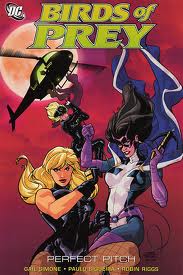
Perfect Pitch
I am beginning to see that not reading these in order may indeed have its drawbacks. This set appears to be the start of the Birds of Prey proper, with Huntress unconvinced that she really wants to be a part of it and Batman making a rather unexpected appearance (well, unexpected for me; I know nothing about Bats in comic-world). It also spans the Infinite Crisis… thing… about which I know nothing, except that a year is skipped and all of a sudden Black Canary is off doing weird things in a nameless Asian jungle while the mysterious Shiva is scaring the pants off people in Gotham.
In terms of plot, occasionally hard to follow for someone with little to no backstory, and also not a nice continuous arc like the previous Birds of Prey (Dead of Winter) I read. The art was usually pretty fun, although I did feel uncomfortable with some of the shots of Black Canary and her kicks. It’s nice to see a group of women working together with no arguments about who gets the guy (well, ok, some arguments, but ‘getting the guy’ in this case means ‘kicking the guy’) – they’re by no means perfect, and there is some dysfunction, but it makes sense. So that’s definitely a plus.

Castle Waiting
Starts off with only a slightly off-kilter telling of Sleeping Beauty – I really liked the focus on the fairies/witches at the start here and moves into the castle and surrounding area essentially becoming a refuge for people who have nowhere else to go, or nowhere else they want to be. The reader arrives via o
ne such, a pregnant woman who later gives birth to a rather… peculiar… baby. But for me, this set of stories is really all about the bearded nuns.
Yes, bearded nuns. Never did I think that someone could have the sympathy, and the art, to draw very attractive women with beards, but such is the accomplishment of Linda Medley. This order of nuns is begun by women escaping an unhappy fate and continues to present just such a chance for other unhappy women. There are many things I loved about the bearded women, just one being that the idea of a man loving one of them was perfectly natural – they are by no means freaks to anyone in the book except those who are clearly immoral/unpleasant/otherwise non-relateable anyway. There’s a nice variety within the bearded women community – the beards and being female are about the only thing they have in common, except that a few of them have also experienced being in the circus. If for nothing else, Medley won me as a fan for this aspect.
She does win me for other reasons: the art is delightful without being distracting or overwhelming; the numerous sub-plots are nicely woven, and I love that the knight in armour is actually a horse.
I look forward to reading more.
Galactic Suburbia in Melbourne
 In which we report live and punchy (not enough sleep to be sassy) from Day 2 of Continuum 8: Craftonomicon, Natcon 2012 in Melbourne Australia. You can get us from iTunes or at Galactic Suburbia.
NEWS
The Con so far: panels, parties, yarn and cupcakes…
What Culture Have we Consumed?
Alisa: Deadline by Mira Grant
Alex: Game of Thrones s1; Dirk Gently’s Holistic Detective Agency; The Courier’s New Bicycle, Kim Westwood (YES ALRIGHT AT LAST)
Tansy: Timeless by Gail Carriger, Cracklescape by Margo Lanagan
Please send feedback to us at galacticsuburbia@gmail.com, follow us on Twitter at @galacticsuburbs, check out Galactic Suburbia Podcast on Facebook and don’t forget to leave a review on iTunes if you love us!
[Photo credit: Cat Sparks]


