Galactic Suburbia 52
 In which we pop the cork on the champagne bottle to welcome in the beginning of the 9 month science fiction awards season – hooray! You can get us from iTunes or stream from Galactic Suburbia.
News
Responses to the Galactic Suburbia Award.
Crawford nominees and winner: Genevieve Valentine’s Mechanique.
BSFA nominees
SF Translation Awards Fundraiser – donate and win awesome books
The Kitschies: yes really, rum and tentacles.
LOCUS Recommended Reading List! [and Poll]
Young Australian of the Year who founded Robogals: Marita Cheng
Women of SF in their own words, reviewed by Brit Mandelo
Diana Peterfreund: following up on Brave New Love [and how the internet often fails to pick up the pieces after a controversy has died down]
Women Writing Horror (it’s new, who knew?)
[and the other Guardian article patronising genre readers, taken apart by Smart Bitches Trashy Books]
Creature Court trilogy giveaway – we’ll be drawing it next episode, email us to tell us about one book you read because of us & you’ll enter the draw to win all three books by Tansy
Creature Court Spoilerific Blog Post – only for those who have read Creature Court Book Three, Reign of Beasts, by Tansy Rayner Roberts
What Culture Have we Consumed?
Alisa: Juliet, Naked by Nick Hornby; The Last Little Blue Envelope by Maureen Johnson
Alex: Clockwork Rocket, Greg Egan; A Fisherman of the Inland Sea, Ursula le Guin; The Business of Death, Trent Jamieson; Skyrim
Tansy: Bad Power by Deborah Biancotti; Batgirl: the Lesson; Redwood & Wildfire by Andrea Hairston; Blake’s 7: The Turing Test [Big Finish], Doctor Who: Foe From the Future [Big Finish]
Please send feedback to us at galacticsuburbia@gmail.com, follow us on Twitter at @galacticsuburbs, check out Galactic Suburbia Podcast on Facebook and don’t forget to leave a review on iTunes if you love us!
Skyrim and the novice gamer
So… computer games…
It would be wrong to say that I have never played computer games. I played a lot of games on cassette, way back when, and doesn’t that make me oooold? There was a great one called Kickstart, I think – it was a motorbike and there was lots of jumping. And balloons to hit. As a family we progressed through to a Gameboy (my brother’s, but I got to play, occasionally), and then to a proper desktop that played Civilisation like nobody’s business. Then I left home, and I didn’t play games again for ages, partly because I didn’t have a computer for it and partly because I had no ‘in’. After we got married I had a go at Starcraft, and played a fair bit until one section really stymied me and I gave up in disgust (I still get scowly thinking about it). J is a long-time gamer, and has been on the look-out for a new game for me to try for a loooong time, especially since we got a PS3 (to play Blu-Ray when we needed a new DVD player, honest!). I’ve been pretty anti, to be honest, for what are probably not great reasons. They take up a lot of time! time when I could be reading or knitting!… but somehow gaming doesn’t seem as ‘worthy’ a use of time. Also, I am pretty uncoordinated, which is disheartening when trying to use controllers; and I loathe learning new skills. Which is pretty pathetic, but true.
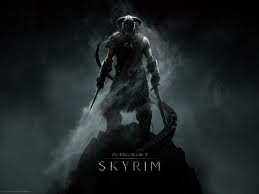 Anyway. He heard about Skyrim, and thought it sounded like the sort of game that I might enjoy, because of its non-linear nature – therefore no time pressures – and because it was reputed to be an amazing world to simply explore. I argued somewhat half-heartedly, we searched the city game shops high and low and eventually got told there was one copy in the game store closest to our house, and took it home.
That evening, one week ago, I sprained my ankle. Ha ha ha.
I haven’t actually played as much as you might think, but more than I might have expected. Partly that’s because I do still want to read and knit, and partly because J decided to have a go too, with a character completely different from mine, so we’ve been Sharing. Not something we’re always very good at. And, yes, I’ve been enjoying it. I’m playing a Wood Elf, which makes me naturally good at archery and general sneakery (I’m meant to be a thief but I just can’t bring myself to nick stuff. Also, the first time I tried I got caught, so I’ve given up on that for now). I nearly gave up on the game right at the start when I had to choose a race for myself; J, and the manual, were all “choose a character that will suit your playing style!” to which I replied “I don’t have a playing style!!” I doubted that I had the wherewithal to be coordinated enough for magicky stuff, and serious crazylike weapons stuff just didn’t seem like me (plus, I’m enough of a Tolkien fangirl to be uncomfortable with being an Orc – the race J chose, who gets to go berserk and literally see red). So, Archer and Wood Elf seemed a good choice (Legolas’ influence, not Paris’, for what it’s worth).
I’ve got a little disheartened when J has levelled up faster than me, found things faster than me, etc – but as he keeps saying, he’s got several game-playing-years on me, so he Knows How Things Work (barred door your lockpicking won’t open? Find a lever or chain to pull.) Also, I have to keep remembering our characters are pole opposites, so that dungeon was easy for him but I can’t sneak there… and so on. We do seem to both be able to kill dragons equally well, so that’s nice. 
I am impressed by the world. I’ve felt uncomfortable about not finishing the quests set Right Now, until realising that it really truly is non-linear; if I leave someone waiting for their cart to be fixed, they’re still there several days (ahem, game days) later. So I can be as flighty as I like – ooh, a cairn! I’ll follow this trail! The landscapes are well-drawn, and while not hugely different in different areas there’s significant change when going up and down mountains, and towards water. One really lovely touch is that when travelling at night, there are often aurora in the sky, which is the sort of whimsy I wasn’t really expecting. One thing I have been particularly impressed by is the gender parity. The manual makes a point of saying that being male or female makes no difference to a character’s achievements or skills. Bandits, other warriors, and general characters are just as likely to be women as they are men – and I haven’t met many jarls (head honchos) yet, but I’m pretty sure I’ve come across one female jarl, which I hadn’t expected. So that’s a really major plus.
I will definitely be keeping on playing. I’ve now bought a house (bwahaha) which enables me to leave stuff there and not have to carry things all the time, so I can pick up more Cool Stuff and sell it to get more money… I must admit there is part of me that is still unsure of the actual point of this game. Highest level for your character? Most gold, best house? Most dragons killed? Complete all the quests? I guess the last point is the one that makes the most sense in the strictest sense, but I also think that it is the one that perhaps least encapsulates the spirit of the game, and I can’t quite believe I just said that.
Galactic Suburbia: the awards edition
I meant to post this yesterday and totally forgot! If you want to listen to the podcast – from iTunes or via the website – without being spoiled as to the Honours List and the winner, stop reading now! Alternatively, below is the TL;DL version.

The GS Team: Alex, Alisa, Tansy and our Producer (AKA Gentlemen’s Auxilary)
Yesterday Galactic Suburbia put up a Very Special podcast, announcing the honours list and winner of the inaugural Galactic Suburbia Award.
After much discussion, and wanting in particular to create something that wasn’t already out there in the multitudinous world of spec fic awards, we came up with this definition:
The Galactic Suburbia Award: for activism and/ or communication that advances the feminist conversation in the field of speculative fiction in 2011
Honours List
Carrie Goldman and her daughter Katie, for sharing their story about how Katie was bullied at school for liking Star Wars, and opening up a massive worldwide conversation about gender binaries and gender-related bullying among very young children.
Cheryl Morgan for Female Invisibility Bingo, associated blogging and podcasting, and basically fighting the good fight
Helen Merrick, for the Feminism article on the SF Encyclopedia
Jim C Hines for “Jane C Hines” and associated blogging, raising awareness of feminist issues in the SF/Fantasy publishing field.
Julia Rios, Kirstyn McDermott and Ian Mond for Episode 11 of the Outer Alliance podcast (The Writer and the Critic special episode)
L. Timmel Duchamp – for continuing to raise issues of importance on the Ambling Down the Aqueduct blog and various Aqueduct Press projects
Michelle Lee for the blog post “A 7-year-old girl responds to DC Comics’ sexed-up reboot of Starfire”
 Winner
Nicola Griffith – for the Russ Pledge, and associated blogging
The winner will receive a Deepings Doll hand-painted figurine of a suffragette with a Galactic Suburbia placard, hand-painted by Jilli Roberts of Pendlerook Designs. (Tansy’s very talented mother!) Each Deepings Doll is individual, so the one each winner will receive (we do plan to make this an annual tradition) will be unique.
If you have ideas for our Honours list for 2012, please email us at galacticsuburbia@gmail.com or tweet @galacticsuburbs
=====
It’s been lovely to see such a positive response from our honourees and winner. Already, Nicola Griffith, Cheryl Morgan and Timmi Duchamp have posted the award details on their blogs with gracious commentary. We at Galactic Suburbia had a great time chewing over what our award should be, and what we wanted to celebrate in the SF community.
===============
The Clockwork Rocket

One thing must be noted about Greg Egan’s fiction in general, and this book in particular. He, and it, are uncompromising. In reading it the audience must be one of two things: able and willing to understand complex physics, or willing to accept that they do not understand those physics and carry on with the story regardless. If you are not in either of those two camps, The Clockwork Rocket is most definitely not for you and Egan makes no apology for that. This is a book that comes with diagrams. (For reference, I fall into the second camp. It’s a long time since I did any physics seriously.)
This is a story set in a universe different from ours in one very crucial aspect: the speed of light is not a constant. In many respects, this book (the first of a trilogy) represents the working out of the consequences inherent in that seemingly simple fact – to the point where a large chunk of the book is actually just that: a physics student exploring the ramifications of observed phenomena on the possibilities of time and space.However, were this novel merely an amusing exercise for the physics lover, I would not have persevered. Along with the physics, Egan has incorporated some rather profound discussion of gender and reproduction, all within a quite compelling story about saving the world.
Why does the world require saving? Egan takes the ancient fear that comets herald the end of the world and makes it true (…maybe). At the start of the story, the occasional streaking light is seen in the night sky; over time, with more appearing, these streaks come to be called Hurtlers. This increase in number, and in brightness, leads some people to wonder about exactly what is causing them, and whether it might lead to problems for the world in the future. The protagonist, Yalda, is the one to realise that yes, these Hurtlers may actually represent her world’s doom, and she and others start work on an audacious plan to attempt that doom’s subversion. The plot follows Yalda’s initial experience of education, her move to university, and on into theoretical physics and astronomical research, for roughly the first half of the book. The second half is concerned with Yalda and friends convincing people of the truth of the problem, and of their proposed solution: build a rocket, send it out, and have it return in a few years of world time. Because of the non-constant speed of light, if the rocket is accelerated to a sufficiently high speed many generations will pass on the rocket – and those generations will have the time to do the necessary research to avert disaster planet-side. (If it sounds like I’m spoiling a major plot point, occurring late as it does in the book, fear not: this is all mentioned in the book’s blurb. My guess is that it was put there to encourage readers to push on through the theoretical physics in the knowledge that honestly, there really is a plot here, too. Also, if you’re about to raise issues with the physics – don’t. I’m just telling you what Egan sets out in the book, and I do not have enough physics myself to be able to point out possible flaws in his logic.) Naturally, the course of research never does run smooth, so Yalda and friends experience problems – deliberate and accidental – as well as the frustrations familiar to any scientific pioneers. They do eventually get off the ground, and I think it’s fair to say that much of the most interesting plot occurs onboard the titular rocket.
Egan has not transplanted Earth to his new universe. The world of the story, and the people, are just different enough to be disquietingly alien. Plants emit light at night. People have variable morphologies: if an extra pair of hands is needed for a task, it can be extruded. And, most profoundly, children are formed directly from the mother’s body: she becomes essentially a cocoon, and then splits into four, to create new beings. Ideally, she produces two sets of male and female pairs. When each of these females in turn is ready, she and her co (male partner) meld and she likewise splits into four – and the children will then be raised by her co. Like me, perhaps one of your first reactions is to cry ‘incest’. However, there is no sexuality on this planet, so it’s quite a different situation; our ideas of sexual and familial separation are irrelevant. There are a lot of interesting repercussions of this form of procreation. For me, the most intriguing issue raised is the issue of gender. Children are born from one half of the pair, and that one is called the mother; this is similar to humanity, and perhaps warrants Egan’s use of the feminine pronoun. However, the co raises the children – generally also seen as primarily a mother’s job in humanity – and the suggestion that females could take on this role is seen as entirely unnatural. There is also little suggestion throughout the book that there is anything other than this reproductive role to distinguish between male and female; females do not seem to be subordinated in terms of schooling, for example, simply because they are female, although they may be subject to harsh penalties if they appear to be rejecting their biological destiny. This may be similar to some extremist views today about women being fit only to bear children, but here it’s not the only thing they are capable of doing but rather the genuinely last thing they ever will – and in some sense what they are intended, ultimately, to do. It doesn’t need to be explained, I imagine, that the existence of a drug that can stall their reproductive splitting (there needs to be a word like bifurcate – quartofurcate?) is contentious to the point of immorality or illegality (it’s a bit blurry which). Egan is setting some very provocative questions here about the nature of gender and reproduction and parenting (single parents are the norm!). This is not to say that his ideas and choices are always unproblematic; the very nature of reproduction was troubling, for me, although Egan makes it clear there is no pain involved. And all of this, all of this normal way of being, is off balance right from the start by the main character Yalda, because she is a single: when her mother split, only three children were created. She has no co, and is therefore alternately pitied and reviled. Partly as a consequence of this, she gets the opportunity for a more advanced education than might otherwise have been possible – a bit like having an independent income and a room of one’s own. As often happens, the slightly-outsider character allows for a more interesting perception on the society.
Overall, I really loved this novel. Yes, there were pages where I skimmed the intense physics discussions, because vector diagrams just don’t do it for me. But the character of Yalda, and a desire to find out exactly where all of this was heading, kept me reading – and will make me get the second book as soon as humanly possible.
The Cold Commands
I’d like to say that The Cold Commands is a satisfactory or entertaining sequel to Richard Morgan’s The Steel Remains, but those who have read the latter would know that I was lying through my teeth; it couldn’t be either. So I will go with ‘appropriate.’ Other adjectives to describe it as a novel include ‘enthralling,’ ‘chilling’, and ‘relentless’.
You could probably read this without having read the first book, but personally I wouldn’t recommend it; partly because things make more sense in context, and partly because The Steel Remains is excellent.

The enthralling part comes largely from the characters: the situations they find themselves in and their development as people. As with the first book, the story is largely told from the perspective of Ringil, Egar and Archeth. Ringil is recovering – slowly – from his time with the dwenda Seethlaw, but he has changed: not only older, maybe wiser, definitely sorer, but in some even more intangible ways also involving blue fire and interest from the dark gods themselves. Ringil is a delightfully ironic take on the stereotypical fantasy hero; he’s a warrior, wields a sword gifted to him by non-humans, and has a strong sense of justice… but he’s also homosexual in a world that doesn’t accept that, has been disowned by his family and forgotten by most of the world, and doesn’t particularly want to fight most of the time. On the other hand, Egar Dragonbane quite likes fighting, almost as much as he likes having sex. Exiled from his home on the barren steppes, Egar is struggling to come to terms again with city living and his one-time mistress. Egar is definitely more in the Conan tradition, and provides an interesting contrast to Ringil, with the added benefit of more brains that nomadic barbarians have classically been awarded. Also, more humour. Rounding out a truly unlikely trio is Archeth, I think the most interesting of the three. She’s a half-breed – half human, half Kiriath, the now-absent one-time allies of the humans – which means she has access to and some control over what might be magic or might be highly advanced technology (there’s definitely some playing with the old Clarke adage here). She too is homosexual, leading to some difficulties, which combined with the fact that she is female and has the ear of the emperor – sometimes – leads to clashes with religious authorities. On top of all of this is her continuing anguish at having been left behind by the Kiriath, which she feels both as a betrayal, and as a failure on her part, of not being good enough to accompany them. These three came together many years before the events in even The Steel Remains, to deal with the threat posed by the Dragons. The Steel Remains was mostly about their individual adventures and problems, with those issues coming together towards the end to reveal the beginnings of a very interesting pattern. Here, they have their own chapters, but the links between them are more obvious and their private fights and confrontations more definitely, if still obscurely, connected.
Chilling and relentless describe the overall plot; both are to be expected in a novel by Richard Morgan. The Steel Remains left our (anti)heroes having defeated a possible dwenda invasion, and feeling slightly uncomfortable about what that might mean for their world. Dwenda are still something of an issue in this sequel, but there are other maybe-threats too, such as the Dark Court, the gods worshipped by some, who are paying an disturbing level of interest to the goings-on of individuals like Ringil; and something, or possibly someone, that appears to have newly come from the absent Kiriath but without a user’s manual. Plus there’s the everyday, run of the mill threats like a mildly crazy emperor (who might feed you to the octopus), unpleasantly near-crazy religious zealots, and inter-city strife over trade and slavery. The relentless part comes from the steady pace of things going wrong or new problems being discovered. It’s not frenetic, in that the characters are not running from one thing to the other unless they’re being chased; instead it’s like a normal few months where almost nothing goes to plan, and problems pile up on top of each other slowly and steadily. Ringil, Egar and Archeth find themselves involved in problems they would actually rather not have anything to do with, thanks all the same, but don’t seem to have a choice about. All of that is chilling, too, as is the uncomfortable knowledge that while there are some happy times for the three protagonists, this is unlikely to all end well. And then there’s the deft and clever world and secondary characters created by Morgan; that’s chilling too, because they are so very real. For example, the various cities and their politicking, internal and external, are intricate and recognisable, and quite clearly keep going about their business without much concern for the events being portrayed in the novel. Then there’s the slavery, newly legalised in a number of states. Slavery, and the treatment of slaves, is often portrayed in an unemotional way – as a business opportunity. It’s clearly not because Morgan approves of slavery; Ringil in particular works rather hard to stamp it out. But the presentation of how it could become normal very quickly is indeed chilling because of its plausibility. And the way that people appear to have forgotten recent history, too, is both plausible and recognisable.
Overall this is an enthralling piece of fiction, ticking a lot of boxes for me: quirky and original characters; action that’s well-described and gritty without being in love with gore; deft world building that doesn’t swamp the story; and a story that leaves me desperate for more. I am fairly sure that there should be a third book about Ringil and his grim band (not that I’ve seen anything official about that), which makes me very happy indeed.
Galactic Suburbia 51
 In which women aren’t funny, don’t write important books, but come in handy as assassins and thieves. You can get us from iTunes or download us from Galactic Suburbia.
News
Connie Willis named SFWA Grand Master
Liz Bourke on Strange Horizons & the art of the mean review
Survey shows that men (as well as women) often play characters of the other gender while gaming – in many cases, men are bored with or alienated by the big musclebound male characters, which game designers think they want. Sound familiar?
Hoyden about Town are asking for guest bloggers to crosspost their Australian Women Writers Challenge reviews on Hoyden (ASIF also keen to do so)
More on feminine tosh: a good solid article in the Australian media (shock!) about the women in literature issues of recent months (and, you know, decades).
Have we been following the “Women aren’t funny” stoush that played out in NYT? This interesting development.
DC Comics – cancellations & new titles – Tansy is especially excited by World’s Finest (featuring the Earth 2 Huntress & Power Girl)
Stranger with My Face – Women in Horror film festival in Hobart, Tasmania – 17-19 February
Tansy’s book launch for Reign of Beasts (Creature Court Book Three) on 2 February at Hobart Bookshop, 5:30pm.
What Culture Have we Consumed?
Alex: Ashes to Ashes season 2; Dr Who season 1; Rocannon’s World, Ursula le Guin; The Declaration, Gemma Malley; Grey, Jon Armstrong; The Collected Works of TS Spivet, Reif Larsen. BBC 4 “Cat Women of the Moon” podcast
Tansy: Destination: Nerva (Big Finish, audio), Astonishing X-Men by Joss Whedon, The Name of the Star by Maureen Johnson, DVD Extras Include Murder, by Nev Fountain
Alisa: absorbed in novel submissions; The Big Bang Theory; Swordspoint Audiobook, written and performed by Ellen Kushner
GS Award will be proclaimed… in a short while!
Winner of Alex’s Yarn giveaway: Jo
Tansy: Creature Court trilogy give away!
Email to tell us about one book you read after we talked about it on GS to be eligible
Please send feedback to us at galacticsuburbia@gmail.com, follow us on Twitter at @galacticsuburbs, check out Galactic Suburbia Podcast on Facebook and don’t forget to leave a review on iTunes if you love us!
Grey, by Jon Armstrong
 I’m glad I read YARN first, because if I had read this first I don’t think I would have picked it up. That’s a long way of saying that this book isn’t nearly as good as the second (which is really a prequel).
GREY is focussed on the spoilt son of a big-time CEO, and his flouncing around when he doesn’t get everything his own way. It has overtones of Romeo and Juliet with – I can’t believe I’m saying this – even more pretensions, and less soul. (Also no Mercutio.) Michael is being set up to marry the daughter of a CEO whose company his own family’s company is merging. Things go wrong, Michael has to start thinking about what he wants from life, things go more wrong. Very quickly.
One of the things I loved about YARN was its world-building. I really enjoyed the attention to detail of rooms, clothes, and architecture that Armstrong lavished on his made-up world – and the language that went with a world’s total obsession with fashion. I didn’t get the same detail or interest here. The attention to fashion is still present, and is indeed one of the things that sets Michael apart from his father: Michael has dedicated himself to grey, rather than the (literally) eye-watering colour combinations of his father’s set. To the point of burning the cones in one eye so that it can only see greys. However, discussion of the slubs (which feature heavily in YARN), the ‘Ceutical Wars, the “families” and their hold over the world – these things are skimmed over with not enough depth or tantalising clues to serve as much of an insight into this bizarre world. For me, it ended up making the world and the story just so much froth.
I also struggled to connect with Michael. My co-conspirators on Galactic Suburbia had a number of issues with Tane, the narrator of YARN, but I found him an interesting and engaging enough character that I didn’t mind riding along with him. Michael just got annoying. He’s pretentious, a bit of a whiner, spoiled, and entirely too self-obsessed for most of the novel. And not in very interesting ways.
Look, I finished it, so clearly I didn’t hate it; if I could I would have given it 3.5. Possibly I finished it because I found it an incredibly fast read, mostly because the plot itself is frenetically paced. Reading it and imagining the events feels like being caught up in a whirlwind as Michael gets pushed here and there and visits this person and finds that out and oh costume change! One thing I did hate was Michael’s father’s taste in music. I understand – well, I presume – that the music of the Ultras is meant to be an ironic take on modern pop and rock and its idiocy, as well as the dark undertones of violence etc etc… but the fact that their music can actually kill because it’s so loud, but even more that some of the performers have turned killing into part of their stage routine? Not. Cool.
Definitely read YARN. If you end up being really interested in what else Armstrong imagines for that world, read GREY. Otherwise, I probably wouldn’t bother.
Galactic Suburbia: now half a century old
 In which we leap happily back and forth (with occasional ranting) over those fine lines between feminist critique and anti-female assumptions, plus share our bumper collection of holiday culture consumed. Happy New Year from the Galactic Suburbia crew!
NEWS AND LINKS
Hugo nominations open and we’re gonna have our say
Aqueduct Press will be publishing Brit Mandelo’s thesis, “WE WUZ PUSHED: On Joanna Russ & Radical Truth-telling”!
Islamic superhero comic turned animated series The 99 to screen in Australia (ABC3)
Amanda Palmer’s wedding post
Great piece on how the very idea of ‘Mary Sue’ is sexist, ties into this episode’s theme about the criticism of female characters.
The wealth of powerful girl heroes in today’s YA
WHAT CULTURE HAVE WE CONSUMED?
Alisa: Shades of Milk and Honey, Mary Robinette Kowal; The Freedom Maze, Delia Sherman (with cover art by Kathleen Jennings); The Vampire Diaries; Primeval; The 99; Planetary; Homeland and Boxcutters.
Alex: The Double Life of Alice Sheldon, Julie Phillips; Changing Planes, Ursula le Guin; Perchance to Dream, Lisa Mantchev; Twilight Robbery, Frances Hardinge; Chronicles of Chrestomanci vol 1, Diana Wynne Jones. DOA and Going Postal.
Tansy: The Freedom Maze, Delia Sherman; Beauty Queens, Libba Bray; Snuff by Terry Pratchett, Going Postal (TV) – Batman (animated) & My First Batman Book by David Katz, David Tennant & Catherine Tate in Much Ado About Nothing (DIGITAL THEATRE DOWNLOAD AWW YEAH).
Please send feedback to us at galacticsuburbia@gmail.com, follow us on Twitter at @galacticsuburbs, check out Galactic Suburbia Podcast on Facebook and don’t forget to leave a review on iTunes if you love us!
Distress: a Greg Egan novel
 Thanks to this book I finally (kind of) understand what anarcho-syndicalism is. Ish.
This was a brilliant book on a lot of levels. It takes some really serious physics that had even me cross-eyes at points, adds gender/sexuality politics and anarchy-syndicalism, and even manages to have a plot in there.
The physics: the plot revolves around a physics conference and the possible revelation of a Theory of Everything, courtesy of (female, African) Nobel Prize winner Violet Mosala. There are people with conflicting theories, and others who – for reasons of their own – don’t necessarily want a Theory of Everything, thankyouverymuch.
Gender/sexuality politics: this is not a world where people pretend that there are only male and female. Instead, there are seven genders: en-male and en-female (what society today would class as ‘normal); asex (which covers a whole spectrum of people, from those who choose to become physically asexual through to those who choose to appear as such to the world); ifem and imale (which sad to say I’ve forgotten what they are!) and ufem and umale (u might stand for ultimate, I’m not sure; I thought of them as the airbrushed and queasy-making sorts you see on body-building magazines). There’s a wonderful section near the start where the main character talks about gender and gender migration as “ninety percent politics,” and that becoming asex in particular is a protest action. It’s really thought-provoking stuff, not least because I think it’s done really neatly and while there is a bit of info-dumping, it is in context and it is relevant to the story – and it’s not preachy, either.
Anarcho-syndicalism: the majority of the book takes place on Stateless, an engineered atoll run on anarcho-syndicalist lines. Which no one in the wider world of politics is very happy about. There’s some quite intriguing discussion of how this works and why the place doesn’t collapse into genuine and destructive anarchy, which – like the gender discussion – mostly feels natural. Frankly, even when it doesn’t I found it so intriguing that I didn’t much care.
The plot: a fairly pedestrian journalist/documentary maker Andrew ends up on Stateless to cover the physics conference and particularly Mosala and her ToE. There are complications: physics-related, political, personal. There are twists and revelations. It’s fast-moving enough that I certainly didn’t get bored; there’s enough character development that I was happy to follow Andrew on his voyage of exploration and discovery, and I liked Mosala too – she’s more complicated than Andrew, and although it might have been interesting to have some of the story from her perspective part of the point of the novel is, I think, the public perception and representation of people.
One of the other things I really liked about Distress is that it is quite Australian. There’s a great bit where Andrew is talking about civil rights, and he mentions a few people who might get annoyed if they were told to avoid generalisations: Dr King, Ms Greer, and Mr Perkins. I would bet there’s a lot of people in Australia, and most outside of it, who wouldn’t get that reference. But Egan doesn’t explain it (which I liked). There’s also a rather bitter section midway through about “Professional Australians,” which sounds like quite the rant against politicians but also perhaps ex-pats who get the job (somehow) of defining Australia to foreigners, full of “a claustrophobic vocabulary of tired nationalist myths.” It also has a rather harsh critique of Young Einstein, which I remember loving but I’m sure the Suck Fairy has visited in full force.
Films of 2012
I’ve decided that, since I can’t find a convenient film-version of Goodreads, I will keep a tally on the blog here – over on the right, if you’re reading this on the blog itself; if you’re getting this through RSS or email, and you care, you’ll have to visit. Anyway so far there are two movies there: Frost/Nixon, which I’ve been meaning to watch for ages, finally saw yesterday, and really enjoyed – what a cast! – and Chronicles of Riddick, which I love despite its flaws.


