Merry Happy Valkyrie
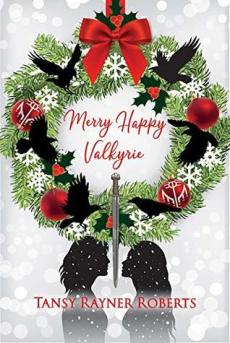 I wouldn’t necessarily call myself a Scrooge, although others might; I don’t put up Christmas decorations, I don’t wear baubles for earrings, I don’t watch Christmas movies (ok, Alisa made me watch Christmas Chronicles, but IT STARS KURT RUSSELL so it doesn’t count).
I don’t deliberately go and read Christmas stories. But this is a Tansy story, and I’d heard it played with some jokes about Tasmania and weather, so I figured I’d give it a go.
(I guess I should say that both Tansy and the publisher are friends of mine… but if I didn’t like it, I just wouldn’t say anything….)
Lief is a weather reporter, and lives in Hobart, but her hometown is Matilda – where it always snows at Christmas. Now, for the non-Australians, this is hilarious. Australian weather is always a bit unpredictable, especially in Tasmania, but the idea of guaranteed snow in December is outrageous. It has been known to snow in the hills near Melbourne, for instance, on Christmas Day… but the next year it was in the mid-30s C. Tasmania is more ridiculous (from 38C to snow in 5 days in January, and that’s just what I – as a visitor – have experienced)… but the idea of confidently predicting snow, in December? Uh, no.
Anyway, this is understandably intriguing, but less understandably hasn’t been closely reported on. Until now, when Lief is forced to go home for Christmas with a far-too-bubbly camerawoman in tow. Matilda doesn’t like visitors: there are far too many secrets that need to be kept. And when there’s not one but a whole truckload of strangers, and then weird things start happening – like earthquakes – clearly things are going to get real.
This is a very fun, and very enjoyable, and very intriguing, novella. It’s written in that Tansy style that means there’s a lot of banter and snark, some surprising description that really works, and at a brisk pace that means there’s no time for dawdling HURRY UP. Thoroughly enjoyable, and not just a Christmastime read.
Miranda in Milan
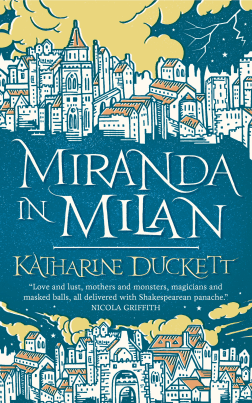 This novel (novella?) was sent to me to review by the publisher, Tor.com, at no cost. It will be out on 26 March, 2019.
Aside from King Lear, which I loathe, I probably dislike The Tempest more than any other Shakespeare play. I don’t know why; there’s nothing particular I can pinpoint. But I really, really dislike it.
It turns out, though, that stories of Miranda after the play are stories I can really get behind. So maybe this is part of the problem: in the play, I think Miranda is just a bit nothing. But For Meadows’ Coral Bones made me swoon for joy, and now Katharine Duckett’s Miranda in Milan similarly plays with the aftermath of Miranda’s return from the island – in a very different way from Meadows, but equally dealing with some of the issues that a young woman with such an upbringing might need to confront.
Here, Miranda is returned to Milan, and basically confined to the room – she’s only allowed out when wearing a veil, which she loathes. Her father is off reestablishing himself as duke, Ferdinand is in Naples, and she has no friends. Until suddenly she does develop a friendship, and she begins to discover some of what’s gone on in Milan that led to Prospero’s banishment – and, by extension, her own.
Nicola Griffith’s blurb is (unsurprisingly) apt: “Love and lust, mothers and monsters, magicians and masked balls…”. That’s about it. What is love and how do you know it, what makes a monster, and can magicians be trusted… Duckett writes about these things, and does it quite beautifully.
Sorry you have to wait til March to read it.
The Fated Sky
 Don’t be like me: if you think you might like to read The Calculating Stars, just buy this at the same time. Because otherwise you’ll get to the end of the first and you’ll be forced to cry NOOOO and shake your first at the sky because you can’t go immediately on to this.
Trust me on this. (Also I can’t believe I didn’t review Stars when I read it. Oops.)
Elma York is a scientist and a pilot. There’s a dreadful catastrophe on Earth in 1952, and from that point history is different from our history, because humanity’s attempts to get to space happen much, much faster, from necessity rather than hubris or curiosity.
York is female, and Jewish. It’s the female bit that leads to most of her personal difficulties; it seems to me that Kowal pulls no punches when it comes to laying out the sexism of the 1950s and 60s. I often found it distressing to read about. And it’s not only that which is distressing. There’s also the racism: York herself, while not actively racist, is complicit in the systemic racism of her time because so often she simply isn’t aware of the experiences of the not-white folks around her. And her attempts to ‘help’ are often blundering. I do like that Kowal shows York learning from her mistakes – sometimes because she is actively shown what she has done, or what society has done; sometimes she thinks her way there personally. She’s certainly never perfect, though – she’s a product of her times.
And then, in terms of things that can be hard to read about, York also suffers from anxiety. Although I do not myself suffer from it, it was reading about this that perhaps affected me most. The way it physically affects her, and the way those around her react, and the reasons for it existing or being exacerbated. Kowal writes about it exquisitely (said the person for whom it is largely unfamiliar, so take that into account).
I really feel like these books are perfect for 2018.
I don’t want to spoil either book, so I won’t go into much detail of the plot, but of course humanity’s efforts to reach space and work there are more successful in the books than in real life; otherwise there wouldn’t be two books (AND, so excite, at least two more planned!!) about it. But it’s fair to say that there is no plain sailing – which is as you would expect from Kowal, frankly, and indeed from any early-space-reaching novel attempting verisimilitude.
I love these books with a great passion. They tore at my heart, and made me angry for the way people are stupid for stupid reasons; they made me happy for the fact that there are good people, too, striving to do what is right and sometimes failing but also keeping on going, often in the face of terrible opposition. I love Kowal’s writing and I love the pacing of these stories and I cannot, cannot wait to read more set in this world.
Summer in Orcus
 When I was looking through my ebooks and came across this one, I couldn’t for the life of me remember how I acquired it. Looking at the cover I thought it might be connected to Kathleen Jennings, but turns out it’s not her art – just similar. Then eventually I realised that it came in the Hugo packet, and I had run out of time to read it before voting was complete.
T. Kingfisher is, I discovered, a nomme de plume of Ursula Vernon. I’ve read some of Vernon’s short stories, but not enough to really have a sense of what her work is like. So I had no idea what I was getting myself in for with this story.
The answer is: whimsy, and delight.
Firstly, Summer is the main character, and that’s delightful. Secondly, she has a painful childhood, because her mother is needy and overly protective. I find this quite fascinating as a way of thinking about a parent in a fairytale-is story. Not absent, not careless, not hardhearted; but the sort of parent who makes their child feel bad for wanting independence, who needs constant reassurance, and who peculiarly demand their child to be more like the adult, offering comfort. So that’s an intriguing aspect that’s introduced immediately. Which is also something I like – this is aimed, I guess, at what Americans call ‘middle grade’ readers; Summer is 12 – and so there is little beating about the bush. The story proceeds at what would be well called a brisk pace. Indeed, and thirdly, Summer has met Baba Yaga and her chicken-legged house within three pages and is off on her adventure in Orcus in chapter 3, to find her heart’s desire. Summer’s not quite sure what her heart’s desire is, but assumes she’ll know it when she finds it.
Also, she has a talking weasel to accompany her.
I told you there was whimsy.
So there are talking animals and dryads and a land that’s kind of falling apart, dandy-ish birds and terrifying fortune-telling cheeses. People who are actively trying to destroy things and a wolf that’s not just a wolf, and Summer reflecting on whether her experience in Orcus will be like an experience in Narnia. And an antelope woman.
I loved it. A lot. Kingfisher’s prose is delightful, the characters are varied and only Reginald, the dandy bird, is faintly ridiculous. While it initially seems like it might be a relatively standard portal fantasy (which would have been fine), it reminded me more of Catherynne M Valente’s Fairyland books in their self-awareness than anything else. It’s also not completely standard in the way that Summer’s quest pans out, but no way am I spoiling that. Suffice to say it left me musing.
I really enjoyed the character interactions, and the places Summer visits. I liked that Summer wasn’t always sure what to do but that she was a resourceful and sensible girl – and sometimes that meant being quite scared, as was appropriate in some of the circumstances she found herself in. She deserves to have lots of people read about her adventures.
Beauty, by Robin McKinley
 I have never read a Robin McKinley book before. I gather, from looking around, that this might be a slightly scandalous announcement? At any rate, that’s the case. I have a feeling that I got this, and The Hero and the Crown, from a Humble Bundle or similar. It’s not something I would have bought off my own bat.
This is fairly straightforward retelling of Beauty and the Beast. It goes into a substantial amount of background for Beauty’s family, which I really enjoyed – the discussion of the family, and their changing circumstances, was a perfectly delightful story all by itself. Because here’s the thing: even though it’s a standard retelling of the fairytale, insofar as that bit goes (and I recently read Angela Carter’s version, which WHOA), what makes this stand out is McKinley’s fabulous prose. Reading her work is utterly effortless, and a joy. I love her descriptions and I enjoy her dialogue and the characters are delightful. Beauty has two older sisters – and they’re distinct from one another, and although they’re not the centre of the story I still know them and care about them. Her father is a bit more distant, which makes sense as it’s Beauty’s perspective we get. And Beauty herself is wonderful: not entirely content with herself and her life, for various reasons, but also devoted to her family and doing what is necessary, generally happily. Her conflict in staying with the Beast is presented clearly, with duty meeting fear and so on…
This is not a fractured fairy tale nor a complete reimagining. It’s a story that takes a well known story and makes it more rounded, and presents it wrapped in lovely words.
Making the Monster
 This was the second book in my birthday haul from my mother this year. The first was… not as good as I had hoped. Happily, this did not fall into the same trap.
The idea behind Harkup’s book is to look into the science that was happening around the time of Shelley writing Frankenstein, to explore what ideas influenced her. I was slightly concerned that this could go down the route that Russ identifies of suggesting Shelley was nothing but a conduit for the ideas of the time, but she does nothing of the sort. She does look into what sorts of things Shelley’s husband, father and friends were into, but only to suggest that this is how Shelley herself could have found out about these things: with Percy interested in electricity, for instance, it makes sense that they may have talked about some of the ideas being discussed by scientists, and so on. So I was relieved that this book is very much about how Mary Shelley herself knew what she did, and how she might have accessed knowledge of galvanism and resurrectionists and all of those other things that are so vital to the development of this story of the modern Prometheus.
As well as being an investigation into the science of the early 19th century, this almost inevitably also becomes a biography of Shelley – where she was when, who she encountered, how different places gave her access to ideas or inspiration, and so on. There’s also a discussion of how popular culture has dealt with the story, and the ways that film versions in particular have percolated through the popular Western mindset – and how these are often quite different from Shelley’s actual story.
Electricity, preservation of flesh after death, skin grafts, the circulatory system, evolutionary theory, blood transfusions, batteries… all of these things were being discussed in the early part of the 19th century and had an impact on Shelley’s writing. This is a fascinating introduction to the science of this period as well as being a fascinating way of thinking about Frankenstein. Harkup also does justice to Frankenstein as a way of interrogating science, and scientists.
I don’t adore Frankenstein – I’ve only read it once – but I really enjoyed this historical context.
A biography of Olympe de Gouges
 Since I started learning about the French Revolution I’ve been fascinated by the women involved in it. The workers Pauline Leon and Claire Lacombe, the intriguing Theroigne de Mericourt, and of course Olympe de Gouges – who wrote the Declaration of Rights of Woman and the Citizeness, in answer to the Declaration of the Rights of Man and the Citizen. And ended up getting executed. There’s not a whole lot about Olympe in English, which I think is an absolute travesty, so when I went on a bit of book-buying spree of revolutionary books and came across this one, I decided I needed to own it.
I should have paid attention to how long it was. It’s only 100 pages of text, and given it cost $66 I’m a bit grumpy. I may still have bought it, but probably as an ebook instead.
I’m also a bit grumpy because of the content. Partly I’m sad because the translation isn’t excellent, so there are bits where I’m not sure if a sentence is a translation issue or a writing issue. Partly I’m annoyed because I think it would be very difficult to read and really get this book without knowledge of the French Revolution. That makes it inaccessible to people coming it at from a feminist history perspective rather than a French Rev one, which is doing Olympe a disservice. I would really have liked to see Mousset lay out more of the context of the revolution than simply mentioning some of the events that were happening around Olympe’s life.
Mostly though I’m dismayed at some of the ways that Mousset talks about Olympe’s life and writing. Some of this comes out of currently reading Joanna Russ’ How to Suppress Women’s Writing, as part of our Galactic Suburbia one-chapter-per-episode readalong. One of the things that Russ identifies is the idea that women’s writing is inherently personal, or autobiographical. Mousset frequently sees Olympe in the characters of her plays, and suggests that she is interested in the right of illegitimate children because she is one, in divorce because of an unhappy marriage, in housing for the elderly because her mother died destitute, and so on. As if it’s not possible to care about those things without some personal connection. I’m not denying that those issues may have played a part, but to suggest that this woman – who was clearly driven, intellectual, and passionately interested in making society a better place – was only inspired by things she experienced greatly weakens her commitment.
And then there’s the way that Mousset talks about her writing: “Her lack of culture forced her to constantly make reference to herself” (p31) – which I just don’t understand as a concept, and aren’t we all still in admiration of Shakespeare for probably not having the greatest education early on? Olympe explicitly presents herself in her writing at times, downplaying her achievements – but couldn’t this just be seen as a pose? Check this out:
“I haven’t the advantage of being schooled, and as I’ve already said, I know nothing, I will therefore not use the title Author, although I’ve already presented the Public with two plays, which it was kind enough to welcome. And, unable to imitate my colleagues in their talent and arrogance, I shall listen to the voice of modesty, which suits me in all respects.” (p33)
Doesn’t that just scream Olympe playing the pose of modest woman (which she was accused of not being), but also having a dig at male ‘colleagues’ for their arrogance? Maybe there’s extensive French scholarship to suggest that Olympe was always excruciatingly honest and never played a pose, but right now I’m not buying it. And Mousset follows up this quote by saying that “If there was one thing that she was absolutely not, that was modest!” – which… do we care? Would we make the same comment of a male author? After another passage where Olympe talks about her achievements, or lack of, Mousset says “It’s obvious here that Olympe is mocking herself” (p34), but again I can’t help but wonder if it’s all a pose to get the audience on side. And my irritation is compounded when Mousset comments that “If her lack of humility still seems irritating today, imagine how exasperating she must have been at the time!” (p37, my italics). To which I have no answer because I’m gobsmacked.
Olympe, writing and politically active in the late 1780s and early 1790s, seems like a forerunner of second wave feminism: “Whichever barriers may be encircling you, it is in your power to emancipate yourselves from them; you only have to wish to do so” (p1) – pretty sure enslaved women on what would soon be Haiti wouldn’t have agreed with this sentiment. (It should be noted that Olympe was passionately anti-slavery, to the point of one of her plays being banned for its anti-colonial message.) Mousset does present Olympe’s achievements in terms of her plays being performed, and outlines some of the ways in which she was involved in politics and Parisian society. Partly because she was a moderate in many ways as that became increasingly like an anti-revolutionary, and probably also because she was an outspoken woman, Olympe eventually ended up on the wrong side of the people in charge, and Mousset presents Olympe’s final two years quite well.
For me, this feels like an extensive early version that could easily be twice as long with added commentary on the French Revolution to give Olympe greater context. I do like the way that Mousset presents Olympe’s most well-known work today, the Declaration of Rights of Woman and the Citizeness, with some commentary on the way Olympe changed the wording from what had been adopted by the national government. But I’m not sure I could recommend this to someone – certainly not as an entry to the world of women’s involvement in the Revolution. (That book is Liberty: The Lives and Times of Six Women in Revolutionary France, By Lucy Moore.)
Icefall
 I do not love mountaineering. I do not like watching it, I do not like reading about it.
I loved this novella.
(Note: I am friends with the publisher, but that hasn’t impacted on my attitude.)
There is SO MUCH going on in this story, I’m not sure where to start. Obviously I’ve started with the fact that it involved mountaineering… but that doesn’t tell you much. This isn’t just a story about climbing mountains, it’s about an unbeaten mountain on a harsh planet, and it’s about the joys of climbing as well. I don’t understand those joys, but I got a glimmer of an idea about them from reading this.
There’s only so much mountaineering I would read, though, even from the greatest writer. What really sucked me in here is both the relationship between the characters and the voice of the narrator herself, Aisha. Her relationship with her wife, Maggie, seems straightforward and then slowly reveals all of those complexities and unexpected difficulties that characterise real relationships. Their interactions were loving and troubling and selfish and selfless… how they would react to each other was always a bit ambiguous, to me, and that definitely contributed to the tension.
Aisha, as the narrator, is the person in whose head the reader spends most time, and she’s an appropriately complex person. I loved that Gunn gives us flashbacks to establish a pretty profound backstory for her after we already have a sense of what she’s experiencing in the now. She’s dealing with old injuries – mental and physical – and she has to watch her beloved risk herself on that damned mountain, while also carrying around some old guilt and questions about identity and worries for the future. Basically I just wanted to sit there and pat her hand to make her feel a bit better about the world.
This is a novella, so it doesn’t take long to read. Which is a tragedy, but it also means it’s tightly paced – a few slower, character-driven parts, but always with the knowledge of time passing urgently in the story’s now. Gunn has put a lot of thought into the universe-building that just gets lightly touched on – just enough to make this seem very well-realised. I can well imagine more stories in the broader universe… and possibly more set on Icefall itself. Which I would read, but I may need a bit of space before doing so.
Definitely recommended. Buy here.
The Seven Culinary Wonders of the World
 This book was sent to me by the publisher, Murdoch Books, at no cost. It’s out on 1 November; RRP $35.
I was intrigued by the idea of looking at culinary traditions and histories through seven key ingredients, and those chosen here seem quite appropriate. Not comprehensive, since you could argue for others (like corn, or potato, were my first thoughts) but nonetheless widely used in a variety of cultures over the world and with interesting histories attached. Linford’s chosen seven ‘wonders’ are: rice; salt; honey; pork; tomato; chilli; and cacao.
In each chapter, Linford talks a little about the chemistry or something scientific of each ingredient, but that’s not the focus. There’s more about the history, although it’s still very much an introduction – how something like the tomato moved from the Americas to the rest of the world (I love that tomatoes are, relatively speaking, new to Italy), as well as the development and cultivation over time of different types (the ambition to create inedibly hot chilli is completely foreign to me). There’s a fairly wide-ranging look at how different cultures use different ingredients; because this is a relatively short book (about 230 ish pages), this is by no means exhaustive, which may annoy some people if she hasn’t chosen a particular culture. Still, she does talk about the use of chilli, for instance, in Mexican and Indian and Thai and Malaysian and Korean and Chinese and Portuguese and Italian and American (esp Texan) and Hungarian and Spanish cookery. And finally, there are recipes. Again, these are not comprehensive, but there’s no way it could have been. For pork, she has everything from Chinese pork potstickers (dumplings) and char siu to sautéed chorizo with red wine to glazed ham; for honey, it’s baclava to honey-glazed shallots and grilled goat’s cheese with honey. The recipes are set out nicely on the page, and each one only takes up a page (possibly a requirement in choosing?)
My one reservation with this book is that sometimes the language got repetitive. It’s as though Linford, or her editor, assumed that people would mostly not be reading this straight through (I did), and so they thought that repeating certain key phrases would be both a good and not noticed. I noticed. And while it wasn’t enormous clumps of text that were repeated, it was obvious enough that I got a bit impatient.
Overall this is a nicely-presented book: I love a good hardcover, although I love a cookbook with a ribbon even more! Each chapter has its own colour for the page numbers and the recipe text and the illustrations (there are some nice illustrations throughout – not photos), which is a nice touch. This is a nice book for someone like me who likes the background to ingredients as well as a variety of recipes.
The Brink of Darkness
 This book was sent to me by the publisher, Bloomsbury, at no cost. It came out in August; $16.99.
I read the first book in this series, The Edge of Everything and according to my review I largely enjoyed it – I have to say I’d mostly forgotten the book by the time the sequel arrived. If you liked the first one you’re likely to enjoy this one, I think. If you’re not sure, then I have one word for you:
MELODRAMA.
Everything is DIRE and potentially life-altering and epic. X has gone; oh no! My friends are unhappy with me; oh no! etc. I did end up getting impatient with the book – mostly with the characters, but I wonder if it’s actually a pacing issue. Maybe I wouldn’t have had the time to roll my eyes at the melodrama if things had moved faster?
Spoilers for the first book
X is back in the Lowlands and of course things have changed because not only does he want to find his mother, but he also wants to be back with Zoe. Mild spoiler: I found the whole ‘searching for his mother’ thing overdone. There were definitely moments where I thought if he’d asked a different, obvious-to-me question, things would have been different. I also thought some of the revelations about the mother were a bit… meh. Unlikely, or unnecessary.
Zoe is still with her family but her house has been destroyed and she also has to be honest with her friends. I found some aspects of Zoe’s life believable but others not – there was veering between responsible and not that annoyed me.
Look, this isn’t a hard book to read, so it’s not like you’re devoting days of your life to it. I did end up skimming some sections because the conversations got a bit boring and I just wanted to find out how things resolved. But I am also not going to tell someone not to read it: it’s not terrible, it does have interesting and somewhat diverse characters (ish), and it has some interesting things to say about family and friendship that I largely liked. So I didn’t love it but I also didn’t loathe it. Ultimately it’s not really a book aimed at me – I am too old and have rarely enjoyed the sort of over-the-top drama this revels in, even when I was the age this is intended for – and that’s perfectly ok.


