Great Scott! A reviewing adventure
We are big fans of adventure and action films. My beloved is an unrepentant Top Gun fan, much to my dismay. We’ve both liked various Tony and Ridley Scott films over the years. So we thought, why not do a best-of viewing? That would be fun!
And then I looked at IMDB and MetaCritic, and it turns out that some of the top-rated films from Tony in particular are comedies. I am not watching Get Santa, nor Cyrus. Anyway, after some to-ing and fro-ing, we’ve decided on an idiosyncratic list of five from each Scott, which we’re going to watch in chronological order. It includes some films we’ve seen before, and a couple we never have (or not recently enough to have any real memory of). We’ll be watching and reviewing every fortnight(…ish).
We are looking forward to:
Ridley – Alien (1979)
Ridley – Blade Runner (1982)
Tony – Top Gun (1986)
Tony – Beverly Hills Cop II (1987)
Tony – Crimson Tide (1995)
Tony – Enemy of the State (1998)
Ridley – Gladiator (2000)
Tony – Spy Game (and here) (2001)
Ridley – Robin Hood (2010)
Ridley – The Martian (2015)
The Companions
 I can’t begin to say how angry I am at the blurbing of this book. It doesn’t even begin to hint at how awesome and wide-ranging and epic it is. Without prior knowledge that Tepper is amazing (which I knew from reading Beauty), I would have had zero reason to expect this to be at all something I would like.
The blurb tells you that humans have arrived at Moss to see if there’s intelligent life – which is true; that Jewel is accompanying her half-brother “to help Paul decipher the strange language of the Mossen” is not true, since she’s no linguist, and that “she has a secret mission too” is only half-true, since it’s not exactly an official thing that she’s doing. “A new law on Earth means the imminent massacre of all beasts great and small” is strictly speaking true, but it suggests that there are still many such creatures on Earth which is simply not what we are shown – almost all non-human creatures have long since been got rid of. And that “the Planet Moss, itself a living entity, is not sure it cares for any of the species currently living on its surface” is I guess kind of true but doesn’t give any indication of the complexity of what’s going on. And I certainly couldn’t write the blurb, but I’m not paid to do so.
So what should it have said? Well, clearly humanity have space travel, but personally I think it would have been good to include the fact that humanity is part of a vast interplanetary network involving dozens of different species, and in fact there’s a hugely important narrative thread that involves several different species manoeuvring around one another for dominance in ways that are depressingly familiar. That puts quite a different spin on the narrative than simply “humans are exploring new planets!!” Continue reading →
Farscape rewatch: S1, e5
Each week on a Sunday afternoon, join Alex (of Randomly Yours, Alex) and Katharine (of the unpronounceable Ventureadlaxre), as they re-watch the Australian-American sci-fi show Farscape, notable for the Jim Henson animatronic puppets, the excellent mish-mash of accents, and the best OTP ship of all time.
Season One, Episode Five: Back and Back and Back to the Future
Summary: some aliens good, some aliens bad.
A: a ship is being destroyed and there’s dissent over whether to help them; what a surprise that Rygel is all ‘leave them to their fate!’ Continue reading →
Galactic Suburbia spoilerific
Alisa came to visit me a few weeks ago. We found a French science fiction mini series on SBS On Demand and we watched the entire thing, and then we had to record a special episode of Galactic Suburbia to try and hash out what exactly it was that we had just watched. You can listen to it over at Galactic Suburbia or on iTunes.
Warning: it’s entirely spoiler-filled… although I think you could still enjoy the show even after listening to us. But there’s not a screaming hurry, as it’s on the SBS site until the middle of 2017!
The Deadly Sisterhood
Not a lady-assassins novel, but a history book about the role of eight significant women in 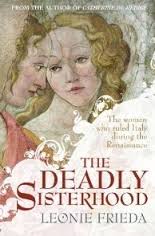 the Italian peninsula during the Renaissance.
I scored this at a school market for about $2, which was very cool.
Firstly, two problems:
- There were a number of egregious editing issues, which really annoyed me. A major publisher should not be putting out books with mistakes that *I* can pick up as I read it – it’s not like I read with the attention of a copy editor.
- More significantly, the book falls into the trap that many such history books do. They’re trying to write a book about the women, who have largely been ignored by contemporary and modern historians… but there’s so much else! being done by the lads! and honest, it’s needed for context! … that there are large slabs of text that really don’t seem to be connected to the women who are in theory at the heart of the book. Even if there are occasional mentions of “oh, and he was Duchess Blah’s son”. It was frustrating to have the women seem to be ignored in their own book.
Anyway. Frieda focusses on eight women, some of whom I’d heard of – Lucrezia Borgia, of course – and others I hadn’t heard of – of course. It covers the height of the Italian Renaissance, from 1471 to 1527. She discusses their births and marriages and deaths, their children and (often multiple) husbands, as well as the roles they played in politics – both consciously and as marital pawns – and in the artistic and cultural milieu. Actually that last was the bit that, surprisingly, got least attention; I would have thought that the women would have played greater roles as patrons. Perhaps Frieda was more interested in discussing the political aspect, which is definitely at the forefront of her interests here.
Despite the problems mentioned above – and that sometimes the language was a bit too snarky; I don’t need to be reminded that one of the Isabellas apparently got quite fat, unless that contributed to how people treated her – I did enjoy reading this, and I am very pleased to know more about these women of important families who themselves managed to do important and significant things.
Devour
 Set your level of disbelief suspension to Sky High and you might enjoy this thriller. Published by Hachette, it was sent to me at no cost (RRP$29.99 pb, $16.99 eb); it comes out in July.
Olivia Wolfe is an investigative journalist (of course) who gets into some hot water trying to get a story in Afghanistan (of course). To give her some time away from pushy police and terrorists who might want to harm her, her newspaper sends her to Antarctica where a British science team is trying to drill down to Lake Ellsworth (which really happened a few years ago) in an effort to discover whether there’s life in the ancient, ice-locked lake. While there, she discovers possible murder and possible sabotage. There’s also Russians involved (which surprised me a bit because I thought we were beyond Russians as Generic Bad Guys).
There’s intrigue, there’s action, there’s death and some destruction; as the title suggests there’s something dangerous that might be unleashed that would be bad for the whole world. It’s fast-paced… in fact, sometimes too fast-paced, in that I nearly got whip-lash as people’s motives changed or allegiances swapped. And there’s a fairly explicit and unexpected sex scene that seemed quite out of place.
This is probably good airplane-fodder. It doesn’t require a whole lot of thinking, and in fact I’ll admit that I started skimming the exposition in the last third because I was only interested in the action, not the details. (Larking seems very intent of giving minute details about equipment and such – I’m not sure whether she thinks it makes the story more grounded, or well-researched, or what. I just found it boring.) I still managed to follow the story without paying too much attention.
One thing to be aware of: if stalkers squick you out, avoid this book. There’s a stalker who gets the occasional point-of-view section (which also felt out of place) that was generally unpleasant to read.
Cyteen: abandoned
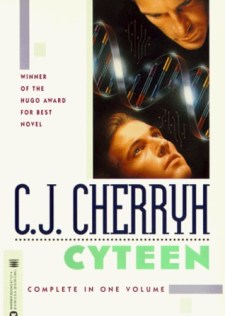 “Finished” does not describe what I did. “Abandoned”, sadly, does. I have simply not been able to get into this book at all. I find the Jordan/Justin naming confusing; I’ve been confused about what an ‘azi’ actually is; I don’t understand what these people are doing and whether I shoulda actually care. Since I started this book I’ve read about six others, which is a really bad sign.
My big question now is whether to actually abandon the book – physically remove it from the house – or whether to put it back on the shelf and think that I might actually get to it Some Other Time.
I’m really sad about this. I’ve always assumed that I would like CJ Cherryh; she’s been upheld as such a great part of sf history – and female, of course, as well. But at the 100-page mark I feel zero enthusiasm for nearly another 600 pages.
Music and Freedom
TL;DR: the fine print says that one of the classifications for this book is ‘psychologically abused women’. Yup. If that’s not your thing, do not read this book.
 This book was sent to me by the publisher, Penguin Random House, at no cost (RRP $32.99, out 27 June).
This is definitely not the sort of book I generally read. Partly because it’s mainstream ‘literature’ – I have nothing against it but there’s so much speculative fiction to get to! – and partly because the whole point of the story is about a woman whose life has been appalling. And I just don’t enjoy reading those sorts of stories.
My main take-away from this novel is: I am so glad that my husband is loving and encouraging. The most annoying thing he does is encourage me too much (ok, slight exaggeration there, but I’m still feeling intensely grateful). Continue reading →
Farscape episode 4
Each week on a Sunday afternoon, join Alex (of Randomly Yours, Alex) and Katharine (of the unpronounceable Ventureadlaxre), as they re-watch the Australian-American sci-fi show Farscape, notable for the Jim Henson animatronic puppets, the excellent mish-mash of accents, and the best OTP ship of all time.
Season One, Episode Four: Throne for a Loss
Summary: A plan goes wrong and Crichton, Aeryn and D’Argo all have to go rescue the little twerp, Rygel. What a surprise.
K: I do like how to a certain aspect Aeryn lets John waffle on and doesn’t tell him to shut up. And almost tries to understand him half the time.
A: I think John’s habit of just repeating Earth references as if a greater number of exemplar will help an alien understand, for example, Clint Eastwood, is embarrassing and ludicrous.
So Moya is Serenity now? Hauling cargo?
K: Big damn heroes!
A: Big. Damn. Heroes. Continue reading →
Illume
 I have known Kate Smith for a very long time, and I’ve been reading bits of her fiction for nearly that long. The thing about Smith’s writing is that she is often quite opaque – if you don’t get her song lyric references or her film references, you might be a bit lost. But she writes with a lot of passion and a lot of quirky description – which sometimes gets away from her but sometimes really works nicely.
Illume is set in Paris, and focusses on Thane, who works for the equivalent of UNIT or Shadow Unit or all the other not-really-police-branches who deal with the things that go bump in the night. This time, it’s about lovers who think they can make their love immortal, dangerous mirrors, and vampires. You never really get to the bottom of the characters who make the narrative tick; they’re surface, trading witty repartee and dangerous allusions and making intuitive links. That’s not to say they’re superficial – I don’t think they are – but Smith doesn’t really show us what makes even Thane tick, let alone his partner Mal or his crime-partner Genetta or any of the other odd bods who rock up. And I don’t think this is an oversight on Smith’s part; I think it’s quite deliberate. She seems more interested in the glitz and suggestive shadows than in deep psychological questions. So if you’re up for something light-hearted and fast-paced and quirky – definitely quirky – in the urban fantasy vein, this is your thing.


