A quarter-century of Galactic Suburbia
In which we hit and run the Locus Recommended Reading List, tackle e-books and piracy, and delve into the knotty issue of religion in science fiction. You can download or stream us at Galactic Suburbia, or subscribe to us on iTunes.
News
Locus Recommended Reading List – hot off the press!
Philip K Dick shortlist.
First annual Geek Girl Con in Seattle.
Cloud-delivered ebooks from Readings/SPUNC; comments from Benjamin Solah; and a response to comments on the internet about the cloud publishing.
Discussion of ebook piracy: Jim Hines found out the world is not the USA and the rest of the world does not experience publishing nor this ebook revolution apace with the USA. (Hines’ original post here). Charles Tan responds; Karen Healey says I was wrong and I’m sorry.
Weird Tales revamp (new website; pay rate to 5 cents per word; and implemented a new submissions portal for potential contributors).
Feedback (we love feedback)
Sean, Thoraiya, Niall
Pet Subject
The place of religion in science fiction. A Jew, a Christian, and a lapsed pagan discuss.
Modern religions, made up religions, machine religions… or no religions? What place can/does/should religion play in sf?
Jo Walton on religion in SF!
“There’s the kind of SF where the writer is themselves a member of some religion and this imbues their writing… .
Secondly, there’s theological SF… where the writer rigorously extrapolates science fictionally the consequences of some religious dogma being true. …
Thirdly, there’s the story as analogy thing… .
Fourthly, there’s using the way religions have worked in history and extrapolating that into the future.”
Please send feedback to us at galacticsuburbia@gmail.com, follow us on Twitter at @galacticsuburbs, check out Galactic Suburbia Podcast on Facebook and don’t forget to leave a review on iTunes if you love us!
Managing Death
 Some spoilers for Death Most Definite. (By Trent Jamieson)
When we left the somewhat hapless Steve at the end of Death Most Definite, he had just managed – through no intention of his own – to become Australia’s Regional Manager of Mortmax. Essentially, he became Australia’s Death. He had also discovered that the Stirrers – that ancient foe of the Psychopomps (employees of Mortmax, responsible for ensuring souls get to the Underworld) – are awaiting the imminent arrival of their god, meaning that they are ‘stirring’, or breaking through into our world via the recently deceased, with increasing frequency. To help him cope with this, he’s changed several people into Pomps, most of them Black Sheep – those with family connections to the Death business but who had themselves not chosen it. Oh, and he’d also brought back to life the woman with whom he’d fallen in love when she was already dead, and turned her (back) into a Pomp, too.
It’s not really a surprise that Managing Death opens with Steve having a nightmare.
The first few chapters deal largely with Steve being his normal whingy, drinking-too-much self, despite his greatly enlarged powers and the fact that he now actually gets to hold Lissa without fear of sending her to Hell. Through him we get to meet a few new characters – my personal favourite being Aunt Neti, an eight-armed and totally intimidating character who helps guard Hell, usually with a batch of scones served on some awfully nice bone china (heh). Also newly introduced, and getting a significant amount of page-time, is Suzanne, the Regional Manager for America. She’s a fairly standard cutthroat business/vixen type, but she gets some pretty good lines. I think her 2IC (or Ankou, in Jamieson’s terminology), Cerbo, is more interesting, although he gets less space to himself. There are also a number of characters from the first book who reappear, of course, including Lissa, who sadly doesn’t get quite as much of an increased role as I had hoped. While she is important, and is never just a damsel in distress or bed-warmer, I was disappointed by the short shrift I think she got particularly towards the end. Steve’s cousin Tim, now his Ankou, has a fairly significant role, and we also get more Wal. Ah, Wal: the fat cherub tattoo Steve got when drunk one night, who pops off his arm and bad-mouths Steve whenever he’s in Hell. Even more than the fact the story is set in Brisbane, Wal is a sign that this is a very Australian book. That, and a burnt-sausage Christmas lunch.
The plot of Managing Death, on the face of it, is simple. It revolves around Steve (well, Tim) having to organise the Death Moot – a get-together for all the Regional Managers – and Steve trying to convince them that the approaching Stirrer god is a problem they all need to deal with. Along the way there are also business issues that must be resolved: particularly how to recruit more Pomps so that they don’t get overworked (can you imagine trying to write that job advertisement? Or answering it?). Jamieson complicates matters with someone attempting to kill Steve. Although there are several lulls where little seems to actually happen – Steve is a bit too whiny and introspective in this novel for my tastes – it is nonetheless exceptionally page-turn-y. Something always seems to be going wrong.
Overall, I enjoyed the book. The characters are generally likeable or disagreeable, depending on their relationship with Our Hero; they have just enough depth so as to not be completely transparent. The plot largely kept my interest, although I do think Jamieson wrapped everything up a bit too quickly towards the end, and there was one particular solution to a problem that I thought came from far too far out of left-field to be entirely comfortable with. It’s definitely a “Book Two”: Jamieson does a fairly good previously-in-Death-Works wrap-up, but nonetheless I don’t think it would work well without having read Death Most Definite. Similarly, although some problems are tidied up, there are numerous issues left hanging to be resolved (I hope!) in the third book, The Business of Death, which I believe is due in 2011. Despite niggling issues with the book, I am definitely looking forward to the third book. Call me sadistic, but I am looking forward to just what Jamieson does to Steve next. And given the original way in which he has dealt with the idea of Death and the Underworld, I expect that the ultimate resolution will also be appropriately original.
Australia Day podcast
In what is starting to look suspiciously like a trend, Tansy and I joined Jonathan for an Australia Day podcast yesterday, in between various other engagements. We were sad not to have other eminent Australian podcasters join us, but when you’ve got three hours between east and west as well as things like sleeping in and bbqing… well. It just gets hard to organise. Anyway, we valiantly carried on, discussing what it’s like to be an Australian specfic author, whether there is an Australian ‘tone’, and what we’re looking forward to on the Aussie scene in the coming year. You can listen to it here or, I think, get it from iTunes by going to Jonathan’s regular podcast, Notes from Coode St.
(It should be noted that Jonathan calls his post “The Sounds of Now,” and he threatened to put a little Gangajang at the start of the podcast. I was trying to figure out some INXS or Wolfmother-appropriate title, but… nah.)
The 24th episode of Galactic Suburbia
In which we flit over the first shortlist of the year and some charitable links, sweep though a fortnight of culture consumed, and then leap with both feet into the pet subject of Inside Indie Press. You can download or stream us from Galactic Suburbia, or get us from iTunes.
News
BSFA Awards Shortlists
QLD Flood fundraisers for writers & readers: After the Rain; Authors for Queensland auction; QWC appeal launches Saturday, on Twitter at @writersonrafts
What Culture Have we Consumed?
Tansy: no books for me, shockingly! More Big Finish audio plays.
Alex: Agatha H and the Airship City, Phil and Kaja Foglio; Transformation Space, Marianne de Pierres; Dust, Elizabeth Bear; two stories from James Tiptree’s Her Smoke Rose Up Forever (spoilery discussion); The Name of the Wind, Patrick Rothfuss. Also begun a rewatch of BSG…
Alisa: No Ordinary Family; Dexter season 5
(diversion on the subject of Whether Alisa Should Watch Doctor Who)
Pet Subject: Inside Indie Press
Big news in TPP space is the closure of Speakeasy.
Is there an obvious point at which a project becomes a non-viable project?
How do you know that you’re ditching a project just because the stories don’t fit your particular idea/viewpoint?
The older books are harder to use as examples because lots of things about them were learning.
Horn – first to break even BUT I got caught on the selling to bookstores so i ended up having to sell 80% of the print run after review and buzz copies (1/4 of the print run) to break even.
Pay scales, writing contracts, competing with the US indies…
Please send feedback to us at galacticsuburbia@gmail.com, follow us on Twitter at @galacticsuburbs, check out Galactic Suburbia Podcast on Facebook and don’t forget to leave a review on iTunes if you love us!
The Name of the Wind
I really thought I was a bit over epic fantasy trilogies. I mean, I haven’t consciously started one in a very long time. Partly that’s because they’re black holes sucking time and energy into them, partly it’s because I am wary of starting trilogies at all – especially when the rest haven’t been written yet and I haven’t got a sense of whether the quality holds up – and partly, I’ve realised, my tastes have been veering towards science fiction, and especially hard SF and space opera, much more consistently in the last few years. No idea why, just have.
Consequently, when a friend started raving about Patrick Rothfuss and The Name of the Wind at me, I had no idea what she was talking about. And none of the above occurred to me, either, because it wasn’t until a few weeks after she had put a copy in my hands and promised me late nights reading that I discovered the darn thing was a first book, and that the others are as-yet unpublished. I started feeling annoyed… and then realised that I had forced Holly Black’s White Cat into her hands, so we’re kinda even in that its sequels are also unpublished. But I figure I still have a bit of leeway since Name is about a quarter the size of White Cat.
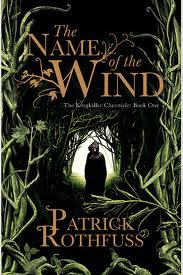 Anyway. I read it. And it’s the sort of book that if someone described it baldly, I would probably roll my eyes and say that I was largely over big fat magical quests in faux medieval settings with some mysterious baddy in the offing.
Yeh.
It is one of the longer books I’ve read in a while, at 662. While it was sometimes a bit of a slog, the fact that it has exceptionally short chapters – there are 92, plus a prologue and epilogue – meant that it was easier to keep ploughing through. And honestly, it was worth it. I liked the conceit that it was a man telling a story to a chronicler, and that there were occasional breaks from the main story back to the scene of the storytelling; it helped keep it grounded, and it also meant that you knew Kvothe was going to get through the obstacles put in his way. It’s an interesting way of doing it, letting the reader know that the protag is definitely going to go and be amazing, because that’s why he’s telling the story in the first place. There’s none of that “ooh, surprise! The farm boy with uncommon wit is really a magician!”
Kvothe? He’s a pretty good main character. He has lots of advantages – uncommon wit, fast reflexes, an exceptional memory – but disadvantages too – his upbringing, his temper, and a whole lot of bad luck. I had rather hoped, when the story opened with an adult man, that we would be skipping all of that apprenticeship stuff. It was not to be, and I’ll allow that I was – surprisingly – riveted by his childhood and his time at the University (that’s not a spoiler; it’s obvious pretty early on that that must happen). And, as I’m sure was the intention, I am now beside myself with wonder about what happens to Kvothe when he leaves the University, how he gets the name Kingkiller, and why he’s now an innkeeper.
The other characters pale in comparison with Kvothe; they don’t get as much time, of course, and they just can’t be as interesting. Even the woman in his life – who is one of the more interesting love-interests I’ve come across in a while, I’ll admit, and I’m wild with curiosity about her background, and if we don’t find out more about her I’ll do a Misery on Rothfuss – didn’t keep me as interested as Kvothe. They’re not boring, though, and many of them are nicely quirky; one of my favourites is Auri, a wild girl Kvothe befriends. And of course Abenthy, his first teacher, is awesome.
The worldbuilding is quite detailed; not that original, in some aspects, but nicely realised and crafted. I really liked the notion of going to University to study what others perceive as magic (and not in a Pratchett-style University, either); and I liked the sense of historical depth Rothfuss implies, too, without going into long, drawn-out, pompous epics told over the campfire or dug out as a revelation from a dusty tome.
And the plot? Again, on the face of it not overwhelmingly original. A young boy with a tragic past seeks to make his way in the world; a poor young man struggles in a world driven by money; a boy experiences a mystery as a child and strives to understand it as he grows up. Oh, and there’s a girl. But saying it like that does not, of course, do it justice. While the story might in places follow a well-worn path, there’s a reason for that: that path leads to fascinating places. And, to continue the metaphor, the scenery on this particular version of the path is marvellous and well worth making the journey. Even most of the bit-characters are interesting in their own rights, and the writing is delightful enough to lure the reader on.
I enjoyed this book way more than I had anticipated.
Galactic Suburbia 23!
This is my 1000th post! And it’s a Galactic Suburbia one!
In which we greet a brand new year with discussion about digital media, awards, books, feminism, feedback, more books, anti-heroes, gender roles and take a look at what to look forward to in 2011. We can be downloaded or streamed from Galactic Suburbia, or from iTunes.
News
Follow up on the Jewish fantasy discussion by Rachel Swirsky.
Locus to go digital with issue #600.
Launch of the Cascadia Subduction Zone, new critical zine with focus on women’s work.
The i09 Power List: 20 people who rocked SF & Fantasy in 2010.
Carl Brandon Awards: Hiromi Goto and Justine Larbalestier.
Hugo nominations open – last year’s members of Aussiecon 4, don’t forget you’re eligible to nominate!
Feedback: Kaia, Kathryn & Thoraiya
What Culture Have we Consumed? [AND what culture are you most looking forward to consuming in 2011?]
Alisa: Fringe Season 3, Dexter Season 4, Being Erica (ep 1), Nurse Jackie, How I Met Your Mother, reading Managing Death (Trent Jamieson)
Looking forward to: LSS 2011
Alex: Zombies vs Unicorns, ed. Larbalestier and Black; Factotum, book 3 of Monster Blood Tattoo, by DM Cornish; Dervish House, by Ian McDonald; The Killing Thing, by Kate Wilhelm; Surface Detail, by Iain M Banks.
Looking forward to: Blue Remembered Earth (probably), by Alastair Reynolds; books 2&3 of The Creature Court, Tansy Rayner Roberts; the 2011 Women in SF Book Club; Bold as Love sequence (Gwyneth Jones); Twelve Planets (from Twelfth Planet Press).
Tansy: Wiped, Richard Molesworth; The Doctor Who Christmas Special! The Gene Thieves & the Norma; Ascendant, Diana Peterfreund; Big Finish Podcast
Looking forward to: Doctor Who and Fringe (SHOCK, I know), Sherlock, Torchwood, The Demon’s Surrender by Sarah Rees Brennan, Burn Bright by M. de Pierres.
Please send feedback to us at galacticsuburbia@gmail.com, follow us on Twitter at @galacticsuburbs, check out Galactic Suburbia Podcast on Facebook and don’t forget to leave a review on iTunes if you love us!
Death Most Definite
 (By Trent Jamieson)
Anthropomorphising death is not a new idea; humans have been doing it for thousands of years. Perhaps my favourite, and one of the more famous modern examples, is Terry Pratchett’s Death, astride his white horse Binky. ‘Death’ has often been characterised as a single individual, either solely responsible for the actual death of every person (much like Santa visiting every kid), or as some sort of observer, making sure your death goes according to plan. Trent Jamieson takes a different approach, by taking and developing the idea of the psychopomp.
Psychopomps act somewhat like the ferryman Charon: not responsible for death itself, they are rather charged with ensuring the soul makes it to the afterlife. This role has often been seen as a supernatural one, with the psychopomps themselves feared as bringers of death. Jamieson’s trick, and one that works very nicely, is to make psychopomps basically ordinary humans, who happen to have a somewhat unusual job. And this is one aspect that makes Death Most Definite an amusing novel to read: being a psychopomp is just that. A job. Complete with bureaucracy, office politics, bad Christmas parties, and the potential for aggressive takeovers.
Our narrator is Steve, a Pomp who joined the business because it’s what people in his family do (with the exception of the Black Sheep, that is. I love the idea of the black sheep being the ones who want ordinary lives). He’s not bad at his job, which essentially consists of being a conduit for souls to reach the afterlife (they actually go through his body, in some sense), and keeping an eye out for Stirrers – nasty critters from the Other Side, who are capable of inhabiting a dead body and must be sent back, lest they start to take over the world. But he doesn’t love it, and he doesn’t really have the social nous to deal effectively with office politics. Things start to go badly for him when he sees a dead girl in a food court who doesn’t appear to want pomping – and who then tells him to start running. Right before someone starts shooting at him. These things should not happen; and he should most definitely not be checking out the dead girl, and finding that she is decidedly hot.
The plot follows Steve discovering that all is not well at Mortmax (which is a great name), the company that employs the Pomps. In fact, things go very bad, with all sorts of unscheduled deaths taking place and office politics getting decidedly unpleasant. Steve must figure out what is going on, not get killed himself, cope with being one of the few Pomps left to do their work… and eventually take a stand to save the world (his bit of it, anyway).
Steve is an engaging and amusing narrator. He’s self-deprecating, which adds a nice light wit to the tone of the novel without turning into an attempt at a seriously comedic book – attempts that too often fall flat. He’s agreeably individual – tall, gangly, moping for an old girlfriend, and into scrapbooking – without coming across as The Only One With A Destiny. He’s ordinary, and so are his workmates, which helps make the business of being a pomp also seem quite ordinary.
The other main character is Lissa, fellow Pomp and recently dead. She’s feisty and determined, not prone to damsel-in-distress mode. She and Steve share some marvellous banter – it felt quite realistic. Because the novel is from Steve’s point of view, however, we don’t learn nearly as much about Lissa as we do about Steve, which was a little disappointing. As a result, she’s less well-developed and complex than him. This is not to say she’s stereotyped, though – she’s not, and there are hints at depth which will hopefully be more fully explored in the next two novels (Managing Death and The Business of Death).
One of the more unexpected aspects of the novel is the fact that it is largely set in Brisbane. Brisbane is not exactly renowned as a place to set urban fantasy (which I think this is, although I’m not a great categoriser). I don’t know the city at all, but from the descriptions of the streets, the shops, and the general layout I get the feeling that the book stays quite true to it. Such a setting – and the occasional foray into the Queensland hinterland – adds to the sense of ordinariness that permeates the book. I mean that in a good way, of course. Clearly the work of a psychopomp is not ordinary, and the nastiness that ensues throughout isn’t either – thankfully. But unlike some urban fantasy that makes the characters and places seem exotic and mysterious (which can be entertaining to read), I can well imagine meeting these people and walking these streets. It brings a sense of… proximity, I guess, that made me at least care all the more about what happened to Steve in particular.
This is Jamieson’s debut novel, which actually surprised me a bit; it doesn’t have that feel. It’s a fast-paced, engaging, and overall entertaining book. Although it’s the start of a trilogy, it is self-contained, for which HALLELUJAH. Of course it’s nice to know that there is more to find out, but it is also very nice to not be left in suspense at the end of a book when you don’t have the sequel sitting right next to you. Hopefully, Death Most Definite and its sequels do well, and there will be more Jamieson novels in the future. I read it in one sitting (well, with a break for dinner, but that hardly counts).
Bold as Love
It’s Women in SF week over at Torque Control, and they’re posting the top ten SF books written by women over the last decade. Coming in at #10 is Bold as Love, by Gwyneth Jones, which I read a few weeks ago and have been meaning to blog about… so it seems an opportune time.
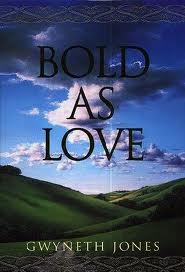
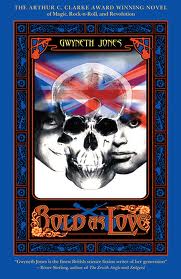
This is the book that, infamously, Tansy threw across the room when she got to the end and discovered it wasn’t a standalone novel. And I can understand that; I was halfway through it before she told me it was this one, and I too had just assumed it would stand alone. Truthfully, I think it could: there’s a huge messy pile of unresolved issues by the end of the book, but it’s done in such a way that actually I don’t feel a burning need to go find the next FOUR BOOKS. Well… that’s kind of a lie. I really really want to know what happens to my guys, but it’s a delicious sense of anticipation, not a burning MUST HAVE RESOLUTION NOW GETOUTOFMYWAY feeling.
Anyway. I was amazed to discover the book was only written in 2001; I thought it would prove to be much older. As Torque Control point out, it feels like it’s rooted in 1971 – the music, the festivals, etc. At the same time there are definite aspects that make it very modern – and those are mostly the same aspects which, when I thought about them carefully, contribute to the science fictional feel. (More on that later.) So it’s set at some time in the near future when the United Kingdom is splintering into separate countries, and a music festival has been organised to mark Dissolution. From this, essentially, come the main players in the novel – all musicians of one stripe or another – who end up being involved in politics. This seemingly-natural transition was, for me, the one aspect that didn’t sit comfortably. Perhaps it’s because I’m not very aware of the counter-culture movement in the UK (or Australia for that matter), and maybe they have, or could be imagined in the near future to have, this sort of political clout. It’s a minor quibble, though; after all, it’s sf/fantasy, and sometimes they require a bit of a leap.
Sf/fantasy? Well. Yes. When Tansy mentioned that it’s part of a series, she also mentioned that the fantastic elements become more pronounced over the series, and I can already see areas in which that can happen. But it is also definitely science fictional: there’s advanced technology in some areas, for example, and anyway it’s set in the future. I know that’s not a hard&fast guarantee of sf – just look at Michael Chadbourn – but it’s still there. In fact I think it’s one of the most fascinating meta-aspects of the book: it’s so genre, but… why does it have that feel? I don’t know, and I’m slowly coming to the realisation that actually, I don’t care about classifications so much. It’s a GOOD BOOK.
The plot, then, revolves around what happens to England (mostly) after Dissolution. There are social issues – such as the impact of a large Muslim minority; environmental issues – mostly around sustainability – which also tie into technological ideas; political issues – exactly what would happen if you put a bunch of counter-cultural musicians in a position of power? – and lots&lots of personal issues. After all, even when society is collapsing around you, in reality the thing that’s most likely to concern individuals is Does s/he like me? Who are my friends? What’s going to happen to me?
This is actually the first Gwyneth Jones book I’ve managed to get through, of two attempted: I gave up on Escape Plans pretty early on. And she is nasty to her characters! I don’t think there’s a single undamaged person in the entire ensemble. Thing is, the damage doesn’t make you want to cry for them, usually; instead, it turns them into quite hard characters, who would be utterly contemptuous of anyone even thinking of being sympathetic. Fiorinda is the sort of woman (girl, really, she’s a teenager – at least in years) who would fascinate me in real life but probably repel at the same time: she’s cynical and hard, and I’d be way too soft for her. She makes for an intriguing, and contradictory, main character. The main two male characters essentially revolve around her. I love Sage: he’s totally anarchic and narcissistic, while also being tender and considerate and generally awesome – plus his stage shows sound like they’d blow your head off. And Ax… well. He’s Mick Jagger and Jim Morrisson and David Bowie. And Bono and Bob Geldof too. I really really liked him, but I think Sage is still my favourite because he’s a bit more… human. And he’d hate me for saying it.
It’s a marvellous book. It deals with gender issues, social issues, and political issues. It wraps all of those things into the equivalent of the most awesome three-day music festival in the mud; you can’t let go, you can’t go home, you have to see it through. I have two copies (by accident) and I’m seriously thinking about keeping both of them.
Writing masculinity
What better anthology to read at a largely testosterone-fuelled event like a 24 hour bike race than one intending to discuss masculinity? And so it was that I read c0ck, edited by Keith Stevenson and Andrew Macrae.
ETA: I have been reminded that the best way to pronounce the title is with a Scottish accent – “cawwwk” – and then it doesn’t sound nearly so rude.
I got into the Australian sf scene just after this anthology came out in 2006, and despite hearing good things about it and seeing it for sale at numerous cos, I only got around to buying it at WorldCon this year. I feel that I am now a bona fide member of the scene. I read it in a day – it’s only 130-odd pages long, and I’d already read the longest piece in it earlier in the week. Lying in my sleeping bag, my brain started analysing my reactions, and I couldn’t go to sleep until I wrote this:
Taken individually, many of these stories are just sf/f/horrow; quite good, mostly, but not necessarily exceptional in the issues of ideologies they present. However, being collected in this anthology – with such a provocative title – means they create something of a gestalt: they become a sum greater than their parts, forcing the reader to acknowledge and consider the particular modes and methods of characterisation utilised (if, that is, you follow the type of reading suggested by the editors). As a collection, these stories interrogate ways of being male (and, conversely, female) that are possible, acceptable, or viable. The very idea of what it means to be a man is questioned and investigated. In 137 pages, these authors use sf in particular in ways that to me are exactly what the genre should be about: they tell engaging, sometimes creepy, stories, all with quite different characters, and they suggest ways of thinking about ourselves and society that might, hopefully, lead to change in those ways of thinking.
Yes, I get a bit pompous late at night. Anyway, I primarily bought the anthology because of Paul Haines’ Ditmar-winning “The Devil in Mr Pussy (or How I Found God inside my Wife),” which was exactly as creepy and shudder-inducing and brilliantly written as I have come to expect from the man. One of the things I really like about Haines is he in some ways so domestic a writer – most of the stuff I’ve read is set in suburbia, with normal people as the characters – that it is intensely believable and, therefore, intensely horrific. In this case, a couple move into a new house and are trying to have a baby. He’s also trying to write, and ends up taking the cat’s antidepressants. Weird, weird things happen. This was a well-deserved Ditmar win.
I liked most of the other stories in the anthology. Cat Sparks’ “The Jarrah Run” was another favourite, set on an alien world, and kinda interrogating the idea of the knight errant, and “Honeymoon” by Adam Browne and John Dixon was also excellent, with a clever take on suitors fighting for the hand of the maiden. All up, I think the collection basically succeeds in its aims. If nothing else, I was forced to ask of each story what it was saying about masculinity, whether that was realistic or stereotypical, whether I subscribed to that idea or not, and the implications of all of those. There’s violence, and control issues, and sex (lots of sex), helplessness, frustration, and a variety of relationships with women and other men. I’m pleased to have finally read it; I think it’s a really interesting part of the Aussie spec fic scene of the last few years.
Episode 21 of Galactic Suburbia
You can get us from iTunes, or download from Galactic Suburbia.
In which we work, play, shake up our format a little (gasp!) and cover the life & death of magazines, the changing face of the industry, respect for non fiction, sexual harassment, rants, reboots and as usual, books, books and more books. Also a few sneaky clues about what Twelfth Planet Press is publishing next year!
News
Realms of Fantasy is back, again…
Escape Pod expands: “We have been pushing to expand what Escape Pod does, adding an SF blog and distributing our stories via magazine format. We’re also becoming a pro market, and hope to keep paying our authors pro rates well into 2011 if the donations make it possible.”
Cheryl Morgan talks about paying for reviews as semipro.
On the Cooks Source scandal and seeing stuff on the internet as ‘public domain’.
Jim C Hines on reporting sexual harassment in SF/F.
Old men complaining? When you get old, do you by consequence lose your sense of wonder? Just simply because you’ve read everything? And is/should all SF be aimed/written for the 60 year old man? And Jason Sanford responds
New Buffy Reboot
New Friend of the Podcast: The Writer & the Critic (Mondy & Kirstyn).
Chat, rants and backpedalling…
What Culture have we Consumed?
Alex: Blameless, Gail Carriger; “The Devil in Mr Pussy,” Paul Haines; Women of Other Worlds, ed. Helen Merrick and Tess Williams; Bold as Love, Gwyneth Jones; Day of the Triffids (2009 BBC production)
Alisa: works too hard, and also Fringe.
Tansy: To Write Like a Woman, Joanna Russ; Marianne, the Magus & the Manticore by Sheri S Tepper; Sourdough & Other Stories, Angela Slatter; China Mountain Zhang, Maureen McHugh, Mists of Avalon movie
Please send feedback to us at galacticsuburbia@gmail.com, follow us on Twitter at @galacticsuburbs, check out Galactic Suburbia on Facebook and don’t forget to leave a review on iTunes if you love us!


