Galactic Suburbia 20!!
You can download us from iTunes or from our website!
In which we talk World Fantasy, female editors, Joanna Russ, James Tiptree Jr, Connie Willis, Pat Murphy, and more World Fantasy – plus Alisa tells us off for not mentioning how awesome certain books actually are (we totally did).
News
World Fantasy Award winners!
Peter Tennant at Black Static looks at the stats for women being published in recent horror & dark fantasy anthologies; the Hathor Legacy compares representation of female authors in two recent horror anthols.
Cat Sparks is the new fiction editor of Cosmos, taking over from Damien Broderick.
Discussion on the lack of female editors in pro fantasy publications (read through the comments which raise many important points about the post).
Steampunkgate (yes, really):
Charles Stross criticises the “glut” of steampunk and calls it out at a subgenre;
Nisi Shawl talks about the literary side of steampunk just isn’t as diverse and interesting as the other aspects of steampunk… yet;
Catherynne Valente rants and then raves about steampunk;
Scott Westerfeld gets cranky about the steampunk haterz.
Small press turned imprint to publish line of multicultural SF/Fantasy for children.
Jeff VanderMeer reports on Amazon Best of SF/F lists for 2010.
What have we been reading/listening to?
Alex: Changeless, Gail Carriger; The Two of Them, Joanna Russ; Brightness Falls from the Air, James Tiptree Jr; Full Moon City, ed Darrell Schweitzer and Martin Greenberg; backlog of Tor.com (esp. AM Dellamonica’s “The Cage” and Robert Reed’s “The Next Invasion“) and Strange Horizons (esp. Sandra McDonald’s “Seven Sexy Cowboy Robots“).
Alisa: Fire Watch, Remake (both Connie Willis); White Cat by Holly Black; Ethan of Athos by Lois McMaster Bujold.
Tansy: The Hundred Thousand Kingdoms, NK Jemisin, Adventures in Time and Space with Max Merriwell, by Pat Murphy.
Pet Subject
Capclave and World Fantasy Convention! Alex and Tansy interrogate Alisa about her trip away, her loot, her adventures and all the gossip.
Please send feedback to us at galacticsuburbia@gmail.com, follow us on Twitter at @galacticsuburbs, check out Galactic Suburbia on Facebook and don’t forget to leave a review on iTunes if you love us!
Galactic Suburbia #19: the Greco-Roman issue
You can get us from iTunes or download us here!
While Alisa is away, Alex & Tansy play… in ANCIENT GREECE! We talk awards, the end of publishing as we know it, stressful feminist debates, Vonda McIntyre, Twitter fiction, Stargate, and whether there’s enough Greek & Roman mythology in modern fantasy.
News
Tansy wins WSFA Small Press Award for Siren Beat;
Last Drink Bird Head Award Winners;
John Joseph Adams takes over from Cat Rambo & Sean Wallace as editor of Fantasy Magazine;
Realms of Fantasy dies: from Shawna McCarthy, and the publisher;
Wiscon committee disappoints through inaction (also here); and then finally moves to disinvite Elizabeth Moon as GoH (warning, many of the comments on that one are pretty awful to wade through); also here and here;
Paul Collins on how the ebook revolution isn’t working so well ;
Cat Valente on tedium, evil, and why the term ‘PC’ is only used these days to hurt and silence people;
Peter M Ball explaining how white male privilege uses requests for civility to silence the legitimate anger of others;
on Vonda McIntyre’s “Dreamsnake”, a controversial Hugo winning novel from 1979 which has been out of print for 10 years; and an interview with Vonda McIntyre about the book.
What have we been reading/listening to?
Tansy: Death Most Definite, Trent Jamieson; Blameless, Gail Carriger, Bleed by Peter M Ball, “Twittering the Universe” by Mari Ness, Shine & “Clockwork Fairies” by Cat Rambo, Tor.com.
Alex: Silver Screen, Justina Robson; Sprawl; Deep Navigation, Alastair Reynolds; The Beginning Place, Ursula le Guin; abandoned Gwyneth Jones’ Escape Plans; listening to The 5th Race, ep 1 (Stargate SG1 fan podcast).
Pet Subject
Classical mythology in modern fantasy. Can it still work? Do you have to get it ‘right’?
Book mentioned:
The Firebrand, Marion Zimmer Bradley
Medea, Cassandra, Electra by Kerry Greenwood
Olympic Games, Leslie What
Dan Simmons’ Ilium and Olympos
Gods Behaving Badly, Marie Phillips
Troy, Simon Brown
Margaret Atwood’s Penelopiad and Jeanette Winterson’s Weight, also David Malouf’s Ransom – along the same lines as Lavinia by Ursula Le Guin
Robert Holdstock’s Celtika, Iron Grail, Broken Kings
Galactic Suburbia becomes an adult
I , like you, have to just accept that these show notes are accurate, as I was absent for the recording of this, the 18th episode of Galactic Suburbia! However, Tansy and Alisa have never given me reason to doubt them… yet…. The podcast can be got from iTunes, or streamed/downloaded from here, which is where I’m heading after uploading this post.
Episode 18: Special Horror Edition
In which we discuss translated awards, constructive feminist discourse on the internet, make a special Swancon announcement, and dissect our complex relationship with the horror genre.
News
Geffen Awards (Israel)
Torque Control discussion on women & the Clarke & the dire state of women in British SF, with list of all British releases of SF or SFnal books by women in 2010.
— inspired by interview with Tricia Sullivan.
Torque Control announces they will be blogging about 2010 British SF releases by women in December and ask for readers to join them. Also call for contributions of top 10 female authored SF books in the last decade for a theoretical “future classics’ list.
Super Special Swancon Announcement!
What have we been reading/listening to?
TANSY: The Wiscon Chronicles IV edited by Sylvia Kelso; Azu Manga Daioh by Kiyohiko Azuma; Asimovs & F&SF, Salon Futura
ALISA: secret projects & another Book I Am Not Reading
Pet Subject: while Alex is away, let’s talk about HORROR
– we’re both pretty selective about the horror/dark fiction we read. What does it have to do to catch our eye?
– favourite horror/dark writers
– where do we draw the line on what we like/can appreciate in horror?
– does our feminism get in the way of reading/enjoying horror fiction?
Please send feedback to us at galacticsuburbia@gmail.com, follow us on Twitter at @galacticsuburbs and on Facebook! and don’t forget to leave a review on iTunes!
All’s well that ends…
Enchanter’s End Game: Book 5 of the Belgariad
David Eddings
Me
Oh, the end.
Reading the last book in a series is a funny experience. I know someone who will often not watch the last episode or season of a show, or will not read the last book, because she doesn’t want it to end. I Could Not Do That. I need closure. I need to know how it all ends, how the strings are going to be tied together, how the characters could possibly, possibly get out of the bind they’re in. And, sometimes, I need the happy-ever-after, too. I’m that kind of girl.
TEHANI
Oh, completely agree! Not knowing how it ends, ESPECIALLY when you’ve invested in a lengthy series, is horrible! (I’m looking at you Melanie Rawn and Robert Jordan (with respect)). The happy-ever-after is nice, but not always warranted, as long as the resolution makes sense in terms of the character, world-building and plot that’s gone before – why yes, I’m still bitter about a certain Australian big fat fantasy quartet that ended in the most stupid manner imaginable… Fortunately, we don’t have that problem here.
Me
The final book of the Belgariad begins with Garion, Belgarath and Silk’s fairly tedious journey through Gar og Nadrak, on the way to what we have finally discovered is the whole point of the series: a showdown between Garion and Torak. One of the things that really appeals to me about this whole series is on the first page of the story: Garion admits, to himself at least, that he is afraid of this confrontation. I think this really struck a chord with the teenaged me, having perhaps watched a bit too much He-Man, Transformers, and similar, where no one is ever afraid. Garion is quite convinced that he is going to die – and yet he keeps on going. He is dubious about everything he’s discovered about his heritage, from being a sorcerer through to being a king, but he never really considers giving up. This sort of grim determination has become something of a staple in YA, and I think that’s a really great thing – but I still like it here, too.
TEHANI
It’s one of the real high points – demonstrating that it’s okay to be scared, and real courage means you keep going anyway. That’s a massive message, but it’s not preached at us, which makes it even more appealing.
Me
As an aside, I’m really glad that Eddings wrote both Belgarath and Polgara, to fill in some gaps. In the first few pages here we meet that random gold prospector in the mountains, and there’s a tantalising glimpse at both Belgarath and Polgara’s back story. I always really wanted to know more about Polgara being OWNED by someone, and the winter spent by the two of them with the prospector also sounded like it could be a good story. I’m still not entirely convinced by that Nadrak custom, but the prospector’s story was indeed worth it. I also really like the little vignette with Garion talking to the wolves – the idea that wolves have exquisite manners is very appealing – and again, Belgarath in particular gives a bit more about wolfish society.
TEHANI
Makes you wonder when they decided to write those prequels really – the old prospector’s not the only one whose story is explored in the two novels that tell the stories that came before – Vordai’s tale was another, and it makes me think about how much the Eddings team structured to set that up. It can’t have been on the cards from the beginning, because there are continuity errors between Belgarath, Polgara and the Belgariad and the Mallorean, but either they’re really good at making use of little tidbits dropped in along the journey, or they started planning that early on in the book writing.
Me
The only really interesting thing, for me, about the journey through Nadrak country – not being particularly keen on fur or gold mining – is our introduction to Vella, who gets much more of a part in The Mallorean. Her interaction with both her owner and her potential buyer demonstrate a really interesting take on how gender relations can function. It’s never explained, at least not sufficiently, why the custom is for men to own women; it’s also not explained at what ages ownership starts, and all those other messy legalistic things. However, the fact that ownership does not give automatic rights over a woman’s body, that she is well within her rights to defend herself with violence, and that a woman can dance incredibly provocatively and still be reasonably sure that no man will attempt to even grope her … well. That’s a mighty interesting idea. Problematic, in a number of ways, but mighty interesting.
Oh, I guess the other mildly fascinating part of Nadrak is its king, the absolutely revolting King Drosta. Debauched, alcoholic, and more than willing to be a two-faced traitor, he is really quite remarkable as a study in what monarchy can lead to. He’s still totally disgusting.
TEHANI
It’s funny on the reread, how small a part some of those characters actually play, because we know so much more about them from later books. Vella is great, but I remembered her being more present, because I’m confusing things from the Mallorean!
Me
From Nadrak our heroes pass through the land of the Morindim, making a rather interesting differentiation between magic and demon-summoning, and then finally we get back to the great big army that Ce’Nedra has gathered – with a side-trip through Cherek, to see Barak’s wife make the Cherek queen finally grow a spine, which is quite entertaining. So is Ran Borune finally being proud of his wayward child, rather than just doting.
TEHANI
Hmmm. Interesting statement “…to see Barak’s wife make the Cherek queen finally grow a spine…” Seems to me, on reflection, that a lot of the great actions by the female characters are orchestrated by someone else (often also female). Is that weird? I mean, I always knew Belgarath and Polgara were pulling the strings of most of the plot, but then there’s the way Islena is pushed around by Merel, and how Adara gently manipulates Ce’Nedra, and more and more examples. Is it a bad thing, or just an example of how women working together achieve more than they would alone? 🙂
Me
Sadly, for much of the time Ce’Nedra’s army is just moving across the Algar plain, and then winching those enormous Cherek warships up the ridiculous escarpment that separates Algaria from the Angaraks. It is actually a fascinating study in medieval-ish warfare: the amount of time it takes to manoeuvre everything and everyone in to position, and then the battle takes basically no time. And I love, love, love that Eddings brought King Fulrach of Sendaria along, made him to be in charge of the supply train, and then actually thought about the practical necessities of an army the size of this one. Feeding one’s soldiers is, of course, of prime importance – but a lot of fantasy writers, when they set up big battle set-pieces, imagine that you can feed hordes on what they can scavenge. When that means stealing from family-sized farms, I think your army is going to get might hungry, and then mighty rebellious, awfully quickly. Anyway – Fulrach comes in to his own, in this section, and it’s a marvellous sight to see. However, I’m no tactician, but surely the idea of having basically every Western king along for the ride – in a land with no electronic communication – is a plan of utmost folly? Yes, the queens are at home, and most of them are able to run the kingdom as efficiently as their husbands, but they’re presuming their populace is happy enough that they won’t take the opportunity to try something like rebellion. That’s a lot of trust. I suppose the number of men they’ve taken away for their own army means there are fewer at home to do the rabble-rousing.
TEHANI
I think the role of the gods plays a big part in how all the kings can bugger off to war. The Western nations all seem pretty secure in their monarchies (barring a bit of dissent sowed by the bear priests), and it’s set up to be their heritage, so the people accept it? Also, I’m no historian, but didn’t the kings of old used to lead their armies in their conquests? I’m thinking of King Richard (ahem, mainly because of Robin Hood stories!) and Alexander the Great here, because my history is rubbish!
Me
Finally there’s fighting, although most of it is off-stage, which is just fine by me. Instead the reader is privy to intelligence as it comes in, and to the after-effects of the fighting: the death, and the injuries, and the bits that often seem to get ignored. And finally someone – Polgara, as it happens – voices what often annoys and saddens me about medieval battles, because it just seems so pointless: setting everything on fire. (Obviously I hate the killing and maiming too, but at least if you insist on fighting those things seem to have a point.) There’s a seriously awesome sorcerous battle at the same time as the fight between the West and the East (since that’s what it comes down to, OH THE SYMBOLISM), lots more fighting – some exquisite set-pieces that reveal rather interesting facets of character, and then OH LOOK how convenient Ce’Nedra, Polgara, and Durnik get kidnapped. SO CONVENIENT. But hey, this way we get to meet ’Zakath, and I love ’Zakath. So urbane, so crazy-violent-mad.
TEHANI
Oh yeah, ’Zakath is awesome! I have so many favourite characters in these books J Am so pleased we get so much ’Zakath in the second series.
Me
Finally, the end genuinely approacheth. We meet Zedar at LAST, and Garion comes face to face with the once-impossibly beautiful god Torak. And then Durnik dies. Quiet Durnik, consistently useful, shrewdly insightful, over-awed by his companions and totally in love with Polgara: he dies. And if you’re anything like me, you’ve forgotten the name that a couple of people have given him over the course of 4.75 books, and it is just heartbreaking. Of course, then Belgarath does something impossibly horrible to Zedar, and the bloodthirsty wench that I am is as pleased as all get out that he gets his come-uppance.
TEHANI
I REMEMBERED what all those people had named Durnik and I STILL teared up! It’s a great scene, terribly sad because of Polgara and Garion’s reactions I think – Durnik’s such a stable part of Garion’s life (one of the very few, if not the ONLY, fixed point for him!), that this hits him right at the core. And poor Polgara.
Me
And finally, finally, Garion and Torak meet. If I was disappointed by Belgarath vs Ctuchik, and Belgarath vs Zedar seemed totally one-sided, this particular battle is quite a good one. I especially like that it really started with Torak trying to win Garion over, promising to be his father; and then he once again tries to seduce Polgara (EW), but of course it all comes back down to violence. It is pathetic, in the true sense of the word, that all Torak wants (it seems) is love and acceptance – but he can’t go about getting it in the normal way. Eddings does really interesting things with his gods, I think, and making Torak so very tortured allows the possibility that he’s not as completely irredeemable as the rest of the books would suggest. But, of course, he’s still the bad guy, and as a result he dies.
TEHANI
Reading this again, I really felt sorry for Torak. And while I know that he’s not even portrayed all that well in the prequels, it gives you one of those, “Oh, if only someone had helped him see the light when he was young…” moments! Silly, I know, but that’s the reaction I had this time around!
Me
It’s a cataclysmic finale, and in some ways anything after it is always going to be a let-down. But, just like I love the end of The Lord of the Rings because it shows everything going back to normal, I do quite like the end of this book, and the series. Most importantly, of course, we are reminded that Durnik is The Man with Two Lives, and it’s all okay in the end. He and Polgara get together (at LAST), and – skipping right to the end – she doesn’t even have to give up her magic. I was pretty unimpressed that the gods would make her do that, originally; now I actually find it kind of funny, to imagine Polgara going through those weeks and months without trying magic, only to discover it was there all along. Is that mean of me? I have always wondered, though: if you can hear a fellow sorcerer doing magic, why hadn’t Garion or Polgara heard Durnik practising? Surely his first few attempts would have sounded like all the bells on the island.
TEHANI
Maybe Belgarath muffled the sound – or mucked about with his own noisiness while Durnik was practising, or, or … heh, maybe we just have to accept this part as one of those little mistakes we find when we revisit our darlings. I always thought it was funny though – her reaction when she finds out she’s been all selfless for no reason is actually rather restrained really!
Me
Garion and Ce’Nedra get married. Yeah yeah. Like that wasn’t always going to be perfect.
And, of course, there’s teasing hint from Polgara that maybe the story isn’t finished yet – that the Mrin Codex doesn’t finish with Garion’s battle, so maybe there’s still something left to do. OH REALLY?? How convenient! An opening for a further series of books!
TEHANI
Such a cynical thought! But for all its faults, and the Mallorean has definite faults (the main one, for me, being that it’s actually the entire plot of the Belgariad retold with some different characters!), I’m really glad we got the second series, because I love all these characters! I think that’s why the reread, despite the issues we’ve talked about as we’ve gone along (hey, the Suck Fairy http://www.tor.com/blogs/2010/09/the-suck-fairy came to visit in the years since we read it last!), was so easy to do – we love the characters, and they still deliver on their awesome.
Me
All up, I was pleased at having done this re-read. I still enjoyed the characters that I enjoyed the first two times around – especially Polgara and Silk – although their mannerisms did get a little tiresome after a while. There’s only so many times Silk can turn white at Relg going through stone, and say exactly the same thing each time. I was certainly more aware of the problems inherent in this story than I was originally, especially in the men vs women stakes – and so often they did seem to be a confrontation. That Ce’Nedra would threaten tears at Garion so frequently was quite off-putting, but then – she is only sixteen, so perhaps allowances can be made. Although not many. Actually, I was struck this time by just how many strong women there actually are, and strong in different ways: Polgara, Porenn the Drasnian queen, Vella, the Dryad queen, Vordai in the swamp, Barak’s wife Merel … it’s actually quite a good list.
A number of people have tried to convince me that re-reading The Mallorean is A Very Bad Idea. I’m not convinced. I won’t be doing it immediately, but perhaps in the medium-term future….
TEHANI
Oh, I reckon we go visit Sparhawk first!
This reread has been great fun – it’s been ages since I’ve gone back to any old favourites (simply too many new books to read to go back to the oldies, although the old darlings still get pride of place on my bookshelves!), so I was glad to have to make time to get through these again. It’s such a comfort read, but it also helps me to see where I’m at with my reading now, and examine my baseline for my current favourites, which is interesting in itself! Maybe I’ll put some Anne McCaffrey or Raymond Feist back on my To Be Read shelf and see if the experience is the same!
Lots of Ce’Nedra, and a few other people: the Belgariad, book 4
See Tehani’s post for the comments she gets!
Castle of Wizardry: Book 4 of the Belgariad
David Eddings
Spppooooillllers!!
Me
This may have the dumbest title in the whole series. I don’t anyone ever calls Belgarath a wizard. And what exactly is meant to be the castle – the stronghold at Riva? That’s just ridiculous. I choose to believe that some editorial knob decided that it was the sort of title that would appeal to the BFF fans, and ignored the fact that it doesn’t represent the storyline at all.
The big OMG REVELATION of this book is that OMG REVELATION Garion is actually Riva’s descendent and therefore the rightful Rivan King!!! And most importantly that means OMG REVELATION that he has to marry Ce’Nedra!!!! And most importantly to her, scullery-boy Garion now outranks her!!!!! Oh, the drahmah.
Heh. I don’t remember whether this really was a revelation to my 13- or 14-year-old mind. I’d like to hope not, but even today I try to cultivate something of a ‘don’t anticipate the storyline’ attitude: I like being surprised, so if I can help it – especially if I think it will spoil the book or movie – I try not to figure things out in advance. Of course, sometimes I can’t help it, and sometimes it’s more fun being smug that you had it figured out waaay in advance.
TEHANI
I didn’t read this til I was at least 19 or 20, so yeah, totally knew all the big “surprises” WAAAAY before they were revealed! But I’m the opposite of Alex – I love figuring out stuff in advance. It’s kind of like when people tell you stuff that’s embargoed and you get to feel all smug that you know something other people don’t. Well, kind of the same, cos, yanno, there’s all those OTHER people who figured it out first. Or read the book before you. And the author… Well, it makes ME feel good anyway!
Me
So, yes. Garion discovers that he is rightfully a king. All of that whinging and feeling sorry for himself ought to stop now … although of course it doesn’t. I actually really like the revelatory scene itself, with Garion still uncomprehending and Errand finally completing his errand, and everyone excited – and Ce’Nedra devastated. Eddings never mentions it, but I always imagined her as having read too many Arendian romances and really quite enjoying the pathos of “oh I love him but we can never be together.” And then, all of a sudden, she gets what she wants … but not how she wants it.
TEHANI
It’s true! It’s like a Shakespearian tragedy as far as Ce’Nedra’s concerned, but then all of a sudden she’s told she CAN have what she wants, and that kind of takes lal the fun out of it! She does do very well with coming to terms with it – and turning it to her advantage. Definitely a product of her upbringing there…
Me
I love Errand, the little boy who managed to steal the Orb. I love the fact that he makes everyone wet their pants by offering the Orb to them out of the blue. The idea of a genuine innocent is of course a fascinating one, particularly when you think about the fact that Errand was brought up by a man who had sold his soul to a malignant god rather than the pure one he’d originally served. You’d think that would make Zedar incapable of not corrupting the boy. And what about the circumstances in which he grew up? Are we to assume that Zedar cared for him so well that he never misbehaved to get more attention? – or does that behaviour not count? Of course, we find out in the next series that Eddings is a cheat, when it comes to Errand, but still; interesting questions.
TEHANI
I wondered the same thing when I reread – between Ctuchik and Zedar, surely he’d HAVE to be exposed to some corruption. Although was it mentioned at some point how confining and challenging it was for Ctuchik to contain himself from his usual debauches? Regardless, there is the “cheat” aspect revealed in the Mallorean, and, well, Errand is just so CUTE!
Me
One of the tangents of the gang turning up at Riva is Garion’s reunion with Lelldorin, now sort-of married to a Mimbrate woman, whom he would formerly have sworn off as an enemy. What I love about their little story is that it has all the elements of a classic medieval romance … and it’s just so ridiculous. Eddings plays it with a straight face, but it just gets more and more insane, until it’s quite obvious that he’s totally gaming the reader. I love it.
TEHANI
All the relationships in these books are fun though – there’s always something that sets them apart from the norm just a little, and the couples all have their little quirks. One thing that bothers me, and I think you’ve mentioned it before, Alex, is the way the women all seem to have some little (or big!) manipulative tricks that make it seem like they are always the ones controlling the relationship. Ariana does it to Lelldorin, Ce’Nedra does it to Garion (and her father), Polgara does it to Belgarath (and everyone), Taiba does it to Relg, the Queens do it to their husbands, and so on and so forth. Which is a bit sad, because while it’s intended (I guess) to show how women are just as able to control their lives as men, despite outward appearances, what mostly comes across is that women have to be scheming and deceitful to get what they want…
Me
Getting back to Ce’Nedra, I really really like her part in the last quarter or so of this book. Garion, Belgarath and Silk are off on another journey, but Ce’Nedra womans up and organises a great big damn army to distract the Angaraks away from his and his vital mission. I love her armour, and that she makes the armourer give it bigger boobs than he had originally forged. I love that she gets so nervous before giving speeches that she feels sick. I love the dramatic speeches, the Churchill-esque eloquence, and then – the cold-hearted, calculated, bitchy climax – the way she manipulates both her father and the Tolnedran legions is absolutely, totally, gold. Although, seriously? All of that at barely sixteen years old?
TEHANI
Hey, we just had an Aussie girl sail around the world on her own at 16… Certainly I can see Ce’Nedra succeeding in this with the backing of the Kings and Polgara, and when you consider she was raised as the daughter of an emperor, it makes sense that she has the statesmanship to come up with the idea and have the nous to pull it off. This is my favourite Ce’Nedra of all the books I think – she’s really shown off to great effect in this section!
Me
The book as a whole has a different feel from the others, and it’s largely the “breaking of the fellowship” effect. We get to see Belgarath being compassionate towards Vordai, the witch of the fens – but we’re not stuck with the three boys off gallivanting. Instead Polgara and Ce’Nedra have – no, they don’t have. They compose the Tantrum to End All Tantrums, and then get on with actually leading the West, rather than traipsing around. I really, really like that we get more of an insight into the kings and how they relate to one another – I still like Anheg a lot. It’s also quite remarkable because we actually see serfs, if only briefly. While they’ve been occasionally noticed in the background – and, in a smart-alec way, Garion has previously overheard the two serfs whom Ce’Nedra meets – it’s a nice touch that Eddings actually includes a little story about how the serfs end up in her army. Of course, being in the army is actually a horrible, horrible thing, and the main (aristocratic) characters couldn’t usually care at all about the people dying in droves around them. But the fact that Eddings condescends to include this little vignette is nice.
TEHANI
Have to confess, one of my favourite things about big fat fantasy is the multiple viewpoints of characters all living separate lives until they come together, so this book is just up my alley! While it’s been a separation, rather than different storylines, the back and forth between events really works for me!
Me
There is no climax in this novel. It’s a classic middle-of-the-series book, moving all the pieces into place for a resounding finale. Which is fine, if you have the final book to hand.
TEHANI
Which fortunately, we both did! Onwards, to the “end”!
Galactic Suburbia 16
Galactic Suburbia can be downloaded from iTunes or our blog
In which we have apparently learned the art of conversational restraint! Clocking in at a miraculously tidy 45 minutes, the Galactic Suburbia crew discuss publishing news, a bunch of great new books, and read some feedback.
News
Strange Horizons Fundraising Drive.
Tehani’s post on open short story markets in Australia.
Aqueduct Press now releasing several of their titles as ebooks.
Ticonderoga to publish Year’s Best Australian Fantasy & Horror; editors Liz Gryzb & Talie Helene.
MindMeld best female characters.
Alisa and Tansy on Coode Street podcast.
What have we been reading/listening to?
Alex: Liar, Justine Larbalestier; White Cat, Holly Black;
Tansy: Cryoburn, Lois McMaster Bujold; Kiss Me Deadly, Tricia Telep (ed)
Alisa: Love Songs for the Shy and Cynical; Tomorrow when the War began; new segment (whcih i will start next ep)
Pet Subject
Feedback!
from Jason Fischer & Thoraiya Dyer, plus a shout out to Celia from Worldcon!
Please send feedback to galacticsuburbia@gmail.com or follow @galacticsuburbs on Twitter
Journeying onwards and leaving endings hanging: The Belgariad Book 3
You can find Tehani’s post over here, if you want to see what comments she gets. More spoilers ahead!
Magician’s Gambit: Book 3 of the Belgariad
David Eddings
Me
Ce’Nedra gets to star in this book a bit more than the others, and I’m sure she loved that. Firstly, I think it’s totally awesome that Durnik, of all people, gets to be the one to peg her for being lovelorn over Garion. It’s really a very cute scene, and Ce’Nedra’s dreadful acceptance that she belongs to the Empire and therefore cannot make her own choices in that regard is somewhat heartbreaking. Additionally, of course, it’s immensely amusing for the reader that she keeps refusing to understand who and what Belgarath and Polgara are, and the adventure that she’s got herself involved in. It’s like Eddings is allowing a sceptical reader – a reader who hasn’t been totally suckered by the story yet – someone to identify with.
TEHANI
I hadn’t thought of it that way! But you’re right, Ce’Nedra’s naivety in the ways of the gods does permit a certain scepticism in the reader. I like that we get a view here of Durnik as actually being rather wise in the ways of relationships – he’s always been portrayed as intelligent, but rather backwater and perhaps a bit stodgy, but his observations here offer another side to him, which is rather important later on.
Me
I think you’re right about Durnik. I found myself liking Durnik more and more this time around, partly I guess because I know how it all turns out, but also because I’m finding the ‘normal’ characters a bit more appealing than the exceptional ones, a lot of the time.
There’s a lot of journeying in this book. Firstly, the band has to go through Maragor, perhaps the most sobering of all the lands in this imaginary world. Grolims may butcher people all day every day – but they’re Angaraks, and we have no sympathy for them. Here, although we’ve never met a Marag, we know enough that their slaughter was totally unwarranted: especially with the heavy hint that the Tolnedrans did it for the gold, not to stamp out their ritualistic cannibalism. The concept of a god who weeps eternally is a staggering one.
TEHANI
It’s not a very flattering portrayal of the Tolnedrans, and this is interesting in terms of the rest of the nations. Nyssians are not shown in a very good light, but we as the reader are still able to find them likeable in some way – in fact, all of the other Western nations, while generally “good”, are given faults of some kind (however slight), but we find them quirky rather than not nice. With the extermination of the Marags, Tolnedrans are painted with a completely different brush, which is quite unusual, particularly as one of our main characters is from that background. Or is her Dryad nature what save Ce’Nedra? Or perhaps the message is that she overcomes such an acquisitive heritage?
Me
That’s a very interesting observation. I don’t think the Dryad aspect is emphasised enough – and we don’t know enough about them – for that to be the mitigating factor. So I’d go with the idea that it’s meant to show how much she changes. Huh. Paints her in a much better light, doesn’t it?
Also in this section we finally learn a bit more about Garion’s ‘friend’ – the one in his head – and exactly what this entire adventure is leading up to. I have to say I find the idea of a universe that has a purpose (although no guiding intelligence), and that purpose getting divided because of a little accident, one of the weaker parts of the whole plot. I have no problem with two destinies battling it out; I’m a Christian, I can do dualism. But that there was an accident, which managed to split the purpose? That just seems … silly. Especially if there is no overarching God to take notice of that accident. Anyway – I accept it for the plot-device it is, and continue.
TEHANI
It sometimes seems a bit of a cheat really – I wonder what mistakes Garion would have made if it weren’t for the meddling voice in his head?
Me
I’m sure someone has written that fanfic… or they should, if they haven’t ☺
We get to visit the Vale of Aldur, for the first time: it’s like hearing about someone’s house for ages and finally getting there. Seeing Polgara surrounded by adoring birds humanises her, I think, in a bizarre way. Garion’s attempt to move the rock – by lifting it, so that he ends up almost burying himself in reaction – is hilarious, and I really like that their magic actually does have physical repercussions like that. And have I mentioned yet how much I adore Beldin? I love him. I love his crotchetiness, I wish Eddings had actually written his oaths down, I love his insulting nature and that (we find out eventually) it hides an intellect both enormous and immensely caring. He makes me happy.
From the Vale the troupe heads to Ulgo, with another of the more interesting groups of people in this world, and one that I can’t think of an analogue for. It’s curious, too, that they are less stereotyped than others. Admittedly we meet fewer Ulgos than members of other races, but nonetheless: Relg is a fanatic, but he’s clearly marked out as being different even from most of the other Ulgos in that respect. The trip into Ulgoland is marked by wonderful monsters, and I think Eddings did very well in this area. Flesh-eating horsey-looking critters? Respect, man. And we get to ditch Ce’Nedra for a while, leaving her with the Gorim. Aw, poor man! No, wait: the way he deals with Relg? He can deal with anything.
TEHANI
I’ve always felt like the Ulgos are analogous with Jewish people (and my little Wikipedia link suggests that too!).
Leaving Ce’Nedra behind also lets Garion miss her, I think, which obviously eases him into his feelings a bit more. Not so much in this book, but in the next…
Me
Finally, the adventure leads to Cthol Murgos. Various adventures ensue, and my favourite may be the encounter with Yarblek, if only for the facts that Polgara deals with his Nadrak ways – thinking she might be for sale – with such aplomb, and for the way she tells everyone else to keep their indignation to themselves.
TEHANI
That whole gender thing with the Nadrak people is a really interesting one – on the surface it looks like women are treated in a fairly negative way, but then you see Polgara take control of her situation and you start to wonder about the practice, and it’s eventually revealed (in a later book) that it’s most definitely the women who are in control, despite outward appearances.
Me
You know, I think the Nadraks may be one of my favourite groups of people, for exactly the same reasons that I adore Silk.
During their time in Gar og Nadrak, Relg has to rescue Silk by taking him through rock, and it’s not often you get to see Silk totally and utterly at a loss.
TEHANI
And that going through rock thing bothers Silk for quite some time to come – it REALLY puts him out of sorts! Gets a bit belaboured by the end of it, in fact…
Me
Belaboured is putting it mildly!
Finally, there’s the epic battle between Belgarath and Ctuchik, which is actually not so epic. That is, in concept it is, but Eddings doesn’t draw it out nearly as much as he might have. I’m in two minds about whether I would like to have seen more , or not. And the fact that Ctuchik essentially destroys himself … well. It’s a bit of a cheat, but it does make sense. I guess.
TEHANI
This book is pretty violent overall – lots of random Murgos being killed because they’re in the way of the group. It’s all rather bloodless though, which is probably why I never realised just how brutal the series is in general until this reread – lots of characters killed “off screen” and even those who cop their serve right up front don’t really seem to have an impact. I actually found the way the main bad guys have died to be more bothering, often because of the reaction of Garion and the others to how it happens.
Me
The fact that they are largely callous and coldhearted about it? Yeh, bothered me too.
TEHANI
There were some new (to become ongoing) characters introduced in Magician’s Gambit who bear notice. Yarblek, who Alex already mentioned, comes to be quite pivotal and who I like for his brassness, and Errand, the innocent raised by Ctuchik to steal the Orb. I tried to read the character of Errand with fresh eyes when he’s introduced in this book (which is a bit hard, knowing how his storyline concludes), to look at him as he’s presented, and to view his initial part in the story without consideration of where he ends up. Conclusion? He’s a little cutie! I love his seriousness in his efforts to hand the Orb to random people, and I love that he’s foreshadowed from the beginning to be important later.
Me
I too tried to see Errand with fresh eyes, and in some ways it’s easier this time around: last time I read it, I hadn’t been around young kids for a while! Makes it easier to imagine him as the cutie he’s described as when you’ve got a point of reference.
This book really does feel like the middle of a series, and that’s not necessarily a bad thing. We know all the main characters; now we get to see them interacting and meeting new people. We know the basic aim of the plot, and indeed the book finishes with the retrieval of the Orb, which for a while appeared to be the main point. But it finishes with Our Heroes in a building that’s crashing down around their ears, and the suggestion that there is yet more to do for this particular adventure to finalise itself. I’m so very glad that I wasn’t reading this series as it was being published, because the ending – everyone heading out of the citadel – is immensely unsatisfying if you can’t immediately go and read the continuation.
Which is, of course, what I did.
TEHANI
Ahem, and so did I. To the exclusion of much else, including these reread notes! Got very distracted by story and forgot to be critical! Will try harder…
Galactic Suburbia 15: live show!
Live from Aussiecon4, speaking from the entirely unsuburban wasteland of downtown Melbourne, Alisa, Alex and Tansy faced an audience of real people, and managed to keep their chatter to a 50 minute podcast. SHOCK. Some awards news, Worldcon gossip, what we are reading and our pet topic: female heroes in SF & Fantasy. You can download it from here or get it on iTunes.
News
World Fantasy Nominations announced.
Sir Julius Vogel Awards.
European SF Society Awards.
Our favourite bits of Aussiecon4 so far.
What have we been reading/listening to?
Alex: Beastly Bride, ed. Ellen Datlow and Terri Windling; Legends of Australian Fantasy, ed. Jonathan Strahan and Jack Dann; Secret Feminist Cabal, Helen Merrick;
Tansy: Shades of Milk & Honey, Mary Robinette Kowal; The Hunger Games, Suzanne Collins; Who Fears Death, Nnedi Okorafor
Alisa: Death Most Definite, Trent Jamieson.
Pet Subject: Female heroes in SF/F
As ever, please send feedback to galacticsuburbia@gmail.com or to our Twitter account – @galacticsuburbs. We’d especially love to hear your response to our “live” episode, or your highlights from Aussiecon.
Over the next week we’ll be putting up a series of mini-eps from the convention, including our post-Ditmars round up, our post-Hugos round up, a omg-the-convention-is-over round up, and an interview between Alex and Phil & Kaja Foglio of Girl Genius fame. Was Jake Flinthart correct to accuse her of giggling? Find out!*
On a personal note (stolen from Tansy), thanks to everyone who came to the panel, or talked to us at the con about Galactic Suburbia. We were blown away by how many people have listened to us, bought books we recced, and wanted to say hi. Extra special mention to Celia, who apparently DID have an awesome Worldcon, and to the woman who recognised Alisa & me gossiping in the row behind her at the Hugos, because SHE KNEW WHAT OUR VOICES SOUNDED LIKE.
* the answer is yes
Racial stereotyping and plot development: the Belgariad, book 2
Tehani and I continue our re-read of David Eddings’ The Belgariad. Tehani’s got it over here, if you’d like to read the comments she gets; there are more spoilers ahead!
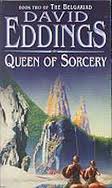
Queen of Sorcery: Book 2 of the Belgariad
David Eddings
Me
I’ve never figured out whether the title refers to Polgara or Salmissra, but that’s ok. Maybe it’s both of them.
Tehani
I reckon Polgara. Salmissra is a queen, but not a sorcerer really is she?
Me
But she’d like to be… and Polgara’s not a queen. Maybe it’s an amalgam of both of them??
One of the really interesting things about the Belgariad when I think about the stereotypes is that not only are the people stereotypes, but so are the nations. I think the Sendars are probably meant to be British: solid farmer-types, a mixture of every other race, practical and polite. The Nyissans – well, I’m fairly sure they’re meant to be the Egyptians: snakes, hot weather … and, I dunno, maybe the stereotypes of using poison? Y’know, I like the Nyissans. They’re so different from all the other cultural groups. And the countryside itself is also different – horribly represented, so far as I’m concerned, child of the tropics that I am, but nonetheless: I like it. The Chereks are Vikings. I haven’t figured out who the Drasnians are, but the Tolnedrans are Romans: they like building roads, they are inherently merchants, oh and they have legionnaires. And an Emperor.
Tehani
I actually wrote a mini-thesis on this when I was at uni! It was called “Representations of reality in fantasy fiction” or some such (much edited and published in an issue of Andromeda Spaceways some years ago!). Fun fact: my very first forays on the Internet were researching this topic, which gives you some idea how long ago that was… There’s a lot more on it in today’s digital world, and Wikipedia gave me this. Which tells us that Drasnians are kind of Western Russians with a twist of Renaissance Italians!
It’s an interesting thing Eddings did here, because by making the “evil” characters analogous to nations such as Egypt and the Middle East, it casts a social commentary of the time. Of course, Eddings might turn around and tell you it’s all completely unintentional, as Tolkien tried to claim of his own worldbuilding…
Me
Ooh, interesting! I’d have loved to write something like that!
All of this makes me think about the Brotherhood of Sorcerers, and it makes me wonder if they’re a little microcosm of ancient Greece – and Athens specifically. You know: philosophy, thinking more deeply than everyone around them… Belgarath as Socrates, maybe? Beldin as Diogenes, the original Cynic who lived in a tub on the streets? And … does that maybe make Belzedar Xenophon, going off to serve with both the Spartans and the Persians? Does that make the Angaraks Persians?? I’ve always considered the Angaraks to be Generic Racially Stereotyped Asians (GRSA) – after all, it was written in America, in the “eee Yellow Peril!!” ’80s. Maybe I’m just reading way too much into this.
Tehani
Wow, you’re good! The articles DOES suggest the Angaraks are Persians (with a hint of China in the worldbuilding). Well done!
Me
So, yes: the Angaraks. Often described as having slanted eyes, I recall, adding to the GRSA feel. I could start speculating on what nationality each of the sub-groups was meant to be based on, but that way leads to buying into some frightful racism, I think. I have always felt sorry for the Thulls, being roundly loathed by everyone.
On to the plot.
I think Garion getting kidnapped by Salmissra is about the most interesting thing to happen in these first two books. She is cool: the very idea of her is cool. A woman picked at childhood, trained to become exactly like the original Salmissra, and fed so many drugs to keep her looking young that weird things happen to her system. A genuine hedonist, someone so totally and utterly self-obsessed that the entire world basically revolves around her – at least within the palace. Hmm, sounds like a particularly misogynistic Roman way of thinking about Cleoptara…. Anyway, there are flunkies who make everything work, and Sadi is another reason why I like Salmissra. He is the consummate politician; in fact, he is basically the Nyissan Sir Humphrey, and there’s a certain glory in that.
Tehani
Sadi doesn’t get as big a showing here as he does later in the books though, right? He plays a much bigger role in other books in the series, and I didn’t realise that he was really only a bit player in this one. Which is in itself kind of cool, because it makes you realise that Eddings really was clever at utilising his established players.
Me
Yeh – I think I love Sadi here remembering what he becomes. He’s like an awesome, possibly-evil possibly-good (does that make him chaotic??) vizier.
When Garion is kidnapped, we also get two awesome appearances, with Polgara being Most Awesome and Terrifying, and Barak turning into Big Scary BearMan. They scare the crap out of all the Nyissans in the palace, and get the boy back. Hurrah. And the queen gets turned into a snake. That is cool.
One of the other major events of this book, and which has ongoing repercussions, is that Garion finally realises that he too possesses the ability to use the Will and the Word, and the first time he consciously exercises it is to kill someone. There are all sorts of things to be said about this occurrence, but one of the big ones is: there is no external judgement for what he does. Yes, he keeps beating himself up about it, but eventually that just goes away. Yes, Chamdar was a dreadful enemy. But still, the fact that Polgara is able to fool everyone about who actually did the deed (and later, when it’s revealed Garion can do magic, no one bothers to dig this story up), and that it doesn’t have ongoing repercussions? There’s one of the biggest indications that these are seriously fluffy fantasy books. Despite the fact that burning to death is a horrible, horrible way to go.
Tehani
That’s a really good point – throughout the books, there’s little consequence for the frequent death dealing and maiming. Yes, Garion is distressed by what happened, just as Durnik expressed his horror over killing a man in the first book, but they kind of just … get over it? Get used to it? I understand that it’s the medieval setting thing, and the brutality of life blah blah, but it’s also a little bit, hmmm, privileged? As in, because they are on the side of might and right, there are no consequences? Maybe I’m off base with that…
Me
No, I think you’re right on track. It is might is right, when right is might. And Belgarath, Garion et al are inherently good and therefore their actions are inherently good. Very privileged and problematic.
We have some more fun characters in this book. Greldik: The most stupendous ship’s captain in the history of narrative, with the possible exception of Odysseus. Always drunk, but always willing to take the crazy option and get through. Mandorallen: the ridiculous, most stereotyped – consciously stereotyped – knight since Don Quixote. (Actually, I only just thought of that. I’ve not read Cervantes, but I know a little about him. Mandorallen isn’t totally deluded, but maybe he’s what Quixote wanted to be?). It was really when Mandorallen got going – and Barak too – that I realised something quite remarkable about this series: it is so bloodthirsty. Limbs go flying, people get their throats cut, and there is general mayhem every few pages. And there’s no “oh, no one really got hurt.” No, people die, all over the place – and it’s not just Murgos, that dastardly race. Random Arendians frequently die, people who get in Polgara et al’s way frequently die, and there is a remarkable lack of scruples about death more generally.
Then we have Hettar, one of the less stereotyped characters. Not in his taciturn, “You killed my father, prepare to die!!!” attitude, but in terms of being the Sha-Dar, and communicating with horses. Again, being good with animals is nothing new, but I think Eddings gives it an interesting twist. And the fact that it is most definitely not linked to magic is also interesting; in other books, Belgarath would have been snooping in Hettar’s mind to figure out if he was somehow using the Will and the Word. But not here. Of the other members of the band – Lelldorin gets remarkably little airtime, really, for all that he’s meant to be Garion’s bosom-buddy. Durnik just hangs around in the background. And then there’s Ce’Nedra.
Ce’Nedra may be the most difficult character in this entire series for me to deal with. She’s so awful, so stereotyped, such a little princess – she drives me nuts! But… even this early on, she starts to show some interesting character traits. The fact that she is so manipulative is actually kind of interesting, as is the way she plays some of the other (male) characters. And her attitude towards Garion does actually have some complexity, which is nice. I remember her improving as the series goes on.
Tehani
Regarding the characters, I was reminded early in this book that one of Eddings’ real gifts is writing characters – we’re bombarded with a huge cast in this series, but each of them is quite unique, which makes them easily identifiable and great to read. And while they may be stereotypical, as we’ve noted already, they are actually still multi-dimensional and their characters have growth. Sometimes it’s an unfolding of personality which is actually due to backstory (such as for Polgara, Belgarath and Silk), others is actual new growth, as for Garion, Ce’Nedra and Durnik. Even bit characters, such as those random legionnaires or castle guards that the band come across and generally intimidate into submission have their part to play and do it well!
Me
Sadly, this book ends on a very frustrating note, for me. Barak is going to kill himself because he’s the BearMan and he finds that unbearably humiliating. Fair enough. Then Polgara tells him he’s going to have a son, and he decides that’s worth living for. Fair enough. But. BUT. There are so many things wrong here. Firstly, he has two daughters already: aren’t they worth living for? I wish I could see this as Eddings’ take on a character like Barak, but he’s already shown him to be the doting father of the two girls. Maybe it’s the surprise that there’s a third on the way that made him remember his family? … yeh, I doubt it. And then there’s how his wife Merel got pregnant. The suggestion is very, very strong that Barak forced his wife to have sex with him, when they met in Val Alorn. And he gets rewarded with a child – a son, no less. This makes me angry and sad by turns.
Nonetheless, I choose to continue.
Tehani
I totally didn’t notice Barak with the son thing when I was younger – I guess it wasn’t on my radar at all. But I sure did this time around, and yes, it’s a pretty backward idea. However, I think I disagree on the Merel thing. The way Merel is written in the last book suggests to me that she actually does like/love Barak, but it still hooked on the situation of their marriage. She is supportive of him when it counts, which speaks volumes. And, well, Polgara did have words with her… It is a lazy plot device though, I agree.
And I too continue – the books are getting a little fatter as they go on and the cast of characters continues to grow. I find myself looking for the breaks in the books that indicate the initial trilogy The Belgariad was supposed to be! And thoroughly enjoying the ride.
Getting the band together: the Belgariad, Book One
Tehani and I have decided to re-read The Belgariad, and – partly to justify that, partly because it’s fun to compare notes – we’re blogging a conversation about each book. We respond to each other in the post itself, but you can find Tehani’s post over here if you’d like to read the conversation going on in the comments. Also, there are spoilers!
Pawn of Prophecy: Book 1 of The Belgariad
David Eddings
Me
My introduction to David Eddings came when I was about 13. I think it may have been because of a boy… anyway, David Eddings was, aside from Tolkien which I didn’t think counted, my introduction to fantasy.
I loved it. I adored the characters, I thought Polgara was the greatest character, I basically recognised Garion, and… yeh, I was hooked.
I re-read the Belgariad and the Mallorean when I was in first year uni, so about age 18. I read one a day for ten days. I still enjoyed it. I don’t remember whether I had a different opinion of the characters and plot from my first read, but I certainly read the whole lot.
I’m nearly 31, now, and I decided to read them again for the first time since then. Actually, I re-read Polgara because I was craving something familiar and reassuring. And then I realised, actually, that I enjoyed it. I still liked Polgara, I still enjoyed the world, and it was indeed familiar and reassuring. So I decided to re-read Pawn of Prophecy, which is the only one of the two series that I actually own. (I do own Belgarath and Polgara. In fact, I gave Polgara to myself as a Christmas present the year it came out in hardback; signed it as being ‘from Santa’, confused the hell out of my family for all of about 30 seconds.)
Tehani
I was a relative latecomer to being a fantasy fan. When I was 19, a friend of mine handed me Magician by Raymond Feist and said I’d love it. I stayed up until 3AM on Christmas Eve and read pretty much right through Christmas Day. On Boxing Day, I handed it back to him and said he was right. Then he gave me the first book of The Tamuli, and said I should try that too. And then I was hooked.
I came to the Belgariad backwards, having read The Elenium and The Tamuli first, but that didn’t mean I enjoyed it any less that first time round, and it was a staple annual reread for about five years. When Alex said she was planning a re-read I thought that sounded like a great idea (despite the groaning shelves of To Be Read books) and I realised it’s been at least five years, possibly more, since I’ve read these. So it’s almost like reading them for the first time!
Me
Now that I am more familiar with fantasy tropes and stereotypes, I understand that Eddings is totally stereotypical. In fact, I also recently re-read the first book of the Elenium, and I realised that most of the knights could be directly mapped onto tropes from the Arthurian mythology. I don’t think the same applies to the Belgariad, but of course most of the characters are recognisable stereotypes from other places. Some of them are in Tolkien, some are in medieval and earlier mythology. Some have become stereotypes perhaps because of Eddings. And … sometimes that matters. Sometimes it doesn’t.
Tehani
I wonder though how many later fantasies have enforced the stereotype and so the characters now seem more stereotypical? At the time the Belgariad was published, was there that much quest fantasy around? I think also that because the Belgariad is essentially YA, the “tropes”, such as they are, are okay for the audience. A good introduction, if you will!
Me
Well, quests were all the rage in ancient and medieval literature, but I’m not sure whether they went out the window in the early modern period – it’s possible that happened, and that Tolkien and Eddings etc reintroduced the concept. I think you’re right about Eddings being a good introduction to the ideas, though.
Anyway, Pawn is essentially all about getting the band together. We’re introduced to the young man on a quest – although we don’t really know, early on, that he will be the central character. I don’t know whether I guessed, the first time I read it, that he would be the main character; it seems so obvious now. He’s a foolish young boy, who makes very silly mistakes and has some fairly shallow young friends; he lives an idyllic farm life, with all good things around him and an aunt who cares for him deeply. Then, of course, he’s ripped from that life and thrown into turmoil. He doesn’t know why, he doesn’t know what’s going to happen, and he’s forced to go along with it.
Tehani
And isn’t it done well? It all makes perfect sense, and it all happens at the right time for the story, I think. There’s enough set up for us to really start to get to know the characters, then BAM! All of a sudden things are afoot and happening, and they start to change before our eyes. I think it is one of Eddings’ biggest positives, the way the characters evolve in what seems a very natural way. Unlike so many of the modern fantasies, where characters start out from nothing and are all of a sudden all-powerful!
Me
Two things strike me about this section of the book. One, I think Eddings captures whiny teenage boys quite well, actually. Garion’s just tagging along, and he doesn’t know why, and he eventually gets roundly ticked off. Sounds much like most teenaged boys I’ve met.
The other is of course another stereotype of the genre: no one seems to go to the toilet. Although there’s reference to being tired, and occasionally to eating, making camp and a fire and generally living rough all seem remarkably easy. It doesn’t actually bug that much because I’m so used to it, but I did actually notice it this time. And it may also be because this time, I skipped over at least some of those sections… they’re just a bit boring. And don’t add much to the story.
Tehani
They do bathe though! Polgara insists on it regularly.
I read so quickly that I routinely skim that sort of stuff – I think it’s one of the reasons I used to enjoy re-reading books so much, as I’d missed so much the first (or second or third!) time! It didn’t strike me as too onerous in Pawn though. I think because the book is short (relatively speaking), so I didn’t mind those bits to plump it up.
Me
As for the other characters: I love Silk, and I always have. The thief, the guide – so witty, so clever, so always-after-the-profit. And so entertaining. Barak? The enormous Viking-type, keen to have the biggest warship in the Cherek navy. The kings and nobles? Well, at least they’re a bit different from one another. Again, they’re stereotypes, but they are interesting. I like King Anheg: he’s awesome. I really like that he looks stupid but is actually really, really smart.
Tehani
I’m also a Silk fan. In fact, as I was reading I really felt he was the most interesting character in this book. I love all the characters, but in this first one, Silk is the only one who is really fun, I thought.
Me
One of the most important aspects about the Belgariad is the magic – the Will and the Word. There’s not a whole lot in Pawn, but there’s enough to realise that magic is enormous in the context of the world, and presumably will be in the rest of the series. I quite liked the tantalising hints about magic in this introduction. And this leads, of course, to talking about Belgarath and Polgara.
I still hugely enjoy that Belgarath starts as a tramp, a storyteller, and no one really cares about him in that guise. I like that it’s an effort, sometimes, for him to prove who he is. I like that he’s a grumpy old man, that he hates ceremony, and that he’s so blunt with everyone. Polgara? She is still awesome. Yes, she stereotypically cooks for everyone: but she likes cooking, and you know, I’m fine with that. I like cooking, and I still get to be a feminist. She also has delightfully snarky dialogue, she’s calm under pressure, she puts up with her father and a whingey teenaged boy, all with immense grace. Plus, she’s tall, and beautiful, and intimidates every single person she tries to, and most of those she doesn’t.
Tehani
Polgara really IS awesome! I found myself admiring her even more than I remembered. Her inherent power and will, despite everything going on, in the face of the general patriarchy of the nobility, is awe-inspiring, and becomes even more so as her backstory unfolds and you begin to realise exactly what her very very long life has been like. She’s one of my favourite fantasy women of all time.
Me
I really enjoyed Pawn of Prophecy. Again. In fact, to the point that I decided to reread the entire series. Because as far as I remember, it only gets better. And yes, it has also made me realise that I am easily pleased, especially when it comes to nostalgia (and especially of the kind where the bad CG doesn’t interfere with my enjoyment. Terminator, I am looking at you).
Tehani
Yep, you didn’t have to talk real hard to convince me either – have Queen of Sorcery underway!


