On Her Majesty’s Secret Service
This review is part of Project Bond, wherein over the course of 2014 we watch all of the James Bond movies in production order.
Summary: In which Blofeld plans to hold the world to ransom with an infertility virus via pretty girls, while Bond proves he’s a Time Lord, breaks the fourth wall, pretends to be a gay genealogist, and gets married.
And widowed.
 Alex: Let me deal with each of the points above in order.
Once again we’re back to SPECTRE doing evil things, but this time Bond deals exclusively with Blofeld. In the course of trying to bring Blofeld down in the interests of “of course I would”, Bond discovers that Blofeld is running a not-for-profit centre dealing with severe allergies. Which sounds surprisingly philanthropic until it’s revealed (partly via a very acid-trip/hypnotism colour sequence) that the patients have all been tasked with spreading a nasty virus that will render anything it comes near – including humans – infertile somehow. Exactly how? No idea. But it will, honest! Unless the UN grants him… immunity!! (Wha-?)
All of the patients are very pretty young girls. This allows for some gratuitous shots of women in crazy/skimpy clothing, lounging around. It reminded me a lot of Castle Anthrax.
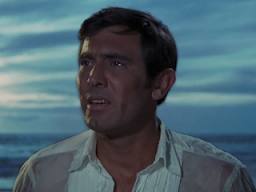
Bond, however, is not Bond. Or rather, he is Bond but his face has changed, not that anyone notices. Connery hung up the Walther PPK after five films and Broccoli et al went with George Lazenby instead: an Australian who, before this, had only ever done chocolate commercials. And the first sight I got of him this time, all I could think was: Look at that chin! You could hurt someone with that chin. The prologue introduces both main protagonists, as Bond gets into a high-speed car-flirtation with a woman who then tries to walk into the ocean. He rescues her, ends up getting decked by thugs, and then – after defeating them – she’s gone. At which point Bond picks up her shoes, comments “This never happened to the other fellow” and looks straight at the camera. I’m honestly not sure what I think of this level of meta in my Bond. It’s a bit weird, frankly, and is matched by the “all the girls I’ve loved before (and the villains who’ve failed to stop me)” montage in the credits immediately after – and the souvenirs, matched with appropriate musical stings, that Bond finds in his desk when he’s back in London. (Bond has a desk! Who knew?)
Lazenby often gets panned in the “who’s your favourite Bond” discussions and look, this is not the greatest Bond film. But I don’t think that’s entirely Lazenby’s fault. In fact, when Bond is facing off against Blofeld – now played  by Telly Savalas – I think Lazenby is excellent. Despite being in a kilt (another thing that never happened to the other fellow. Also, I don’t think Connery would have been shown flicking through a Playboy and nicking the centrefold). It’s not Lazenby’s fault that the script is a bit weak; the montage of riding horses through dappled light is utterly eye-rolling, despite the presence of Diana Rigg, and would not have been improved by Connery (or, dare I say, Daniel Craig). Plus, I’m not sure whether it’s because of Lazenby or changing expectations of film-making, but I think the fight scenes were slightly more realistic and definitely more aggressive than in most of the previous five films.
I’d like to point out right here that Bond and Blofeld met in the last film, so the idea that Bond could try to fool him by posing as someone else – even a gay genealogist with the College of Heraldry – is ludicrous, unless we accept that You Only Live Twice is retconned out of continuity?
Anyway, Blofeld wants his position as the real count de Bleuville accepted, which is how Bond gets into his clinic, by posing as the genealogist who will investigate his claim. (He has his own coat of arms investigated to brush up on heraldry. His family’s motto? “The world is not enough.”) This leads to ‘amusing’ scenes of boring pretty young ladies absolutely stupid with discussion of lions couchant and bezants. Did I mention that one of these young ladies is Joanna Lumley?

Speaking of ladies, so far I’ve only hinted at the primary Bond Girl in this film, and she’s the most famous of these first six: Diana Rigg. She also has a sensible name! – Tracy. And Tracy is a match for Bond – ruthless, somewhat careless about sex (by traditional standards – she sleeps with him partly because she thinks she ‘owes’ him after he stumps for her at the card table), stubborn and independent… well, that’s what she’d be like today. She doesn’t entirely get to be that here, not least because her father – second only to Blofeld in European crime but still very much a frustrated and concerned father – decides to bribe Bond to woo her, because “what she needs is a man to dominate her.” To his credit, Bond protests that what she actually needs is therapy… but in return for Blofeld’s location, he will indeed get more involved with her. Of course it all ends up gooey and sentimental and they fall in love, and they get married at the end of the movie. There are royalty present, apparently. Moneypenny cries.
And then, as they leave on honeymoon, Blofeld – who should be dead – drives past, and his 2IC shoots at the car, and Tracy dies. Tracy, the Bond girl least involved in Bond’s machinations to this point, is killed not in a fight or as a hostage or a statement of ruthlessness, but because the villain can’t aim properly. I hate this ending so much.
Racial issues: there’s only two non-white characters, by my reckoning; an Asian woman who only appears briefly, and a black man working for Tracy’s father, who fights well but only gets to grunt, never speak.
Louis’ version is lovely, but having only known Iggy from his Stooges days and then doing insurance ads… well, this is a revelation.

James: The credit girls have improbably pointy boobs in this film. The cast seem to be wearing too much foundation, but perhaps that’s just the high-res scans and retouching of the original films. I enjoyed the ski scenes and everyone loves a mountain top fortress. The plot and script is the weakest of all the film so far. Lazenby isn’t good, but I’m not sure he’s as bad as he gets portrayed either. Not a gadget to mention in this film. 2 Martinis.
Galactic Suburbia 95
In which the Hugo host debacle online conversation became a many-tentacled AI that wants to steal our souls, and ladies are cranky. Get us from iTunes or over here!
Speaking of Cranky Ladies – check out Tansy and Tehani’s crowdfunding campaign.
News In Depth: The Hugos v. Jonathan Ross, Safe Spaces & Online Discussions
Foz Meadows laying out the original drama in her usual inimitable style.
Cheryl on the arguments for & against Jonathan Ross as host as particularly on the importance of Intersectionality – how to be a good ally, and why you LISTEN to why people are upset, even if it’s inconvenient to you or your community.
The Chairs of LonCon apologise for the situation – weirdly, this graceful and thorough acknowledgement of their responsibility for how the chain of events went is often not being mentioned in coverage of the discussion.
UPDATE, PLEASE READ:
The downside of recording several days ahead of broadcast is that sometimes the conversation we are contributing to moves on without us – in particular with the “Hugos and Jonathan Ross” conversation we recorded on Wednesday night there has been some serious reframing of the narrative, some of it highly gendered.
We wanted to reference some of this further discussion rather than be seen to ignore such an important (and troubling) development.
Some important posts calling attention to the reframing of the narrative to trivialise the concerns of women (and to hide the fact that many prominent men shared and vocalised those concerns):
Kameron Hurley on Power, Responsibility, Empathy and Privilege
Kari Spelling on how the conversation has changed from being about the unsuitability of Ross as a Hugo host to being about how women were “mean” on Twitter – and how those women are continuing to be unfairly targeted.
Natalie Luhrs on “Reframing and Punching Down” – with particular reference to how those posts calling for people to be nicer to each other, or how fandom is too hysterical to deserve nice things, aren’t always as helpful as you think they are.
David Perry questions the mythical concept of Seanan Maguire’s Angry Mob, calling particular attention to how Seanan and her tweets are now being reframed as central to Jonathan Ross’s resignation, due to selective quoting, selective memories and gross misrepresentation of the actual timeline of events. This is important stuff, people. Our history just got rewritten while we were watching.
[note: we deliberately didn’t mention Seanan by name while discussing the issue in this episode of GS because we could see she was already being unduly blamed and centred in the discussion despite being only one participant – it’s the exchange between Seanan and Jane Goldman mentioned in the Perry article that Alisa also refers to as a conversation that ends in mutual apologies and is later misrepresented by others long after it’s concluded.]
Another important post by Kameron Hurley, Rage Doesn’t Exist in a Vacuum. On why internet rage happens, why someone else might be more upset than you are about a thing, and why it’s important to speak up about upsetting things even if it ruins someone else’s happy party fun times.
Culture Consumed:
Alisa: Game of Thrones S1, Fringe S3, Kaleidoscope ToC
Tansy: Ms Marvel #1 & She-Hulk #1 Fringe S3
Alex: Midnight and Moonshine, Lisa L Hannett and Angela Slatter; A Stranger in Olondria, Sofia Samatar
Pet subject: feedback
Galactic Suburbia Award!! (last call for suggestions)
for activism and/or communication that advances the feminist conversation in the field of speculative fiction
Please send feedback to us at galacticsuburbia@gmail.com, follow us on Twitter at @galacticsuburbs, check out Galactic Suburbia Podcast on Facebook and don’t forget to leave a review on iTunes if you love us!
The Pankhurst women
 This post is written as part of the Women’s History Month Cranky Ladies of History blog tour. If you would like to read more about cranky ladies from the past, you might like to support the FableCroft Publishing Pozible campaign, crowd-funding an anthology of short stories about Cranky Ladies of History from all over the world.
One cranky lady is awesome. Three in one family? That deserves a collective noun.
Let’s call them a Pankhurst.
These were women who went to prison, and on hunger strike, for their beliefs. Who held controversial views and insisted on their right, as humans, to make their views heard. Emmeline and her daughters Christabel and Sylvia Panhurst were very definitely Cranky Ladies. (Emmeline also had another daughter, Adela, who was probably equally cranky and was certainly involved in politics and the suffrage movement; less seems to be known about her activities than those of the other women in the family, though.) Their primary focus for much of their politicking careers was gaining suffrage for women in Britain (Sylvia went on to do other, also radical, things.)
Emmeline came from a family that had long supported equal suffrage for men and women, and married a radical lawyer named Richard who was a pacifist, republican, anti-imperialist and also a supporter of women’s suffrage. Gloriously, he seems to have genuinely walked the talk, and encouraged his wife to be involved in committees supporting women’s suffrage – even when they had children, which is also remarkable. She did many serious things as a young wife and mother, including hosting political parties for her husband – let’s not forget how important a space this could be for women; salons were not just about cucumber sandwiches and gossip, but often a place where women could genuinely get their views heard, in a society that prevented women from voting at a national level. She also worked as a Poor Law Guardian, including taking issues such as poor diet, clothing and conditions straight to the authorities and arguing for change – some of which was made. And she was in at the outset of the Independent Labour Party in the 1890s, forming a close working relationship with Keir Hardie.
All of these things would be enough to make Emmeline an admirable woman, if not one that stood out: there were, after all, many other women doing similar things at the time – you don’t get to have a Manchester National Society for Women’s Society with just one woman involved, and of course there were other societies doing similar things around the entire country. But Emmeline is most well known for the organisation she founded, with her daughters, after her husband’s death: the Women’s Social and Political Union, or WSPU.
You might have heard of them. They’re the ones who were originally called suffragettes by the Daily Mail, in an effort to be disparaging. How’d that work out again?
Emmeline and Christabel, in particular, decided that the so-called ‘constitutional’ methods used so far, especially by groups like the NUWSS (National Union of Women’s Suffrage Societies, headed by the awesome Millicent Fawcett), were just taking too long. Petitions, rallies, and refusal to pay taxes was all well and good, but maybe what was needed was something a bit more… confronting. Christabel later said that the first militant action she ever undertook was simply (‘simply’!) speaking in a political meeting; Emmeline identified the first militant act of the WSPU as when a group of women stood on the steps of the House of Commons to protest against the Women’s Enfranchisement Bill having been deliberately talked out, so that no vote on it could be taken. Things escalated from here, with all three Pankhurst women being arrested at various points for various actions, including deliberately spitting at a policeman in order to get arrested; ‘incitement’, in Emmeline’s case; and sometimes for speaking in public. Members of the WSPU did more and more radical things, up to and including arson and destruction of public property; Emily Davison, she who died after being knocked over by a horse at Epsom Derby, was a member.
When they were put in prison, most of the WSPU were put into the Second Division – where ordinary criminals went – rather than the First Division, for political prisoners. Partly to protest this indignity, many of them – including all three Pankhursts – went on hunger strikes. The authorities responded by force feeding them, which caused outrage, and was later stopped when the government – a Liberal government! – introduced what became known as the Cat and Mouse Act: when a woman got sick from a hunger strike, she was released to recuperate… and then got rearrested. Rinse, repeat. Emmeline, Christabel, and Sylvia all went on numerous hunger strikes, and Emmeline’s health especially was seriously compromised.
I should note at this point that I do sometimes fall into the trap of talking up the Pankhursts and their militancy and ignoring the long, hard work that women like Fawcett put in for many decades on the suffrage issue, which also contributed enormously to the profile of the women’s suffrage movement, and helped to demonstrate that the vote was not simply desired by a small bunch of waspish spinsters trying to get back at men. I firmly believe that suffragists (as the constitutionals are often remembered) and suffragettes both contributed to the eventual success of the movement.
Throughout its existence, Emmeline and Christabel ran the WSPU fairly undemocratically. Which sounds like an odd temporisation, but the reality – which seems actually quite hard to come at – is that while they ran the WSPU along authoritarian lines (there were no elections; the Pankhurst word was it), members could and did often run their own thing when it came to protesting. All the evidence suggests that they had no idea of what Davison was going to do at Epsom, for instance. And they lost the support of Sylvia, mostly because their politics diverged: Sylvia kept going left (she ended up being involved in the founding of the British Communist Party), while Emmeline and Christabel were starting to tend right. They never reconciled.
Women got the right to vote in Britain in 1917, if they were over 30 and either householders or married to a householder; in the same bill, all men over 21 got the right to vote. Women got the franchise on the same basis as men in 1928. Emmeline and Christabel had not actually been involved much in the struggle since 1914, having chosen to devote their efforts to WW1; Sylvia continued to protest, with her East London Federation of Suffragettes, because she was also protesting against the war itself. Emmeline even went to Russia and got to meet Kerensky, between the February and October Revolutions, although neither was very impressed with the other. After the vote was achieved, if on compromised grounds, Emmeline did not retire to a life of carpet bowls and singalongs: she went on lecturing tours of America and elsewhere, and even stood as a parliamentary candidate for the Conservative Party. Christabel also went on speaking tours; she was most focussed on the problems of venereal disease, and how to stop this ‘great scourge’. Sylvia went on to have a long and radical life: she was involved in socialist politics, she ran a newspaper that was probably the first British publication to run a black journalist’s article, and she was intensely motivated by anti-racist, anti-fascist, and anti-imperialist ideas. Also, she had a baby without being married, and she wasn’t ashamed of it. In the 1920s.
Emmeline Pankhurst. Christabel Pankhurst. Sylvia Pankhurst. Three very cranky ladies who have had a huge impact on history: the first two mostly in Britain, the last in Britain but also in Ethiopia, where there’s a street named after her in Addis Ababa for the work she did on their behalf. Every time I think that voting is a waste of time because one person can’t change things, I think of their sacrifices – even though in a different country – and I realise just how amazing an opportunity it is.
(I’ve reviewed biographies of Emmeline and Sylvia, as well as other books about suffrage history.)
Galactic Suburbia 94!
 In which we get excited about awards, and sexism in SF. In other words, it’s Galactic Suburbia! You can get us at iTunes or over at Galactic Suburbia.
Tiptree Award Winner & Shortlist – first Australian Tiptree winner! Congrats to N.A. Sulway!
Culture Consumed:
Alex: All Harry Potter movies; Project Bond; Supurbia
Tansy: Regency romance novels, Minister of Chance
Alisa: Supurbia
Pet Subject: the not-SFWA “debate”, the pervasive dismissal of women in SF
Note: this episode was recorded several days before broadcast, before Sean Fodera made his apology to Mary Robinette Kowal, who accepted it gracefully. Please look at her post about why she accepted, and the role of apologies in general.
Some other relevant articles we discuss or allude to, or which Alisa found after recording and wanted us to include – keep following the Galactic Suburbia Facebook Page as she’s been updating it with interesting links daily:
GENERAL BACKGROUND
The Radish hosted early discussion on the Bulletin anti-censorship petition.
The Daily Dot coverage of the petition & responses in the community.
Steven Gould on why the petition was based on a false premise.
SL Huang writes Can We Please Not Rewrite History, Folks?, and worth checking in on SL’s original Timeline of 2013 SFWA Controversies, now updated. [my apologies for stumbling over pronouns on the podcast]
THE LATEST WAVE OF TURMOIL, DISSENT AND SEXISM
Silvia Moreno-Garcia outlines the invective against Mary Robinette Kowal on SFF.net and the politics of “plunging necklines,” “diaphanous white outfits” and ankles.
Mary Robinette Kowal’s post on Being a Representational Example
Scalzi presents the Insect Army t-shirt design courtesty of Ursula Vernon’s awesome artwork.
N.K. Jemisin makes her own comments on the current shenanigans. Some really important words here. Alex also mentions Nora’s important tweet from 5 days ago:
N. K. Jemisin @nkjemisin
The loss of privilege is not oppression. The loss of privilege is not oppression. THE LOSS OF PRIVILEGE IS. NOT. OPPRESSION.
The post we possibly discuss in most detail on the podcast today: Juliet McKenna’s Why The SFWA Shoutback Matters
A really important message from James Patrick Kelly on age, and generations, and making a difference.
and don’t forget the…
Galactic Suburbia Award!! for activism and/or communication that advances the feminist conversation in the field of speculative fiction. There’s still time to send us your suggestions – only work from 2013, please, but start saving the 2014 links to send us next year.
Please send feedback to us at galacticsuburbia@gmail.com, follow us on Twitter at @galacticsuburbs, check out Galactic Suburbia Podcast on Facebook and don’t forget to leave a review on iTunes if you love us!
Escape Plan
Every now and then I feel a bit embarrassed by the sort of movies I like. But then I remember, actually? a) no one gets to tell me to be embarrassed, and b) just because I like explosions and chase scenes doesn’t mean I have to hand in my feminist credentials.
So yes, I love action movies. And when we saw that iTunes had a movie called Escape Plan listed, starring Sylvester and Arnie – and that we had never heard of it – well, that sounded like a perfect Saturday afternoon. And amazingly, it was way better than either of us expected.

There were problems with it, yes. The enemy-turned-ally becomes the plucky self sacrificing brown man. Which is always worth wincing over, not least because it’s so damned cliched. I still have absolutely no idea why we were meant to care about Schwarznegger’s character – that is, why the revelation at the end was meant to be so momentous. And of course it doesn’t pass the Bechdel test, but actually in this context I have no problem with that. The fact that there actually are two women, with names, is impressive. And they’re not even love interests.
The premise: Sly has spent 14 years getting put into jail in order to figure out whether they can be broken out of. And of course, they all can be. So it’s Sneakers but with jailbreaks. Then he gets put into one that’s been designed to be used now that the US has ended extraordinary rendition. It’s a jail that will be privately run, privately organised, and house “the people no government wants responsibility for.”
Let’s just pause there for a moment and shudder. And then consider Australia’s policy on where it sends refugees that try to come here.
Inside, things are bleak, and Sly’s get-out plan is dead in the water. Then he makes friends with Arnie and they start planning how to break out. The prison is built vertically, and Sly thinks it might be built into cave fissures… but then he climbs up, and discovers that actually they’re on a massive ship. Which sounds crazytown, until today we read that Manus Island staff are living in a floating hotel. Which… hilarious. Sly can build a sextant from nothing and figures out where they are, and then it’s just a matter of calling in favours until they can escape.
What worked? Sly and Arnie together. They were awesome. The prison idea itself is pretty cool, and prison escapes lend themselves to entertaining convolutions of plot. It has zero re-watchability, but sometimes that’s ok.
When we finished, my darling suggested we watch the 6th Fast&Furious film, which neither of us has seen. But I refused.
I said that we had to start from the start, and watch the whole lot. So that’s what we’re doing at the moment.
Thunderball
This review is part of Project Bond, wherein over the course of 2014 we watch all of the James Bond movies in production order.
Summary: in which James Bond is back to fighting SPECTRE, often underwater. We’re back to being worried about atomic weapons, and the problematic nature of plastic surgery. Also, Nassau means bikinis, baby. Yeh.
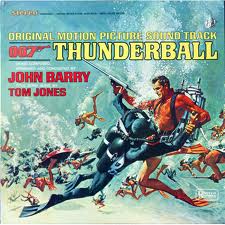 Alex: This Bond moves firmly back into the SF zone with James Bond escaping from some villains at the start of the movie with the help of a jetpack. Seriously, the thing is straight out of the Jetsons. But because he is with A Girl, the jetpack is only useful to get him over a wall to the waiting car; then it’s into the DB5 and up with the bullet-proof screen. The prologue is a classic whack-a-villain sequence; in this instance the only immediate indication we have that the villain is such is that he is cross-dressing in an awesome blonde wig.
I love Tom Jones. This theme song is up there with my very favourites.
This movie sees Bond back to battling SPECTRE – and just like before, if you missed the one and only explanation for what SPECTRE stood for, tough cookies. Once again, Number 1 has no face, but he does have a ruthless streak as wide as the electric chair he utilises on someone who appears to be skimming proceeds. We’ve got a new Number 2: Largo, who proves to be a key player in this film. He has an eye patch. He is therefore, by default, evil.
Most of this film is again set in foreign locations – it opens in France and moves to Nassau – but there is a fairly long stretch in a sanitarium, where Bond is recovering from his last adventure. This involves canoodling his physical therapist. At least, he wants it to; she protests in rather strong terms, which nearly made me cheer. Then he is nearly killed while on a torture-rack-cum-massage-contraption, and in return for him not reporting her… well. Pretty sure that qualifies as blackmail, sir. You are a cad. The sanitarium also sees Bond just happen to come across a man who has been killed, who turns out to be someone else’s doppelgänger… which ends up being the key to the entire mystery. But I get ahead of myself.
While Bond is having massages, a NATO team is out flying a training sortie that involves two real live atomic bombs. Our doppelgänger has killed the real pilot and taken his place, then gasses the rest of the crew while they’re flying around. So he helps SPECTRE steal the bombs. But SPECTRE don’t really want the bombs for themselves – although they’ll probably detonate them anyway; it’s all about blackmailing the British government. For ONE HUNDRED MILLION pounds. (I can’t help but be reminded of Austen Powers.) And the way the government will signal that they agree to the plan? By making Big Ben strike 7 times, at 6pm.
I love the British.

Anyway, off to Nassau; Bond meets the dead pilot’s sister, who is Largo’s mistress and called Domino because she’s always in black and white; he eventually solves it all and they all live happily ever after. But there are some interesting things to comment on along the way… like the fact that Largo keeps sharks, which means I get to reference another XKCD comic! Also that he does not utilise the sharks that well, because Largo falls into that classic Bond pattern of the Gentlemanly Villain. There were so many opportunities for Largo to kill Bond, but when he’s come for lunch it would be soooo rude to push him into the shark pool, don’t you know.

Also in the Bond pattern: a new Felix Leiter! This time a fella who looks like the poor man’s Clint Eastwood, in sunglasses. Q turns up, in a Hawaiian shirt that hurts my eyeballs, and he and Bond go way beyond sparring into evincing quite withering dislike of each other. This hurt my heart a little. Bond’s main assistant in Nassau in female, and black. Naturally, she dies.
Bond gets around quite a few laydees in this film. One of them is with SPECTRE – Fiona – and I quite liked her. I particularly liked her when, after having sex with Bond and then the goons turn up to capture him, she totally calls Bond on that trope that I’m not allowed to name. Bond is snide and says he did it for King and Country, and she is contemptuous of the idea that sleeping with him would make her switch allegiance. Of all the unexpected things, Bond got meta on itself! I nearly cracked up when that happened! And then she died. Because Bond moved her into a bullet (again. This is a habit).
The one thing that really spoiled this film for me was the underwater fight scene at the end just going on toooo long. I’m guessing it was all new and exciting technology, but… it got a bit wearing. I was hoping for some fun when the sharks turned up, but even they were a bit boring.
Hey James, that underwater grenade scene. Would that actually have been as bad as Bond makes out?
James: Yes, water is incompressible so explosive underwater = very unpleasant and direct impact. Also … The nuclear bomb labelled “Handle like Eggs”? love it. I have to say, as a young man I enjoyed the underwater fight very much (which I have seen very many times), but on the re-watch it did rather drag on – 2.5 Martinis.
Galactic Suburbia 93!!
In which 2014 is officially a thing. Who saw that coming?
We’re back! How did you spend your summer? (yes, we know some of you spent it having winter, but honestly, is that our fault?)
Galactic Suburbia returns for a fresh new year of culture consumed, awards commentary, feminist snark and adorable baby gurgles.
Culture Consumed:
Alex: On the Steel Breeze, Alastair Reynolds; Riddick; The Deep: Here be Dragons; Once Upon a Time: New Fairy Tales (ed Paula Guran)
Alisa: Haven S1 and S2; Star Trek; Kaleidoscope submissions (PhD)
Tansy: Terry Pratchett: The Witches (board game), The Hour Season 1, A Natural History of Dragons by Marie Brennan; When we Wake; Courtney Milan romance novels.
Pet subject: Gearing Up for Hugo Nominations – what we’ve read, what we recommend, and what we still plan to get to before the deadline.
Alisa: Reading – Ancillary Justice by Ann Leckie, Stranger in Olondria by Sofia Samatar, Coldest Girl in Cold Town by Holly Black
Alex: Saga; Ancillary Justice; Iron Man 3; still to watch Game of Thrones s3
Tansy: Still to read: Hild by Nicola Griffith, The Red by Linda Nagata, some novellas. Liz Bourke’s Sleeping with Monsters (Best Related Work or fan writer? Why doesn’t the Hugo have an Atheling?) Kirstyn McDermott’s Caution: Contains Small Parts. Supurbia (Graphic Story); The World’s End.
Galactic Suburbia Award!!
for activism and/or communication that advances the feminist conversation in the field of speculative fiction
Send us your suggestions and thoughts on who we should be looking at for the year that was 2013: blog posts, podcasts, GOH speeches and other awesome people talking about feminist stuff in interesting ways.
Please send feedback to us at galacticsuburbia@gmail.com, follow us on Twitter at @galacticsuburbs, check out Galactic Suburbia Podcast on Facebook and don’t forget to leave a review on iTunes if you love us!
Sylvia Pankhurst
Recently I’ve been really getting into the history of the women’s suffrage movement in Britain. There are professional reasons for this, but the reality is it’s been a simmering interest for a very long time. I don’t remember what grade it was, but I know I did a research essay on Emmeline and Christabel Pankhurst at school – to my teacher’s complete not-surprise – and was quite inspired. It was probably the first time I had felt that voting was actually something I ought to be interested in. And every now and then when I get discouraged by Australian politics and wonder whether it’s worth voting… well, I remember that although it was easier in Australia, women all over the world fought incredibly hard to get someone like me the opportunity to cast a ballot. Who the heck am I to throw that back in their historical faces?
One of the books I got in a rash of purchasing last year was Sylvia Pankhurst: A Life in Radical Politics. I knew Sylvia had fallen out with her mother and sister, and she went on to form her own (somewhat amusingly named) suffrage organisation, ELFS (East London Federation of Suffragettes). Thanks to a biography of Emmeline Pankhurst I knew a bit more about her politics, and her daring/disgraceful child out of wedlock. I also knew, although I don’t remember why, that she was incredibly important to mid-century Ethiopia, of all (seemingly surprising) places. There is, though, a whole lot more to her than these nuggets.
Mary Davis states right out that her intention is not to write a standard biography. Instead, she is aiming to look particularly at feminism and socialism in Britain in the first half of the 20th century via Sylvia. (She calls her Sylvia throughout, and justifies this with pointing that there were four Pankhursts active at the same time as suffragettes, and Sylvia was not the most famous. She also acknowledges that this is a problematic choice, which delighted me for its frankness.) What this book does then is look first at the development of the WSPU (created by Emmeline and Christable Pankhurst, Sylvia also involved); and then how/why Sylvia broke away as her socialist views conflicted with her increasingly right-wing mother and sister. Sylvia worked to meld her feminism and socialism, although this was incredibly difficult – a whole bunch of trade unions wanted nothing to do with feminism or helping oppressed women. As in so many cases, some of the oppressed don’t want to change the system; they want to get to the top of it and take advantage of it. When women eventually got the right to vote (some in 1917, all in 1928) Sylvia was changing her focus to the proletariat – she was a firm supporter, early on, of the Russian Revolution, and was involved in the Communist Party (well, one of).
Socialism and feminism were, if not acceptable causes, at least ones that other people clearly identified with. But Sylvia was also committed to more intriguing causes, which had fewer proponents in Britain at least: like anti-racism, anti-imperialism and anti-facism. Her newspaper was apparently the first in Britain to have a black journalist write for it. She spoke out on Ethiopia’s behalf when Italy invaded. These things got her some flak, as can be imagined, in Britain. But Ethiopia invited her to live there in the 1950s, and Addis Ababa has a street named after her, and her son still lives there (or did in 1999 when the book was published).
I love a good bio. Sometimes they can wander aimlessly, and sometimes they can focus too much on one aspect of a life. Davis’ approach seems, to me, to be the best of both worlds. It doesn’t pretend to be exhaustive; it does focus on one aspect, but that’s the whole point. And I really liked that it pointed out some aspects of British history, too, like bits of labour history that don’t often make it into mainstream historical narratives. In fact this is pretty much a checklist for the history of oppression: workers and women and black people are all covered, and all shown to have vital and real histories. Who knew? This book is a really great way into these areas of history, especially the suffrage/socialism aspect (and it’s only 120 pages long!).
Riddick

Some people will probably find this unbelievable, but I was disappointed by Riddick, the third in the Richard B. Riddick series.
Did Diesel and Twohy realise that Riddick was going to be such a badass when they named him Richard B. Riddick? It makes him sound like a cartoon character.
There are spoilers below, if you care.
I was disappointed to be disappointed, because I really like the first two films. I am so not the target audience of Pitch Black; I do not like horror, I do not tend to like creature features, I do not enjoy being scared. But Pitch Black… well, it has Claudia Black and Radha Mitchell, which helps. The planet and its creepy inhabitants are just so crazy that I liked them, and I found the interaction between the different sorts of characters – the scared, competent pilot; the wine snob; the drug-addicted cop; the imam; and the Riddick – quite enthralling. As for Chronicles of Riddick, I’m only a little embarrassed to say that I love this insane b-grade dystopic over-the-top sf action film. Hell, it has Karl Urban in awesome makeup, and it has mad sets, and Crematoria is spectacularly nuts as a planet. So going into Riddick, I thought – well, how bad can it be? From the ads it was clear they were taking the franchise back to the Pitch Black model, which is fine; I was expecting some equivalent fight scenes against humans and weird aliens, some snappy dialogue, maybe a plot. Also Katee Sackhoff!!
There were some entertaining bits, I’ll admit. That Riddick is now so notorious that mercenaries know his name, and the smart ones know to be terrified, allowed for some pretty amusing scenes. The aliens were indeed as weird and unlikely as I expected. There was a brief shot of Karl Urban in his eyeliner. Sackhoff (whose character is Dahl, which is a very unfortunate name) is kickass with a sniper’s rifle. That one of the mercenaries was actually there in order to get information about the drugged-up Johns from Pitch Black gave it something of a Die Hard 3 feel, which I really liked, and meant that it did actually tie into both parts of Riddick’s past. I was intrigued by the back-to-basics appearance of the film, back to the first appearance of Riddick; it seems to suggest that Riddick makes more sense in a mostly-fighting-animals world, rather than even pretending to fit in, or interact, with humanity like in the second. And that’s an idea worth exploring.
But.
Oh, but. The first third or so of the film is basically Riddick-as-Robinson Crusoe, which was weird. Especially the bit where he domesticates a canine because… does that kind of make the dog a replacement for Jack/Kyra? Also, Riddick with a dog? That he feeds and cares for? ?!?!? That was all a bit odd. And then the movie proceeds to the fighting-the-mercenaries bit, which is where the vague plot actually starts. And Dahl arrives. In a very tight outfit, with belts and straps that emphasise her bust even more. And half the time when the dialogue involved her, it was someone being sleazy. Even Riddick himself gets in on it, which shocked me enormously. The merc on the other team – fine, I understand, he’s a douche; that’s been established already, he doesn’t like a woman being in authority over him, and she can deal with him. It’s not nice, but the writers seem to think that that helps to establish him as being Super Bad. However, I honestly don’t remember Riddick being sleazy or misogynist in the other films. Did I miss something? He’s totally big-brother to Jack/Kyra – actually, not even that to Jack, he’s completely dispassionate. Maybe there’s a moment of maybe-electricity with the pilot, Fry, but no suggestion that they make out, as far as I recall. The comment that Riddick makes towards Dahl is just so crude that I was disgusted. Over at The Mary Sue, the argument is that Dahl – established as lesbian early on, in a moment that impressed me – uses her last line as a come-on to Riddick. I actually didn’t read it this way; for me, it seemed to reflect the situation they were in (a very intimate embrace on a rope hanging from a plane). Maybe I’m just in denial.
I am glad I did not pay to see this, but got to see it at a friend’s house. That said, Diesel has just announced the fourth movie… which makes my prediction of Riddick: the Search for Furya (based on the final 60 secs of this film) all the more likely. If they can get Karl Urban back into his eyeliner, I probably will go and see it. Because I am weak like that.
From Russia with Love
This review is part of Project Bond, wherein over the course of 2014 we watch all of the James Bond movies in production order.
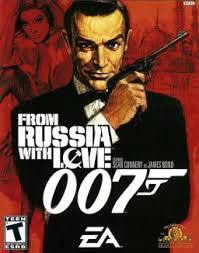 Summary: Bond is lured to Istanbul to help SPECTRE steal a Russian encryption machine. Also, there is bellydancing. And stroking of a cat.
Alex: I’ll start by talking about the gender stuff, because the representation of women’s sexuality is quite interesting in this movie. Two women throw themselves at Bond – which is not exceptional in the canon, but in Dr No Honey Rider was quite reticent and Sylvia wasn’t immediately ripping his pants off, so in 1963 there’s no precedent. Additionally, Kerim Bey – Our Man in Istanbul, and not an especially handsome one – has women dragging him off to bed, and two women in the gypsy camp have a fist-fight over who gets to marry the chief’s son (who as far as I can tell, is never seen). So women are sexual creatures, mostly; the only other woman we really see is Rosa Klebb, but she’s old so clearly she doesn’t count (sarcasm!), because she sure doesn’t do sexy. The young women 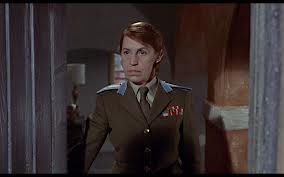 are passionate; in fact, they can barely contain themselves. Bond is generally happy to go along with it; while he doesn’t really initiate anything he does take over when he goes along with it. Bey seems to see pleasing his women as a chore (he actually sighs and says “back to the salt mine” when he agrees to canoodle with one), but has an endless number of sons and extols the virtues of big families. From this I guess we learn that women are ruled by their passions and men are ruled by cool intellect? Or something to that effect. Also, of course, in Bond we have an example of the Magical Penis trope (I really wanted to find a link to explain that, but it wasn’t obvious on TVTropes and NO WAY was I going to google it) – he turns Tatiana into a Good Woman through sex.
The mechanics: we get a prologue! In which Bond appears to be hunted and killed, but it all turns out to be a training exercise for Scary People. From which we learn that Bond is already a force to be reckoned with. There is also clear continuity with past movies: Bond is canoodling with Sylvia, the woman from the opening of Dr No, in his first scene here; and SPECTRE are very keen for Bond to be the agent they lure to Istanbul not least to take revenge for his killing of Dr No. Also, SPECTRE! Whose name is not explained in this film so if you weren’t paying attention the one time the acronym was explained in Dr No, sucks be to you.
I was intrigued by SPECTRE, actually. I had forgotten that the face of Number 1 is never shown: just his hand, stroking the white cat, thus spawning ever so many copycats (Baron von Greenback in Danger Mouse, Claw in Inspector Gadget, the villain in Austin Powers… who have I forgotten?). We don’t know his name, and it’s not given in the credits. SPECTRE as an organisation is clearly well-organised (they have a secret training base! Number 5 is a chess champion! They use live targets in training!), and the movie wants us to be aware of their power: it devotes the prologue and then the first maybe 10 minutes to them, showing them as focussed and driven. Conversely, when we finally do get to Bond, he’s relaxing on the banks of a river with a woman. Where Tatiana has just said she is willing to use Feminine Wiles to serve Mother Russia (she’s an unwitting agent of SPECTRE), Bond is using Masculine Wiles just to enjoy himself. A nice dichotomy is set up, which is somewhat undercut by Bond’s willingness to jump at M/Moneypenny’s orders… until Sylvia persuades him to stay just a little longer.
It should of course also be mentioned that this movie sees the introduction, albeit all too briefly, of Q – the eQuipment Officer. Who gives Bond some gadgets, but they are disappointingly low tech and there is a tragic lack of snark from him.
 Other things confirmed by this film: being Bond’s associate is a dangerous business, as Kerim Bey ends up dead. Hmmm… given Quarrel in the previous film, perhaps it’s only dangerous if you’re not white? OK, maybe two films isn’t quite enough to make this generalisation.
Things I did not know until I went to IMDB: Daniela Bianchi, who played Tatiana, was dubbed for this role because her English was so poor! But she was 1960’s Miss Rome so I guess that makes… no, it doesn’t make sense at all.
James: First a note to the editor, if the phrase ‘Magical Penis’ is used in another review my subscript notes will cease.
Alex: it’s a real trope! Happens all the time!!
James: Another tip of the hat to the negative restoration and transfer quality for the Blu Ray nerds. So much of this film has been filmed on location in Istanbul and it really shows, much less blue screen etc. Compared to future Bond the majority of the film centres around one city and few locations, the two embassies and some tourist highlights in Istanbul (The Blue Mosque, Basilica Cistern, Hagia Sophia and the Bazaar). One thing that doesn’t really make sense is that all film the good guys know the bad guys are lurking and yet they are so casual about security … For example on the train Bond tells Tatiana ‘Lock the door, I’ll knock three times’ as the bad guys walk up and down the corridor and occupy the cabin at the end of their carriage. I did enjoy that Bond marks the major villain who’s been stalking him all film by his choice of red wine with fish, and not a million other more obvious things he’s done. 2.5 Martinis (which curiously don’t feature in this film at all).

 Randomly Yours, Alex