Emmeline Pankhurst: a niche in history
 I have always been a bit of a fan of Pankhurst. I can remember years back doing an assignment on her, which may have been at the very outset of my interest in feminism and is the reason why I am passionately devoted to the idea of women voting any time they can. So I was pretty happy to, finally, get around to reading this bio of a remarkable woman.
Purvis begins her account with a historiographical examination of the treatment Pankhurst has received over the last seventy years or so, which is illuminating – especially as it all really began with her daughter Sylvia’s account, which was rather bitter and very much tainted by the feud between the two, thanks both to family issues and a fundamental difference in opinion about politics (Sylvia moved/stayed quite far left and was heavily into socialist politics, Emmeline moved away from many of her socialist tendencies for various reasons). Many subsequent accounts have leaned too heavily (in Purvis’ view) on Sylvia’s story, while others have come from a decidedly ‘masculinist’ perspective and thus denigrated Emmeline’s achievements and intentions. Modern feminist historians have often been troubled by her at least partly because she moved towards a more conservative, imperial point of view during and after WW1, but Purvis is insistent that we take Emmeline on her own terms.
I really enjoyed this as a book and as a history. Purvis writes very engagingly and paints a captivating picture of an extraordinary time, an amazing woman, and the politics of the suffrage campaign especially. It appears to be a very well-researched history, with copious endnotes to back up her points that include reference to many, many letters to and from Emmeline and others in her circle, as well as newspaper accounts, court proceedings, diary entries and the like. It really makes me wish I could find The Suffragette, the WSPU’s newspaper, online somewhere. Someone get on that!
A potted bio of Emmeline’s life: interested in politics very early on, married at about 22 to the 40-something Richard Pankhurst, a lawyer who was a strong socialist and campaigner for women’s rights, among other things. She had five children, one of whom died very young, but/and she was always and still involved in campaigns and political work. Richard died when Emmeline was 40, leaving her with little money and four children to support – financial trouble continued to dog her until her death at 69. What she is most famous for, of course, is the setting up of the Women’s Social and Political Union, with her daughters but especially the eldest, Christabel – and that it eventually took the step into militancy in order to advance the cause of women’s suffrage. Window smashing, arson, destruction of paintings… all of these things were seen as much worse when committed by women. Purvis points out the success that various Irish politicians and agitators were having with similar tactics, and the fact that this got them an audience with English politicians and even the king. Not so much the women. The WSPU began in 1903; women gained limited suffrage in 1918, at the same time as men gained it with no property qualification (and women had to be 30, men 21). This was not, of course, the end of Emmeline’s life – she had started campaigning for women’s war work with WW1, and also expressing her concerns about sexual double standards and morality with the increase of VD. After the war she lectured around America and Canada on topics like public hygiene, avoiding VD, and the necessity of the British Empire. She died back in England not long after discovering Sylvia had had a son without getting married, pretty much destitute.
Just writing that down makes me exhausted. Emmeline comes across, in this book, as an amazingly energetic and passionate woman. She’s one of the reasons the Cat and Mouse Act was introduced: imprisoned suffragettes would hunger strike; be let out to recover; then get re-imprisoned. She went on hunger strike 13 times. She never wrote her speeches down but always spoke extempore; she travelled around Britain campaigning for and against political candidates, speaking at rallies, and trying to convince people about the necessity of women’s suffrage. She never wanted the vote just for its own sake; she was driven by the idea that women being able to vote would bring about the incredibly necessary changes to society that would prevent the exploitation of women, the horrors of poverty, and alleviate other social problems that she saw in her work as a Poor Law Guardian and on an education board. She worked as a registrar for births and deaths and was always shocked and saddened by teen girls coming to register the birth – and sometimes death – of their illegitimate children, often the result of incest.
This was not a woman driven by a desire to be a man, as so much of the anti-suffrage press claimed; she did not regard herself as better than men but as deserving of equal citizenship. Not least because working women had to pay taxes but could not influence how they were spent, and because she abhorred double standards and thought women’s influence could help solve many problems. (She was quite the optimist.) People at the time, and even her daughter Sylvia, often seemed to think that the cause had become almost more important than the object. It’s not hard to see how this could happen, to be honest, when you’re fighting for something that frequently gets you attacked – verbally, physically – and condemned by large sections of society. I’m personally torn on the notion of militancy, but I’m not torn on what I think of this woman. She’s a hero. I wish I’d known she has a statue near Westminster when we were in London, because I would absolutely have gone on pilgrimage.
This is highly recommended as a way of understanding the English suffrage movement – the militant side at least, because yes Millicent Fawcett and other ‘constitutional’ suffragettes are largely ignored, except as they interacted with Emmeline – as well as how late Victorian/Edwardian England society functioned. Plus, this is a woman who deserves to get as much recognition as possible. She devoted her life, her health, and even – arguably – her family and friendships to public service.
Galactic Suburbia 70!
 In which Feminism 101 meets Aussie politics for a battle of the bands! You can get us from iTunes or Galactic Suburbia.
News
Julia Gillard and the Sexists of Doom
The Speech (and bonus Penny Wong Interview)
Commentary in the New Yorker
@vodkandlime talks about the response to the Gillard speech
Ben Peek on the failings of the mainstream media
British Fantasy Awards: special squeeage for Angela Slatter, first Australian to win one.
Jonathan Strahan and Nightshade Book launch Eclipse Online
Strange Horizons Fundraising Drive is on
Crikey looks at author earnings and advances.
What Culture Have we Consumed?
Alex: Deathless, Catherynne M Valente; Arc 1.3; Hydrogen Sonata, Iain M Banks; Looper; abandoned: Armored (ed John Joseph Adams)
Tansy: The Outcast Chronicles, Rowena Cory Daniells; Unspoken, Sarah Rees Brennan; Wild Mary: A Life of Mary Wesley by Patrick Marnham, Under My Hat edited by Jonathan Strahan. Also GAME OF THRONES
Alisa: The Future is Japanese (ed Nick Mamatas); Looper; Death’s Daughter, Amber Benson; Casual Vacancy J K Rowling; Studying Men and Masculinities, David Buchbinder
Next Episode: feedback probably
Please send feedback to us at galacticsuburbia@gmail.com, follow us on Twitter at @galacticsuburbs, check out Galactic Suburbia Podcast on Facebook and don’t forget to leave a review on iTunes if you love us!
We Who Are About to…
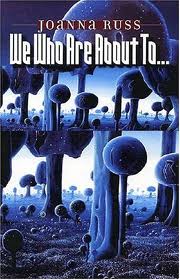 This is not an easy book to read. But it’s a Russ, so that’s not exactly a surprise, is it? She takes an SF trope – the idea that survivors of a crashed spaceship somehow colonise an uninhabited planet – and wreaks merry havoc.
This was apparently first published as two novellas (maybe even novelettes; the book is only 120 pages). By the end of the first half, all but one of the characters is dead. Surely the second half is going to show the sole remaining character that the planet is actually inhabited?
Yeah no. Not so much.
Told from the perspective of a woman who really doesn’t fit in with her fellow survivees, this is quite an uncomfortable read, for a lot of reasons. Firstly there’s the attitudes of each of the survivors: their entitlement, feelings of contempt, and the beginnings of a Lord of the Flies milieu. Then there’s the narrator herself, who while apparently more likeable – if only because the reader has insight into her thought processes – is still an uncompromising and actually rather difficult person to be around. And then there’s the plot, which is basically: crash; deal with each other; deal with being the only human on the planet. The end.
The other characters are very difficult to get your head around because we only see them from the narrator’s point of view, and for quite a limited amount of time. There’s a young girl, clearly spoiled and needy; her parents, who have all sorts of weird things going on with money and work and respectability that actually, when you deconstruct them, aren’t that weird and that makes it all the more uncomfortable (trophy spouse, use of marriage, etc). A jock in a universe that appears to have less use for such types, and a professor who appears to be the polar opposite and whose smugness speaks of all that’s wrong with academia. And two other women – quite different from each other, but sharing elements with our narrator, which makes her uncomfortable and serves to illuminate her character as the story progresses.
The narrator’s background is something of a jumble, which is unsurprising given that Russ writes much of the last half in almost a stream of consciousness. We learn a bit about her experimentation with niche religion and politics, a bit less about her relationships – platonic and sexual – and a bit more about her sheer determination in the face of difficulty. I don’t know that I liked her, but I certainly admired her.
The plot is definitely a secondary consideration here. While it is of extreme importance, because it’s the springboard for Russ’ investigation into character and because it’s an inversion of an SF trope, there’s so little to it (really taking place almost solely in the first half) that it must be secondary, I think. Which is not to suggest that it is poorly constructed or anything like that, of course. It’s confronting and minimal and all the more confronting for that.
This must have issued an important challenge to SF when first published – and still does, I think. It’s not easy, but it is worthwhile.
Galactic Suburbia 67
 In which we talk trolling, internet pile-ons and Twittiquette (it’s a word, right?) as well as Weird Tales, Analog, heavy metal, straight white YA dystopias and (this may shock you) Joanna Russ. You can get us from iTunes or from Galactic Suburbia.
News
Announcing the brand new Last Short Story podcast starring (so far) Jonathan and Mondy.
Tansy visits the Panel 2 Panel podcast to talk about comics with Kitty.
TPP event at Melbourne Writers Festival and Alisa’s Woman Achievers Award
Alisa’s report and Jason Nahrung‘s report.
The Weird Tales dramah:
Round up of links
Jeff VanderMeer’s take on it.
In happier news, Ann VanderMeer now editing at Tor.com
Stanley Schmidt steps down from Analog
When authors go bad (on social media) and reviewers get burned.
What Culture Have we Consumed?
Alisa: Glory in Death J D Robb; trying to read Matched by Ally Condie, Outer Alliance podcast on the lack of queerness in YA dystopias
Tansy: The Imaginarium of Doctor Parnassus; What Women Want by Nelly Thomas; Big Finish Audio – Invaders From Mars by Mark Gatiss & The Chimes of Midnight by Robert Shearman (2002)
Alex: Metal Evolution; We Who Are About to…, Joanna Russ; CSZ special on Joanna Russ; The Lost Books of the Odyssey, Zachary Mason
Please send feedback to us at galacticsuburbia@gmail.com, follow us on Twitter at @galacticsuburbs, check out Galactic Suburbia Podcast on Facebook and don’t forget to leave a review on iTunes if you love us!
Galactic Suburbia 66!!
 In which we suffer post-Olympics slump but make up for it by talking about sport in SF/F: from coyote baseball, holodeck racquetball and the points system of Quidditch to the history of sport in Doctor Who. And don’t forget that Buffy was a cheerleader! You can get us from iTunes or Galactic Suburbia.
News
World Fantasy ballot released.
Mythopoeic Awards include Delia Sherman and Lisa Goldstein
New Science Fiction Awards Database Website by Mark R Kelly (Locus)
Kirstyn McDermott makes Jason Nahrung a mug based on Alex’s GS review of Salvage
New Galactic Chat: Sean interviews Trudi Canavan
Readercon Apology sets the standard.
Feedback: Sean & Kitty on the harassment at cons issue.
What Culture Have we Consumed?
Alex: Existence, David Brin; all of Planetary, by Warren Ellis; Caliban’s War, James SA Corey
Tansy: “Foundlings” by Diana Peterfreund in Brave New Love; Shooting the Poo 14 (Sherlock Holmes) & 15 (Alien movies part 1)
Alisa: Coode St Podcast Ep 112 featuring Genevieve Valentine, and… reading unapologetically is a life skill!
Pet Subject: Sports in SF/F
The tennis match Alisa refers to is this one with Billie Jean King.
Please send feedback to us at galacticsuburbia@gmail.com, follow us on Twitter at @galacticsuburbs, check out Galactic Suburbia Podcast on Facebook and don’t forget to leave a review on iTunes if you love us!
Galactic Suburbia 63
 In which we look at the politics of female author portraits, why you shouldn’t tweet celebrities about their alleged irrelevance, and start thinking about what we’re going to vote for in the Hugos. You can get us at iTunes or from Galactic Suburbia.
News
Women in SF & Fantasy in Australian media – the article is a month old, but still relevant!
WA Premier’s Book Awards Shortlist announced and Penni Russon is on it!
Top 10 list of the greatest female SF/fantasy authors ‘of all time’ – do you agree?
Tansy’s Pinterest board of portraits of “Lady Novelists”
It’s Not Wise to Be A Jerk to Felicia Day
What Culture Have we Consumed?
Alex: Schismatrix Plus, Bruce Sterling; Embassytown, China Mieville; Snow White and the Huntsman; Bitter Greens, Kate Forsyth; Diamond Eyes, AA Bell
Tansy: Salvage, by Jason Nahrung; Medea, Kerry Greenwood; Captain Vorpatril’s Alliance by Lois McMaster Bujold; Ame-Comi Wonder Woman & Batgirl; Silk Spectre #1 by Darwyn Cook & Amanda Conner; The Invincible Iron Man, Matt Fraction
Alisa: Blackout, Mira Grant
Please send feedback to us at galacticsuburbia@gmail.com, follow us on Twitter at @galacticsuburbs, check out Galactic Suburbia Podcast on Facebook and don’t forget to leave a review on iTunes if you love us!
[photo: Stella Miles Franklin, older and more characterful than we usually see her in images]
Prometheus
I saw it, and I enjoyed it. I’m not saying it was a great movie; it was a fun way to spend a Saturday evening.
However…
What follows is my entirely spoilerific rambly take on Prometheus. You’ve been warned.
The first thing to mention is, I’m sure to no one’s surprise, the role of women in the film. I thought it started well with one of the lead archaeologists being a woman, and indeed the one to make the final discovery that locks the whole ‘they’re inviting us to go visit them’ into place. And then the apparent leader of the spaceship is a woman, too, so that was cool, and one of the crew too, seemingly the one with med training. So… three out of 17. Well, ok, it’s only 2093, so maybe things haven’t changed a whole lot? Anyway, things progress, and then I got cranky… because Holloway, the male archaeologist, is talking about how amazing it is that life is ubiquitous and that it can be created anywhere, and Shaw – the woman – gets all teary because she can’t have children. Now, I understand that this is indeed a very painful thing for many women; and I understand that it sets up the tension for later in the film when – spoilers! – she appears to be pregnant, but… seriously? What it felt like was someone, somewhere, thinking “hmm, we really must account for this young woman having a spectacular career and going off in a spaceship while not worrying about her toddlers at home. I know! Make her infertile!” And it made me angry. Especially – especially – when teamed with the attitude towards Vickers, nominal head of the spaceship.
Because it really is nominal: in his introductory speech, Weyland appears to make the archaeologists the leaders of the expedition; and Janek is the captain of the ship, so he has significant power too. Fine, whatever, a confused power structure; this is nothing new, and interesting for plot tensions. It still sucks. Then there are a few lewd comments about lap dances with Vickers and suchlike… ok, grunts make fun of their commander, I can kinda see that. But then there’s a conversation between Janek and Vickers where the former says she should just say she’s looking to get laid, rather than pretending to be interested in something vital to the success of the mission. Vickers laughs this off quite successfully, and I thought it would be left there as an example of adult banter between people who respect each other. But then Janek asks whether she’s a robot, and Vickers’ response? “My room, ten minutes.” And at that point I got pretty cranky. Because of course, a woman resisting a man’s advances is clearly inhuman. And a woman already struggling with clear chains of command is clearly going to sleep with a subordinate just to prove she can! So. Dumb.
Oh, and the medic gets very few lines and dies horribly, but this was the case for most of the male red-shirts too, so that didn’t fuss me much.
And then there’s the mystical pregnancy. Oh yes, ladies and gentleman, there is one. I guess it shouldn’t be too much of a surprise when you realise that yes, Ridley, this is an Alien prequel (more on that below). Shaw is told, by David, that she is pregnant… about three months’ pregnant, which is impossible unless we’re to accept that pregnancy is halted by cryosleep, which I guess it might be. Of course the other option is that actually this is from the sex 10 hours ago, which is also impossible… but the TRUTH! Yeh, it’s an alien. And it leads to a very graphic attempt at a caesarian, which is only possible after Shaw tricks the automatic surgery unit that it must do abdominal surgery on her, which it has to be tricked into because it’s configured for a male and therefore can’t do a caesarian. WTH? A gender-specific automatic surgery unit? Are you for real? So, a few issues in that little plot device then.
Now that I have that out of my system, what else is there to say? Oh, I thought Michael Fassbender was generally excellent as David, especially for the first half of the film. I think I picked him as an android in the first two seconds of seeing him walk; I really liked being introduced to him walking around the spaceship alone, checking up on things – and his fascination with Lawrence of Arabia was awesome and gave me all sorts of expectations (not all of which were fulfilled) for his role throughout. It does, of course, poignantly contrast with the utter callousness directed towards him by Weyland and, especially, Holloway, later in the film. This callousness from Holloway was one of the things that struck an off-note for me, because otherwise he is shown to be a generally sympathetic and empathetic character. I know it’s possible for someone to be perfectly nice to ‘like’ people and evil towards the ‘unlike’; but it still felt off. And sadly, David goes seriously off piste in the second half of the film, and it was just another bit that didn’t make sense. Why was he so determined to bring back samples that he infected Holloway? From Ash, in Alien, and from Carter in Aliens it makes sense – it’s part of their instructions. But with David, all we know is that Weyland wants to meet the creators; are we seriously expected to think that David hopes that infection will somehow turn Holloway into one? It just seemed like yet another way to draw a parallel between this and Alien – because make no mistake, this is absolutely the Alien/Aliens story all over again, and basically a direct prequel.
Shaw IS Ripley, in many respects. The four Alien movies are in many ways the evolution of Ellen Ripley, from somewhat naive spacefarer with a dislike for violence through to a demi-monster for whom violence threatens become the be-all. Shaw can be seen as the stage before this: she rarely uses violence, and indeed in fighting the alien at the end who threatens to kill her does not personally actually fight him: she lures him into a fight with the alien thing that had previously been in her stomach (which has, in a matter of hours, grown to epic proportions). And at the end (I did say there were spoilers!) she wants to go off and find the aliens’ home planet, if she can, not to deliver the ship-load of biological weapons she has at her disposal, but to ask them what humanity did wrong. No “get away from her you bitch” lines there (but hey, she’s not a mum, so what can you expect?).
Look, there are dozens of other plot holes that I could happily drive a semi-trailer through. I know they’ve been picked over by many people on the internet – and heck, the stuff I’ve ranted about above has been too. But you know what? I don’t count it a waste of my two hours. Terminators 3? That was a gigantic waste of my time, and I wanted a scrubbing brush to clean my brain with afterwards. Prometheus, by contrast, I thoroughly (well, mostly) enjoyed at the time, and I’ve really enjoyed thinking about it afterwards. Would I stop someone from going to see it? Only if I thought they would have series trigger issues. Will I watch it again? Almost certainly not. And that’s ok.
Continuum 8
Or
My Con Experience, by Alex, aged… quite enough thanks.
It was Craftonomicon, the 51st National Australian Science Fiction Convention, this weekend, and the first weird bit about it was that I got there by taxi, and not by plane.
My con started properly on Friday afternoon with a panel on space opera with m1k3y and Jonathan Strahan that went remarkably well, not least because the former was an admirable moderator. I got to gush about a few books and discuss why I like it and what makes something space opera; Tansy thinks I am very harsh because I said generally it has to move outside of the solar system. I say: if it doesn’t, it’s hard to be grand enough to count.
Next I helped Terri and Alisa move a mountain of cupcakes in preparation for Twelfth Planet Press Hour, in honour of two new Twelve Planets books and Jason Nahrung’s Salvage, and TPP in general. The cupcakes were wolfed in minutes, although it is fair to say that people did usually stop for a moment to admire the artwork that Terri had made of them out of frosting and sugar. So very much sugar.
I think Friday ended with dinner, and… I forget. It was a while ago now. There was a great deal of talking. Actually that was kinda the theme of the whole con. The official theme was craft, and I got a number of inches completed on my scarf; the unofficial theme was Talk As Much As You Can. Me and my peeps managed this quite well 😀 .
Saturday I sat in on a panel called “Masters of Podcasting,” which has to be said in an echo chamber to get the full effect, featuring Alisa and Jonathan and Kirstyn and Terry. Tansy and I were very restrained and did not heckle. They said some quite interesting things, like podcasts being the lazy person’s fanzine to create (that’s Kirstyn’s view), which SO resonated. Then I was on a panel called Fans and Faith, with three Christians and a Jew; we made the Jewish boy, Mondy moderate, and a very fine job he did by asking provocative questions and pointing out that while we might not like the representations of Christians we find, at least there are a few – not so much with Jews, especially of the Orthodox persuasion, nor Muslims (Kameron Hurley makes a start in addressing this). It was a good discussion in all and only derailed towards the end by someone basically asserting that you can’t have faith and accept the scientific method, which he believes is essential to SF…
In the afternoon we did a Galactic Suburbia that lasted just ONE HOUR – show notes to come when the Silent Producer has recovered from the con. After that I travelled with Alisa and nine of her Planets (and a few other audience members) to Embiggen Books, which oh my it might have been better for me not to find. What a BEAUTIFUL bookshop! With a door hidden as a shelf and everything!! Mondy hosted the podcast that involved all nine Planet authors and Alisa talking about the project and their individual approaches to it, and it was a lot of fun to sit in the audience and listen to such a diverse range of women talk about their approaches to writing and to the project. Drinks and dinner followed, and I got home… later than Friday.
Sunday I made it in to the con in time to see half of the “Elizabethans are awesome” panel, and then wandered around and helped restock the Twelfth Planet table and generally mooched and chatted. My last panel to contribute to was one on book blogging and reviewing, which went ok. I scurried from that to the live recording of The Writer and the Critic, which was entertaining of course even though they did not especially like Crystal Singer, by Anne McCaffrey, which I adored in my teens.
The evening was taken up with dinner, trying to find out when power might be restored in Perth, and then frocking up because it was Awards Night! And I love awards. It was the Chronos (Victorian state) and Ditmar (national) awards night, with a couple of others thrown in – mostly lifetime achievement type things, plus the Norma K Hemming, for a book which addresses gender/class/disability issues. I won’t go into all of the winners – that would be a Galactic Suburbia job! – but I will proudly mention that I won two! I got the Best Fan Written Work for Tiptree, and a collection of her short stories, which thrilled me immensely. And then… then, they announced that Tehani and I won the William Atheling award for criticism for our conversational review series of the Miles Vorkosigan novels. This thrilled me absolutely to bits, and if there hadn’t been lots of people there I may even have had a tear in my eye. The rest of the night involved much talking and laughing and a midnight run for ice cream….
Monday was hard to get to, mostly because it was a public holiday and my tram never showed, so I ended up driving in so that I could catch Alisa, Terri and Jonathan before they winged their way back to Perth. I managed it, and then I went to a panel that was officially meant to be about whether women are equal to men in sf and fantasy, but ended up ranging over a variety of mostly interesting topics. After a spot of chatting and lunch I concluded my con with a panel on “The Awards Debacle”, which was sadly lacking in any controversy because the panelists all agreed with each other.
Now, I am tired, but not as tired as those who had to actually travel to get home; I am anticipating an early night before returning to the so-called real world. But this con has been a seriously awesome experience: lots of talking, lots of knitting, lots of talking. I met a couple of people I only know via the ether, which was great, and it was really wonderful to spend face to face time with the people I talk to so often but so rarely get to experience with body language! We all had ‘the con voice’ by Monday morning – dropping about an octave – partly from aircon, partly from late nights, partly from talking too much but only just enough.
And that’s my con-going for the year.
Snapshot 2012: Helen Merrick

Helen Merrick is an SF reader, critic and fan. By day she teaches Internet Studies at Curtin University in Western Australia and writes a bit about SF, feminism, fandom, online communities and sustainability. Her publications include the edited collection Women of Other Worlds, and numerous articles in books such as On Joanna RUss, and The Routledge companion to SF. Her book the Secret Feminist Cabal was shortlisted for the Hugo, won the William Atheling, and was on the honours list for the James Tiptree Jr Award. She has just finished a co-authored book on feminist theorist Donna Haraway called Beyond the Cyborg (forthcoming from Columbia UP) that manages to include a fair bit of SF and Ursula Le Guin, which makes her very happy.
Your examination of the role of feminism in science fiction fandom, in The Secret Feminist Cabal, was on the Honor List for the Tiptree Award in 2010 – congratulations! What was it like to be recognised in this way?
I was totally blown away! It was the icing on the cake in terms of how the book was received by the SF/F community, which I totally did not expect, given it was an academic book. I seem to recall I found out about it on twitter, as I hadn’t even seen the honours list. It was all the more rewarding as the Tiptree award mostly honours fiction, and only a handful of non-fiction works have been recognised by the judges. It was also, of course, a lovely feeling as so much of the book is indebted to, and documents, the communities and histories that surround the Tiptree award, its motherboard, and the feminist sf fandom that helped support its foundation. I even ‘stole’ the title off the Tiptree award motherboard (they did give me permission)!
Some of your research interests lie, broadly, in how feminism interacts with science fiction and vice versa. Do you see the two converging or diverging at the moment, and why?
Both, actually. I think we are seeing some really important conversations happening around feminism, gender, sexuality and race within the community in the last few years. And while there are certainly times when it feels like we are still fighting the same old battles Joanna Russ, Vonda McIntyre and others were waging back in the 70s, I think there is an improvement in terms of the kind of audience that are listening, and changing their views. What really encourages me is the impact of a younger generation of awesome feminist authors, editors and readers on this dialogue: like the Galactic Suburbia team (yourself, Tansy Rayner Roberts and Alisa Krasnostein), Alisa’s Twelve Planet series, and others such as Brit Mandelo (Tor) and Julia Rios (Outer Alliance), and authors such as Cat Valente, NK Jemisin and Karen Lord. This is not to overlook the work of others like TImmi Duchamp at Aqueduct Press, the Wiscon group, the Tiptree award and other feminist initiatives in the field that have kept these conversations on the board. On the other hand, I do wonder, along with Gwyneth Jones, about how well contemporary feminism/s are being expressed in the SF/F fiction itself, and whether we are too ready to welcome kick-ass female heroines as an easy sign of success? Not that I don’t enjoy reading books with kick-ass heroines, but I worry about what it means if this becomes a mainstreamed, diluted sign of what feminism in genre is about. But then again, we have had recent works as diverse as Kameron Hurley’s God’s War, Nnedi Okorafor’s Who Fears Death, and Kim Westwood’s The Courier’s New Bicycle which all do brave, confronting work with gender, sex and sexuality which are anything but comfortable!
You’ve been involved in helping to edit and re-write some of the gender-related entries of the SF Encyclopedia, now (moving) completely online. What importance do you attach to this sort of resource?
I’m so glad you asked me about this! The SFE3 is — and will be — an amazing resource. I felt it was an incredible honour to be asked, and I was really chuffed when Peter Nicholls brought me on board in order to work on entries related to feminism and gender. I remember back when I was first working on my PhD thesis, Nicholl’s first edition of the Encyclopedia was a very important source for me. Even though it was very much of its time, there were long lists of female authors of SF that provided an important starting point for much of my research. The SFE3 is a herculean task of bring the second edition up to date, which has involved an absolutely enormous amount of work behind the scenes by the editorial team of Nicholls, John Clute, Dave Langford and Graham Sleight. So far I’ve edited the entries on feminism, and women writers of sf; I’m working on a new entry on gender, and also will be editing the older entry on women as subjects of sf.
What works by Australians have you been loving recently?
So Many! I’ve been following along the Australian Women Writers Challenge which I think is a great initiative, and has helped me keep track of the aussies I’ve been reading. Books I have loved recently: Rayner Robert’s Creature Court trilogy, all of the 12 Planet collections, Glenda Larke’s Stormlord trilogy, Lara Morgan’s Rosie Black Chronicles, and Kim Westwood’s Courier’s New Bicycle. I’ve also enjoyed Carole Wilkinson’s Dragonkeeper (which is from a few years ago, but I just read it when she came out for the writer’s festival – lovely children’s fantasy), Kate Gordon’s Thyla, Rebecca Lim’s Mercy series (paranormal YA), Joanne Anderton’s Debris and I have Margo Lanagan’s Sea Hearts waiting on my to-be-read shelf.
It’s two years since the WorldCon was held in Australia. How do you think the speculative fiction scene in Australia has changed since then?
Aussiecon 4 was such a buzz, and a great chance to showcase Australian talent — in some ways it feels like the energy has just carried on. We seem to be seeing more and more quality Aussie spec fic being published all the time; certainly the Aussie awards lists of the last couple of years have been absolutely packed with fantastic work. And I can’t help but notice how well Aussie women are doing in the field – especially in fantasy and YA. It’s also worth noting the enormous growth of home-grown podcasts in the spec-fic scene, which certainly seem to help keep up the Australian profile in the international scene: Galactic Suburbia, Coode St, Writer and the Critic, Bad Film Diaries – the list goes on. I think its very encouraging that off the back of Aussiecon there appear to be all sorts of avenues and channels that have opened up in terms of conversations and connections with the international scene. We may be small, but we get noticed 🙂

This interview was conducted as part of the 2012 Snapshot of Australian Speculative Fiction. We’ll be blogging interviews from 1st June to 8th June and archiving them at ASif!: Australian SpecFic in Focus. You can read interviews at:
http://thebooknut.wordpress.com/tag/2012snapshot/
http://kathrynlinge.livejournal.com/tag/2012snapshot/
http://helenm.posterous.com/tag/2012snapshot
http://bookonaut.blogspot.com.au/search/label/2012Snapshot
http://www.davidmcdonaldspage.com/tag/2012snapshot/
Galactic Suburbia turns 60 and has cake
 In which we celebrate our 60th episode and Peter MacNamara Award for Excellence win with cake, yarn and superheroes. For best results, consume this podcast with fabulous cake and/or sock yarn. You can get us from iTunes or Galactic Suburbia.
News
Aurealis Awards:
Sturgeon shortlist
50% female speakers at a tech conference and how it was done
The Hugo Packet is released
Kirstyn examines her 23 year old self through the lens of her current feminist self.
Marvel Comics follows Archie’s lead with a gay marriage between Northstar and Kyle: the news was launched by Whoopi Goldberg on The View.
Chicks Unravel Time announced from Mad Norwegian Press and Tansy is in it
What Culture Have we Consumed?
Alex: The Monster, Garth Nix and Sean Williams (Troubletwisters #2); Agatha H and the Clockwork Princess, Phil and Kaia Foglio; Birds of Prey: Dead of Winter; Wonder Woman: Rise of the Olympian
Tansy: Discount Armageddon by Seanan McGuire, Made in Dagenham
Alisa: Black Heart by Holly Black; The Avengers movie
Please send feedback to us (especially about any cake you may have eaten or yarn you may have knitted with this podcast) at galacticsuburbia@gmail.com, follow us on Twitter at @galacticsuburbs, check out Galactic Suburbia Podcast on Facebook and don’t forget to leave a review on iTunes if you love us!

 Randomly Yours, Alex