The Seven Wonders of the Ancient World

I received this book to review at no cost, from the publisher Hachette. It’s out now (trade paperback, $34.99).
As someone who has been keen on ancient history since forever, of course I was intrigued by a new book on the seven ancient wonders. And I’ve also read other work by Hughes, and enjoyed it, so that made me doubly intrigued.
Before I get into the book: of course there is controversy over this list. Hughes acknowledges that, and goes into quite a lot of detail about how the ‘canonical’ list came about – the first surviving mention of such a list, why lists were made, what other ‘wonders’ appeared on such lists in the ancient world of Greece and Rome, as well as what other monuments could be put on such a list were it made today. I appreciated this aspect a lot: it would have been easy to simply run with “the list everyone knows” (where ‘everyone’ is… you know), but she doesn’t. She puts it in context, and that’s an excellent thing.
In fact, context is the aspect of this book that I enjoyed the most. For each of the Wonders, Hughes discusses the geographical context – then and now; and the political, social, and religious contexts that enabled them to be made. This is pretty much what I was hoping for without realising it. And then she also talks about how people have reacted to, and riffed on, each of the Wonders since their construction, which is also a hugely important aspect of their continuing existence on the list.
- The Pyramids: the discussion of the exploration inside, by modern archaeologists, was particularly fascinating.
- The Hanging Gardens of Babylon: the discussion of whether they even existed, and if so where, and what ‘hanging’ actually meant, was intriguing.
- Temple of Artemis: I had no idea how big the structure was.
- Statue of Olympia: I had NO idea how big this allegedly was.
- Mausoleum of Halikarnassos: NOT HELLENIC! Did not know that.
- Colossus of Rhodes: also had no idea how big it allegedly was, nor the discussion around its placement.
The Quiet Revolution of Caroline Herschel

I’ve read a bit about Caroline Herschel, often in the context of “here are women who did important things in science who don’t get enough recognition.” She was one of those women who helped a man get lots of science done – in her case, her brother William: she was his assistant for much of his observing life, writing down his observations and helping with his frankly unwieldy telescopes, as well as keeping house for him for many years until he married – and then his wife had money so they had more servants. All of those things are immensely important and often get overlooked; no one is able to do science on the scale of William Herschel, or Robert Boyle, or Charles Darwin, without an immense amount of assistance: usually either female, lower class, or both. Hence why that assistance is often overlooked, because the European narrative in particular is much happier with the ‘great man’ theory.
To leave Caroline’s story at that, though, is to do her an immense disservice. She was an astronomer in her own right, discovering eight comets (two of which she wasn’t the official discoverer, because someone else got there first, but she didn’t know about that when she found them). She also contributed observations to William’s immense catalogue of the ‘nebulous’ stars. In the late 1700s, most people assumed that that ‘cloudy’ or nebulous patches in the sky were simply stars that contemporary telescopes couldn’t resolve. William used the largest telescopes of the time to realise that actually, some of those areas actually couldn’t be resolved – they really did look cloudy – and suggested that maybe some of those areas were where stars were born. (He also discovered Uranus – the first planet to have been discovered by a human, rather than seen naked-eye, which is what shot him to fame.) Caroline personally observed and described some of the Herschel catalogue.
And then there’s the other scientific tasks she undertook, which might be easy to skim over because they don’t seem that sexy. She worked for years on a massive index and catalogue of stars, using the main one available in English: double checking for errors, making it systematic, and so on. Not glamorous, requiring hours of probably boring labour, required a great deal of knowledge – what an amazing contribution to astronomy.
Anyway, the biography: is not entirely what I was expecting! It focuses largely on a decade in the middle of Caroline’s life, her most scientifically productive – and a decade for which she destroyed her dairy entires and never discussed in either of the two memoirs she produced later in life. There’s a lot of speculation for why this might be; most people conclude that it’s because she wrote some bitchy stuff about her new sister-in-law and that this didn’t fit her self-image as meek, self-effacing, and doing everything for family. It’s a fascinating question and one that will almost certainly never be resolved. So Winterburn has used letters, information from journals, and references in other places to reconstruct those lost years, and in doing so to highlight just how phenomenal Caroline was as a scientist. While she wasn’t the first women to be paid to do science – lots of other women were doing ‘science’, it just wasn’t usually called that – she was the first English woman to have a royal pension for doing science, and that’s very damn impressive.
There are oddly repetitive bits throughout the book, where Winterburn repeats ideas or phrases that have just been laid out a paragraph or two earlier; and the book can’t solely concentrate on the one decade, because the reader needs greater context for Caroline’s life – so it’s not without flaws. There’s also a frankly odd emphasis on the events of the French Revolution; while it certainly had a huge impact on some of the people Caroline and her brother corresponded with, it didn’t actually seem to have a direct impact of Caroline, living in England – she wasn’t obviously a supporter of either Burke or Paine (anti or pro the revolution), so I was confused by how many ink was spent discussing those foreign events. Nevertheless, overall I really enjoyed this, and am immensely pleased to know more about Caroline. To the point where I’m considering the so-called Herschel 400 as an observing list.
The Tigris Expedition, Thor Heyerdahl

All of the things I said about The Ra Expeditions also apply here. Although this is happening in the late 1970s, so the racism is both a bit less, but also even less comfortable, if that’s possible.
Interestingly, I didn’t find this as historically problematic as Kon-Tiki or Ra. I think that’s mostly because he’s only sailing around places where there is actual archaeological evidence for contact – Mesopotamian stuff found in the Indus Valley, and vice versa – so there clearly was contact, although at how many degrees of separation is unclear from just those remnants. Although I did have to stop and laugh when Heyerdahl earnestly suggests that just because there’s a similarity between how a place name is said today, and how we think a word was said in a language nobody now speaks – well, that’s evidence that they might be the same place!
For real.
ANYWAY. I don’t need quite such an expurgated version of this book as with the other two, because the ideas and the language aren’t quite as offensive. And as with the other two, this is genuinely a fascinating adventure story. Getting the built made – of reeds, in Iraq – is another amazing story of ingenuity and the problems of materials etc in an area that really didn’t have ‘modern’ resources at the time. Was importing South American boatbuilders the most authentic way of doing it? Probably not. Anyway, then you’ve got eleven men on this little boat navigating the Arabian Gulf Persian Gulf Sumerian Gulf (there’s a whole thing about which name is appropriate), which is filled with enormous boats and isn’t all that easily navigable… and they go to Oman, and Bahrain, and Pakistan, and then back west – honestly it’s an amazing journey, with a lot of quite serious problems that they do manage to overcome. Heyerdahl is open about some of the friction experienced between the men – he has to be, given there’s someone with a camera filming them for much of the voyage – as well as their frustrations about what’s going on on land.
Would I recommend this wholeheartedly? No. Would I recommend it with reservations? Sure. Only to an historically literate reader, who’s in a place to deal with fairly stereotypical 1970s attitudes. It’s probably the best of the three in terms of not being problematic.
The Eagle and the Lion: Rome, Persia, and an Unwinnable Conflict
I read this thanks to NetGalley and the publisher, Apollo. It’s out now.
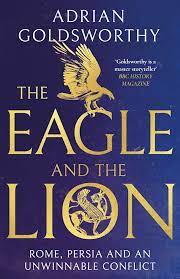
Some time back I read a book about the Mongolians, in particular at the western edges of their advance, and how those kingdoms related to what I know as the Crusader States. It completely blew my mind because I’ve read a bit about the ‘Crusades’ general era, and that book made me realise just how western-focussed my understanding had been: the invading Europeans connecting back to Europe and maybe Egypt (thanks to Saladin); maybe you’d hear about the Golden Horde occasionally. But interacting with the Mongols was HUGELY important.
This book does a similar thing for Rome. My focus has always been on the Republic and early principate, so maybe that has had an influence. But in my reading, Crassus’ loss at Carrhae is present but (at least in my hazy memory of what I’ve read), it’s almost like Parthia comes out of nowhere to inflict this defeat. Persia then looms as the Big Bad, but I think that dealing with the Germanic tribes and the Goths etc seem to take a lot more space. Even for the eastern empire, which is definitely not my forte, regaining Italy etc and fighting west and north (and internally) seems to get more attention.
And then you read a book like this. It is, of course, heavily leaning in the other direction; that’s the entire point, to start redressing some of the UNbalance that otherwise exists. These two empires could be seen as, and describe themselves as, the “two eyes” or “two lanterns” of the world (those are Persian descriptions); for basically their entire collective existence they were the two largest empires in this area (China probably rivalled them at least at some points, but although there were tenuous commercial connections, they’re really not interacting in similar spheres). It makes sense that the relationship between them, and how they navigated that relationship, should be a key part of understanding those two empires.
Goldsworthy does an excellent job of pointing out the limitations in ALL of the sources – Greco-Roman, Parthian, Persian – and clearly pointing out where things could do with a lot more clarity, but the information just doesn’t exist. Within that, he’s done a really wonderful job at illuminating a lot of the interactions between Rome and Parthia/Persia. And he also clearly points out where he’s skipping over bits for the sake of brevity, which I deeply appreciate in such a book.
It’s not the most straightforward history book of the era. It covers 700 years or so, so there’s a lot of dates, and a lot changes in this time as well – republic to principate to later empire, for Rome; Parthian to Persian; countless civil wars on both sides. A lot of leaders with the same or similar names, unfamiliar places names, and all of those things that go towards this sort of history book requiring that bit more attention. I definitely wouldn’t recommend this as My First Roman History Book! But if you’re already in the period and/or area, I think this is an excellent addition to the historiography. Very enjoyable.
Viking Women: life and lore, by Lisa Hannett
This is not a standard “here’s what we know about Viking women” book. Those exist, and Hannett acknowledges them, and now I’m all keen to go buy them.

It’s also not a “here’s a reworked set of sagas”, which of course also exist. I’m less excited about those, to be honest, not least because most of the new variations just keep on focusing on the dudes (as far as I can tell).
Hannett is both an academic and a writer of fiction, so this book brings together both in an intriguing and fascinating way. Each chapter generally takes one woman from the sagas (there’s one chapter with two women, and another with three), whom Hannett both explores as a character in her own right, and also uses as a way of illuminating what we know about women in their positions more broadly. And in chapter, Hannett also tells the story of that woman, from her saga. So the history and the fiction are intertwined such that each reinforces the other. Also, Hannett wants you to be under no illusions about the lives of Viking women: while in some respects they did have advantages over the general perception of ancient and medieval European women, they were still absolutely second class citizens (or worse, as slaves).
Hannett describes the way she approached the fictional parts as “reasonably, carefully, colour[ing] them in” – which I think perfectly encapsulates what she’s done. There’s really so little about the women in the stories that a pencil outline just about covers it. Doing both the fiction AND the history means that the reader sees the research – archaeological, literary, intertextual and so on – that informs the fiction, and then how the saga also helps us understand the experiences and realities of life for Viking women. It brings together Hannett’s strengths in a truly glorious way.
I particularly liked that Hannett focuses on ‘ordinary’ women. There’s no royalty (well, not AS royalty), and there’s no goddesses or other, otherworldly women. They are all women who could, actually, have lived – and several of them are documented in less literary sources, so they probably actually DID exist. And so there are enslaved women; there are wives, to men of varying levels of honour, with a variety of experiences; there are mothers with varying experiences of child-bearing. Women who are witches and nuns, women who wield power in a variety of ways; those whose lives were (in context) fairly easy, and others who experienced trauma and exceptional difficulty. So, the whole gamut of life.
This is a fantastic look at the experiences of Viking women, and nicely situates the Icelandic sagas in history and literature. You do not need any background in Vikings to appreciate this.
Object Lessons: Pregnancy Test

I received this book courtesy of the publisher, Bloomsbury.
I have never personally interacted with a pregnancy test, and yet – as Weingarten discusses here – I still know the basics of what one looks like. The appearance of the ‘wand’, and what it means on tv show when a woman is in a bathroom watching a little plastic stick, is ubiquitous in Western media. As with all Object Lessons, though, Weingarten shows just how complicated and not-straightforward this objet is.
This is another brilliant instalment in the Object Lessons series. The author goes through the history of pregnancy tests and the development of its most common appearance today. She also problematises the whole concept of pregnancy and how the simple yes/no really isn’t that simple, and challenges the idea of pregnancy testing at home being an unassailably good thing.
I loved that Weingarten took the idea of pregnancy testing back before the 20th century, in a brief tour of various cultures have sought to confirm what at least some women suspect before external confirmation. The discussion of the medicalisation of women’s experiences is something I’ve read around before, and continues here, as Weingarten points out the ways in which doctors etc present women’s bodies as ‘mysterious’ and needing external (usually male) deciphering. Coming into the 20th century, I had NO IDEA how early scientific testing happened – using mice, rabbits, frogs and toads (… the mammals not surviving the experience).
Then there’s the pregnancy test in media, from Murphy Brown on to The Handmaid’s Tale… and also what could arguably be called the weaponisation of the test: people forcibly or covertly tested for pregnancy, and then their subsequent experiences determined by the results. And the fact that yes/no doesn’t actually cover all the possibilities: that a chemical pregnancy might give a positive result; that miscarriages can happen really early on and without a test, you would never know you were pregnant anyway…
Weingarten, as with other Object Lesson writers, is coming at this topic both personally – having used pregnancy tests herself – and academically. She brings the two perspectives together thoughtfully, honestly, and engagingly.
Every time I read one of these, I come away with a better, and more nuanced, understanding of the world.
Messalina: A Story of Empire, Slander, and Adultery
I read this courtesy of NetGalley and the publisher. It’s out in May 2023.
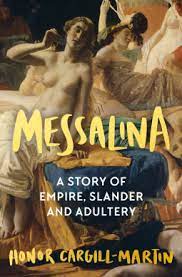
It’s incredibly hard to write modern biographies of ancient women. Not least because most ancient historians didn’t care that much about women as individuals; they only mattered when they intersected with men (… not too different from many wikipedia entries today, actually), and also for Roman historians they were often used as literary devices – history writing being quite different in the first few centuries AD in Rome from what it is generally accepted to be in the West today. SO that leaves a serious paucity of information for the person who wants to write a serious biography of, say, Messalina. I have a fantastic biography of Agrippina the Younger on my shelf, which does a good job of trying to consider Agrippina as a person, rather than just a mother and/or power-mad; one of Theodora that is slightly less successful but made a valiant attempt. And now, at least, Messalina: a woman whose name has become a byword (and at one point medicalised) for the over-sexed and never-satisfied woman, whose sexual depravity was the source of her power, and whose only use of that power was evil.
I loved this biography a lot. Messalina was human! Who knew?
The author gives what I think is an excellent overview of the social and cultural and immediate historical situation in Rome in the early Julio-Claudian period, in particular looking at the ways in which expressions of and usage of power had been altered with the change (albeit begrudgingly accepted) from republic to empire. And the point is to situate Messalina within that. (Had I completely forgotten just how illustrious her lineage was? Oh yes. Perhaps I never really knew – descended from Mark Antony! And from Octavian/Augustus’ sister! Very impressive.)
There’s a good attempt at reconstructing just what sort of thing Messalina was doing after Claudius became emperor, as well as logical (rather than misogynistic) rationale for it: like she’s shoring up her own power base, and that of Claudius, and that of her son. The arguments here are persuasive, although of course we’ll never know. I particularly liked that Cargill-Martin never tries to completely purify Messalina: did she have affairs? Possibly; maybe even probably! Were other women doing so? yes. Could there actually be political as well as passionate reasons for doing so? Absolutely. Was it possible for Messalina to both want to have sex AND be a political actor? WHY YES, IT WAS.
Basically I think this is the sort of (properly) revisionist history that a nuanced understanding of women in history enables. Messalina can be treated as a human, as a worthy subject for serious history: she made mistakes, she made what we would think of today as some poor choices, she was constrained by her historical context, and she really didn’t deserve the way that last 2000 years have treated her. Especially Juvenal’s poetry; he can go jump.
Highly recommended particularly to anyone interested in early Roman empire history, or women’s history.
Grave, by Allison C. Meier
I read this book via NetGalley. It’s out on Feb 9, 2023.

As long as these are being published by Bloomsbury Academic, I will keep reading these. (… there’s a joke here relating to the subject matter of this book, but I won’t go there.)
For a book about graves, this book isn’t morbid at all. Which is exactly the tone that I would expect from this series. It takes graves, and the reason for graves, seriously; but it doesn’t dwell morosely on the idea of death. Nor does it romanticise it. Instead, this is a thoughtful and engaging examination of burial practises – particularly in post-colonisation North America – and how and why they’ve changed. That time and place is important to note; while various global practises are mentioned, like the very earliest burials known and Tibetan sky burials and others, this is focused on one specific place and time. And that’s fair: this is a short book! It’s not meant to be an all-encompassing tome. I guess this could be seen as a snapshot of a place that has changed a lot in terms of its ethnic makeup over the last few centuries, that has (for better or worse) often been seen as leading the way in innovation, as well as sometimes dragging its heels on change (hello metric system). So it’s a useful way of getting a glimpse at one history of grave practises.
The author is someone who has led cemetery tours and has done a lot of thinking about what graves and burial practises mean. I learnt surprising things: like, in the USA, it’s quite standard for a body to be embalmed before burial in a coffin. I’m pretty sure that’s not standard in Australia (I just looked up one undertaker group; embalming is an optional extra). A sobering aspect was the history of unmarked graves, and segregation within cemeteries (a relatively new word, apparently!) – I know at least some old general cemeteries in Victoria are, or were, Catholic/Protestant separated (and different areas for Chinese dead, especially in goldrush areas and I guess there must be a few towns with small, historical, Jewish sections?). I most enjoyed the fact that there are new practises being developed. I had already learnt of ‘water cremation’ (yes, it’s a nonsensical term), which is far more eco friendly than the standard creation; but ‘natural burial’ – like a pine coffin that degrades quickly – and other more environmental options are just going to be increasingly necessary. We already have issues with perpetual leases on graves…
Anyway, this is yet another excellent entry into this series. I loved it and continue to look forward to more.
Two more Object Lessons from Bloomsbury Academic
I know, I’m a bit obsessed with this series. But they keep popping up on NetGalley, and I keep being intrigued, and I keep being approved for them… and so I keep reading them…
Mushroom
Intriguingly, Mushroom is perhaps the most surprisingly metaphorical of these so far. It’s certainly not quite what I expected. There are short sections about specific mushrooms, related to (northern hemisphere) seasons. But the main sections are Mystery, Metaphor, Mycology, Medicine and Magic. All of these things I know relate to mushrooms and the history of their use by humans; there was a bit more emphasis on the metaphor aspect overall than I had anticipated. Which was certainly interesting, just not what I imagined!
Mushrooms are eaten for sustenance, of course, but they have also been used for medical and spiritual and magical purposes. Rich explores all of these, and – as most of these books do – also situates the discussion very personally.
Not quite what I expected, but not something I regret reading.
Alarm
This was another excellent addition to this series. With chapters headed Clock, Fire, Siren, Security, Siren, “Failure, False, Fatigue”, and Future, Bennett takes us on a rollicking ride through alarms. There’s history and technology, sure. But there’s also art and culture, and the ways in which alarms are not neutral objects or sounds but can mean different things – particularly, she stresses, in America, where police sirens can mean different things depending on your skin colour (and I suspect the same thing may be true in Australia, at least to some extent). The idea of alarms as a prosthetic is profound – supplementing or replacing our own vigilance; but of course, now smart watches etc are encouraging us to be MORE vigilant (‘closing the ring’). Also, feeding into the capitalist world (my intention to never have one was significantly reinforced by reading this.)
Also, starting a book about alarms with Aeschylus’ Agamemnon, comparing the watchman, Clytemnestra’s alarm system, and Cassandra as alarm? INSPIRED.
Loved it. One of my favourites to date.
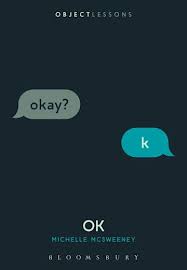
OK: by Michelle McSweeney
I read this courtesy of NetGalley. It’s out on January 12.
Another roaring success from the Object Lessons series. I had NO idea that OK had such a history. I DID know that you could use a tiny little object to illuminate significant moments in history, which is exactly what McSweeney does here: the connection between communication and technology, and the fate of OK in that – from the Penny Press in the 1830s in the US, to the telegraph and telephone and US cultural imperialism via TV and finally BBSs and social media… it’s all here.
I was also introduced to the term ‘phatic language’ and I love it. Phatic language is “language that is socially rich, but informationally empty”. All those markers that signal we’re listening and we care (in theory), including OK. I love that there’s a term for it, and I love that it has a real and important place in communication. I also love that the DARPA dudes thought email would be more like telegrams (terse, all info and no pleasantries) rather than a conversation, and HAHA sorry guys. Also apparently answering the telephone with “Hello?” was initially considered incredibly bad manners? This is a magnificent example of changing language and social expectations.
Meanwhile there’s also the fact that all those email suggestions that gmail throws at you were learned from “the Enron Corpus” – tens of thousands of emails from 2001 – is creepy and makes me even more determined not to use them.
For lovers of language and communication technology and micro history.

 Randomly Yours, Alex