Bean there, done that 2: GoldenEye (1995)
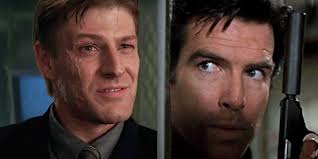
I am well known for being a sucker for James Bond. But this post will be about Alec Trevelyan, I SWEAR.
Having said that, the opening shot – rappelling down a dam wall – is SPECTACULAR.
- The introduction of Alec, as 006 and speaking Russian and interacting with Bond, is glorious.
- And once again, Bean is proficient with weapons. There’s a lot of shooting.
- We’re back to an English accent, and a pretty posh one at that.
- Also, short hair. A much better look.
- Alec wanting to be all noble and self-sacrificial… and getting his way, as he gets shot by the Russian officer.
- “For England!” – what a difference from Patriot Games.
- (It’s a good thing James Bond lives in an alternate universe where gravity works differently, is all I’ll say about the conclusion to the prologue. Also, Tina Turner’s song is one of the great Bond themes… written by Bono and The Edge??)
- NINE YEARS LATER…
- (Famke Janssen deserved better. As did basically every other woman in the Bond franchise, I know. But this is from 1995 and it feels like it’s 1975. Urgh.)
- (Alan Cummings is hilarious, and provides one of my favourite lines.)
- We go for quite a long period without seeing Bean again, for all that he’s listed at the top of the film as “starring”.
- (Eeee Dame Judi! She is absolutely one of the key reasons for why the franchise was able to transition to the 21st century. She’s only 60 in this film.)
- (Eee Desmond Llewelyn. *Hearts* – he’s 80 in this film.)
- (And Robbie Coltrane! … such a good cast.)
- And then BOOM: “hello James” – Alec is back, this time with a scarred face, and is the terrifying arms dealer, Janus, whom Bond has been searching for.
- Turns out he’s the son of Lienz Cossacks who were betrayed by the British and then died in a murder/suicide; he has been planning for betrayal for years.
- His posh accent is glorious in this context.
- Long tank/car chase and we’re finally back to Alec, on a very fancy train (whoa, Snowpiercer connection!).
- Alec forces his attentions on Natalya, cementing his position as a villain.
- Bean rocks a suit very well.
- Seems that Alec is driven more by money than any philosophy or political ideology.
- And then we’re off to Cuba.
- Alec has a surprisingly sophisticated set-up for a secret base.
- He’s far more suave than the Sean of Patriot Games – which is no surprise, given their respective backgrounds.
- Oh and he’s targeting London? How original. And he’s going to steal all the money from the Bank of England and then wipe all the records via his EMP? uhuh.
- Villains should know better than to monologue when they have their enemy in their sights.
- Alec falls off the antenna structure; Bond catches his foot, and then lets him fall, in a nice(?) echo of the opening scene (rappelling down the dam wall).
- And despite landing on his back from a very great height, what actually kills Alec is the antenna falling on him.
Verdict: Unquestionably A Bad Guy. (He’s presumably been a useful 00 agent for MI6 before his betrayal of the organisation, but he ends his life as an immoral arms dealer and bank robber who is happy to create chaos for money.)
Movies: 2. Beans dead: 2
Bean there, done that: Patriot Games (1992)
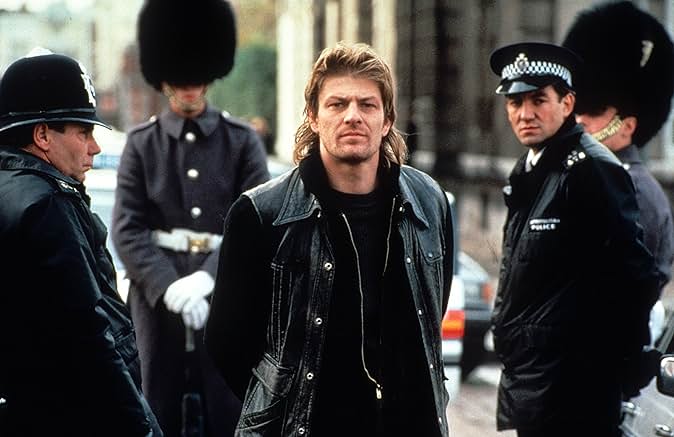
I do adore a Jack Ryan movie (usually).
I love the way this film opens with talking about Russia (it’s 1992!!) – especially given The Hunt for the Red October – and then… BAIT AND SWITCH!
OK, this is going to focus on Sean Bean, I swear.
- I have no idea whether his Irish accent sounds real to the Irish ear, but it’s convincing enough to me.
- THE HAIR.
- Oops, Jack killed Sean’s younger brother. That’s not going to end well.
- How convenient that his character’s name is also Sean (Miller).
- He’s so young! (Huh; he’s 32 in this film, so… yeh ok, I’m old).
- Bean does angry very well.
- They didn’t make him cut his hair in jail? What sort of establishment is this??
- The blue and yellow jumpsuit does nothing good for Bean’s complexion.
- Although my, he is awfully skinny.
- He also does Terrifyingly Feral very well.
- [Eee, James Earl Jones!]
- He finally gets a haircut on the ship… I think it’s an improvement.
- It’s definitely an improvement. Little bit of a crewcut along the bottom of the head – not an undercut, far more military than that.
- [Eek, Samuel L Jackson! Had completely forgotten he was in this film. Also so young… about 43 years old…]
- Bean doesn’t really exhibit much range in this film: he’s angry, or upset, or frustrated, or… yeh that’s about all, actually.
- Movies just don’t do those fades between cut-scenes in the same way any more. More’s the shame.
- Yikes, disaffected IRA training in the desert… with vaguely Arabic types… oh, early 1990s, you were such a time.
- The conclusion feels rather cliched today – the royal at Jack’s house (as if), the navy buddy is there as well, the lights go out and the baddies make use of night vision (in the middle of a lightning storm, really?)… but I really like the speed boat chase: it may not look particularly realistic, but it is still pretty awesome. Also, over a lot faster than similar denouements in other, later, films.
- Bean’s death, impaled on a boat implement of some sort, is vicious.
Bean Verdict: Unquestionably A Bad Guy (slightly ameliorated by the dead brother aspect, but he was already involved in violence before that).
Movies: 1. Beans dead: 1.
Bean there, done that
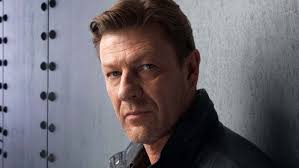
It’s been a long time since we did a movie-a-thon, and I was suddenly struck by how much fun it would be to do a Sean Bean watch.
So here it is. Unashamedly, we have picked movies that we already know and love, but which we haven’t seen for ages (with two exceptions).
- Patriot Games
- GoldenEye
- Ronin
- The Lord of the Rings: the Fellowship of the Ring
- The Island
- The Martian
… I’m happy to take suggestions for other movies we should add (not TV, that’s a whole other thing). But you need to give me a good reason.
The Return
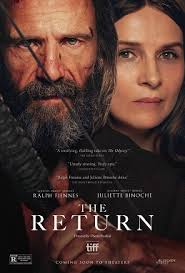
I am a complete sucker for Greek myth films. And even more, I am an utter sucker for films that take bits that have been done less often, and which do so with nuance and a modern sensibility while still keeping true to the original. Nearly impossible? For sure.
The Return manages this with aplomb.
(Spoilers, I guess? If you can spoil a 3000 year old story? Although there are some changes to the ‘original’, which I will discuss.)
The film doesn’t try to cover all of Odysseus’ wanderings – and Troy is covered in a single sentence in the brief introduction. Instead, it opens with Odysseus washed ashore on Ithaka, and Penelope besieged by the suitors. It really only covers a few days – exactly how long is unclear, because Odysseus may have spent a few days in Eummaeus’ cottage, recovering his strength. The narrative moves between several strands. There’s Odysseus, coming to understand what has happened to his island, and Penelope, often at her loom, agonising over what to do and how to look after her sons. Interestingly, there’s quite a focus on the suitors, especially Antinous (the least objectionable on the surface, but shown to be very complex and with a horrible side) and a couple of others, like Pisander (who I spent the whole film trying to place – he was Ricky September in that weird episode of Doctor Who, “Dot and Bubble”). And there’s also Telemachus… and, look. He’s never been a favourite. Ever. I was terrified we’d be subjected to a whole section of him going off and visiting Helen and Menelaus, but thankfully we’re spared that.
This is not an action film. There is action: suitors chasing Telemachus, a couple of fights, and a particularly brutal killing of the suitors. The film is far more interested in conversation, though: discussing what happened at Troy – and whether the Greeks were heroes or not; discussing what Penelope should do; discussing what Telemachus should do; mourning the events on Ithaka.
This is a film that takes Odysseus’ experiences at war seriously, and the reality that a decade of fighting will change a man – and that two decades away from his wife and son will change their relationship. It asks very honestly whether Odysseus can ever truly come home, and how his family can now relate to him. It does not paint Odysseus as a hero, nor laud his accomplishments at Troy. Overwhelmingly, he is tired. He mourns the last two decades; he is remorseful of some of his actions, and fears the future. He’s not yet bitter and angry but you can see it’s a possible outcome.
One of the really interesting changes is that of the “maids” – and I find this particularly intriguing in light of the discussion around them over the last few years, with Emily Wilson’s translation finally making it painfully clear that these women are slaves, not just servants. The choice is to make them almost absent. A few are shown sleeping with (literally and, er, metaphorically) some suitors, but that’s all: no sense of whether they are being compelled, and also no sense of whether all of the women shown are actually members of the household. I guess this is one way to avoid the ‘necessity’ of killing them all at the end.
This is a great film. I appreciate the way it takes Odysseus’ agony seriously. It doesn’t do quite as well with Penelope – it’s not particularly informed by Atwood’s Penelopiad or Claire North’s Songs of Penelope series – but it does give her some agency. Overall, it is an excellent entrant into the halls of Greek myth-inspired films.
Macbeth: the start of a project
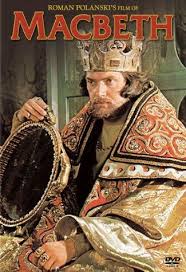
I have loved the play ever since I encountered it. I have seen many versions since then – several on stage (a memorable one at Melbourne Uni, performed in the round, with costuming to make it classic leathers-n-chains punk gangs), and several on film. Now I embark on an endeavour to watch as many versions I can find…
It’s a lot about Lady Macbeth – she is so active and yet she’s not allowed to be powerful without being punished. I’m also fascinated by the way it portrays power. And then the text around it is fascinating too: the utter misuse of history that it represents (yo, English propaganda!); the way that aspects of Lord of the Rings (the Huorns going to the Hornburg/Ents going to Isengard, and the Witch King being killed by a hobbit and a woman) are apparently speaking to Tolkien’s annoyance with the play (the forest coming to Dunsinane; no man of woman born…) – and its many appearances in popular culture.
So: here go.
1971: Polanski / Finch.
The 1971 Polanski Macbeth is my ur-text for the play. We watched it in Year 11 English, and it has coloured my view of the play irrevocably. (This was 1995 and of course I had no idea of anything about Roman Polanski at the time.) Francesca Annis is what I most remember – even more than Jon Finch – because her Lady M was so fierce and then so completely undone.
The weird sisters:
- First appearance;
- Maiden/mother/crone styling.
- Entirely physical – no sense that they are magical
- The maiden flashes her genitals!
- Second appearance:
- A cave full of naked women, all contributing to the cauldron.
- Macbeth drinks their concoction and then has weird hallucinations. – it’s not clear whether they have done magic or just given him really trippy drugs.
Macbeth:
- You really don’t get a sense that Macbeth is very impressive at the start: we don’t see him fighting, just immediately confused by witches.
- He’s conflicted right from the start – even in front of his men. Distracted, rather than decisive.
- Malcolm and Macbeth suspicious of each other from the start.
- His haircut is doing him no favours.
- After the coronation, when he’s dealing with the murderers, is when Macbeth starts to show some determination (being bloody, bold, and resolute…).
- His behaviour is verging on manic.
- Macbeth dreams of Banquo and Fleance killing him, after he sends the murderers for them.
- By the time he’s told that the English and Malcolm are coming, he’s becoming cruel and rash.
Lady Macbeth:
- In the first shot, we marvel at the HAIR. And the CLEAN DRESS.
- She is excited to see Macbeth – and he to see her: they are shown to be in love.
- She suggests murder – to Macbeth’s complete surprise.
- Uses tears to manipulate Macbeth into assassination.
- She has a potion to hand already that will drug Duncan’s servants.
- She is already freaked out while Macbeth is doing the deed. And she never recovers the composure she had at the start.
- Lady Macbeth falls asleep doing embroidery – first sign that she does anything so ladylike. And she has her first hallucination of bloody palms: her behaviour is very distracted.
- Re-reading the first letter: hair in disarray, can’t read for tears.
- We do not see her fall, but hear the cry of the nurse at finding her.
Terminator: Dark Fate
I MEAN.
Just.
I mean. What a film.
I love T2, and I really enjoyed Genisys, but this… this is another league.
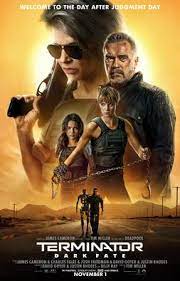
Mostly, I love Sarah. I really, really love Sarah, and what she represents:
- I love that she’s so competent.
- I love her determination.
- I am saddened by her bitterness, but everything about her subsequent actions makes sense.
- I love that SHE gets some of the great lines to call back to the first movies.
And I really, really love that basically Sarah is living out the unreconstructed second-wave feminism attitude at its worst – the assumption that it’s about Dani’s child, the grumpiness about being Mother Mary and wombs, etc. And then Dani and Grace are there as third-wave feminism: this is the first time a protagonist hasn’t been white! And a modern-day Terminator not set in middle class white American burbs! It’s race and class and women being both tough and vulnerable, which Sarah has never been allowed to be simultaneously – she’s one or the other. I love how Sarah comes to realise the truth, and the fact that she accepts it and keeps going (looking at you, TERFs).
And I also love Karl. Like, seriously.
- Karl, the draper.
- The ‘give a little girl butterflies on her curtains’ terminator.
- (And the fact that apparently this aspect arose out of Arnie’s actual interest in home decor.) His whole deadpan explanation about why his relationship with his wife works – HELLO HEALTHY MASCULINITY.
- And of course, this is the logical conclusion of the exploration of terminator / humanity boundaries. The machine who knows what he is and consciously – even logically – becomes more human.
- Plus, he has a great sense of humour.
None of this is to detract from Grace and Dani, either.
- Grace: another logical conclusion for the franchise – an augmented human – and her augmentation comes, of course, with frailty, because human bodies aren’t built for the sort of output of a terminator. I am always amused by her less than gracious arrival into the past. I love her.
- Dani: somewhat bewildered and hapless, like an early Sarah, but definitely catches on faster – which makes sense given that she’s clearly had a tougher life than pre-terminator Sarah, and she’s been managing her family. She also gets a ruder awakening, arguably, since her “father” (she doesn’t know it’s a terminator) is killed in front of her and then her brother dies too. She seems to know her limits and yet still push against them. She’s determined and angry and she’s really, really great.
I love this film.
Terminator Salvation and Genisys
I was thinking that I should review Salvation, Genisys and Dark Fate together, because then it’s two trilogies, in a sense… but then, no. Because Dark Fate definitely gets its own post.
Therefore, a few thoughts on Terminator: Salvation:
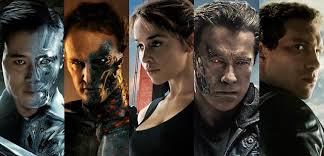
And then Terminator: Genisys.
- This is only the second time I’ve seen this film, too, and now I am surprised at myself. The DVD has a quote from someone calling it the best Terminator film since Judgement Day, and they’re not wrong.
- I was suuuuuper dubious about someone else being Sarah, and when I saw that they had re-done That Photo to make it Emilia Clarke I was very angry; like Hayden Christensen at the end of Jedi angry. However, Clarke made it work… and this Sarah is a very different Sarah, after all.
- Timeline? WHAT TIMELINE? Nah man, now we’re into the multiverse, and everything you thought you knew has gone out the window. (Theoretically.) And this is why there was no ‘watching in internal chronology’.
- Once again Kyle Reese is very much the focus, except this time he’s an adult… and rather than getting to be the hero as T1 Reese did, now he’s thrown into a very unexpected situation and he struggles to keep up. To his credit, though, he eventually does; and he usually pulls his weight along the way. I think Courtney was fine in the role.
- I really, really enjoyed the way that this film played with so much of T1, and even bits of T2. Everything from “on your feet, soldier”, to the molten metal… the arrival of the Model 101 (with a body double for Arnie, I’m told), and the punks, was beautifully screwed with. And Reese’s flight from a cop who turns out to be a T1000 – that was magic.
- I’ve decided the T1000 is my favourite Terminator. Way more interesting than the 101, and not as distressingly overpowered as the TX.
- I think, and I hope, that Arnie enjoyed playing this version of the Terminator. From “old, but not obsolete” to “Nice to meet you” [insert terrifying grin] – it’s such a glorious evolution for an actor, not to mention the character.
- Sarah was very interesting! She’s not quite as hard as T2-Sarah, but she’s pretty close; probably saved from absolute paranoia by not having been institutionalised. In fact she’s remarkably well socialised for someone largely brought up by a machine (and if you didn’t laugh when Arnie said “Sarah Connor, seat belt” as they are literally trying to escape an inferno, you were not paying enough attention). I love the gradual revelation that she deeply resents having known a lot about how her life will pan out; and I love her unreserved and defiant affection for Pops.
- And then there’s John Connor. This Connor (when he’s Connor-proper) is slightly more interesting than the Bale Connor, I think; and then to completely flip the tables and throw them across the floor by making Connor a Terminator… honestly, that’s just genius. Connor v Model 101 but now you’re on the side of the 101! Such a logical place to go, I guess, if you’re messing with the Terminator franchise; and I love it.
- So… Genisys is the unholy lovechild of Apple and Google, right? Synching across all of your devices and everything you know about yourself? Cool cool cool.
Salvation gave us a machine built from a man, who doesn’t know he’s a machine and doesn’t want to be and ends up working for the humans. Genisys gave us a man turned into a man/machine hybrid who knows exactly what he is, and works for the machines. And Dark Fate… well, I guess it’s the final, logical conclusion: to have a machine who knows he’s a machine become wonderfully human.
Terminator 1-3
I don’t remember how but we got started talking about the Terminator movies. One thing led to another, and suddenly we own all of them on DVD (trust me, it didn’t cost much), and we’re watching them all.

Ah, but in what order? Like our Marvel watch last year, I really wanted to do it in internal chronological order… but HAHAHA no. That’s all a bit too hard. So production order it is.
Some reflections on the first three films, therefore…
- I’m not sure, but I think T2 might have been my first Arnie movie. Looking at the dates of his films, I don’t think I would have seen any of the others in the cinema. I didn’t see T2 in the cinema either; I distinctly remember the sleepover birthday party where I saw it (on VHS, children). And when he gets into those black clothes, and puts on the sunglasses… that really is my image of him; my expectation of what he looks like. Apparently that imprinted on me more deeply than I had realised.
- And so, the opening moments: those energy bubbles. The progression of technology in terms of what the bubbles look like is fascinating! I really like the fact that each of these movies keeps that as the opening, recreates the crouched figure, and so on. My reaction to Arnie in T1 was that he looked truly inhuman, with the ludicrously defined muscles. He’s still impossibly buff in the next two movies, but looks slightly less… sculpted?
- Which brings me to technology – within the film, imagined for the future, and used in the making. Within the film, of course, each is a microcosm of its day. Landlines and eventually mobiles (although Kate Brewster’s phone still looks super old fashioned). The cars! The TVs! By T3, the internet and how it could be connected and infected.
- The terminators themselves are a spectacular example of how future tech is imagined. Model 101 is a robot with human skin, and while he has no pain and copes with infinitely more damage than a human, that’s about it. A bit faster, perhaps. But then the T1000 suddenly has the ability to shapeshift, and can resume shape after being a liquid, and is just generally more impressive. And then TX… a shift up again. Far more resistant to damage, able to create complex machines as part of her anatomy rather than just blades – and able to talk to modems – she’s magnificent. I love this idea that in order to defeat humans, the machines must evolve. There’s something to explore in that.
- And what the terminators are like also reflects what SFX were able to do. I hadn’t realised before but when the 101 is just the robot, at the end of T1, it’s actually stop-motion – and it’s really obvious to me now. The T1000’s beautifully liquid reassembly is still a joy to watch. And while it’s utterly cheesy and made me roll my eyes, the TX being able to morph so that she is basically able to use her body like rope is another change in the technology available for such effects.
- I love Sarah Connor. I quite like her in T1, although she’s not all that much more than a damsel in distress. But then what Cameron does with her in T2 is spectacular; I do wonder how much that was inspired by Ellen Ripley. Making her a Cassandra is a great narrative choice, for all it’s hideous to watch her in the asylum, and seeing the evolution of her attitude towards the Model 101 is fascinating. Also, filling her coffin with weapons for later? Most badass request ever put in a will.
- Not gonna lie: had posters of Edward Furlong on my wall as a teen. I think he still stacks up as a teen actor. Nick Stahl, unfortunately, is just not that great in T3. He’s probably the most disappointing part of the film.
- The films as objects are also interesting. T1 is definitely of its time – it feels so slow, and some of the chase scenes get pretty boring. Also Kyle Reese is a boor in much of his interaction with Sarah (I do really like Michael Biehn in the role), and I find it quite hard to watch these days. T2 is by far the best of the trilogy, although that might also reflect my childhood viewing of it. The pace, Sarah, the explosions, getting Dyson on side… it’s just a well-constructed narrative overall. T3 isn’t a disaster but it’s also not a masterpiece. What I do love about it, though, is that there’s so little hope, in comparison with the other two. And I guess that’s the point. For all that they’ve done, for all their attempts at circumventing Armageddon, the suggestion is that humans just will create their own destruction. Can’t say I necessarily disagree.
Do not regret re-watching these films at all. May regret either Salvation or Genesis… stay tuned.
Sutton Hoo and The Dig
Last year, I got to fulfil one of my longest-held, quite esoteric, dreams.
I got to visit Sutton Hoo.
I have been fascinated by this place for longer than I can remember. It’s the site of a ship burial and other grave mounds from the Anglo-Saxon period, and the origin of some of the most beautiful archaeological pieces dug up in England. Every time I’ve been to England I’ve wanted to visit, and it’s just never worked out. But this time – this time I made it work.
Making it work wasn’t easy. We had to catch two trains – one from Cambridge to Ipswich, and then another to Melton, the closest station. Except on the day we were travelling, our train to Ipswich was cancelled, so we caught a train to Ely in order to get a different train going to Ipswich. Ely is in the completely opposite direction from Melton. All of this took a bit over 2 hours.
Notice I said “we”. For reasons that are still beyond my ken, my friend living in Cambridge decided to accompany me, as did her somewhat-bemused husband whom I had known for exactly seven minutes at this point.
From the Melton station it’s about a half-hour walk to Sutton Hoo. Through a village, and then along a main road with dubious pedestrian access. But then… oh, then.

You see this, a replica of the ship that was buried. And you see the visitor’s centre with its replicas of the great treasures – all of which are now in the British Museum, because the original owner of the property made them a gift; which means I’ve seen the helmet and the shield and every else a number of times. But now I was actually there, where they were found. It’s fair to say my friends thought I was a bit off my nut.
Usually, I understand, visitors get to go up an observation tower, to see the grave mounds from on high. But this was unavailable on the day we visited. Instead, we got to walk amongst the grave mounds themselves – something that is usually not allowed, and won’t be allowed again. So that was remarkable. The whole setting is remarkable, and glorious. And I finally got there.

All of this came back to mind when I watched The Dig on Netflix. I was astonished, to be honest, that the story of an archaeological dig got made into a film with relatively big names – Ralph Fiennes and Carey Mulligan – and has had a fair bit of press. Maybe here in Australia I don’t appreciate that the British public actually does know about the finds there? I also didn’t know there was a novel about it, which is the source material for the film. They couldn’t film at Sutton Hoo – it’s open all year – but it certainly felt to me that they recreated the area well. And I know that aspects are dramatised; much of the personal friction is narrative rather than history. But the fact that they showed archaeologists being meticulous – no Indys here – and the excitement about tiny pieces of iron or gold was just wonderful. The entire film, in fact, is beautifully made. And the story, too – a meditation on death and the place of humans in history and the cosmos (the Fiennes character, Basil Brown, is also an amateur astronomer… well, “amateur”; he wrote about astronomical maps and atlases). The events are very consciously placed in the eve of WW2 – there’s constant reference to war coming, men being called up, and so on – which adds that extra layer of immediacy, needing to get on with things, and also of extraordinary events occurring: the find, and the war. Plus the illness of Edith Pretty, instigator of the whole dig.
Highly, highly recommended as a film. And if you are in, or can get to, England – go visit Sutton Hoo.


