Object Lessons: Pregnancy Test

I received this book courtesy of the publisher, Bloomsbury.
I have never personally interacted with a pregnancy test, and yet – as Weingarten discusses here – I still know the basics of what one looks like. The appearance of the ‘wand’, and what it means on tv show when a woman is in a bathroom watching a little plastic stick, is ubiquitous in Western media. As with all Object Lessons, though, Weingarten shows just how complicated and not-straightforward this objet is.
This is another brilliant instalment in the Object Lessons series. The author goes through the history of pregnancy tests and the development of its most common appearance today. She also problematises the whole concept of pregnancy and how the simple yes/no really isn’t that simple, and challenges the idea of pregnancy testing at home being an unassailably good thing.
I loved that Weingarten took the idea of pregnancy testing back before the 20th century, in a brief tour of various cultures have sought to confirm what at least some women suspect before external confirmation. The discussion of the medicalisation of women’s experiences is something I’ve read around before, and continues here, as Weingarten points out the ways in which doctors etc present women’s bodies as ‘mysterious’ and needing external (usually male) deciphering. Coming into the 20th century, I had NO IDEA how early scientific testing happened – using mice, rabbits, frogs and toads (… the mammals not surviving the experience).
Then there’s the pregnancy test in media, from Murphy Brown on to The Handmaid’s Tale… and also what could arguably be called the weaponisation of the test: people forcibly or covertly tested for pregnancy, and then their subsequent experiences determined by the results. And the fact that yes/no doesn’t actually cover all the possibilities: that a chemical pregnancy might give a positive result; that miscarriages can happen really early on and without a test, you would never know you were pregnant anyway…
Weingarten, as with other Object Lesson writers, is coming at this topic both personally – having used pregnancy tests herself – and academically. She brings the two perspectives together thoughtfully, honestly, and engagingly.
Every time I read one of these, I come away with a better, and more nuanced, understanding of the world.
The Once and Future Witches, Alix E Harrow
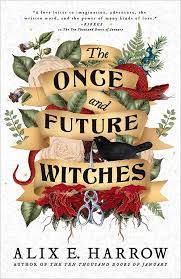
IN THEORY, this book should be right up my alley. Agitating for women’s suffrage! in an alt world where witchcraft is real! but banned! and you Alexandra Pope and the Sisters Grimm! And I’d already read and loved Ten Thousand Doors of January.
… but when I started it, pretty soon after it came out, I bounced right off. It was something about the jagged relationship between the sisters, I think (I have a sister. We’re fine, and always have been). I stopped after about 50 pages. But I didn’t give it away, because I really wanted to go back to it.
This year I want to get through my physical TBR, and so I went back to this. And this time, I did not bounce off (I had also been assured that the sisters’ relationships were more complex and became slightly less jagged than they are at first). And it is, absolutely, a gem of a book. I loved it. I loved all of the relationships, and the worldbuilding, and the gradual reveal of everything that’s going on, and the slight left twist from our world. The use of children’s rhymes and the reclaiming of “old wives’ tales”, the terrible cost and value of love, and everything else, frankly.
Simply wonderful.
Dead Country: a new Craft novel by Max Gladstone
I read this courtesy of the publisher, Tordotcom. It’s out in March 2023.

I love the Craft series, and this is a really, really good Craft story.
It’s also quite unlike any of the other Craft books… although I should add that it’s been long enough since I actually read the first books that I had to go double-check that “Tara Abernathy” was actually a name I recognised. Which tells us two things:
a) sometimes I have a bad memory, but actually that can be good with things like this because it means I get to enjoy them in a different way, and
b) it means that you can definitely read this without having read the other books. The facts around what the Craft is (a variation on magic) and what the world is like (frankly a bit screwy) are all obvious enough from the get-go, as is Tara’s personality and general background.
Having said that it’s a really good Craft story, it’s actually quite different from the other books (ok, maybe from what I remember…). They are set in cities, and with high stakes in play, and quite an assortment of characters, as well as a fair bit of politics/ legal wrangling. This, though… the setting here is super compressed. Tara has come home, to the small and suspicious town she got away from on the edge of the Badlands. And pretty much the entire story is set right there, in that town: there’s Tara’s arrival on foot, and then an excursion into the Badlands, and that’s it. No bright lights. No ‘I’m the ruler and I say so’. There’s a threat to her town, and even though most of them don’t really know what to think of her and some have treated her badly, that’s not something Tara is going to put up with.
Gladstone’s sense of place is wonderful, and makes me wonder whether he’s spent some time in a small town himself. There’s all the cliches, of course, about small towns and the lack of privacy, the suspicion of difference and outsiders – my Nan moved to her husband’s small town when they married, at about age 19, and 60 years later there were still some people who regarded her as an incomer. And Gladstone uses some of those tropes, but not at all in a mean way. He shows it as the reality it is: that those aspects can be both damaging and comforting. That secrets can still exist, for good or ill, and that outsiders can still find a place – but it might have a cost. So yeah, I loved that aspect of the story a lot.
In fact, I really liked this whole novel. Tara is complex and conflicted and also highly competent. The other characters are distinct and generally interesting – I’m intrigued to see what happens next with Dawn, Tara’s maybe-protege, in particular. For all that it’s set in a small town, and there’s no suggestion that the events here will have a significant impact on the major centres of power (well… mostly…), there’s also no suggestion that it’s not important to deal with the raiders and secure the town’s safety. Too often big stories ignore towns like this one.
Think I’m going to go back and read the Craft again now.
The Archive Undying, Emma Mieko Candon
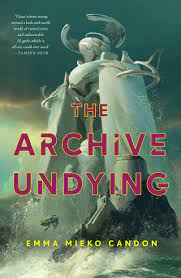
I read this book courtesy of the publisher, Tordotcom, via NetGalley. It’s out in June 2023.
I read really weird books. That goes without saying. This book is one of the weirdest I’ve read in a long, long time.
Think Jeff Vandermeer Annihilation weird.
I loved it, don’t get me wrong. There were moments where I had almost no sense of what was going on, but I did enjoy reading it. I think the problem was usually in not being clear who the narrator was – there are (I think!) a couple of first-person POVs, and (just to confuse things), a few bits where the narrator is actually telling the story in the second person… and I wasn’t always sure who that person was, either. I’ll be interested to know whether the official copy will have different fonts to make that clearer, or whether the ambiguity is part of the narrative.
Honestly, given the story itself, I wouldn’t be surprised if that confusion is part of the whole deal. There’s a lot of confusion here – bodily and relationally and politically.
So there are mechas, and there used to be AIs but they’ve been corrupted; there’s a human polity which seems to want to be in charge, but quite how or why is unclear. (At times I wondered whether I had missed the first book in the series, because there were what seemed like significant ellipses that would make sense if there was presumed knowledge I didn’t have… but no, this is the first book in what might be a series.) There are humans who used to be connected in some way to the AIs, and who are either to be avoided or to followed, depending on your attitude towards the AIs. Most importantly, there’s Sunai, who could not be self-destructive if he tried. He’s a salvage-rat, who gets a job to go with a rig to do… something he can’t remember, actually, because he was very, very drunk when he agreed to it. And when he does remember, it turns out to be yet another bad idea, but he goes along with it mostly because of Veyadi Lut, whom he likes a lot more than he thinks he should. Things go from there. Often badly, generally surprisingly, and with consequences for more than just Sunai.
This is a hefty novel – 416 pages in ebook, according to Goodreads. So as you can imagine, there’s a lot that goes on; at the halfway point I thought we must have been coming up on the conclusion, and then everything went sideways again, and something had to be done – note I don’t say “things had to be made right”. It’s not bereft of hope, but it’s one of those stories where what you thought would be the best outcome isn’t what happens, and where a lot of the things that seem like the very opposite of the best outcome do happen. And yet… I wasn’t miserable at the end.
I’ll be cautious who I recommend this to, and in what situation – do not read this if you want a perfectly comprehensible novel that demands nothing from you as the reader. Do read it if you want a novel take on giant mecha, the place of AIs, and an intriguing narrative structure that requires you to actually pay attention. I will be paying attention to Candon’s work from now on.
Hopeland, by Ian McDonald
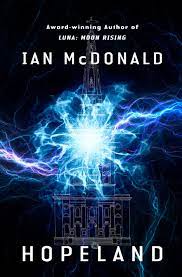
I was sent this by the publisher, Tor, at no cost. It’s out in late Feb, 2023.
My first reaction was and is: What. On. Earth.
What did I just read?
I mean, aside from “something wonderful”, which is easy and true, but gives no information.
Seriously though I was a third of the way through this book and still had no idea what sort of book I was reading. I was barely even sure of the genre.
Fantasy? – maybe?
Science fiction? – basically yes, but only once I was about halfway through?
Maybe just… fiction? But there were definitely some bits that were too weird to entirely count as mainstream, not-speculative, fiction. Also, it’s Ian McDonald.
I’ll admit I hadn’t read the blurb. It’s Ian McDonald, and it’s called Hopeland… why would I read the blurb? So part of my confusion is my own fault. But having now looked at the blurb it’s actually of little to no use in explaining what on earth this is about, so I don’t feel too bad.
So… the story starts in London, in 2011, during the riots. It’s not about the riots, but they certainly set a scene. Raisa meets Amon entirely accidentally – she’s racing across roof tops, he’s looking for a micro-gig he’s meant to be playing at. He helps her win, she invites him to a party with her family, and… it basically goes from there. Occasionally together, often apart, Raisa and Amon live through the next several decades. And see, it’s not like they become hugely important politicians or scientists or celebrities – this isn’t the story of hugely significant people. It’s a story of two people – and their families – living through the consequences of climate change and everything else in the world right now. They have their impact, it’s true, and sometimes on a large scale, but more often in the pebble-and-avalanche way.
It’s utterly, utterly compelling.
Raisa’s family are the Hopelands – more than a family, really; not a nation, certainly not an ethnicity or religion although with aspects of the latter. It takes the notion of ‘found family’ to extraordinary and glorious places and challenged a lot of how I think about family, how it’s constructed and what it’s for. Amon is a Brightbourne, a very different family but with its own legacy to contribute (and his family is where I started wondering if this was a fantasy of some sort).
I want more stories like this. It’s about the very near future so it deals with climate change – and manages to come out hopeful, ultimately, but not saccharine in any way. It’s about people and their failures and their determination to do better, to make themselves and the world better and leave it better for their kids. England, Ireland, Iceland, Polynesia; young people, old people, challenging gender binaries, and playing with Tesla coils. This book is just amazing.
Two more Object Lessons from Bloomsbury Academic
I know, I’m a bit obsessed with this series. But they keep popping up on NetGalley, and I keep being intrigued, and I keep being approved for them… and so I keep reading them…
Mushroom
Intriguingly, Mushroom is perhaps the most surprisingly metaphorical of these so far. It’s certainly not quite what I expected. There are short sections about specific mushrooms, related to (northern hemisphere) seasons. But the main sections are Mystery, Metaphor, Mycology, Medicine and Magic. All of these things I know relate to mushrooms and the history of their use by humans; there was a bit more emphasis on the metaphor aspect overall than I had anticipated. Which was certainly interesting, just not what I imagined!
Mushrooms are eaten for sustenance, of course, but they have also been used for medical and spiritual and magical purposes. Rich explores all of these, and – as most of these books do – also situates the discussion very personally.
Not quite what I expected, but not something I regret reading.
Alarm
This was another excellent addition to this series. With chapters headed Clock, Fire, Siren, Security, Siren, “Failure, False, Fatigue”, and Future, Bennett takes us on a rollicking ride through alarms. There’s history and technology, sure. But there’s also art and culture, and the ways in which alarms are not neutral objects or sounds but can mean different things – particularly, she stresses, in America, where police sirens can mean different things depending on your skin colour (and I suspect the same thing may be true in Australia, at least to some extent). The idea of alarms as a prosthetic is profound – supplementing or replacing our own vigilance; but of course, now smart watches etc are encouraging us to be MORE vigilant (‘closing the ring’). Also, feeding into the capitalist world (my intention to never have one was significantly reinforced by reading this.)
Also, starting a book about alarms with Aeschylus’ Agamemnon, comparing the watchman, Clytemnestra’s alarm system, and Cassandra as alarm? INSPIRED.
Loved it. One of my favourites to date.
Never Afters, by Kirstyn McDermott
I don’t tend to read the works of Kirstyn McDermott. Even though she’s a friend. And not for the usual reasons that friends give, either; instead, it’s because she is too good. Kirstyn tends to write horror, and I tend to find her work just too distressing.
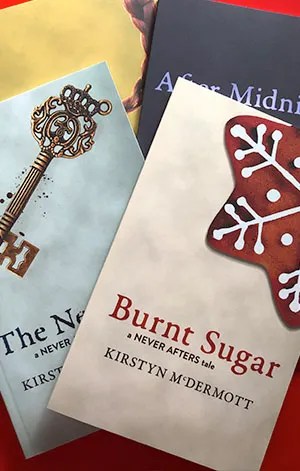
We’ve also had fruitful and fascinating conversations about the nature of horror as a genre, so I’m not going to say that this novella series, the Never Afters series, isn’t horror. Perhaps they’re gothic and gothic is the overarching category and horror fits in that, as I believe Kirstyn would argue, and perhaps other people would formulate it differently; I don’t know. All I know is that these fairy tale continuations, while not exactly the stuff of Disney-fied dreams, also aren’t quite the stuff to bring me nightmares. So that’s nice.
#1: Burnt Sugar. Now adults, childhood long behind, Gretel is a baker and Hansel is drunk more often than not. So far, so not exceptional. But Gretel brought back more than memories from the gingerbread house…. I appreciated that the siblings’ past trauma was dealt with sympathetically without making them only victims (they’ve managed to build a life around it). I know I said these novellas aren’t the stuff of nightmares; maybe what I should have said is that it’s not more nightmarish than the original stories. Because the truth is that this is a horrific story, in the ‘being controlled is terrifying’ way. Very clever.
#2: The New Wife. I don’t think of Bluebeard’s story as being in the same category as Hansel and Gretel – perhaps my fairytale omnibuses (omnibi??) left it out, or I skipped over it in an early aversion to horror? Who knows! But this may be my favourite of the Never Afters. Unlike Burnt Sugar, this story begins within (what I remember of) the original: the new wife unlocking the room that she was never supposed to enter… and goes from there in a rather different direction, involving ghosts, and what I understand is a classic gothic trope – the terrifying house.
#3: After Midnight. How do you do a new take on Cinderella?? Add a few decades, make the prince-now-king as feckless as such types often are, and the now-queen mother to only daughters – and also hardened by her experiences (or maybe she was always so?). Make the story a diary, complete with crossed out sections. Make veiled suggestions about what other things might be happening. Maybe this is my favourite, actually.
#4: Braid. I’d read this one previously – I don’t remember where – but I do remember a conversation about how hair, out of its appropriate place, is surprisingly distressing. Because Zel’s hair is as surprising and unexpected as it was back when she lived in the tower. Like Burnt Sugar and After Midnight, this is set many decades after the time of the fairytale, and deals with what it’s like to live with the consequences of those seemingly romantic and dramatic events of youth. Zel’s life has been complicated, mostly in mundane but nonetheless real and emotional ways – good and bad, love and loss. You just keep living…
#5: By the Moon’s Good Grace. In some ways the least unexpected of the stories. Like The New Wife, it picks up in the middle of the classic story; this has Little Red learning important truths about who her family is, who she is, and the consequences of that.
#6: Winterbloom. Somehow I know the Beauty and the Beast story least well, since I had completely forgotten that the whole saga starts with the father picking a rose without permission. This final novella is another set some years after the fairytale. The Beast is a composer and musician, Beauty is intrigued by roses and creating hybrids; their marriage is generally fine but shows some cracks. And then they have a visitor, aaaand… well. That’s rarely without consequence. Maybe this is my favourite instead?
Alone, excellent; as a set, they show how old stories continue to have resonance, can be used to explore modern and perennial themes.
The books can be bought from Brain Jar Press.
OK: by Michelle McSweeney
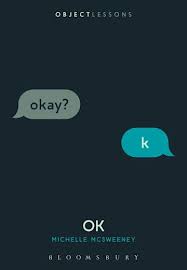
I read this courtesy of NetGalley. It’s out on January 12.
Another roaring success from the Object Lessons series. I had NO idea that OK had such a history. I DID know that you could use a tiny little object to illuminate significant moments in history, which is exactly what McSweeney does here: the connection between communication and technology, and the fate of OK in that – from the Penny Press in the 1830s in the US, to the telegraph and telephone and US cultural imperialism via TV and finally BBSs and social media… it’s all here.
I was also introduced to the term ‘phatic language’ and I love it. Phatic language is “language that is socially rich, but informationally empty”. All those markers that signal we’re listening and we care (in theory), including OK. I love that there’s a term for it, and I love that it has a real and important place in communication. I also love that the DARPA dudes thought email would be more like telegrams (terse, all info and no pleasantries) rather than a conversation, and HAHA sorry guys. Also apparently answering the telephone with “Hello?” was initially considered incredibly bad manners? This is a magnificent example of changing language and social expectations.
Meanwhile there’s also the fact that all those email suggestions that gmail throws at you were learned from “the Enron Corpus” – tens of thousands of emails from 2001 – is creepy and makes me even more determined not to use them.
For lovers of language and communication technology and micro history.
Despatches from the Frontiers of the Female Mind – anthology
WHAT.
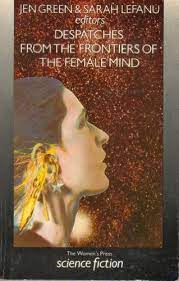
I didn’t know this book existed until this year. It was published in 1985.
The list of contributors is just… I mean:
Joanna Russ (the only reprint)
Gwyneth Jones
Tanith Lee
Pamela Zoline
Mary Gentle
Lisa Tuttle
Raccoona Sheldon! …
and that’s just the names that I immediately recognised.
It’s nearly 40 years old, so some of the stories have aged, I guess? But honestly the general issues in discussion still feel pretty real. Zoline’s “Instructions for Exiting this Building in Case of Fire” – children kidnapped and swapped to stop a nuclear apocalypse – still feels like a chillingly appropriate concept. Josephine Saxton’s view of advertising is hideous and, again, not as laughably far-fetched as I might like (it is ridiculous, but also… ads…). Beverley Ireland’s “Long Shift” is remarkable for its focus on a single woman, just doing her job; I wouldn’t have been surprised to see this published today. Pearlie McNeill is (was?) Australian, and I’ve never heard of her! Apparently this was her only piece of fiction? – SF, anyway. And this is where Raccoona Sheldon’s “Morality Meat” was first published, which is… a moment.
There are very few poor stories here. This is an amazing anthology.
She Who Became the Sun

Whaaaaaat a book.
And yes, I am incredibly late to this party, since Parker-Chan was nominated for the Best Novel Hugo this year (losing to A Desolation Called Peace, by Arkady Martine, a massive favourite of mine so I’m glad I didn’t have to choose…).
This novel is just brilliant. One thing I will say is that it was a bit different from what I expected – which is entirely about me, not about the book. Because of the Hugo nomination, and my genre-leaning friends, I was expecting this to be a book with greater, or more obvious, fantastical elements. Nothing about the book itself made me think that! Parker-Chan’s bio says she was inspired by “epic East Asian historical TV dramas”, and my knowledge of such is below limited (although I am an Australian kid of the 80s and 90s, so does the original Monkey count?).
ANYWAY. It’s 1345, China is ruled by the Mongols – who think the ethnic Chinese are all barbarians, and vice versa. There’s famine in the south; two children in a family are told their destiny: he is bound for greatness, she is bound for nothing. But then he dies, which means his destiny is going wanting… so she decides to become him…
Epicness ensues as Zhu gets caught up in events far beyond what she imagined as a child. First as a monk, then as a warrior and a leader; always worried that heaven might catch on to the fact that the destiny she is grasping was not, actually, intended for her at all. She teeters on the precipice of failure and discovery – not sure which is worse – and sometimes through luck, more often through her intelligence and grit and sheer bloody-mindedness, she ploughs on through…
I believe this is a duology, and honestly the next one cannot come fast enough (which is rich, given how late I am to the party). The pacing was excellent, the stakes were high, Zhu is mighty and charismatic. The supporting cast are varied and intriguing – Parker-Chan writes a significant portion of the story from the other side, as it were: what’s going on in the Mongol camp, particularly from the perspective of a Chinese captive-risen-to-general, which gives the entire novel even more drama and intensity, emotion and high stakes.
What a book.


