The Employees: A workplace novel of the 22nd century

When the Ursula K Le Guin Prize shortlist was announced, I was intrigued. I hadn’t heard of most of the titles, and I happened to have a book voucher from someone for my birthday, so I promptly went ahead and bought a number of the books.
This is the first one I’ve read. And it’s amazing. And it was also shortlisted for the Booker Prize??
It’s 136 pages in length. Not all of those pages are filled, because the bulk of the book is made up of employee statements… and as anyone who’s ever looked at employee feedback will be unsurprised to learn, some people have written a couple of pages and a few have written just one sentence. And that’s it – that’s what you learn of this 22nd century workplace. It’s almost entirely from employee feedback.
It’s brilliant. There are devastating gaps, and hints at terrible and wonderful things. There are touching moments of humanity and grim reflections on work and the workplace. Have you seen Severance? It’s not exactly like that but if you put them together you are forced to start thinking more about corporate workplaces than perhaps the managers would like us to.
The workplace is the Six-Thousand Ship, and the employees are its crew. Where are they? Not quite sure; that is, it’s around a planet called New Discovery, and it’s not near Earth, but other than that – no details. Some of the crew are human, while others are humanoid: some who were born, others who were made. There’s sometimes tension between the two groups, and sometimes camaraderie. Most of their work is what you’d expect on a spaceship, but some of it isn’t. Some of the complaints are also what you’d expect – around isolation, for instance – but some of the comments centre around objects that are never fully explained, from New Discovery itself. It’s deeply familiar, because some Ravn suggests aspects of work won’t change no matter the situation, and simultaneously quite alien.
It’s very, very, clever; absorbing, wrenching, sometimes disturbing, and I loved it.
Spoiled: The Myth of Milk as Superfood

I read this via the publisher and NetGalley. It’s out in April 2023.
This is an angry book.
I’m not saying that’s a bad thing, or that the anger is unjustified. Just that Mendelson doesn’t make much effort to hide the fact that a lot about Big Dairy in America makes her angry, and that the appalling lack of science around the claims for milk make her angry, and that the fact drinking milk is pushed as some mighty panacea when actually the ability to digest cow’s milk as an adult human is largely restricted to humans descended from north-west Europeans… that makes her angry, too.
Some of the most crucial sentences for understanding the point of the book comes early on: “… the founders of modern Western medicine had no way of understanding the genetic fluke that allowed them… to digest lactose from babyhood to old age… That lack turned the one form of milk that is most fragile, perishable, difficult to produce on a commercial scale, and economically pitfall-strewn into a supposed daily necessity for children and, to a lesser extent, adults.”
Yeah.
The section I most enjoyed for itself was the first part, where Mendelson looks at the long history of dairying, and in particular points out that drinking “fresh” milk (which is a whole other discussion of terminology, given what happens to milk in most Western countries today) wasn’t something early herders did. Instead, they were using fermented milk – naturally fermented, from being left out in the heat. She goes through the science of what’s actually happening in this fermentation, discussing why the bacteria in the milk doing all of this doesn’t poison human consumers of such milk. There’s also a really interesting discussion about the archaeology and other evidence for dairying of various forms in numerous locations.
Science is a fairly big part of the book, which I also enjoyed. There’s a lot about what’s in milk of various types, and why, as well as how that’s connected to the digestive system of the various animals that humans choose to milk. Plus the discussion about how limited the ability to actually properly digest full-lactose drinking-milk is, among the adult human population. If you can digest milk as an adult, it’s you that’s the genetic mutation, not everyone else. Doesn’t that make all the soy milk etc-haters look like numpties.
The angry-making bit really starts when the discussion turns to the 18th century in Europe, and the way that ‘drinking fresh milk’ suddenly became imperative for children, in particular, and the idea that if children were denied all the milk they could possibly consume then somehow society was failing them. All of which is nonsense since… see above. And then, of course, it gets into how the industry makes claims, and medical types get on board, and honestly it just makes me really sad and horrified to see how outlandish claims based on ‘science’ (sometimes) that has now been superseded, or sometimes just based on a desire to make money, is still having a massive impact on how we think and act today.
Also? this insistence on drinking-milk all came as a) more people were living in towns and b) before good refrigeration and c) before adequate food-safety measures like pasteurisation (which gets a whole section here, because of the raw food movement) were in place. All of which meant a bunch of kids, in particular, actually got sick and many of them died because of the milk they were told they needed to consume in order to be healthy.
One of the reasons for the angry nature of the book is its focus on the modern American dairy industry. I’m not going to claim that the Australian industry is immensely better, because I don’t know all that much about it, but I do know that we do things a bit differently. And then there’s the way in which drinking-milk is still being pushed as necessary… to populations that are, overwhelmingly, unable to digest full-lactose milk as adults. I think that’s just appalling.
Don’t read this as a fun history or science of milk. Do read it if you’re interested in how drinking-milk got to be the thing it is today – which is genuinely fascinating, as well as infuriating. There’s discussion of Kellogg’s, and milk-drinking cults, and the furore around pasteurisation and homogenisation, and the raw milk fad as well…
Sewer, by Jessica Leigh Hester

I read this via NetGalley. It’s out in November 2022.
OK, first thing to note is that you probably want a relatively strong stomach to read all of this… and you definitely don’t want to read it while eating. While it’s not revolting, there are some descriptions of sewers and fatbergs that are not the most pleasant of reading experiences.
Secondly, stop flushing wipes. No, seriously. Even the ones that say they’re flushable. Stop flushing them. They’re not really flushable. When you put something down the toilet it doesn’t ACTUALLY, magically, disappear. It still needs to go somewhere. And wipes? Oh, they do not disintegrate and become harmless like you might imagine. Stop. Flushing. Wipes.
This book is really remarkable. As with the best of the Object Lesson books, it’s personal and it’s deeply researched and it’s fascinating. Hester is convincing in her argument that sewers are vital to understand because they help us understand our past, as well as consider our future. She is also adamant that investing in sewer infrastructure is something that has been lacking (and I’m completely terrified and appalled by some of the stories about that) and is vitally important for our future. No one wants a return to typhoid and cholera in places like London. Which also means that those places without good, sturdy, reliable sewers – ones that DON’T JUST EJECT WASTE INTO THE OPEN WATER – absolutely need financial assistance in getting that done. If you don’t think that’s a priority… you’re wrong. Simple as that.
Highly recommended for the civil engineer in your life, or the person who’s always asking ‘why is it like that?”, or the person with the more-scatalogical-than-necessary sense of humour.
Also, STOP FLUSHING WIPES.
Lost in the Moment and Found (Wayward Children, #8)
Read courtesy of NetGalley. It’s out in January 2023 (sorry).
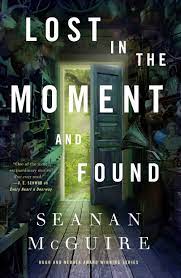
It’s a Wayward Children novella. It’s always an exciting moment.
One thing I that both makes me happy and sad with some of the recent novellas is that they’re standalone. I love that they provide new entry points for readers, and also that McGuire is exploring such interesting variations on the ‘there are Doors that lead to new worlds and young kids who need them can sometimes find them’ thing.
The only reason I’m sad is that I love many of the original cast and I will always want to know more about them. But that’s definitely about me and not about the books.
So! If this is your first Wayward Children, how awesome! And if it’s your 8th, how awesome is this series??
As McGuire herself does in the Author’s Note, I will point out that the lead character deals with an adult gaslighting and grooming them. McGuire wants very much to let readers know that Antsy runs before anything actually happens, and I deeply appreciate this reassurance. I also appreciated, as the story progressed, the narrator noting that Antsy’s fear of not being believed was in fact unfounded. Which is of little use to Antsy, of course, but perhaps of enormous use to a reader.
Antsy: unhappy at home, runs away, finds a Door… which leads her to a shop with a talking bird and a very old woman, which turns out to be a shop where lost things turn up (yes, all your odd socks; kittens and my favourite frog ear cuff, too, I expect). The bird and the woman and now Antsy catalogue what turns up, help people find lost things if they can, and sometimes sell things when they know they won’t be claimed. Many Doors open from the junk shop – which is a very different premise from what happens in most of the other stories – and Antsy goes through to visit markets and to explore. It is, of course, an adventure… and things do, of course, turn out to be not quite as they appear.
I love Antsy; I thoroughly enjoyed the story; McGuire is still doing great work in this series.
Growing Up Weightless, John M Ford
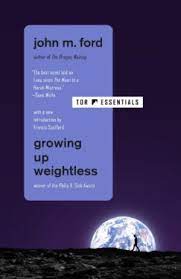
I read this courtesy of NetGalley. The re-published edition, from Tor Books, is out in September 2022.
Honestly this book really shouldn’t work. It’s so full of lacunae it was like reading the second or third book in a series and not having the information to fill in the gaps. Another issue is the formatting, although I suspect that’s a matter of it being an e-ARC: there are sections where the POV suddenly changes but it’s not indicated by an extended break or anything like that. And if that’s an artistic choice rather than a formatting thing… well, I don’t particularly like it, but it did make me work harder and pay probably closer attention, so maybe that’s what Ford wanted for me. And thirdly, it’s not exactly a grand story. No explosions, no dramatic twists of fate for society, no incredible revelations.
And yet.
It shouldn’t work, but it does.
It’s not a grand story: it’s an intimate one, a growing-up story – as the title suggest, ‘growing up weightless’: it’s set on the moon, not all that far into the future but far enough that there’s a settled, indeed governmentally independent, colony. And as children have done since time immemorial, some of the children of the moon are unsettled, feeling like they don’t fit in and want more/different/other. And they’re also playing games: surprisingly substantial parts of this story are the kids playing a role-playing game, as outlaws in Sherwood Forest (do I love the idea that this milieu could continue to be attractive for coming generations? yes I do).
Matt, the main character, is born into an important luna family, and is feeling the pressure to figure out what he’ll do as an adult; he basically knows, but he’s afraid to tell anyone else. He loves his friends, and acting, and the role-playing game they’ve had going for many hours now; his relationship with his family is a bit fraught. The moon is somewhere that teens can travel around quite safely, especially within their own domes; there’s excellent train networks, so you can travel between domes too – and so they do. This is pretty much how the main action happens, such as it is. This is, on reflection, a fairly claustrophobic story, as befits one set on the moon.
Along – or perhaps slightly behind – Matt’s story is his father’s, and this is where even more lacunae exist. Albin’s relationships with various figures, the decisions that need to be made for the moon’s future, even how he feels about anyone – all of this is very shadowy. Which mirrors how Matt feels about his father, really, so again maybe that really makes sense and I’m only realising as I write this just how clever and deliberate Ford was.
It probably shouldn’t have worked, but it did, and I am once again grateful that Tor is re-publishing Ford’s work, so that people like me get to appreciate it.
The Atlas Paradox, Olivie Blake

Read courtesy of NetGalley; it’s due out in October 2022.
This review will have some spoilers for the first book, The Atlas Six. And you really need to read the first one. Do not come to this with no prior knowledge.
This is an example of one of those books where very quickly I am pretty sick of the bullsh!t of every single character, impatient with their childishness and arrogance and lack of ability to see beyond their own selfishness… and yet I kept reading. Partly for the characters – I like Libby (and let’s not analyse that particular sentiment), and to my amusement I like Nico, and of course I like Gideon; Reina I am intrigued by. The others I find very frustrating if occasionally intriguing. But I also keep reading because I just have no real idea where Blake is going with all of this. I don’t know whether the characters are going to actually come together, or not; whether they will work with Atlas, or not; whether the world is going to end, or not. And so despite my impatience and frustration – all, it must be said, indications that Blake is skilful at creating characters; I don’t tend to waste emotions on 2D characters – I devoured this book, and am now also impatient for the third book. This situation cannot be left where it is and I need to know how it resolves.
So the book opens with Libby gone, her colleagues initially assuming she’s dead and then realising that she’s just… gone. Using his abilities, Ezra has dropped her in the past, hoping to save her or save the world or… honestly who really knows, Ezra is so messed up. The others, back in the Library mansion, are meant to spend their year doing basically an Honours project, researching their own thing. As may be of little surprise to those who’ve read the first, mostly they just don’t bother because have you ever met another group of incredibly smart people who collectively had so little interest in actually doing the work they’re expected to do? Reina is not included in that indictment. And I guess Nico isn’t either but he’s Nico, and like all the others is definitely running to his own agenda. It will also come as no surprise that things go badly for pretty much everyone at different stages of the story. They don’t cope very well with that.
There’s an enormous depth, here: Blake hints at a lot with Atlas, and with Dalton, and with Reina and Parisa in particular. There’s also terrifying potential for what could eventually occur. Both of these novels have been very well-paced; Blake uses the multiple-narrator mode beautifully to explore the variety of characters and give hints at what’s in their brains. I think, actually, that it’s using that format which makes these novels so very compelling.
Enclave, by Claire G Coleman
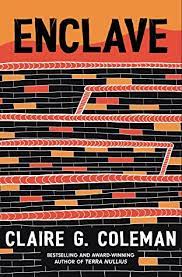
I received this from the publisher, Hachette, at no cost.
If you’ve read Terra Nullius or The Old Lie, by Coleman, then I heartily recommend the same strategy as I used: just read the book. Don’t read this review, don’t read the blurb. You already have a sense of how Coleman writes, and what Coleman writes. The first two were very different, but you know how they’re similar; this is also very different, but it’s clearly a Coleman novel. If you were staggered by those first novels, then you really don’t need to anything else other than: it’s a new Coleman novel.
Still with me? Haven’t read either of the first two (but now you know you should because they’re amazing), or somehow not sure about this one? Christine lives in a walled city with no contact with the outside world. Everyone knows that the outside world is terrifying, full of violence and bad things; unlike their city, which is calm and peaceful and carefully surveilled for any trouble. Everyone who lives inside this city is white; the bussed-in servants are brown, but they’re nameless and just go about making houses liveable. Christine isn’t entirely happy – her best friend is missing and she doesn’t know what to do – and then does something unforgivable, and then everything changes.
It’s fantastic.
Bootstrap, by Georgina Young

Received from the publisher, Text, at no cost. It’s out on 19 July 2022, $32.99.
As a time travel/ romance set in Australia, this book is fine. A pretty slow start – there’s a lot of setting up of the small town and the two main characters – but the second 2/3 is pretty well paced. There are some quirky ideas, the characters are believable (and recognisable, for Australians at least), and it’s… fine.
Yes, I know that sounds like damning with faint praise. And it is fine! Truly! I didn’t mind reading it! But… it’s not outstanding. Sadly. For a YA audience that’s not read many time travel stories; or for Australians who have never seen themselves on the page before, maybe it would be different? I don’t know.
I have a couple of issues with the book. The first is with the blurb writer – note, please, NOT with the author. The book itself literally references The Time Traveller’s Wife. So when the blurb calls this a “genre-bending” novel? No, it’s not. Jonathan Strahan’s new anthology is literally Someone In Time: Tales of Time-Crossed Romance. So time-travel and romance isn’t new. Even making it queer doesn’t make it new.
The second issue is the language. It’s very Australian. In fact, I would go so far as to call this excruciatingly Australian. I am a big fan of stories being told in the vernacular, but this felt like the author had first written the story in more generic English and then went back and switched everything to the most ocker she possibly could. For instance: “I get a schnozz full of water” (138), “I wanna touch him” (140), “And it’s like finally, ya nong” (144) and so on. Piles of Aussie slang (logs in the toilet) and references to Australian brands (Lemon Fresh, a man eating a Barney Banana ice cream “shoulda gone a chocolate Paddle Pop, idiot” (58). It just ends up feeling like the author is trying too hard. But maybe I’ve become an elitist and I don’t appreciate what kids in small towns really want to read. So if this works for those kids, awesome! It just means I’m not the right audience, and I’m fine with that.
Budapest: Between East and West
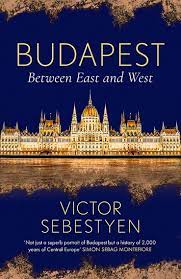
I received a copy of this book from the publisher, Hachette Australia, at no cost. It’s out now; $32.99.
Things I knew about Budapest before reading this: it used to be two towns, and pictures of Soviet tanks in the streets in 1956. I think that’s about it, really.
An intriguing aspect of this book is that it’s written by a man born in Budapest, whose family fled Hungary when he was a child. Sebestyen makes no secret of this, and of his connection to the country and the city. So there’s a mix of ‘objective’ history, and also the occasional mention of how things relate to him personally. I like this kind of honesty a lot.
One annoying aspect – and this might just be a personal gripe – isn’t peculiar to Sebestyen, and is at least partly a reflection of the historical record (and my personal preferences). The book begins with a very brief look at what is known of the area around Budapest from pre-history, and then moves to what the Romans did. There’s barely a discussion of Attila and the Huns. By p30 we’re up to the year 1000. p109 and we’re already at 1800 and at p272 it’s the accommodation between Hungary and Hitler’s Germany. The book is 377 pages long. While I know that there’s a lot more evidence for the alter centuries, it always makes me despair that history is given such an unbalanced presentation. As if the modern world is the only bit worth discussing. Sigh.
Despite this preponderance of modern history, Sebestyen does give a good overview of the history of Budapest – as Simon Sebag Montefiore notes in the front cover quotation., it’s really a history of Central Europe. You can hardly have a history of the city without discussing the history of (what is now) the country; and in this particular case, at least some of what was happening in Austria for a few centuries. And so I learned more about the Turkish occupation, as well as how the Habsburgs managed to create Austria-Hungary as a dual monarchy; and of course the role of Hungary in both world wars and then as part of the Soviet bloc.
The story is largely told chronologically, with occasional chapter breaks about particular themes – one in particular that stood out was about the role of the Jewish population in the city. I had no idea that Hungary had been something of a haven for European Jews, although they were still not safe from the occasional pogrom (because anti-Semitism is apparently just too easy). The way that Jews stood outside of the feudal system, basically – and the incredibly bizarre way Hungarian feudalism was structured, with a massive number of nobles who refused to get into trade or anything similar – meaning that Jewish artisans and traders filled that niche.
This book fits into a tradition of using city histories as a way of looking at changes over time, to everything from culture and tradition to language and politics and everything else. The sub-title is pointed, here: part of Sebestyen’s argument is that Hungary doesn’t really fit into the way Europe sees itself, and doesn’t particularly fit elsewhere either. (The story of Hungarian as a language, and the efforts to revive and develop it, is a particularly fascinating part of the book.)
Thoroughly enjoyable.
An Open Door: New Travel Writing for a Precarious Century

I read this courtesy of NetGalley. It’s out in November 2022.
An anthology of travel and place writing published in the context of the pandemic? And one that’s not just all sentimentality about things from the before-time? And that’s starting from, sometimes going to, Wales? These are excellent things.
A sad thing is that this anthology was prompted by the death of Jan Morris, which I hadn’t heard about. I haven’t read much of Morris’ work but her little book focusing on Wales and her home there is absolutely captivating.
All of the authors here have a connection to Wales – some born there, some moving there. But not all of the essays are about Wales. Instead, there’s Brazil and Somalia, Venice and Paris and Japan, and Sapelo Island as well. Sometimes it’s because of partners from elsewhere, sometimes family who have migrated. Sometimes they offer reflections on one particular moment in a life, and sometimes reflections from a generation of experience and change. There are, of course, also essays set in Wales: like one about find green space to be calm and solitary while in a wheelchair; another about following the pilgrim way in the north on foot.
I don’t know anthologies like this very well, so it’s depressing although not surprising to learn that the range of authors – that they are not all male and able-bodied and white and young-but-mature – is something worth noting. It is, of course, the more enjoyable for this diversity of voices.
This was a delightful set of essays, and an example of how broad ‘travel writing’ can be. I hadn’t come across the idea of ‘place writing’ before reading the introduction but it occurs to me that that is, in fact, often what I enjoy reading. There are some wonderful examples of that genre here, as well as travel. And while it did make me slightly nostalgic for travel in the before times, that reality is different now – pandemic and climate change both contributing, not to mention political climate. I probably should look out for more books like this.


