The Deep: a BBC submarine series
Note: some spoilers here. Not huge ones.
 I’m loving my BBC iplayer subscription, because it turns out there’s a bunch of BBC science fiction that hasn’t been picked up by Australian tv. Outrageous! The series we’ve just finished is The Deep, a submarine adventure under the Arctic. Be warned: if you don’t want your characters to be hurt, don’t watch this. If you don’t like the uncertainty of Spooks then this is probably not the show for you. Just saying.
The series opens with a marine biologist (I think), Catherine, in a little sub around a thermal vent in the Arctic. And something goes wrong. Flick forward six months and the biologist’s husband Clem is about to go out on a new mission to the same area to continue her mission… but then they get politely hijacked and told they have to go looking into what happened to Catherine and her crew. Basically the rest of the story – there’s five episodes – follows the deep-sea, under-ice adventures of the Orpheus (hello, classical imagery). One spoiler I think it’s important to put up front is this: from the first episode, I found it impossible to tell whether this was going to turn into a version of The Abyss, with aliens or Atlanteans responsible for the mishaps. But no. Instead, this is very much a science fiction thriller, with the story firmly entrenched in human politics, human problems, and very real human ambition and greed.
The story: is tightly, and I thought largely well, written. There are a few sub-plots but they are all ultimately tied into the over-arching issue of survival, immediately and long-term. There are betrayals and tragedies, unexpected friendships and some really, really cool twists.
The characters: largely enjoyable, if not always likeable. Frances (Minnie Driver) is the captain, generally as autocratic as she needs to be but occasionally lets personal considerations get in the way. I do not think that this a reflection of her being a woman – and I thought long and hard about that – there are plenty of examples of men acting likewise, and she is certainly never decried within the show for being weak as a consequence of having boobs. James Nesbitt is Clem, the engineer on the Orpheus, who is a bit mad with grief at being a widower and definitely the most irrational of the lot; there are times where he acts really quite irresponsibly, making me uncomfortable. But he’s sympathetic as well as unpredictable, and probably one of my favourites. The other main character is Samson (Goran Visnjic), whose accent bothered me greatly because I could never place it. I could never quite figure out his exact role on the boat, either, since he seemed to take on medical roles, and be the driver of the mini-sub, as well as doing some biological research stuff. It’s possible I just missed which one was his primary occupation. Anyway, Samson was for me the hardest character to bond with – he’s got various personal conflicts, and seemed to vacillate personality-wise. Of the minor characters Tobias Menzies as Raymond, the salvage/insurance dude along for the ride to investigate what happened to Catherine et al, is most awesome. He’s really hard to pin down regarding motives and attitude – really cleverly written – and Menzies is brilliant.
I can really recommend this if you’re after 5 compulsive hours of submerged adventure. And I do mean compulsive; the end of episode three made me immediately need to watch episode four because it was such a cliff-hanger. It’s not a completely happy story, by any means, but it’s worth it.
Galactic Suburbia 71
 In which Tansy & Alex talk sexism, steampunk, Samuel Delaney and tiny baby Avengers fighting tiny baby X-Men. Also, feedback from listeners! You can get us from iTunes or at Galactic Suburbia.
News
Pornokitsch on the Mammoth Best New Horror introduction
Twelfth Planet Press announces Best YA SF anthology – Alisa & Tehani reading for this in 2013 and we hope it doesn’t break them.
The Fantasy Pin-Up Calendar Thing
The Calendar itself
Tansy’s post – when fantasy art embarrasses us all
Skepchick asks us to Please Stop Making Calendars
NK Jemisin on her involvement in the project
Sexism in the Skeptic Community – what happened after she spoke out
What Culture Have we Consumed?
Alex: Edge of Infinity, ed. Jonathan Strahan; Babel-17, Samuel Delaney; The Contrary Gardener by Christopher Rowe in Eclipse Online
Tansy: Wilful Impropriety, Ekaterina Sedia (ed); Hawkeye #1-3, Matt Fraction, David Aja; “A-Babies Vs. X-Babies” one-shot written by Skottie Young with art by Guruhiru
FEEDBACK
Suzy McKee Charnas story at SnackReads
Please send feedback to us at galacticsuburbia@gmail.com, follow us on Twitter at @galacticsuburbs, check out Galactic Suburbia Podcast on Facebook and don’t forget to leave a review on iTunes if you love us!
Galactic Suburbia 70!
 In which Feminism 101 meets Aussie politics for a battle of the bands! You can get us from iTunes or Galactic Suburbia.
News
Julia Gillard and the Sexists of Doom
The Speech (and bonus Penny Wong Interview)
Commentary in the New Yorker
@vodkandlime talks about the response to the Gillard speech
Ben Peek on the failings of the mainstream media
British Fantasy Awards: special squeeage for Angela Slatter, first Australian to win one.
Jonathan Strahan and Nightshade Book launch Eclipse Online
Strange Horizons Fundraising Drive is on
Crikey looks at author earnings and advances.
What Culture Have we Consumed?
Alex: Deathless, Catherynne M Valente; Arc 1.3; Hydrogen Sonata, Iain M Banks; Looper; abandoned: Armored (ed John Joseph Adams)
Tansy: The Outcast Chronicles, Rowena Cory Daniells; Unspoken, Sarah Rees Brennan; Wild Mary: A Life of Mary Wesley by Patrick Marnham, Under My Hat edited by Jonathan Strahan. Also GAME OF THRONES
Alisa: The Future is Japanese (ed Nick Mamatas); Looper; Death’s Daughter, Amber Benson; Casual Vacancy J K Rowling; Studying Men and Masculinities, David Buchbinder
Next Episode: feedback probably
Please send feedback to us at galacticsuburbia@gmail.com, follow us on Twitter at @galacticsuburbs, check out Galactic Suburbia Podcast on Facebook and don’t forget to leave a review on iTunes if you love us!
On the Edge of Infinity
Edge of Infinity is not especially concerned about Earth, but it cares deeply about humanity. It’s not blindly optimistic, but neither is it depressingly morbid. It cares about the little things and the big, it’s got romance and death, and lots and lots of adventure, set within our solar system but not on Earth. Also, space ships.
Pat Cadigan opens the anthology and immediately throws the reader into the position of deciding whether they can hack the displacement. “Nine decs into her second hitch, Fry hit a berg in the Main ring and broke her leg.” This, accompanied by the story’s title – “The Girl-Thing Who Went Out for Sushi” – is a very clear sign that Here Be Science Fiction; the sort of science fiction that requires the reader to do a bit of work, while trusting in the author that these things really will make sense. And, of course, they do; Cadigan is a marvellous writer who mixes the very weird with the quite familiar, and gently leads the reader to understanding where she’s going with her story. The unfamiliar language is used partly to warn the reader that this is not a situation they can just take for granted, but also because it’s entirely appropriate that language would change out there around the moons of Jupiter – perhaps especially, as in this case, when those living in an alien-to-humanity environment have themselves changed from the human standard, at least morphologically. Cadigan also makes some interesting points about how being “two-steppers” has impacted on humanity’s ways of thinking, especially with regard to binary decision making. At heart, this story is about choice: an individual’s freedom to make choices about their body and their livelihood and where they live. Just suggested in the background is also a broader discussion about political choice, too, with shades of James SA Corey’s Leviathan Wakes and Caliban’s War, about the place of Jupiter in the solar system. It’s a fitting opening to the anthology, flagging as it does many of the issues that resonate across the set.
Elizabeth Bear’s”The Deeps of the Sky,” which comes next, is the only story that focusses on aliens. Here again though the focus is on choice; Stormchases and his skiff have been out mining a storm for trace elements such as iron when a curious object appears in the sky, and he has to decide what to do about it. The plot is thus quite straightforward, but it’s the world building that makes this story an interesting one. As mentioned, it focusses on an alien society – probably living in Jupiter – and aside from the alien biology, the aspect Bear gives most attention is that of reproduction. Who gets to reproduce and with whom, and at what cost (…literally) is absorbing Stormchases, and therefore the narrative. And it is indeed different enough to cast a rather fascinating light on humanity’s own tendencies in those realms.
Bringing the anthology back closer to home (… again, literally) is James SA Corey’s “Drive”, a story that unfolds along two different temporal tracks: in one, Solomon has just taken off from Mars in his souped-up space craft; the other follows Solomon from his first encounter with Caitlin and their subsequent relationship. Like Cadigan, Corey envisages a solar system that is as uneasy with differentials in political power as it is with access to, and production of, resources. This provides much more of the narrative tension for Corey than it did for Cadigan; Earth’s attitude to Mars has an immediate impact on Solomon and his life. I’m excited to see stories like this one, despite its melancholy tone, because it puts the idea of colonising Mars squarely back into the realm of the possible, at least from an SF perspective. There’s no suggestion that it will be easy – quite the contrary – but at least humanity is there, reaching beyond our own troposphere. Somehow the idea of being out on Europa or Titan isn’t quite the same, even though the colonisation of Mars is generally a prerequisite of that further expansion.
Sandra McDonald and Stephen D Covey deliver “The Road to NPS,” similar to “Drive” in that it focusses on the issue of transportation – bringing to mind Samuel Delaney’s Nova, and the suggestion that once a civilisation expand beyond the solar system, transportation becomes the most important issue. For Rahiti, this presents a challenge he cannot leave alone – despite the threat, and very real danger, inherent in doing so. Rahiti is one of few antagonists of this anthology that I did not particularly connect to. I think this is partly because his motivation seemed to be entirely commercial – which isn’t necessarily a bad thing, it simply did not work for me. And he just didn’t seem like that nice a guy, overall.
The first AIs turn up in John Barnes’ “Swift as a Dream and Fleeting as a Sigh,” where, intriguingly, AIs are therapists. For humans. Which is about the most unlikely role I’ve ever read them in. This is one of the most complex stories of the anthology, narratively speaking. The “I” is the AI, and the narrative follows multiple threads. First, and appearing sporadically throughout, is the narrator’s own musings on its own capabilities – specifically the difference in subjective time that it and its human interlocutors experience. It draws a comparison for one of the humans: that “the ratio of [its] cycles of information processing per second to theirs is about the same as theirs to an oak.” In response to which, very sensibly, the human (eventually) asks what an oak would think about… which doesn’t seem to be the point, but perhaps from the AI’s point it is. Anyway, the story is a fascinating glimpse into what that sort of processing power might do (brain the size of a planet, and so on). The rest of the narrative involves the AI musing on its interactions with two humans it has counselled. Laura and Tyward see the AI for different reasons – Laura because of Ty, Ty because of an ant (a mechanical one). Their relationship, shown through the AI’s interactions with them as individuals, is poignant and realistic, even though I think the conclusion is a bit of a stretch. Finally, I’d like to point out how hard it was to write this without referring to the AI as ‘he’. I think this was because its character came across so strongly, and as humanly flawed rather than a remote perfect artefact, that it seemed wrong for it to be genderless. As for ‘he’ – well, yes. Aren’t all robots male? (sigh)
Paul McAuley’s “Macy Minnot’s Last Christmas on Dione, Ring Racing, Fiddler’s Green, the Potter’s Garden” wins for longest title. It, as a title, also covers the most important things that Mai Kumal learns about when she travels to Dione, one of Saturn’s moons, on the occasion of her father’s death there. Overall this is a less a narrative, really, than a rumination on what humanity might do Out There, so far away from the safe little blue ball. Colonisation; extreme adventure sports; secretive colonisation; and outrageous, lavish works of art. This is definitely one of the more overtly optimistic pieces of the anthology. While it’s a bit sad that Mai and her father were estranged, this is set against a glorious back drop of humanity’s potential, both in terms of relationships and Grand Achievements. And I think it’s a wonderful dream, for that.
Taking quite a different tack, one of the narratively most straightforward stories is “Safety Tests.” Here, Kristine Kathryn Rusch takes a very normal, albeit still dangerous and necessary aspect of humanity + machinery – the idea of needing a licence – and explores it. In space. Using spaceships. Around an inhabited space station. Over the course of a single day, Devlin must deal with six quite different applicants for public piloting licences. Things progress from there about as Devlin appears to expect every day to progress. That is, poorly. There’s not much extra world building built into this story, but it’s the sort of situation one can imagine fitting into most any space-faring story (imagine Ellen Ripley or Han Solo going for their licences. I dare you).
“Bricks, Sticks, Straw” is my favourite story of all, so thank you very much Gwyneth Jones. Set very briefly on Earth, the focus is on four Remote Presence devices, operated by humans on Earth but physically located on the four Galilean moons of Jupiter. Thanks to a solar storm, the link to those devices is severed, but the software agents… well. They continue to exist, and to operate, if in rather different ways from what their designers and operators would recognise. These manifestations are wonderfully thought out – how such software, designed to be intelligent and run programmes, might react to apparently being abandoned by their makers, and how they might interact after that happens. (It does make me wonder somewhat about the poor old Mars landers and rovers….) Sophie, on Callisto, is the focus of the story: she is both an array collecting data of the Jovian system; and a memory, or a remnant, or an avatar of the Sophie back on Earth. Of the four devices, she is the only one who both accepts this reality and thinks that getting back in touch with Earth is actually important. So this is the only story that does not imagine humanity having literally spread out through the solar system – yet, anyway; it’s also the story that feels temporally closest to Now. Sophie is delightfully engaging, and her concerns entirely realistic (within the bounds of the story, naturally).
Following a theme of Hannu Rajaniemi work in Jonathan Strahan anthologies (… that would be two from two, so maybe not a theme yet; the other one was “The Server and the Dragon,” in Engineering Infinity), “Tyche and the Ants” is the most magical-seeming of these stories, while – as the reader suspects throughout and has confirmed by the ending – having a very solid science fictional basis to everything; it’s the perception that lends the magic, not the action. It also comes close to the Jones story as being my favourite. Tyche lives on the moon, dividing her time between the Base, where she’s meant to stay, with only the Brain for company; and the place through the Secret Door, where waits the Magician and various other creatures. Her seemingly happy life is, however, disturbed the day the ants come to the moon. On one level this can be read as a poignant almost-fairytale; it’s sweet, if combined with some rather sad moments because of Tyche’s confusion. However, Rajaniemi does that wonderful thing of suggesting an enormous background to the story, without ever overwhelming the immediate story – and I now really want a novel set in this universe. Please. Because there are all sorts of ideas about humanity that are suggested at but not fully developed.
The main narrative thread of most of these stories so far (the Barnes is perhaps the exception) has encompassed a relatively short timeframe. Not so Stephen Baxter’s “Obelisk.” Beginning with the arrival of Wei Binglin on Mars, as he pilots the Sunflower in after a very difficult voyage, the story follows the next several decades of Binglin’s life as he adapts to Mars, deals with the brash American Bill Kendrick, and both watches Mars develop and assists in that happening. Binglin is an interesting character through which to explore this; he feels a great deal of guilt concerning the Sunflower, and he’s unconvinced, early on, about living planetside. His growth as a character works overall, and I can absolutely agree with how Baxter imagines Mars bootstrapping itself. And the fact that he imagines it as a largely Chinese endeavour is certainly believable, although there’s not a whole lot of Chinese-specific culture to be seen. However, I was troubled by the way Baxter dealt with Xue Ling, Binglin’s adopted daughter. The role she plays seems largely superfluous; certainly the apparent pull she exerts on both Binglin and Kendrick is not required to get them to do what they do. Rather she sometimes seems like an excuse. Her actions at the conclusion of the story were especially problematic, seeming not to fit in at all and feeling instead like gratuitous sentimentality on Baxter’s part, or as if there needed to be some big dramatic Thing to impart some sense of occasion to the story. It was unneeded and I think actually undercut the rest of the story.
Alastair Reynolds’ “Vainglory” is another story that uses two temporal tracks. In the first, Loti Hung is confronted by Vanya Ingvar, and asked some uncomfortable questions about her interactions with a certain Skanda Abrud; while the second is essentially Loti remembering exactly that interaction. While many of the central characters throughout this anthology have been engineer or science-y types (although not all, Tyche in Rajaniemi’s story and Mai is McAuley’s especially), Loti is quite different: she’s an artist. Specifically, a rock artist – someone who carves rock on a massive scale – we’re talking asteroids here. And I love the very idea of a science fiction story that focusses on the possibilities for art in the future, in these far-out locations humanity may find itself in (McAuley does a similar thing). The story is about one of Loti’s commissions, and it not turning out to be quite what she thought; and Ingvar investigating just exactly went on with it. The interaction between the two women is understated and believable, as is that between Loti and Skanda. Again, this quite personal story is set against a much larger backdrop of solar system colonisation, the arrogance of wealth, and questions of justice.
While transportation may be one of the major issues of solar system colonisation, as shown in “Drive” and ” The Road to NPS,” solar system habitation is going to be greatly impacted by something that already affects large swathes of Earth: access to water. In “Water Rights,” by An Owomoyela, this issue is front and centre after an explosion interrupts the water supply for many of the near-Earth colonies. This is of immediate interest to Jordan Owole because, as the owner of an orbiting hydroponics outfit – which naturally has a large reservoir – she’s now become of great interest both to the authorities and to independent orbiting homesteaders. Which is an uncomfortable position to be in, to say the least. While this sounds potentially depressing, Owomoyela pulls a beautiful turn at the end which nearly brought tears to my eyes, and makes it amongst the more obviously optimistic of the anthology.
The ultimate story in this set is from Bruce Sterling, and a weird one it is. “The Peak of Eternal Light” is set on Mercury – a Mercury with incredibly restrictive and quite bizarre gender restrictions, especially when it comes to marriage. There were moments when I, as a woman, found reading this story actively unpleasant; while Sterling may not (probably does not) accept the ideas presented here as worthy, and does indeed go on to critique them to some extent, it was still not an enjoyable experience. There are a number of instances where he veers very close to existing stereotypes that, in a futuristic setting – even with outre accoutrements intended to suggest perhaps that this is new and weird – were depressing to imagine continuing beyond the confines of Earth. Marriages are entirely arranged and intended to be endured, nothing more; couples spend time with one another in strictly regimented ways, and the women appear to live in the equivalent of a harem. The central couple, who refer to each other as Mr and Mrs Peretz, do begin to question some of the limitations placed on them; and I did enjoy the idea that the bicycle, which was indeed a revolutionary form of transportation in its time for women, would find a new lease on life on Mercury. This questioning, though, did not compensate for the overall image of life on that planet. I do not want Sterling’s vision of the future.
Overall, this is an awfully good anthology. And it’s very exciting indeed to read an anthology entirely dedicated to science fiction, and science fiction of what might be called the medium term future; not the immediate collapse of Earth’s ecosystem, nor the humans-spanning-the-galaxy stories (which I do adore, I’ll be honest). It’s an anthology that spans ideas, planets, concepts, personalities and the future of humanity. What’s not to like?
Galactic Suburbia 69
 In which we admire our Hugo pins, discuss the narrative around bestseller authors like JK Rowling, and take on the idea of what a Best Of anthology actually means. You can get us from iTunes or from Galactic Suburbia.
News
HUGO PINS
Trifle Club
The Casual Vacancy released – are you going to read it?
Giveaway from ages ago – copy of Showtime goes to Terry Frost for Joshua York from George R R Martin’s Fevre Dream
New Giveaway for Kaaron Warren’s Through Splintered Walls. Tweet, comment, email or Facebook us about your favourite Australian ghost story OR your favourite female vampire.
Paul Kincaid in the LA Review of Books suggests that SF is tired. Reviewer, heal thyself? He also talks on this subject at the Coode Street Podcast.
Aurealis Awards reminder: submit your books and stories now.
What Culture Have we Consumed?
Alisa: Soft Apocalypse, Will McIntosh, SportsNight (& Newsroom)
Tansy: Sea Hearts, Margo Lanagan; Marvel Heralds; Outer Alliance Episode 24 Changing the Conversation with Julia Rios, Nnedi Okorafor, Jim C Hines & Sofia Samatar.
Alex: Battleship; The Forever War, Joe Haldemann; City of Illusions, Ursula le Guin; The Shapes of their Hearts, Melissa Scott; Nova, Samuel Delaney
Please send feedback to us at galacticsuburbia@gmail.com, follow us on Twitter at @galacticsuburbs, check out Galactic Suburbia Podcast on Facebook and don’t forget to leave a review on iTunes if you love us!
Caliban’s War: a review
This review will contain spoilers for Leviathan’s Wake, the first in this series.
Leviathan Wakes centred primarily around two characters: James Holden, somewhat reluctant captain of a fairly small spaceship who was in the wrong place at the wrong time, and then things got worse; and a detective straight out of the pulps, whose obsession with finding a missing girl took him all sorts of interesting places and got him involved in some very, very messy stuff.
 When Caliban’s War opens, Miller (the detective) is gone, and Holden is trying to figure out what to do with his now-smaller crew on his very shiny, somewhat illegal and quite fast Rocinante. But events begin with two completely new characters. In the Prologue, a young girl is taken from her creche and shown a man who is not a man; in chapter one, a Martian marine watches her platoon get slaughtered by something monstrous, which doesn’t react like it ought to. Both of these events indicate fairly obviously that the molecule that caused all the fuss in Leviathan, and which crashed on Venus at the end of that novel – but clearly didn’t get destroyed – is Up To Something. And we go from there.
Mars and Earth are on the verge of war, while a little girl is missing. The political position of the outer planets and asteroids is of serious concern, as is the relationship between two crew members. What I really liked about this novel is that it manages to focus on the big and the small at the same time, without trivialising and without making one look pointless in comparison. Prax’s world is (quite literally) falling apart and he can’t find his daughter and this is a real, vital, and urgent problem that has to be dealt with. Meanwhile, how to keep incompetent politicians from muddling into a war – or, worse, deliberately starting one – consumes Avasarala’s night and day, as the assistant to the undersecretary of executive administration of the UN – a title that sounds empty but that really makes her one of the most powerful wheelers and dealers on the planet. These two plots get about equal time, and equal sympathy, which is a marvellous achievement – especially since they’re not the only parts in the whole. There’s also Bobbie, the Martian marine, and how she copes with being a survivor, as well as being turned into a political pawn; and Holden sticking his nose in where he knows it doesn’t belong, meanwhile maybe messing things up with Naomi. Plus, all of this is tied into That Alien Molecule.
The storyline might sound like it gets a bit complicated, but Corey (actually Daniel Abraham and Ty Franck) keeps it well under control by cycling through the different points of view in distinct chapters, each of which is named after their character. I get that sometimes authors want the reader to be in the dark about who is speaking, but sometimes that’s just a pain in the butt, so I applaud this measure. The collision of the different plots, which you just know is going to happen, happens in occasionally surprising but consistently pleasing ways – it never feels forced, and the plots entwine and carry on organically, with individual threads not getting subsumed by what might be considered (by some) as more important matters.
Characters are one of the strengths of this writing team. Holden is the main carryover character, but despite the reader already knowing him fairly well he still manages to occasionally surprise, as he develops in response to new stimuli such as his position with Rocinante and Naomi and oh, his experience with nasty mutant alien things. Much of that development is for the worse, at least at first, but it’s real and sympathetically described – not just put in for shock value. Of the others, probably my least favourite is Prax, a biologist, and the one whose daughter is missing; he’s the least interesting exactly because he is so single-minded in what he needs to achieve. His personal degradation matching Ganymede’s is cleverly written, but I don’t find monomania that intriguing. Meanwhile, Avasarala and Bobbie tie for my favourites. Avasarala balances foul-mouthed, cynical, driven and obsessive politician with loving grandmother is totally believable ways, and makes me despair for world politics. Bobbie’s development is probably the most nuanced of all: she deals with the aftermath of her platoon’s destruction, with the tension between Mars and Earth, with politics she knows little about and cares for less, all outside of the marine corps which is the only place she’s ever wanted to be. There are some novels with shifting points of view where as a reader, I am tempted to skip some chapters to get to the interesting bit. That’s not a problem I faced here.
Finally, a note on world building. The tensions between Mars and Earth, and the Outer Planet Alliance, can be read to some extent as an extension of terrestrial politics over the last couple of centuries; Mars and Earth are superpowers, while the OPA are colonies beginning to buck the reins of their colonial masters. It’s not a straight transposition, of course, but the idea that some – especially Earth-based – politicians would attempt to treat the solar system as an extension of their own world definitely makes a sad sort of sense. Zooming in somewhat, Corey’s development of the way asteroids and moons could be made not just habitable for humanity but vital to humanity’s livelihood in space is beautifully detailed without being overdone. As is the fragility of those systems. And their vision of Earth? Brilliant – and one of the interesting points of optimism for the system as a whole, which I won’t describe because it would just take too long.
Overall? I enjoyed Leviathan, but this is even better.
The Shapes of their Hearts
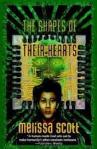 Cyberpunk. I loves it. This is not one of the best, but it’s definitely an interesting idea: someone has a new revelation from God, and recruits followers; for various reasons they leave for a new world, but this is complicated by said revelation, so original dude has a scan done of his brain and this scan lives on as a computer programme to keep giving visions and explaining the revelation. Et viola: deus ex machina where you take an I-don’t-understand-Latin stance; a very literal ghost in the machine. Now add someone who wants a copy for themselves, but that would be illegal, and… here we are.
I do not understand the title.
The plot: is generally straightforward. The POV jumps around a bit, but not confusingly. There are a few twists in the tale, generally related to character revelations, and the conclusion was pleasingly both appropriate and not completely neat. It’s closer to a heist story than a quest, in the way the Object is sought after; the vaguely criminal, or at least not-completely-above-board, elements contribute to this feel. One of the problems for me is that there are some tantalising little side stories… but they’re only hinted at, never given conclusion or even fleshed out very much. And this was annoying mostly because some of them appear, at the start, as if they are going to become very important. But they don’t.
The characters: a good variety. (Hey, I think it passes the Bechdel Test! Woot!) There’s the kinda-cops on Eden, who each have troubled/secretive backgrounds but work well together (that makes it sound like a buddy-cop movie; it’s really not); a DaSilva (cloned bodyguard) and her employer; and an IT/weather tech on Eden who’s really not sure she wants to be there anymore. The POV switches between one of the cops and the IT woman, mostly, which works well. None of the characters are especially fleshed out – there’s some background here and there, but not a whole lot about motivation or interactions beyond the plot – and now that I think about it, I didn’t actually care much about any of the characters themselves.
All of this makes it sound like this is a novel not worth bothering with, but there are definitely some really great aspects – I did finish it, after all. If you’re not in to cyberpunk then it isn’t for you, but I really enjoyed the bits ‘online’, so to speak, with one of the characters stuck there and having to deal with their predicament – including hostile programmes and the possibility of being ripped out of the virtual world, with attendant physical ramifications. I also enjoyed much of the characters’ interactions, and the plot itself: it’s fast-paced, easy to read, and enjoyable. The world building isn’t wildly exciting or innovative, but some of the ideas that Scott brings out certainly are. There’s only a passing reference, but the issue of clones is fascinating, especially when they know what they are; she’s done interesting things imagining how the law might treat them. The question of FTL travel is barely touched on, but again is really interesting: Scott allows it, but with serious physical and mental consequences if you do it too many times. I would read a whole book that set out to explore that idea.
Long story short: I didn’t love it, but it doesn’t put me off other Scott novels (which is good, because I have at least one more already on the shelf…).
City of Illusions
Fulfilment of my desire to read all of Ursula le Guin’s work continues apace, but this did not actually move me towards my goal… since as soon as I opened it I realised that I had read it before (in a double with Rocannon’s World). However, my memory being what it is, I couldn’t remember details, so I just kept on reading.
 City kinda fits into the Hainish cycle, but doesn’t really. It’s set on an Earth that has been a part of the League of All Worlds – the general background for the Hainish novels – but Something Has Happened, far back in the past, such that humanity now appears to exist solely in isolated enclaves that have little to do with each other, let alone to do with an interplanetary society. Some of the Hainish novels mention an Enemy approaching, and there is rumour of an enemy on Earth too, but their connection, if any – ?
The novels begins with a strange man wandering out of the Forest into the clearing of Zove’s House, which is something that just doesn’t happen. Additionally, he has weird eyes, as shown by the cover there – yes, like a cat. (Note: I think the blurb accompanying this edition is atrociously misleading.) He is taken in, and taught to live as a man, because despite being fully grown he has no language or any other capabilities beyond those of an infant. They give him a name: Falk, meaning yellow. Eventually Falk leaves, in the manner of young men who feel they have a quest to complete, and his travels take him to various parts of the world – meeting new people, most of whom are far less welcoming than his original sponsors, and eventually getting to the city of the Shing, who may or may not be enemies. And there he learns a secret….
I like this story a lot, for all it’s not my favourite. I always enjoy le Guin’s imagined future societies, and the things she sees continuing: here, for example, the Older Canon, Taoism, and the Younger Canon, which appears to be bits of the Bible; bits and pieces of technology; occasional random names (Kansas!). Her people are often sketches but for all that they generally feel real; Parth, Falk’s main teacher, is only in the story for the first 25 pages, but she is vital and vibrant and alive. The plot is also sparse; I have been known to describe le Guin’s work as exquisite pencil drawings, especially when compared to the lavish oil paintings of much modern fantasy. Anyway, the story certainly doesn’t fill in all of the details of Falk’s learning or his quest: after 11 pages, she skips five years – I can well imagine some authors taking the first book of a novel to fill in that time with everything he learnt! There are some clever twists along the way, but I don’t really think they’re the main point, somehow. The story is definitely important, but ultimately I think it is the vehicle for demonstrating Falk’s character, how he changes and develops and deals with situations.
An interesting part of the le Guin canon, for sure.
Galactic Suburbia 68!
The post-Hugo edition! In which stats are chewed and swallowed, rebels become the government, the secret (true) history of Wonder Woman is revealed and Alisa joins another cult. You can get us from iTunes or at Galactic Suburbia.
News
Hugo Awards: The Winners, the Ustream and the Stats (you can download the stats pdf at the bottom of the page that links to)
Caroline Symcox on coming out as Christian to SF Fans & coming out as SF fan as a curate.
Another Wonder Woman TV show in development – this one may contain some Wonder Woman.
Further discussion on conventions, creepers & safe spaces
Genreville
We Don’t Do That Anymore
And the SF Signal Podcast
Science books written for girls, or possibly “girls”.
What Culture Have we Consumed?
Alisa: Newsroom; Getting Things Done podcast, David Allen
Alex: Outcasts; Heir to the Empire, Timothy Zahn; Midnight Lamp, Gwyneth Jones
Tansy: How to Train Your Dragon audiobook; To Spin a Darker Stair (Fablecroft); The Twelve Labors of Wonder Woman;
Please send feedback to us at galacticsuburbia@gmail.com, follow us on Twitter at @galacticsuburbs, check out Galactic Suburbia Podcast on Facebook and don’t forget to leave a review on iTunes if you love us!
In the Mouth of the Whale: a review
I have not read The Quiet War nor Gardens of the Sun, so no doubt I missed some of the A-HA! moments that other readers got. But the promotional copy said this could be read as a stand-alone, and I pretty much agree. McAuley explains pretty much everything – eventually, in some cases – that is clearly a hang-over from the other two novels, and the action certainly seems to stand by itself. I’m not sure whether I am now spoiled for those other two novels, or whether this will simply give me a different way of looking at them. Because I certainly intend to read them, which may be the biggest endorsement I can give of this novel. It makes me want to read more of the same universe.
 The novel is told from multiple perspectives in multiple places. There’s the Child, growing up in Brazil with what appears to be a fairly normal childhood, but which clearly is not – for a start she is referred to as “the Child,” and capital letters may as well be glowing and red as well as capitals; then there’s the fact that her part of the story is not told by an uninvolved third party or by herself, but by a ‘we’ who refer to the Child as “our dear mother, twice dead” (p4) and about whom too much knowledge has been lost. So, weird.
Then there’s Isak, who is introduced while harrowing a hell with Horse, his ‘kholop’ (possibly terminology from the other books?), and whose life is as esoteric and bizarre as one could hope in an SF novel. Something of an outcast but still devoted to his family and his job, talented, and rather good at getting into trouble and usually getting out of it. Hells are technological rather than spiritual, but there’s still something Dante-esque about them and their connection to the ‘real’ world.
Finally there’s Ori, who works “on the skin of the Whale” (p19), whose jobs seem as dangerous as Isak’s but with a lot less kudos. The Whale is a monumental craft orbiting… somewhere… and Ori and her kin are essentially enslaved workers, keeping it going for their masters. She’s got ambition but seemingly little hope of fulfilling it.
These three stories look, for a long time, like their intertwining is going to take quite some stretch of the imagination. But intertwine they do, of course, and it works. But aside from the plot, one of the very interesting aspects of this novel is the storytelling techniques used by McAuley. The Child’s story is told, very consciously told: the reader knows there is a narrator, because they break in every so often to comment on what is unknown or on various frustrations. Isak gets to tell his own story – he’s an active narrator, choosing what to tell. And Ori, the slave, is the subject of a faceless narrator, with no choice over what is told or not. Very, very clever.
The plot? Well, it’s set a long way in the future, and humanity has splintered into a number of different… I want to say genres, but that would be weird. I’ll go with subsets instead. They do not coexist peacefully, and there’s something that all of them want to control for very different reasons. And in their own way, the Child, Isak, and Ori all end up playing a part in the battle to control and use that object.
Each of the threads has some very interesting aspects to it along the way, of course. Through the Child McAuley explores a not-too-distant Earth, with gene modification and other such SFnal aspects but also family interactions and attitudes towards technology. Via Isak the theme of technology is continued, and how knowledge can or should be stored and used – and what it means to keep it safe. And in Ori the ideas of freedom and individuality are played out and explored.
Very enjoyable far-future SF, with quirky and fairly well-developed characters. Lots of fun to read.

 Randomly Yours, Alex