Howl’s Moving Castle
 Yes I’ve only just discovered Diana Wynne Jones. Yes that’s very sad. Yes I understand you read them as a child. No, I’ve not yet seen the movie.
Moving on.
The book is a delight. I myself am the eldest of three (although there’s a brother in the middle – unlike Sophie I’m not burdened with two sisters) so I totally felt for Sophie and her lack of expectations, as the eldest of the family, as well as the burden of expectations. I also loved that Jones upsets fairytale expectations with the half-sister not being evil. And then I REALLY liked that after she is cursed and becomes old, Sophie takes complete advantage of the perks that age provides – being a crone provides lots of leeway, as Ursula Le Guin, amongst others, has discussed. You get to honest and irritated and people have to put up with you!
Speaking of, I see similarities between Jones and Le Guin, in that both of them have a relatively sparse style. Jones doesn’t spend much time explaining the world, explaining what the magic system is and how it works and all the backstory of the characters etc etc. She just dumps you in the world that’s a bit familiar and a bit weird and expects that you’ll be fine. And you are, because the people – even when they’re a fire demon – are recognisable and sympathetic.
Meanwhile, there’s a castle trundling about the moors. That’s awesome.
This is a great fun book with a bit of adventure, a bit of amusing romance here and there that’s kind of gently skewered while also being treated gently, a few surprises, and a young woman mostly enjoying being a crotchety old woman. Plus, being in trade is completely natural and fine, dominating others is not ok, and pre-judging people can get you into trouble.
Don’t read this when you’re 36 unless you miss out when you’re 12. Read it when you’re 12 if you possibly can.
Beggars in Spain
 What if you could genetically engineer babies to turn off the necessity to sleep? What if, with all that extra time, those children turned out to be super intelligent? And what if there were other consequences as well, that really hadn’t been anticipated?
That’s the premise of Beggars in Spain. While the science may be somewhat wobbly – sleep deprivation is a torture technique, so surely there would be greater consequences on the negative side – the point of the book is the social ramifications. Because of course, it’s only a small minority of foetuses who get this modification, thus creating a brand new minority group – one with what looks like enormous advantages over ordinary people, or Sleepers.
The focus is on Leisha, a Sleepless, whose sister Alice is a Sleeper and who often serves as a counterpoint to Leisha. The narrative skips through several stages of Leisha’s life, which I really like as a way of exploring developing social expectations, ideas and consequences. Firstly, Leisha is born, grows up, and goes to college. Then she is in her 40s, a lawyer, and American society has changed radically around her – there’s a huge reaction against the Sleepless, and the Sleepless themselves are more and more disillusioned by ‘normal’ society. To the point where many are starting to segregate themselves. Twenty years later and society has once again altered radically, with a hideous class system such that Kress draws deliberate parallels with Rome and the old ‘bread and circuses’ maxim. Then yet another couple of decades later things are changing for the Sleepless, and there are likely to be consequences for the world… but that, presumably, is for the next book.
Not being American, I think there were subtle (and not so subtle) digs at American society that didn’t really make sense to me. There’s a lot of discussion about American society not appreciating individual effort and problems with the notion of equality and so on that, while I got what Kress was talking about, didn’t have the immediate or historical resonances that I suspect a well-read American might pick up. Nonetheless this is an intriguing novel that combines generally engaging characters and genuine moral difficulties; there’s some action, there’s some intense political discussion, there’s some surprising technological development and totally retrograde societal change. I’m going to be getting the sequel.
Great Scott! A reviewing adventure
We are big fans of adventure and action films. My beloved is an unrepentant Top Gun fan, much to my dismay. We’ve both liked various Tony and Ridley Scott films over the years. So we thought, why not do a best-of viewing? That would be fun!
And then I looked at IMDB and MetaCritic, and it turns out that some of the top-rated films from Tony in particular are comedies. I am not watching Get Santa, nor Cyrus. Anyway, after some to-ing and fro-ing, we’ve decided on an idiosyncratic list of five from each Scott, which we’re going to watch in chronological order. It includes some films we’ve seen before, and a couple we never have (or not recently enough to have any real memory of). We’ll be watching and reviewing every fortnight(…ish).
We are looking forward to:
Ridley – Alien (1979)
Ridley – Blade Runner (1982)
Tony – Top Gun (1986)
Tony – Beverly Hills Cop II (1987)
Tony – Crimson Tide (1995)
Tony – Enemy of the State (1998)
Ridley – Gladiator (2000)
Tony – Spy Game (and here) (2001)
Ridley – Robin Hood (2010)
Ridley – The Martian (2015)
The Companions
 I can’t begin to say how angry I am at the blurbing of this book. It doesn’t even begin to hint at how awesome and wide-ranging and epic it is. Without prior knowledge that Tepper is amazing (which I knew from reading Beauty), I would have had zero reason to expect this to be at all something I would like.
The blurb tells you that humans have arrived at Moss to see if there’s intelligent life – which is true; that Jewel is accompanying her half-brother “to help Paul decipher the strange language of the Mossen” is not true, since she’s no linguist, and that “she has a secret mission too” is only half-true, since it’s not exactly an official thing that she’s doing. “A new law on Earth means the imminent massacre of all beasts great and small” is strictly speaking true, but it suggests that there are still many such creatures on Earth which is simply not what we are shown – almost all non-human creatures have long since been got rid of. And that “the Planet Moss, itself a living entity, is not sure it cares for any of the species currently living on its surface” is I guess kind of true but doesn’t give any indication of the complexity of what’s going on. And I certainly couldn’t write the blurb, but I’m not paid to do so.
So what should it have said? Well, clearly humanity have space travel, but personally I think it would have been good to include the fact that humanity is part of a vast interplanetary network involving dozens of different species, and in fact there’s a hugely important narrative thread that involves several different species manoeuvring around one another for dominance in ways that are depressingly familiar. That puts quite a different spin on the narrative than simply “humans are exploring new planets!!” Continue reading →
Devour
 Set your level of disbelief suspension to Sky High and you might enjoy this thriller. Published by Hachette, it was sent to me at no cost (RRP$29.99 pb, $16.99 eb); it comes out in July.
Olivia Wolfe is an investigative journalist (of course) who gets into some hot water trying to get a story in Afghanistan (of course). To give her some time away from pushy police and terrorists who might want to harm her, her newspaper sends her to Antarctica where a British science team is trying to drill down to Lake Ellsworth (which really happened a few years ago) in an effort to discover whether there’s life in the ancient, ice-locked lake. While there, she discovers possible murder and possible sabotage. There’s also Russians involved (which surprised me a bit because I thought we were beyond Russians as Generic Bad Guys).
There’s intrigue, there’s action, there’s death and some destruction; as the title suggests there’s something dangerous that might be unleashed that would be bad for the whole world. It’s fast-paced… in fact, sometimes too fast-paced, in that I nearly got whip-lash as people’s motives changed or allegiances swapped. And there’s a fairly explicit and unexpected sex scene that seemed quite out of place.
This is probably good airplane-fodder. It doesn’t require a whole lot of thinking, and in fact I’ll admit that I started skimming the exposition in the last third because I was only interested in the action, not the details. (Larking seems very intent of giving minute details about equipment and such – I’m not sure whether she thinks it makes the story more grounded, or well-researched, or what. I just found it boring.) I still managed to follow the story without paying too much attention.
One thing to be aware of: if stalkers squick you out, avoid this book. There’s a stalker who gets the occasional point-of-view section (which also felt out of place) that was generally unpleasant to read.
Cyteen: abandoned
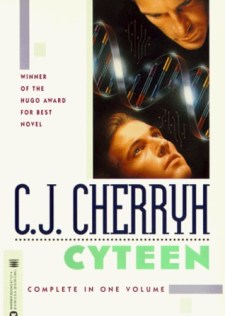 “Finished” does not describe what I did. “Abandoned”, sadly, does. I have simply not been able to get into this book at all. I find the Jordan/Justin naming confusing; I’ve been confused about what an ‘azi’ actually is; I don’t understand what these people are doing and whether I shoulda actually care. Since I started this book I’ve read about six others, which is a really bad sign.
My big question now is whether to actually abandon the book – physically remove it from the house – or whether to put it back on the shelf and think that I might actually get to it Some Other Time.
I’m really sad about this. I’ve always assumed that I would like CJ Cherryh; she’s been upheld as such a great part of sf history – and female, of course, as well. But at the 100-page mark I feel zero enthusiasm for nearly another 600 pages.
Music and Freedom
TL;DR: the fine print says that one of the classifications for this book is ‘psychologically abused women’. Yup. If that’s not your thing, do not read this book.
 This book was sent to me by the publisher, Penguin Random House, at no cost (RRP $32.99, out 27 June).
This is definitely not the sort of book I generally read. Partly because it’s mainstream ‘literature’ – I have nothing against it but there’s so much speculative fiction to get to! – and partly because the whole point of the story is about a woman whose life has been appalling. And I just don’t enjoy reading those sorts of stories.
My main take-away from this novel is: I am so glad that my husband is loving and encouraging. The most annoying thing he does is encourage me too much (ok, slight exaggeration there, but I’m still feeling intensely grateful). Continue reading →
Kid Dark Against the Machine
 Another short story from Roberts set in the world of “Cookie Cutter Superhero”, from the anthology Kaleidoscope. It’s a world where there’s a machine that makes people superheroes… for a time. Where the first story looked at what might happen when a girl with a physical disability got to the machine, this one looks at the aftermath for one person – what’s it like when you didn’t choose to be a superhero and then you have to go back to being ‘normal’?
I love this story, and I love this world. I love Griff, struggling to deal with the ordinary world and how to fit in to it after a period of fame. I love how Roberts imagines super villains. And I love the hints at what it’s like to have a sidekick thrust on you when you really don’t want one.
You can read it over here. Free!
Queen of the Desert: the film
As I mentioned in my post about the book Queen of the Desert, a biography of Gertrude Bell, I finally got around to reading the book after seeing the biopic directed by Werner Herzog and starring Nicole Kidman. I didn’t mind the film; my mother, having read the book, didn’t love it but didn’t hate it; having read the book I am increasingly annoyed by the film.
The good things: Continue reading →
Gertrude Bell
 Every now and then I come across a new historical figure and I think
HOW IS IT POSSIBLE THAT I HAVE NEVER HEARD OF THIS PERSON WHAT HAS THE WORLD BEEN DOING THIS JUST SHOWS HOW MUCH STUFF GETS LOST
Usually that person is a woman, although not always. Gertrude Bell is the most recent of these people. I don’t even remember how I heard about her – it might have been in passing in a podcast or something? – at any rate the moment I heard about her I went online to see if there was a biography about her. There are two, I think, modern biogs; this seemed to be the better rated, and so I immediately bought it. Since then my mother has read it, since I always have too many books to be read, and she loved it; then we spent some time together which just happened to coincide with Nicole Kidman’s movie about Bell being at the cinema, so we went to see it and I was pushed to move my reading of this bio to the front of the reading queue.
Gertrude Bell might be described as the ‘female Lawrence of Arabia’, but really it would be more accurate to say that he was the male Gertrude Bell, since I think she had more adventures and was more involved in the immediate post-WW1 decisions regarding Mesopotamia.

 Randomly Yours, Alex