The Rebirth of Rapunzel
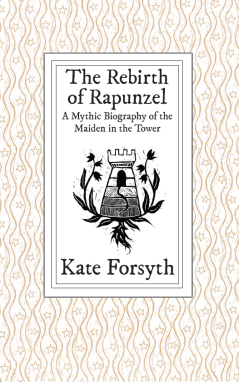 This book was given to me by the publisher at no cost.
I adored Kate Forsyth’s Bitter Greens a few years ago – a reimagining of the Rapunzel story, along with the story of one of its first tellers, Charlotte-Rose de Caumont de La Force (1650-1724). It’s a book of excruciating loveliness, whose three interleaved stories are told in heartbreaking detail and with great compassion.
But I’m not here to talk about that. If you haven’t read it – and even if you don’t think you like fairytale reimaginings – you really ought to go read it.
What The Rebirth of Rapunzel does is present Forsyth’s research into the story of Rapunzel – about the differences in versions, and the people who told them, along with what the story has meant, can mean, and what it shows us about fairytales in general. I think it’s just awesome that research like this can find a home; it’s so depressing when something you’ve spent many years on simply… disappears into a black hole. Forsyth has made her research very readable. I’m coming from a background of literary and historical criticism (I’ve read a couple of the books Forsyth refers to), but I’m pretty sure that such a background isn’t necessary to understand and appreciate Forsyth’s points. This isn’t academic-lite; it’s academic-approachable. Continue reading →
Consider the Fork
 When I listened to the first episode of Gastropod, I immediately decided I needed to read Bee Wilson’s Consider the Fork. And now I have, and I was not disappointed.
To start with the writing: Wilson writes beautifully. Her prose is clear, occasionally whimsical, sensible, and altogether a delight to read. It’s not that often that I read 280 pages of history in just over a day, even when I’m on holidays. In fact at one point I tried to put it away because I was worried I would finish it too quickly (I was away from my bookshelf; I was feeling a bit irrational, ok?). Her love of food and history and cooking come through clearly; she mingles the occasional personal anecdote with what’s clearly broad-ranging research. But she also doesn’t get bogged down in the research – she’s not aiming to construct a thorough, blow by blow account of the development of cooking or food technology. She’s writing for an educated but non-professional audience and she does it really well.
The chapters are organised around probably the most important aspects of cooking and its technology: pots and pans; knives; fire; measuring; grinding (I admit this one surprised me a little); eating; ice; and the kitchen itself. In each chapter she gives some of the current thinking about where and if possible how the technology began (in some instances in the Palaeolithic, in others more recently), and then – depending on the objects – skims through the ancient world, the medieval, and the early modern.
My main quibble with the book is its European preponderance, but I do wonder whether I’m being overly sensitive about that. There’s a wonderful section about the Chinese knife, the tou; and a discussion about the difference in fork+knife vs chopsticks; some about the differences in wok cooking opposed to more European methods; and other mentions as well. I wonder if there’s more history done on this from a European perspective – or that’s translated into English anyway. Although if that’s the case I would have liked a mention of the dearth of literature.
Another small quibble is that sometimes her language implies that the changes in cooking technology were things that the population had just been waiting for. While that might be true for can openers (invented FIFTY YEARS after the invention of the tin, I kid you not), sometimes it grated a little: to whit: “At last, these people [the ancient Greeks] had discovered the joy of cooking with pots and pans” (12). I get what she means but it grated a little.
Anyway. A few gems include ideas for future ice cream experiments (burnt almond, orange flower water, cinnamon, apricot, quince; bitter cherry; muscat pear…), the history of the refrigerator and freezer and how they show differences between the English and Americans post-WW2, and developments from coal to gas to electricity in terms of stoves. Also the thing about the tin opener. SO WEIRD.
Overall this is a joyous book that I highly recommend if you’re into food and history, especially both at the same time. Her writing really is marvellous, you might learn something, and it re-inspired me to get into my kitchen and make something. (Which was annoying because I was on holidays, but whatevs.)
The Dream-Quest of Vellitt Boe
 This book was sent to me by the publisher, at no cost.
A middle aged woman goes on an epic quest. You’ll want to be reading this in August when it’s released by Tor.com.
…no seriously, what more do you need to know?
Oh ok.
Vellitt is a mathematics professor at the only women’s college in her city. Although it’s not really “her” city – it’s just where her youthful ramblings ended up taking her. Anyway one night she discovers that one of the students has left – run away with a boy – and not just any boy, but one from the waking world. Because Vellitt’s world is a dreaming world, and things are not the same there as they in the waking world of Earth. Thus begins Vellitt’s quest.
I was fascinated by the world building here. It’s not entirely original – there are other stories where people know that they live in a secondary world or an imagined world or a story – but this dreaming world with its heavy sky and ninety seven stars and changeable distances and multitude of cranky, vicious gods is beautifully realised. I could imagine many stories set here but actually, I rather hope that Johnson just leaves this as a stand-alone jewel.
Johnson says that this was an attempt to re-imagine a Lovecraft story she loved as a child but whose racism and lack of women was clearly problematic. The story is completely and thoroughly Vellitt’s. She reminisces about her experiences travelling the wide world as a young woman, about the people she met and skills she learned; but she’s not pining for her youth. She’s entirely comfortable with her black and silver hair and with the experience age has brought. Vellitt deals with all the problems cast her way – sometimes well, sometimes with help, and sometimes she’s left shaking with fear and revulsion. She’s determined and pragmatic and I really like her.
The Moon is a Harsh Mistress
 This was sent to me by a Galactic Suburbia listener, when I mentioned that I had finished my first Robert Heinlein (Stranger in a Strange Land) only recently. Isn’t that awesome??
… apparently I should feel a bit bad about not loathing this. Ah well.
The short version is: I enjoyed it more than I anticipated that I would. I had zero knowledge of what the story was about before going in (except for the slight teaser from Jonathan Strahan describing Luna: New Moon as “The Moon is a Very, Very Harsh Mistress”), and given that it was published in 1966 by a man who has almost become synonymous with outdated ideas and views… yeh, I found it surprisingly readable.
Let me deal with the problems first and get them out of the way. Yes, it’s racist. The Chinese colonists and those on Earth are not given the same level of respect as the white colonists. I am in no way disregarding that; but I was expecting it. It’s like being able to tolerate – that is, not run away screaming from – such racism in James Bond movies. But I’m white; I have the advantage of not having to deal with that sort of crap every day. I can understand not wanting to wade through that to get to possible good bits. I am certainly not saying anyone has to read this.
Additionally, yes it’s sexist. Interestingly it’s not as sexist as I had expected; there are a couple of women who have active and interesting roles. While Wyoming doesn’t have as active role as some of the others, she is present and she is a genuine member of the action, as are – if to a lesser extent – a couple of other women. So I think it does slightly better on the female angle than on the non-white angle (damning with faint praise?).
The short version of the plot: the moon is being used largely as a penal colony – well, the bit the story cares about; there’s also a Chinese colony, but they hardly feature (see? racism). The colony is being used as labour to extract stuff that Earth needs. So there’s a revolution. Naturally.
SPOILERS below in case you’re like me and a Heinlein novice. This isn’t pretending to be an in-depth analysis of the book, just a few comments on the things I found interesting.
Baudolino
 I’ve had this on my self as needing to be read for… a long time. I have finally got to it as part of my effort to make a dent in the to-be-read shelf. I read the first couple of pages to see whether I did want to read it, and I did. It opens with Baudolino starting to write his memoir, in a mixture of languages and appalling spelling and with the occasional bit of Latin intruding because Baudolino wasn’t able to scrape it all off the parchment. It’s unclear whether Baudolino is telling the truth … and basically that’s the motif of the entire book.
The entire premise of the book is to explore the ideas of truth and ‘truthiness’ (which I think Stephen Colbert developed) – when does a thing that’s not true become true because it’s been claimed to be true enough times? – and notions of faith, and honesty, and history. And basically it’s a big sprawling story about one man claiming to have connections to a whole bunch of stuff that is generally accepted to have happened in history along with other things that exist in myth and legend. It’s sprawling and epic and quite remarkable. As you would expect from Umberto Eco.
Baudolino is telling his story to a Byzantine man he’s rescued during the Crusaders’ sack of that city; Baudolino isn’t part of the sacking but he looks Frankish enough to be able to get around. He’s telling the story as a way of making sense of his life, searching for the meaning he hopes to see in his experiences. So there’s two narratives going on here, as Baudolino and his friend look to get out of Constantinople, and the story of Baudolino himself. It’s the second, of course, that’s the most interesting bit. His story begins with meeting Frederick Barbarossa and being adopted by him because he, Baudolino, tells such interesting stories and appears to be a good luck charm of sorts. It then progresses through Baudolino going to university in Paris, and then various escapades with Frederick, and eventually going on a mind-boggling journey to find the country of Prester John. Along the way he encounters the story of the Grasal (Grail), meddles in politics, makes and loses friends, nearly dies several times, and is rarely accounted as much of a scoundrel as he actually is.
Note: the fact that this book is translated is remarkable, and the translator – William Weaver – should get more acknowledgement than he does. It’s beautifully written.
Frankenstein
 I have now read Frankenstein. I’ve never had the impetus to read it before; I never studied Gothic literature, and it’s just never been bumped up the to-be-read list. But a few weeks ago someone at church read it, and waxed so lyrical in wanting to have a pop-up book club to discuss it (as a sequel to one last year on The Book of Strange New Things) that I agreed… and here we are.
Um, spoilers?
I do not like Victor Frankenstein.
I had a general knowledge of the story – that Victor created the monster, who then implored his creator to create a mate for him, and then the monster killed Victor’s bride. I knew there was something to do with the Arctic but I didn’t know why. So to be honest, I wasn’t really expecting to be particularly surprised by the novel. And in the broad outlines, I wasn’t, but in some of the details I certainly wasn’t.
I had no idea that the story was structured as a story within a story, with Victor relating his tale of woe to Robert as they sat stuck in the ice in the far reaches of the Arctic, who is then relating it by letter back to his own sister. I don’t think that particularly changes the story itself but it’s intriguing to see Shelley using this conceit as the excuse for why, and how, the story is being told – that she wasn’t just writing a third-person omnipotent narrator watching and relating all the events. Instead, this allows Victor to include his passionate remonstrances and remembrances, and for Robert to include his own reflections at beginning and end.
Side note: I would have liked more about Robert. Did he get home? Why was he so passionate about finding what was in the extreme north? I wanted more than just what he told his sister!
And so Victor. Continue reading →
Nemesis Games
Previously, in The Expanse: Leviathan Wakes; Caliban’s War; Abaddon’s Gate; Cibola Burn.
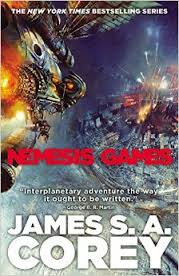 Basically my entire review of this book consists of JAMES COREY YOU ARE TOO MEAN FOR WORDS WHY FOR DID YOU DO THAT?!
Spoilers for the first four. Duh.
The preceding books have mostly focussed on Holden and someone else, or a few other someones, doing important things in the solar system. This time there are four points of view: Holden, Amos, Alex, and Naomi. This should have warned me about what was coming, but somehow my brain refused to process the obvious reason for doing this.
Corey splits up the crew of the Roci.
Splits. Them. Up.
I mean, it was bad enough when half the crew went onto the surface of a planet in the last book. Of course sometimes one or more have gone off on their own individual missions. But never before have the four been pursuing largely separate ends, separate from one another. It was devastating.
Where Cibola was focussed on the early attempts at colonising a new planet through the gate, this is focussed squarely on the repercussions of such colonising for the solar system itself. After all, why bother terraforming a planet when there are planets already ready to be colonised, where you can walk on the surface? Why break your back mining asteroids when there’s minerals on the worlds where you can breathe the air? … but then what happens to those places that had people working on them, who then leave?
It’s kind of an epic version of a gold rush.
Overall this is another excellent, page-turning, enthralling novel and I cannot wait for the sixth (and final, I think) volume.
I have one quibble. Continue reading →
Nightshades
This book was provided to me by the publisher at no cost.
 It’s fair to say that I’m not a huge vampire fan. I have read a few vampire books, I’ve seen a few vampire movies, but they’re not automatically my preference. So I acknowledge that I may not be the best judge of a vampire story. But anyway, here I go giving a review of one anyway.
Vampires, in this it’s-tomorrow story, have recently been acknowledged as existing in the real world. But unlike in Gail Carriger’s stories, they’re not making moves as a population group to be accepted by the general human population. In fact it’s not really clear what the purpose of the vampires is as a group. Which is fine, because that’s not Olson’s purpose in writing the story. Instead the story is focussed on two people: one an FBI agent who’s joining the newly created paranormal division, and the other… well, that would be telling.
Alex, the agent, is a ‘legacy agent’ – his mother was a big shot in the Bureau and he’s looking to live up to that. Well, that’s what I got from the start of the story, anyway. It was kind of ignored for the rest of the story, though, and while I can see that neither the story nor the man want people to keep harping on his past it also felt like a part of his character that just went nowhere. Overall, though, he was a competent agent and made some interesting choices.
The other character was more interesting, but I don’t want to say too much about her because that are some nice revelations that are part of the fun of the story.
This story is fast-moving and has some nice character moments. It’s clearly setting up for a sequence of stories about the way humanity reacts to those different from them, and also what consequences predators can have. I’m not sure at this stage whether I’d sign up for the rest of the series, simply because I have so many other books to read and I did not fall completely in love with any of the characters or the setting. But if you’re into vampire stories crossed with police procedural types, then this is probably just your thing.
I also want to note that I read this off the back of Umberto Eco’s Baudolino, and that was a REALLY weird back to back experience.
Extra(ordinary) people
 Oh Joanna.
Five narratives, loosely connected by brief snatches of conversation between a schoolkid and their tutor on history. Each story different – thematically, stylistically – each story offering different perceptions on humanity and difference and survival.
I’d read “Souls” before – I have it as an Ace double with Tiptree’s “Houston, Houston, Do You Read?” The Abbess Radegunde is a remarkable woman – highly educated, linguistically talented, devoted to God and her flock of nuns – and then one day the Vikings come a-raiding. And things change, but definitely not in the way the Norsemen were expecting. How can you judge the people around you? What are you willing to sacrifice? How do you know who you are? I love that this story seems like one sort of story and then KAPOW it’s a very different one.
I found “The Mystery of the Young Gentleman” quite hard to come to grips with, and even on reflection it’s still not entirely clear. Partly this stems from language: someone refers to the narrator as an ‘invert’, and I wasn’t entirely clear what that meant although I knew it had insulting sexual/gender overtones; I’m still not clear whether the speaker intended it to mean homosexuality or cross-dressing. In the context, probably either-or. Anyway, the story is written by the titular young man, as a series of letters although we don’t know who the recipient will be. He’s travelling across the Atlantic with a young Spanish girl pretending to be his niece, and there’s a nosy doctor and a few other passengers. Like I said I’m still not entirely sure what was going on here – whether the young man was rescuing a girl like himself, where both of them are like Radegund from the previous story? Maybe. Despite my lack of complete comprehension I did still enjoy the story in a very Russ-type way: it challenges ideas of gender and sex and sexuality and identity and appearance and how much information you need for a story, anyway. Also what sort of stories ought to be read by young women.
“Bodies” goes well into the future and was probably the most opaque of the five stories, for me (possibly not helped by reading while camping, but anwyay…). This is also written as a letter, but this time we know who is being addressed – James – and the writer is reflecting on the time when they met (after he had been pulled from the past/resurrected/ reconstructed) and the immediate aftermath. It’s also concerned with sexuality and gender identity – James has had a bad life because of his, and adjusting to a future where he is actually allowed to be himself is difficult. In some ways I was put in mind of Marge Piercy’s Woman on the Edge of Time in terms of how hard it might be a for a 20th-century mind to cope with something approaching a utopia (especially someone who has been oppressed), because we’re suspicious and guarded.
“What did you do during the revolution, Grandma?” is a bit Greg Egan and a bit Ursula Le Guin and a bit James Tiptree Jr. What if our universe exists on a hypersphere and the point where we happen to exist is the point where cause and effect happen to equal 1? Which means there are other universes where cause and effect does not equal 1… and then what would happen if you could access those other places? What would humans do? … it’s a pretty weird story. I am intrigued by the conceit although I don’t think Russ plays it out as much as she might. Again she goes in for human stories rather than the maths looking at cause and effect in humanity, and love and sex and confusion.
Finally, with “Everyday Depressions”, I nearly cried. It, too, is epistolary – it opens with “Dear Susanillamilla” – and it’s about the letter-writer hashing out the plot and characters for a novel she (I presume) is thinking of writing. The bit that made me cry was when the heroine’s mother is named Alice Tiptree, of the Sheldons of Deepdene. The entire collection opens with a quote from Alice Sheldon:
“I began thinking of you as pnongl. People” – [said the alien] “it’s dreadful, you think a place is just wild and then there’re people – “
I can’t help but see similarities in the way Russ wrote to Alice Sheldon in the style of these letters, and in Sheldon’s letters back. The development of the gothic novel the writer is proposing to write also just makes me ache, in knowing the Russ/Sheldon connections – and also of course Russ’ own discussions about the gothic story. This little story is an absolute gem if you know those connections, and still amusing and lovely even if you don’t.
Oh, Joanna.
The Dark Labyrinth
You know that thing where because you read so much of one genre, you keep expecting non-genre books to follow the same conventions?
That.
 I know the Durrell family from having read My Family and Other Animals by Gerald Durrell at school, and then reading several more of his memoirs off my own bat. It’s quite funny to realise that the moody older brother Gerald remembers turned into, apparently, quite a well-known author.
I think I took this off my parents’ bookshelves many years ago and I’ve never got around to reading it. I have finally done so as part of a concerted effort to get through my to-be-read pile, which I started… last week.
This was published in 1947 (my copy is from 1969). I kind of feel like I need to better understand post-war Britain before making claims about this novel… but actually that’s not the case. Certainly I think Durrell is making some pretty specific comments on British society of the time; but he’s also making comments about humanity more generally that are still applicable today.
The story: a bunch of random people, some with tenuous connections and other not, come together to go explore a labyrinth on Crete as a day-trip from their Mediterranean cruise. The first chapter is written in the aftermath, so we know right from the start that there’s been an accident and some people haven’t survived – I was surprised to see this narrative technique in a box written 70 years ago, to be honest, and was quite confused initially (it’s one of the aspects I now love about it). The rest of the novel gives some background to most of the characters, and then details their experiences within the labyrinth.
I should stop here and say I really loved this book. Occasionally the style made me impatient – some sentences were a bit too opaque for my tastes, and I couldn’t quite figure out whether Durrell is being serious in his misogyny or whether he’s being ironic, since I think both options are equally plausible. But this book is staying on my bookshelf, since I can well imagine rereading it (also my mum might be sad if I ditched it).
Durrell himself said the novel was
really an extended morality but written artlessly in the style of a detective story. Guilt, superstition, The Good Life, all appear as ordinary people; a soldier on leave, a medium, an elderly married couple (Trueman), a young unfledged pair, a missionary…
(in a letter to Henry Miller). The variety of characters – yes, many of them tropes – is of course what allows him to explore different attitudes and ideas and problems. The main character, or at least one of two who gets the most airtime, is a mediocre poet-cum-wannabe-critic who has just been drifting for years. Born to some money, never really had the inclination to hold down a job or be properly the starving artist in the garret; not great to his wife; and so on. In contrast, the other character with the most time is Baird, who has come to Crete to try and lay some demons to rest – the difference between the two men is stark. The other single men of the group – the medium mentioned above and an arrogant artist – provide some colour. There are two women: the missionary, who is severe and generally angry and disapproving, and an uneducated young woman trying to better herself. The “elderly” married couple – and it hadn’t even occurred to me that their name is Truman! – are really a package deal throughout the novel and may be my favourite part of the whole story. Certainly their eventual story is the most captivating. They are generally looked down upon by the artists and “better bred” members of the group (they won the opportunity to go first-class on the cruise) but there are simply wonderful moments that make them incredibly real. Like someone walking past their room one night and hearing her crying, and him saying “There, Elsie… I know things would have been different if it hadn’t died.” And then there’s no further explanation.
For all its universality, this is a novel of its times. People are still deeply affected by the impact of World War 2. The medium, Fearmax, has had a basically reputable career as such. Notions of class, while beginning to unravel, are still very prominent (and perhaps they are still in Britain but I think it’s more pronounced here). Psychotherapy is an intriguing notion and people can’t quite figure out whether to view it as science or quackery. That doesn’t mean you need to understand 1940s Britain to get the novel; it just means that understanding these people live in a basically recognisable but actually very different world is an important thing to keep in mind. The past: they did things differently. Even in novels.
As to my earlier comment: there is no fantasy element to this story, even though it really felt like there should be, at times.

 Randomly Yours, Alex