2016 Snapshot: Lisa L Hannett

 Lisa L. Hannett has had over 60 short stories appear in venues including Clarkesworld, Fantasy, Weird Tales, Apex, the Year’s Best Australian Fantasy and Horror, and Imaginarium: Best Canadian Speculative Writing. She has won four Aurealis Awards, including Best Collection for her first book, Bluegrass Symphony, which was also nominated for a World Fantasy Award. Her first novel, Lament for the Afterlife, was published in 2015. You can find her online at http://lisahannett.com and on Twitter @LisaLHannett
You recently won the Ditmar Award for Best Novel for Lament for the Afterlife – congratulations! What’s the response been like to this novel, and what was it like to write?
Thanks! I was (and continue to be) so chuffed that Lament won a Ditmar for Best Novel; it was a wonderful and surreal experience hosting the awards ceremony at Natcon this year, having no idea who the winners would be, and then announcing my own name in that category! More importantly, though, it felt really special to receive this nod from my peers, especially since Lament is my first novel.
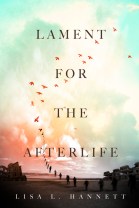 Writing this book was a fascinating challenge, to be honest. At one of the launches, I mentioned that Lament was a complicated response to my perhaps naïve question: “Why war?” and that’s still how I think of it. I am perpetually interested in war stories — particularly wars that seem futile, or that drag on endlessly, or that seem hopeless — and I’m also constantly attracted to narratives exploring ideas of masculinity and/or what it means to “be a man”, which is no doubt also one of the reasons I’m so hooked on researching and writing about the Viking Age. I’m always wondering what happens to the regular folks when they’re confronted with huge social upheavals, and I’m also interested in the power of language to effect change (for better or worse). So, bearing all this in mind, working on Lament meant I was immersed in a bunch of topics that I find so absorbing, which made writing it — well, I won’t say fun because it was sometimes really hard, especially when dealing with such harrowing material. (The footage I watched of WWI soldiers suffering from shellshock while researching this story will be burned into my memory forever.) But it was engrossing, and putting this story together certainly made me grow as a writer. The book’s unconventional structure meant that I could write Peytr’s life narrative out of sequence, which I’d never attempted before, and that also opened up a lot of possibilities in terms of characterisation, plot, and world building. It also meant I avoided the mid-novel slump, since I wrote the middle of the novel after writing everything but the final chapter. It’s a bleak story, so people who are after a cheerful escape won’t necessarily find it’s up their alley, but I couldn’t in good conscience write this story in any other way.
One of the best responses I got was from my editor at ChiZine, who said she was bawling her eyes out at the end, which was the perfect reaction in my opinion. Another brilliant surprise I got was listening to the Writer & The Critic’s “Fab 50” episode and hearing Kirstyn McDermott (whose writing I admire immensely) pick it as her #1! That was pretty exciting. Of course, it was so great seeing Lament get positive reviews on Kirkus, i09, Publishers Weekly, SF Signal and to see it longlisted for the Sunburst Award in Canada. But probably the very best responses have been from soldiers who’ve read the book, given it five stars, then said I’d nailed the guys’ sweary voices, the overall tone, the confusion and dread and boredom of being on the frontlines, and so on. Man, that was as much an honour as it was a relief.
You and Angela Slatter have collaborated on a number of collections in Australia, such as The Female Factory, and these works are quite different for you both. How do you go about writing those stories?
In many ways, Angela and I have such different interests in reading and writing — she’s an enormous crime buff, for instance, and can write a cracking mystery tale, whereas I love reading and watching crime stories but don’t know if I’d ever write one; she’s got such a strong commercial voice, whereas I love veering off into experimental narrative structures; she’s often drawn to writing strong female characters, which I also love doing, but I find myself often depicting vulnerable men — but we have so very many interests in common (mythology, history, fairy tales, etc etc etc) there’s always a place where our styles and ideas can overlap.
When it came to writing The Female Factory, Alisa had given us the challenge of creating Science Fiction pieces (which neither of us do overly much) so it was fantastic having two minds on the job! We brainstormed as much for that collection, I’d say, as we did when writing Midnight and Moonshine, even though that book was about three times longer. No matter what we’re working on together — whether it’s stories about raven-women and Norse gods or about kids cobbling a mother together out of stolen body parts — we always discuss the main ideas, character arcs and plot points together before starting a project. Then, usually, one of us writes the opening, or a key scene, or something crucial to kick things off. Once there are words on the page, we pass the document back and forth between us — adding bits, deleting bits, editing each other’s paragraphs, building on them — until we’ve got the whole thing drafted. This process sometimes takes up to ten drafts, which is many more than we do when working on stories individually. Mostly this is because we’re perfectionists, but also because we’re communicating so clearly and extensively throughout the drafting process; we add loads of comment bubbles explaining the changes we’ve made, and why, so that we’re both on the same page and aiming for the same narrative goals. Also, by the time we’ve gone through this many drafts, the “voice” of the piece no longer seems to be either just Angela’s or just mine. Instead, it’s a third voice that you won’t find in our individual projects — and I think that’s an important feature of our collaborations. Most of all, our partnership works because we’re so open to discussion, we’re not precious about being edited, and because we trust each other implicitly.
You often seem to have a lot of projects on the go at the same time. What’s the most exciting one you’re working on at the moment?
I’ll narrow it down to two because I’m equally excited about them! I’m a whisker away from finishing the edits on my next collection, The Homesteaders, which is a sort of follow-up book to Bluegrass Symphony. Backwoods witches, immortal soothsayers, bear-shaped child-stealers, raven-shaped miners, and lots of ghosts appear in these short stories, and they’re all tinged with a down-home country twang. I’m also doing rewrites on my next novel, Ketill’s Daughter, which is the first in a two-book series called The Invisible Woman. Set in Viking Age Norway, this first book tells the early story of Unn the Deep-Minded — wife of one king, mother to a second, and eventually a famous Viking herself — as she struggles to find her own fame and fate in this warrior world, all while her shape-shifting time-travelling fylgja (a kind of spirit guide) keeps butting in to mess things up for her… The second book in the series (called Deep-Minded) will follow Unn out of Norway into medieval Ireland, Scotland, and finally Iceland.
What Australian work have you loved recently?
Alison Goodman’s Lady Helen / The Dark Days Club is such a rollicking read! I enjoyed it so much, I’m dying to read the next book in the series. James Bradley’s Clade was an astounding work of speculative fiction, and though I read it last year, I still think about it frequently. Another Book One I devoured last year was Kim Wilkins’ Daughters of the Storm; I’m hanging out for Sisters of the Fire! And of course, Angela Slatter’s Vigil: it’s a really fun urban fantasy set in Brisbane, and I gulped it down almost whole.
Which author (living or dead) would you most like to sit next to on a long plane trip and why?
Well, they’d have to be outgoing enough to kick off the conversation because, usually, I’m one of those people on planes who’s like, I don’t care how close together our seats are: please don’t talk to me I just want to read my book and watch a crappy movie and hopefully fall asleep. BUT, assuming I was in a chatty mood … and excluding any writers who are currently my friends (because how to choose only one?!) … I’m going to go with the first name that pops into my mind, and that’s David Malouf. I’ve recently re-read Ransom, which is an incredible reimagining of the story of King Priam, Hector, and Achilles, and good lord it’s a brilliant book — as brilliant as An Imaginary Life, really — and I’d love to have a long talk with him about it, antiquity, poetry, myths, short stories, the libretti he’s written, the great breadth of his knowledge about language, life, the universe, and everything — and I’d also like to ask him where he’s stashed the painting that’s ageing on his behalf (because, seriously, how is it possible that he’s 82? He looks at least twenty years younger. Witchcraft, I say! Or a supernatural portrait.)
Crossposted to the Snapshot blog, along with all the other interviews.
Farscape: s1, e8
Each week on a Sunday afternoon, join Alex (of Randomly Yours, Alex) and Katharine (of the unpronounceable Ventureadlaxre), as they re-watch the Australian-American sci-fi show Farscape, notable for the Jim Henson animatronic puppets, the excellent mish-mash of accents, and the best OTP ship of all time.
Season One, Episode Eight: That Old Black Magic
Whilst in a marketplace on a planet, Crichton gets tricked away by some old wizard guy for his own sick and twisted games. Which, in turn, show that more people than we think can be sick and twisted also.
K: Rygel needs medication? Ah well, life comes and goes. Bring back the cute bird instead.
A: And John’s in his old space suit!
AHAHA Rygel has man-flu and Crichton is grossed out by the idea of raw brains. Continue reading →
Farscape rewatch: s1, e7
Each week on a Sunday afternoon (uh, ish), join Alex (of Randomly Yours, Alex) and Katharine (of the unpronounceable Ventureadlaxre), as they re-watch the Australian-American sci-fi show Farscape, notable for the Jim Henson animatronic puppets, the excellent mish-mash of accents, and the best OTP ship of all time.
Season One, Episode Seven: PK Tech Girl
Our favourite fugitives have been know to find dead ships and ransack them for salvage. It’s on one of these jaunts that they happen to find one of Crais’ workers, and things spiral out from there into emotions, a fire fight with another crew seeking salvage, and Rygel’s darkest memories.
A: EW close up of Rygel’s nose is WRONG. BUT! Crais! … nope, not Crais. So sad that Crais is not back. D’Argo wants info but Aeryn wants weapons. Perfect.
K: She is, isn’t she? Dead ship though, in the uncharted territories… must be Firefly 😀
A: those graphics are beautiful
K: They are. I also like what Aeryn’s wearing in this episode. SUCH a girl crush.
A: I love Aeryn walking around with that ENORMOUS gun. So competently.
K: She probably feels way more competent and comfortable with it, rather than without. Continue reading →
Beggars in Spain
 What if you could genetically engineer babies to turn off the necessity to sleep? What if, with all that extra time, those children turned out to be super intelligent? And what if there were other consequences as well, that really hadn’t been anticipated?
That’s the premise of Beggars in Spain. While the science may be somewhat wobbly – sleep deprivation is a torture technique, so surely there would be greater consequences on the negative side – the point of the book is the social ramifications. Because of course, it’s only a small minority of foetuses who get this modification, thus creating a brand new minority group – one with what looks like enormous advantages over ordinary people, or Sleepers.
The focus is on Leisha, a Sleepless, whose sister Alice is a Sleeper and who often serves as a counterpoint to Leisha. The narrative skips through several stages of Leisha’s life, which I really like as a way of exploring developing social expectations, ideas and consequences. Firstly, Leisha is born, grows up, and goes to college. Then she is in her 40s, a lawyer, and American society has changed radically around her – there’s a huge reaction against the Sleepless, and the Sleepless themselves are more and more disillusioned by ‘normal’ society. To the point where many are starting to segregate themselves. Twenty years later and society has once again altered radically, with a hideous class system such that Kress draws deliberate parallels with Rome and the old ‘bread and circuses’ maxim. Then yet another couple of decades later things are changing for the Sleepless, and there are likely to be consequences for the world… but that, presumably, is for the next book.
Not being American, I think there were subtle (and not so subtle) digs at American society that didn’t really make sense to me. There’s a lot of discussion about American society not appreciating individual effort and problems with the notion of equality and so on that, while I got what Kress was talking about, didn’t have the immediate or historical resonances that I suspect a well-read American might pick up. Nonetheless this is an intriguing novel that combines generally engaging characters and genuine moral difficulties; there’s some action, there’s some intense political discussion, there’s some surprising technological development and totally retrograde societal change. I’m going to be getting the sequel.
Great Scott! presents: Alien
 Ridley: 1979
Every fortnight (ish) my beloved and I are watching a film by either Ridley or Tony Scott. We’re watching in chronological order. There are, of course, spoilers.
General thoughts:
I love the music, and the lack of music is quite stark in a number of these scenes – when they’re looking through the cabinets and the only sound is their footsteps, it really enhances the creepy-factor. And I love the graphics – the planets are gorgeous.
They have such bulky space suits – they seem peculiarly un-futuristic, but then the whole aesthetic is that it looks remarkably familiar for all that it’s set a long way in the future.
I really like the way the characters physically deteriorate. Ripley has a massive bruise on her cheek; Lambert is grimy and sweaty and distraught. Parker is sweating. Ash, though, continues to look calm. BECAUSE ASH IS CREEPY.
The cinematography is marvellous and it’s a delight to watch. Intimate, for all it’s set on a huge spaceship.
Farscape s1, e6
Each week on a Sunday afternoon, join Alex (of Randomly Yours, Alex) and Katharine (of the unpronounceable Ventureadlaxre), as they re-watch the Australian-American sci-fi show Farscape, notable for the Jim Henson animatronic puppets, the excellent mish-mash of accents, and the best OTP ship of all time.
Season One, Episode Six, Thank God It’s Friday Again!
Summary: In which D’Argo turns from super angry to super hippie, Crichton gets beaten up (again), Aeryn discovers more and more about herself, and Rygel is actually kind of helpful?
K: D’Argo seems a bit cross about something. So it seems Luxons have a thing called hyper rage and Crichton is right in his firing line as he’s another male and therefore competition, I assume?
A: dangerous stuff. Also, Rygel looks disturbingly excited about D’Argo having killed someone.
K: Mad Max reference, and now we’re in a scene from the second Matrix. Though this probably came out before that?
A: “No one saw the third one” – ? I thought Thunderdome was more popular than the second! And ha, alien orgy scene. Awesome.
And D’Argo is now… stoned? And happy to see Crichton? Must be stoned. Continue reading →
The Companions
 I can’t begin to say how angry I am at the blurbing of this book. It doesn’t even begin to hint at how awesome and wide-ranging and epic it is. Without prior knowledge that Tepper is amazing (which I knew from reading Beauty), I would have had zero reason to expect this to be at all something I would like.
The blurb tells you that humans have arrived at Moss to see if there’s intelligent life – which is true; that Jewel is accompanying her half-brother “to help Paul decipher the strange language of the Mossen” is not true, since she’s no linguist, and that “she has a secret mission too” is only half-true, since it’s not exactly an official thing that she’s doing. “A new law on Earth means the imminent massacre of all beasts great and small” is strictly speaking true, but it suggests that there are still many such creatures on Earth which is simply not what we are shown – almost all non-human creatures have long since been got rid of. And that “the Planet Moss, itself a living entity, is not sure it cares for any of the species currently living on its surface” is I guess kind of true but doesn’t give any indication of the complexity of what’s going on. And I certainly couldn’t write the blurb, but I’m not paid to do so.
So what should it have said? Well, clearly humanity have space travel, but personally I think it would have been good to include the fact that humanity is part of a vast interplanetary network involving dozens of different species, and in fact there’s a hugely important narrative thread that involves several different species manoeuvring around one another for dominance in ways that are depressingly familiar. That puts quite a different spin on the narrative than simply “humans are exploring new planets!!” Continue reading →
Farscape rewatch: S1, e5
Each week on a Sunday afternoon, join Alex (of Randomly Yours, Alex) and Katharine (of the unpronounceable Ventureadlaxre), as they re-watch the Australian-American sci-fi show Farscape, notable for the Jim Henson animatronic puppets, the excellent mish-mash of accents, and the best OTP ship of all time.
Season One, Episode Five: Back and Back and Back to the Future
Summary: some aliens good, some aliens bad.
A: a ship is being destroyed and there’s dissent over whether to help them; what a surprise that Rygel is all ‘leave them to their fate!’ Continue reading →
Galactic Suburbia spoilerific
Alisa came to visit me a few weeks ago. We found a French science fiction mini series on SBS On Demand and we watched the entire thing, and then we had to record a special episode of Galactic Suburbia to try and hash out what exactly it was that we had just watched. You can listen to it over at Galactic Suburbia or on iTunes.
Warning: it’s entirely spoiler-filled… although I think you could still enjoy the show even after listening to us. But there’s not a screaming hurry, as it’s on the SBS site until the middle of 2017!
Cyteen: abandoned
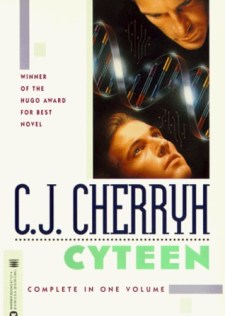 “Finished” does not describe what I did. “Abandoned”, sadly, does. I have simply not been able to get into this book at all. I find the Jordan/Justin naming confusing; I’ve been confused about what an ‘azi’ actually is; I don’t understand what these people are doing and whether I shoulda actually care. Since I started this book I’ve read about six others, which is a really bad sign.
My big question now is whether to actually abandon the book – physically remove it from the house – or whether to put it back on the shelf and think that I might actually get to it Some Other Time.
I’m really sad about this. I’ve always assumed that I would like CJ Cherryh; she’s been upheld as such a great part of sf history – and female, of course, as well. But at the 100-page mark I feel zero enthusiasm for nearly another 600 pages.

 Randomly Yours, Alex