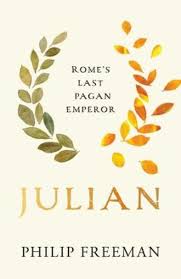
My knowledge of Roman history goes: not great to okay for the Republican period; not bad for the Julio-Claudians; verrrry sketchy and potted post the Year of Four Emperors, right up to… like, the fall of Constantinople. There are bits and persons in there I know about! But it’s not connected up.
Anyway then I learned there was a newish (2023) biography of Julian, and I was excited.
Julian “the Apostate” is one of those fascinating characters who pop up in Roman (and other) history: they don’t last long but they have an outsized legacy because of a key thing or moment. In Julian’s case, it’s that he is the nephew of Constantine – our man who moved the Roman Empire’s capital to the city he modestly named for himself, and also paved the way for Christianity to become the dominant religion in said empire. Was Constantine a “real” Christian? What do you even mean by that? Not relevant, for the purposes of this biography (and, uh, completely impossible to answer anyway). What IS important is that after Constantine, the empire was basically expecting a Christian emperor. And so when Julian comes along and goes PSYCH! I’ve been pretending for a decade or so!, there are a lot of people who are Unimpressed.
This is a short biography: we’re talking 133 pages, and they’re not huge pages either. So there’s not super detailed info about every day of Julian’s life. What Freeman does present, though, is an excellent overview of the main stages of Julian’s life: upbringing in Asia Minor after his now-emperor cousin kills the rest of their family (… yeah…), then raised to Caesar (sub-emperor) and sent to fight in Gaul – with no military experience! but apparently sometimes reading about a thing does make you good at it! Then back towards Constantinople, expecting to fight the cousin, who conveniently (fr) dies on the way, leaving Julian uncontested as Augustus. At which point he begins to try bringing back pagan ways, and eventually oppressing Christians.
And then he heads off to Persia. Apparently he paid more attention to Alexander than to, like, pretty much everyone else. It doesn’t go well.
Freeman’s writing is immensely readable. I don’t think you need to have much knowledge of Roman history to understand what Julian is doing; Freeman presents enough background that the various issues – like the place of Christians in society by this point – is easy to grasp. He doesn’t go into the weeds about what the Senate and others are doing at this point, or even what’s happening in the rest of the empire; this is a very focused, narrow biography, and it works for that reason.


