Dusk or Dark or Dawn or Day: Seanan McGuire
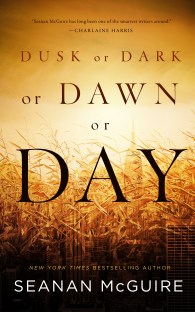 Due out from Tor.com in January 2017. Sent to me by the publisher at no cost.
I’m really not one for what’s hot in genre. I only knew about the zombie/unicorn thing when the awesome Zombies vs Unicorns came out. Still, if Seanan McGuire is writing about ghosts, that probably means they either are, or are about to be, hot, right?
Jenna is a ghost, living in New York. The story opens with her death, and as it progresses we discover more and more about what it means to be a ghost – what they can do, if not why. And it’s all about time. Ghosts exist because of people who die before their time, and that gives them a connection to time – giving it and taking it.
This is a just-slightly-alternate version of our world, with some people at least being aware of ghosts on some level. And there are also witches, who have an uneasy relationship with ghosts. And with each other.
Jenna is often focussed on her own time on earth, and when she will be able to move on. Occasionally, this preoccupation got a little wearing – understandable, but sometimes not seeming relevant to the narrative. Nonetheless the narrative flows well, as you would expect from McGuire, but more than that for me the story is about delightful relationships. Not all of the relationships are easy – Jenna and Brenda, for instance, have known each other for many years but wouldn’t be described as BFFs by any stretch of the imagination. Perhaps my favourite is Jenna and Delia; in fact I would love to see an entire story about Delia, Jenna’s landlady who is a ghost and one feisty, feisty lady. With a parrot called Avocado.
Look, it’s Seanan McGuire. You know you want to read it. I’m sorry it’s not out until January, but it gives you something to look forward to, right?
Farscape: s1, e8
Each week on a Sunday afternoon, join Alex (of Randomly Yours, Alex) and Katharine (of the unpronounceable Ventureadlaxre), as they re-watch the Australian-American sci-fi show Farscape, notable for the Jim Henson animatronic puppets, the excellent mish-mash of accents, and the best OTP ship of all time.
Season One, Episode Eight: That Old Black Magic
Whilst in a marketplace on a planet, Crichton gets tricked away by some old wizard guy for his own sick and twisted games. Which, in turn, show that more people than we think can be sick and twisted also.
K: Rygel needs medication? Ah well, life comes and goes. Bring back the cute bird instead.
A: And John’s in his old space suit!
AHAHA Rygel has man-flu and Crichton is grossed out by the idea of raw brains. Continue reading →
Godless, by Ben Peek
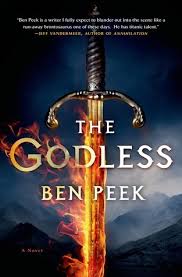 This book was sent to me by the author, at no cost.
It was fascinating, when I started this, to realise just how long it’s been since I read some epic fantasy.
Quite a while.
This is definitely epic fantasy. You can tell because the blurb begins by telling you it’s fifteen thousand years since something happened, and that something is the War of the Gods rather than a generation ship leaving Earth.
So the gods are dead (or dying), and most humans have just been getting on with their lives: knowing that there used to be gods, and that the consequences of their war and deaths are all around – in the mountains called the Spine of Ger, in the ocean called Leviathan’s Blood – but really, just living. There are a few exceptions, though: those who seem to have some of the gods’ power in them. For most humans, those people are cursed and to be avoided – not least because some of them used their powers to rule parts of the world, with varying levels of success or violence.
The narrative is told through three different characters. Ayae is young, a cartographer’s apprentice, a refugee in Mireea, and about to discover that she is cursed. The middle-aged Bueralan is a mercenary captain employed by Mireea who finds himself going surprising places. And Zaifyr… well, he’s completely unexpected. Old, troubled, complex, selfish, blunt, powerful. Much as I think he would hate it, he really binds everything in the narrative together because of his history, and because of his actions throughout the story.
Godless has action and betrayal, sieges and death and confusion and loss. So, epic. And it’s the first of a trilogy, so nothing is resolved – well, there are deaths, but given this situation that may actually not be as final as in other stories. This book definitely doesn’t stand by itself because the last couple of pages are evil, evil cliffhangers.
My one real problem with this book had more to do with the presentation than the narrative. There are numerous points at which characters are reminiscing about the past, but the text’s appearance doesn’t make it clear what’s happening in the past or in the present. In some books that’s because the characters themselves are confused, but that’s not the case here. It would have been good, therefore, to have the font make the time differences obvious – or even just a break in the text itself would have helped. It meant that I had to work harder than was necessary. There were also a number of typos and odd sentence structures, which frustrated me.
I am definitely looking forward to the second book in the series.
Farscape rewatch: s1, e7
Each week on a Sunday afternoon (uh, ish), join Alex (of Randomly Yours, Alex) and Katharine (of the unpronounceable Ventureadlaxre), as they re-watch the Australian-American sci-fi show Farscape, notable for the Jim Henson animatronic puppets, the excellent mish-mash of accents, and the best OTP ship of all time.
Season One, Episode Seven: PK Tech Girl
Our favourite fugitives have been know to find dead ships and ransack them for salvage. It’s on one of these jaunts that they happen to find one of Crais’ workers, and things spiral out from there into emotions, a fire fight with another crew seeking salvage, and Rygel’s darkest memories.
A: EW close up of Rygel’s nose is WRONG. BUT! Crais! … nope, not Crais. So sad that Crais is not back. D’Argo wants info but Aeryn wants weapons. Perfect.
K: She is, isn’t she? Dead ship though, in the uncharted territories… must be Firefly 😀
A: those graphics are beautiful
K: They are. I also like what Aeryn’s wearing in this episode. SUCH a girl crush.
A: I love Aeryn walking around with that ENORMOUS gun. So competently.
K: She probably feels way more competent and comfortable with it, rather than without. Continue reading →
Howl’s Moving Castle
 Yes I’ve only just discovered Diana Wynne Jones. Yes that’s very sad. Yes I understand you read them as a child. No, I’ve not yet seen the movie.
Moving on.
The book is a delight. I myself am the eldest of three (although there’s a brother in the middle – unlike Sophie I’m not burdened with two sisters) so I totally felt for Sophie and her lack of expectations, as the eldest of the family, as well as the burden of expectations. I also loved that Jones upsets fairytale expectations with the half-sister not being evil. And then I REALLY liked that after she is cursed and becomes old, Sophie takes complete advantage of the perks that age provides – being a crone provides lots of leeway, as Ursula Le Guin, amongst others, has discussed. You get to honest and irritated and people have to put up with you!
Speaking of, I see similarities between Jones and Le Guin, in that both of them have a relatively sparse style. Jones doesn’t spend much time explaining the world, explaining what the magic system is and how it works and all the backstory of the characters etc etc. She just dumps you in the world that’s a bit familiar and a bit weird and expects that you’ll be fine. And you are, because the people – even when they’re a fire demon – are recognisable and sympathetic.
Meanwhile, there’s a castle trundling about the moors. That’s awesome.
This is a great fun book with a bit of adventure, a bit of amusing romance here and there that’s kind of gently skewered while also being treated gently, a few surprises, and a young woman mostly enjoying being a crotchety old woman. Plus, being in trade is completely natural and fine, dominating others is not ok, and pre-judging people can get you into trouble.
Don’t read this when you’re 36 unless you miss out when you’re 12. Read it when you’re 12 if you possibly can.
Galactic Suburbia!
In which Letters To Tiptree is still turning heads, and it’s winter in Australia. Much winter. So coldness. You can get us from iTunes or at Galactic Suburbia.
WHAT’S NEW ON THE INTERNET?
World Fantasy Award finalists
Locus Awards winners
CULTURE CONSUMED
Alisa: Undisclosed – Vacated; 4 hideous romcoms (Remember Sunday, Thanks for Sharing, Life Happens and Something Borrowed)
Alex: Howl’s Moving Castle, Diana Wynne Jones; Beggars in Spain, Nancy Kress; Fifth Season, NK Jemisin; The Hollow Crown
Tansy: Person of Interest Season 5, Book Smugglers Quarterly Almanac (especially John Chu’s “How to Piss off a Failed Super-Soldier”), Batman v Superman; Hamilton, Rocket Talk podcast – Amal El-Mohtar on Does Hamilton Count as Genre.
Please send feedback to us at galacticsuburbia@gmail.com, follow us on Twitter at @galacticsuburbs, check out Galactic Suburbia Podcast on Facebook, support us at Patreon and don’t forget to leave a review on iTunes if you love us!
Beggars in Spain
 What if you could genetically engineer babies to turn off the necessity to sleep? What if, with all that extra time, those children turned out to be super intelligent? And what if there were other consequences as well, that really hadn’t been anticipated?
That’s the premise of Beggars in Spain. While the science may be somewhat wobbly – sleep deprivation is a torture technique, so surely there would be greater consequences on the negative side – the point of the book is the social ramifications. Because of course, it’s only a small minority of foetuses who get this modification, thus creating a brand new minority group – one with what looks like enormous advantages over ordinary people, or Sleepers.
The focus is on Leisha, a Sleepless, whose sister Alice is a Sleeper and who often serves as a counterpoint to Leisha. The narrative skips through several stages of Leisha’s life, which I really like as a way of exploring developing social expectations, ideas and consequences. Firstly, Leisha is born, grows up, and goes to college. Then she is in her 40s, a lawyer, and American society has changed radically around her – there’s a huge reaction against the Sleepless, and the Sleepless themselves are more and more disillusioned by ‘normal’ society. To the point where many are starting to segregate themselves. Twenty years later and society has once again altered radically, with a hideous class system such that Kress draws deliberate parallels with Rome and the old ‘bread and circuses’ maxim. Then yet another couple of decades later things are changing for the Sleepless, and there are likely to be consequences for the world… but that, presumably, is for the next book.
Not being American, I think there were subtle (and not so subtle) digs at American society that didn’t really make sense to me. There’s a lot of discussion about American society not appreciating individual effort and problems with the notion of equality and so on that, while I got what Kress was talking about, didn’t have the immediate or historical resonances that I suspect a well-read American might pick up. Nonetheless this is an intriguing novel that combines generally engaging characters and genuine moral difficulties; there’s some action, there’s some intense political discussion, there’s some surprising technological development and totally retrograde societal change. I’m going to be getting the sequel.
Great Scott! presents: Alien
 Ridley: 1979
Every fortnight (ish) my beloved and I are watching a film by either Ridley or Tony Scott. We’re watching in chronological order. There are, of course, spoilers.
General thoughts:
I love the music, and the lack of music is quite stark in a number of these scenes – when they’re looking through the cabinets and the only sound is their footsteps, it really enhances the creepy-factor. And I love the graphics – the planets are gorgeous.
They have such bulky space suits – they seem peculiarly un-futuristic, but then the whole aesthetic is that it looks remarkably familiar for all that it’s set a long way in the future.
I really like the way the characters physically deteriorate. Ripley has a massive bruise on her cheek; Lambert is grimy and sweaty and distraught. Parker is sweating. Ash, though, continues to look calm. BECAUSE ASH IS CREEPY.
The cinematography is marvellous and it’s a delight to watch. Intimate, for all it’s set on a huge spaceship.
Farscape s1, e6
Each week on a Sunday afternoon, join Alex (of Randomly Yours, Alex) and Katharine (of the unpronounceable Ventureadlaxre), as they re-watch the Australian-American sci-fi show Farscape, notable for the Jim Henson animatronic puppets, the excellent mish-mash of accents, and the best OTP ship of all time.
Season One, Episode Six, Thank God It’s Friday Again!
Summary: In which D’Argo turns from super angry to super hippie, Crichton gets beaten up (again), Aeryn discovers more and more about herself, and Rygel is actually kind of helpful?
K: D’Argo seems a bit cross about something. So it seems Luxons have a thing called hyper rage and Crichton is right in his firing line as he’s another male and therefore competition, I assume?
A: dangerous stuff. Also, Rygel looks disturbingly excited about D’Argo having killed someone.
K: Mad Max reference, and now we’re in a scene from the second Matrix. Though this probably came out before that?
A: “No one saw the third one” – ? I thought Thunderdome was more popular than the second! And ha, alien orgy scene. Awesome.
And D’Argo is now… stoned? And happy to see Crichton? Must be stoned. Continue reading →
Great Scott! A reviewing adventure
We are big fans of adventure and action films. My beloved is an unrepentant Top Gun fan, much to my dismay. We’ve both liked various Tony and Ridley Scott films over the years. So we thought, why not do a best-of viewing? That would be fun!
And then I looked at IMDB and MetaCritic, and it turns out that some of the top-rated films from Tony in particular are comedies. I am not watching Get Santa, nor Cyrus. Anyway, after some to-ing and fro-ing, we’ve decided on an idiosyncratic list of five from each Scott, which we’re going to watch in chronological order. It includes some films we’ve seen before, and a couple we never have (or not recently enough to have any real memory of). We’ll be watching and reviewing every fortnight(…ish).
We are looking forward to:
Ridley – Alien (1979)
Ridley – Blade Runner (1982)
Tony – Top Gun (1986)
Tony – Beverly Hills Cop II (1987)
Tony – Crimson Tide (1995)
Tony – Enemy of the State (1998)
Ridley – Gladiator (2000)
Tony – Spy Game (and here) (2001)
Ridley – Robin Hood (2010)
Ridley – The Martian (2015)

 Randomly Yours, Alex